Case study · 2025
A perpetuals and swap exchange for Blue Silent Exchange.
A perpetuals and swap venue for Blue Silent Capital, set up on the React-based GMX Clone base and extended with project smart contracts, delivered in 2025 with its source code handed over.
- GMX Clone · MMX
- Solution
- GMX Clone
- Product
- MMX
- Delivered
- 2025
- Stack
- REACT
- Base build
- 6 working days
- Blocks reused
- 16 of 20
- Source code
- Transferred
Blue Silent's perpetuals and swap exchange.
Blue Silent Exchange took a GMX Clone for its perpetuals and swap exchange in 2025, and its source code was handed over to the client's account. The client had two engagements with Miracuves, this one and a Binance Clone.
On the GMX Clone base, Miracuves configured Blue Silent's own markets, trade limits, fee and funding model and brand, then wrote smart contracts for advisors and group trading. Blue Silent's team reviewed those contracts in the project repository.
Project summaryBlue Silent Capital's perpetuals venue.
In 2025 Blue Silent Capital asked Miracuves for Blue Silent Exchange's perpetuals and swap venue, where traders open leveraged long or short positions, or swap tokens, from a connected wallet.
The project started from the GMX Clone base, sold as MMX and written in React, rather than from an empty repository. Its trade screen and the Earn, Referrals, Leaderboard and Dashboard pages around it were already working before the engagement began.
What remained was Blue Silent's own: which markets to list, how far positions could be leveraged, how fees and funding would work and how the venue would look. The work then went past the base, into smart contracts written for this project.
Blue Silent Capital also ran a second, separate engagement with Miracuves, a spot exchange on the Binance Clone. That project has its own page, and nothing here is drawn from it.
Blue Silent at a glance
From a proven trade screen to Blue Silent's venue.
The perpetuals mechanics came from the base, while this project's work centered on four settings that belonged to Blue Silent, then moved into contract work beyond the base.
What the venue had to do
Already in the GMX Clone base
16 of 20 blocks reused unchanged; the base itself builds in 6 working days
Blue Silent's own layer
Leveraged crypto trading answers to regulators.
Blue Silent's record does not name a jurisdiction for the venue, so these rows show how regulators have treated leveraged crypto products in general, not Blue Silent's own position.
Four settings that were Blue Silent's call.
On the GMX Clone base, 16 of 20 blocks carry over unchanged and four are set for each client; on this project those four were Blue Silent's decisions.
Listed markets
Which pairs the venue runs. The base's market header names each market with its collateral pool, price, liquidity on each side and open interest.
Limits on leveraged trades
How far a trader may lever a position, set to Blue Silent's risk appetite. The base quotes no limits of its own; they are agreed and tested before launch.
Fees and funding
The venue's economics: trading fees, funding and referral discounts. On this base, fee levels and discounts are choices made in the source code the client receives.
Brand and theming
How the trading surface looks, carried across the trade screen and the pages beside it in Blue Silent Exchange's own brand.
Where a perpetuals venue gets difficult.
Each problem below was met by the base Blue Silent started from, by the four settings made for it, or by the contracts written for the project.
Liquidation risk the trader cannot see
A leveraged position can be liquidated, and a trader who cannot see that price before sending an order is trading blind.
Limits that fit the risk appetite
How far to let traders lever a position is a commercial and risk decision that software cannot make for the operator.
Holding traders' collateral
Collateral is what a perpetuals venue puts at risk, and how it is held shapes the rest of the design.
Logic beyond the trade screen
The project went past the standard base, and its next stage after the trading front end was smart contract work.
The MMX core and the Blue Silent layer.
Sixteen of MMX's twenty blocks came across untouched, four were set for Blue Silent, and the project's own smart contracts sat on top of them.
The record's block list for the base starts with two applications, a trader app for positions, margin and PnL and an admin for markets, risk and treasury, then an API gateway, a realtime channel for marks and funding and an event bus with retries.
Below them sit order entry, a margin engine, liquidation with partial closes, funding and realized PnL, vault liquidity, index and mark pricing, identity and access with keys and limits, the data store, object storage for exports and audit, and the collateral ledger.
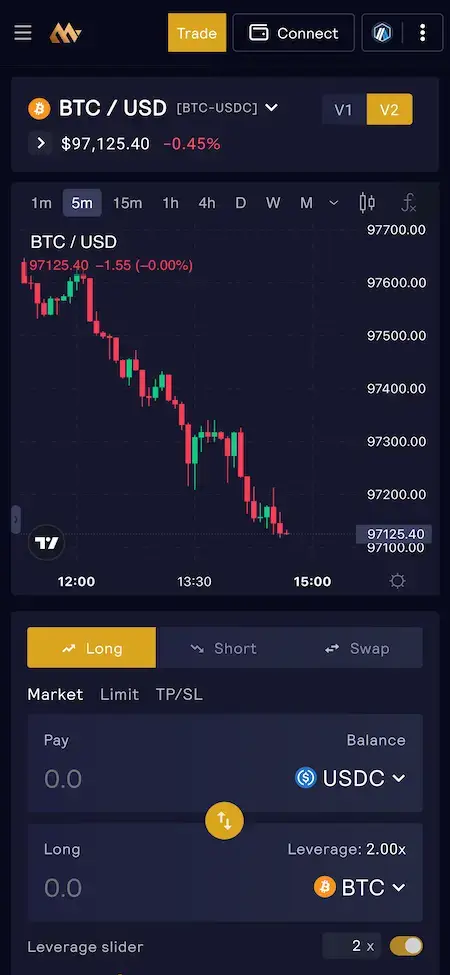
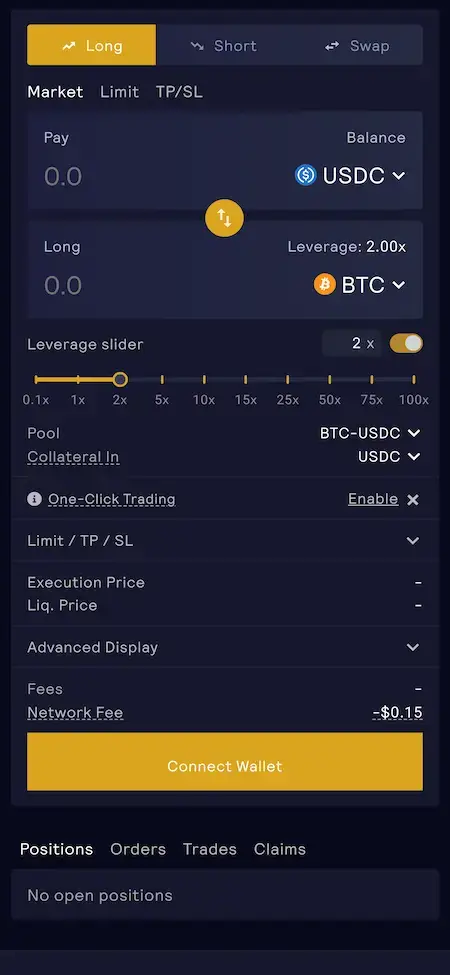
The base gives traders a TradingView candlestick chart, market, limit and take-profit or stop-loss orders, a slider for the position multiple and a network switcher; the base demo lists Arbitrum and Avalanche. Which chains Blue Silent chose is not on record.
Built for Blue Silent
Reused from the GMX Clone base
Per-client blocks on the GMX Clone base
Sixteen blocks carried over unchanged.
In the GMX Clone architecture, 16 of 20 blocks are reused unchanged.
Traders, stakers, referrers and the operator.
The GMX Clone base arranges its pages around four groups of people; the record does not list which of those pages Blue Silent's venue kept.
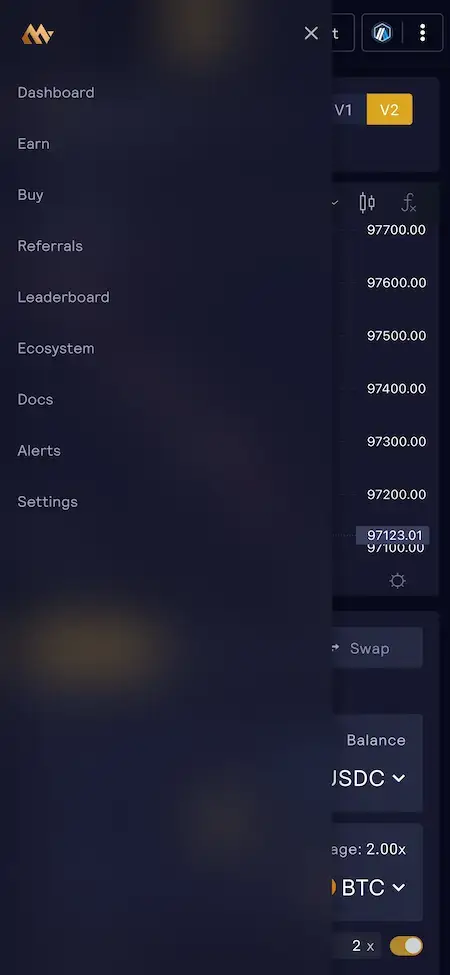
Screens from the MMX base.
Phone screens from the MMX demo, shown as the base this project began from; no screens of Blue Silent Exchange's branded venue are in the project files.
Blue Silent's build, by the record.
A perpetuals and swap venue on 16 reused blocks, with the source code in Blue Silent's account.
Recorded by MiracuvesDelivery record, 2025
- Base
- GMX Clone (MMX), React
- Blocks
- 16 of 20 reused unchanged
- Built for the client
- 4 blocks plus project smart contracts
- Source code
- Transferred
No trading volume, user count or cost figure is on record for this project, so none is claimed. The base itself builds in 6 working days; custom work is timed apart from it.
Blue Silent's perpetuals build, question by question.
What did Blue Silent Exchange start from?
The GMX Clone base, sold as MMX: a React trading platform whose trade screen, order types, position multiple control and Earn, Referrals and Leaderboard pages already worked.
What did Blue Silent decide for itself?
Four things: the listed markets, the limits on leveraged trades, the fee and funding model and the brand on the trading surface.
Did the project go beyond the base?
Yes. Miracuves wrote smart contracts for advisors and for group trading, with supporting logic, and committed them to the project repository, where the client's team reviewed them.
Is this the same project as Blue Silent's spot exchange?
No. Blue Silent Capital ran two separate engagements with Miracuves; the spot exchange was built on the Binance Clone and has its own case study.
How long does the GMX Clone base take to build?
The ready-made base builds in 6 working days. Custom work such as Blue Silent's contracts is timed separately, and no duration for it is on record.
Did Miracuves handle Blue Silent's licensing?
No. The GMX Clone is trading software; licenses, registrations and audits stay with the operator, and Miracuves gives no legal or regulatory advice.
The GMX Clone base, service and industry.
Building something like this?
- Every figure here is defined on the facts page
- Services behind this build: DeFi App Development, React Development