

Launching a smart contract is a defining moment for a blockchain-based product. It can also be the moment when an overlooked programming flaw becomes a permanent financial liability.
Unlike conventional applications, smart contracts can hold and transfer digital assets automatically. Once deployed, their behavior may be difficult or impossible to change, depending on the architecture. A vulnerability in withdrawal logic, administrative permissions, or an external integration can expose user funds long before the development team recognizes the problem.
For founders, the challenge is not simply asking whether the contract works. It is establishing whether the contract will behave safely when someone deliberately tries to make it fail. Founders planning a secure blockchain product launch should establish these security requirements before committing to production deployment.
A smart contract pre-deployment security checklist helps teams identify high-risk vulnerabilities, verify critical business rules, and establish clear conditions for approving a production release.
This guide explains the controls founders should examine, how reentrancy attacks work, what evidence to request from security reviewers, and when to delay deployment rather than accept unnecessary risk.
Founder Security Brief
Key Takeaways
- A successful functional test does not establish that a smart contract is secure.
- Reentrancy attacks can exploit external calls made before sensitive state changes are completed.
- Administrative privileges, token accounting, oracle dependencies, and upgrade mechanisms deserve the same attention as reentrancy.
- Founders should request verifiable audit evidence, not rely on verbal assurances.
- Critical unresolved security findings should block deployment, regardless of the planned launch date.
- Independent review, adversarial testing, safe deployment procedures, and continuous monitoring work together to reduce risk.
Why Smart Contract Security Must Be a Founder-Level Decision
A conventional application can often be patched through a controlled software update. Smart contracts operate differently.
On an immutable deployment, correcting a vulnerability may require deploying a replacement contract and coordinating asset or user migration. Even upgradeable contracts introduce governance, authorization, and operational risks.
The financial consequences can extend beyond stolen funds.
A severe incident may trigger suspended withdrawals, emergency operational intervention, disrupted partnerships, legal costs, and lasting damage to user confidence.
Consider a hypothetical decentralized savings platform holding significant customer deposits. Its deposit and withdrawal functions pass ordinary user tests. However, an external contract can trigger an unexpected callback during withdrawal, allowing the same balance to be considered more than once.
The platform may appear ready for launch while containing a flaw in its core asset-management logic.
The founder does not need to write the security patch personally. But the founder does need to ensure that the responsible engineers have identified the risk, tested the mitigation, and documented the results.
Understanding Reentrancy Attacks Before They Become Financial Incidents
Reentrancy is a smart contract vulnerability that can occur when a contract makes an external call and the receiving contract invokes an entry point before the original execution has finished.
The danger arises when sensitive state has not yet been updated.
How a Reentrancy Vulnerability Develops
Imagine a contract that records deposits and processes withdrawals.
The expected sequence is straightforward: verify the balance, reduce the balance, and transfer the requested funds.
An unsafe implementation may instead transfer funds before updating its internal accounting.
That sequence creates an opportunity for malicious contract code to trigger another withdrawal while the original balance remains unchanged.
Security Explainer
How a Reentrancy Vulnerability Unfolds
Withdrawal Requested
The contract verifies the recorded user balance.
External Transfer Begins
Control passes to the receiving contract before the balance is updated.
Callback Re-enters
The receiving contract invokes another entry point while the original execution remains unfinished.
Another Withdrawal Passes
The stale recorded balance can be reused if the contract lacks effective protections.
Funds Become Exposed
Repeated execution may enable losses if other controls fail.
This is a conceptual attack sequence. It does not represent every possible reentrancy exploit.
Why Reentrancy Is Not Limited to Withdrawals
Founders often associate reentrancy with direct cryptocurrency transfers. In practice, the potential attack surface is broader.
External calls can occur during token transfers, marketplace settlement, lending operations, staking rewards, and interactions with other protocols.
Token callbacks and hooks can introduce unexpected control flow. Cross-function and cross-contract interactions can also expose inconsistent state, even when the visibly vulnerable function does not directly transfer funds.
That is why a reviewer must inspect the complete interaction path instead of checking only a single withdrawal function.
Three Important Reentrancy Defenses
1. Checks-Effects-Interactions
This design pattern performs eligibility checks, updates internal accounting, and only then makes the external call.
It reduces the opportunity for a callback to reuse stale state.
2. Reentrancy Guards
A reentrancy guard can prevent protected functions from being entered again during an unfinished execution.
However, developers must apply guards to the correct entry points and consider interactions with functions that are not protected.
3. Safer Payment Flows
Where suitable, a withdrawal-based payment model allows users to claim funds instead of automatically sending payments during unrelated operations.
This can reduce exposure to unexpected receiver behavior.
These controls should be considered together. No single design pattern guarantees immunity from every form of reentrancy.
For further technical detail, refer to Ethereum’s smart contract security guidance and the ReentrancyGuard documentation.
The Eight Security Areas Every Founder Should Verify Before Mainnet
A reliable review needs to examine both programming weaknesses and the business logic controlling funds, permissions, and external dependencies.
The following checklist is designed to help founders understand what their technical team should demonstrate before production deployment.
Smart Contract Security Audit Matrix
Review the required protection and the evidence your technical team should provide.
| Security Area | What Must Be Verified | Evidence to Request |
|---|---|---|
| Reentrancy | External calls cannot exploit incomplete state changes. | Adversarial callback tests and code review. |
| Access Control | Only authorized roles can perform sensitive actions. | Permission matrix and negative test results. |
| Asset Accounting | Deposits, withdrawals, fees, and rewards preserve financial rules. | Invariant tests and reconciliation results. |
| Oracle Dependencies | External pricing or data feeds cannot be trivially manipulated. | Staleness, deviation, and manipulation tests. |
| External Integrations | Tokens and third-party contracts handle unexpected behavior safely. | Integration and failure-path tests. |
| Upgradeability | Authorized upgrades preserve storage, permissions, and asset integrity. | Upgrade simulation and configuration review. |
| Deployment Security | Reviewed code matches the deployed artifact. | Commit hash, bytecode comparison, and configuration records. |
| Emergency Response | The team can detect incidents and execute authorized protective actions. | Monitoring configuration and incident rehearsal. |
On mobile devices, scroll horizontally to view all table columns.
Each applicable control should have a named owner, documented result, and supporting evidence.
1. Reentrancy and External Call Validation
Engineers should identify every contract interaction capable of transferring control to untrusted code.
Reviewers need to examine whether financial state changes occur before external calls, whether appropriate guards are applied, and whether callbacks can reach other sensitive functions.
Testing should cover direct re-entry as well as unexpected interactions across related contracts.
Founder approval condition: No unresolved exploitable reentrancy path remains in a critical asset-handling flow.
2. Administrative Privileges and Access Control
Some of the most serious smart contract risks originate from excessive permissions rather than complicated programming mistakes.
A privileged account may be able to mint tokens, alter fees, withdraw treasury assets, upgrade contracts, or pause user operations.
Founders should request a clear permission map identifying which address or role can perform each sensitive action.
The review should cover authorization checks, privilege escalation, ownership transfers, initializers, and recovery procedures.
For high-impact actions, assess whether multisignature approvals and timelocks reduce the consequences of a compromised key.
Founder approval condition: Every privileged action has a documented owner, authorization boundary, and tested failure behavior.
3. Financial Accounting and Business Logic
A contract can contain no obvious coding errors and still execute the wrong economic rules.
Lending platforms, staking systems, vaults, and tokenized assets depend on precise accounting across deposits, withdrawals, collateral, rewards, and fees.
Potential weaknesses include incorrect rounding, inconsistent decimal handling, share-price manipulation, and flawed liquidation conditions.
Founders should ask engineers to define the properties that must always remain true.
For example, a vault may need to prove that user claims remain consistent with its accounting of available assets and liabilities under supported operations.
These properties should be tested under unusual transaction sequences, not just normal usage.
For protocols involving lending, staking, or collateralized assets, specialist DeFi engineering workflows provide additional context for evaluating protocol-specific economic assumptions and financial controls.
Founder approval condition: Critical financial invariants survive adversarial sequences and boundary conditions.
4. Oracle Manipulation and External Data Risks
Financial contracts sometimes depend on external data, especially asset prices.
If a protocol assumes that a single market price is always trustworthy, an attacker may be able to influence the conditions used for lending, swaps, or liquidations.
The review should consider price freshness, acceptable deviation, trusted data sources, fallback behavior, and the consequences of temporary liquidity distortions.
Where flash loans or other temporary liquidity mechanisms can influence economic state, the testing process should consider those scenarios.
Founder approval condition: Critical financial decisions do not depend on an unvalidated or easily manipulated data assumption.
5. Third-Party Tokens and Contract Integrations
Not every token behaves identically.
Some tokens apply transfer fees. Others use rebasing mechanisms, callbacks, unusual return values, or nonstandard implementations.
A platform that assumes all token transfers behave exactly the same way may miscalculate received assets or fail under unexpected conditions.
Integration tests should deliberately exercise failed transfers, unusual token behavior, and hostile external contracts.
Founder approval condition: Every supported asset and integration has documented compatibility assumptions and tested failure handling.
6. Upgradeability and Proxy Configuration
Upgradeability can help teams correct defects or introduce new capabilities, but it also creates new risks.
Reviewers should validate initialization rules, upgrade authorization, proxy configuration, storage-layout compatibility, and the effect of upgrades on existing user balances.
An upgrade path should not allow an unauthorized party to replace critical business logic.
Founders must also understand who can initiate upgrades and how users are informed about significant changes.
Founder approval condition: Upgrade permissions and state-preservation guarantees are tested against the intended architecture.
7. Build Integrity and Deployment Configuration
A successful security review is meaningful only when it applies to the code that reaches production.
Even a carefully audited contract can become unsafe if a different version is deployed, constructor parameters are incorrect, or privileged addresses are assigned improperly.
The release process should record the source commit, compiler settings, relevant libraries, deployment scripts, network identifiers, and final contract addresses.
For upgradeable contracts, record the actual proxy and implementation configuration.
Founder approval condition: The deployment team can prove that the intended, reviewed artifact and configuration were deployed.
8. Emergency Controls and Incident Readiness
Security planning should continue after deployment.
Founders should know who monitors suspicious transactions, who is authorized to respond, and what protective actions the contract supports.
An emergency pause can reduce damage in some architectures, but it only protects the functions covered by that mechanism. It cannot reverse already-finalized transactions.
Incident preparation should include alert thresholds, escalation contacts, key-management procedures, and a rehearsed response plan.
Founder approval condition: The team can detect high-impact anomalies and execute a documented response without improvising permissions during an incident.
What Testing Should Prove Before a Smart Contract Goes Live
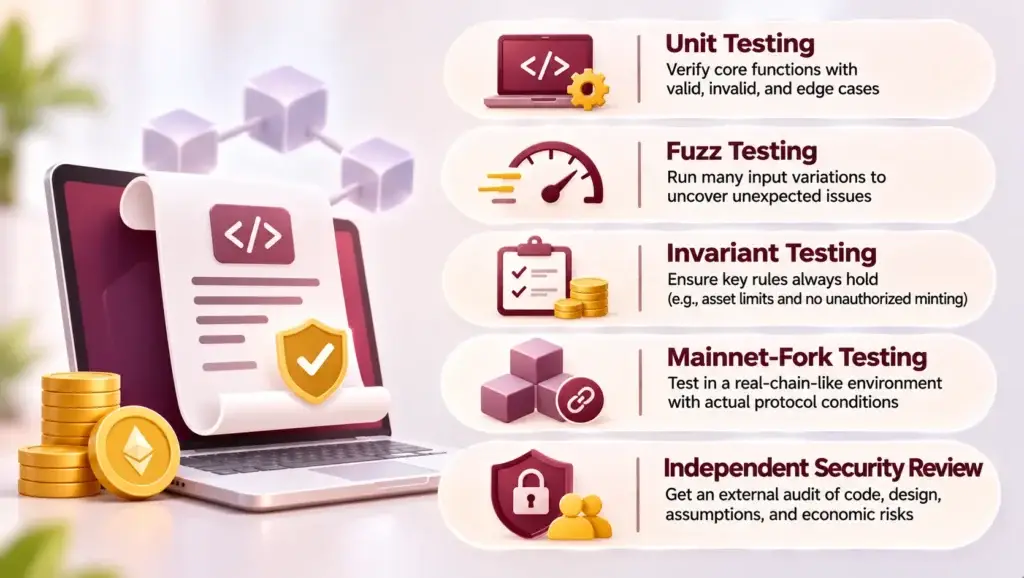
A test suite that validates ordinary user journeys is necessary, but insufficient.
Security validation should deliberately explore abnormal inputs, unexpected execution sequences, and attempts to violate financial or authorization rules.
Unit Testing
Unit tests verify individual functions under expected and unexpected conditions.
They should cover valid requests, rejected requests, boundary values, and error handling.
Fuzz Testing
Fuzz testing runs many variations of inputs against contract behavior.
It can reveal conditions that developers did not explicitly anticipate, although results depend on the selected properties and test design.
Invariant Testing
Invariant testing checks whether essential system properties remain true across sequences of actions.
For a financial protocol, these properties may include limits on withdrawals, conservation of accounted assets, or the impossibility of unauthorized minting.
Mainnet-Fork and Integration Testing
A mainnet-fork environment can reproduce relevant chain state and integration conditions without exposing actual production assets.
This is especially useful when a contract depends on deployed protocols, existing tokens, or external liquidity.
Independent Security Review
Independent review adds a separate perspective to architecture, code logic, implementation assumptions, and economic behavior.
Automated scanning and internal testing remain important, but they should not be treated as equivalent to a qualified independent assessment.
The appropriate review scope depends on the value at risk, protocol complexity, chain environment, and whether the contract introduces new financial mechanisms.
Founders seeking more detail about contract implementation and verification can examine smart contract engineering and testing practices when planning the technical responsibilities of a deployment project.
How Founders Should Interpret a Smart Contract Audit Report
An audit report should support an actionable release decision.
It is not merely a document to display to investors or users.
Founders should examine which contracts and versions were reviewed, what testing methods were applied, which assumptions were excluded, and whether identified vulnerabilities were fixed and retested.
Audit Report Evaluation
Founder Decision Signals
Scope
Does the audit cover every contract and integration that can affect user assets?
Severity
Are critical or high-impact issues still unresolved?
Remediation
Were patches reviewed and tested against the same failure scenarios?
Release Evidence
Can the team match the reviewed code to its deployment artifacts?
Why a Completed Audit Does Not Mean Zero Risk
Audits operate within a defined scope and time period.
Reviewers may identify significant weaknesses, but they cannot prove that every possible vulnerability has been eliminated.
Security conclusions can also become outdated when code, dependencies, integrations, or economic assumptions change.
An audit report therefore needs to be treated as evidence supporting a risk decision, not as an unconditional guarantee.
What a Useful Remediation Record Looks Like
Every material finding should have a documented description, severity assessment, affected code, assigned owner, proposed correction, and verification result.
If the team chooses to accept a residual risk, the decision should identify its potential impact and the authority approving that risk.
Founders should not accept ambiguous statements such as “the issue appears fixed” without appropriate verification evidence.
A Practical Go/No-Go Framework for Smart Contract Deployment
Launch deadlines can create pressure to accept risks that would otherwise block release.
A clear approval framework prevents the decision from becoming a negotiation between engineering urgency and commercial expectations.
Production Release Decision Matrix
| Finding Status | Recommended Decision |
|---|---|
| NO-GO | Unresolved critical exploit affecting user assets, privileged controls, or core financial invariants. |
| HOLD | High-impact findings, incomplete integration tests, uncertain asset accounting, or an unverified remediation. |
| CONDITIONAL | Limited, noncritical residual issues with documented scope, mitigation, and accountable approval. |
| GO | Required controls pass, material findings are resolved, deployment artifacts match reviewed code, and monitoring is operational. |
This is a suggested governance framework, not a substitute for project-specific threat modeling or professional security review.
A security sign-off should come from the appropriate technical and business owners. For protocols managing substantial user funds, independent security input is especially important.
No deadline should override a known, exploitable critical vulnerability.
The Final 24-Hour Checklist Before Mainnet Deployment
The final pre-deployment review is not the stage for beginning security work. It is the stage for confirming that previously completed work remains valid.
Use the following checklist during the final release meeting.
Final Release Verification
Pre-Mainnet Readiness Checklist
- Reviewed source commit and compiler configuration are frozen.
- Critical and high-severity findings are resolved and retested.
- Reentrancy and external-call tests have passed.
- Privileged addresses and permissions have been independently verified.
- Asset accounting and protocol invariants pass.
- Oracle and third-party integration assumptions are validated.
- Proxy initialization and upgrade configuration are verified, if applicable.
- Deployment scripts and parameters have been independently reviewed.
- Emergency controls and key-management procedures are tested.
- On-chain monitoring and incident escalation contacts are active.
- Required release owners have approved the evidence package.
Important: Checklist completion does not constitute security certification. Technical validation and formal release approval remain necessary.
If any launch-blocking issue remains unresolved, the deployment should be deferred until the issue has been addressed and verified.
Five Smart Contract Security Mistakes Founders Should Avoid
Treating a Testnet Deployment as Proof of Security
A contract functioning correctly on a testnet does not demonstrate that attackers cannot exploit its logic.
Testnets help validate execution and integration behavior, but realistic adversarial testing remains necessary.
Assuming Reusable Libraries Eliminate Every Vulnerability
Established libraries can reduce the risk of introducing defects in common functionality.
However, custom integrations, financial logic, permissions, and upgrade configurations can still introduce significant weaknesses.
Auditing One Version and Deploying Another
Changing contract logic after an audit can invalidate important parts of the review.
Material changes require appropriate reassessment. The released artifact must be traceable to the version that received security approval.
Ignoring the Financial Impact of Small Logic Errors
A rounding error, stale price, or incorrect permission check may appear minor in isolation.
Within an interconnected financial protocol, the same issue can compound into a significant exposure.
Launching Without an Incident Response Plan
Teams should not wait for suspicious activity before determining who can pause functions, secure compromised administrative credentials, or communicate with users.
Emergency controls need to be operational before the system begins handling significant assets.
How Security Readiness Should Influence Your Launch Timeline
Founders often view security reviews as the final task before launch. A better approach integrates security decisions throughout the product lifecycle.
Threat modeling should begin during architecture design. Access controls and financial invariants should be considered during implementation. Security-focused tests should run before independent review, and material findings should be resolved before production approval.
This approach also clarifies the difference between software delivery and authorization to deploy a high-risk smart contract.
Miracuves offers a 6-day delivery timeline for applicable ready-made platforms, which can accelerate preparation of an established product foundation. That timeline should not be interpreted as a guarantee that every custom financial protocol can be independently audited and safely deployed within six days.
High-risk contract logic may require additional review, remediation, and testing.
The wider Web3, cryptocurrency, and blockchain industry landscape also introduces operational considerations such as custody responsibilities, governance, and economic risk. These requirements can influence the security scope long before deployment.
For founders preparing to launch, the key is to define security acceptance criteria before committing to a production release date.
What to Prepare for a Deployment Readiness Review
A founder does not need to become a Solidity security specialist to ask meaningful questions.
A concise evidence package makes security discussions more productive and gives technical reviewers a shared reference point.
The package should include the system architecture, asset-flow diagram, permission map, contract inventory, dependency list, test results, audit scope, identified findings, remediation records, and deployment plan.
For upgradeable systems, include proxy configuration and upgrade authorization details. For DeFi systems, include economic invariants, oracle assumptions, and liquidity-related risks.
An effective review should end with three clear outcomes:
- Which material risks have been resolved and independently verified?
- Which residual risks remain, and who has approved them?
- What specific evidence supports the decision to proceed or delay?
If the team cannot answer those questions, the release decision may be premature.
Final Thoughts: Secure the Contract Before You Expose the Capital
A secure smart contract launch begins with understanding what can fail, which failures matter most, and how to verify that meaningful protections are in place.
Reentrancy prevention is essential, but it is only one part of a wider security discipline. Access controls, financial accounting, external dependencies, testing, deployment integrity, and incident preparedness all contribute to operational trust.
For founders, the strongest release decision is not necessarily the earliest deployment. It is a deployment supported by clear risk ownership, technical evidence, and a realistic understanding of remaining uncertainty.
Miracuves helps founders plan and deliver blockchain-based products with source-code ownership, technical implementation support, and deployment workflows aligned with project requirements.
If your team is preparing for mainnet, the next step is to confirm which controls are complete, which need remediation, and what must happen before real user funds enter the system.
Frequently Asked Questions
What should founders check before deploying a smart contract?
Founders should check for security risks, reentrancy attacks, access control issues, payment errors, and unsafe integrations. They should also make sure the contract has been properly tested and any major security problems have been fixed before launch.
How can developers prevent reentrancy attacks in smart contracts?
Developers can prevent reentrancy attacks by updating contract balances before transferring funds, using reentrancy guards, and following secure coding practices. Regular security testing also helps identify possible weaknesses.
Is a smart contract security audit necessary before launch?
A security audit is not always legally required, but it is highly recommended. It helps identify vulnerabilities, protect user funds, and reduce the risk of attacks before the contract goes live.
Can a smart contract be hacked even after a security audit?
Yes. A security audit reduces risks but cannot guarantee complete protection. New vulnerabilities, coding changes, or external integrations can still create security problems after an audit.
What is the difference between automated testing and manual smart contract auditing?
Automated testing uses tools to find common coding errors and security weaknesses. Manual auditing involves security experts reviewing the contract’s code, business logic, and potential risks. Using both methods provides stronger security.
Which smart contract vulnerabilities should be fixed before deployment?
Critical vulnerabilities such as reentrancy attacks, unauthorized withdrawals, weak access controls, and errors in financial calculations should be fixed before deployment. These issues can expose user funds and cause major financial losses.
How can founders confirm that the deployed smart contract matches the audited version?
Founders should compare the deployed contract’s code, compiler settings, and configuration with the audited version. This helps ensure that no unexpected changes were made after the security review.
Does a six-day delivery mean a smart contract is ready for mainnet?
No. A six-day delivery timeline means an eligible ready-made platform can be delivered within that period. Smart contracts may still require additional security audits, testing, and fixes before they are safe enough for mainnet deployment.
Technical References
Miracuves is an independent software development company. We are not affiliated with, connected to, sponsored by, or endorsed by any company or product named in this article.
Terms such as “X Clone” are used descriptively. It is how the software industry refers to building a platform with functionality comparable to a known service, and how clients search for it.
The entire design and codebase of our products is built by our own team. Our products contain no code, design, graphics, or content originating from any third-party website or applications.
All third-party names and marks referenced in this article are the property of their respective owners, referenced solely to identify the services discussed.