Key Takeaways
- AI matchmaking can improve dating compatibility by analyzing user preferences, shared interests, relationship goals and interaction patterns to suggest more relevant potential matches.
- A successful AI-powered dating experience should balance personalized recommendations with natural conversations, emotional connections and meaningful user choices.
- Dating platforms should provide transparent matching preferences, privacy controls and opportunities for users to adjust recommendations rather than relying entirely on automated decisions.
- AI matchmaking works best as a discovery assistant that helps users find compatible people while allowing genuine relationships to develop through human interaction.
How AI Matchmaking Improves Dating Compatibility
- AI matchmaking systems can consider profile information, lifestyle preferences, communication interests and relationship intentions to identify potentially compatible users.
- Recommendation algorithms can use relevant feedback, such as match preferences and voluntary user interactions, to improve future suggestions without depending only on profile appearance.
- Compatibility recommendations should explain useful matching factors, including shared interests, similar relationship expectations and compatible preferences, without presenting algorithmic scores as guaranteed outcomes.
- Personalized discovery features can help reduce irrelevant suggestions, improve match exploration and support more meaningful introductions when combined with accurate user profiles.
Balancing AI Personalization With Human Connection
- Dating apps should allow users to control their discovery preferences, explore profiles independently and decide which suggested matches they want to pursue.
- AI-assisted conversation prompts can help users begin discussions around shared interests, but personal messages and relationship decisions should remain authentic and user-directed.
- Privacy-focused matchmaking should use appropriate consent, secure personal data handling, clear recommendation explanations and safeguards against discriminatory or misleading suggestions.
- A human-centered AI dating experience combines relevant recommendations, respectful communication tools, user feedback and transparent controls to support trust and long-term engagement.
Finding a compatible partner has never been a simple filtering problem. Two people can share interests, live in the same city, and express similar relationship goals yet discover that their conversations lack chemistry. Meanwhile, people who appear different on paper may connect through shared values, curiosity, humor, or emotional understanding.
This is the challenge facing modern dating platforms. Users want introductions that feel relevant, but they do not want their romantic lives reduced to a prediction score.
AI matchmaking can improve dating compatibility by identifying meaningful preference patterns, reducing irrelevant recommendations, and helping people discover potential connections they might otherwise overlook. Its role should be to make introductions more thoughtful—not to determine whom someone should love.
For founders, the opportunity is to combine intelligent recommendations with human choice, privacy, and authentic communication. A ready-made dating app platform can provide the foundation for profile discovery, matching, and communication, while more advanced AI-driven compatibility features can be explored through additional customization. When designed carefully, these experiences can reduce the frustration of repetitive browsing while making online dating feel more personal.
Why Better Dating Compatibility Requires More Than Matching Similar Profiles
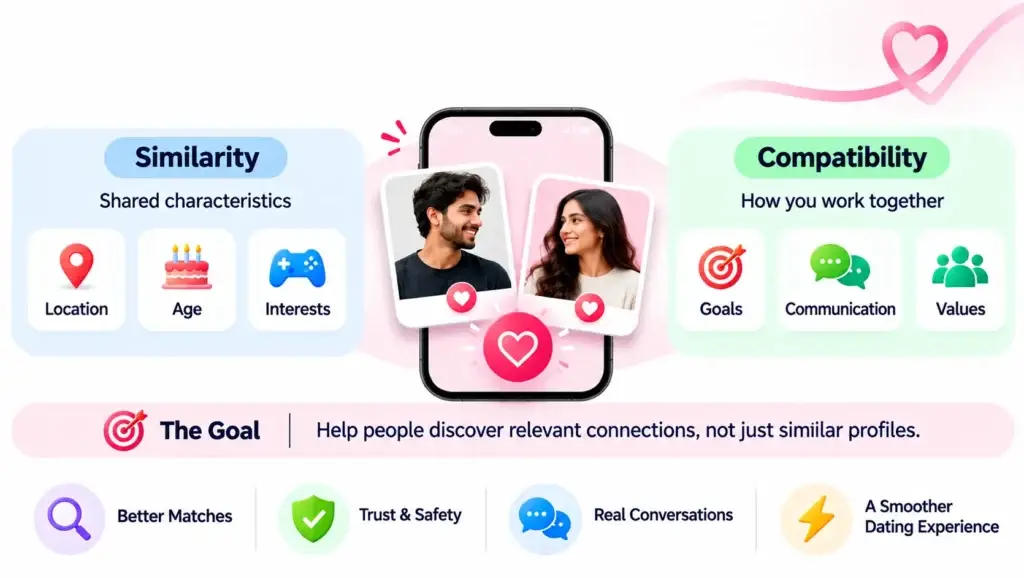
Most dating platforms begin matchmaking with basic filters such as age, location, interests, and relationship preferences. While these details help eliminate obvious mismatches, they cannot fully explain whether two people will communicate comfortably, share important values, or develop a meaningful connection.
For example, two people may enjoy traveling but have completely different expectations about how they spend their free time. Meanwhile, individuals with different hobbies may still connect through similar family priorities, communication styles, and long-term relationship goals.
This highlights the difference between surface-level similarity and genuine compatibility. Similarity focuses on shared characteristics, while compatibility considers how personal expectations, lifestyles, boundaries, and relationship intentions may work together.
However, compatibility does not guarantee romantic chemistry, which develops through real conversations and personal experiences. Dating platforms should therefore focus on helping users discover relevant introductions rather than promising successful relationships through algorithms alone.
This challenge extends across the wider dating and social discovery industry, where recommendation quality, user trust, community safety, and authentic communication influence the overall experience. For founders, improving compatibility means helping people discover relevant connections while maintaining confidence and control throughout their interactions.
How AI Matchmaking Improves Dating Compatibility
AI matchmaking uses recommendation techniques to identify profiles that may align with a person’s preferences, interests, and relationship expectations. Unlike basic filtering systems, machine-learning models can potentially recognize patterns across multiple signals and adapt recommendations using meaningful feedback.
However, intelligent matchmaking depends on reliable information, responsible model design, and clearly defined goals. The technology should improve discovery while allowing users to make their own decisions about potential connections.
1. Understanding Relationship Intentions Before Recommending Profiles
Relationship intentions play an important role in determining whether two people are likely to have compatible expectations. Someone seeking a long-term commitment may not find value in repeatedly receiving recommendations for people interested primarily in casual dating.
AI matchmaking can prioritize explicitly stated relationship goals alongside other relevant preferences. However, important boundaries should remain respected rather than being overridden simply to increase profile views, swipes, or engagement.
2. Recognizing Meaningful Lifestyle Compatibility
Lifestyle preferences can influence relationships in ways that basic interest matching may overlook. Work schedules, social habits, family expectations, relocation plans, and communication preferences can affect how comfortably two people connect.
For example, someone with irregular working hours may value a partner who understands flexible communication and availability. AI recommendations can consider these practical expectations while recognizing that lifestyle differences do not automatically make two people incompatible.
3. Learning From Explicit Feedback Without Assuming Too Much
Dating preferences often evolve as people explore different profiles and better understand what matters to them. AI matchmaking can respond to updated relationship goals, adjusted interests, requests for greater variety, and direct feedback about recommendation relevance.
However, behavioral signals should not be treated as definitive evidence of personal preferences. Rejecting a profile, replying late, or ending a conversation may reflect circumstances unrelated to compatibility, so recommendation systems should interpret such actions cautiously.
4. Identifying Complementary Preferences Rather Than Demanding Identical Personalities
Meaningful compatibility does not require two people to have identical interests, routines, or personalities. Some individuals appreciate shared habits, while others enjoy relationships that introduce different perspectives and experiences.
AI matchmaking should distinguish essential relationship expectations from preferences that allow flexibility. For example, shared long-term intentions may be important, while differences in music, hobbies, or entertainment choices can create opportunities for interesting conversations.
5. Improving Discovery Through Feedback and Refinement
Effective matchmaking systems should improve as users clarify their expectations and provide meaningful feedback. Platforms can begin with transparent matching rules and introduce more advanced personalization when they have sufficient reliable, permissioned information.
For newer dating platforms, complex AI models may not immediately outperform well-designed traditional filters. Founders should focus on recommendation relevance and user satisfaction rather than assuming that greater technical complexity automatically creates better matches.
What Should AI Actually Consider When Suggesting a Match?
AI matchmaking should prioritize information that genuinely helps users discover relevant partners rather than collecting unnecessary personal details. Some signals, such as relationship intentions and location preferences, directly support discovery, while others require careful interpretation and stronger privacy protections.
A responsible recommendation strategy separates useful compatibility information from sensitive or ambiguous data. This allows platforms to improve matchmaking quality without making users feel excessively monitored or profiled.
| Compatibility Signal | Potential Value | Responsible Design Consideration |
|---|---|---|
| Relationship intentions | Reduces conflicting expectations | Respect explicitly stated boundaries |
| Shared interests | Creates conversation opportunities | Avoid prioritizing identical hobbies too heavily |
| Lifestyle preferences | Supports everyday compatibility | Allow flexibility and individual differences |
| Location preferences | Helps identify practical introductions | Avoid unnecessary precise location exposure |
| Communication expectations | Clarifies interaction preferences | Do not infer emotions from reply speed alone |
| Explicit user feedback | Improves recommendation relevance | Explain how feedback influences suggestions |
| Profile completeness | Provides useful matching context | Avoid unfairly penalizing privacy-conscious users |
| Personal values | May identify meaningful alignment | Obtain appropriate consent and avoid sensitive profiling |
Collecting more information does not automatically produce better matchmaking results. Asking a smaller number of meaningful questions can create a more comfortable onboarding experience while giving recommendation systems enough context to identify potentially relevant profiles.
Why AI Matchmaking Can Feel Impersonal Even When Recommendations Are Accurate
AI recommendations can be technically relevant while still making users uncomfortable. For example, displaying a message such as “You are 96% compatible” may create the impression that an algorithm can accurately predict attraction or relationship success.
Without explaining what the percentage represents, such scores can feel misleading or overly mechanical. Dating platforms should communicate recommendation relevance in understandable language rather than presenting compatibility as a scientific certainty.
The Problem With Unexplained Compatibility Scores
Compatibility percentages may appear convincing, but they offer limited value when users cannot understand how they were calculated. A numerical score does not necessarily explain whether two people share relationship intentions, lifestyle preferences, or meaningful interests.
A better approach is to highlight specific matching factors, such as shared long-term goals or similar activity preferences. These explanations allow users to evaluate potential connections independently without assuming that AI can predict emotional chemistry.
When Personalization Becomes Intrusive
AI personalization can feel uncomfortable when dating platforms appear to know more about users than they intentionally shared. Recommendations based on inferred emotional states, private conversations, or sensitive personal characteristics may create privacy concerns and weaken trust.
Platforms should clearly explain which information influences matchmaking and provide meaningful controls over personalization. Just because technology can analyze certain data does not mean that using it for romantic recommendations is appropriate.
When Automation Removes Spontaneity
Dating involves curiosity, personal discovery, and the possibility of unexpected connections. When AI repeatedly recommends nearly identical profiles, the experience can become predictable and restrictive even if the suggestions appear relevant.
A thoughtful recommendation system should balance compatibility with variety while respecting stated boundaries. This helps users explore different possibilities without allowing automated preferences to dictate every aspect of their dating experience.
Human-Centered AI Matchmaking: Five Principles That Preserve Authentic Connection
AI matchmaking should make discovering compatible people easier without replacing the human decisions that make relationships meaningful. The most effective approach is to let technology support introductions while giving users complete control over their preferences, conversations, and connections.
1. Explain the Recommendation Without Overexplaining the Algorithm
Users do not need to understand complex AI algorithms to know why a particular profile appears in their recommendations. Simple explanations based on shared interests, relationship goals, lifestyle preferences, or location can make matchmaking feel more transparent and trustworthy.
For example, a platform might explain that two people share similar relationship intentions or enjoy the same activities. However, these explanations must reflect the actual factors used by the recommendation system rather than suggesting emotional compatibility that the technology cannot reliably determine.
2. Give Users Control Over What Matters Most
Dating preferences can change over time, and users should have the freedom to adjust what matters most to them. A human-centered matchmaking platform should allow members to update relationship goals, location preferences, interests, and other important criteria without unnecessary restrictions.
Users should also be able to distinguish essential boundaries from flexible preferences. Even when AI learns from previous interactions, explicitly stated choices should remain more important than assumptions drawn from swipes or browsing behavior.
3. Make Room for Unexpected Connections
AI matchmaking can become repetitive when recommendations focus too heavily on familiar interests and previous interactions. Although shared preferences are useful, meaningful relationships can also develop between people with different hobbies, backgrounds, or lifestyles.
Dating platforms should introduce thoughtful variety while respecting essential preferences and personal boundaries. This allows users to discover unexpected connections without making recommendations feel random or irrelevant.
4. Keep Conversations Genuinely Human
AI-powered conversation suggestions can help users overcome the difficulty of starting a meaningful interaction. For example, a dating app might suggest an icebreaker based on shared interests, giving members a comfortable starting point for communication.
However, automatically generating and sending romantic messages without clear approval can make interactions feel artificial. Conversation assistance should remain optional, editable, and controlled by users so that genuine communication develops between real people.
5. Make Opting Out a Genuine Option
Not everyone wants an AI-driven dating experience, and platforms should respect different approaches to discovering potential partners. Some users may prefer personalized recommendations, while others feel more comfortable browsing profiles through traditional filters.
Allowing members to reduce personalization, reset learned preferences, or choose simpler discovery options can improve trust and flexibility. AI matchmaking should expand user choice rather than make participation dependent on automated recommendations.
A Practical Example: AI Assistance Without Automated Romance
Consider a hypothetical dating platform designed for adults interested in meaningful relationships. During onboarding, a new member provides basic information about relationship intentions, lifestyle preferences, interests, and preferred location without completing an unnecessarily lengthy questionnaire.
The platform allows members to skip optional questions and update their preferences later. Based on the available information, the recommendation system identifies potentially relevant profiles and provides simple explanations for why those introductions may be worthwhile.
For example, a recommendation might explain that two members share long-term relationship goals, enjoy outdoor activities, and have similar social preferences. The user can then review the profile and independently decide whether to express interest.
If a recommendation feels irrelevant, the member may provide optional feedback or adjust their preferences. The system can use this information to improve future suggestions without making unsupported assumptions about the person’s emotions or personality.
When two members express mutual interest, they can communicate directly and build their connection naturally. AI may provide optional conversation prompts, but neither person is required to use them or allow automated messages to represent them.
This approach demonstrates how intelligent matchmaking can improve discovery without attempting to manufacture attraction or emotional intimacy. Technology creates opportunities for meaningful introductions, while people remain responsible for developing the relationship.
How Explainable AI Can Build Trust in Dating Recommendations
Trust plays an important role in online dating because recommendation systems influence which people users discover and interact with. When members cannot understand why certain profiles appear, they may question whether recommendations reflect genuine compatibility or the platform’s engagement and commercial priorities.
Explainable AI can reduce this uncertainty by communicating the main factors behind profile suggestions. Clear explanations help users develop realistic expectations while making the matchmaking experience feel more transparent and understandable.
Show What Influences Recommendations
Dating platforms should explain the broad factors considered when recommending profiles, such as relationship intentions, shared interests, location preferences, and relevant user feedback. This information can appear through simple recommendation labels or an accessible explanation panel without exposing complex technical details.
If paid visibility or promotional placements influence profile ordering, platforms should distinguish those placements from compatibility-based recommendations. Users should understand whether a profile appears because of matching relevance or commercial promotion.
Avoid Claiming Certainty That the Data Cannot Support
AI matchmaking can identify similarities and preferences, but it cannot guarantee attraction, emotional connection, or long-term relationship success. Romantic compatibility also depends on communication, personal circumstances, mutual effort, and experiences that algorithms cannot fully predict.
Dating platforms should avoid exaggerated claims such as guaranteed compatibility or perfect partner predictions. A more credible approach is to explain how intelligent recommendations help users discover people whose expressed interests and relationship intentions may align with their own.
Let Users Correct the System
Recommendation transparency becomes more valuable when users can correct inaccurate assumptions. If someone changes their relationship goals, loses interest in a particular activity, or adjusts their preferred location, the matchmaking system should allow those updates to influence future suggestions.
Providing editable preferences, clear feedback options, and accessible personalization controls helps prevent outdated recommendation patterns. This combination of explainability and user control makes AI matchmaking more responsive without reducing individual choice.
Privacy and Fairness: The Foundations of Responsible AI Dating Experiences
Dating platforms collect information that can reveal highly personal details about users, including relationship preferences, location, identity, and communication patterns. When AI systems process this information to generate recommendations, protecting privacy and preventing unfair outcomes become essential responsibilities.
Responsible matchmaking requires more than accurate algorithms. Founders should consider data collection, transparency, security, fairness, and user safety throughout the product experience rather than treating these concerns as secondary features.
Collect Only the Information Needed
Dating platforms should collect personal information only when it serves a clear and legitimate purpose. If general location is sufficient for profile discovery, collecting precise location data may introduce unnecessary privacy risks without improving matchmaking quality.
Similarly, users should be able to express important preferences directly instead of having the platform infer sensitive details from unrelated behavior. Limiting unnecessary data collection can simplify onboarding while reducing the amount of personal information the platform must protect.
Treat Sensitive Characteristics Carefully
Some dating preferences may involve sensitive personal characteristics that require additional privacy and legal considerations. AI matchmaking systems should avoid making unsupported inferences about protected or highly personal attributes and should respect applicable laws and user expectations.
Founders should also examine whether recommendation algorithms create unfair visibility patterns or reduce discovery opportunities for particular communities. Responsible fairness practices should respect legitimate personal preferences while preventing unjustified discrimination within platform ranking and recommendation systems.
Protect Personal Information Throughout the Recommendation Process
Protecting user information requires security measures across data collection, storage, processing, and recommendation delivery. Appropriate safeguards may include encrypted communication, access controls, secure APIs, activity logging, and clearly defined data retention policies.
Teams should also evaluate which information is necessary for model development, how personal data can be appropriately de-identified, and how deletion requests affect stored information. Privacy notices, user permissions, and applicable legal requirements should guide these decisions throughout the platform’s operation.
Separate Safety Decisions From Compatibility Predictions
A profile may appear compatible based on shared interests or relationship intentions while still presenting safety concerns. Compatibility algorithms should therefore remain separate from processes responsible for identity verification, abuse reporting, content moderation, and community standards enforcement.
Dating platforms should provide accessible blocking, reporting, and complaint-resolution features to help members manage unwanted interactions. Founders can explore additional considerations around dating app security and user protection when planning safer matchmaking experiences.
Can AI Matchmaking Reduce Swipe Fatigue?
Swipe fatigue occurs when users spend too much time browsing profiles without discovering meaningful connections. AI matchmaking can help reduce this frustration by prioritizing relevant profiles, minimizing repetitive suggestions, and giving users greater control over their dating experience.
However, the effectiveness of AI recommendations depends on how the platform measures success. Instead of encouraging endless browsing, dating apps should focus on helping users discover compatible partners with less unnecessary effort.
Fewer Recommendations Can Sometimes Be More Valuable
Showing hundreds of profiles does not necessarily improve the chances of finding a compatible partner. A smaller selection of relevant recommendations based on relationship intentions, lifestyle preferences, and shared interests can make discovery feel more thoughtful and manageable.
However, limiting recommendations too much can reduce variety and create frustration, especially when the active member base is small. Dating platforms should balance recommendation quality, profile diversity, and user preferences to maintain an engaging discovery experience.
Recommendation Quality Must Account for Member Availability
Even a highly compatible profile offers limited value if the person is inactive, unavailable, or outside the user’s preferred location. Effective AI matchmaking should consider member activity, practical availability, and relevant preferences alongside compatibility signals.
This becomes particularly important for smaller dating communities with fewer eligible members. Recommendation systems should avoid repeatedly displaying the same profiles and instead provide a balanced selection of relevant, active users.
Give Users a Natural Stopping Point
Endless profile browsing can make online dating feel repetitive and overwhelming. Thoughtful matchmaking experiences should encourage users to explore potential connections at a comfortable pace rather than creating pressure to remain active continuously.
Features such as optional discovery pauses, customizable notifications, and user-controlled browsing sessions can support healthier engagement. The goal should be helping people build meaningful connections, not maximizing the time they spend on the platform.
What Founders Should Measure Instead of Swipe Volume
For dating platform founders, successful AI matchmaking should be measured by the quality of introductions rather than the number of swipes or app sessions. Traditional engagement metrics can show how frequently users interact with a platform, but they do not necessarily indicate whether those interactions lead to meaningful connections.
A more effective measurement strategy combines recommendation relevance, mutual interest, conversation quality, user satisfaction, and trust. These indicators help founders understand whether intelligent matchmaking is genuinely improving the dating experience.
| Measurement Area | Useful Indicator | What It Helps Evaluate |
|---|---|---|
| Recommendation relevance | User feedback on suggested profiles | Whether recommendations reflect user expectations |
| Mutual interest | Mutual matches relative to eligible impressions | Whether suggested profiles appeal to both users |
| Conversation initiation | Percentage of mutual matches that begin conversations | Whether introductions encourage meaningful interaction |
| Conversation participation | Balanced communication after matching | Whether conversations progress beyond initial messages |
| Discovery efficiency | Relevant introductions per browsing session | Whether users find promising profiles with less effort |
| User control | Preference updates and personalization opt-outs | Whether users can manage their matchmaking experience |
| Trust and safety | Reports, blocks, appeals, and resolution patterns | Whether the platform supports respectful interactions |
| User satisfaction | Voluntary feedback after interactions | Whether users find the matchmaking experience valuable |
No single metric can accurately predict romantic compatibility or long-term relationship success. For example, a high conversation-start rate may reflect initial curiosity, while lower app usage could indicate either disengagement or that someone has successfully found a partner.
Founders should therefore evaluate performance metrics together rather than assuming that higher engagement always represents better matchmaking outcomes.
Measure Quality Without Invading Private Conversations
Dating platforms do not need to analyze every private conversation to evaluate matchmaking effectiveness. Aggregate interaction patterns, voluntary user feedback, and privacy-conscious analytics can provide useful insights into recommendation quality without unnecessarily accessing sensitive personal information.
Users should clearly understand what information is collected, how it is measured, and why it supports the matchmaking experience. Respecting communication privacy helps strengthen trust while allowing founders to improve platform performance responsibly.
Evaluate the Experience Across Different User Groups
An improvement in overall matchmaking performance does not always mean every user benefits equally. Recommendation changes may increase engagement for some members while reducing relevant discovery opportunities for users in smaller locations or less-represented communities.
Founders should regularly evaluate recommendation fairness, profile visibility, and discovery quality across different user groups using appropriate privacy safeguards. This helps ensure that new members and smaller communities receive reasonable opportunities to connect without being overshadowed by established users or paid profile visibility.
Founder Decision Signals: When Is More Advanced AI Matchmaking Worthwhile?
Recommendation Relevance
If users repeatedly receive profiles that conflict with their relationship goals or preferences, improving recommendation logic may create value. First, verify that existing filters and matching rules work correctly before introducing advanced AI.
Reliable User Feedback
AI matchmaking becomes more effective when platforms collect meaningful, permissioned feedback. Updated preferences, explicit responses, and carefully interpreted interaction patterns provide stronger learning signals than relying on swipes alone.
Personalization and User Trust
Different users prioritize relationship intentions, lifestyle preferences, and shared interests. Adaptive recommendations, clear matching explanations, and adjustable preferences can improve relevance while keeping the experience transparent and user-controlled.
Long-Term AI Management
Advanced matchmaking systems require ongoing monitoring as preferences and community dynamics change. Founders should be able to evaluate recommendation quality, identify unfair outcomes, maintain privacy safeguards, and respond to user concerns.
Common Mistakes That Make AI Dating Experiences Feel Artificial
AI matchmaking can improve dating compatibility, but poorly designed recommendation systems can make the experience feel mechanical, repetitive, or overly controlled. Founders should avoid common mistakes that reduce user trust, limit meaningful discovery, and weaken the human connection that dating platforms are meant to encourage.
Mistake 1: Treating Compatibility Scores as Scientific Certainty
Compatibility scores can help organize and rank potential matches, but they should never be presented as guaranteed predictions of relationship success. Attraction, emotional understanding, and long-term compatibility depend on personal experiences and interactions that algorithms cannot fully predict.
Instead of displaying unexplained percentages, dating platforms should highlight relevant matching factors, such as shared interests, relationship intentions, and lifestyle preferences. This makes recommendations more understandable without creating unrealistic expectations.
Mistake 2: Learning Too Aggressively From Every Swipe
A single swipe or rejected profile does not necessarily reveal someone’s long-term dating preferences. When AI systems interpret every interaction as a strong preference signal, recommendations can become repetitive and overly restrictive.
Dating platforms should combine behavioral patterns with explicit user feedback and adjustable preference settings. This allows matchmaking algorithms to improve gradually without making assumptions that limit discovery or misrepresent individual interests.
Mistake 3: Replacing Genuine Conversation With Automated Messages
AI-powered conversation suggestions can help users overcome the difficulty of starting a conversation, especially when they share common interests. However, automatically generating and sending messages on someone’s behalf can make interactions feel artificial and damage trust.
Instead, dating platforms should provide optional conversation prompts that users can personalize before sending. This preserves authentic communication while allowing technology to support more comfortable and engaging introductions.
Mistake 4: Prioritizing Engagement Over Meaningful Introductions
High swipe counts, frequent notifications, and longer browsing sessions do not necessarily indicate successful matchmaking. Users may spend more time on a platform simply because they struggle to find relevant connections.
Founders should focus on recommendation quality, mutual interest, meaningful conversations, and user satisfaction rather than engagement metrics alone. A smaller number of relevant introductions can create more value than an endless stream of poorly matched profiles.
Mistake 5: Making the Recommendation System Impossible to Understand
When users cannot understand why certain profiles appear, they may question the accuracy or fairness of the matchmaking system. Completely opaque recommendations can create frustration, particularly when suggestions repeatedly conflict with stated preferences.
Providing simple explanations, flexible discovery filters, and transparent personalization controls helps users understand how recommendations work. These features make AI matchmaking feel more trustworthy while preserving personal choice.
Mistake 6: Assuming AI Can Compensate for a Weak Member Community
Even advanced matchmaking algorithms cannot create meaningful connections without a relevant and active user base. A platform needs sufficient member availability, effective onboarding, appropriate geographic coverage, and strong community standards to deliver valuable introductions.
This is why focused dating communities can offer advantages by connecting people with more closely aligned interests, lifestyles, and relationship expectations. When the audience is relevant, AI matchmaking has a stronger foundation for identifying potentially compatible partners.
How to Introduce AI Matchmaking Without Overcomplicating the Dating Experience
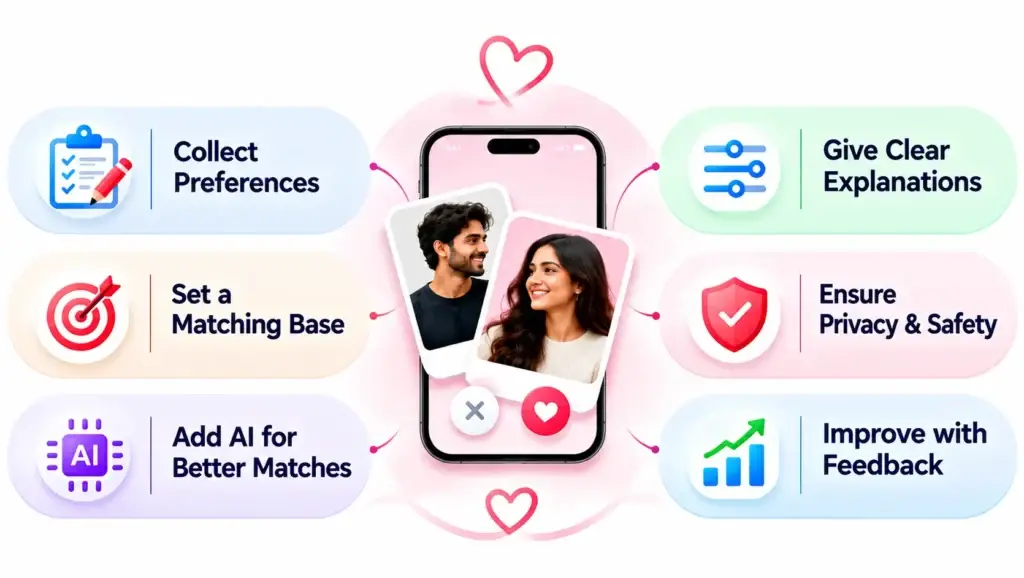
A practical approach to AI matchmaking begins with understanding user expectations rather than focusing entirely on complex algorithms. Dating platforms should introduce intelligent features gradually, ensuring that every improvement makes profile discovery more relevant, transparent, and comfortable.
Start With Clear Preference Collection
Effective matchmaking starts with collecting meaningful information about users’ relationship goals, interests, lifestyle preferences, and personal boundaries. Instead of overwhelming members with lengthy questionnaires, platforms should ask a few relevant questions, explain why the information matters, and allow users to update their preferences whenever needed.
Establish a Transparent Recommendation Baseline
Before introducing advanced AI models, dating platforms should establish clear matching rules based on relationship intentions, shared interests, location preferences, and member availability. This creates a reliable starting point for evaluating recommendation quality and identifying areas where additional personalization could improve the experience.
Introduce Learning Where It Solves a Real Problem
Advanced recommendation techniques should address genuine matchmaking challenges, such as repetitive profile suggestions, irrelevant matches, or limited discovery variety. As platforms grow and collect meaningful feedback, founders can explore AI recommendation system development to improve profile ranking, preference learning, and personalized discovery.
However, these capabilities should be introduced only when they offer measurable improvements in recommendation relevance, user satisfaction, and the overall dating experience.
Test Explanations and User Controls
Users should understand why particular profiles appear in their recommendations and have the freedom to adjust preferences when suggestions do not match their expectations. Clear explanations, flexible filters, and accessible personalization settings help build trust while ensuring that intelligent matchmaking remains under the user’s control.
Review Privacy, Fairness, and Safety Before Expansion
As AI matchmaking becomes more sophisticated, platforms must carefully evaluate how personal information is collected, stored, and used. Strong privacy practices, fair recommendation systems, effective reporting tools, and responsible moderation help protect users and reduce the risk of biased or inappropriate matching experiences.
Improve Continuously Through Meaningful Feedback
AI matchmaking should evolve through user feedback, performance evaluation, and ongoing improvements to recommendation quality. Founders should measure whether users receive more relevant introductions, experience fewer unnecessary interactions, and feel more confident using the platform.
Ultimately, successful AI matchmaking depends on solving real user problems rather than introducing increasingly complex technology. Sometimes a clearer recommendation explanation, a better preference question, or a simpler discovery control can improve the dating experience more effectively than an advanced algorithm.
Where Miracuves Fits Into a Human-Centered Dating Platform Strategy
A thoughtful matchmaking experience requires more than intelligent recommendation algorithms. It also depends on well-designed user profiles, seamless discovery workflows, mutual matching, communication tools, privacy controls, and reliable administrative features that support meaningful interactions.
For founders planning a dating platform focused on genuine connections, Miracuves offers a ready-made foundation with essential discovery, matching, communication, and management capabilities. This allows businesses to focus on creating a distinctive dating experience while exploring advanced AI compatibility features as additional customization requirements.
The existing platform supports interest-based profile discovery, preference filters, matching workflows, and user communication. These capabilities provide a practical starting point for building a branded dating experience without developing every standard feature from scratch.
However, founders should clearly distinguish between existing platform functionality and advanced AI-driven personalization. Features such as intelligent compatibility scoring, machine-learning recommendation models, preference learning, and explainable matching may require separate development, testing, and integration.
Miracuves offers deployment of its ready-made solution within six working days under its defined scope. More advanced AI matchmaking capabilities may require additional planning and development time, depending on the complexity of the requirements.
The main advantage of starting with a ready-made platform is the ability to concentrate on user experience, audience preferences, and meaningful differentiation rather than rebuilding essential dating app functionality.
Ultimately, successful AI matchmaking is not about adding as many intelligent features as possible. It is about introducing the right technology to help people discover relevant connections while preserving trust, privacy, personal choice, and authentic human interaction.
Final Thoughts: Better Matchmaking Should Make Technology Less Noticeable
AI matchmaking has the potential to make online dating more relevant and meaningful by helping users discover profiles that align with their relationship goals, lifestyle preferences, and personal values. Smarter recommendations can reduce unnecessary browsing and make finding compatible partners more convenient.
However, technology cannot replace the emotions, conversations, and shared experiences that build genuine relationships. While AI can identify promising connections, attraction and long-term compatibility ultimately depend on human interaction.
For dating platform founders, the goal should be to balance intelligent recommendations with transparency, privacy, and user choice. A well-designed matchmaking experience should respect personal boundaries, encourage authentic communication, and give users control over their dating journey.
The real purpose of AI matchmaking is to improve the quality of introductions, not to automate human relationships. When technology supports discovery without controlling personal decisions, dating platforms can create experiences that feel more natural, trustworthy, and genuinely personal.
FAQs
How does AI matchmaking improve dating compatibility?
AI matchmaking can improve recommendation relevance by considering relationship intentions, lifestyle preferences, shared interests, and user feedback. It helps identify potentially suitable introductions, but it cannot guarantee romantic chemistry or relationship success.
Can AI accurately predict whether two people will fall in love?
No. AI may identify patterns associated with stated compatibility preferences, but attraction and long-term relationships depend on many unpredictable human factors. Compatibility predictions should be treated as discovery aids, not definitive outcomes.
How can dating apps use AI without feeling impersonal?
They can explain recommendations in natural language, preserve user choice, avoid intrusive profiling, and keep conversations under human control. Optional assistance works better than automation that makes romantic decisions or communicates without permission.
What information should an AI matchmaking system use?
Useful inputs may include voluntarily shared relationship goals, interests, lifestyle preferences, general location settings, and explicit feedback. Platforms should minimize sensitive data collection and clearly explain how personal information influences recommendations.
Should dating platforms show compatibility percentages?
Only when the score has a clear, defensible meaning and can be explained without implying certainty about relationship outcomes. Simple explanations of shared preferences may be more useful than unexplained percentages.
Can AI matchmaking reduce swipe fatigue?
It may help by reducing irrelevant suggestions and prioritizing profiles that align with meaningful preferences. Results depend on recommendation quality, member availability, user control, and whether the platform optimizes for useful introductions rather than browsing volume.
Is AI matchmaking better than traditional matching filters?
Not always. Traditional filters can be effective when preferences are clear and interaction data is limited. AI can add value when reliable feedback and sufficient data support more contextual recommendations. The right approach depends on the platform’s needs.
What should founders prioritize before introducing advanced AI matchmaking?
Founders should prioritize clear onboarding, relevant member availability, trustworthy profiles, effective safety controls, understandable recommendation rules, and user feedback. More advanced AI should address demonstrated problems rather than serve as a marketing label.
Miracuves is an independent software development company. We are not affiliated with, connected to, sponsored by, or endorsed by any company or product named in this article.
Terms such as “X Clone” are used descriptively. It is how the software industry refers to building a platform with functionality comparable to a known service, and how clients search for it.
The entire design and codebase of our products is built by our own team. Our products contain no code, design, graphics, or content originating from any third-party website or applications.
All third-party names and marks referenced in this article are the property of their respective owners, referenced solely to identify the services discussed.