
Food delivery apps have reshaped how people order and experience food. What started as a convenience has now become an everyday habit for millions of users worldwide. Whether it’s a late-night craving or a quick lunch during work hours, users expect fast, reliable, and seamless delivery experiences.
For startups and businesses, this presents a strong opportunity. But building a successful food delivery app isn’t just about launching a platform—it requires the right strategy, features, technology, and execution.
This guide walks you through everything you need to know about food delivery app development, from business models and features to costs and best practices, so you can make informed decisions before starting.
Read More: How to Build a Food Delivery App Like Zomato – Features, Costs, and Timeline
Understanding the Food Delivery App Business Model
Before diving into development, it’s important to choose the right business model. Your entire platform structure depends on this decision.
1. Order-Only Model
In this model, the app acts as a bridge between customers and restaurants. The restaurant handles delivery.
Best for: Small startups or local marketplaces
Example flow: User → App → Restaurant → Restaurant delivers
2. Order & Delivery Model
The app manages both ordering and delivery logistics.
Best for: Businesses aiming to control customer experience
Example flow: User → App → Restaurant → Delivery partner → User
3. Full-Stack Model
You manage everything—from food preparation to delivery.
Best for: Cloud kitchens and vertical brands
Example flow: User → App → Your kitchen → Delivery → User
Key Features of a Food Delivery App
A successful app balances user experience, operational efficiency, and scalability. Here are the core features broken down by user roles.
Customer App Features
- Easy registration and login
- Advanced search and filters (cuisine, price, ratings)
- Real-time order tracking
- Multiple payment options
- Reviews and ratings
- Order history and reordering
Restaurant Panel Features
- Menu management
- Order management dashboard
- Pricing and availability control
- Analytics and reporting
Delivery Partner App Features
- Order notifications
- Route optimization and navigation
- Earnings tracking
- Availability toggle
Admin Panel Features
- User and restaurant management
- Commission and pricing control
- Analytics dashboard
- Complaint and support system
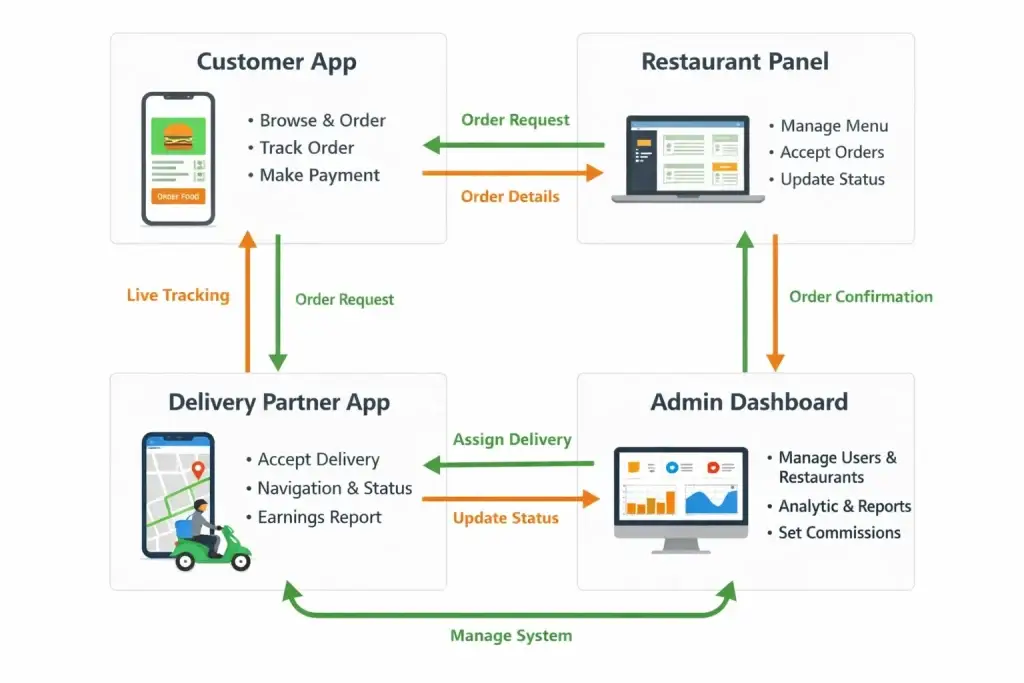
How a Food Delivery App Works
Understanding the workflow helps in designing a seamless system.
- User browses restaurants and selects food
- Order is placed and sent to the restaurant
- Restaurant accepts and prepares the order
- Delivery partner is assigned
- Real-time tracking begins
- Order is delivered to the user
Read More: How To Build a Food Delivery App Like Baemin: Features, Costs, and Development
Technology Stack for Food Delivery App Development
Choosing the right technology stack ensures performance, scalability, and long-term stability.
| Component | Recommended Technologies |
|---|---|
| Frontend | React Native, Flutter |
| Backend | Node.js, Django |
| Database | PostgreSQL, MongoDB |
| Cloud | AWS, Google Cloud |
| Maps & Navigation | Google Maps API |
| Payments | Stripe, Razorpay |
A scalable backend is especially important as your app grows and handles more users and orders.
Development Process Step-by-Step
1. Market Research & Planning
Understand your target audience, competitors, and market gaps.
2. Define Features & MVP Scope
Start with a Minimum Viable Product (MVP) instead of building everything at once.
3. UI/UX Design
Focus on simplicity, speed, and clarity. Food apps rely heavily on user experience.
4. App Development
Develop frontend and backend simultaneously with proper API integration.
5. Testing & QA
Ensure the app works smoothly across devices and scenarios.
6. Launch & Deployment
Release on app stores and monitor initial performance.
7. Post-Launch Support
Regular updates, bug fixes, and feature improvements are critical.
Cost of Food Delivery App Development
The cost varies based on features, complexity, and scale. Here’s a general breakdown:
| Development Level | Description | Estimated Cost (USD) |
|---|---|---|
| Basic MVP | Core ordering, basic UI, simple backend | $15,000 – $40,000 |
| Mid-Level App | Real-time tracking, multiple panels, payments | $40,000 – $100,000 |
| Advanced Platform | AI recommendations, scalability, analytics | $100,000+ |
Key Cost Factors
- App complexity
- Number of platforms (iOS, Android, Web)
- Third-party integrations
- UI/UX design quality
- Development team location
Challenges in Food Delivery App Development
Logistics Management
Handling deliveries efficiently is one of the biggest challenges.
Real-Time Tracking
Requires strong backend and map integration.
Customer Retention
Users often switch apps easily, so loyalty strategies matter.
High Competition
Standing out requires better experience and niche positioning.
Best Practices for Building a Successful Food Delivery App
- Start with a focused niche (e.g., healthy food, local cuisine)
- Prioritize speed and app performance
- Keep the interface simple and intuitive
- Offer multiple payment options
- Implement strong customer support
- Use data analytics for decision-making
Food Delivery App vs Clone Script: What Should You Choose?
| Aspect | Custom Development | Clone Script |
|---|---|---|
| Cost | Higher | Lower |
| Time to Market | Longer | Faster |
| Scalability | High | Limited |
| Customization | Full control | Restricted |
If you’re testing an idea, a clone script may work. But for long-term growth, custom development is often the better choice.
Conclusion
Food delivery app development is a promising but competitive space. Success depends on more than just launching an app—it requires a clear business model, user-focused features, reliable technology, and continuous improvement.
By starting with the right strategy and building a scalable foundation, businesses can create platforms that not only attract users but also retain them in the long run.
If you’re planning to build a food delivery app, working with an experienced development partner can make a significant difference. Miracuves helps businesses design, develop, and launch scalable on-demand platforms tailored to their goals—whether you’re starting with an MVP or aiming for a full-scale marketplace.
FAQs
1. Can I start with a small budget?
Yes, starting with an MVP allows you to test your idea before scaling.
2. What is the most important feature?
Real-time tracking and a smooth user experience are critical for success
3. How do food delivery apps make money?
Common revenue models include commissions, delivery fees, subscriptions, and ads.
4. How do you scale a food delivery app?
By using cloud infrastructure, optimized backend systems, and load balancing to handle growing users smoothly.
5. What integrations are needed in a food delivery app?
Payment gateways, map APIs, notifications (SMS/email), and analytics tools are essential.
Miracuves is an independent software development company. We are not affiliated with, connected to, sponsored by, or endorsed by any company or product named in this article.
Terms such as “X Clone” are used descriptively. It is how the software industry refers to building a platform with functionality comparable to a known service, and how clients search for it.
The entire design and codebase of our products is built by our own team. Our products contain no code, design, graphics, or content originating from any third-party website or applications.
All third-party names and marks referenced in this article are the property of their respective owners, referenced solely to identify the services discussed.