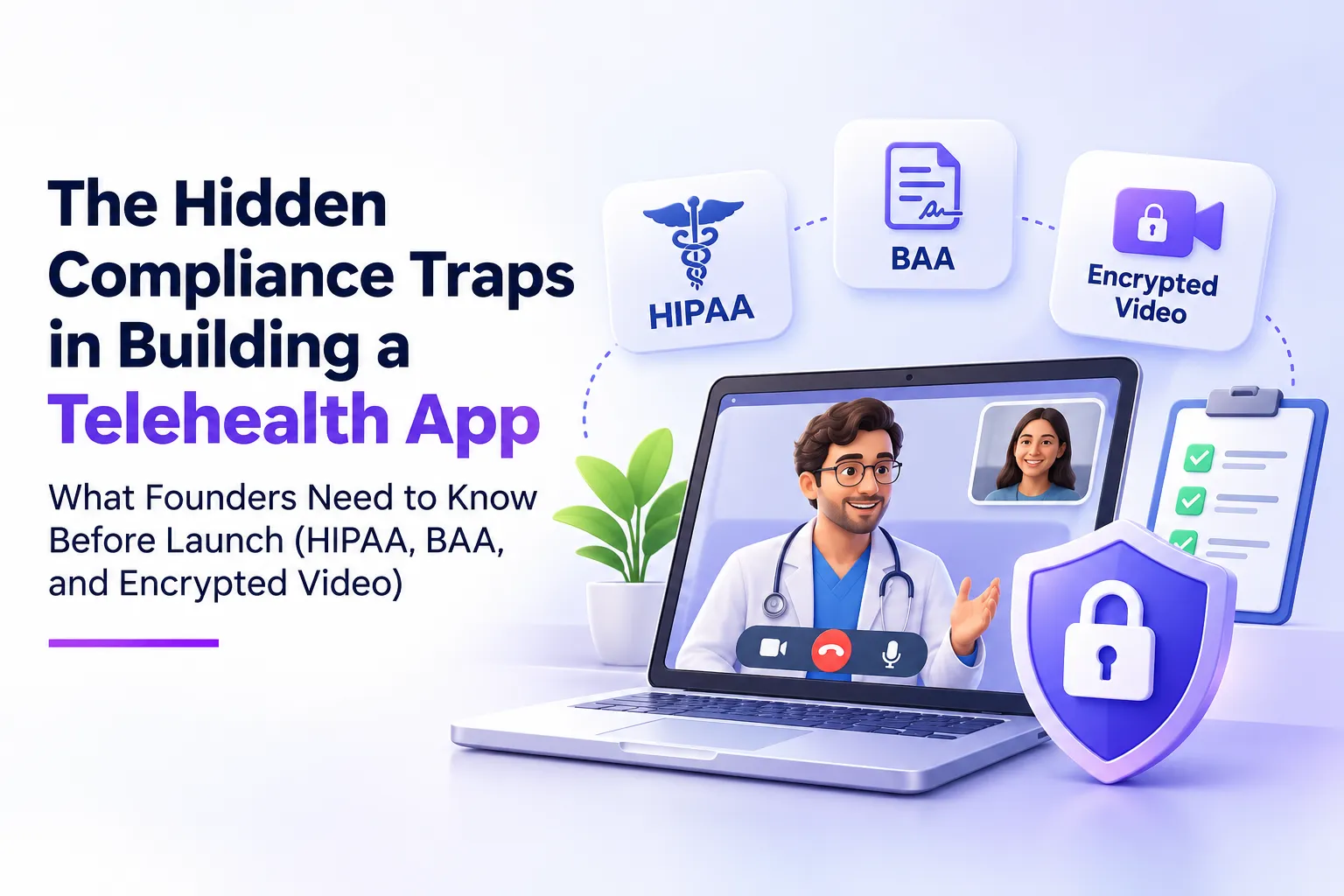
Key Takeaways
- Telehealth app compliance traps often begin with incorrect assumptions. Not every healthcare-related startup has identical HIPAA obligations. Applicability depends on the organization’s role, business relationships, and how patient information is handled.
- A BAA does not make an entire telehealth app compliant. Business associate agreements establish contractual responsibilities, but they cannot replace appropriate access controls, security safeguards, risk analysis, and operational procedures.
- Encrypted video alone is not enough. Founders must evaluate the complete consultation lifecycle, including participant authentication, session access, recordings, storage, metadata, logs, and administrative access.
- Analytics and notifications can expose sensitive patient information. Appointment details, symptoms, identifiers, notification previews, and tracking events should be reviewed to determine whether unnecessary health information is being disclosed.
- Access should follow actual job responsibilities. Patients, clinicians, support staff, and administrators should not automatically receive broad access to patient records. Role-based and contextual authorization help reduce unnecessary exposure.
- Cloud hosting does not automatically create a secure telehealth environment. Databases, backups, logs, storage, monitoring systems, and development environments can all become locations where sensitive information is exposed if they are not properly configured.
- HIPAA compliance does not automatically authorize clinical operations. Provider licensing, patient location, informed consent, prescribing rules, recordkeeping, and other jurisdiction-specific requirements must be evaluated separately.
- A documented security risk analysis is a core readiness activity. Teams should identify ePHI, threats, vulnerabilities, existing safeguards, and remediation priorities rather than relying only on technical security checklists.
- Incident response should be planned before launch. Teams need clear procedures for investigating suspected unauthorized access, preserving evidence, containing incidents, coordinating vendors, and determining applicable notification responsibilities.
- Software delivery and regulatory readiness are separate responsibilities. A ready-made telehealth foundation can accelerate product development, but HIPAA applicability, BAAs, clinical licensing, security assessments, and jurisdiction-specific requirements still require their own review and implementation.
A telehealth application can look ready for launch long before it is ready to handle real patient information. Video calls work, appointment bookings appear correctly, doctors can log in, and patients can receive consultation reminders. Yet one overlooked vendor agreement, exposed session recording, or improperly configured analytics tool can create a serious privacy and security problem.
This is the hidden risk behind digital healthcare products: building a functional application and operating a compliant healthcare service are two different responsibilities. Founders evaluating healthcare platform architecture and implementation need to think beyond visible features and understand how patient information flows through infrastructure, software vendors, clinical workflows, and administrative systems.
In the United States, the Health Insurance Portability and Accountability Act (HIPAA) establishes important privacy and security obligations for covered entities and business associates. However, not every healthcare-related startup is automatically subject to HIPAA, and HIPAA is not the only legal framework that may affect a telehealth business.
A founder might select an encrypted video service and assume patient consultations are protected. But what happens when appointment details appear in application logs? What if a cloud vendor stores recordings without the appropriate business associate agreement? What if a doctor consults a patient in a state where the doctor is not authorized to practice?
These are not minor technical details. They can influence whether a product can launch safely, which services it can offer, how providers operate, and what happens when sensitive information is exposed.
This guide explains the compliance traps telehealth founders should identify before launch, with particular attention to HIPAA applicability, business associate agreements (BAAs), encrypted video, vendor management, patient data protection, and operational readiness.
Why Telehealth Compliance Problems Often Appear After the App Is Built
Telehealth products frequently begin with a straightforward business idea: connect patients with licensed medical professionals through a convenient digital platform. Founders usually concentrate on appointment scheduling, provider availability, video quality, payments, and the patient experience.
These capabilities are important, but they represent only the visible layer of the service. Behind each consultation, information may pass through identity systems, databases, video infrastructure, cloud storage, notification services, support dashboards, and third-party integrations.
For example, a patient schedules an online consultation and enters symptoms describing their condition. The booking service stores the information, a notification provider sends an appointment reminder, an analytics system records the booking event, and the video service creates a session identifier.
Even if no consultation recording exists, several systems may have received information that identifies a patient or relates to their care. Depending on the entities involved and the data disclosed, this information may be protected health information.
The mistake is treating security as a single feature instead of understanding the complete information lifecycle. A strong pre-launch review must establish what information is collected, who receives it, why it is needed, how it is protected, and when it should be deleted or retained.
Compliance Trap #1: Assuming Every Telehealth Startup Has the Same HIPAA Obligations
One of the earliest mistakes a founder can make is assuming that any application involving medical information is automatically regulated in exactly the same way.
HIPAA applies to defined covered entities, including certain healthcare providers, health plans, and healthcare clearinghouses, and to business associates handling protected health information for covered functions or services.
A technology company may qualify as a business associate when it creates, receives, maintains, or transmits protected health information on behalf of a covered entity. Its obligations depend on its actual role, business relationships, and information-handling activities—not merely on whether the product is marketed as healthcare software.
The Difference Between a Healthcare App and a HIPAA-Regulated Service
Consider two hypothetical products. The first is a general wellness journal used independently by consumers, without providing services on behalf of a HIPAA-covered organization. The second supports virtual consultations for a medical practice and stores patient treatment information on that practice’s behalf.
Their legal obligations may differ substantially, even if both applications display health-related information. The first may still be subject to consumer privacy, health-data, or other laws, while the second may operate within a HIPAA-regulated relationship.
Founders should answer three questions before developing compliance requirements: Who is operating the service? On whose behalf is the information being processed? What categories of information move through the platform?
These answers determine whether the product needs HIPAA-specific agreements and controls and what other legal obligations should be considered.
Why Incorrect HIPAA Assumptions Create Business Risk
Underestimating obligations may result in unsuitable vendors, inadequate authorization controls, missing contracts, or gaps in data-handling procedures. Overestimating them can also distort technical decisions by pushing founders toward unnecessary restrictions without understanding the actual legal requirements.
The appropriate approach is a documented applicability assessment involving qualified legal and privacy professionals, followed by technical requirements that reflect the service’s real operating model.
Compliance Trap #2: Believing a Signed BAA Makes the Entire App HIPAA Compliant
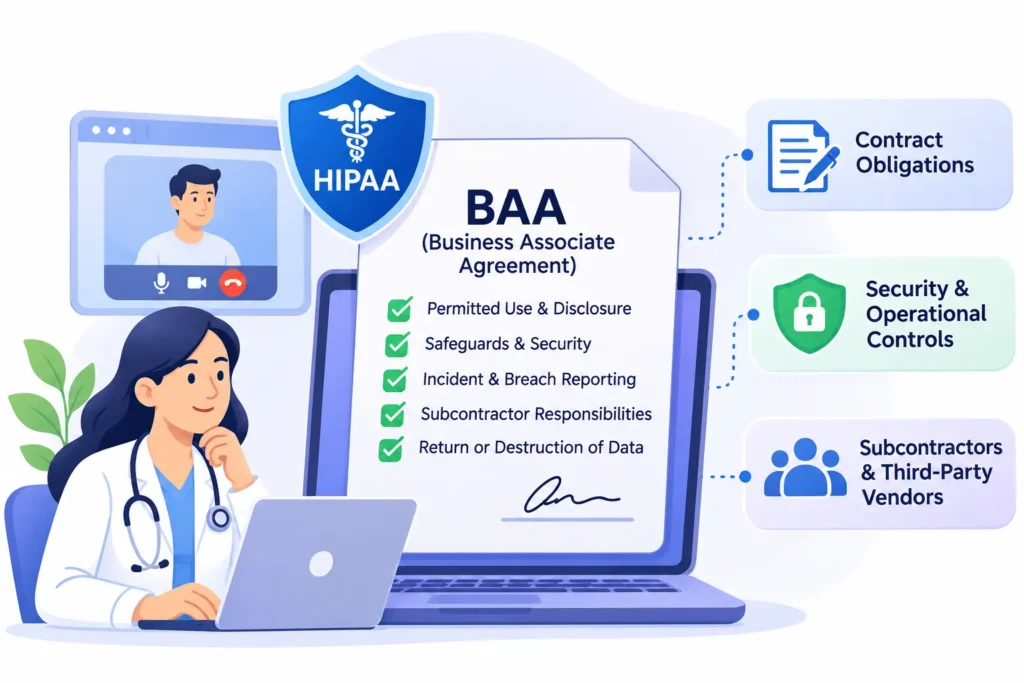
A business associate agreement, or BAA, is a contractual arrangement used in HIPAA-regulated relationships to establish how a business associate may use or disclose protected health information and what safeguards and responsibilities apply.
For telehealth founders, BAAs are particularly important because an application may depend on several external providers. Cloud infrastructure, video communication services, managed databases, support platforms, and other services may qualify as business associates or subcontractor business associates depending on their activities.
The trap is assuming that signing a BAA automatically makes the platform compliant. A contract cannot compensate for weak access controls, unrestricted patient-data exposure, inadequate incident response, or a missing security risk analysis.
What Should a Telehealth BAA Address?
A HIPAA business associate agreement generally addresses permitted and required uses and disclosures, safeguards, incident and breach reporting, subcontractor responsibilities, support for relevant privacy obligations, and return or destruction of protected information when the relationship ends where feasible.
Beyond the required contract provisions, founders should negotiate operational responsibilities where appropriate. These may include incident escalation contacts, service availability expectations, access to security documentation, support for investigations, and responsibilities when services are terminated.
The agreement must reflect the actual service relationship. A generic document copied from another project may not properly describe the data or systems involved.
The Subcontractor Problem That Founders Often Miss
Suppose a telehealth company signs a BAA with its primary hosting provider. The company then integrates a separate transcription service that receives consultation audio. The original cloud agreement does not automatically establish an appropriate agreement with the transcription vendor.
Every service relationship must be evaluated independently. When a business associate engages a subcontractor that handles protected health information on its behalf, applicable downstream contractual obligations must also be addressed.
Even an encrypted cloud storage service may fall within the business associate framework when it maintains ePHI on behalf of a regulated organization, regardless of whether it holds the decryption key.
Founders should maintain a vendor register that identifies each service, the information it receives, the reason for processing, contractual status, security owner, and the approved configuration.
Compliance Trap #3: Assuming Encrypted Video Calls Automatically Meet HIPAA Requirements
Encrypted video is an important component of secure telehealth communication, but video transport security is only one part of patient privacy.
A video platform may encrypt audio and video while still exposing sensitive information through meeting invitations, recording storage, session logs, administrative access, or third-party integrations.
Founders should evaluate the complete consultation lifecycle: creating a session, authenticating participants, joining the call, transmitting audio and video, saving optional records, ending the session, and retaining or deleting associated information.
Transport Encryption vs. End-to-End Encryption
Transport encryption helps protect information while it travels between communication endpoints or infrastructure components. End-to-end encryption is a more specific architecture in which the intended endpoints control the ability to decrypt the communication content, subject to the implementation’s actual design.
These terms are not interchangeable. Some video systems decrypt and process media within managed infrastructure to support routing, recording, or other features. Whether that processing is appropriate depends on the service’s design, vendor obligations, access controls, and risk analysis.
HIPAA does not universally demand end-to-end encryption for every telehealth call. Under the current Security Rule, encryption specifications are addressable: regulated entities must assess them, implement them where reasonable and appropriate, or document justified alternatives under the rule’s framework.
In practical telehealth systems, properly configured encryption is generally an important safeguard, but no encryption label should be treated as a complete compliance guarantee.
Why Session Access Controls Matter as Much as Encryption
Imagine a video consultation where the media stream is encrypted but the invitation link can be forwarded freely and allows anyone with the URL to join the session.
The encryption may protect the network connection while the application still fails to establish whether the correct people are participating. Strong consultation workflows should use appropriate participant authentication, session authorization, expiry controls, and mechanisms for preventing or removing unauthorized access.
For sensitive consultations, providers may also need identity confirmation, patient consent workflows, and policies for handling unexpected participants or interruptions.
Recorded Consultations Create a Separate Security Problem
Live communication and stored recordings have different risks. If a consultation is recorded, the resulting files may need storage encryption, restricted access, retention policies, auditability, and appropriate handling when a patient exercises applicable rights.
Recording consent and confidentiality rules can also vary by jurisdiction. A platform should not enable automatic recording simply because the video provider supports it.
Founders should determine whether recording is clinically necessary, who can initiate it, where files are stored, who can access them, and how long they remain available.
Compliance Trap #4: Ignoring Metadata, Appointment Details, and Analytics Tools
Patient information can be exposed without a database breach or stolen consultation recording. Appointment-related metadata may reveal a patient’s identity, provider, appointment date, specialty, symptoms, or the purpose of a visit.
A particularly overlooked risk involves analytics and tracking systems. These tools may record page visits, clicks, form submissions, device identifiers, or application events. If those events include protected health information, the disclosure and vendor relationship require appropriate analysis.
The Hidden Risk in Appointment Tracking
Suppose an authenticated patient selects a specialist and enters a reason for consultation. The application fires a tracking event that contains the patient’s account identifier, appointment category, and selected symptoms.
If that event is transmitted to an external analytics service, the product team must determine whether the disclosure is permitted and whether the vendor is appropriately contracted and configured.
The solution is not necessarily to abandon product analytics. Instead, founders should establish what information analytics genuinely needs, remove sensitive fields, evaluate applicable vendor obligations, and avoid transmitting identifiable medical details when they are unnecessary.
Importantly, not every visit to a public healthcare webpage automatically creates protected health information. The applicable facts and regulatory interpretation matter. Authenticated patient portals, appointment forms, and symptom-entry workflows deserve especially careful review.
Notifications Can Reveal More Than Founders Expect
An appointment reminder may seem harmless until its preview reveals a sensitive specialty, diagnosis, or treatment detail on a shared device.
SMS, email, push notifications, and customer support messages need privacy-conscious templates and communication preferences. The organization should evaluate the information included, the channel’s security characteristics, applicable communication rules, and the patient’s stated preferences.
A safer design often separates a generic reminder from detailed information available only after the patient securely authenticates.
Compliance Trap #5: Giving Doctors, Staff, and Administrators Excessive Access
A telehealth system typically includes several user roles: patients, clinicians, reception staff, clinical managers, customer support personnel, and administrators. Each role needs different information to perform legitimate tasks.
A common implementation mistake is giving broad administrative access to everyone responsible for operating the platform. That may simplify early testing, but it can create unnecessary exposure once real patient records enter the system.
Access controls should reflect job responsibilities, clinical relationships, and relevant privacy requirements. The minimum necessary principle generally limits uses and disclosures to what is necessary for a permitted purpose, subject to its exceptions, including treatment-related disclosures.
Role-Based Access Is Only the Beginning
Role-based access control helps determine what categories of functionality a person can use. Additional contextual authorization may be needed to establish whether a specific clinician or support employee should access a particular patient’s records.
For example, two clinicians may have the same professional role, but that does not necessarily mean both should automatically see the same complete patient history in every workflow.
Audit logs can help organizations investigate unusual access, but logs must be protected against unauthorized modification and should avoid unnecessarily duplicating sensitive medical information.
Founders comparing digital healthcare platform models should examine how patient, provider, and administrative permissions are separated before selecting a product foundation.
What About Emergency Access?
Healthcare operations sometimes require controlled access during emergencies. These scenarios should be anticipated rather than solved by leaving unrestricted administrative access permanently enabled.
Emergency access procedures, approval policies, event monitoring, and retrospective review can help organizations balance clinical needs with confidentiality safeguards.
Compliance Trap #6: Treating Cloud Hosting as a Complete Security Strategy
Cloud infrastructure provides useful building blocks for secure healthcare applications, but the presence of encryption settings, audit services, and identity tools does not mean they are automatically configured correctly.
A telehealth application may use managed databases, file storage, message queues, backups, container services, and monitoring tools. Sensitive information can spread across these components through normal operations unless the architecture establishes clear handling rules.
Founders need to understand which responsibilities belong to the infrastructure provider and which remain with the application operator or development team.
The Database Backup Problem
Production records may be protected with carefully configured access controls while backups remain accessible through separate storage accounts or outdated permissions.
Backups should have appropriate access restrictions, encryption and key-management protections, recovery testing, retention policies, and defined deletion procedures where applicable.
Organizations also need to know whether patient information appears in development, testing, troubleshooting, or demonstration environments. Real patient data should not be copied casually into nonproduction systems.
Security Logs Can Become Secondary Patient Databases
Application logs may accidentally capture request bodies, access tokens, prescription details, appointment notes, or identifiers. A system intended to help engineers investigate errors can therefore become another location where sensitive information is stored.
Before production, logging rules should be reviewed to prevent unnecessary collection of patient information. Access to monitoring systems should also be restricted and monitored.
Compliance Trap #7: Confusing HIPAA Security With Complete Permission to Operate Telehealth Services
HIPAA primarily addresses defined privacy, security, and related obligations. It does not independently authorize clinicians to practice medicine in every jurisdiction or eliminate prescribing and professional licensing requirements.
For founders entering the U.S. healthcare market, clinician licensing, patient location, informed consent, professional practice standards, recordkeeping, prescribing restrictions, and reimbursement requirements may all influence platform operations.
Cross-State Consultations Require More Than a Video Connection
A patient may book a consultation while physically located in a state different from the clinician’s licensing jurisdiction. State regulations differ, and the clinician may need an appropriate license, registration, or another recognized legal pathway.
The platform should therefore consider how it verifies provider eligibility, captures relevant patient location information, and handles appointments that cannot lawfully proceed under the selected operating model.
These workflows are especially relevant when evaluating doctor appointment and provider-management platforms, where scheduling logic must reflect operational restrictions rather than simply displaying open time slots.
Prescribing Rules May Change Independently of HIPAA
Electronic prescriptions introduce additional responsibilities, especially when controlled substances are involved. Federal rules, state laws, practitioner registrations, and the circumstances of a consultation may affect what can legally be prescribed.
As of November 2026, certain federal telemedicine prescribing flexibilities have been extended through December 31, 2026, subject to applicable conditions. Founders should not assume that an extension will continue unchanged after that date.
Medication-related workflows should therefore be reviewed separately from the application’s HIPAA controls, with input from qualified healthcare counsel and clinical leadership.
Compliance Trap #8: Launching Without a Documented HIPAA Security Risk Analysis
A security checklist can help a team identify implementation tasks, but it is not a substitute for the risk analysis required of HIPAA-regulated entities under the Security Rule.
A proper analysis identifies electronic protected health information, the systems that process it, reasonably anticipated threats and vulnerabilities, existing safeguards, and risks to confidentiality, integrity, and availability.
The findings should lead to documented risk-management decisions and an implementation plan. The organization must also revisit relevant risks when technologies, vendors, workflows, or operating conditions change.
Why a Security Audit and a HIPAA Risk Analysis Are Not Identical
A technical assessment may identify exposed services, insecure dependencies, or application vulnerabilities. A regulatory risk analysis has a broader purpose: understanding the risks to protected information throughout the organization’s relevant systems and workflows.
Both can be valuable. Neither automatically replaces the other.
For example, penetration testing might demonstrate that an authenticated user cannot access another patient’s records through a particular API. A broader risk analysis must also examine internal permissions, vendor access, retention, backup recovery, employee procedures, and other potential exposure paths.
Compliance Trap #9: Forgetting Incident Response and Breach Notification Until Something Goes Wrong
Healthcare founders frequently plan for application downtime but spend less time defining what happens after suspected unauthorized access to patient information.
An incident response plan should establish who investigates alerts, who can disable compromised access, how evidence is preserved, when vendors must escalate events, and who makes legal notification decisions.
Under HIPAA, applicable breach notification duties depend on the circumstances and the parties involved. Business associates generally have notification obligations toward the covered entities they serve, while covered entities have their own responsibilities under the Breach Notification Rule.
Contracts can establish more specific operational reporting expectations, but founders should not assume that a generic vendor support agreement adequately covers security incidents.
A useful launch exercise is to simulate a realistic event: an employee account is compromised, a support dashboard is accessed unexpectedly, or a storage configuration exposes patient files. The team should test whether it can identify the affected information, contain the incident, coordinate vendors, and make required decisions.
HIPAA, BAA, and Encrypted Video: What Each Requirement Actually Addresses
These three concepts are often discussed together, but they solve different parts of a telehealth privacy and security problem.
| Area | What It Addresses | What It Does Not Guarantee | Founder Action |
|---|---|---|---|
| HIPAA | Privacy, security, and related obligations for regulated entities | Automatic permission to operate or prescribe | Assess applicability, risks, policies, and safeguards |
| BAA | Business associate responsibilities for handling PHI | That the vendor’s configuration is secure | Review vendors, contracts, and subcontractors |
| Encrypted video | Protection of communication content in defined parts of the media path | Safe recording, session access, storage, or metadata handling | Assess full session lifecycle and technical configuration |
| Risk analysis | Identification and assessment of risks to ePHI | That every identified risk has been resolved | Document risks, controls, owners, and remediation |
| Clinical operating rules | Licensing, prescribing, consent, and care delivery obligations | Compliance with privacy and security requirements | Validate applicable jurisdictions and clinical workflows |
A defensible launch plan addresses these areas together while keeping their responsibilities distinct. Trying to solve all of them by selecting one supposedly compliant software provider creates dangerous gaps.
How to Evaluate a Telehealth Video Provider Before Signing a Contract
Video provider selection should begin with a realistic description of the proposed clinical service. A small practice conducting scheduled consultations has different requirements from a platform providing multiple simultaneous specialties, recording services, interpretation support, or integrations with electronic health records.
Before committing to a video integration, ask whether the vendor will sign an appropriate BAA where required, what services the agreement covers, and whether subcontractors participate in processing patient information.
Next, examine how media is encrypted, who can access session content, what happens to diagnostic logs, and whether meetings can be recorded or transcribed. The answers should be supported by technical documentation, not simply a marketing claim that the provider is healthcare-ready.
Additional evaluation questions include:
- Can session participants be authenticated and authorized appropriately?
- Are temporary meeting identifiers and joining links protected against unintended reuse?
- Can recording and transcription be disabled or governed by explicit policies?
- Where are recordings, transcripts, and session metadata stored?
- Which administrators or support personnel can access those resources?
- How are operational incidents communicated and investigated?
- Does the integration support the required browsers, devices, accessibility needs, and connectivity conditions?
- What happens when a patient or clinician loses connectivity during a consultation?
Video quality remains important because dropped consultations can disrupt care. However, operational reliability and information protection must be evaluated together rather than treated as competing priorities.
The Compliance Risks Change With the Telehealth Business Model
Different telehealth business models create different data flows and operational obligations. Founders should not assume that a compliance checklist developed for a simple appointment system covers every form of digital care.
Doctor Discovery and Appointment Booking Platforms
These products often collect patient identifiers, provider preferences, appointment details, and payment information before a consultation takes place.
The main areas to review include provider verification, appointment visibility, access permissions, booking notifications, patient consent, and the information shared with scheduling or payment providers.
Some founders begin by reviewing doctor-booking platform workflow considerations, but any operational design still needs to be assessed against the actual jurisdiction, data relationships, and clinical services offered.
On-Demand Video Consultation Platforms
Immediate consultation services introduce additional challenges around clinician availability, patient identity, session authorization, and clinical handoffs.
For example, a patient may connect to an available provider without scheduling a conventional appointment. The system must still determine whether that provider is eligible to deliver care in the patient’s location and whether the consultation records are routed to the correct account.
The operational issues become clearer when examining on-demand virtual consultation workflows, particularly the relationship between real-time availability, patient intake, and provider assignment.
Messaging-First and Asynchronous Care Platforms
Not every telehealth product relies primarily on live video. Some allow patients to submit questions, upload documents, or exchange messages with clinicians over time.
These services require careful consideration of message retention, attachment access, notification previews, clinician response procedures, and how sensitive conversations are stored or exported.
Founders evaluating online consultation and patient communication platforms should pay particular attention to the difference between secure messaging inside an authenticated application and information disclosed through external notification channels.
Hybrid Virtual Care and Ongoing Patient Management
Hybrid services may combine bookings, video visits, prescriptions, follow-up messaging, and integrations with other clinical systems.
Every additional workflow can introduce new information exchanges. A clinician may need access to records from another care setting, while the platform must handle permission boundaries, audit trails, data accuracy, and responsibility for updating the clinical record.
When reviewing integrated telemedicine workflow planning, founders should evaluate data-sharing dependencies and clinical handoffs before adding new services to the initial release.
A Practical Pre-Launch Compliance Checklist for Telehealth Founders
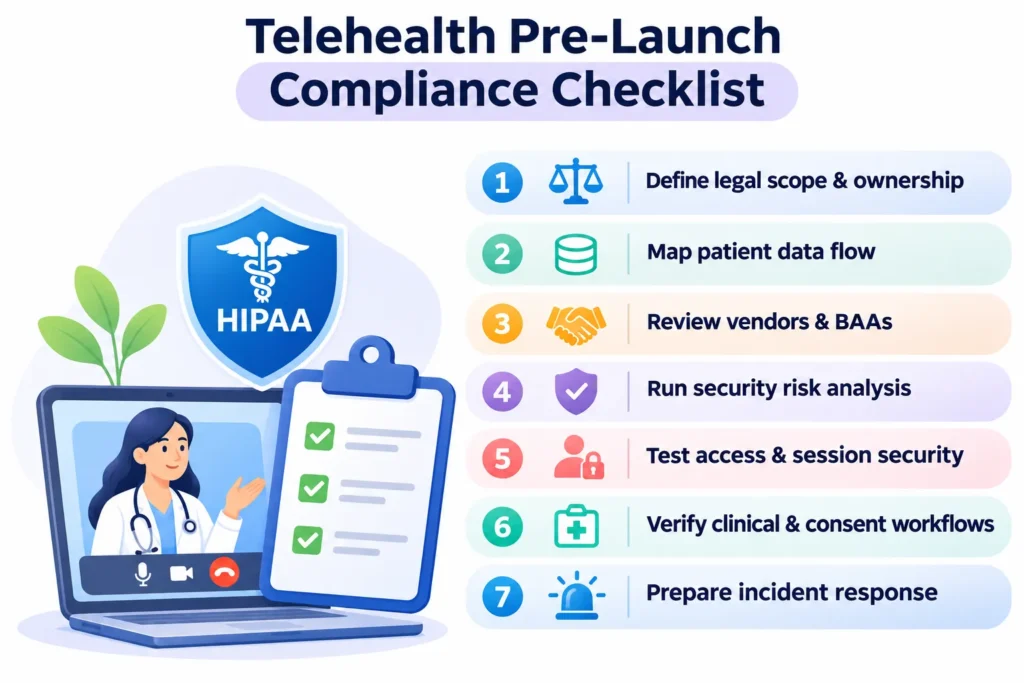
The most useful compliance preparation happens before the application processes real patient information. By that stage, product decisions about vendors, hosting, identity systems, and data storage may be expensive to reverse.
A structured readiness review should address the following workstreams.
1. Establish Legal Scope and Organizational Responsibilities
Determine the operator’s legal role, whether HIPAA applies, which state or national rules affect the service, who the covered entities and business associates are, and which team members own privacy, security, and clinical governance.
2. Map Every Patient Data Flow
Trace information from patient registration through booking, consultation, documentation, payment, support, backup, and deletion. Include indirect destinations such as logging systems, notification vendors, and analytics providers.
3. Review Vendors and Business Associate Agreements
Identify relevant vendors, evaluate their handling of information, confirm contractual obligations, and understand which subcontractors are involved. Review whether the agreed service configuration is the one the product actually uses.
4. Complete the Security Risk Analysis and Remediation Plan
Assess risks to electronic protected health information, document existing controls, prioritize weaknesses, assign corrective actions, and retain evidence of decisions and completed work.
5. Test Authorization, Identity, and Session Security
Validate access controls, administrative privileges, account recovery, video session authorization, expired links, and attempts to access another patient’s information. Test unsuccessful and unauthorized workflows, not only successful user journeys.
6. Validate Clinical and Consent Workflows
Review clinician licensing, patient location, required telehealth consent, prescribing workflows, documentation, and procedures for interrupted consultations or emergencies. Requirements should be checked for the intended geographic market.
7. Prepare Incident Response and Ongoing Operations
Establish alert ownership, breach investigation procedures, vendor escalation, access reviews, staff training, backups, business continuity processes, and policies for updating security documentation after changes.
The output should be a documented launch-readiness decision, including unresolved risks and accountable owners, rather than a generic statement that all compliance requirements have been completed.
Founder Decision Signals: How to Choose the Right Launch Approach
Founders face a practical trade-off between launching quickly and establishing appropriate clinical, operational, and information-security controls. The strongest approach is not necessarily a lengthy custom build, but it is also not the fastest deployment regardless of risk.
Compliance Scope
Have you established the business’s legal role and the markets where the service will operate?
Vendor Risk
Do you know which providers receive patient information and what agreements apply?
Video Security
Have you evaluated the full communication lifecycle, including recordings, logs, and participant access?
Operational Readiness
Can your team manage incidents, clinician eligibility, patient access, and continuous risk review?
A ready-made foundation can be useful when the required booking, patient, provider, and administration workflows are already available and the team wants to concentrate on the specific clinical model.
A more customized approach may be necessary when the service involves specialized care pathways, unusual data relationships, extensive clinical integrations, complex identity systems, or particularly sensitive information.
In either case, founders should require a clear separation between the software delivery scope and the organization’s legal and regulatory readiness responsibilities.
How Miracuves Can Support a Compliance-Aware Telehealth Product Launch
Miracuves helps founders plan and implement digital healthcare products using ready-made and customizable application foundations. Depending on the selected solution, these may include patient-facing experiences, provider workflows, scheduling, video consultations, and administrative controls.
For qualifying ready-made solutions, Miracuves offers a 6-working-day delivery model. This can help reduce the time needed to establish a software foundation, but it does not mean that HIPAA compliance, clinical licensing, vendor approvals, security assessments, and jurisdiction-specific legal requirements can be completed automatically in six days.
The appropriate path is to define the clinical workflow, supported market, information-handling responsibilities, vendor dependencies, and security expectations before finalizing the implementation scope.
This distinction protects founders from confusing a successful software demonstration with a production-ready healthcare operation. The value of a ready-made foundation is reducing avoidable product work while allowing the business to concentrate on the controls and integrations that actually matter for its market.
Final Thoughts: A Successful Telehealth Launch Requires More Than a Working Video App
The most expensive telehealth compliance mistakes often begin as small implementation decisions: a vendor added without reviewing its data access, a consultation link that is insufficiently protected, a recording stored outside the intended environment, or an analytics event that contains patient details.
These issues are easier to manage when founders treat privacy, security, and clinical governance as part of the product foundation rather than a final approval step.
HIPAA applicability must be assessed correctly. Business associate agreements must reflect actual vendor relationships. Video security must cover more than encryption. Access permissions, incident response, patient consent, clinical eligibility, and operational documentation also deserve attention.
For businesses preparing to launch, investing in secure healthcare application infrastructure is most valuable when it is paired with clear legal responsibilities, documented risks, and appropriate operational safeguards.
The objective is not to make compliance sound effortless. It is to identify preventable problems early enough that founders can make better product decisions, protect patient trust, and establish a more dependable foundation for digital care.
Frequently Asked Questions
Does every telehealth app need to comply with HIPAA?
No. HIPAA applicability depends on whether the organization is a covered entity, a business associate, or otherwise operates within a regulated relationship. A consumer health application may be subject to other privacy or health-data laws even when HIPAA does not directly apply. Founders should obtain an applicability assessment before finalizing requirements.
Does an encrypted video call make a telehealth app HIPAA compliant?
No. Encryption protects aspects of communication, but HIPAA obligations may also involve access controls, risk analysis, vendor contracts, storage security, incident response, and privacy policies. Session links, recordings, logs, and other systems must be evaluated separately.
What is a BAA in telehealth?
A business associate agreement is a contract used in applicable HIPAA-regulated relationships to establish permitted uses and disclosures of protected health information and related safeguarding responsibilities. It does not, by itself, certify the security of the complete telehealth application.
Do telehealth apps need a BAA with every third-party vendor?
Not automatically. The need for a BAA depends on the vendor’s role and whether it creates, receives, maintains, or transmits protected health information on behalf of a covered entity or business associate in a qualifying relationship. Each relevant service and subcontractor relationship should be evaluated.
Is end-to-end encryption mandatory for HIPAA telehealth calls?
The current HIPAA Security Rule does not universally require end-to-end encryption for every telehealth video session. Encryption implementation specifications are addressable and must be handled through the rule’s risk-based framework. Appropriate communication security and access safeguards are still required.
Can telehealth apps record patient video consultations?
Recording may be possible when the applicable privacy, consent, clinical, and state-law requirements are satisfied. The organization should establish a legitimate purpose, appropriate access controls, secure storage, retention policies, and vendor responsibilities before enabling recordings.
What happens if a telehealth app experiences a patient data breach?
The organization must investigate the incident, contain exposure, assess the information and entities involved, and determine applicable notification duties. Under HIPAA, covered entities and business associates have different responsibilities, and state or other laws may impose additional requirements.
Can a telehealth app be launched in six days and still require compliance work?
Yes. A ready-made software foundation may be delivered quickly, but regulatory applicability, agreements, clinician licensing, security risk analysis, testing, and operational approvals are separate activities. A six-day software delivery commitment should not be treated as a guarantee of compliance or production authorization.
Miracuves is an independent software development company. We are not affiliated with, connected to, sponsored by, or endorsed by any company or product named in this article.
Terms such as “X Clone” are used descriptively. It is how the software industry refers to building a platform with functionality comparable to a known service, and how clients search for it.
The entire design and codebase of our products is built by our own team. Our products contain no code, design, graphics, or content originating from any third-party website or applications.
All third-party names and marks referenced in this article are the property of their respective owners, referenced solely to identify the services discussed.