Written by the Miracuves Editorial Team. Reviewed by Yash Narayan, SEO Associate, Miracuves.
Key Takeaways
- Price a team, not a hire. At May 2025 US median wages, one person in each of five core AI roles costs about $711,000 a year, or roughly $1.02 million once benefits are added.
- An agency usually wins on start date because it skips a hiring cycle. Building and validating the system takes about as long either way.
- Hiring wins when AI work is continuous and the team stays busy. The break-even point depends on utilization, not on headline rates.
- With any outside team, put a written IP assignment, your own repositories and cloud accounts, and a handover plan in the contract before work starts.
- A hybrid often works best: an internal owner for priorities, architecture and security, with outside engineers delivering defined work.
You have a defined AI project, such as an assistant that answers questions from your own documents or a pipeline that reads incoming invoices, and a budget line for it. The open question is who builds it: engineers you hire, or an outside AI team on contract. This guide puts in-house AI engineers vs an AI agency on the same footing, with US pay data, a worked first-year budget and a delivery timeline, so you can see which route is cheaper and faster for your situation and what the contract must say either way.
Neither route is cheaper by default. A startup shipping its first AI feature faces a different calculation from a company with years of model work ahead. The answer turns on three things: how much AI work you have, how steady it is, and how soon it has to be in production.
A note on perspective: Miracuves, which publishes this guide, sells AI development services. So the sections below say plainly where hiring is the better investment, and every number is either sourced or labeled as an assumption you can replace with your own.
You are pricing a team, not a hire
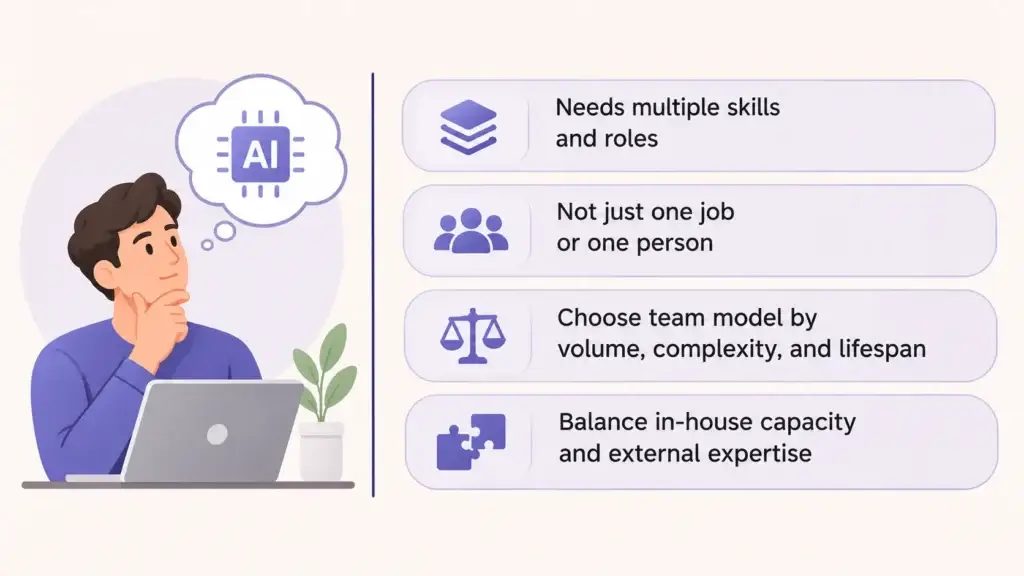
Take the document assistant. The chat window looks simple, but a production version needs reliable access to the source documents, permission checks so people only see what they are allowed to see, good retrieval, a way to measure answer quality, secure deployment, monitoring and a feedback loop from users.
One strong engineer can build a convincing demo of that. Running it reliably draws on data engineering, application development, infrastructure, testing and security review. A machine learning engineer who can tune retrieval may not know how to deploy it safely, and a backend developer who can wire up an API may not know how to evaluate model output.
That is why one salary and one agency quote are rarely comparable. The salary buys one person’s capacity. The quote, if it is a good one, covers a set of skills and a defined outcome. The table shows where the two models differ.
| Decision factor | In-house AI engineers | Specialized AI agency |
|---|---|---|
| Budget structure | Mostly recurring payroll | Project fees, milestones or a retainer |
| Start speed | Depends on hiring time | Sooner, if suitable people are free |
| Skill coverage | Limited to the people you hire | Can span several specialties |
| Day-to-day control | Direct management | Through agreed governance and reporting |
| Knowledge retention | Stays inside, until people leave | Depends on documentation and handover |
| Best suited to | Continuous, proprietary AI work | Defined projects and variable demand |
Duration is the factor that moves the most money. A six-month initiative makes permanent hiring hard to justify; a stable multi-year roadmap can justify a department.
What an in-house AI team costs in the US
Job titles such as “machine learning engineer” or “MLOps engineer” do not map one to one onto government occupation codes, but the closest U.S. Bureau of Labor Statistics categories give a sourced starting point. The figures below are national median annual wages for May 2025 from the BLS Occupational Outlook Handbook.
| Role on an AI team | Closest BLS occupation | Median annual wage (May 2025) |
|---|---|---|
| Machine learning or AI engineer (model work) | Computer and information research scientists | $140,300 |
| Application and backend engineer | Software developers | $135,980 |
| Data scientist (evaluation and analytics) | Data scientists | $120,230 |
| Data engineer or MLOps engineer | Database architects | $139,500 |
| Engineering lead or AI program manager | Computer and information systems managers | $175,140 |
Wages are only part of what an employer pays. In the BLS Employer Costs for Employee Compensation release for June 2026, wages and salaries made up 70.0% of total compensation for private-industry workers and benefits the other 30.0%. That gives a simple loading rule: divide a salary by 0.70 to approximate wages plus benefits, before recruiting fees, equipment and tools.
Applied to the table, one person in each of the five roles adds up to $711,150 in median wages, or roughly $1.02 million a year with benefits. Few first projects need all five roles full time, and senior AI specialists in competitive markets are often paid well above the median, so treat this as an order-of-magnitude check rather than a budget.
The costs that sit on top of salary
- Recruiting. Screening for AI roles means testing how candidates handle model behavior, data quality and deployment limits, not just general coding. Practical assignments, interview panels and recruiter fees all land before the hire writes a line of code, and your senior engineers lose time to interviewing.
- Tools and infrastructure. Cloud environments, storage, GPU time, hosted model APIs, experiment tracking, observability and security tooling. Many systems start on existing hosted models rather than custom training, so heavy compute is not a given, but someone has to estimate it for your workload. Both routes pay this line.
- Onboarding and management. New hires need repository access, documentation, domain knowledge, security policies and time with existing engineers before they own a feature.
- Turnover. When a specialist leaves, you lose capacity and the reasoning behind architectural decisions. Code review, shared documentation and cross-training reduce that loss; they do not remove it.
- Idle capacity. Payroll continues after the first project ships. If no follow-up work is ready, the commitment does not shrink with it.
To calculate a project-specific cost, allocate shared expenses and engineering capacity consistently, rather than charging the entire organization’s infrastructure to one project.
What an agency engagement really costs
An outside team replaces payroll with a commercial agreement. The common forms are a fixed scope, milestone payments, dedicated capacity billed monthly, or a support retainer after launch. They split risk differently: a fixed scope moves estimating risk to the vendor but makes every change request a negotiation, while time-and-materials keeps you flexible and leaves overruns with you.
The quote is not the full cost of running the system. Budget separately for:
- cloud hosting, model API usage and other third-party fees;
- data preparation the vendor assumed would already be done;
- change requests, which grow fast when acceptance criteria are vague;
- your own oversight: someone still writes requirements, supplies data, reviews demos, makes security decisions and signs off on deliveries;
- knowledge transfer and post-launch support.
Check who is actually assigned. A proposal that describes a multidisciplinary company does not mean those specialists are on your project or inside the quoted scope. Ask for named roles and the share of their time.
Onshore, nearshore and offshore partners
Agency rates track local wage levels, so the same scope can be quoted very differently depending on where the team sits. A lower hourly rate does not automatically produce a lower project cost, because coordination, rework and time-zone delays are paid for by your own staff. Compare options on cost per accepted milestone rather than on hourly rate.
| Partner location | Relative rate level | What usually improves | What to check before signing |
|---|---|---|---|
| Onshore (same country) | Highest | Shared working hours, easier legal recourse, simpler data-residency answers | Whether the senior people in the proposal are the ones assigned |
| Nearshore (similar time zone) | Middle | Several overlapping working hours a day at a lower rate | Language fit, contract law, and how data leaves your environment |
| Offshore (distant time zone) | Lowest | Largest rate savings and progress around the clock if handoffs are planned | Daily overlap window, documentation discipline, security controls and IP assignment |
For regulated data, location can matter more than price. Confirm where data will be processed, who can access it and which laws apply before you compare quotes.
A worked first-year budget
Consider a hypothetical company adding document processing and information retrieval to an existing platform. The first build needs specialist AI skills, but the company does not yet know whether it will need a permanent AI team.
This is a budgeting exercise, not a market-rate quotation, a salary survey or a Miracuves service price. All figures are assumed values in USD, chosen to show how the calculation works. Replace them with pay data for your market, plus benefits, employer taxes and recruiter fees.
| Assumed annual expense | Internal team | External partner |
|---|---|---|
| Engineering compensation / contracted delivery | $180,000 | $95,000 |
| Recruitment and onboarding | $20,000 | $5,000 |
| Management and coordination allocation | $25,000 | $15,000 |
| Cloud, model usage and tools | $18,000 | $18,000 |
| Maintenance / contingency allowance | $12,000 | $22,000 |
| Illustrative 12-month total | $255,000 | $155,000 |
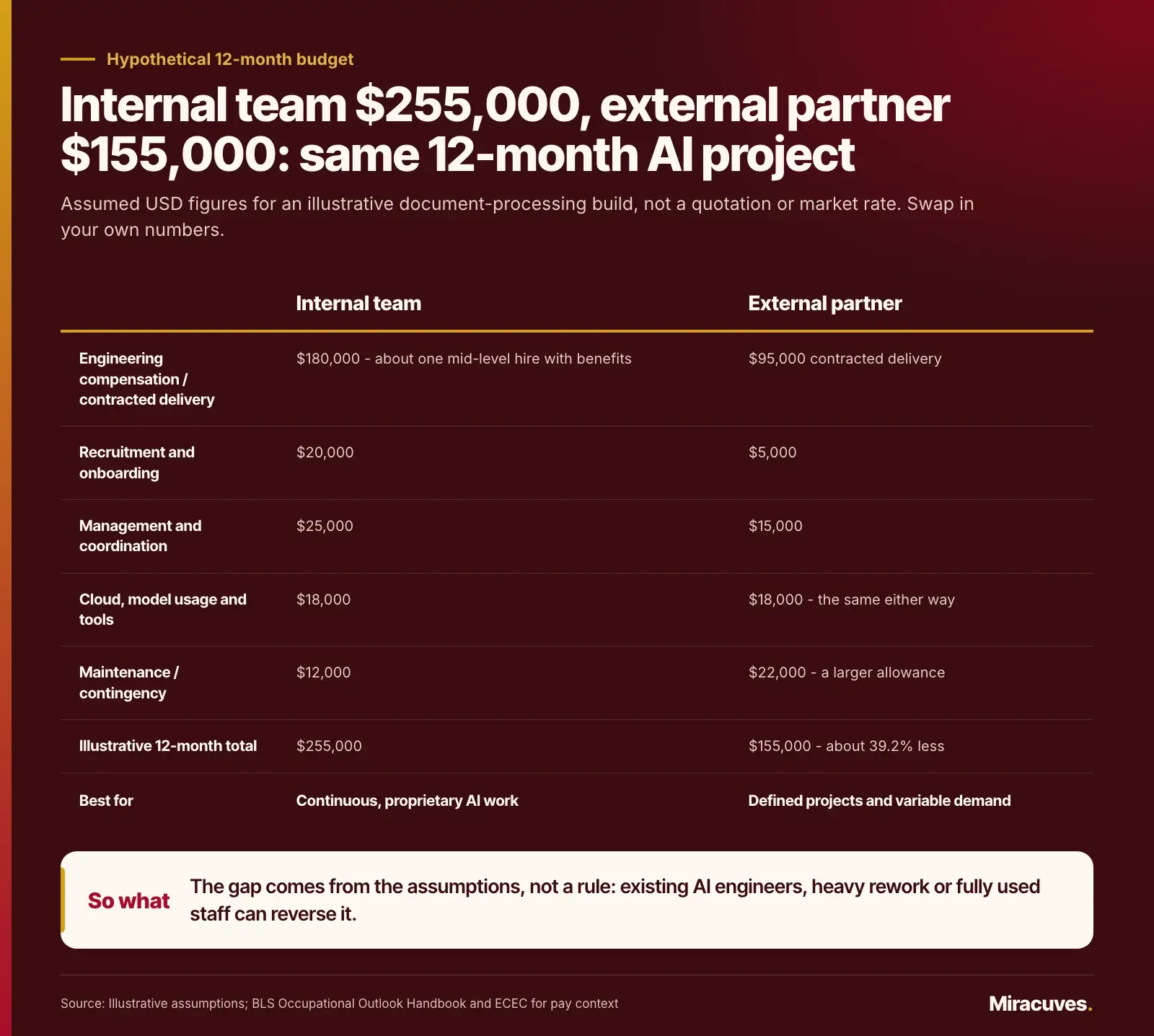
Under these assumptions the external route costs $100,000 less in year one, about 39.2% of the internal total. That follows from the chosen staffing level and scope; it is not a general savings claim.
Read the internal column against the pay data above. The $180,000 compensation line is deliberately small: at the BLS median, one computer and information research scientist costs about $200,000 a year once the 30% benefits share is included. The line therefore stands for a single mid-level hire, or a small team in a lower-cost market. A U.S. team covering three or four of the roles in the earlier table would cost several times more, which would widen the gap rather than close it.
The result reverses if the company already employs experienced AI engineers, if the outside work needs heavy rework, or if steady demand keeps permanent staff fully used. The rule that holds in every case: compare the two routes over the same period, the same scope and the same level of technical responsibility. A salary, an hourly rate and a project quote are not comparable until you adjust for what each includes.
How long until the first release?
Measure speed from budget approval to a secure, tested system people can use, not from the day someone starts coding.
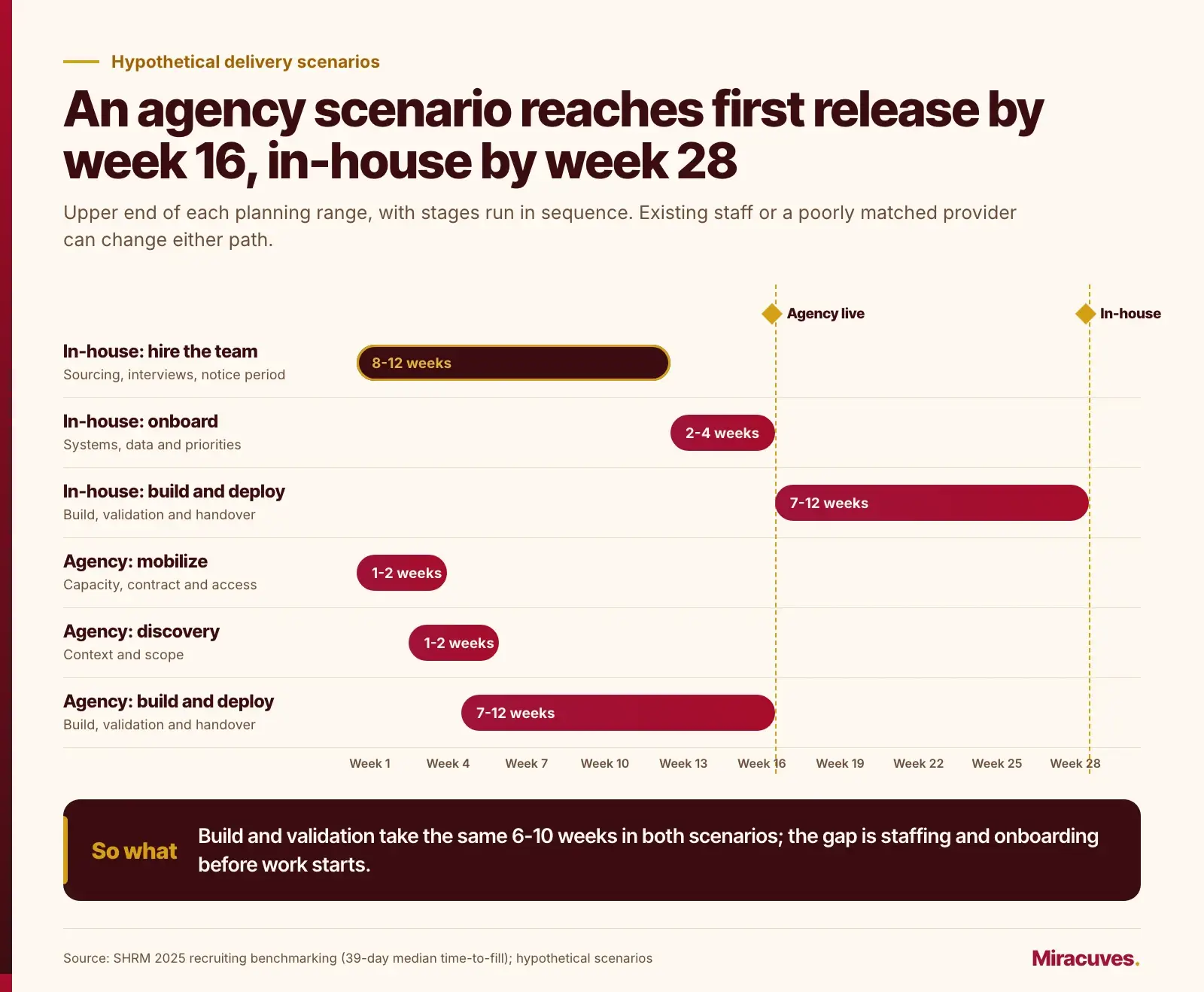
Hiring sets the floor. SHRM recruiting benchmarking data for 2026 puts the median time-to-fill for nonexecutive positions at 39 calendar days, counted from the day a requisition opens to the day a candidate accepts the offer. Add the new hire’s notice period and onboarding, and allow longer for senior or specialized AI positions; that is why the internal scenario below assumes 8 to 12 weeks for staffing alone.
An agency can start sooner only if the right people are free, and contracting, access approval and security review still take one to several weeks. Both routes then need context: a new employee has to learn your systems, data sources and priorities, and an outside team has to learn your business. The agency’s advantage is reusable practice from similar builds, not instant knowledge of your company.
During the build, a coordinated team can run independent work in parallel: one person prepares the retrieval pipeline while another builds the interface and a third sets up deployment environments. Adding people only helps when the work genuinely splits, and changing requirements or missing business data slow either route. Production readiness means the system handles realistic load, recovers from failures, respects data permissions and is monitored after release.
| Project stage | Internal hiring scenario | Agency scenario |
|---|---|---|
| Staffing / mobilization | 8-12 weeks | 1-2 weeks |
| Onboarding / discovery | 2-4 weeks | 1-2 weeks |
| Build and validation | 6-10 weeks | 6-10 weeks |
| Deployment / handover | 1-2 weeks | 1-2 weeks |
| Total planning window | 17-28 weeks | 9-16 weeks |
These are hypothetical planning scenarios, not delivery promises. They assume stages run in sequence on comparable scope. Existing staff can remove the hiring delay entirely, and a poorly matched provider can take longer than shown. The chart below draws the upper end of each range and merges build, validation and handover into one 7-12 week bar.
Putting a number on waiting
Budgets usually count invoices and salaries and leave out the cost of the months before anything ships. If a team reviews thousands of documents by hand each month, every month of delay means more manual work. That is an opportunity cost, not a guaranteed loss, and it depends on real volume and on how well the automation performs.
This is a hypothetical planning calculation. Actual benefit should be adjusted for adoption rates, gradual rollout, error handling, and the time required to reach stable performance.
Use this as a sensitivity test, not a line item: how much does the decision change if the release lands one, three or six months later than planned?
Where the break-even sits
The economics shift as the volume of AI work grows. A company that needs specialists for a few months a year is usually better off buying capacity. A company with steady work eventually reaches a point where its own team is cheaper. A utilization comparison shows roughly where.
Use equivalent work complexity, quality standards, management responsibilities, and delivery outcomes when making the comparison.
Suppose a hypothetical internal team costs $240,000 a year and delivers 3,000 productive engineering hours: $80 per productive hour. If comparable outside capacity costs an assumed $100 per productive hour, the same $240,000 buys 2,400 hours. Once you need more than about 2,400 hours a year of this kind of work, and can keep the internal team busy, hiring is cheaper per hour. That is a rough threshold, not a full break-even analysis, because an internal team’s capacity is finite and the work is never perfectly uniform.
The point is to make utilization visible. Hiring gets expensive when engineers sit underused; contracting gets expensive when you buy the same skills continuously for years.
Signs that hiring is the better investment
- AI is the product’s edge. If you compete on proprietary models, recommendation quality or constant experimentation, the knowledge your engineers build about past decisions and model limits is hard to rent.
- Demand is steady. Regular model updates, new datasets, integrations and release cycles keep a team fully used. One big build followed by occasional maintenance does not.
- The work depends on deep internal context. Legacy systems, sensitive data and complex approval chains favor people who sit next to the system owners. Outside teams can work here, but the cost of transferring context and setting up access is real.
- You can lead an AI team. Someone has to set technical direction, priorities, security rules and evaluation standards. Companies that already have that structure get far more from direct hires.
Signs that an agency is the better fit
- A clear first project and no AI team. A scoped engagement lets you see results before committing to permanent headcount.
- Specialist skills for a limited phase. Initial architecture, migration, deployment or performance work often needs skills you will not use full time afterward.
- A fixed date. A customer commitment or launch window may not leave room for several hiring cycles, provided the vendor’s availability and fit are checked first.
- The investment is still unproven. A defined engagement caps the commitment while you find out whether the results justify more spending.
The hybrid option
You do not have to pick one side. One workable setup keeps an internal engineering lead who owns requirements, architecture approval, security decisions and priorities, while an outside team delivers a defined build. As the product matures, responsibilities move inside, and the outside team stays for major upgrades or temporary peaks.
| Responsibility | Internal team | External team |
|---|---|---|
| Business priorities | Owns roadmap and success criteria | Gives feasibility input |
| Architecture | Approves long-term direction | Designs and builds agreed components |
| Implementation | Reviews and integrates | Delivers assigned engineering work |
| Security and access | Controls policies and approvals | Works within approved permissions |
| Monitoring and support | Owns operating decisions | Handles agreed incidents and improvements |
| Knowledge transfer | Receives and maintains documentation | Documents systems and trains named owners |
A hybrid only works when ownership is explicit. If every decision needs sign-off from both sides, or nobody owns production incidents, combining teams adds delay instead of removing it.
Contract terms that decide whether you can leave
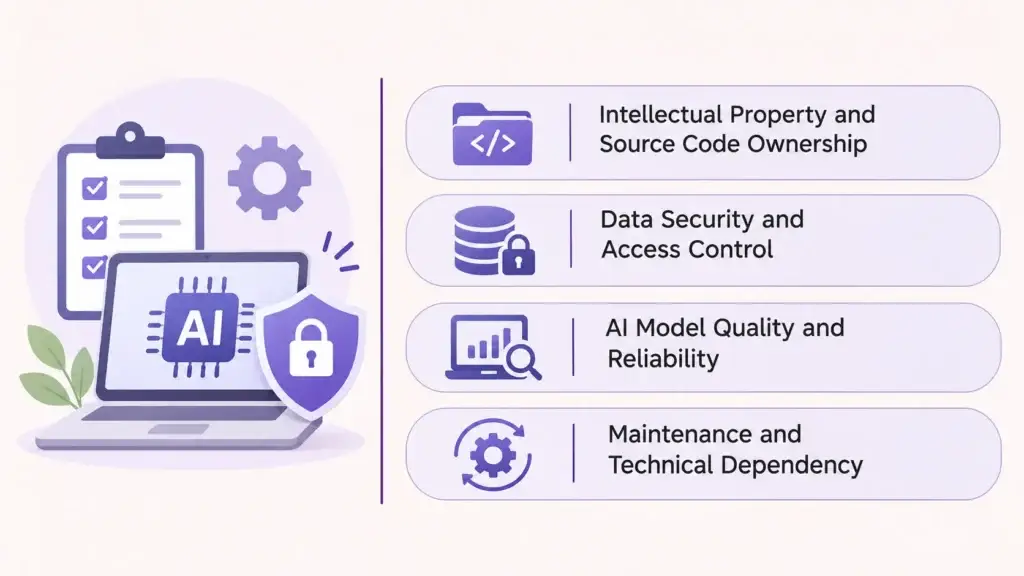
A low quote or a fast kickoff means little if you cannot control, maintain or move the system afterward. Four areas need settling before work starts. This is general information, not legal advice; have counsel review the actual contract.
Intellectual property and source code
Under U.S. copyright law, code an employee writes within the scope of the job is a “work made for hire” owned by the employer. Commissioned work from an outside firm is different. The U.S. Copyright Office’s Circular 30 explains that a commissioned work counts as made for hire only if it falls into one of nine listed categories, such as a contribution to a collective work or a compilation, and both parties sign a written agreement saying so. Software is not on that list, so a “work for hire” clause alone may not transfer ownership of custom code. Software contracts therefore add an explicit written assignment of copyright and other IP.
Also list what the vendor brings in: pre-existing frameworks it keeps and licenses to you, open-source components, model licenses and third-party APIs. Some of these carry terms that no ownership clause can override.
Data security and access
AI systems often touch customer records, internal documents or financial data. Either team needs permission-based access, secure handling of credentials, encrypted transfer, logging and clear retention rules. With an outside provider, also agree on hosting environments, subcontractor access, incident response and the return or deletion of data at the end.
If GDPR applies to the personal data the system processes, GDPR Article 28 requires a contract or other binding legal act with the processor. It must cover documented instructions, confidentiality, security measures, prior authorization of sub-processors, audits, and deletion or return of the data when the service ends.
Model quality and acceptance
A convincing demo proves little. Write acceptance criteria into the contract: a representative evaluation set drawn from your own data, accuracy thresholds per task, expected behavior on bad or missing input, and for generative systems, checks on unsupported answers, retrieval quality, tool actions and when the system hands off to a person. Milestones should be paid against those tests, not against a walkthrough.
Maintenance and the exit
Models, data and third-party services change, so someone must monitor errors, investigate quality drift, update dependencies and respond to incidents. Agree who that is before launch. Keep repositories, cloud accounts and API keys in your company’s name from day one, and plan the exit before the work starts. Our AI codebase handoff checklist lists what to receive, from repository access to deployment runbooks, so an internal team or another provider can take over without starting again.
Seven questions to answer before you choose
- How many months of AI work are already funded? A short build and a multi-year roadmap justify different structures.
- Which skills are actually missing? Separate application, data, model and infrastructure work instead of treating everything as one AI role.
- When must it be in production? Count hiring, onboarding, data access, evaluation and deployment, not just coding time.
- Who owns the system after release? Name the owner for monitoring, security, incidents, updates and new requests.
- How sensitive is the data? Settle contractual and technical controls before anyone gets access.
- How much management time do you have? Employees and vendors both need direction and decisions.
- Can the model change as the product grows? Check that the arrangement allows knowledge transfer, later hiring or a smaller outside role.
Speed
When hiring delays threaten a defined business opportunity, examine external capacity with confirmed availability.Budget
When fixed payroll commitments would exceed predictable engineering demand, evaluate project-based or flexible arrangements.Ownership
When proprietary AI systems require continuous research and improvement, develop stronger internal technical ownership.Scalability
When demand fluctuates, consider a hybrid structure that can add expertise without permanently expanding payroll.Three mistakes cost the most. The first is comparing one engineer’s salary with a full delivery team’s quote. The second is picking the lowest proposal without checking whether it leaves out evaluation, testing, infrastructure setup, documentation or production support. The third is quieter: hiring before the problem is defined, then finding that the real bottleneck was data quality or workflow integration, not modeling.
Where Miracuves fits
We are one of the outside options this guide describes, so here is what we would actually do for a reader in this position. For a defined first project, our AI development team scopes the first release with you, builds it against agreed acceptance tests, and hands over code, documentation and runbooks in your own accounts, so you can take it in-house later. If you already have application engineers and only lack AI skills, the hybrid route fits better: dedicated AI developers join your team under your lead, and the knowledge stays with you.
For some use cases, a ready-made AI product from Miracuves can replace much of the first build. Eligible ready-made solutions can be delivered in 6 working days; custom AI work is scoped separately based on integrations, data readiness and complexity. If your roadmap shows years of continuous proprietary model work, the break-even math above probably points to hiring, and that is the honest answer.
Frequently Asked Questions
Is it cheaper to hire in-house AI engineers or work with an AI agency?
It depends on how much AI work you have and how steady it is. An agency is often cheaper for a defined first project or intermittent work, because you avoid recruiting and carrying a full team. An in-house team usually wins when engineering demand is continuous for several years and every engineer stays fully used. Compare both over the same period and scope.
How much does an AI engineer cost per year in the US?
The closest BLS occupation, computer and information research scientists, had a median annual wage of $140,300 in May 2025. Benefits made up 30% of private-industry compensation in June 2026, so a median hire costs the employer roughly $200,000 a year before recruiting, equipment and tools. Senior specialists in competitive markets are often paid well above the median.
How long does it take to hire an AI engineering team?
SHRM’s 2026 benchmarking puts the median time-to-fill for nonexecutive roles at 39 calendar days, from opening the requisition to an accepted offer, and specialized AI roles can take longer. Add notice periods and onboarding, so plan on two to three months before a newly hired team is productive. Companies that already employ qualified engineers can start much sooner.
Is an offshore AI agency cheaper than an in-house team?
Offshore hourly rates are usually lower because they follow local wage levels, but the total depends on coordination, rework, time-zone overlap and how much of your own staff time the engagement consumes. For regulated or sensitive data, check where it will be processed and who can access it. Compare cost per accepted milestone, not hourly rates.
Who owns the code when an agency builds my AI product?
Not automatically you. Under US copyright law, commissioned work counts as work made for hire only in nine listed categories with a signed written agreement, and software is not one of them. Contracts therefore include an explicit written assignment of copyright and other IP, plus a list of pre-existing components the vendor licenses to you. Have counsel review the terms.
How do I avoid becoming dependent on an AI agency?
Keep repositories, cloud accounts and API keys in your company’s name from the start, and put IP assignment, architecture documentation, deployment runbooks and knowledge-transfer milestones in the contract. Define post-launch support and an exit process before work begins, so an internal team or another provider can take over without rebuilding the system.
Miracuves is an independent software development company. We are not affiliated with, connected to, sponsored by, or endorsed by any company or product named in this article.
Terms such as “X Clone” are used descriptively. It is how the software industry refers to building a platform with functionality comparable to a known service, and how clients search for it.
The entire design and codebase of our products is built by our own team. Our products contain no code, design, graphics, or content originating from any third-party website or applications.
All third-party names and marks referenced in this article are the property of their respective owners, referenced solely to identify the services discussed.