Key Takeaways
- A visual social app needs a focused marketing strategy to attract users, creators, brands, and early communities.
- Growth depends on clear positioning, creator onboarding, referral loops, niche content, and daily engagement campaigns.
- Influencer partnerships, short-video campaigns, app store optimization, SEO, and paid ads can support early traction.
- Creator tools, rewards, challenges, and community features help improve retention after the first app install.
- A focused visual social platform can grow faster when marketing targets a clear audience instead of broad social networking users.
Marketing Signals
- Users need simple onboarding, content discovery, invite rewards, trending challenges, personalized feeds, and active notifications.
- Creators need launch incentives, audience growth tools, analytics, monetization options, profile visibility, and collaboration opportunities.
- Brands need campaign tools, sponsored content options, creator discovery, audience targeting, and performance reports.
- Admins need control over campaigns, referrals, creators, ads, push notifications, analytics, moderation, and user activity.
- Marketing automation helps recover inactive users, promote trending content, announce creator campaigns, and improve repeat sessions.
Real Insights
- A visual social app grows better when it starts with a niche audience and clear creator value instead of generic posting.
- Paid ads may bring installs, but weak onboarding and empty feeds can quickly reduce retention.
- Creator partnerships, referral campaigns, and daily engagement prompts can build stronger early network effects.
- Founders should track installs, activation rate, first post rate, creator retention, referral invites, and repeat usage.
- Miracuves builds visual social apps with growth-ready features, creator tools, referral workflows, ads, analytics, moderation, and admin control.
A new visual social app does not fail only because the technology is weak. Many fail because the first user opens the app and sees nothing worth following.
That is the cold-start problem.
A social platform needs people, content, activity, trust, and repeated participation before it can feel alive. Paid ads may bring installs, but if the feed feels empty, users leave quickly. Creator seeding solves this by building content supply before the public launch.
For founders planning a visual social platform, creator seeding is not just a marketing tactic. It is the bridge between product readiness and real community traction. This guide explains how to recruit early creators, prepare content before launch, design stronger creator incentives, and measure whether your app is ready for wider acquisition.
What Creator Seeding Means for Visual Social App Growth
Creator seeding means inviting a selected group of creators to join, publish, test, and shape the platform before it is opened to a wider audience.
For a visual social app, this can include:
- Photographers posting early portfolio content
- Fitness creators sharing transformation updates
- Fashion creators uploading styling reels or lookbooks
- Local food creators posting restaurant discoveries
- Artists sharing behind-the-scenes work
- Coaches or educators publishing short visual lessons
- Community influencers starting niche challenges
The goal is not to fill the app with random posts. The goal is to create enough relevant content that the first real users immediately understand the platform’s value.
A founder should think of creator seeding as product-led marketing. The content itself becomes the first marketing asset. If the feed looks active, niche-focused, and useful, users are more likely to follow, save, comment, share, and return.
Why a New Social App Needs Content Supply Before User Acquisition
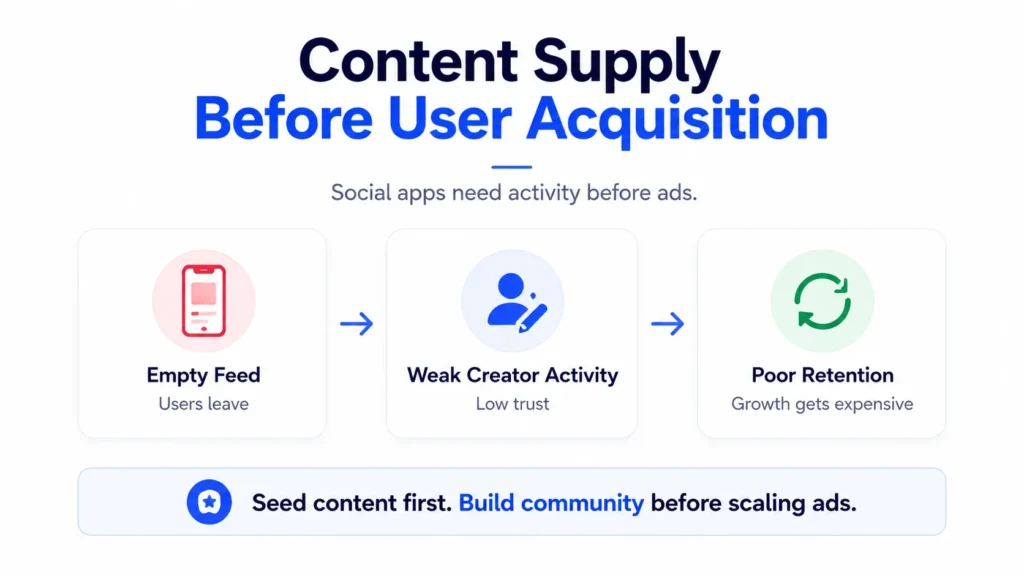
Most app marketing plans focus on downloads. Social apps need a different sequence.
A utility app can grow if users complete a task. A taxi app helps someone book a ride. A delivery app helps someone order food. But a visual social app depends on participation. Users come for content and stay for people.
If your app launches without content supply, three problems appear quickly:
| Cold-Start Problem | What Users Feel | Business Impact |
|---|---|---|
| Empty feed | “There is nothing to see here.” | Low activation and fast churn |
| Weak creator activity | “Nobody is posting regularly.” | Poor content freshness |
| No social proof | “This platform is not active yet.” | Lower trust and fewer referrals |
| Generic positioning | “Why should I use this instead of existing apps?” | Weak differentiation |
| Poor retention loop | “I have no reason to come back.” | Paid acquisition becomes expensive |
Creator seeding gives the platform a stronger first impression. It helps the app feel alive before scaling acquisition campaigns.
Start With a Niche Before Recruiting Creators
The strongest creator seeding plans begin with a narrow audience.
A broad visual platform for “everyone” is difficult to explain. A focused platform for a specific creator community is easier to position, seed, moderate, and grow.
For example, a founder could start with:
- Streetwear creators in one city
- Fitness transformation creators
- Wedding photographers and bridal stylists
- Independent food reviewers
- Regional language content creators
- Interior designers and home decor creators
- Student creators around campus life
- Local travel creators
- Artists selling visual work
- Micro-influencers in a specific lifestyle category
A niche does three things. It gives creators a reason to join, gives users a reason to browse, and gives the founding team a clearer content standard.
The question is not “How do we attract everyone?” The better question is “Which creator community can we serve better than a generic platform?”
Read more: How to Solve the Empty-Feed Problem Before Launching a Visual Social App
Build an Early Creator List Before Launch
Once the niche is clear, founders should build a creator list before public launch.
This list should not be based only on follower count. Early-stage platforms need creators who are active, consistent, approachable, and aligned with the niche. A creator with a smaller but loyal audience can be more useful than a large influencer who posts once and disappears.
What to Look for in Early Creators
Good early creators usually have:
- A clear content style
- Consistent posting habits
- Strong comments from their audience
- Niche relevance
- Willingness to test new tools
- Interest in community building
- Openness to feedback
- Professional or semi-professional content quality
Avoid choosing creators only because they are famous. Big names may help with visibility, but early product learning often comes from creators who are willing to test, post, report friction, and help shape the first community experience.
Give Creators a Reason to Post Before Everyone Else Joins
Creators are not just users. They are supply partners.
If you want them to post before the app has a large audience, they need a clear reason. That reason can be practical, emotional, financial, or community-driven.
| Creator Incentive | Why It Works | Founder Benefit |
|---|---|---|
| Early verified badge | Gives creators status and recognition | Builds trust signals inside the app |
| Featured creator placement | Helps creators get visibility | Improves feed quality and discovery |
| Founder access | Makes creators feel heard | Creates feedback loops before scale |
| Category ownership | Lets creators become early leaders in a niche | Builds community identity |
| Launch challenge participation | Gives creators a content format | Creates repeat posting |
| Analytics access | Helps creators understand performance | Encourages ongoing use |
| Monetization path | Shows long-term earning potential | Improves creator retention |
The best incentive is not always cash. Many early creators care about visibility, recognition, creative control, audience growth, and being part of something early.
Design First-Week Content Prompts and Launch Rituals
Creators often want to participate but need direction. A good seeding plan gives them simple content prompts.
Instead of saying “post anything,” create formats that are easy to repeat.
Examples:
- “Introduce your niche in 30 seconds”
- “Show your setup”
- “Post your best before-and-after”
- “Share one mistake beginners make”
- “Create a mini tutorial”
- “Start a 7-day challenge”
- “React to another creator’s post”
- “Share your local recommendation”
- “Post your weekly progress”
- “Invite your audience to vote”
These prompts reduce friction. They also make the feed feel organized instead of random.
A launch ritual can work even better. For example, the first 50 creators could join a “Founding Creator Week,” where each creator posts one introduction, one tutorial, one story, and one community challenge. This gives the platform a structured content base before the wider launch.
Prepare the Product Surfaces That Make Creator Seeding Work
Creator seeding is not only a marketing operation. The product must support it.
A founder can recruit creators, but if the upload flow is confusing, profiles look weak, notifications are irrelevant, or moderation is missing, creator energy will drop quickly.
Before public launch, the app should have the core surfaces needed for creator activity:
Product Surfaces That Support Creator Seeding
| Product Surface | Business Value | Founder Impact |
|---|---|---|
| Creator profiles | Gives creators identity, credibility, and a reason to build presence | Improves creator retention and profile sharing |
| Simple upload flow | Reduces friction for photos, videos, captions, and tags | Increases posting frequency |
| Category and hashtag discovery | Helps users find relevant niche content faster | Improves activation and content browsing |
| Follow, save, comment, and share actions | Creates engagement signals around seeded content | Helps identify what content attracts users |
| Creator analytics | Shows creators what is working | Encourages repeat publishing |
| Moderation and report workflows | Protects trust and content quality | Reduces platform risk as activity grows |
| Admin dashboard | Gives the platform operator control over users, content, reports, and campaigns | Improves operational speed after launch |
For founders moving from strategy to execution, visual social platform foundation can help reduce the time spent building basic social workflows from zero. The stronger decision is not to copy another platform blindly, but to start with a product base that can support your own creator niche, brand identity, monetization plan, and community rules.
Use a Three-Stage Creator Seeding Workflow
A practical creator seeding plan should be built in stages.
Stage 1: Pre-Launch Creator Recruitment
Before the app is public, identify and invite a small group of creators who match the niche.
The goal is to validate interest. You want to know whether creators understand the app’s positioning, whether they see value in joining early, and what would make them post repeatedly.
Useful actions:
- Build a list of 50 to 150 niche creators
- Segment them by category, audience size, and content quality
- Send personalized invitations
- Offer early access
- Explain the platform’s niche clearly
- Ask what creator tools they want
- Invite them to a private onboarding group
Stage 2: Private Content Seeding
Once creators accept, give them structured posting prompts and early access.
The goal is to fill the feed with useful, niche-relevant content before public users arrive.
Useful actions:
- Share posting prompts
- Create first-week content themes
- Feature early creators on the app
- Test upload and profile flows
- Review content quality
- Fix friction before public launch
- Collect creator feedback
Stage 3: Public Launch Activation
After the app has enough content supply, launch to users through community outreach, referral loops, creator announcements, social campaigns, and selective paid acquisition.
The goal is not only installs. The goal is activated users who follow creators, save content, comment, share, and return.
Useful actions:
- Ask creators to announce their profiles
- Launch a niche challenge
- Use referral incentives
- Promote high-quality creator content
- Retarget warm waitlist users
- Track activation and retention metrics
- Improve onboarding based on behavior
Measure Creator Seeding With the Right Metrics
Vanity metrics can mislead founders. A launch may get impressions but still fail if creators do not return or users do not engage.
Track metrics that show supply, quality, and retention.
| Metric | What It Tells You | Why It Matters |
|---|---|---|
| Activated creators | How many invited creators actually post | Shows whether the creator offer is strong |
| Posts per creator | Whether creators publish once or repeatedly | Measures content supply consistency |
| Content diversity | Whether the feed has enough variety | Helps avoid repetitive or thin content |
| Profile completion rate | Whether creators take identity seriously | Improves trust and discovery |
| Viewer follow rate | Whether users find creators worth following | Measures feed relevance |
| Save and share rate | Whether content is useful or interesting | Signals content quality |
| Day 7 creator return | Whether creators come back after first post | Shows creator retention |
| Report or moderation rate | Whether content quality is manageable | Protects platform trust |
A founder should not scale paid acquisition until these signals are improving. Otherwise, the business may pay to bring users into a weak experience.
Founder Decision Signals Before Scaling Acquisition
Content Supply
If the first feed does not feel active, acquisition spend will work harder than it should. Seed enough relevant posts before inviting a broad audience.
Creator Retention
If creators post once and disappear, the incentive system is weak. Improve visibility, analytics, feedback, and monetization logic before scaling.
Trust and Safety
If moderation, reporting, and admin controls are not ready, growth can create operational risk. Safety should be part of the foundation, not a later patch.
Market Fit
If users follow, save, comment, and return, your niche is showing traction. That is a better signal than installs alone.
Make Safety Part of Creator-Led Growth
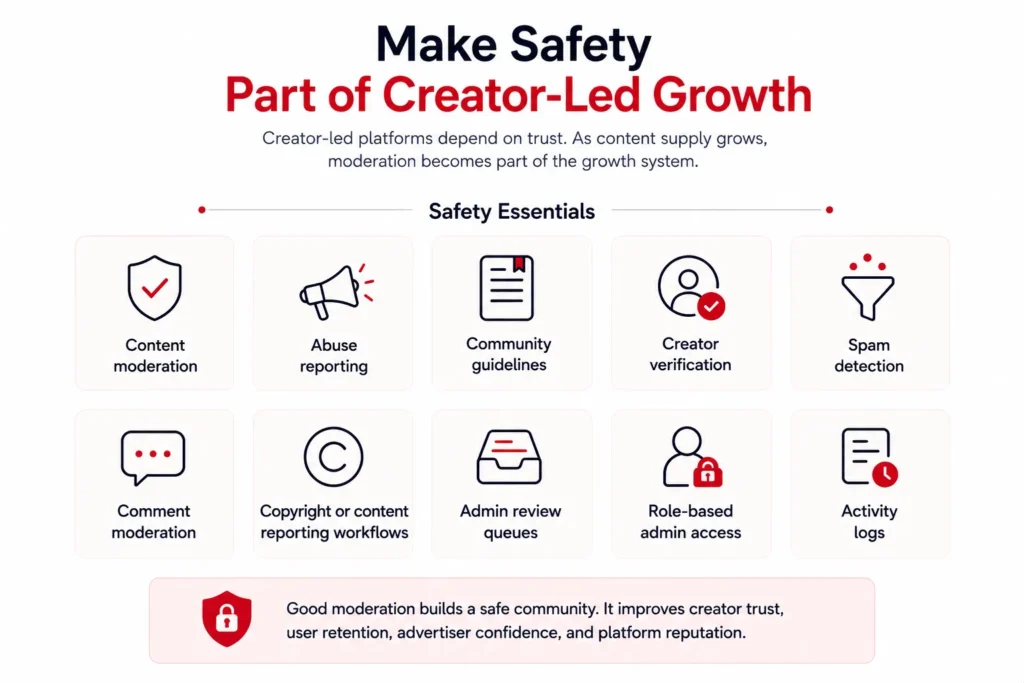
Creator-led platforms depend on trust. As content supply grows, moderation becomes part of the growth system.
A visual social app should support:
- Content moderation
- Abuse reporting
- Community guidelines
- Creator verification
- Spam detection
- Comment moderation
- Copyright or content reporting workflows
- Admin review queues
- Role-based admin access
- Activity logs
This matters because poor moderation can weaken creator trust, user retention, advertiser confidence, and platform reputation. A safer community gives creators more confidence to post and gives users more confidence to participate.
Common Creator Seeding Mistakes Founders Should Avoid
Mistakes Founders Should Avoid
Recruiting creators only by follower count
Large audiences do not always create strong early communities. For launch-stage platforms, niche relevance and posting consistency often matter more.
Launching paid ads before the feed is ready
Paid acquisition can increase installs, but if users arrive to an empty or confusing experience, the spend turns into churn.
Giving creators no reason to return
Creators need visibility, feedback, analytics, recognition, and a possible monetization path. Without those signals, posting becomes a one-time favor.
Ignoring admin and moderation workflows
Creator growth increases operational complexity. Founders need control over users, content, reports, campaigns, and platform rules from the beginning.
How Miracuves Helps Founders Turn Creator Seeding Into a Launch-Ready Product
A creator seeding strategy works better when the product foundation is ready to support creator activity.
Miracuves helps founders build ready-made and white-label app solutions with source-code ownership, branded design, admin control, creator workflows, monetization-ready modules, and faster deployment. For a visual social app, that means founders can focus more energy on niche positioning, creator recruitment, launch campaigns, and retention instead of rebuilding every basic social workflow from zero.
Founders can also explore social media app development services if the product requires deeper customisation, special workflows, or a broader platform roadmap.
Final Thoughts: Fill the Feed Before You Fill the Funnel
A visual social app needs more than downloads. It needs a reason for users to explore, follow, post, save, comment, and return.
Creator seeding helps founders create that reason before public launch. It turns the first feed into a proof point. It gives early users something to discover. It gives creators a reason to participate. Most importantly, it helps the founder test whether the platform’s niche has real energy before scaling acquisition spend.
The smarter launch path is not to market an empty app aggressively. It is to build content supply first, test creator participation, strengthen the product experience, and then scale with better confidence.
FAQs
What is a creator seeding strategy for a social app?
A creator seeding strategy is a pre-launch growth plan where selected creators are invited to publish content, test the app, and help shape the first community experience before public users arrive.
Why does a new visual social app need creator seeding?
A visual social app needs creator seeding because users expect content immediately. If the first feed feels empty, users may leave quickly. Seeded creator content helps the app feel active from day one.
How many creators should founders onboard before launch?
There is no fixed number. A focused app can start with a small group of highly relevant creators. The stronger signal is not the number invited, but how many publish repeatedly and attract early engagement.
What type of creators should be invited first?
Founders should prioritize creators with niche relevance, consistent posting habits, strong audience trust, and willingness to test a new platform. Smaller creators can be more useful than large influencers during early validation.
Should creators be paid during the seeding phase?
Some creators may require payment, but not every incentive needs to be cash-based. Early visibility, verified status, featured placement, analytics, founder access, and future monetization opportunities can also motivate participation.
How do founders measure whether creator seeding is working?
Track activated creators, posts per creator, content diversity, viewer follow rate, save rate, share rate, Day 7 creator return, and user retention. These metrics show whether the app is building real participation.
When should paid acquisition begin?
Paid acquisition should begin after the app has enough content supply, clear onboarding, working engagement loops, and early retention signals. Otherwise, paid traffic may increase installs without building long-term users.
Miracuves is an independent software development company. We are not affiliated with, connected to, sponsored by, or endorsed by any company or product named in this article.
Terms such as “X Clone” are used descriptively. It is how the software industry refers to building a platform with functionality comparable to a known service, and how clients search for it.
The entire design and codebase of our products is built by our own team. Our products contain no code, design, graphics, or content originating from any third-party website or applications.
All third-party names and marks referenced in this article are the property of their respective owners, referenced solely to identify the services discussed.