Key Takeaways
- The real cost to launch dating app MVP goes beyond development and includes product planning, customization, infrastructure, security, app-store preparation, user acquisition, moderation, and ongoing operations.
- Custom dating app MVP development can require a substantial upfront budget. Published estimates in the source place custom MVP development broadly around $25,000–$70,000, but actual costs vary according to features, platforms, engineering rates, integrations, and testing requirements.
- Ready-made and custom development have different cost structures. A ready-made foundation can reduce initial engineering work, while custom development provides greater control when the product depends on unique matching logic, membership rules, or user experiences.
- A lower development quote does not automatically mean a lower launch budget. Hosting, third-party services, verification, moderation, marketing, support, and future improvements can significantly affect the total cost of operating the product.
- Separate software costs from business launch costs. A practical budget should account for product preparation, software acquisition or development, technical deployment, trust and safety operations, and growth and retention.
- Feature prioritization is one of the strongest ways to control MVP costs. Registration, profiles, discovery, matching, messaging, reporting, moderation, admin controls, and analytics should generally be evaluated before advanced AI recommendations, live video, or elaborate gamification.
- Dating apps require a dedicated budget for community acquisition. A technically complete product can still struggle if there are not enough relevant members in the target geography or audience to create meaningful discovery and matching experiences.
- Moderation and member safety are launch costs, not optional extras. Reporting systems, review workflows, account appeals, impersonation handling, and protection against abusive or underage activity should be considered before user growth accelerates.
- Third-party services can create recurring expenses. Cloud infrastructure, storage, SMS verification, payments, notifications, maps, analytics, and other services may charge according to usage, making operating costs change as the user base grows.
- Long-term ownership matters when comparing development approaches. Source-code rights, hosting access, data portability, documentation, third-party licenses, customization rights, and support terms can materially affect the lifetime cost of a dating platform.
- The right development approach depends on the business hypothesis. If the main uncertainty is whether a target audience will join and remain active, conserving capital for acquisition and validation may favor a suitable ready-made foundation. If differentiation depends on original technology, custom development may be justified.
- The strongest MVP budget preserves money for post-launch learning. Founders should avoid spending the entire budget on the first release and reserve capital for user acquisition, support, analytics, iteration, and improvements based on real user behavior.
Launching a dating app in 2026 involves more than paying developers to create profiles, matching systems, and messaging features. The real investment includes product planning, software development, hosting, security, app-store preparation, user acquisition, and the ongoing work required to keep a matchmaking community active.
For founders evaluating their first launch, the biggest financial decision is often whether to purchase a ready-made software foundation or commission a fully custom product. A ready-made matchmaking platform can shorten the initial development process, while custom development offers greater flexibility when the business depends on a distinctive user experience or matching architecture.
However, neither option has a universal price. A lower initial software investment does not automatically mean a lower total launch budget, and a larger development budget does not guarantee stronger user retention or product-market fit.
This guide examines the real cost to build and launch a dating app MVP in 2026, compares ready-made and custom development, identifies expenses founders frequently overlook, and explains how to choose an approach based on financial risk, launch objectives, and long-term ownership.
What Does a Dating App MVP Actually Cost in 2026?
The cost of a dating app MVP depends on how much software must be created, how many platforms need to be supported, which external services are integrated, and how much operational work is required before the first users can join.
For context, published 2026 development guides have estimated custom dating app MVP builds at approximately $25,000–$70,000, with some sources presenting narrower ranges within that band. These are directional supplier estimates, not verified averages or fixed quotes. They also differ in platform coverage, engineering rates, testing requirements, and included infrastructure.
A ready-made product follows a different pricing model. Instead of funding every foundation component from the beginning, a founder purchases access to an existing software base and pays for the additional work needed to adapt it. That changes the initial cost structure, but does not eliminate deployment, customization, integration, maintenance, or marketing expenses.
The Five Layers of a Real Launch Budget
A practical budget should separate the costs of creating the product from the costs of operating the business. This distinction is especially important in matchmaking, where the product delivers limited value until enough suitable users participate.
- Product preparation: Market research, target-audience validation, requirements, user journeys, and interface planning.
- Software acquisition or development: The ready-made license or custom engineering work, including testing and administrative functionality.
- Technical deployment: Hosting, domain configuration, integrations, store submission, analytics, and launch verification.
- Trust and operations: Identity and age-assurance workflows, reporting, moderation, support, and security maintenance.
- Growth and retention: Community-building, campaigns, onboarding, referral programs, analytics, and product improvements.
For example, a founder may receive an affordable software quotation but still need to finance content review, paid advertising, customer support, and a geographic launch campaign. Those are not necessarily flaws in the quotation. They are separate operating requirements that must be visible before the business commits its capital.
Ready-Made vs. Custom Dating App Development: Where the Money Goes
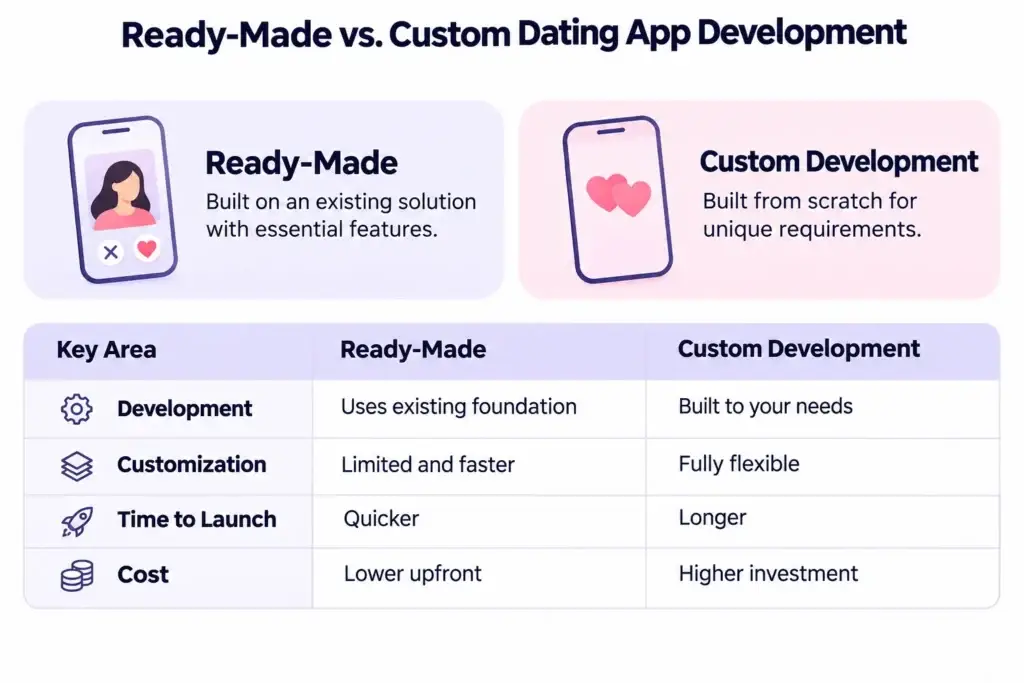
Both approaches can produce a usable first-market product. The difference is how much existing engineering is reused and how much new work must be commissioned.
Ready-Made Development: Paying for an Existing Foundation
A ready-made solution generally starts with pre-existing account management, profile discovery, matching workflows, messaging, and administrative capabilities. The provider can configure the software for the founder’s branding and deployment requirements, with additional customization priced according to scope.
This approach makes financial sense when the proposed business uses familiar matchmaking interactions and the main differentiation comes from the community being served, its positioning, acquisition strategy, or membership experience.
For instance, a founder targeting a particular professional community may not need to invent a new messaging architecture. The real business challenge might be attracting the first members, establishing trust, and making the experience relevant to that audience.
The ready-made route may allow more of the budget to remain available for those activities. Nevertheless, founders should verify what the standard package includes, which modifications require a separate quotation, and who controls the code, hosting, and third-party accounts.
Custom Development: Paying for Product-Specific Engineering
Custom development begins with the requirements of the proposed product. Developers design and implement the user experience, server-side logic, data architecture, integrations, and administrative systems around those requirements.
The greater flexibility is useful when the business model depends on interactions that ordinary matching platforms do not provide. These may involve novel compatibility scoring, specialized membership rules, complex community governance, unique onboarding processes, or proprietary recommendation methods.
However, original engineering requires additional specification, development, testing, and maintenance. Requirements that appear minor during planning can become costly when they affect data structures, permissions, matching logic, and multiple app screens.
Custom development should therefore be a deliberate product decision, not simply a preference for owning something that was built from scratch.
| Cost consideration | Ready-made development | Custom development |
|---|---|---|
| Initial engineering | Existing foundation reduces work | Core workflows built to specification |
| Brand customization | Often simpler within existing UI patterns | Designed specifically for the product |
| Matching logic | Existing rules may be configurable | Can implement new recommendation models |
| Testing effort | Reuse reduces some validation work; changes still need QA | New components require broader validation |
| Launch preparation | Configuration, accounts, compliance review, and submission | Deployment after full implementation and testing |
| Future modifications | Depend on code quality and architectural flexibility | Depend on original architecture and maintenance quality |
| Financial risk | Unexpected customization or migration expenses | Scope growth and extended engineering effort |
Neither route automatically guarantees the lower lifetime cost. A rigid prebuilt product can become expensive to alter, while an overengineered custom system can consume capital before the business validates demand. The deciding factor is the relationship between the product’s unique requirements and the amount of software that must be changed to support them.
How to Calculate the Total Cost of Launching a Dating App MVP
A useful financial estimate should show both the amount required to reach launch and the amount needed to operate through the initial validation period.
Founder Budget Formula
Total first-year budget = Product cost + Customization + Launch setup + 12 months of operations + User acquisition + Contingency.
Keep one-time expenses and recurring costs in separate columns. Do not include the same activity twice under development and operations.
Step 1: Define the Software Scope
Write down the minimum user experience needed to test your business hypothesis. A typical first release needs functioning registration, profiles, discovery, matching, messaging, administrative visibility, and basic user safety controls.
Advanced compatibility algorithms, live events, elaborate gamification, and video experiences should be evaluated separately unless they are essential to the core value proposition.
When comparing supplier quotations, request the exact included modules and accepted functionality rather than relying on a list of attractive product terms. A feature that exists only as a demonstration may not be included in the contracted delivery.
Step 2: Separate Essential Customization From Optional Improvements
Changing a logo, color system, and basic text is different from redesigning matchmaking rules or introducing a new membership structure. Even if both activities are described as customization, they can have entirely different engineering implications.
Divide requirements into three categories: required before launch, useful after validation, and experimental. Price the first category immediately, estimate the second for future planning, and avoid committing funds to experimental work until evidence supports the need.
Step 3: Calculate Infrastructure and External Service Expenses
A dating platform may depend on cloud servers, databases, media storage, push notifications, email delivery, SMS verification, maps, payment services, video infrastructure, and error monitoring.
Some of these services charge a recurring platform fee. Others charge based on users, message volume, storage, verification requests, or processing activity. The cost of operating an app with a small pilot audience can therefore differ substantially from its cost after a successful acquisition campaign.
Ask each supplier which third-party services are included, which accounts the founder must open, and how estimated usage affects monthly charges. Ownership of infrastructure accounts is also important because it can reduce migration complications if the business changes technical partners.
Step 4: Add Launch Readiness and Operational Costs
A working application is not necessarily ready for public release. The team must prepare legal documents, community rules, data-handling policies, store listings, user-support processes, reporting workflows, and testing across target devices.
For a community-based dating product, operational preparation should also include handling abusive profiles, impersonation, harassment, account appeals, and potentially underage users. Those responsibilities exist regardless of whether the software foundation was purchased or custom-built.
Step 5: Set Aside Capital for Growth and Iteration
The MVP is intended to produce evidence. Founders should reserve funding to observe behavior, identify onboarding barriers, study match quality, and make product changes based on actual usage.
If every available dollar is spent on the first code release, the business may struggle to respond to the very insights the launch was supposed to generate.
The Hidden Costs That Can Make a Dating App Launch More Expensive
Initial development quotations rarely provide a complete picture of operating a dating business. The following expenses deserve independent evaluation because they can grow even when the software itself is stable.
1. User Verification and Identity Assurance
Trust has a direct impact on whether members feel comfortable joining, communicating, and eventually paying. Basic registration checks are not the same as identity verification, and self-reported age is not the same as age assurance.
Verification may require external services, additional user-interface flows, human review, and secure handling of sensitive information. The cost varies according to the assurance level and the number of checks performed.
Founders should decide what identity signals are genuinely necessary for their initial audience, how unsuccessful verification attempts are handled, and whether stronger checks will be introduced as the platform expands.
2. Moderation and Member Safety Operations
Profile images, biographies, private messages, and user reports introduce ongoing moderation needs. Automated filters can assist, but complicated cases may still require human judgment.
An app without a clear response process may accumulate spam accounts, misleading profiles, or unresolved complaints. This affects user experience and can undermine the trust required for a matchmaking community to grow.
Moderation budgets should consider reporting tools, review queues, escalation rules, administrator permissions, and expected response capacity. A smaller launch audience may allow simpler processes, but the operating model should be established before growth accelerates.
3. App-Store Accounts, Billing, and Subscriptions
Application distribution introduces fees and policy requirements beyond the software quotation. As of 2026, Apple’s standard developer membership is listed at $99 per year in the United States, while Google Play lists a $25 one-time developer registration fee. Regional pricing, eligibility, and account requirements should be checked before publication.
If members purchase subscriptions, credits, or other digital benefits, applicable app-store billing rules and commissions also need to be incorporated into the revenue forecast. The relevant commission depends on the platform, transaction type, program eligibility, and applicable policies.
Store approval is a separate process from software deployment. A developer may complete technical delivery while the public release remains subject to review, account verification, or additional compliance information.
4. User Acquisition and Community Density
Dating products face an unusual early-stage challenge: each new member needs enough relevant people nearby or within their preferred audience to make discovery worthwhile.
Attracting thousands of sign-ups across disconnected locations may create less value than building a smaller but active community in one well-defined market. This is why launch spending must consider geographic concentration, demographic relevance, and member activity rather than downloads alone.
A founder planning a narrowly focused audience should consider the strategic value of hyper-vertical dating communities. Concentrated positioning can help clarify recruitment, messaging, and launch economics, although it does not eliminate the need to validate market demand.
The acquisition budget may include partnerships, creator collaborations, referral incentives, local events, paid campaigns, and community management. Each channel should be measured by its contribution to active, relevant members rather than registrations alone.
5. Maintenance, Updates, and Technical Support
Mobile operating systems, external APIs, payment integrations, and security requirements evolve after launch. Even a stable product requires updates and monitoring.
Maintenance may include fixing defects, monitoring server performance, updating dependencies, renewing credentials, reviewing security alerts, and adapting to store policy changes.
Founders should clarify which issues the original supplier will handle, how long support coverage lasts, and whether new feature requests are included. A support agreement that appears comprehensive may have different terms for defects, third-party failures, and enhancements.
How Development Choices Change Your Three-Year Cost of Ownership
Comparing only the initial invoice can lead to a poor decision. The more useful calculation considers software expenses, hosting, ongoing maintenance, future customization, support, and possible migration throughout the period the founder expects to operate the product.
For financial planning, a three-year model is useful because it requires a founder to consider what happens after the initial release. It is a planning horizon, not a prediction that the product will succeed or remain unchanged for three years.
| Budget period | Ready-made route | Custom route |
|---|---|---|
| Before launch | License, branding, required changes, deployment | Discovery, design, engineering, testing, deployment |
| Year one | Operations, integrations, support, marketing, early iteration | Operations, support, marketing, stabilization, early iteration |
| Year two | Scaling, new requirements, possible refactoring | Scaling, enhancements, infrastructure optimization |
| Year three | Growth engineering, security, migrations if needed | Growth engineering, security, architecture evolution |
The ready-made route can retain a cost advantage when the existing architecture continues to support the business. That advantage may shrink if the platform requires repeated deep modifications, expensive workarounds, or a complete replacement.
Custom development may provide more direct control over original system design, but this benefit only materializes when the code is properly documented, maintainable, and transferred under suitable ownership terms.
Before signing either agreement, request clarity on source-code rights, third-party licenses, deployment access, data export, technical documentation, ongoing support, and the cost of adding future features. These details often matter more to lifetime costs than the language used to describe the initial package.
A Practical Founder Scenario: Choosing the Right Budget for a First-Market Launch
Consider a hypothetical founder planning a relationship-focused platform for professionals within a single metropolitan area. The founder wants to test whether a curated community can sustain meaningful engagement before expanding to additional locations.
The concept requires profiles, preferences, discovery, mutual matching, messaging, reporting, and administrative oversight. It does not initially need a proprietary recommendation algorithm, video-based events, or a complicated social network.
In this scenario, the business’s central uncertainty is not whether developers can build a matching engine. It is whether enough relevant members will join and remain active.
Option A: Use a Ready-Made Foundation
The founder selects a platform whose existing workflows match the intended product, pays for branding and essential configuration, and allocates a separate budget to attracting the initial community.
This route limits the amount of new engineering required before market testing. The founder can focus on onboarding quality, local partnerships, safety processes, and member feedback.
The main risk is discovering that a later business requirement cannot be implemented without substantial changes. Reviewing the underlying architecture and customization options before purchase is therefore essential.
Option B: Commission a Fully Custom Product
The founder funds original design and development, with greater freedom to define every interaction and underlying workflow.
This makes sense if the founder’s hypothesis depends on a genuinely differentiated method of evaluating compatibility or organizing member interactions. It may be less attractive when the product’s essential flows are already familiar and the immediate challenge is demand validation.
The key lesson is that development spending should follow the business hypothesis. When the unknown is market demand, founders may benefit from conserving capital. When the unknown is whether a distinctive product mechanic creates value, custom engineering may be a necessary part of the experiment.
Which Features Deserve Budget Priority in a Dating App MVP?
Feature prioritization is one of the most effective ways to control development costs. However, the objective should not be to remove everything that appears expensive. It should be to include the functionality required for a safe, measurable, and useful first release.
| Capability | Launch priority | Budget reasoning |
|---|---|---|
| Registration and profiles | Essential | Establishes user identity and relevant preferences |
| Discovery and matching | Essential | Tests the core product experience |
| Messaging | Essential | Enables post-match engagement |
| Blocking, reporting, moderation | Essential | Supports user safety and responsible operations |
| Admin controls and analytics | Essential | Supports oversight and measurable learning |
| Paid memberships | Depends on test objective | Needed if early monetization is being validated |
| Advanced recommendation models | Conditional | Justified when central to differentiation |
| Live video and social events | Usually deferrable | Adds integration, infrastructure, safety, and testing requirements |
The correct priority can change with the business model. A subscription-led product may require billing in its first release, while a free pilot intended to test match quality might defer monetization until the community becomes active.
Founders should also distinguish operational safeguards from optional engagement features. Removing essential safety controls to save initial development costs can create reputational and operational problems that are more expensive to address later.
How Matching Architecture, Platform Choice, and Integrations Affect Cost
Two dating products with similar-looking interfaces can have very different engineering costs. The difference often comes from the technology operating behind the screens.
Basic Matching vs. Advanced Recommendation Systems
A basic matching workflow may use member preferences, location, eligibility rules, and mutual interest. It can often be implemented with conventional application logic.
Advanced recommendation systems may introduce behavioral scoring, ranking models, experimentation infrastructure, and additional data-processing requirements. Those capabilities also require sufficient relevant behavioral data to evaluate their usefulness.
For an early product with a limited user population, a complicated recommendation engine may not improve the experience enough to justify its cost. A simpler approach can provide the evidence needed to decide which improvements are worth building later.
Native Applications vs. Cross-Platform Development
Supporting multiple mobile operating systems can increase testing and maintenance requirements. Cross-platform frameworks can allow a team to reuse significant portions of application code, while native applications may provide advantages for specialized platform functionality.
The appropriate choice depends on the target audience, device requirements, performance expectations, and existing technical foundation. Cross-platform development is not automatically less expensive in every situation, especially if the application requires extensive platform-specific features.
Third-Party Services vs. Building Everything Internally
External communication, payment, identity, and analytics services can reduce initial development effort. However, usage-based billing and future dependency changes must be considered.
Building these systems internally can introduce significant engineering and maintenance responsibilities. The better financial decision is generally to retain control of strategically important product logic while evaluating established services for supporting capabilities.
For founders who need requirements beyond an existing foundation, reviewing custom matchmaking application engineering can help distinguish work that requires original development from functionality that can be configured or reused.
Why Launch Timing Has a Financial Cost
Speed matters because founders operate with limited capital, uncertain demand, and competing priorities. Every additional development cycle may defer the collection of real user feedback and extend the period before the business can test its assumptions.
However, opportunity cost is not simply the number of days spent building. A poorly prepared release can waste an otherwise valuable acquisition campaign. Technical deployment, operational readiness, and community activation must align.
Miracuves offers six-working-day deployment for its qualifying ready-made solutions, helping founders avoid rebuilding established workflows. That timeline should be understood as a product-delivery commitment for the agreed base scope, not a guarantee of immediate app-store approval, audience acquisition, or completion of substantial custom development.
A useful launch plan should distinguish four milestones:
- Software ready: The agreed functions are deployed and tested.
- Release ready: Store materials, legal requirements, accounts, and operating processes are prepared.
- Market ready: The initial audience, partnerships, and launch communications are organized.
- Validation ready: Analytics and feedback methods are in place to evaluate behavior after launch.
Separating these milestones prevents the founder from confusing software completion with commercial readiness. It also helps explain why two startups using the same technology may have very different launch budgets.
The Marketing Budget: What to Fund Before and After Launch
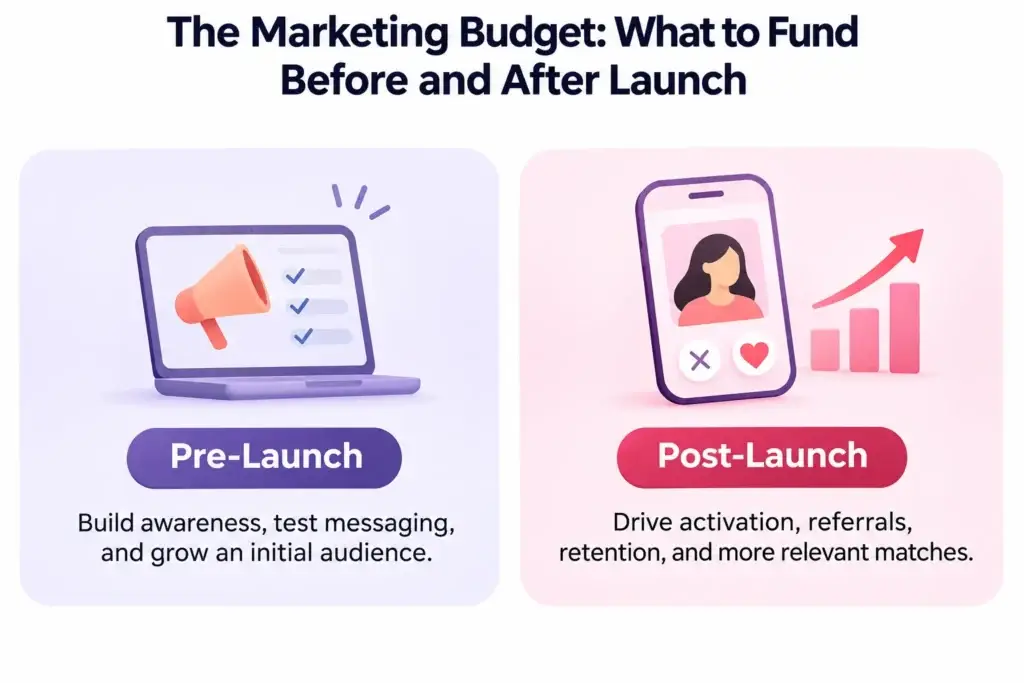
Marketing is often treated as a later expense, but a dating product requires a deliberate plan for attracting enough relevant members from the beginning. An empty discovery experience can discourage users even when the software performs correctly.
Pre-Launch Spending
Before public release, the founder should define the initial audience, identify a launch geography or community, test messaging, and develop a recruitment process. A landing page, waitlist, audience interviews, community partnerships, and small controlled campaigns can generate useful signals without requiring a full advertising rollout.
The objective is to learn whether prospective members understand the value proposition and are willing to participate. A large waitlist is not sufficient evidence unless those prospective users fit the audience the platform needs.
Post-Launch Spending
After release, expenditure should shift toward activation, referral behavior, retention, and improving the density of relevant profiles. Founders should study where users abandon onboarding, whether members discover suitable profiles, and whether matches turn into meaningful engagement.
A clear distinction between these two phases helps prevent premature spending. The pre-launch and post-launch marketing framework provides further context for planning the sequence of campaigns around a matchmaking product.
Ultimately, the marketing budget should respond to demonstrated user behavior. Increasing advertising before improving onboarding or match relevance may increase acquisition costs without producing a sustainable community.
How to Estimate Break-Even Without Relying on Unrealistic Revenue Assumptions
A cost comparison becomes more useful when the founder connects projected expenses to possible revenue. Subscription pricing, paid enhancements, and advertising can contribute to monetization, but not every active member will become a paying customer.
Instead of starting with an optimistic revenue target, founders should calculate the contribution earned from an average paying user after transaction fees and variable service expenses.
Break-Even Planning Formula
Monthly paying members needed = Monthly fixed operating costs ÷ Contribution per paying member.
Contribution per paying member = Recognized monthly revenue per paying member − Variable costs attributable to that member.
This estimates operating break-even, not recovery of the original product investment. Initial development costs must be recovered separately when assessing overall return on investment.
Suppose a founder discovers that converting free users into paying members is more difficult than expected. The business may need to improve perceived membership value before investing in expensive new features. Conversely, if conversion is healthy but relevant matches are limited, community acquisition and user density may deserve greater priority than additional monetization tools.
Use conservative, expected, and optimistic scenarios rather than a single forecast. Evaluate monthly active members, conversion to paid memberships, churn, average revenue per paying user, customer acquisition cost, and support expense. This produces a more useful financial picture than estimating revenue solely from total registrations.
When Ready-Made Software Is the Better Financial Decision
Ready-made development is generally worth evaluating when the founder wants to test an identifiable community need using familiar matchmaking interactions and has limited reasons to invest in proprietary engineering before launch.
It is especially relevant when budget preservation, faster market validation, and the ability to fund acquisition are more important than producing a completely original technical architecture.
However, the choice should depend on evidence. A founder should request a working demonstration, confirm the delivery scope, inspect source-code ownership terms, and clarify what is required to implement any features outside the standard package.
It is also useful to compare differences in product packaging and support commitments. A guide to ready-made dating software features and pricing can help founders prepare questions about included functionality, additional costs, and the responsibilities of the software provider.
A well-matched foundation can reduce avoidable development work. A poorly matched foundation can turn into a series of expensive modifications. The objective is not to select the fastest product at any cost, but to identify the fastest suitable path to a reliable market test.
When Fully Custom Development Justifies the Higher Investment
Custom development becomes more compelling when an essential competitive advantage cannot be achieved by adapting an existing product. That advantage should be specific, meaningful to the target audience, and important enough to justify additional engineering risk.
Examples include an original compatibility methodology, highly specialized community interactions, complicated membership eligibility rules, or an experience requiring distinctive integrations and permissions.
A founder with validated demand, a clearly documented product specification, and adequate working capital may be better positioned to fund that development than an entrepreneur who is still testing the basic value proposition.
For broader category context, Miracuves’ dating and social discovery industry overview explains the ecosystem in which product architecture, community experience, and commercial requirements intersect.
The most important question is whether the custom functionality is necessary to produce evidence or whether it is an improvement that can be introduced once evidence exists.
A Founder Decision Framework for Ready-Made vs. Custom Development
Budget Availability
If the business has limited runway, preserve sufficient funding for user acquisition, safety operations, and product iteration.
Product Differentiation
If differentiation depends on original technology, custom development may be necessary. If differentiation is audience-led, existing software may fit.
Time to Validation
Choose a delivery approach that allows the team to test the most important business assumption without unnecessary delays.
Long-Term Control
Review source code, hosting access, data portability, documentation, and customization rights before comparing total costs.
These signals should be evaluated together. A startup with limited funds but an essential proprietary algorithm may need a narrower custom experiment rather than a full commercial product. Another startup with adequate funding but an uncertain audience may still benefit from an existing foundation because additional engineering would not resolve its central business risk.
In either case, the right development strategy is the one that produces useful evidence while maintaining sufficient financial flexibility to act on the results.
Mistakes That Increase the Cost of a Dating App MVP
Common Budgeting Mistakes
Mistake 1: Comparing Quotes With Different Scope
One supplier may include deployment and support while another quotes development alone. Compare identical deliverables, integrations, acceptance criteria, and ownership terms.
Mistake 2: Spending the Entire Budget Before Launch
A completed application still needs members, support, and improvement. Allocate capital for an operating runway.
Mistake 3: Building Advanced Features Before Validating Demand
Complex functionality can create unnecessary engineering and maintenance costs if the audience has not demonstrated a need for it.
Mistake 4: Underestimating Moderation
Unresolved abuse reports and weak safety procedures can undermine trust. Plan moderation responsibilities from the beginning.
Mistake 5: Ignoring Source-Code and Data Ownership
Unclear ownership can complicate modifications, vendor changes, infrastructure migration, and future financing.
Mistake 6: Assuming Technical Deployment Means Market Success
Release readiness, user acquisition, community density, retention, and revenue validation all require separate planning.
What to Ask a Development Partner Before Approving the Budget
A strong quotation should make its assumptions visible. Founders should be able to understand what they are purchasing, which requirements can change the price, and what responsibilities remain with the business after technical delivery.
- What exact functions are included in the agreed first release?
- Which operating systems, websites, and administrative interfaces are included?
- What happens when a requirement changes after work begins?
- Which external services require separate accounts or usage payments?
- Who owns the delivered code, design assets, and production data?
- What documentation and technical access are transferred at handover?
- How are security testing, user reporting, and moderation handled?
- What does the support agreement cover, and for how long?
- Is the proposed timeline for development, deployment, or public store approval?
- How will the platform be maintained and expanded if the business validates demand?
The answers should be documented rather than treated as informal promises. Clear requirements and acceptance criteria make it easier to compare proposals and reduce the risk of unexpected expenditure.
How Miracuves Helps Founders Control the Cost of an Early Dating Product
Miracuves supports founders evaluating ready-made software and custom engineering, allowing the initial technical approach to reflect the maturity of the business idea.
For a founder whose requirements fit an established matchmaking workflow, a ready-made, white-label foundation can reduce the amount of original development required. Source-code ownership, administrative access, and customization options are important when the business expects to evolve after receiving early market feedback.
For concepts that need materially different functionality, a custom scope may be more appropriate. The decision should follow the requirements, budget, and validation objectives rather than assuming that either development model is universally superior.
The practical goal is to preserve capital for the activities that determine whether the product becomes a sustainable business: attracting the right users, maintaining trust, encouraging meaningful engagement, and improving the experience based on observed behavior.
Final Thoughts: Budget for Validation, Not Just Development
The real cost to build and launch a dating app MVP in 2026 depends on more than the initial engineering approach. Founders must account for implementation, customization, infrastructure, privacy and safety, user acquisition, ongoing maintenance, and the financial capacity to improve the product after launch.
Ready-made software is often a sensible starting point when the core product follows established matching workflows and the business needs to validate an audience efficiently. Custom development can be justified when the product’s competitive advantage genuinely requires new technology or a substantially different experience.
For founders seeking a faster route to testing a matchmaking concept, exploring a ready-made matchmaking platform can provide a practical reference point for evaluating the trade-off between initial cost, customization, ownership, and deployment speed.
The strongest financial decision is not necessarily the smallest software invoice or the most sophisticated first release. It is the development approach that delivers a reliable product, preserves room for market learning, and creates a manageable path from an initial experiment to a sustainable business.
Frequently Asked Questions
How much does it cost to build a dating app MVP in 2026?
Published 2026 custom-development guides commonly estimate a dating app MVP in the approximate $25,000–$70,000 range, although included features, development rates, and platform coverage differ. Ready-made software can have a substantially different upfront cost structure. A realistic budget must also include hosting, customization, security, launch preparation, acquisition, and ongoing operations.
Is a ready-made dating app cheaper than custom development?
Ready-made software often reduces initial engineering expense because core workflows already exist. However, customization, integrations, infrastructure, and maintenance can change its lifetime cost. Custom development may offer better long-term value when distinctive functionality cannot be supported efficiently by an existing foundation.
What hidden expenses should founders include in a dating app launch budget?
Important expenses include hosting, storage, verification, moderation, security reviews, app-store accounts, payment processing, user support, acquisition campaigns, maintenance, and future product improvements. These should be included alongside software development costs.
How long does it take to launch a ready-made dating app MVP?
Delivery depends on the provider, software readiness, configuration, and customization requirements. Some ready-made solutions support deployment within days, while significant modifications need additional time. Public release may also depend on app-store reviews and the founder’s operational preparation.
Can founders launch a dating app MVP without advanced AI matchmaking?
Yes. An initial product can use preferences, discovery rules, location criteria, and mutual interest to test whether users find relevant matches. Advanced recommendation technology can be considered after the business has enough behavioral evidence to justify its complexity.
How much should a startup budget for dating app maintenance?
Maintenance depends on traffic, infrastructure, integrations, support terms, security requirements, and the frequency of updates. Founders should request separate recurring estimates for hosting, third-party services, defect resolution, monitoring, and enhancements rather than assuming these are included indefinitely in the development price.
Does owning the source code reduce long-term dating app costs?
Source-code ownership can improve flexibility when changing providers, customizing features, or maintaining the software independently. However, the benefit depends on code quality, documentation, third-party licenses, and the founder’s access to deployment infrastructure. Ownership alone does not eliminate maintenance costs.
What is the best way to choose between ready-made and custom dating app development?
Start with the business hypothesis, essential features, available budget, and required launch date. Evaluate whether an existing solution supports the critical experience without major changes. Choose custom development when the product’s essential differentiation requires original engineering. Compare total ownership costs and preserve enough funding to acquire users and learn from the initial release.
Miracuves is an independent software development company. We are not affiliated with, connected to, sponsored by, or endorsed by any company or product named in this article.
Terms such as “X Clone” are used descriptively. It is how the software industry refers to building a platform with functionality comparable to a known service, and how clients search for it.
The entire design and codebase of our products is built by our own team. Our products contain no code, design, graphics, or content originating from any third-party website or applications.
All third-party names and marks referenced in this article are the property of their respective owners, referenced solely to identify the services discussed.