

Key Takeaways
- Hyper-vertical dating apps serve a specific community instead of competing with mass-market platforms.
- Shared professions, lifestyles, values, or interests can improve match relevance and member trust.
- Verification, niche filters, private access, matching, messaging, and subscriptions are core features.
- Success depends on concentrated demand, clear positioning, strong moderation, and local member density.
- A focused dating platform can create better monetization and retention than a generic Tinder clone.
Strategy Signals
- Members need relevant profiles, niche preferences, verified identities, private messaging, and clear community standards.
- Founders need focused acquisition channels, invite systems, paid memberships, retention data, and launch-market controls.
- Admins need control over users, verification, reports, subscriptions, moderation, matching rules, and analytics.
- Community-specific onboarding and filters help reduce irrelevant matches and improve user intent.
- Notifications keep members updated on matches, messages, approvals, subscriptions, and community activity.
Real Insights
- A niche dating app wins by serving one valuable audience better than a broad platform can.
- Weak positioning can make the product feel like another generic swipe app with fewer users.
- Verification, exclusivity, and shared identity can justify premium subscriptions and improve match quality.
- Founders should prove member density and willingness to pay before expanding into additional communities.
- Miracuves builds Tinder Clone apps with hyper-vertical matching, verification, subscriptions, messaging, and admin workflows.
The dating market does not need another application built around profile cards, swipe gestures, chat, and a premium badge.
Those features are no longer a strategy. They are basic category expectations for any modern dating-like app.
Founders often look at the size of the online dating market and reach the wrong conclusion: a large market must leave room for another broad platform. In reality, the larger the audience, the more capital a general dating app may require to acquire users, balance marketplace supply, moderate behaviour, establish trust, and keep members active.
The strongest opportunity in dating technology is no longer about attracting everybody.
It is about becoming indispensable to a specific group.
A hyper-vertical dating-like app serves a clearly defined community whose members share a meaningful characteristic, such as profession, faith, lifestyle, ambition, geography, cultural background, relationship intent, or membership network.
Instead of asking, “How do we compete with Tinder?” the founder asks, “Which community has a high-value matching problem that broad platforms consistently solve poorly?”
That shift transforms the product from another generic dating app into a focused network built around relevance, trust, and stronger member intent.
Another General Dating App Is Not a Startup Strategy
“Dating app for everyone” sounds ambitious. It is usually a refusal to choose a customer.
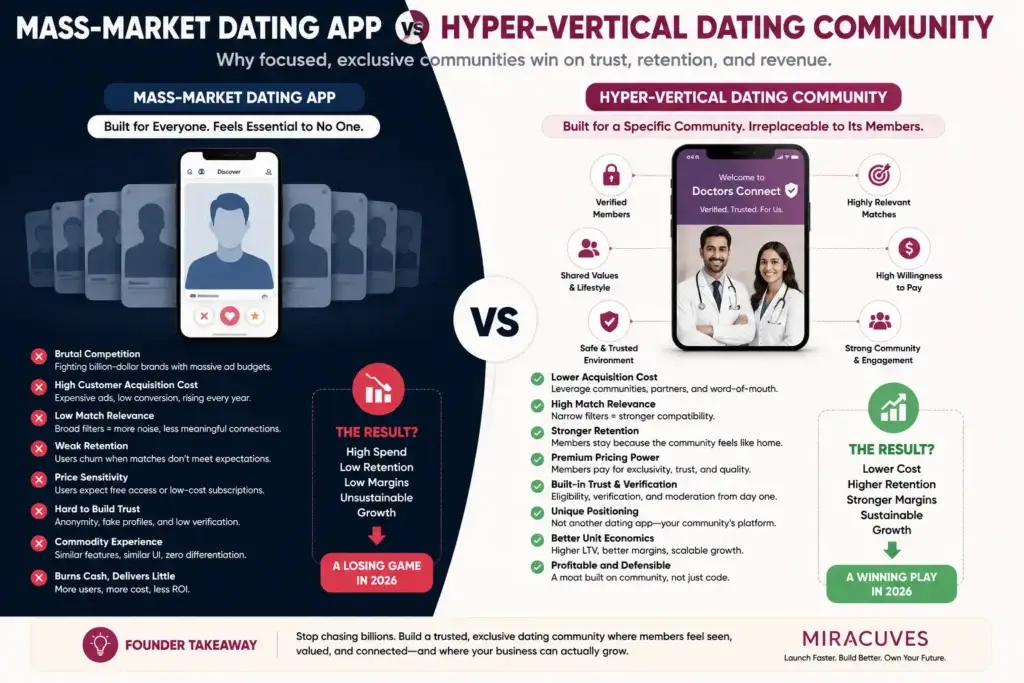
A broad dating platform has to support multiple age groups, identities, locations, relationship intentions, safety expectations, cultural preferences, and behavioural patterns. Every marketing message becomes less specific. Every recommendation system must reconcile conflicting signals. Every new location creates another liquidity problem.
The result is a product that may technically serve everyone while feeling essential to no one.
Large dating platforms can tolerate this complexity because they possess established brands, enormous datasets, mature safety operations, extensive product teams, and existing pools of users. A new founder begins without those advantages.
That is why copying the visible Tinder experience is commercially misleading. The interface is the easiest part to observe. The difficult assets are hidden:
- Existing member density
- Brand recognition
- Behavioural data
- Recommendation history
- Moderation operations
- Fraud detection
- Re-engagement systems
- Paid acquisition capability
- App-store presence
- Trust built over time
A swipe deck can be reproduced. A mature network cannot.
Read More: What is Tinder App and How Does It Work?
The Match Group Moat: Why General Dating Apps Bleed Cash
Match Group operates a portfolio of established dating brands rather than depending on a single undifferentiated product. Its investor materials describe a range of brands designed for different forms of connection, while its product strategy has continued to invest in recommendation systems, new discovery experiences, trust, safety, and lower-pressure formats.
That distinction matters.
A founder launching a broad dating app is not simply competing against Tinder’s feature list. The founder is competing against a portfolio strategy, installed user bases, years of interaction data, large operational teams, and substantial capacity to test new product behaviour.
The pressure is visible across the category. Bumble reported that its 2025 revenue fell from approximately $1.07 billion to $965.7 million, while total paying users declined from 4.1 million to 3.7 million. Its fourth-quarter paying users fell 20.5% year over year even as average revenue per paying user increased.
Bumble’s annual report also shows how expensive the category can be at scale. The company reported approximately $165.5 million in selling and marketing expense for 2025, after spending approximately $261.2 million in 2024.
This does not prove that every new dating app will fail. It demonstrates something more useful: even recognised dating brands must continuously invest in acquisition, product development, positioning, trust, and monetisation.
A startup with a broad audience inherits the same problems without the same resources.
Read More: Tinder App Marketing Strategy
Your Real Competitor Is Marketplace Liquidity
Dating applications are two-sided marketplaces disguised as consumer apps.
A normal software tool can deliver value to its first user. A dating app usually cannot. Its value depends on the presence of enough relevant, active, geographically compatible members.
This is the liquidity problem.
Imagine that a founder acquires 10,000 registrations across an entire country. That number may look encouraging in an investor presentation. It becomes much less impressive after dividing users by:
- City
- Age range
- Gender or matching preference
- Relationship intention
- Activity status
- Distance preference
- Compatibility criteria
- Trust and verification status
The relevant pool available to any one user can quickly become very small.
When users repeatedly encounter inactive accounts, weak matches, long distances, or profiles outside their intent, they do not blame marketplace mathematics. They blame the product.
They leave before the network becomes useful.
A hyper-vertical dating app does not eliminate the cold-start problem. It makes the problem more manageable by narrowing the definition of a valuable match and giving the founder a concentrated acquisition path.
One thousand relevant members in a connected professional network can be more commercially valuable than 20,000 scattered registrations with no shared reason to engage.
Read More: How the World’s Top Dating App Makes Money
The Micro-Community Multiplier: Higher Intent, Stronger Trust, Better Margins
Broad dating platforms compete on volume.
Hyper-vertical communities can compete on relevance.
When every member joins because of a shared identity or lifestyle, the platform removes part of the uncertainty that users experience on general apps. The community itself becomes a filter.
A dating platform for medical professionals, for example, does not need to explain why irregular schedules, demanding careers, and professional ambition matter. Members already understand the context. A platform for serious endurance athletes can design matching around training schedules, travel, routines, and lifestyle compatibility. A private network for members of a cultural organisation can build around shared expectations and trusted referrals.
This specificity produces four potential advantages.
1. The value proposition becomes immediately understandable
“Meet people” is vague.
“Meet verified professionals who understand your schedule and long-term priorities” is concrete.
A specific promise improves advertising, landing pages, onboarding, referral messaging, influencer partnerships, and app-store positioning.
2. Member intent is easier to qualify
A narrowly positioned platform discourages irrelevant sign-ups.
Application questions, profession checks, invitations, membership rules, and profile requirements can improve the quality of the pool before matchmaking begins.
3. Trust can become part of the product
In broad marketplaces, verification is often an extra feature. In a gated community, it can be the central reason to join.
Trust may come from:
- Professional email verification
- Identity checks
- Referral codes
- Organisation membership
- Manual profile review
- Behavioural moderation
- Community reporting
- Visible admission standards
Final verification and privacy requirements should be designed around the operating jurisdiction, user group, and legal advice. A dating platform should never treat safety as a cosmetic badge.
4. Users may pay for relevance rather than volume
People do not necessarily pay because an app contains more profiles. They pay because it reduces wasted time and increases confidence in the people they can meet.
A niche platform can therefore monetise access, curation, verification, convenience, and community—not merely unlimited swipes.
Read More: Business Model of Tinder
Hyper-Vertical Does Not Mean “Pick a Hobby
Many founders hear “niche dating app” and choose a random interest category.
That is not sufficient.
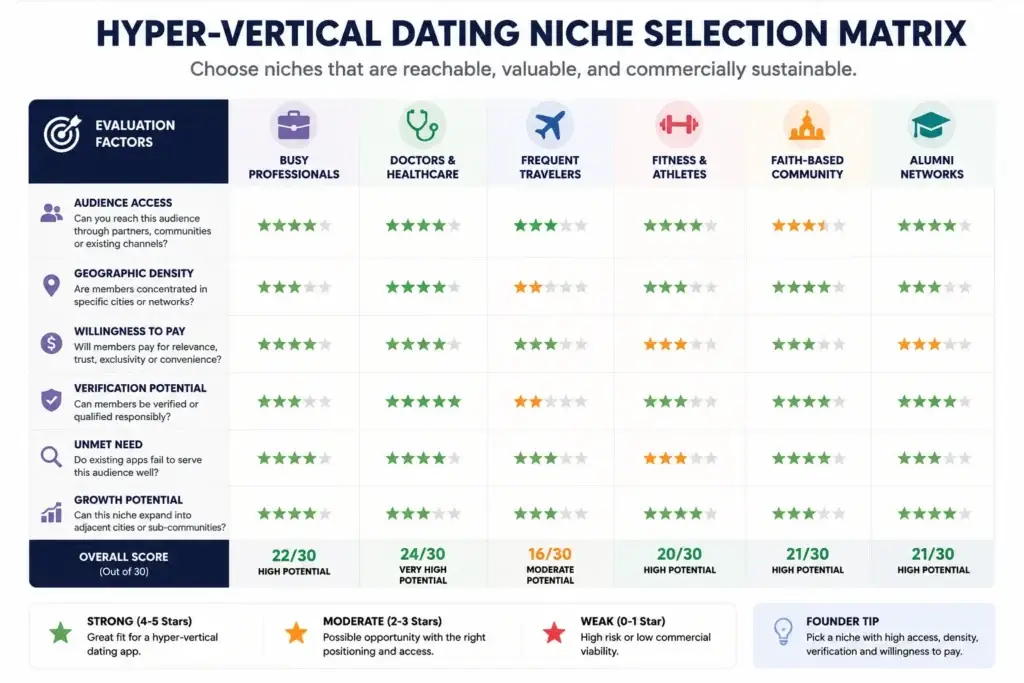
A commercially defensible vertical sits at the intersection of identity, pain, access, density, and purchasing power.
A niche may be interesting but still fail because its members are too geographically dispersed. Another niche may have strong identity but little willingness to pay. A profession may appear lucrative but be difficult to verify or reach without partnerships.
The strongest opportunity has several of the following characteristics:
| Decision factor | Strong signal | Weak signal |
|---|---|---|
| Shared identity | Members actively identify with the group | The category is only a casual interest |
| Unmet need | Broad platforms create repeated frustration | Existing apps already serve the group well |
| Reachability | Founders can access associations, creators, events, or databases lawfully | Audience must be found through broad paid advertising |
| Geographic density | Members cluster in specific cities or institutions | Members are thinly distributed |
| Willingness to pay | Relevance, privacy, status, or time savings carry value | Users expect a completely free service |
| Verification | Membership can be checked responsibly | Eligibility is subjective or impossible to confirm |
| Community behaviour | Members benefit from repeated interaction | The platform offers no value beyond one-to-one matching |
| Expansion path | Adjacent cities or subgroups can be added methodically | Growth requires abandoning the original proposition |
The founder’s task is not to find the narrowest possible audience. It is to find the smallest market that can become liquid, trusted, and economically attractive.
Founder Decision Signals
Audience Access
You already have relationships with associations, creators, clubs, employers, events, institutions, or offline communities that can seed the platform.
Match Density
You can launch city by city or network by network instead of spreading early users across an entire country.
Pricing Power
Members will pay for verification, curation, privacy, high-intent introductions, or access to a respected network.
Community Depth
The platform can deliver events, groups, introductions, resources, or social participation beyond repetitive swiping.
Profitable Hyper-Vertical Dating App Ideas
The following examples are strategic directions rather than promises of profitability. Each one still requires demand validation, audience interviews, legal review, and a realistic acquisition plan.
Dating for demanding professions
Doctors, aviation professionals, offshore workers, founders, emergency responders, consultants, and other groups may struggle with schedules or lifestyle expectations that general matching filters do not capture.
The differentiation should not stop at occupation. The product might include schedule compatibility, relocation preferences, work-travel frequency, long-term planning, and verified professional status.
Private networks for established communities
Membership organisations, alumni networks, cultural associations, premium clubs, and invitation-only communities may already possess trust and distribution.
The dating layer becomes an extension of an existing network rather than a standalone application trying to create a community from nothing.
Lifestyle-intensive communities
Some lifestyles affect daily routines, spending, travel, health, location, and social calendars. Examples can include endurance athletes, frequent travellers, rural professionals, remote workers, or members of a specific creative industry.
The platform wins when it translates the lifestyle into useful matching signals rather than merely adding a label to the profile.
Values-led matchmaking
Faith, family expectations, cultural traditions, sustainability commitments, sobriety, or relationship structure can materially influence compatibility.
These markets require thoughtful governance. Founders must avoid reducing nuanced beliefs to crude filters and should involve community members in the design of profile fields, moderation rules, and matching logic.
Curated executive or premium networks
High-income professionals may value discretion, identity verification, fewer but more relevant introductions, and human-assisted matching.
Here, the business model may resemble a membership service more than a mass-market dating application.
Local-first dating communities
A hyper-local platform can serve one city, university ecosystem, business district, island, expatriate network, or regional community.
Local concentration can improve match availability and make offline events commercially practical.
The Best Marketing Channel Is a Community You Already Control
A general dating app must locate strangers one advertisement at a time.
A vertical platform can recruit through existing trust networks.
This changes the economics of launch.
Potential distribution partners include:
- Professional associations
- Niche creators
- Conference organisers
- Alumni groups
- Private clubs
- Community newsletters
- Lifestyle brands
- Coworking networks
- Cultural organisations
- Local event operators
The ideal partner already has the audience, credibility, and communication channel. The platform supplies the matching infrastructure, branded experience, verification flow, moderation tools, and monetisation layer.
This is where brand builders and niche influencers possess an advantage over general app founders. They may already own the difficult asset: a concentrated audience with shared identity.
Their business question is not “Can we attract millions of daters?”
It is “Can we convert part of our existing community into a trusted, paid matching network?”
That is a far more disciplined launch hypothesis.
Read More: How Capping Daily Matches Increased Dates by 41%
Zero Marketing Is the Wrong Promise—Efficient Distribution Is the Real Advantage
A niche platform will still require marketing.
The difference is that its acquisition can be more targeted, measurable, and community-led.
Founders still need:
- Launch campaigns
- Referral loops
- Community ambassadors
- Content
- Events
- Partnership management
- Re-engagement
- Member success stories with permission
- City-by-city activation
The advantage is not zero marketing expenditure. It is reduced dependence on indiscriminate mass-market acquisition.
A focused platform can measure whether one association, event, creator, employer network, or neighbourhood produces enough high-quality members to create liquidity.
That provides a repeatable growth unit.
Monetisation Works Better When Membership Means Something
Mass-market dating apps commonly use freemium subscriptions and in-app purchases. Bumble describes its model as free access with a subset of members purchasing subscriptions or premium features.
A hyper-vertical platform can use the same mechanics, but it should not copy the monetisation strategy blindly.
The strongest model depends on why the community is valuable.
Paid membership
Charge a recurring fee for entry into a verified or curated network.
This works when the membership itself signals quality, privacy, relevance, or status.
Application or verification fee
A one-time fee can support manual review, identity validation, or onboarding.
The platform must communicate exactly what the fee covers and avoid implying guaranteed acceptance or successful matching.
Tiered subscriptions
A basic level can provide access, while higher tiers may include advanced filters, profile visibility, read receipts, priority review, travel mode, or curated introductions.
Paid introductions
Members pay for a limited number of carefully selected introductions rather than unlimited browsing.
This model shifts the product from attention maximisation toward match quality.
Events and experiences
Private dinners, mixers, workshops, trips, or interest-based gatherings can generate ticket revenue while improving trust and community density.
Bumble’s 2026 experimentation with paid group-dating events illustrates the category’s broader movement toward facilitated offline interaction as platforms respond to swipe fatigue.
Concierge matchmaking
Premium members receive human-assisted profile refinement, match review, or introduction support.
This can create high-value tiers but adds substantial operational requirements.
Brand partnerships
Relevant lifestyle, travel, wellness, hospitality, or professional brands may sponsor experiences or member benefits.
Advertising should remain selective. An exclusive community can quickly lose trust if monetisation overwhelms the member experience.
The Product Should Feel Like a Private Network, Not a Reskinned Tinder
A white-label foundation is useful only when the founder changes the product around the chosen community.
Replacing the logo and colours is not differentiation.
The platform must encode the vertical into its onboarding, profile design, eligibility, recommendation logic, communication, moderation, monetisation, and community rituals.
Community-specific onboarding
Ask questions that reveal compatibility inside the vertical.
For a founder network, this might include work intensity, travel, preferred city, family plans, risk tolerance, or lifestyle boundaries. For a faith-based community, onboarding may need community-reviewed questions and carefully framed value preferences.
Eligibility and verification
The admin team should be able to configure:
- Application review
- Identity verification
- Professional verification
- Referral requirements
- Approval and rejection reasons
- Waitlists
- Geographic restrictions
- Community-rule acceptance
Matching logic
A general-purpose distance and age filter may be inadequate.
The matching engine should support weighted preferences, deal-breakers, relationship intent, availability, values, lifestyle patterns, and behaviour-based recommendations where appropriate.
AI can support relevance, moderation, discovery, and onboarding, but it should remain a tool rather than a substitute for authentic connection. Recent Match Group research similarly indicates that younger singles may welcome AI assistance while remaining resistant to replacing human relationships with AI companions.
Community layers
A niche platform can improve retention through:
- Topic groups
- Local chapters
- Member events
- Curated prompts
- Community discussions
- Introductions
- Expert sessions
- Shared activity discovery
This reduces dependence on endless profile browsing.
Admin control
The admin dashboard is not a secondary feature. It is the operating system of the community.
Platform operators need control over:
- Member applications
- Verification
- Reports and appeals
- Content moderation
- Subscription plans
- Refunds
- Profile visibility
- Match settings
- Geographic launches
- Events
- Notifications
- Analytics
- Suspicious activity
- Role-based team access
Miracuves’ solution ecosystem supports white-label, source-code-owned social and communication products that can be adapted around profiles, matching, messaging, notifications, privacy, moderation, and admin control.
Read More: Eliminating the Bot Problem: Benchmarking Biometric Verification in Dating Clones
Trust and Safety Cannot Be Added After Launch
A dating platform facilitates interactions between strangers. That makes trust infrastructure part of the product foundation.
A responsible platform may require:
- Identity and selfie verification
- Age controls
- Profile review
- Block and report tools
- Image and text moderation
- Harassment detection workflows
- Suspicious activity flags
- Location privacy
- Secure API integration
- Encrypted data transfer
- Role-based access control
- Audit logs
- Appeal and dispute workflows
- Account deletion and data-handling controls
The exact controls depend on geography, community, age profile, platform model, and legal requirements.
Founders should use careful language such as “privacy-conscious workflows,” “supports verification,” or “can be configured for applicable requirements.” They should not claim universal compliance, guaranteed safety, or regulator approval without verified evidence.
Why a White-Label Matching Engine Changes the Capital Allocation
Founders often allocate too much capital to recreating standard technology and too little to solving the actual marketplace problem.
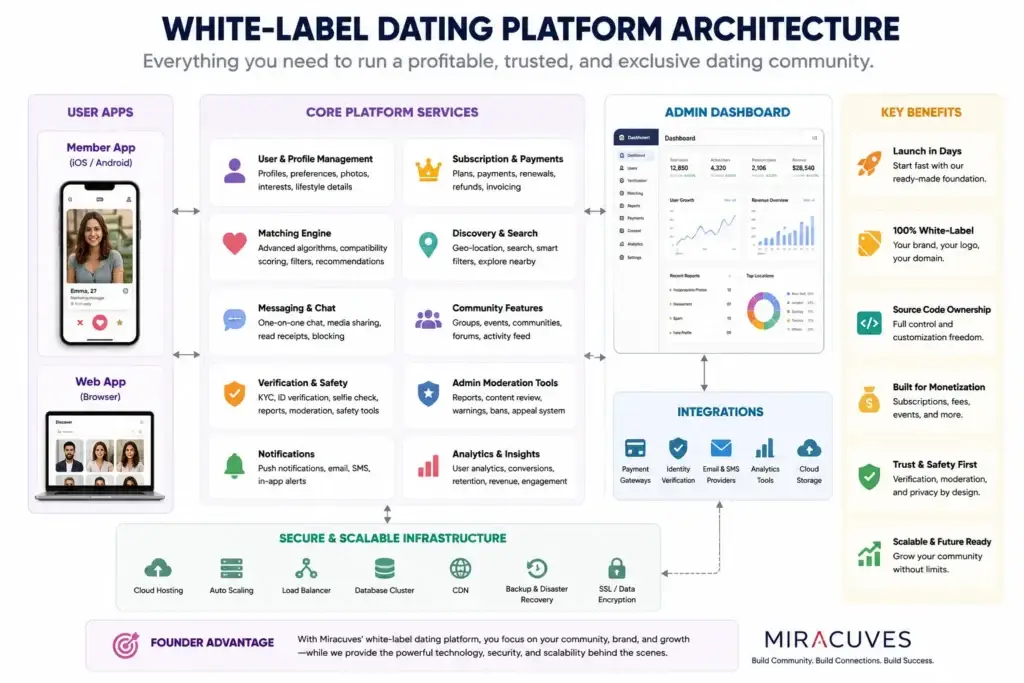
A ground-up build may require teams to create authentication, profiles, discovery, matching, chat, notifications, subscriptions, moderation, reporting, verification, analytics, and admin controls before the founder can properly test the community thesis.
A white-label foundation changes the allocation.
Instead of spending the early phase rebuilding expected modules, the team can focus on:
- Selecting the vertical
- Interviewing members
- Designing admission rules
- Securing distribution partners
- Creating the pricing model
- Seeding one location
- Defining community standards
- Customising matching criteria
- Building events and retention loops
- Measuring match quality
Miracuves helps founders start from a ready-made, white-label product foundation with source-code ownership, custom branding, and admin control. For relevant ready-made solutions, a 6-day launch may be available, subject to the selected modules, integrations, branding, and customisation requirements.
The point is not merely to launch faster.
It is to test the risky assumption first.
For a niche dating business, the risky assumption is rarely whether developers can build chat. It is whether a specific community will join, trust the platform, find relevant people, remain active, and pay.
Read More: White-label Tinder App Security Explained
White-Label Versus Custom Development
| Decision area | White-label foundation | Fully custom build |
|---|---|---|
| Initial focus | Community positioning and customisation | Architecture and module development |
| Launch speed | Faster when core flows already exist | Longer because core systems begin from zero |
| Product flexibility | Depends on source-code access and customisation scope | High when properly designed and funded |
| Upfront investment | Typically more cost-efficient for validation | Higher due to engineering depth |
| Differentiation | Comes from niche workflows, brand, matching, and operations | Can include deeply original product behaviour |
| Best suited for | Founders validating a defined community | Businesses with proven demand or unusual technical requirements |
| Main risk | Choosing an inflexible or poorly owned foundation | Overspending before proving marketplace demand |
A white-label app is not automatically the correct choice. Founders should confirm source-code access, architecture, documentation, scalability, security controls, customisation rights, deployment ownership, third-party dependencies, and post-launch support.
Mistakes Founders Make With Hyper-Vertical Dating
Mistakes Founders Should Avoid
Choosing a niche that cannot become locally liquid
A global audience may look large in research but remain useless when members are scattered across hundreds of locations. Launch where a concentrated pool can form.
Using a demographic label as the entire strategy
A vertical needs a meaningful problem, distinct matching logic, access channel, trust model, and monetisation reason. A label alone does not create value.
Launching too many cities at once
Expansion can dilute member density. A strong local experience is usually more persuasive than weak national coverage.
Confusing exclusivity with unnecessary friction
Applications and verification must improve trust. Excessive waiting, unclear rejection, or intrusive data collection can damage conversion.
Ignoring gender and preference balance
Raw registration numbers do not describe marketplace health. Founders need cohort-level visibility into availability, intent, activity, and match outcomes.
Copying mass-market engagement tactics
An exclusive platform should optimise for relevant conversations, trusted meetings, and member satisfaction—not simply maximum swiping time.
Treating moderation as customer support
Safety incidents, harassment reports, fraud, appeals, and privacy issues require defined policies, trained reviewers, logs, escalation, and response standards.
A Practical Launch Sequence for a Hyper-Vertical Dating App
Step 1: Interview the community before defining the product
Speak with potential members about:
- Why existing platforms fail them
- Which profiles they distrust
- What they want verified
- Which compatibility factors matter
- What would make them pay
- What would make them refer others
- What would make them leave immediately
Step 2: Select one concentrated launch market
Choose a city, professional network, institution, organisation, or creator audience where the founding team can recruit both sides of the marketplace.
Step 3: Define the admission promise
Clarify:
- Who can join
- How eligibility is checked
- What information remains private
- How long review takes
- Which behaviour causes removal
- How members appeal decisions
Step 4: Establish the monetisation hypothesis
Test one clear value exchange.
Do not launch with five confusing subscription tiers. Start by testing whether members will pay for verified access, curated introductions, better discovery, or events.
Step 5: Customise the matching engine
Translate community insight into profile fields, filters, ranking signals, deal-breakers, prompts, and recommendations.
Step 6: Seed the marketplace manually
Early-stage matching may require direct onboarding, ambassador recruitment, waitlist balancing, member interviews, and curated introductions.
Automation cannot repair an empty marketplace.
Step 7: Measure meaningful outcomes
Track:
- Approved-member activation
- Profile completion
- Relevant profile availability
- Match acceptance
- Conversation starts
- Reply rate
- Report rate
- Subscription conversion
- Renewal
- Event participation
- Successful introductions, where members voluntarily report them
Downloads are not the main indicator of marketplace quality.
The Contrarian Verdict
Do not build a Tinder clone for everyone.
The category already has large brands, mature networks, extensive behavioural data, and enormous capacity to acquire and re-engage users. Even established companies are redesigning core interaction models, investing in AI-assisted discovery, experimenting with offline events, and responding to user fatigue.
Build the matchmaking infrastructure for a community that already knows why it belongs together.
The winning proposition is not:
“We have profiles, swipes, and chat.”
It is:
“We are the trusted place where this specific group meets people who understand its lifestyle, values, expectations, and constraints.”
That promise is narrower.
It is also more memorable, more defensible, easier to distribute through partnerships, and potentially easier to monetise.
The next valuable dating company may not look like a global dating app at first. It may look like a private network for one profession, one city, one lifestyle, or one high-intent community.
That is not a limitation.
Final Thoughts: Build for Relevance, Not Reach
The strongest dating app opportunity in 2026 is not another mass-market platform competing for downloads, swipe volume, or broad awareness. That path requires substantial capital, continuous user acquisition, and enough marketplace activity to challenge already established brands.
A more defensible strategy is to build for a specific community with a clear identity, concentrated demand, and a strong reason to trust the platform. Hyper-vertical dating creates value through relevance, verified members, shared lifestyles, and higher user intent. It also gives founders a more focused acquisition strategy, clearer monetisation opportunities, and a product experience designed around the needs of a particular audience.
The real opportunity is not simply launching a smaller Tinder clone. It is using familiar dating mechanics as a foundation while building a trusted private network where every feature, filter, safety control, and interaction supports one valuable community.
For founders planning to enter the dating market, the smarter question is no longer, “How do we build the next Tinder?” It is, “Which community can we understand and serve better than any general dating platform?”
Start with a focused audience, build around genuine trust, and create a platform people feel was made specifically for them. Let’s build together.
FAQs
Is it still profitable to launch a dating app in 2026?Is it still profitable to launch a dating app in 2026?
A dating app can become profitable when it solves a specific, valuable matching problem and achieves sufficient member density. A broad app without audience access, differentiation, trust infrastructure, or a clear monetisation model is much harder to sustain. Profitability is never guaranteed and depends on acquisition, retention, pricing, operations, and market execution.
What is a hyper-vertical dating app?
A hyper-vertical dating app serves a narrowly defined community based on profession, lifestyle, values, geography, culture, membership, or relationship needs. Its onboarding, verification, matching criteria, moderation, and monetisation are designed specifically for that audience.
Why are niche dating apps easier to market?
They can use more specific messaging and focused distribution channels. A founder may recruit through professional associations, creators, clubs, alumni groups, events, or existing communities instead of relying entirely on broad paid advertising.
How narrow should a dating-app niche be?
It should be narrow enough to create a clear value proposition but large and concentrated enough to produce marketplace liquidity. The right niche is reachable, underserved, verifiable, geographically practical, and willing to pay for a better experience.
What features should a private dating community include?
Common modules include member applications, identity verification, profiles, matching, messaging, subscriptions, reporting, blocking, moderation, notifications, privacy controls, analytics, and an admin dashboard. Community-specific fields and matching logic create the real differentiation.
How can a niche dating app make money?
Possible models include recurring memberships, verification fees, tiered subscriptions, curated introductions, concierge matchmaking, paid events, profile visibility upgrades, and carefully selected brand partnerships.
Does a white-label dating app allow customisation?
That depends on the provider and agreement. Founders should confirm source-code ownership, branding rights, matching customisation, admin controls, deployment access, third-party integrations, documentation, and future development flexibility before choosing a platform.
Can Miracuves launch a white-label dating platform quickly?
Miracuves offers ready-made, white-label app foundations that may support a 6-day launch where applicable. The final timeline depends on branding, modules, integrations, matching requirements, verification workflows, and customisation scope.
Miracuves is an independent software development company. We are not affiliated with, connected to, sponsored by, or endorsed by any company or product named in this article.
Terms such as “X Clone” are used descriptively. It is how the software industry refers to building a platform with functionality comparable to a known service, and how clients search for it.
The entire design and codebase of our products is built by our own team. Our products contain no code, design, graphics, or content originating from any third-party website or applications.
All third-party names and marks referenced in this article are the property of their respective owners, referenced solely to identify the services discussed.