How to Build an App Like Dream Yacht Charter - A Developer’s Guide
Last Updated on April 27, 2026 by sakshi Building an app like Dream Yacht Charter…


Mira AI
AI you own, from day one. Ready-made AI platforms live in 6 working days, or custom AI built by our engineers.
Explore Mira AINot sure where AI fits? Talk it through with an engineer, free.
Talk to an AI engineerFrom a first assistant to agents that run whole workflows. Full source code on every build.
Machine learning, computer vision and language models, on data pipelines built to last.
Production-ready AI products with apps, admin and full source code, branded as yours.
Where AI earns its keep in your market, with the platforms we have already built there.
Bring in AI engineers by the month, or hand us the whole build.
What we have learned shipping AI products, from our blog.
Prompt-to-app generation, credits and an admin console, with the full source code.
Explore the Bolt.new clone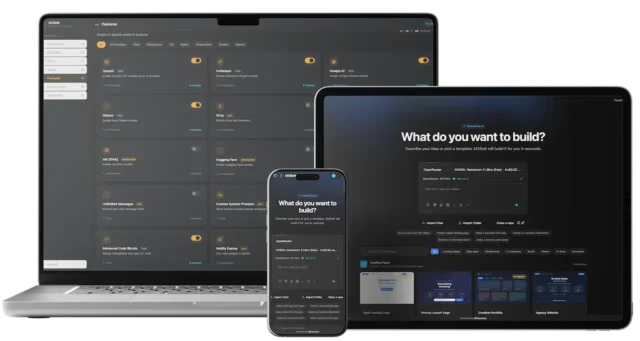
8 ready-made AI platforms24 AI and data services100% source code ownership6 working days to launch
One app, many services
Rides, food, delivery and payments in a single super app, with one wallet and one operations console.
All 6 in Super App →Move people, profitably
Driver and rider apps, dispatch, fare rules and payouts, tuned for city-scale operations.
All 5 in Ride Sharing →Everything to the door
Food, grocery, pharmacy, parcel and alcohol, with dispatch, live tracking and courier payouts.
All 35 in Delivery →The platform underneathWhite Label Food Delivery AppWhite Label Load Board Software
Book a professional in minutes
Home services, healthcare and freelance work, with scheduling, quotes and escrow.
All 13 in On Demand Services →The platform underneathWhite Label AI Astrology Platform
Supply, demand, and the listing in between
Rentals, ecommerce, travel and jobs, with search, inventory and governed payouts.
All 31 in Listings →The platform underneathWhite Label Marketplace SoftwareWhite Label Vacation Rental SoftwareWhite Label Yacht MarketplaceWhite Label Travel Portal
Where audiences gather
Social feeds, messaging, file sharing, AI assistants and website builders.
All 28 in Networks →The platform underneathWhite Label Live Streaming AppWhite Label Messaging App
Attention, monetized
Video on demand, short form, creator subscriptions and betting.
All 16 in Entertainment →The platform underneathWhite Label Video Streaming PlatformWhite Label Micro Drama AppWhite Label Short Video AppWhite Label Creator Monetization PlatformWhite Label Sports Betting Software
Money that moves
Neobanking, brokerage, investment and cross-border remittance, built for compliance.
All 8 in Finance Investment →The platform underneathWhite Label Trading Platform
Exchanges, tokens and NFTs
Spot and P2P trading, launchpads and NFT marketplaces with custody and KYC.
All 13 in Blockchain →The platforms underneath
White Label Food Delivery AppWhite Label Load Board SoftwareWhite Label AI Astrology PlatformWhite Label Marketplace SoftwareWhite Label Vacation Rental SoftwareWhite Label Yacht MarketplaceWhite Label Travel PortalWhite Label Live Streaming AppWhite Label Messaging AppWhite Label Video Streaming PlatformWhite Label Micro Drama AppWhite Label Short Video AppWhite Label Creator Monetization PlatformWhite Label Sports Betting SoftwareWhite Label Trading Platform159 launch-ready platforms across 10 categories, each shipping in 6 days with full source code.
Twenty-five sectors, each with its own page naming what we have already shipped into it and what we would build from zero.
Buyer-to-Broker Yacht Marketplace, Charters & Marine Services
A white label yacht marketplace published under your brand: buyers filter by real vessel specs, brokers work a staged lead pipeline instead of an inbox, and eight marine service lines earn beside every listing.
Go Live in 6 Days with 60 Days Tech SupportComplete Source CodesComplete RebrandingComplete WhitelabelingApp Publishing SupportFree 1 Year Updates
⚡ The Build at a Glance
Revenue Levers
dealer plans, upgrades, lead fees, shows, tools, licensing
Service Lines
charter, insurance, transport, finance, survey and more
Revenue Share
the source is yours outright, no per-seat fee
User Roles
guest, buyer, seller, broker and admin dashboards
Each enquiry is logged with its source, stage and first-reply time, so a slow broker shows up on the dashboard.
Over forty vessel fields from beam and draft to engine hours and rig, plus video and a full price history.
🚀 Ready to put a yacht marketplace under your own name?









Try Every Role
Every role has a live login and needs no setup. Search the stock as a buyer and send an enquiry, then switch to the broker desk to stage it, and open the operator console to see the same lead from above. That round trip is the quickest way to judge the platform.
BUYER WEB APP
What your buyers use, across 46 routes: technical and map-radius search, full-screen galleries with video, side-by-side compare, favourites, saved searches with a chosen alert cadence, enquiry forms and a signed-in message inbox.
BROKER WORKSPACE
The broker's working day: a listing manager with photo and upgrade control, a kanban enquiry board with stages and notes, replies scoped to each enquiry, client records with budgets and shortlists, LeadSmart answers, the listing optimizer and response-time reports.
ADMIN CONSOLE
Where the platform is governed: users and brokerages, listing moderation, plan editing with activate switches and subscriber counts, taxonomy and settings, the eight marine service desks, articles and FAQs, tickets, disputes and the analytics dashboard.
ANDROID APP
The Expo React Native app, with tabs for Home, Search, Favourites, Messages and Account and screens for listings, brokers, charter, boat shows, surveyors, valuations, compare and each role's dashboard, all calling the same API as the web app.
See It Run
One ordinary lead from start to finish, rather than a feature reel. A search narrows by length, draft and price, a listing opens to its gallery, spec sections and price history, and the buyer saves the search with a weekly alert before sending an enquiry. That enquiry lands on the broker’s kanban board, where it gets a stage, a threaded reply and a curated shortlist on the client record. The operator console closes it out: a listing held for moderation, a plan being edited, and fresh intake in the insurance and transport desks.
The Full Interface
Screens from every side of the marketplace: faceted results with range filters, the listing page with gallery, specs, price history and broker details, compare, the saved-search and alert manager, the buyer inbox, the broker’s listing manager and kanban board, client records with shortlists, LeadSmart review, market evaluation and reports, and the operator console with moderation, plans, taxonomy and the eight service desks.

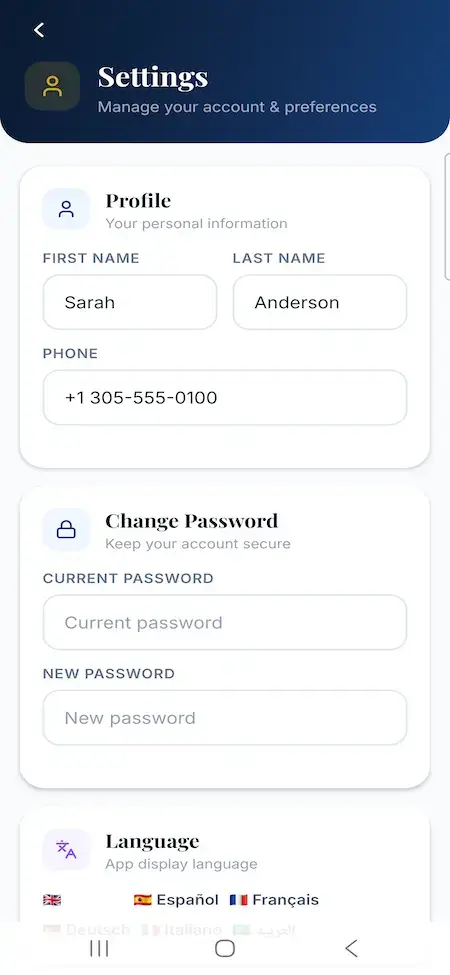
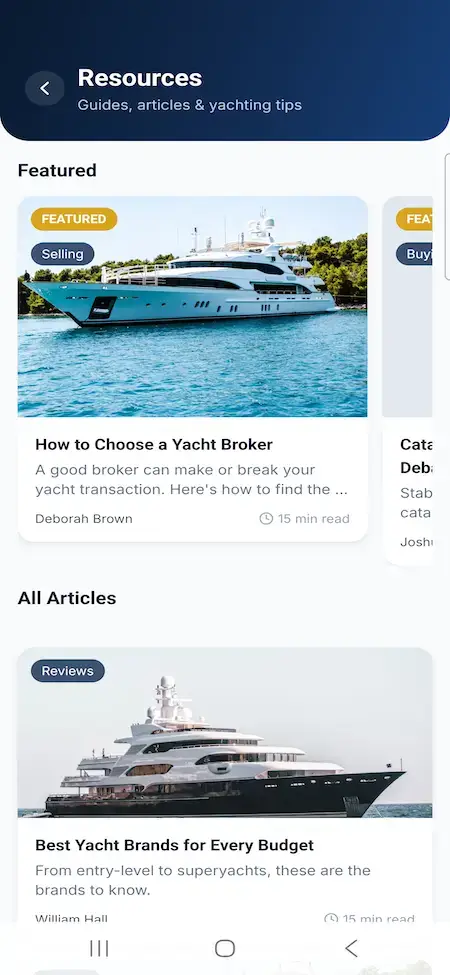
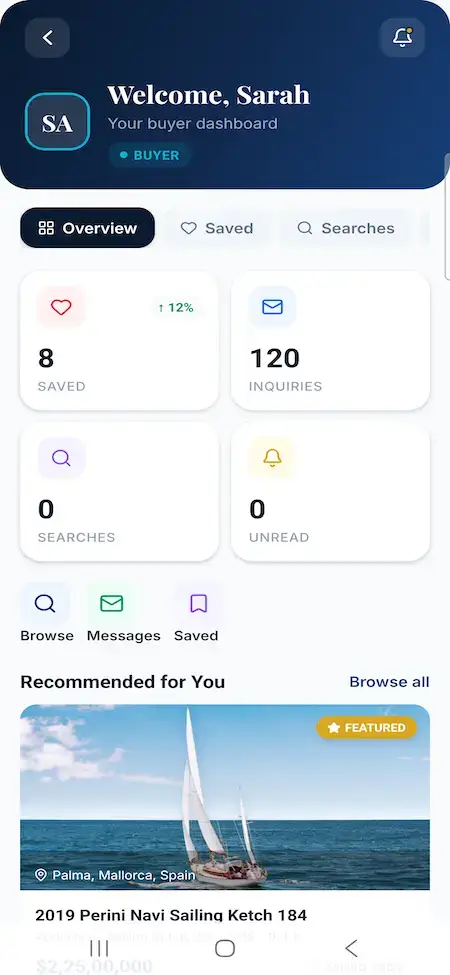
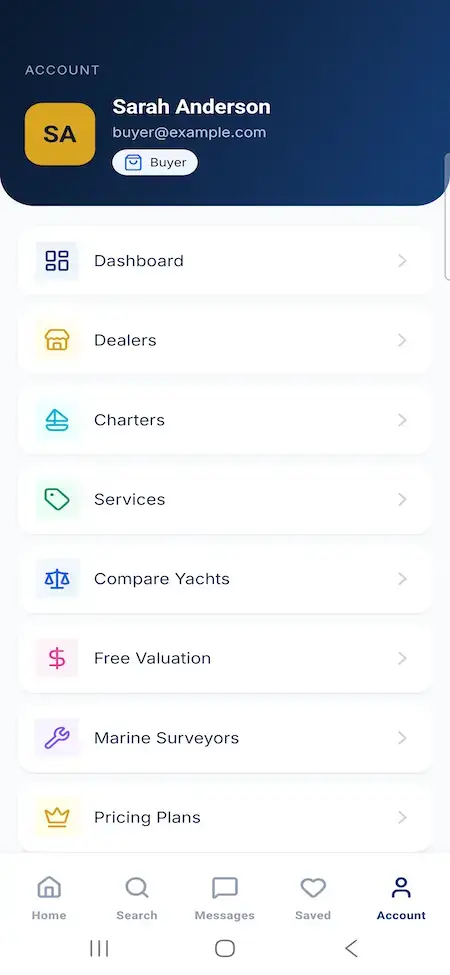
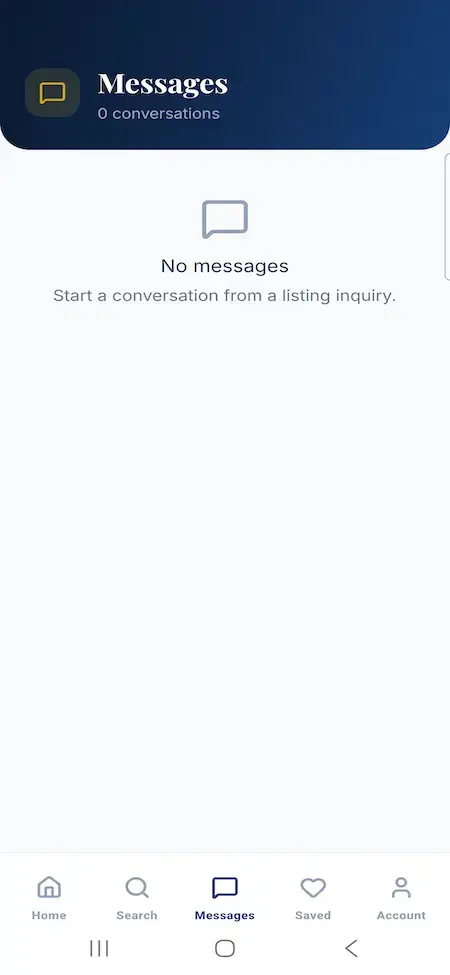
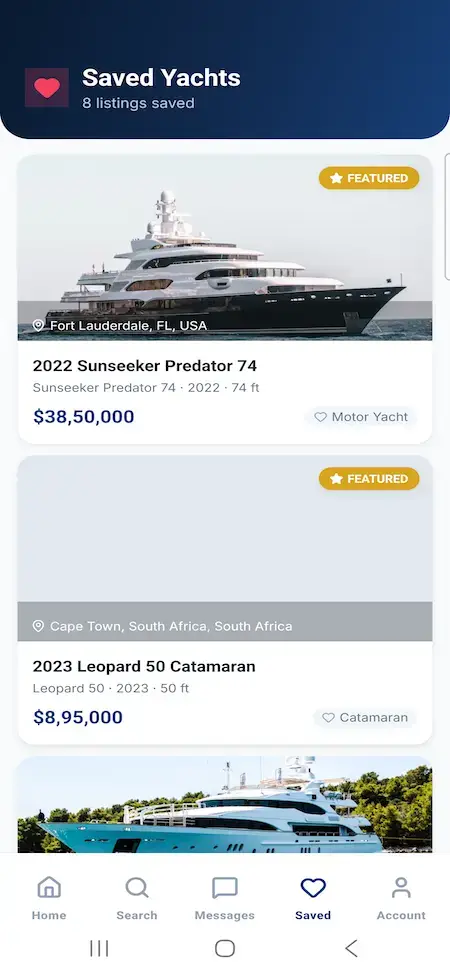
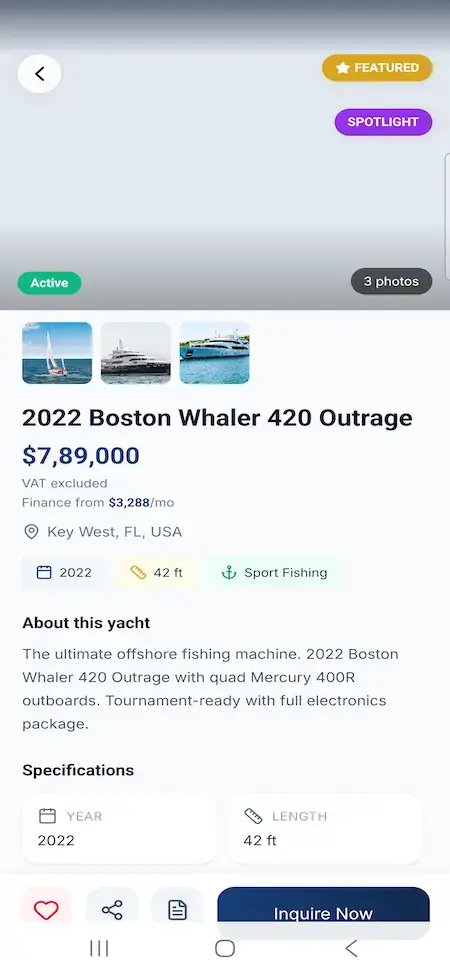
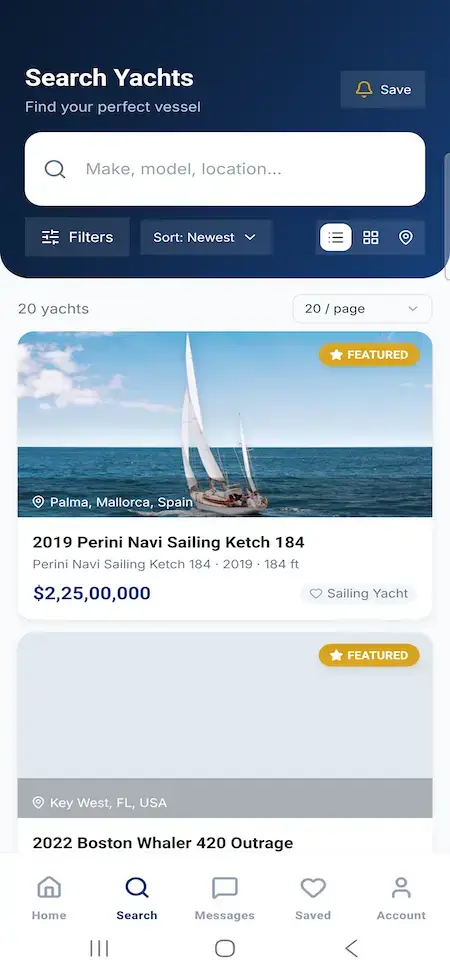
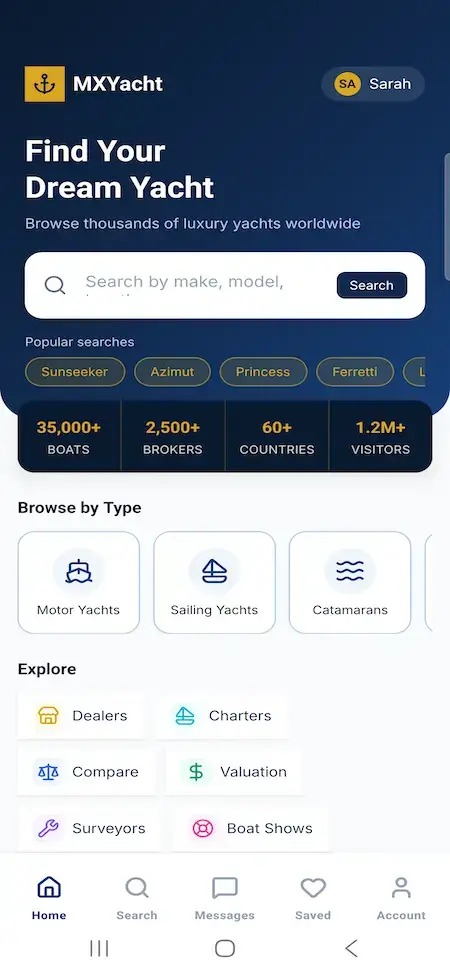
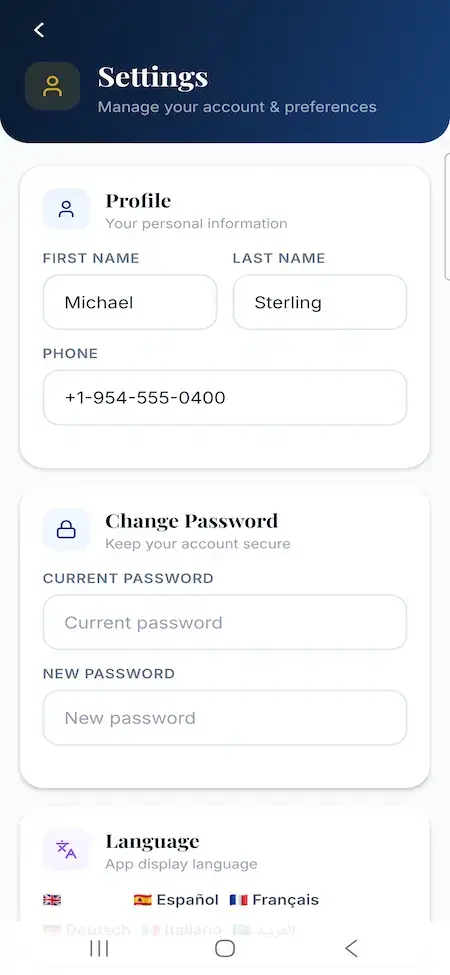
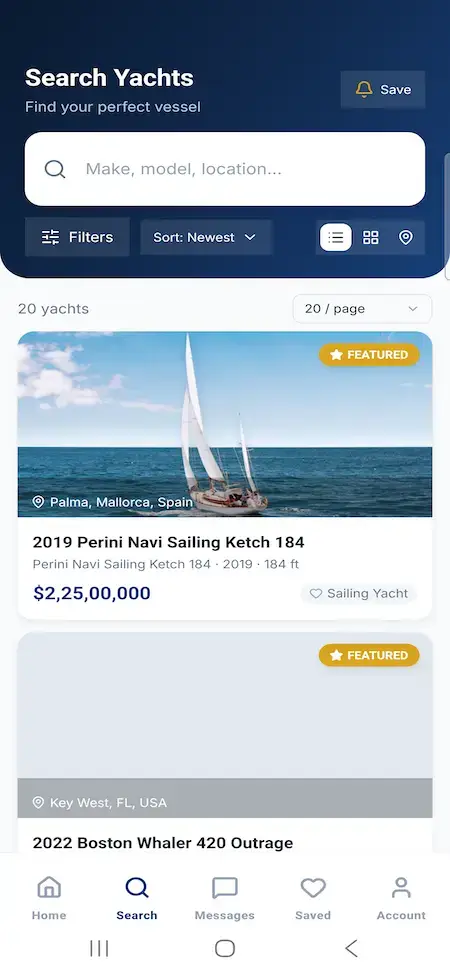
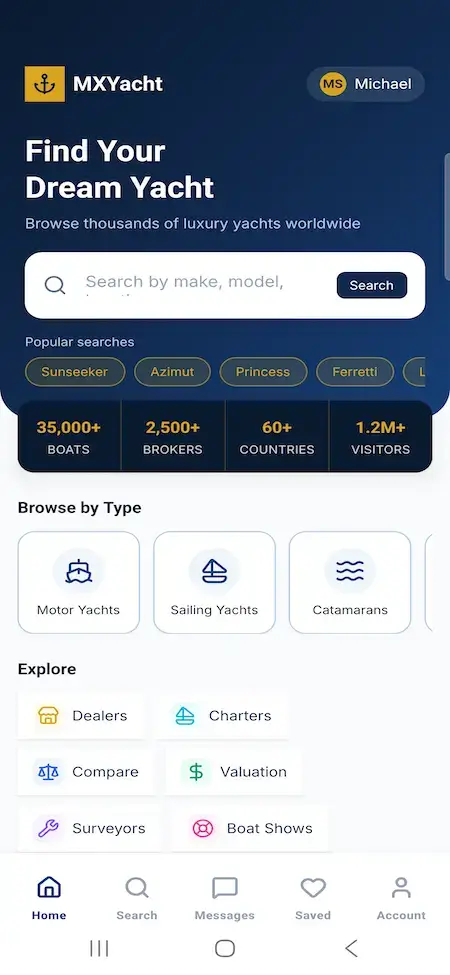
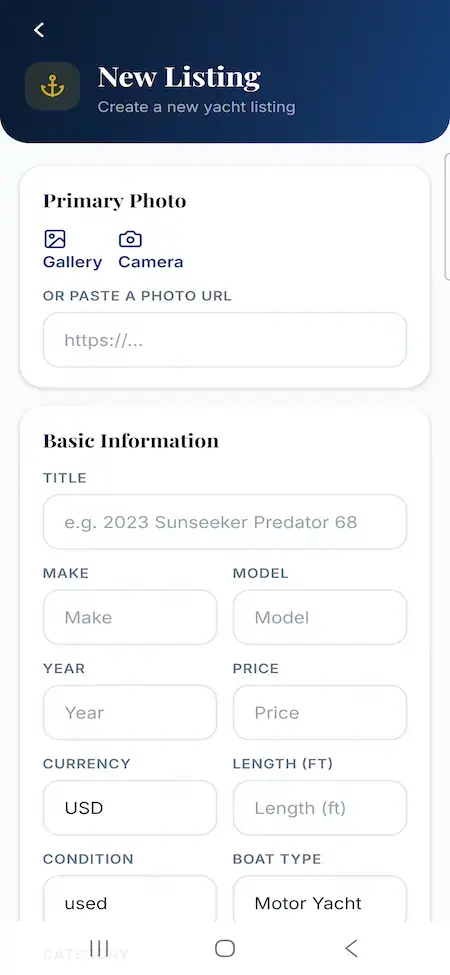
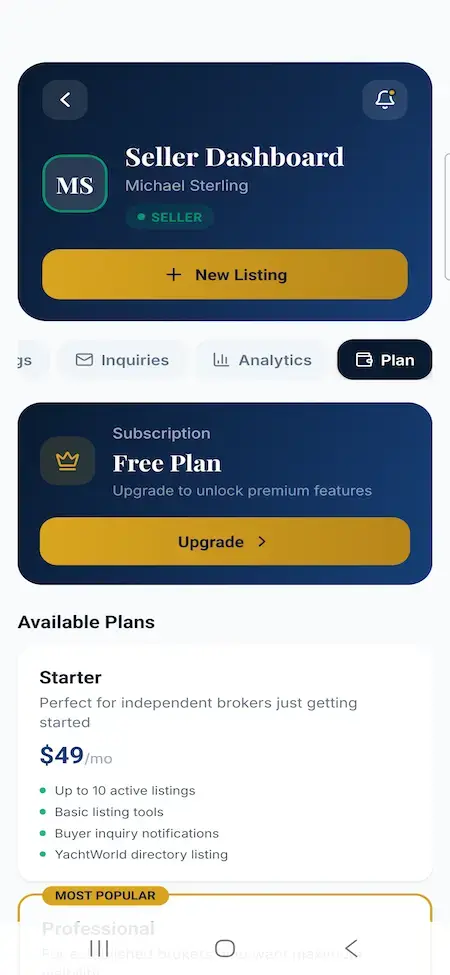
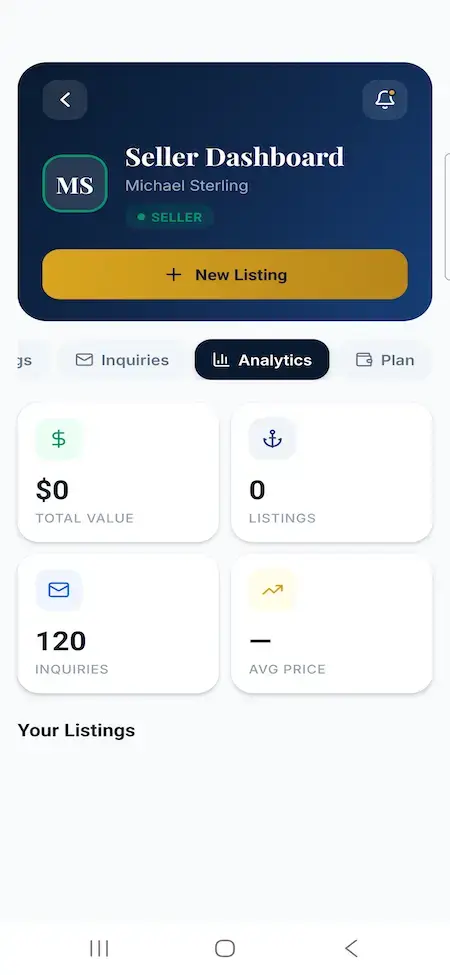
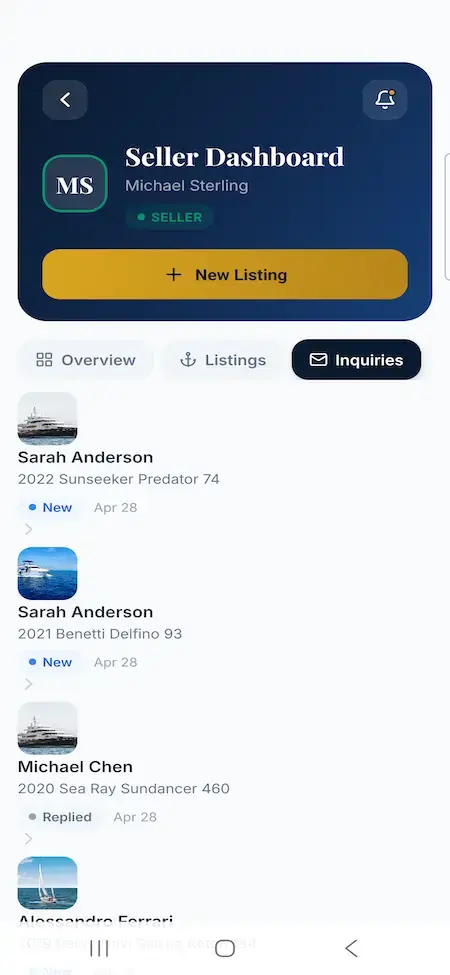
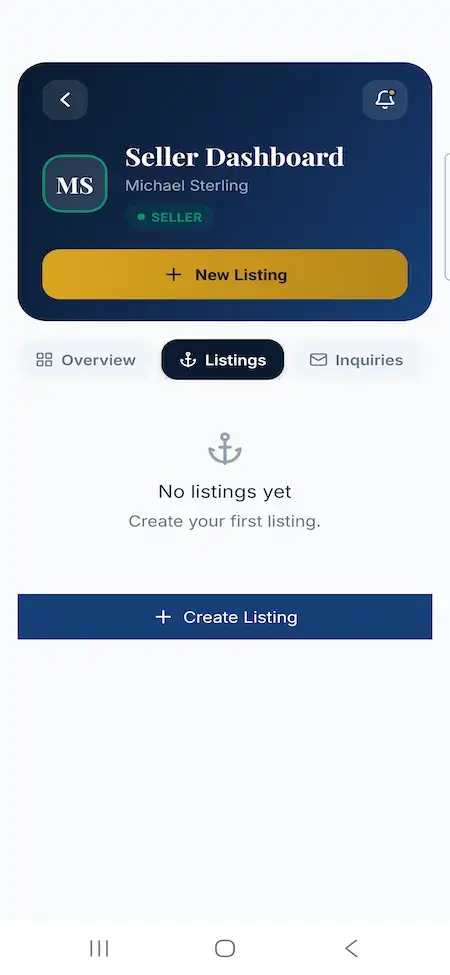
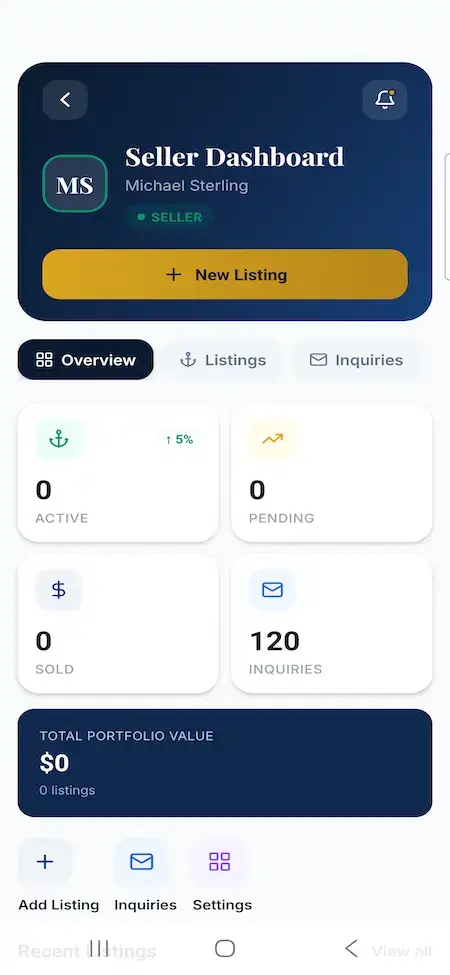
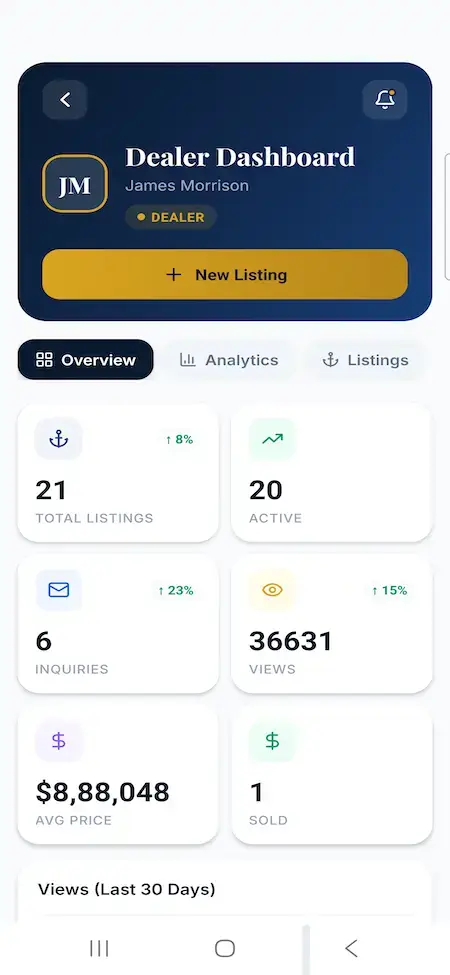
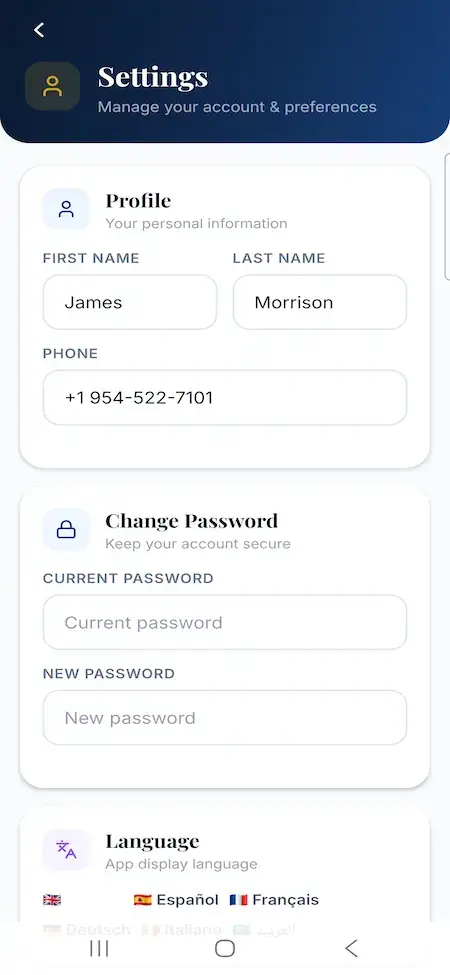
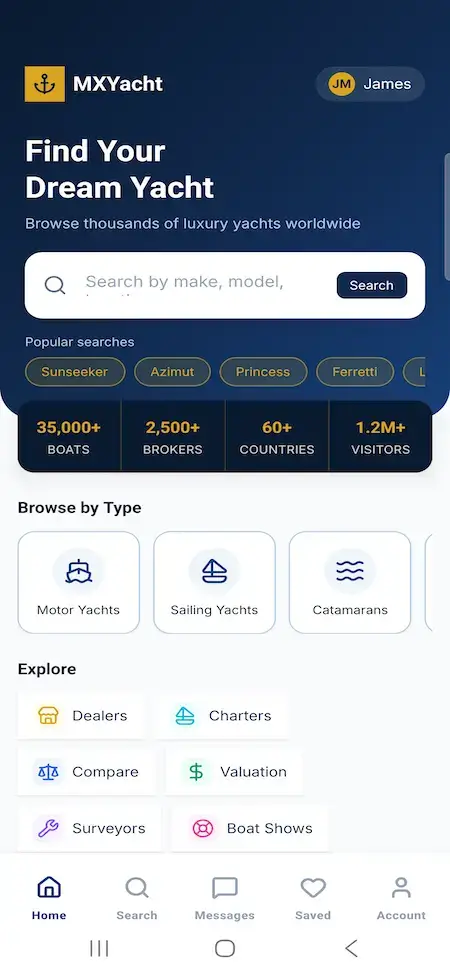
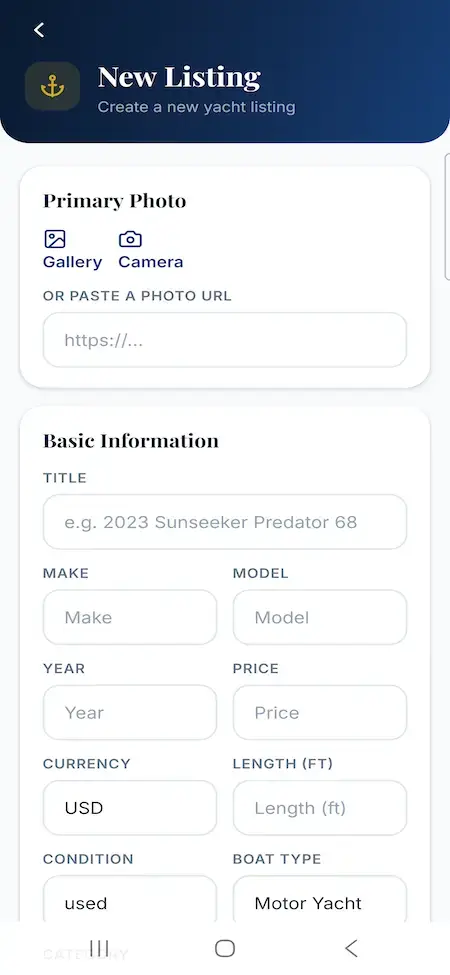
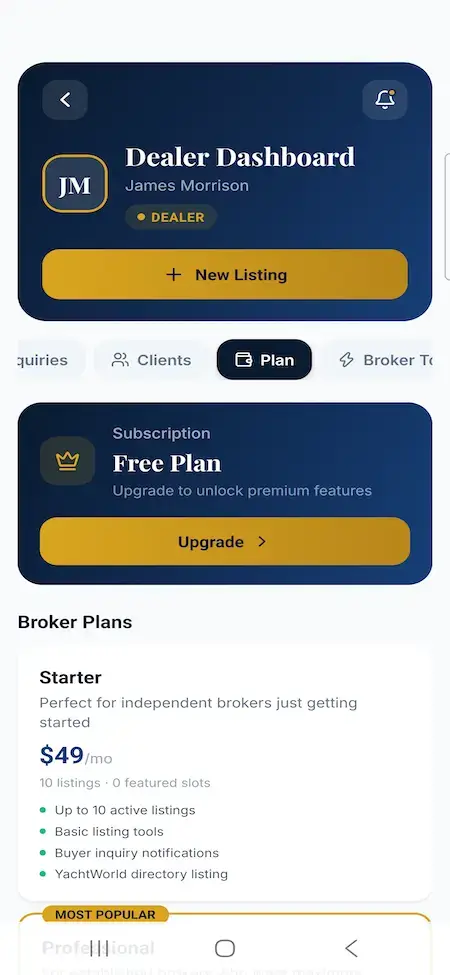
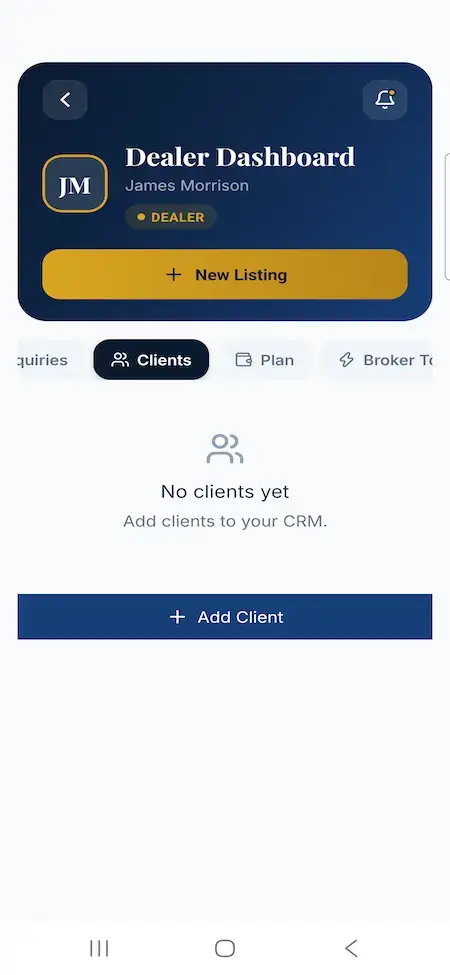
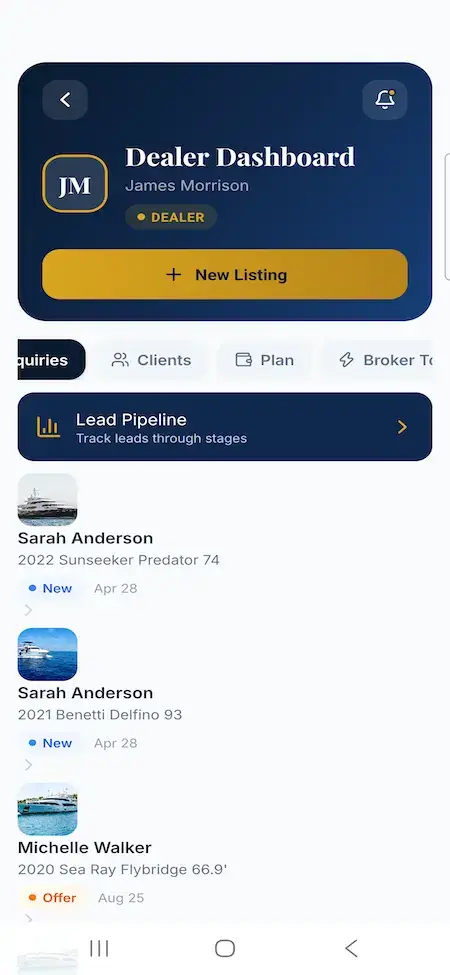
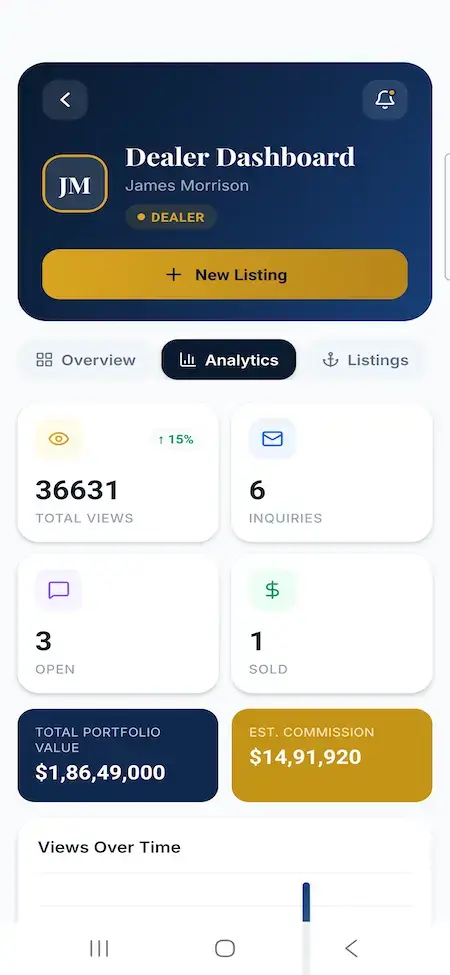
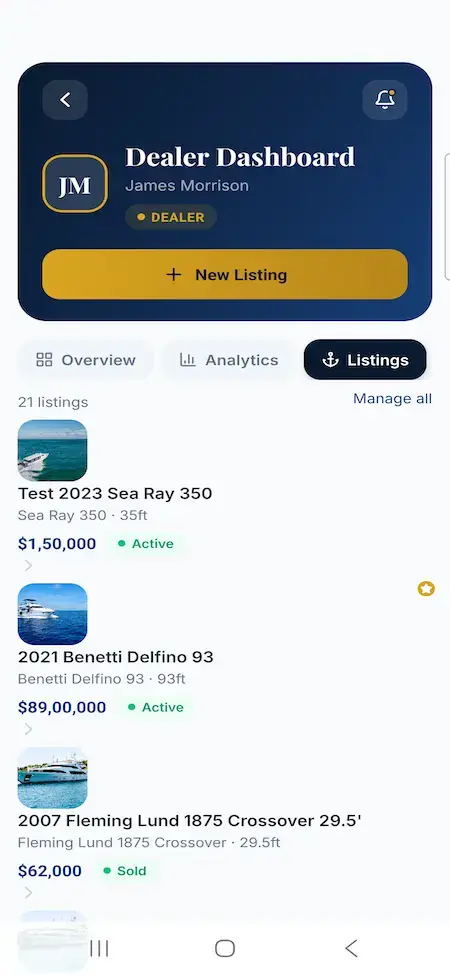
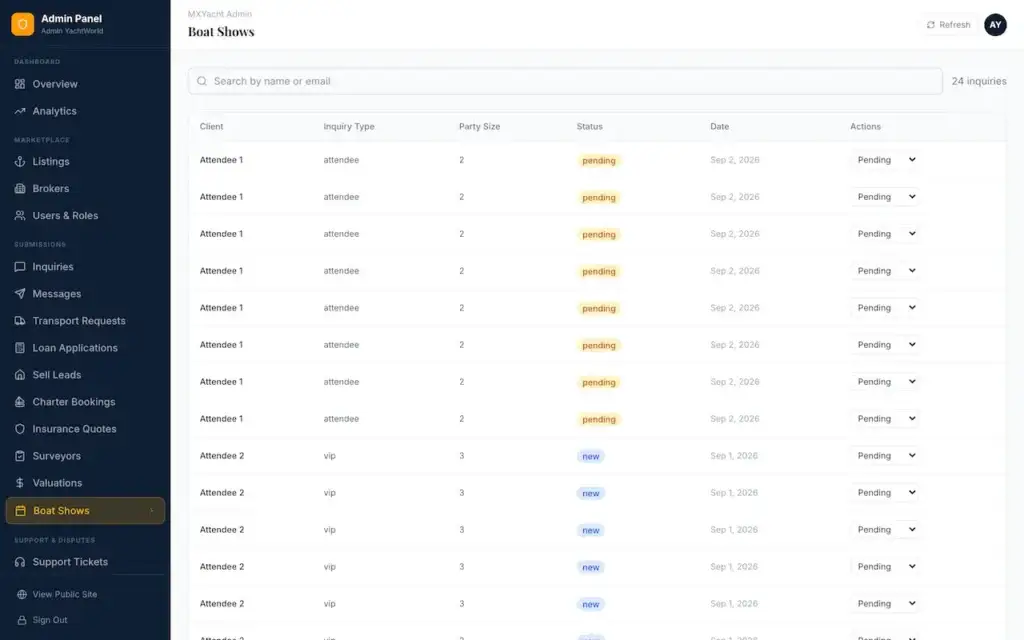
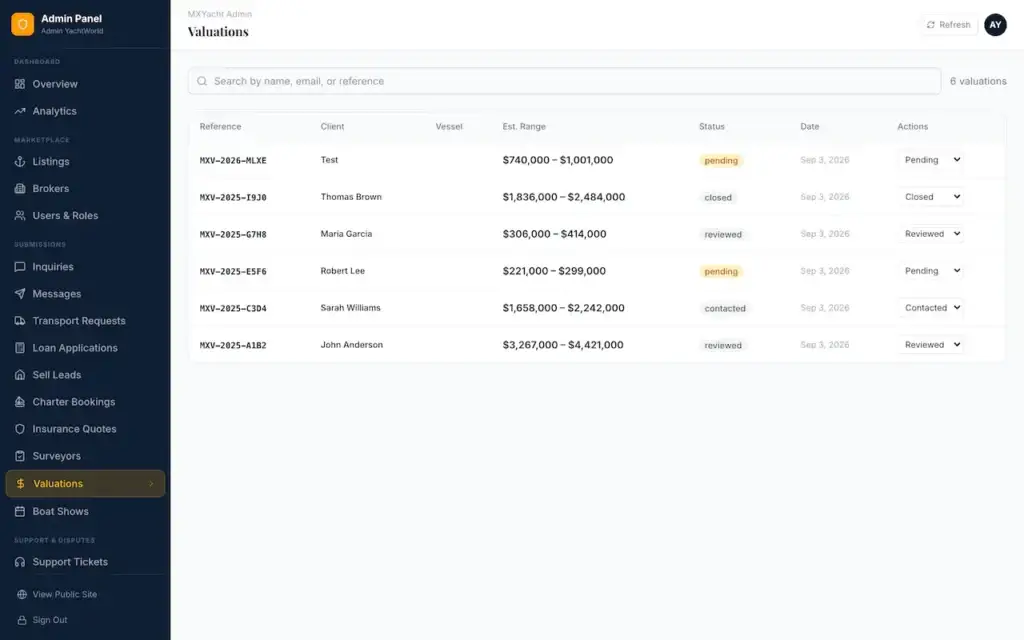
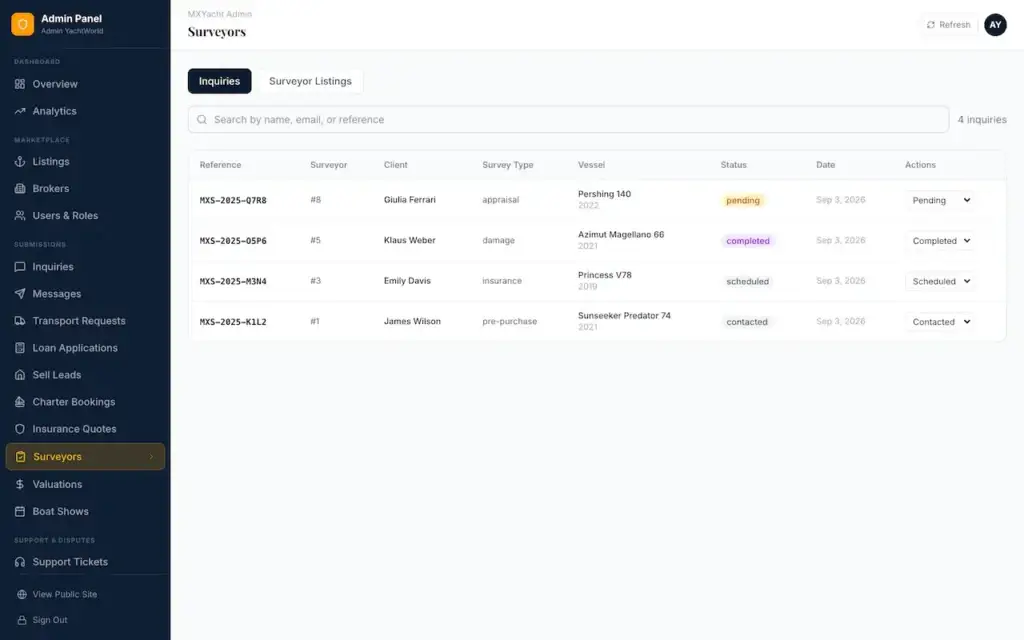
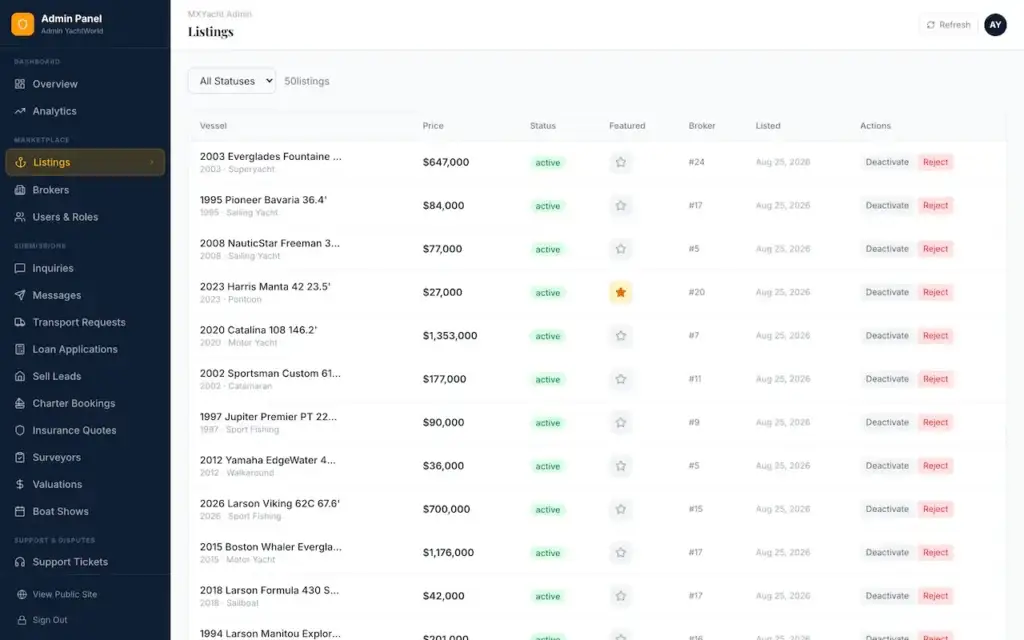
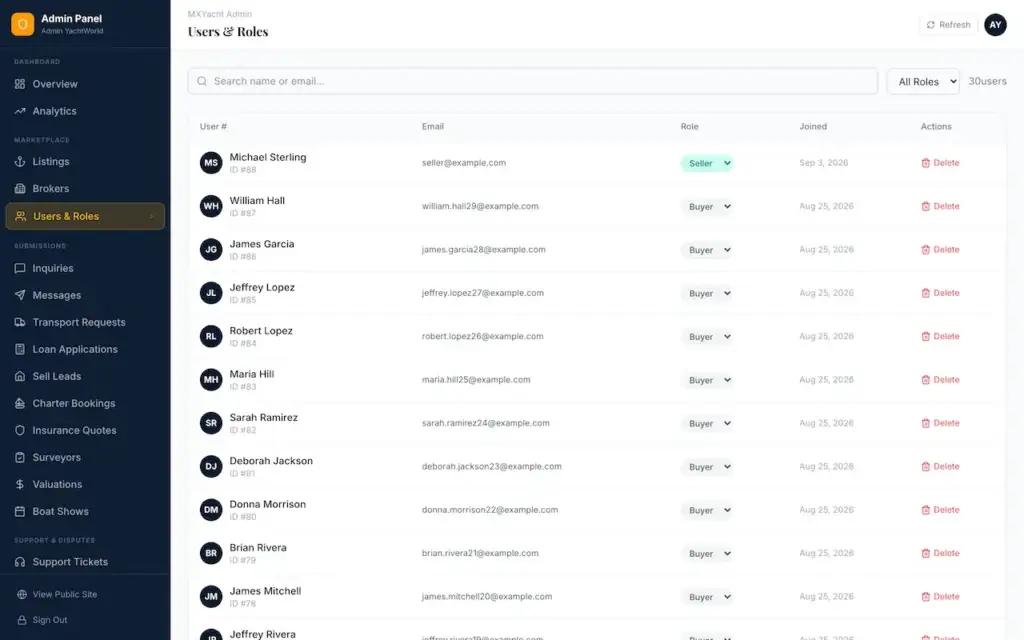
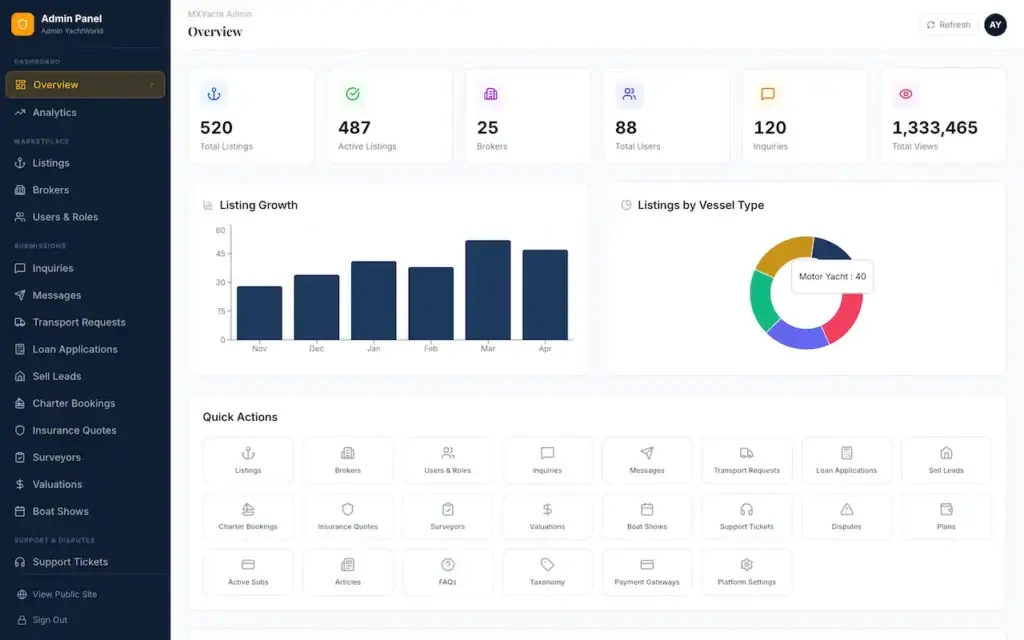
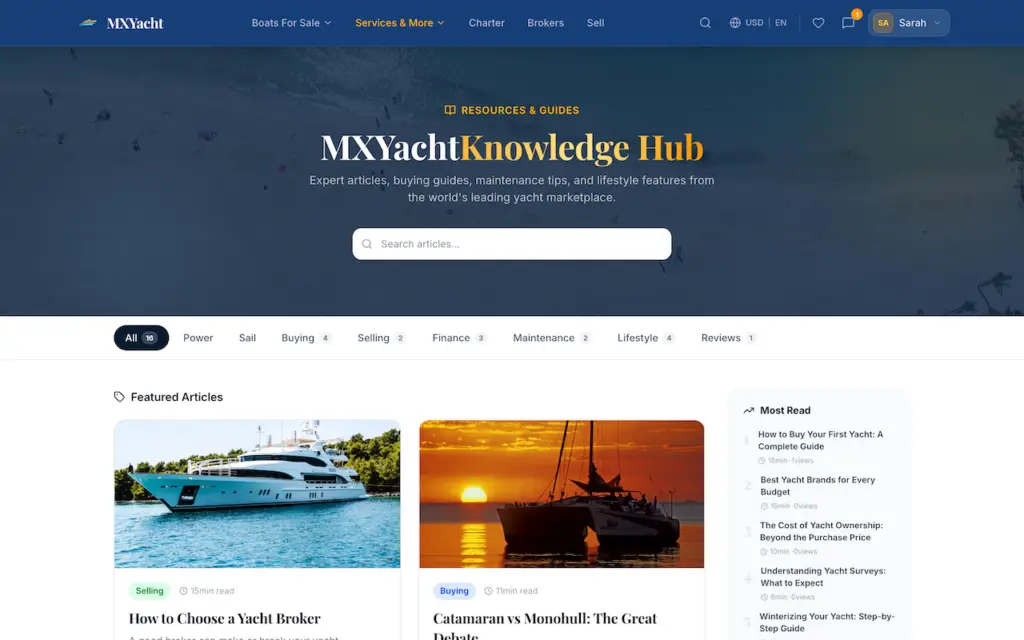
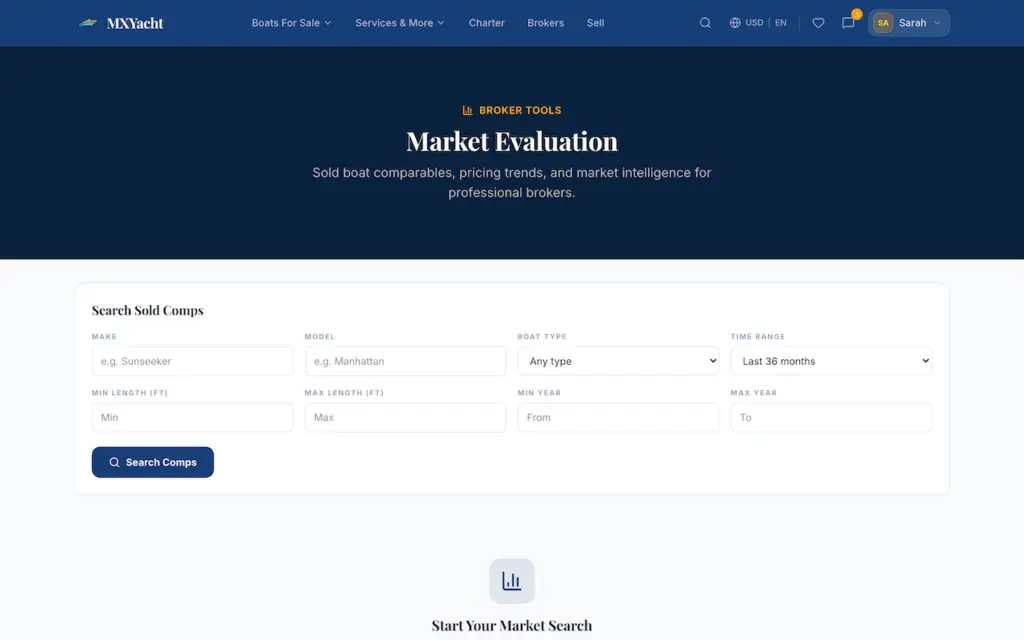
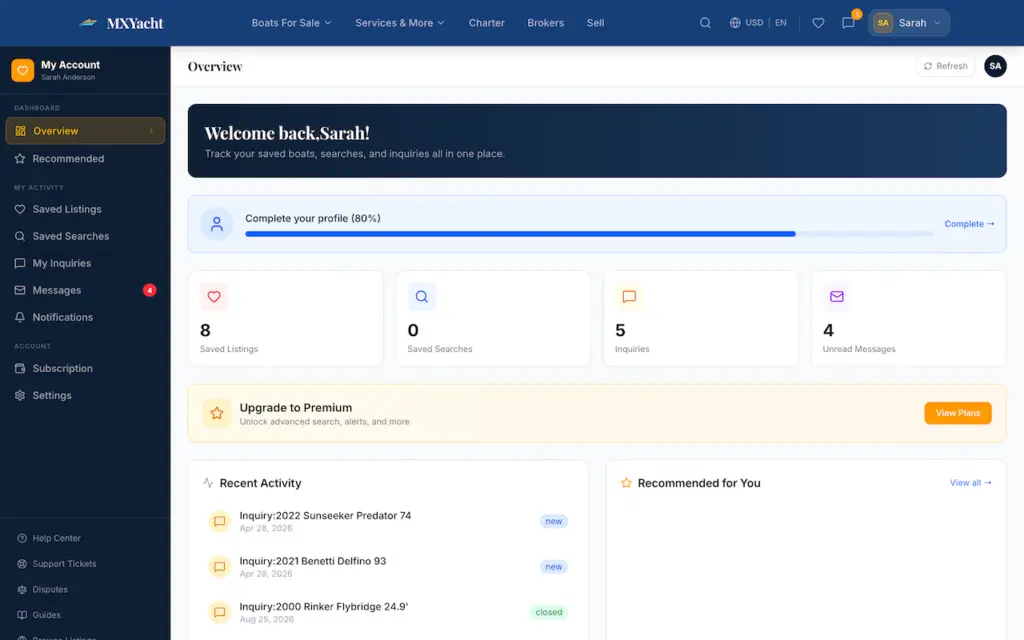
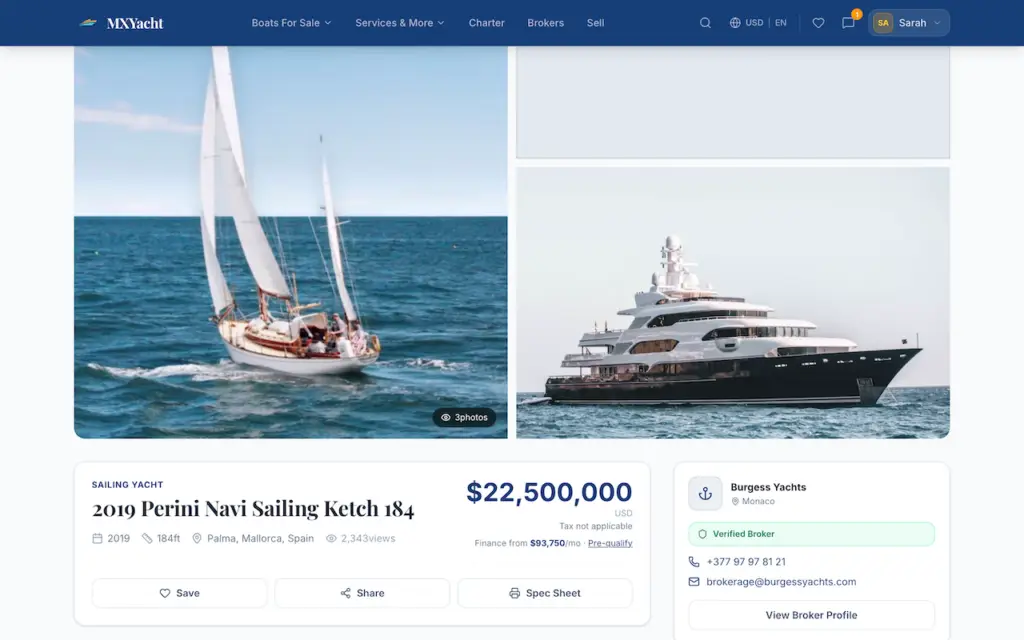
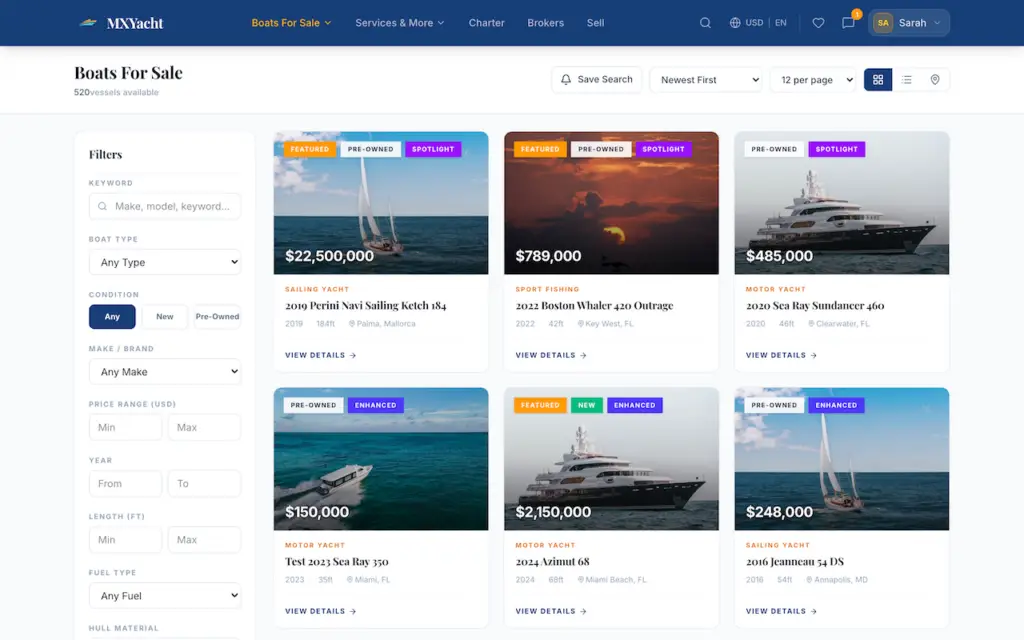
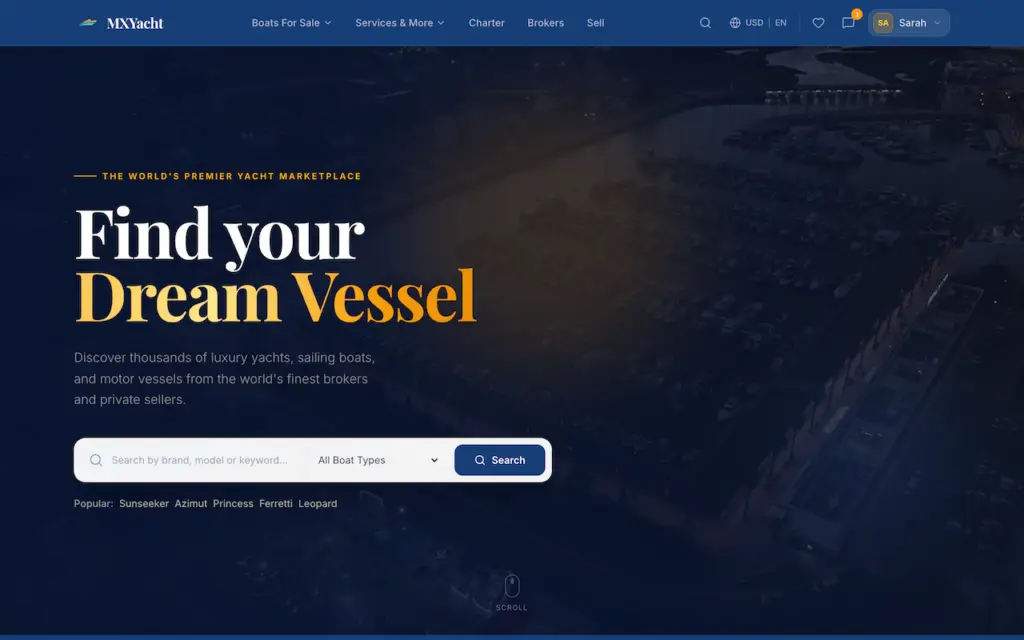
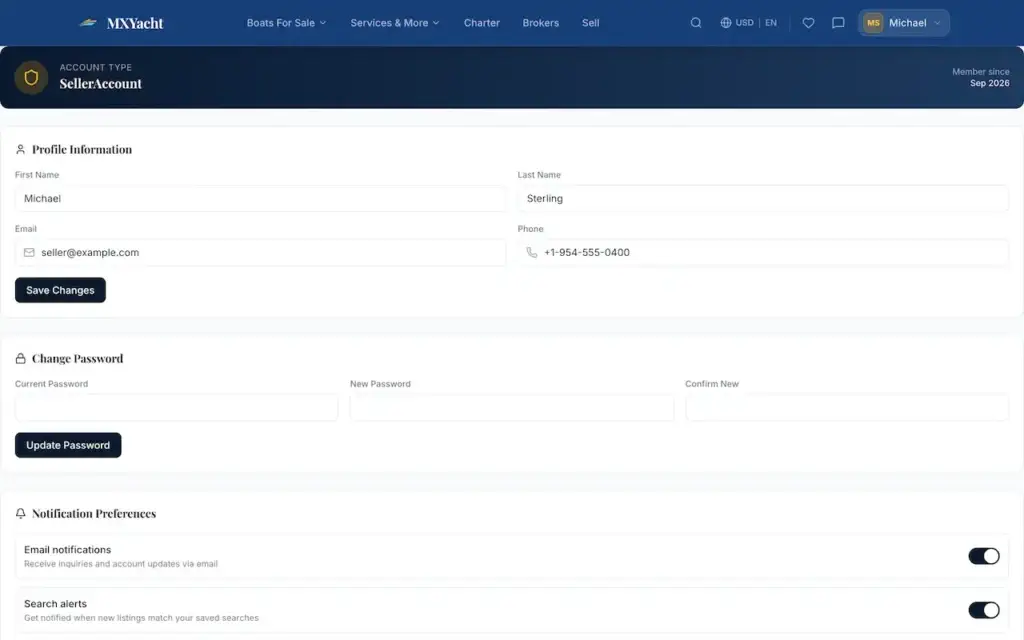
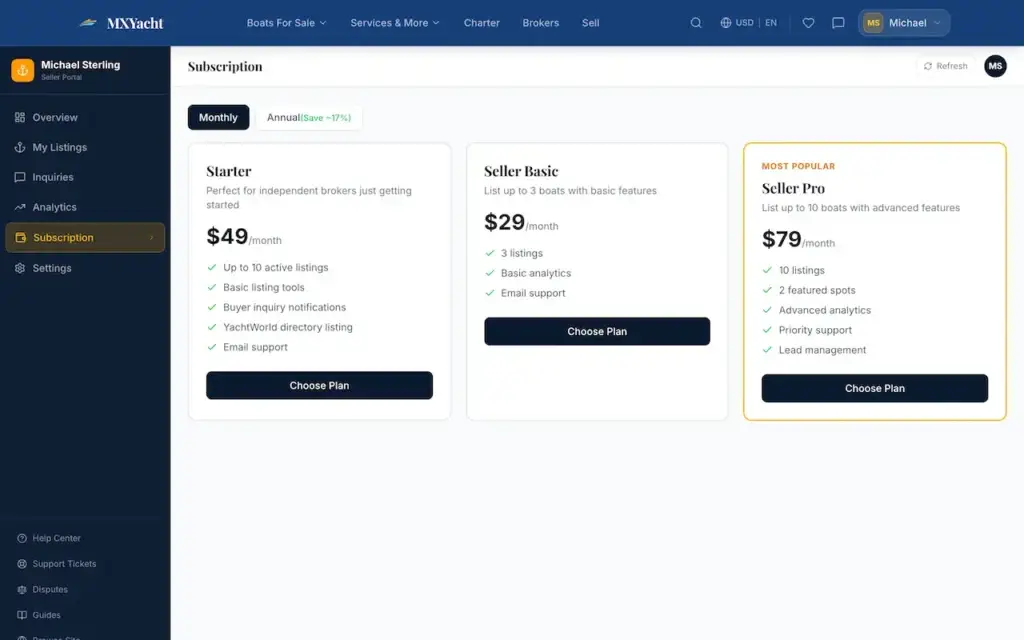
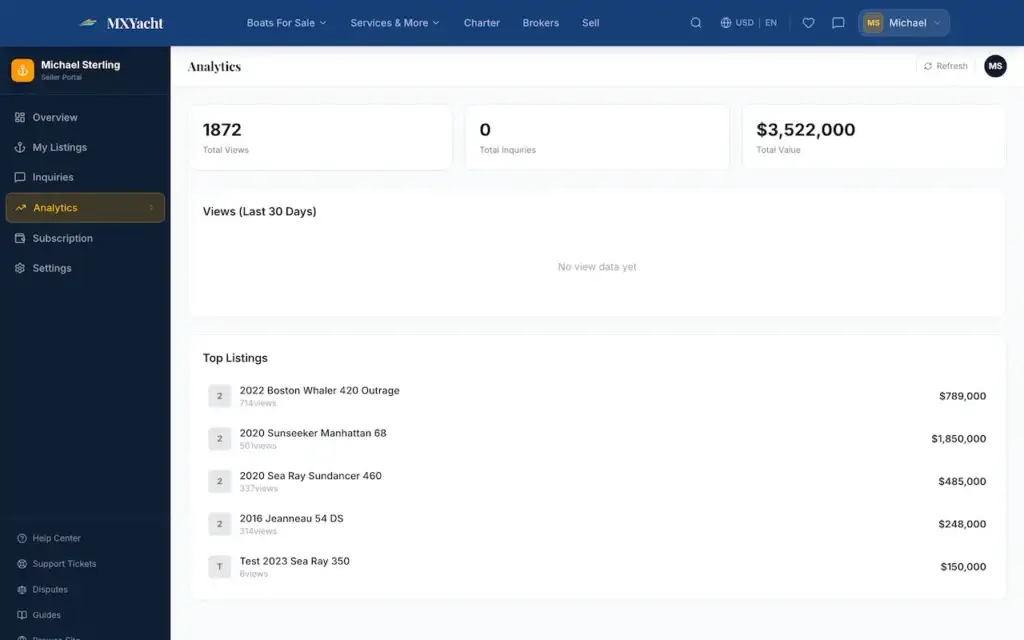
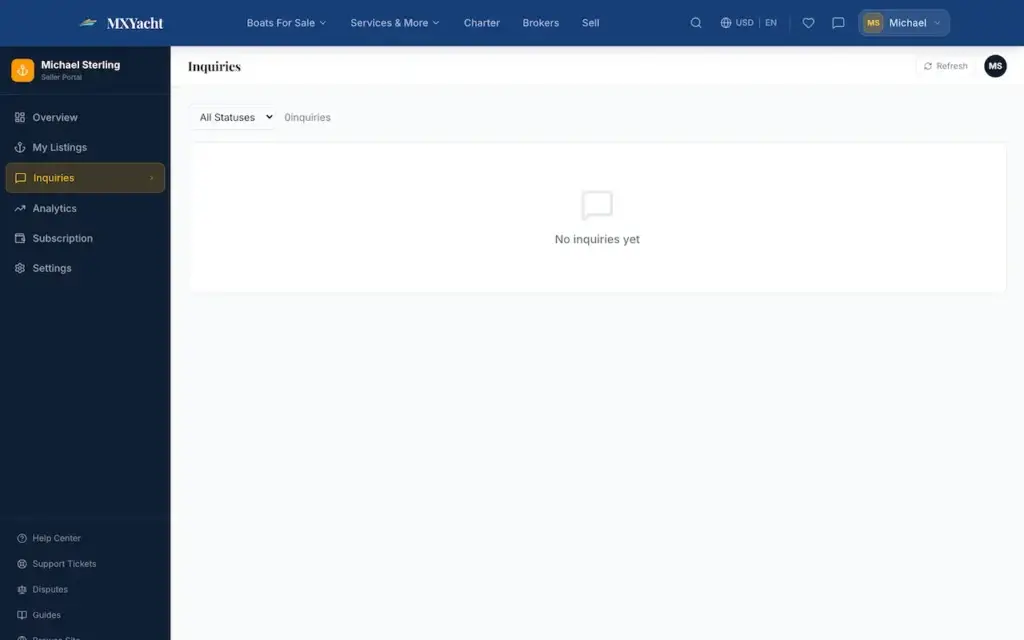
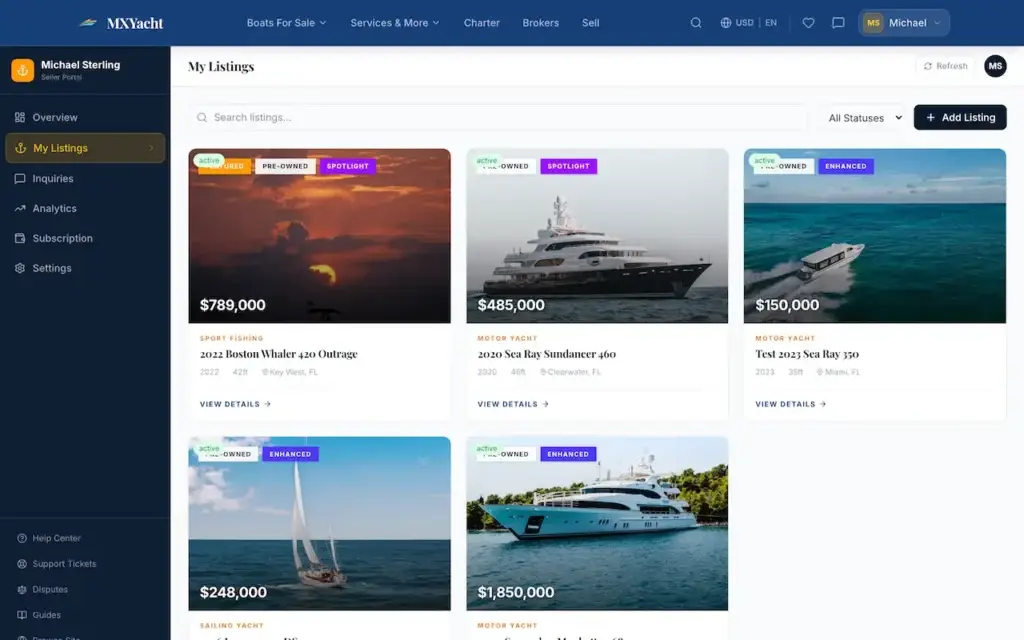
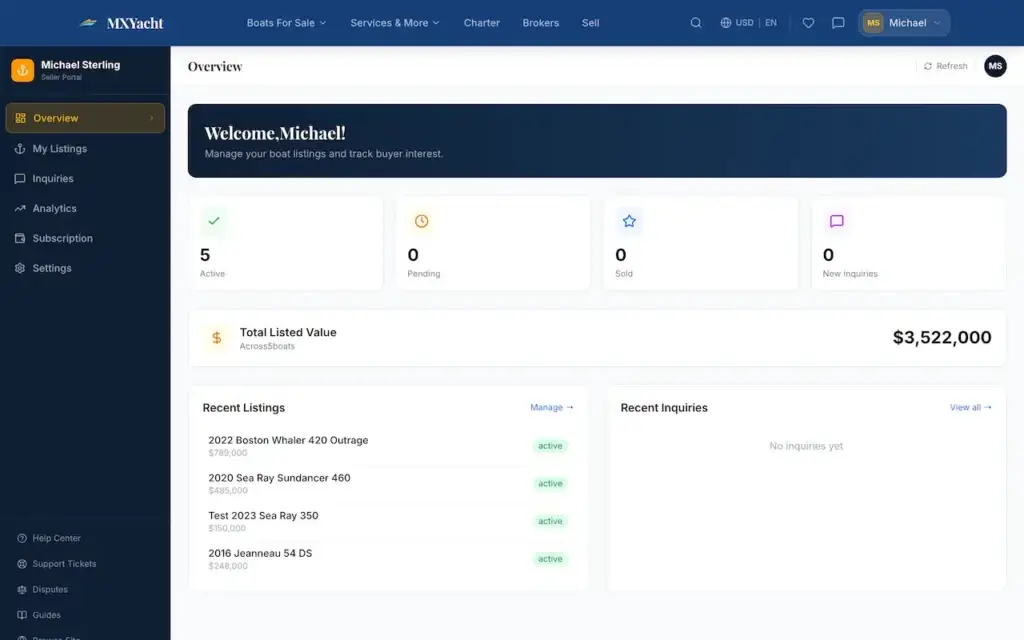
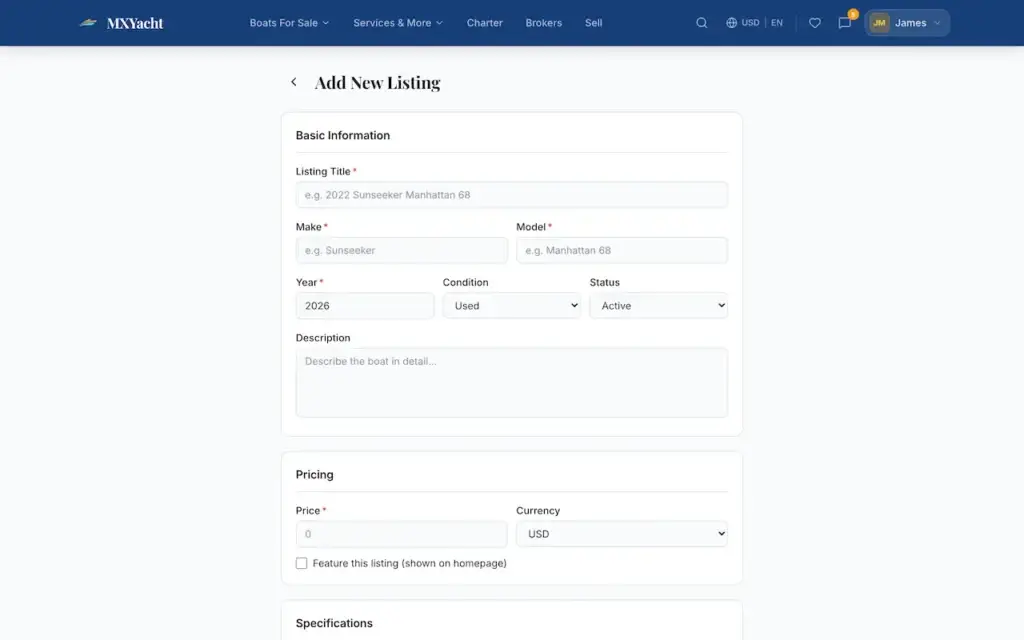
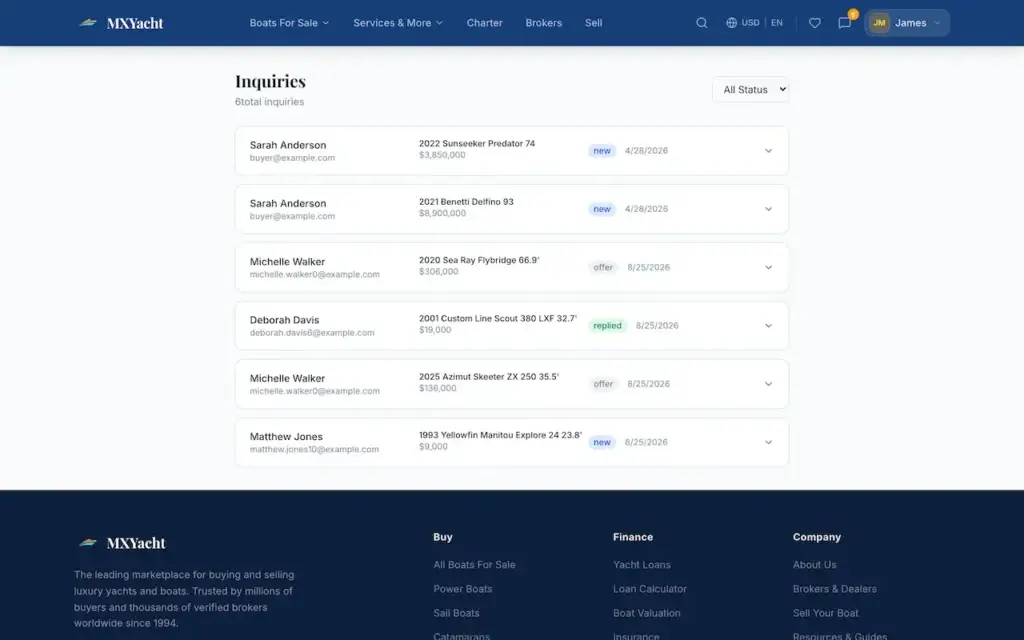
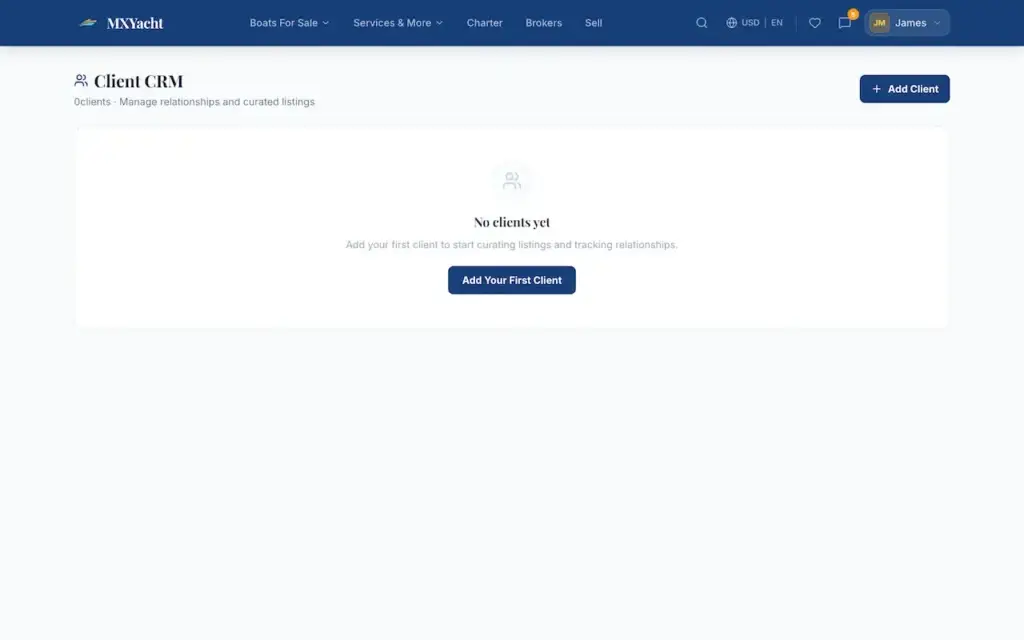
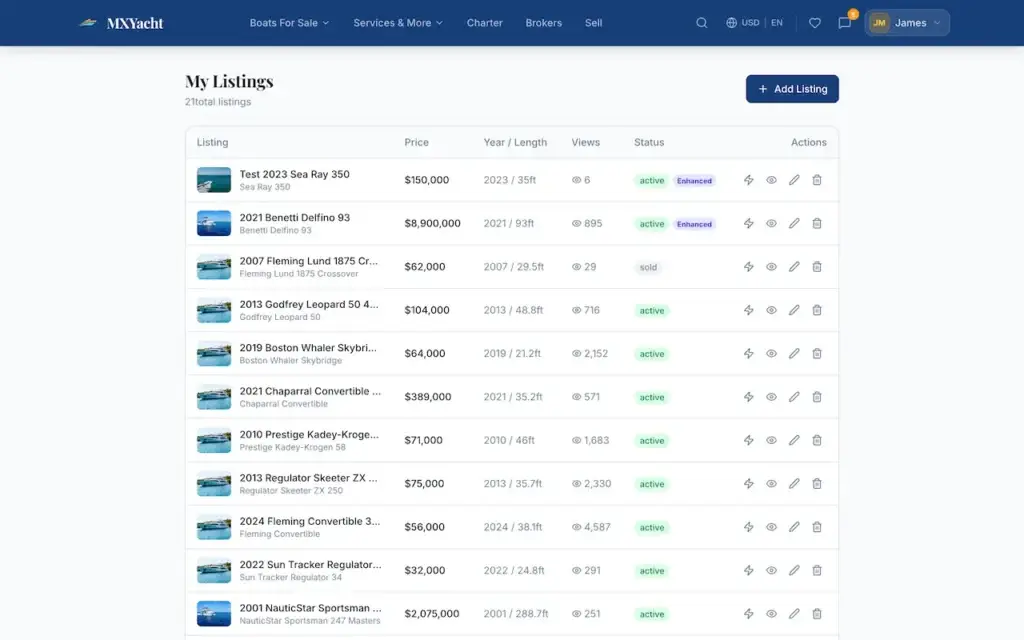
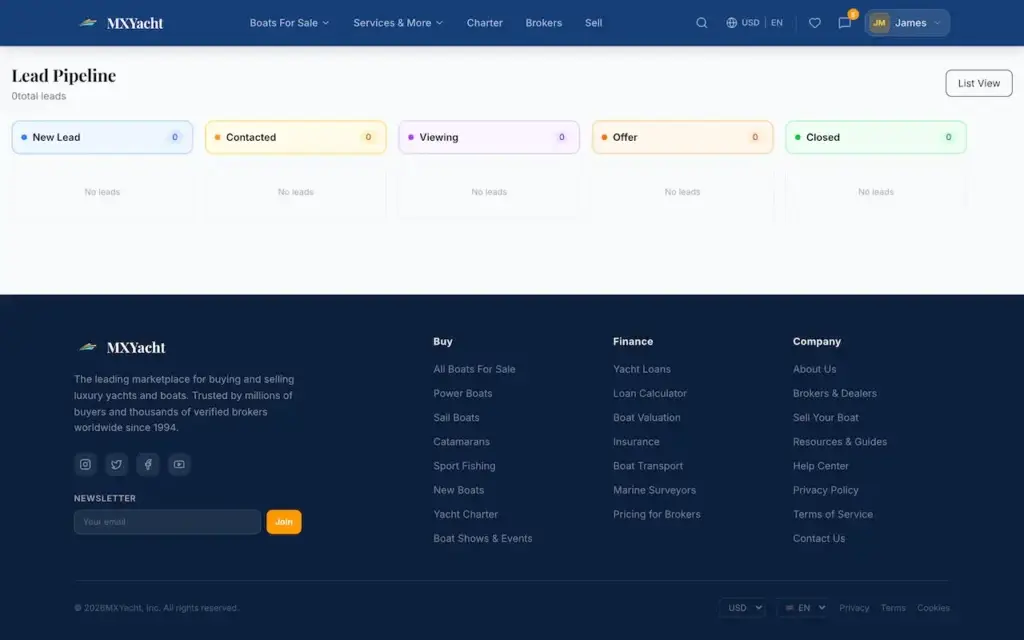
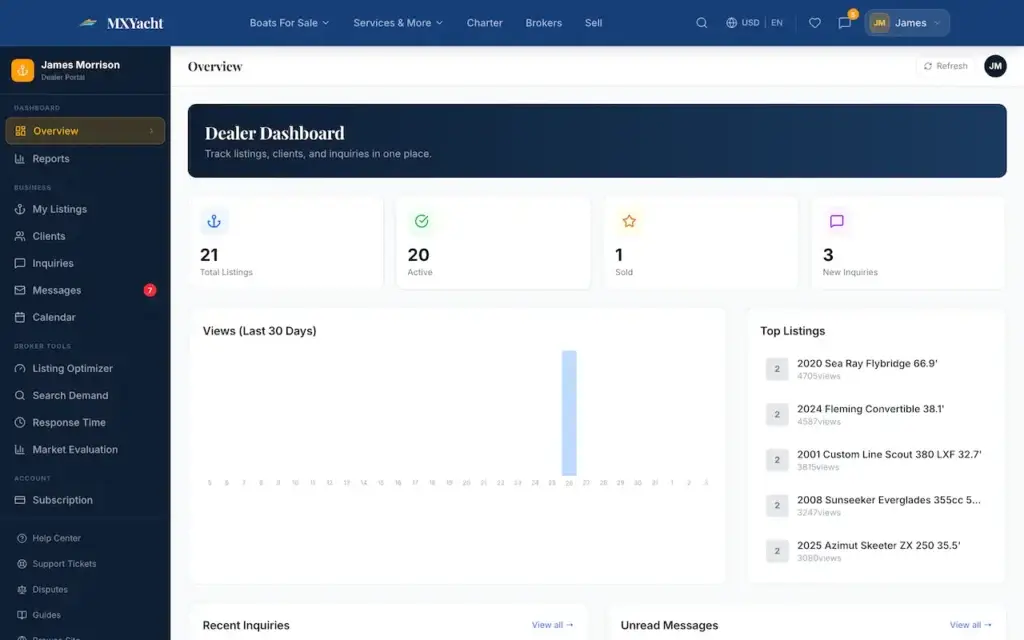
Trace one buyer from a first search through favourites, compare, a saved search, an alert match, an enquiry and the LeadSmart questions, then pick the same lead up on the broker desk as it is staged, answered and given a shortlist. Web and mobile share one API, so an enquiry sent from a phone appears on the broker board with no second integration. For a guided look at one flow, book a call and we will open it with live data in it.
No Borrowed Proof
Our portfolio includes marketplace, rental and listing builds, each published with its own figures. None of them is a marine brokerage yet, so instead of lending this page proof from a different product, what follows are properties of the software, each one checkable in the demo above.
A Worked Example
A modelled reference showing how the platform is set up for a brokerage group running its own branded marketplace. It is not a client engagement, and every figure describes the software rather than a result a customer reported.
Marine Sector
Branded Brokerage Marketplace
A brokerage group whose leads arrive by email and chat apps moves stock, enquiries, client records and marine services into one branded system instead of five.
This is a modelled reference deployment, not a client engagement. Every capability listed above ships in the base build and is demonstrable in the live demo. The figures are properties of the platform, not results reported by a customer.
Start Here
A white label yacht marketplace is a finished marine marketplace you publish as your own. Buyers filter vessels by make, length, draft, engine hours and location, line up a shortlist side by side, save searches that email fresh matches, and send enquiries that arrive as structured leads rather than loose emails. Brokers keep their stock current, move each lead through stages, answer inside a thread and attach alternatives from their own client files. The operator moderates supply, sets the plans and runs eight marine service desks.

A listings grid is the easy part. What this adds is the lead lifecycle, the broker's client records and the service desks - the pieces a classifieds template leaves you to invent.
The whole monorepo, the Drizzle schema and its migrations transfer to you. There is no seat fee, no dependence on our roadmap, and plain PostgreSQL underneath.
Hull material, keel, rig, displacement, berths and engine hours are real fields with their own filters. It is neither a property template relabelled for boats nor a charter booking tool.
Web, Mobile and One API
This category is hard in a few specific places, and those are the places already solved here: a listing record detailed enough for a seven-figure asset, search that mixes technical ranges with a map radius, a lead that keeps its history as it passes between people, and a console someone without an engineering background can run.

Buying and selling vessels is the centre of gravity. Charter is present, as one of eight service modules with its own catalogue and enquiry form, but this is a brokerage marketplace rather than a charter booking product.
In the Base Build
Everything below is built and can be tried in the demo. Where a feature needs a third-party account or a deployment decision before it runs in production, the note sits beside that feature instead of in small print.
Sign-up with a chosen role, JWT sessions, bcrypt-hashed passwords, reset and email verification for buyers, sellers, brokers and admins.
Two-factor sign-in, a GDPR export that leaves secrets out, deletion behind a password check, and brokerage checks on every broker route.
More than forty real fields covering identity, dimensions, machinery, accommodation, performance, tankage, rig and location.
Ordered, captioned photos, video tours, a zoomable full-screen gallery, share links, printable spec sheets and JSON-LD.
Three sale states with sold price and date, a price history that only appends, price-drop badges and upgrade flags that expire.
Keywords, taxonomy, numeric ranges and a map radius in one query, with facet APIs, sorting and stable paging.
Favourites, compare, named saved searches with an alert rhythm, the job that finds new matches, and recommendations.
Rate-limited capture with source and intent, stages, private notes, a kanban board and a measured first reply.
Threads tied to each enquiry, an inbox with unread counts, a live SSE stream with heartbeat, and Web Push once VAPID is set.
Client records owned by the brokerage, with budgets, status and private notes, and a shortlist of vessels attached to each.
LeadSmart qualification with an adjustable intent threshold, listing scores, response-time benchmarks, valuations and sold comparables.
Plans with limits, listing upgrades, and eight marine service modules, each with intake, a reference code and its own desk.
For buyers: each capability above can be switched on, switched off or renamed per deployment through plans, settings and taxonomy. If something you need is missing, it is usually still buildable. Tell us what your brokerage needs and we will scope it, fold in what fits the deployment, and quote the rest in writing.
Revenue Levers
A yacht marketplace earns from several lines at the same time, and each one is modelled on its own so you can adjust one without disturbing the rest. Broker subscriptions and listing upgrades carry the most weight: the first is recurring and predictable, the second grows with how much stock brokers want pushed to the front.
Tiers aimed at a chosen audience, with listing limits and featured slots set in plan JSON. Subscription records hold status, period and billing cycle, and the console edits plans and counts subscribers.
Spotlight and enhanced placements with start and end dates, shown in search and on the listing page. The per-listing upsell that sits beside the recurring plan.
Charter, insurance, transport, finance, survey, valuation and boat-show intake can be charged as referral fees, per-lead prices or lead bundles. The software supplies the intake and the desk; the commercial terms are yours.
Show pages with RSVP and interest capture feed an operator desk, which is what organizers sell exhibitor presence and lead packages against.
LeadSmart, the optimizer, response-time reporting and market reports fit naturally into upper broker tiers instead of being handed to every level.
Brand, taxonomy, plans, content, currency, language and active modules are all settings, so selling branded regional instances is a sales job, not an engineering one.
Where commerce stops: choosing a plan, billing-cycle records, checkout and cancellation are built, and invoice history is a generated six-row mock. Connecting a live provider such as Stripe or Adyen is a standard configuration step rather than a gap, and we quote it with your deployment.
Run by Operators, Not Engineers
The console covers users and brokerages, listing moderation, plans and packaging, taxonomy and settings, all eight service desks, content, trust cases and reporting. It is the part most marketplace builds postpone and never quite finish.
Total and active listings, brokerages, users, enquiries, messages, views and subscriptions, on one dashboard.
Six months of user and listing growth, calculated from stored records rather than a separate reporting copy.
Enquiry to message, message to sold and overall conversion, measured across the whole marketplace.
Listings, enquiries and plan value compared broker by broker, which makes performance reviews concrete.
Find, page, edit and remove users, plus brokerage records and the moderation of their listings.
Every listing in one collection, with moderation actions for stock that should not go public yet.
Create and edit plans, switch them on or off, see subscriber counts, and review broker and user subscriptions.
Insurance, transport, finance, charter, survey, valuation, boat-show and sell leads, each with its own status workflow.
Articles, FAQs, help pages, platform settings, and the taxonomy for boat types, categories, conditions and features.
Tickets with category, priority, owner, attachments and threaded replies, plus disputes with evidence and a ruling from the operator.
In plain terms: only the platform settings are confirmed to save and reload, a few admin controls are decorative, and the six-month subscription trend is a modelled monthly-equivalent series, not settled cash. The security handbook lists each one, and we would rather you read it there than find it later.
One Fixed Price
A white label yacht marketplace from Miracuves starts from around $4,299 for the launch-ready build, and rises with payment-provider integration, partner fulfilment workflows, mobile scope, migration from an existing inventory system and the complexity of your infrastructure.
Not sure which option
is right for you?
Talk to us - we'll understand your goals, timeline, and budget, and point you to exactly what you need. No upselling, just honest advice.
What Transfers
What transfers is a complete, deployable platform: the application source, the schema underneath it and the documents a technical buyer will ask for. Ownership is full, with no runtime licence, no seat fee and no tie to our roadmap.
The React and Vite single-page app: 46 routes, TypeScript, Tailwind and generated query hooks.
The Expo React Native app with tab navigation, detail screens and EAS build profiles.
The admin-only surface for moderation, plans, taxonomy, service desks and reporting.
203 handlers in 35 modules, with the OpenAPI YAML and the React Query and Zod clients generated from it.
Forty PostgreSQL tables in thirty Drizzle modules, with JSONB only where a flexible shape earns its place.
Docker, Compose, Nginx, PM2 and EAS profiles, so launch is a configuration task rather than a packaging project.
Ten documents: requirements, data model, API surface, security posture and compliance.
Sixty days of guidance on the platform, six months of priority bug fixes and twelve months of product updates.
See what transfers before you sign. We will walk your technical lead through the repository, the schema and the documents, and say plainly which integrations are configuration and which are quoted work.
Right Fit
It fits operators who sell high-value stock to buyers who decide over months, not minutes, and who need that long decision to stay inside one system from first search to offer.
If your margins depend on lead quality, on how fast brokers reply, and on service demand that currently leaks to partners with no record, an owned yacht marketplace becomes a lasting asset instead of a brochure site with a contact form.
Six Ways to Run It
Which module leads decides what kind of operator you are. A brokerage group leans on stock, pipeline and client records. An independent marketplace leans on plans and upgrades. A services business leans on the eight intake desks. All three are configuration, not separate builds.
Single-Brand Brokerage Portal
Since taxonomy, plans, content, currency, language and active modules are all in the operator’s hands, one codebase can appear as a premium single-brand portal in one deployment and a neutral multi-dealer marketplace in the next.
Multi-Dealer Aggregator
Every listing belongs to your own offices. Brokerage association routes each lead to the right desk, and moderation holds one quality standard across the whole group.
Services-First Operator
Invite brokers and private sellers onto subscription tiers, and earn from featured and spotlight placement rather than from a cut of a sale you never process.
Charter Alongside Sales
Start from services rather than stock. Insurance, transport, finance, survey and valuation each have their own form, reference code and desk, which is enough to run a marine services lead business by itself.
Boat Shows & Regattas
Run a seasonal charter catalogue next to brokerage stock, with dates and party size captured as structured intent, so booking agents get a qualified enquiry instead of a contact-form note.
Licensed Regional Instances
Give boat shows and regattas their own pages with rate-limited RSVP, then pass qualified visitor interest to exhibitors from the operator desk.
License branded regional instances to banks, insurers, marina groups or marine brands, each with its own domain, taxonomy, plans and modules, without forking the code.
The Timing
Generic classifieds software has served premium marine poorly for years. A yacht is not a stock item: photos, technical specs, service records, survey evidence, provenance and the broker’s name all carry weight, and a platform that squeezes all of that into a price and three pictures leaves buyers unsure and brokers slow.
Buying a yacht takes months. The platform that holds the buyer's attention through saved searches, alerts and a broker relationship is usually the one that closes the sale.
The same boat often sits on several portals at once. What sets an operator apart is how fast a lead is qualified and answered, which the pipeline and response-time metric track.
Every vessel sale pulls in insurance, transport, finance, survey and valuation. Capturing that in one system turns a single deal into several revenue events.
Yacht buyers shop across borders. Six display currencies and five interface languages are in the base build rather than a phase-two project.
Pushing stock to other portals rents you reach and leaves the data with them. An owned platform keeps the searches, saved criteria and conversations.
An hour spent rebuilding context from an inbox is margin gone. Client records, shortlists and a staged pipeline give that hour back to selling.
The slow part is building the layer that handles this properly: a listing record rich enough for the asset, search that mixes technical ranges with a map radius, a lead that survives changing hands, and a console a non-engineer can run. Each is unglamorous, necessary and slow to get right.
The Stack
A marketplace like this needs a schema indexed for the searches people actually run, one contract that keeps three clients in step, and deployment files nobody has to reinvent. This is what sits underneath.
React · Vite · TypeScript
Expo · React Native · NativeWind
Express 5 · OpenAPI 3 · Zod
PostgreSQL · Drizzle ORM
OpenAPI · Orval · Zod
Docker · Nginx · PM2 · EAS
For technical buyers: the code is laid out so your team can extend it without a fight. Each of the 35 route modules owns its handlers and schema, the OpenAPI file regenerates both clients, and every integration point (payments, SMTP, VAPID, exchange rates, object storage) is a documented seam rather than a hard-wired vendor.
The Pipeline
From the outside it looks like a grid of boats. Underneath, it is a sequenced pipeline of discovery, qualification, conversation and oversight. This is the route from a first search to a vessel under offer.

A buyer arrives from search or an alert and narrows a large catalogue down to a handful of candidates.

Explicit intent is captured so the buyer can be brought back without paid re-acquisition.

Interest becomes a structured lead rather than an email, and the broker gets context before replying.

The lead is staged, answered and measured, which is where most brokerage operations leak value.
The conversation becomes a managed client record rather than one thread in an inbox.

The listing moves through its lifecycle and the operator retains control of supply and trust.
Visual Flow Diagram
Search → Shortlist → Save Alert → Inquire → Qualify → Converse → Under Offer
Inside the Build
One OpenAPI YAML produces the web client, the mobile client and the Zod schemas, so the three surfaces cannot drift apart unnoticed. The running API is the authority, and spec checks live in CI.
Every API area keeps its own handlers and schema module, so a new capability is a new module, not a change threaded through a monolith.
Photos, price history, views, upgrades and enquiries all attach to the listing, so a broker dashboard, a search facet and a price-drop badge need no outside joins.
SSE is mounted ahead of the main router with its own heartbeat and disconnect cleanup. Delivery is process-local on purpose, and the move to shared pub/sub is written down.
Drizzle provides a typed schema and parameterized queries over all forty tables, with JSONB kept to the few places that need a flexible shape.
JWT role claims and brokerage middleware guard the broker side, and hiding a button is never treated as a permission check.
Headroom
Ordinary at the edges and specific where a high-consideration marketplace needs it: a stateless API tier, a relational model indexed for real search queries, and a written route from a single-node launch to horizontal scale.
One query path handles keywords, taxonomy filters, numeric ranges and a map radius together, and that query shape decides whether a marketplace feels quick at ten thousand listings or at two hundred thousand.
Make, type and location facets come from their own endpoints, so changing a filter does not force a full recount of results.
The only thing held in memory is the SSE connection map, which is why the written scale path swaps it for shared pub/sub instead of pinning users to one node with sticky sessions.
Rate limiting runs in-process at launch and moves to a shared store once there is more than one instance. The documents say so rather than presenting a single node as endlessly elastic.
Listing photos and video are the first thing to outgrow an application server. Uploads pass through one endpoint that checks size and file type, and the written next step is S3-compatible storage behind a CDN.
Because every upload already uses that one endpoint, moving storage is an adapter change, not a rewrite of every listing form.
The schema ships as a working foundation. Production hardening adds the constraints that keep it correct under concurrent writes and make the query planner behave predictably.
The handbook lists these as pre-launch tasks rather than leaving an incident to reveal them.
Hardening adds foreign keys, checks, status enums and indexes measured on the columns buyers actually filter by.
Tokens instead of server sessions, so growing means adding instances, not adding sticky routing.
One upload endpoint that checks size and type, with object storage and a CDN as the planned step when media grows.
A shared rate-limit store, shared pub/sub for SSE and object storage, named plainly instead of hidden behind the word cloud-ready.
Compose with Nginx, PM2 on a virtual machine, or your own Kubernetes manifests. Files for the first two are included.
Process-local SSE and in-process rate limits are described as single-node traits, not sold as enterprise messaging.
Server-sent events deliver new enquiries and messages in near real time, with a 30-second heartbeat and cleanup on disconnect. For a marketplace where a lead arriving two seconds late changes nothing, that is the right amount of machinery.
Delivery is process-local, so a second instance needs shared pub/sub before every user sees every event. The documents say that up front rather than letting you find it when you scale.
Day one: a single node is ready at launch using the included Docker Compose and Nginx files, or PM2 if you prefer a process manager to containers. Everything above is the road from there, not a condition for going live.
Documented, Not Asserted
This platform holds identities, private client notes, enquiry history and commercial terms, so its security is written down rather than claimed. It ships with a developer and security handbook and a VAPT compliance paper, and both say openly what is built and what falls to the operator.
Documented Security Practices
A marine marketplace holds buyer identities, private broker notes, inquiry history and commercial terms, so the posture is documented rather than asserted. The build ships with a developer and security handbook and a VAPT compliance document, each mapping a control to the file that implements it.
GDPR-Ready Data Handling
Buyer and broker records carry contact details, budgets and private notes, which makes subject-rights handling a launch requirement rather than a later project. Export and erasure are implemented and the remaining privacy work is named.
Secure APIs, Sessions & Token Handling
Buyer accounts, broker workspaces, admin access and media uploads are all reached through the same contract, so authentication is enforced at the API rather than in the interface. UI visibility is never treated as an authorization boundary.
Secure Authentication & Role-Based Access
Access is controlled across guest, buyer, seller, dealer and admin, with dealer association deciding which inventory and which leads a broker can reach at all.
Abuse, Rate Limiting & Bot Protection
Public intake is the exposed surface on a marketplace: inquiry forms, RSVP capture and service quote requests all invite spam. Limits are applied globally and tightened per route.
Moderation, Disputes & Audit Controls
Supply quality and buyer trust are operator responsibilities, so listing moderation, support tickets and disputes ship as first-class workflows with a chronological record.
Bcrypt at cost 12, JWT sessions that expire after seven days, TOTP two-factor with a sign-in challenge, and role plus brokerage middleware.
A global cap of 100 requests per 15 minutes per IP, with tighter limits on enquiry, RSVP and other submission routes.
Parameterized Drizzle queries everywhere and allowlists on editable routes, so an unexpected field can never turn into a write.
A GDPR export in JSON with passwords and reset data removed, and password-checked deletion that cascades to linked records.
Structured Pino request logs with query strings redacted, so tokens and personal data stay out of log tools.
The pre-launch gates are published, not hidden, which is the gap between an open foundation and a surprise in procurement. No certification or vulnerability-free claim is made.
For serious operators: the handbook ties every control to the file that implements it and marks each as built or as pre-launch hardening. The named release gates include removing the fallback JWT secret, finishing object-level ownership checks on every route that takes an identifier, encrypting TOTP secrets, hashing reset tokens, making scanned uploads private and a full privacy review across all forty tables. We would rather give you that list than have an outside tester find it.
Scoped Extras
The platform is complete and demonstrable as delivered. These are the additions operators ask for most, because they need a third-party account or because scale, a security review or procurement demands them. Tell us which apply and we will scope them; some fold into the deployment and others are quoted, but none is a rebuild.
Wiring Stripe, Adyen or a regional provider into the existing plan and subscription records, with hosted fields, webhooks, settlement, refunds, tax and real invoices replacing the mock history.
Passing insurance, transport, finance, survey and valuation leads into partner systems with contracts, SLAs and status callbacks, instead of stopping at the operator desk.
Shifting listing media from the app server to S3-compatible storage with a CDN in front, usually the first change once media volume climbs.
SAML or OIDC sign-in for staff, tamper-proof audit logs and access-review evidence for operators whose procurement asks for them.
Moving faceted search to a dedicated engine once catalogue size and query load outgrow relational filtering.
Bringing across your current listings, media library, brokerage records and past enquiries from the platform you use today.
Sending your stock out to other marine portals and taking broker feeds in, on whatever schedule and format each partner needs.
Separate regional instances or one multi-tenant deployment, each region with its own taxonomy, default currency and active service modules.
This yacht marketplace sits within a wider marine, rental and listings suite. If your plans reach beyond vessel brokerage, these connect naturally.

Yacht marketplace and brokerage platform with spec-rich listings, a broker lead pipeline and CRM.

Peer-to-peer boat rental marketplace with trip booking, owner listings and captain options.

Real estate search and listing platform with price history, virtual tours and verified owner details.

Yacht charter booking platform with fleet catalogue, availability and crewed or bareboat options.
The Economics
The economics are unusual because each asset is worth a great deal and deals are few. The platform does not need volume to be valuable; it needs to keep hold of the few high-value leads it gets. That is why the lead record, the response-time metric and the client files matter more here than in a high-frequency marketplace.
Broker subscriptions bring steady recurring income while upgrades rise with stock pressure, so no single lever carries the model.
With eight service modules, insurance, transport, finance, survey and valuation demand is captured instead of drifting to partners with no record and no fee.
You own it outright with no seat fee and no revenue share, so each extra broker and listing adds no licence cost.
Plan, subscription and upgrade records already carry periods, cycles and status, so adding a payment provider is wiring, not redesign.
Broker subscriptions are the recurring line and listing upgrades are the line that grows with stock. Service lead fees come third, and operators most often underestimate them, because insurance, transport and finance demand arrives with every sale whether you capture it or not.
The same boat is often listed on several portals, so the edge is not supply but who replies first with context. The platform records first-response time per broker and shows it on the dashboard, turning an invisible habit into a managed number.
Branding, taxonomy for boat types and categories, plan tiers with their limits and displayed prices, content and FAQs, currency and language defaults, support categories and dispute reasons, and which of the eight service modules are switched on at all.
Plan selection, billing-cycle records, checkout and cancellation are built, and invoice history is a generated six-row mock. Connecting a live payment provider is a standard configuration step, quoted with your deployment, not a limitation of the platform.
Yes. Brokerage association sits on both users and listings, dashboards change with the role, and moderation covers the whole network, which is what a multi-office group needs from the first day.
No, and we will not present them that way. They are arithmetic on plan values you set yourself, included to show which levers move together. Miracuves has no marine brokerage deployment to cite yet, and the portfolio publishes the engagements that do exist with their own figures.
Three Illustrative Models
The case for ownership is that brokerage stock is usually syndicated across several portals, so the listing itself is not the lasting asset. The lasting assets are the buyer relationship, the qualification data and the habit of replying fast, and all three live in software you either own or rent.
Model A: One Brokerage Desk
Internal seats
Brokers on internal seats rather than paid tiers, with the return coming as commission kept through faster, better-qualified deals.
Here the lever is reply speed and curation, not subscription income. An illustrative model, not a forecast or an observed result.
Model B: A Regional Marketplace
Tiered broker plans
Brokers on basic and pro tiers with listing and featured limits, plus spotlight upgrades bought per listing in peak season.
Multiply your own plan prices by your own broker count; the software supplies the mechanism and you set the numbers. An illustrative model only.
Model C: A Multi-Region Network
Plans, upgrades and service leads
Subscriptions and upgrades across regions, with the eight service modules adding per-lead or referral income on top.
At this size the service lines and regional licensing often matter as much as broker plans. An illustrative model only.
Why Miracuves
You can reach a yacht marketplace through a classifieds script, a freelancer, an agency, or by owning the platform outright.
Hull, keel, rig, displacement, berths and engine hours are proper fields with filters of their own, not property-listing labels renamed for boats.
Enquiry pipeline, client records, LeadSmart, the optimizer and response-time reports ship together - the layer generic marketplace kits leave to you.
Moderation, plans, taxonomy, settings, eight service desks, tickets and disputes. The admin side is what usually gets postponed and never finished.
The monorepo, the schema and the generated clients are yours outright on standard PostgreSQL: no runtime licence, no seat fee, no revenue share.
An OpenAPI contract with generated React Query and Zod clients cuts the cost of the integrations every brokerage ends up needing.
Payment wiring, partner fulfilment and app-store publishing are named as setup steps at the start, not discovered after the invoice.
| Criteria | Miracuves White Label Yacht Marketplace | Generic Clone Script | Custom Dev Agency |
|---|---|---|---|
| Time to Launch | 6 days (Production) | Unknown / DIY | 6-9+ months |
| Source-Code Ownership | ✔ Full | Often limited / encrypted | Usually yes |
| Feature Depth | High (listings, pipeline, CRM, services) | Basic (listing grid only) | Depends on budget |
| Security & Compliance | Documented controls, GDPR-ready | Minimal | Varies widely |
| Scalability & Performance | Documented horizontal-scale path | Rarely considered | Depends on architecture |
| Monetization Options | Plans, upgrades, service lead fees | Limited / needs custom work | Custom (more time & cost) |
| Admin & Analytics | Full-fledged dashboard | Very basic or missing | Custom build (extra cost) |
| Cost vs Speed vs Quality | Balanced | Cheap but risky | High cost, slow |
| Ongoing Support & Updates | Available with clear plans | Usually none | Depends on contract |
Not every path to a marine marketplace survives its first broker network. A classifieds script gives you a grid of boats with no lead lifecycle. A freelancer gives you the pages you listed and no console. An agency gives you both on a twelve-month timeline. The cards below are what separates them once real stock and real brokers arrive.
Industries
It suits any operator whose stock is high-value, specification-heavy and sold through people rather than a checkout. Brokerages use the whole stack from stock to client records. Marine portals rely on plans, upgrades and service lead fees. Charter managers run the charter catalogue next to sales stock. Insurance, transport and finance firms use the intake desks as a lead engine. Surveyors and valuers use the specialist directory. Show organizers use events and RSVP capture. Marinas and dealer groups use multi-broker stock and moderation. Banks and insurers license it as a co-branded pre-qualification portal.
The platform is built marketplace-first for brokerage, adaptable to other high-consideration assets, able to run across regions where your footprint needs it, and white-labelled entirely under your own brand.
Changelog
| Version | Date | What's New |
|---|---|---|
| v2026.1 | Sep 2026 | Initial release. 35 API modules, 203 handlers, 40 tables, 46 web routes, Expo mobile app, admin console and eight marine service modules. |
Blog & Resources
Guides, trends and case studies on yacht marketplaces, marine brokerage, charter platforms and boat rental businesses.
How to Build an App Like Dream Yacht Charter - A Developer’s Guide
Last Updated on April 27, 2026 by sakshi Building an app like Dream Yacht Charter…
Dream Yacht Charter vs GetMyBoat Business Model Comparison
Last Updated on May 5, 2026 by sakshi As the travel and leisure tech space…

Best Yacht Charter Clone Script in 2025: Features & Pricing Compared
Last Updated on June 2, 2026 by Rutuja Gaikwad Luxury travel has always been about…

Dream Yacht Charter App Features You Need
Last Updated on April 28, 2026 by Anmol Singh Ever dreamt of sipping wine on…

FAQ
Common questions about the white label yacht marketplace, answered plainly.
A finished marine marketplace you publish under your own brand. Buyers filter vessels by make, length, draft, engine hours and location, compare a shortlist, save searches that email new matches and send enquiries that arrive as structured leads. Brokers keep their stock current, stage each lead, reply in threads and attach shortlists from their client records. You moderate supply, set the plans and run eight marine service desks. It comes as a web app, an Expo mobile app, an operator console and an OpenAPI contract, with the full source code.
Everything a buyer or broker sees: the marketplace name, logo, colours and domain, the mobile app’s name, icon and store listing under your own developer accounts, email wording, currency and language defaults, taxonomy labels, plan names and the service modules you choose to show. No Miracuves name appears anywhere in the product. Deeper layout or workflow changes are code, and we quote them as customization.
The launch-ready build starts from $4,299 and covers the 46-route web app, the Expo mobile app, the operator console, 203 API handlers in 35 modules, the 40-table PostgreSQL schema, the deployment files and the documentation set. Deployment takes six working days on your infrastructure. Cost rises with payment-provider integration, partner fulfilment, data migration from an existing inventory system and infrastructure complexity; custom work runs two to eight weeks.
A rented portal or SaaS listing tool charges per seat or per listing and keeps your buyer data on its servers under its terms. Here the source code, the database and the buyer history are yours, hosted where you choose, with no runtime licence, seat fee or revenue share, and nothing switches off if a subscription lapses.
Plan selection, billing records, checkout and cancellation are built, and invoice history is a generated six-row mock. Connecting a live provider such as Stripe or Adyen is a standard configuration step we quote with your deployment. We say this plainly rather than implying live card processing ships in the base build.
Not mainly. It is a brokerage marketplace for buying and selling vessels, built around a lead pipeline and broker client records. Charter is one of eight service modules, with its own catalogue and a date and party-size enquiry form. If charter booking is your core business, a charter or peer-to-peer boat rental platform is the closer fit, and we will tell you so.
Sell leads, charter, insurance, transport, finance, surveyors, valuations and boat shows. Each has a public intake form, a reference code where built, a status workflow and a desk in the operator console. They route enquiries; they do not bind cover, approve credit, guarantee transport or certify surveys, and the platform never claims they do.
Yes. The Expo React Native app uses Expo Router tabs for Home, Search, Favourites, Messages and Account, with listing, broker, charter, boat-show, surveyor, valuation, compare and dashboard screens, all on the same API as the web app. EAS build profiles are included; publishing to the stores needs your own developer accounts and signing.
Five: guest, buyer, seller, broker and admin. Role claims sit in the JWT, brokerage association is enforced by middleware on broker routes, and each role has its own dashboard. The four signed-in roles all have working logins in the live demo.
Yes. Brokers get a listing manager with photo and upgrade control, a kanban enquiry board with status, stage and private notes, messaging scoped to each enquiry, client records with budgets and notes, a shortlist per client, LeadSmart review with an adjustable intent threshold, listing optimizer scores and a response-time report.
Ranges cover price, year, length, beam, draft and engine hours, alongside filters for type, category, condition, make, fuel and hull material, country, state and a map radius, plus toggles for price drops, under offer and video. Separate facet endpoints for make, type and location feed the filter panel, so refining a search does not force a full recount.
Six display currencies: USD, EUR, GBP, AUD, CAD and AED, converted through a cached exchange-rate API whose provider you choose. Five interface languages: English, Spanish, French, German and Italian. Both are defaults the operator sets.
Each user gets a server-sent event stream with typed events, a 30-second heartbeat and cleanup on disconnect, and Web Push fan-out works once you add VAPID keys. SSE delivery is process-local rather than a durable queue, and the documented scale step is shared pub/sub. We name that limit rather than calling it enterprise messaging.
Yes. The whole monorepo transfers: the React and Vite web app, the Expo mobile app, the Express 5 API, the Drizzle schema of 40 tables in 30 modules, the OpenAPI contract and its generated clients, the search-alert job and the Docker, Nginx, PM2 and EAS files. No runtime licence, no seat fee, no revenue share and no tie to our roadmap.
Bcrypt hashing, JWT with role and brokerage middleware, TOTP two-factor, global and per-route rate limits, parameterized Drizzle queries, update allowlists, request logs with query strings redacted, password-checked deletion and upload size and type checks. The handbook maps each control to its source file and publishes the pre-launch hardening list. No certification or vulnerability-free claim is made.
Tell us. The base build is a floor, not a ceiling. Inventory migration, feed syndication to other portals, partner fulfilment, a dedicated search engine, enterprise SSO and object storage have all been scoped before. Some fold into the deployment and others are quoted, and the conversation starts with what your brokerage needs.
Let's turn your idea into
a live platform.
Get a free consultation, a clear timeline, and honest answers. We'd rather earn your trust than rush a sale.
The phrase gets used loosely, and most white label marketplace software is a portal you rent per seat. Here is exactly where the line falls on this platform.
The marketplace name, logo, colours and domain, the Expo app's name, icon and store listing under your own developer accounts, email wording, plan names, taxonomy labels and the service modules you choose to show. Currency and language defaults are settings, so a regional brand is configuration rather than a code change.
The React and Vite web app, the Expo mobile app, the Express 5 API with 203 handlers, the 40-table PostgreSQL schema, the OpenAPI contract with its generated clients and the Docker, Nginx, PM2 and EAS files, plus ten documents. There is no runtime licence, no seat fee and no revenue share on anything you sell through it.
It is not a hosted listings portal that keeps your buyer data or switches off when a payment lapses, and it does not include the accounts behind it: payment provider, SMTP, Web Push and exchange-rate keys and your Apple and Google developer identities are yours, in your name. The pre-launch hardening list still applies, and live payments are a configuration step we quote.
Miracuves is an independent software development company. We are not affiliated with, connected to, sponsored by, or endorsed by YachtWorld, or any other yacht, boat or marine listing service.
“White label yacht marketplace” describes a category of product, not any one company. Brand names appear elsewhere on this site only to describe the kind of platform being built and the terms buyers search for.
The entire design and codebase is built by our own team. The product contains no code, design, graphics, or content originating from any third-party marine marketplace website or application.
No vessels, listings, brokers or service partners are supplied with the platform. Broker licensing, listing accuracy and title checks, and the regulated work behind the insurance, finance, transport and survey modules belong to you and your partners; the modules only route enquiries. All third-party names and marks are the property of their respective owners.
Build Your Branded App - Clone or Custom

Envision. Decide. Deploy.
With Perfection in Just 6 Days
90+ readymade clone apps deployed in 6 days. Schedule a Live Walkthrough Now.
Custom development from 15 days. Free consultation
Launch a ready-made solution under your own brand in 6 working days, with a discount and two bonuses on us.
The discount applies to the published price and depends on the solution. Both bonuses are included with a ready-made solution ordered during the offer. The offer runs in 96-hour windows; the timer shows the current one. The 6 working days start once your branding, hosting and accounts are ready. We reply in under 2 hours, Mon-Sat.