

Key Takeaways
- AI developer fatigue happens when teams spend too much time correcting, re-prompting, debugging, and rebuilding AI-generated code.
- Endless prompting can feel productive but often hides unclear architecture, weak planning, and missing technical direction.
- Founders may lose time, budget, and focus when AI tools create unstable features that need repeated fixes.
- The real cost includes broken workflows, poor documentation, slow delivery, developer burnout, and technical debt.
- A structured development process can reduce AI fatigue and turn AI-assisted work into a more reliable product workflow.
Cost Signals
- Founders need clear scope, feature priorities, technical ownership, code review, and realistic delivery planning.
- Developers need clean architecture, reusable components, stable APIs, database clarity, and documented decisions.
- Product teams need acceptance criteria, user flows, test cases, release notes, and bug tracking before building with AI.
- Admins need reliable dashboards, permissions, logs, reports, and support workflows instead of fragile AI-generated shortcuts.
- Monitoring helps detect repeated failures, broken builds, slow fixes, unclear prompts, and features that keep returning to rework.
Real Insights
- Prompting is useful for speed, but it cannot replace product thinking, architecture planning, and senior code review.
- AI-generated code becomes expensive when teams keep fixing symptoms instead of solving the root technical problem.
- Clear documentation, modular code, testing, and deployment discipline reduce fatigue and make development easier to continue.
- Founders should measure not only build speed but also rework time, bug frequency, maintenance effort, and developer load.
- Miracuves helps founders reduce AI development fatigue with code audits, backend cleanup, architecture planning, documentation, and production-ready rebuilds.
AI coding tools have changed how founders build products. A solo founder can now open Cursor, describe a feature, generate screens, ask for backend logic, fix bugs, and feel like an entire engineering team is sitting inside the editor.
That early speed is real. But for complex app businesses, the dangerous part is not the first week. The dangerous part starts when prompting becomes debugging, debugging becomes re-prompting, and re-prompting becomes a full-time operating loop.
This is the hidden cost of endless prompting.
For founders building marketplaces, delivery platforms, fintech products, creator apps, AI tools, or clone-based businesses, AI-assisted coding often creates an illusion of velocity. The product looks like it is moving forward because code is being generated. But launch readiness depends on something deeper: architecture, integrations, admin control, testing, security, deployment, and long-term ownership.
That is where many solo founders hit what this report calls the Prompt Fatigue Variable: the point where the time spent explaining, correcting, debugging, and rebuilding AI-generated output becomes greater than the time needed to configure and launch a commercially ready white-label app foundation.
Public research supports the core risk behind this argument. Stack Overflow’s 2025 Developer Survey reported that 46% of developers distrust the accuracy of AI tool outputs, while 45% said debugging AI-generated code is time-consuming. METR’s 2025 randomized study of experienced open-source developers found that AI tools increased completion time by 19% in mature repositories, despite developers expecting the tools to make them faster.
For founders, the question is no longer “Can AI write code?” It can.
The better question is: Can endless prompting get your app to market faster than starting with a proven product architecture?
The Illusion of Velocity: When Prompting Becomes Debugging
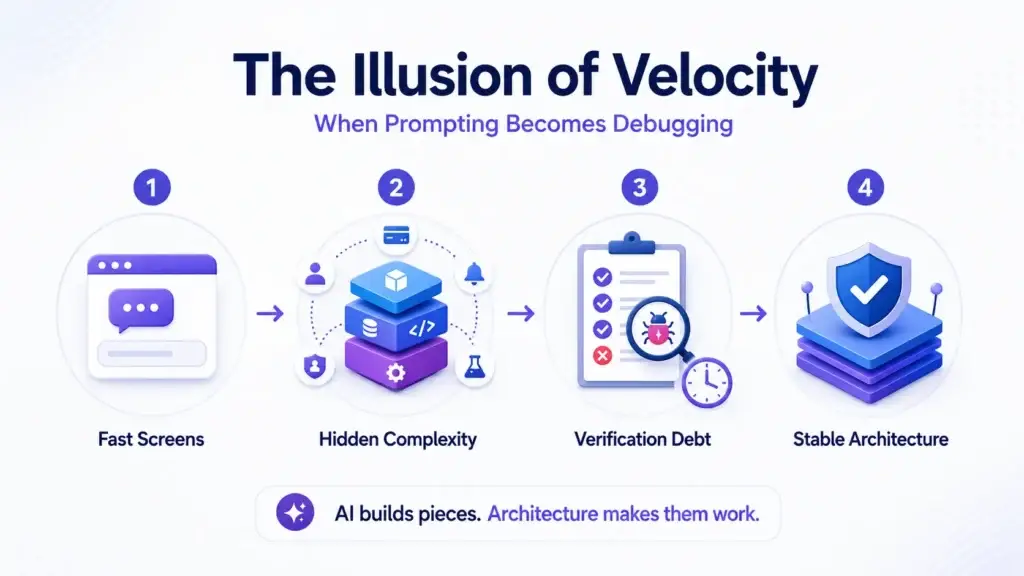
The first phase of AI-assisted development feels powerful.
A founder types:
“Build me a food delivery app dashboard.”
The AI returns components, routes, tables, API suggestions, sample logic, and a clean-looking interface. In a few hours, the founder sees something that looks like progress.
That is the illusion of velocity.
The problem appears when the app moves beyond isolated screens. A real platform needs authentication, role-based dashboards, payment flows, notification logic, database consistency, admin controls, vendor or provider management, reporting, user permissions, moderation, deployment, and testing. These layers do not succeed because a prompt was well-written. They succeed because the underlying architecture is stable.
AI is useful for producing pieces. But products are not just pieces.
A commercially ready app requires the pieces to work together under real conditions. That includes edge cases, failed payments, cancelled bookings, duplicate orders, wallet mismatches, refund disputes, provider approvals, content reports, and admin overrides.
This is where many founders discover that the time saved during generation is later spent in verification.
OpenAI itself describes hallucinations as plausible but false outputs and notes that hallucinations remain a fundamental challenge for large language models. In app development, a hallucination is not only a wrong answer. It may be a non-existent package, a broken API method, a misleading security assumption, or a database pattern that works in a demo but fails in production.
For a solo founder, every hallucination has a cost:
- Time spent identifying the issue
- Time spent explaining the issue back to the AI
- Time spent checking whether the fix broke something else
- Time spent rebuilding context in a new chat
- Time spent deciding whether the app is safe enough to launch
That is not development velocity. That is verification debt.
Read more: The Modularity Audit: Is Your AI Codebase Ready for Human Developers?
What Prompt Fatigue Really Means for Solo Founders
Prompt fatigue is not simply being tired of writing prompts.
It is the operational exhaustion that happens when a founder becomes the product manager, developer, QA analyst, DevOps engineer, security reviewer, and debugging lead for AI-generated code they may not fully understand.
At the beginning, prompting feels like leverage. By week two or three, the founder often starts repeating the same cycle:
- Ask AI to build a feature.
- Run the code.
- Hit an error.
- Paste the error into the AI.
- Apply the fix.
- Break another part of the app.
- Re-explain the architecture.
- Start a new thread because the context became messy.
- Lose track of which code is stable.
- Delay launch again.
The founder is not really building anymore. They are supervising.
A 2026 longitudinal study on AI coding assistants described a shift from creation work toward verification and correction work, calling this emerging category “supervisory engineering work.” It also found a productivity-experience paradox: developers continued to perceive productivity improvements, while worsened developer experience increased across the matched cohort.
That insight matters for founders because perceived speed can be misleading.
A founder may feel productive because every prompt creates output. But the business outcome is not output. The business outcome is a working product in the market.
Data Breakdown: The Diminishing Returns of the LLM Context Window
A longer context window does not automatically create a better product architecture.
As an app grows, the AI must keep track of user roles, database relationships, routes, middleware, business logic, dependencies, naming conventions, edge cases, integrations, and previous fixes. The longer the conversation becomes, the more likely it is that important constraints get buried.
Research on long-context language models has shown that models do not always robustly use information across long inputs. The “Lost in the Middle” study found performance often drops when relevant information appears in the middle of a long context, even for models designed for long-context use.
For founders building with AI, that problem appears in practical ways:
- The AI forgets a previous schema decision.
- The AI changes a function name used elsewhere.
- The AI suggests a package that conflicts with the current stack.
- The AI fixes one screen but breaks another flow.
- The AI treats a production workflow like a demo project.
- The AI assumes missing business rules instead of asking for them.
This is why prompt fatigue is not just about prompting skill. It is about architecture continuity.
When a founder uses AI to build a full app from scratch, every session depends on the founder’s ability to preserve context, catch errors, and maintain system coherence. That is a heavy burden for someone who also needs to validate demand, talk to users, prepare pricing, build partnerships, and plan launch.
The Prompt Fatigue Variable
The Prompt Fatigue Variable can be described with a simple model:
Prompt Fatigue Cost = Re-prompting Hours + Debugging Hours + Context Rebuild Hours + Regression Fix Hours + Opportunity Cost The tipping point arrives when: Debugging + verification time becomes greater than new product progress.At that point, the founder is no longer using AI as leverage. The founder is using AI as a second job.
Read more: The Security Illusion: Why AI App Platforms Can Expose Your Startup to Legal Liability
The Week 3 Tipping Point: When AI Coding Stops Feeling Fast
The “week 3” tipping point should be treated as a decision model, not a universal law. Different founders, products, and AI workflows will vary.
But the pattern is common enough to matter.
Week one is usually fast because the founder is building visible surfaces: landing pages, dashboards, simple CRUD flows, authentication screens, or demo logic.
Week two becomes slower because the founder starts connecting systems: databases, payments, file uploads, notifications, maps, booking flows, chat, search, or admin logic.
Week three is where fatigue often becomes measurable. The founder is no longer asking, “Can AI build this?” They are asking, “Why does this keep breaking?”
Here is a practical model for solo founders building a complex app with AI-assisted prompting:
| Build Stage | Founder Activity | Visible Progress | Hidden Time Cost | Prompt Fatigue Risk |
|---|---|---|---|---|
| Week 1 | Generate screens, basic flows, sample backend logic | High | Low to moderate | Low |
| Week 2 | Connect APIs, database, payments, roles, dashboard logic | Moderate | Rising debugging and rework | Medium |
| Week 3 | Fix broken integrations, rebuild context, test edge cases | Low to uneven | Debugging starts exceeding feature creation | High |
| Week 4+ | Patch regressions, refactor AI-generated code, prepare deployment | Uncertain | Launch delay and founder burnout | Very high |
This is where the comparison becomes uncomfortable.
If a founder spends three weeks prompting, debugging, and rebuilding context, they may have already spent more calendar time than a ready-made app foundation needs for configuration, branding, and launch preparation.
Miracuves positions its ready-made clone solutions around faster validation, white-label branding, source-code ownership, and deployment in 6 working days for ready-made products. For a founder who has already lost weeks to prompt loops, the real question is not whether AI can generate code. The question is whether the founder can afford another month of uncertain architecture.
Prompting vs Pre-Built Architecture: The Founder Cost Comparison
Prompting is flexible. Architecture is leverage.
A founder can use AI to build from zero, but building from zero means the founder must define and verify every important system decision. That includes frontend structure, backend logic, database design, security controls, admin workflows, payment behavior, deployment setup, user roles, and product analytics.
A pre-built architecture starts from the opposite direction.
Instead of asking AI to invent the foundation, the founder starts with a launch-ready structure that already contains the core product logic. Then customization focuses on brand, workflows, business rules, monetization, and market positioning.
Prompting vs Pre-Built Architecture
A practical comparison for founders deciding whether to keep building through endless AI prompts or move faster with a launch-ready white-label foundation.
| Decision Factor | Endless AI Prompting | Pre-Built White-Label Architecture | Founder Impact |
|---|---|---|---|
| Initial Speed | Feels fast because code appears instantly. | Starts with an existing product foundation. | Prompting wins on visible output; architecture wins on launch readiness. |
| System Consistency | Depends on prompt quality and context continuity. | Built around defined modules and workflows. | Less risk of fragmented logic. |
| Debugging Burden | The founder owns every hallucination and regression. | Technical setup and configuration follow a more stable foundation. | The founder can focus more on business validation. |
| Admin Control | Must be designed, generated, tested, and connected. | Included as part of the app operating layer. | Faster control over users, transactions, content, and operations. |
| Source Code | Owned if built correctly, but may be unstable. | Delivered as part of the ownership model. | Better long-term control without vendor lock-in. |
| Launch Confidence | Depends on founder-led QA and deployment knowledge. | Built for deployment and app launch workflows. | Shorter path from idea to market testing. |
The founder decision is not “AI or no AI.”
The decision is: Where should AI sit in the product journey?
AI is useful for ideation, documentation, small scripts, feature thinking, test ideas, and workflow drafts. But when a founder is building a commercial app business, the foundation should not depend entirely on a fragile prompt chain.
Read more: Fix vs. Rebuild: The Ultimate Decision Framework for AI-Built Startups
Instant Velocity: Why Smart Founders License Pre-Built Architecture
Smart founders do not avoid technology. They avoid avoidable delay.
A ready-made architecture gives founders something AI prompting cannot reliably provide by itself: a coherent product base. That means the app already has the core structure required to operate as a business, not just a demo.
For example, a delivery platform needs customer, merchant, delivery partner, and admin workflows. A marketplace needs listings, bookings, payments, reviews, dispute handling, and provider dashboards. A creator app needs feeds, uploads, profiles, content moderation, engagement loops, and monetization controls. A fintech product needs wallet logic, user verification, transaction history, audit logs, and compliance-ready workflows.
These are not isolated prompts. These are operating systems.
Miracuves helps founders move faster by offering ready-made and white-label app solutions that can be customized around a founder’s business model, brand, and launch scope. The value is not in copying another app blindly. The value is in starting from a proven product foundation, then adapting it for market validation.
Founders exploring this route can start with the Miracuves solutions hub, review the clone app development service, or explore AI-specific support through generative AI app development.
The difference is strategic.
A founder using endless prompts asks:
“Can I make this work if I keep debugging?”
A founder using pre-built architecture asks:
“How fast can I validate demand with a product foundation that already works?”
That second question is more valuable.
Founder Decision Signals
Speed
If three weeks of prompting has not produced a stable launch path, the project may need architecture leverage instead of better prompts.
Cost
The visible cost of AI tools may be low, but the hidden cost appears in founder hours, missed launch windows, and repeated debugging cycles.
Scalability
Generated code can create useful fragments, but scalable apps need consistent data models, admin controls, integrations, and deployment discipline.
Market Fit
Founders learn faster from real users than from another week of local debugging. Launch readiness should be measured against market feedback.
Why Prompting Alone Cannot Replace Product Architecture
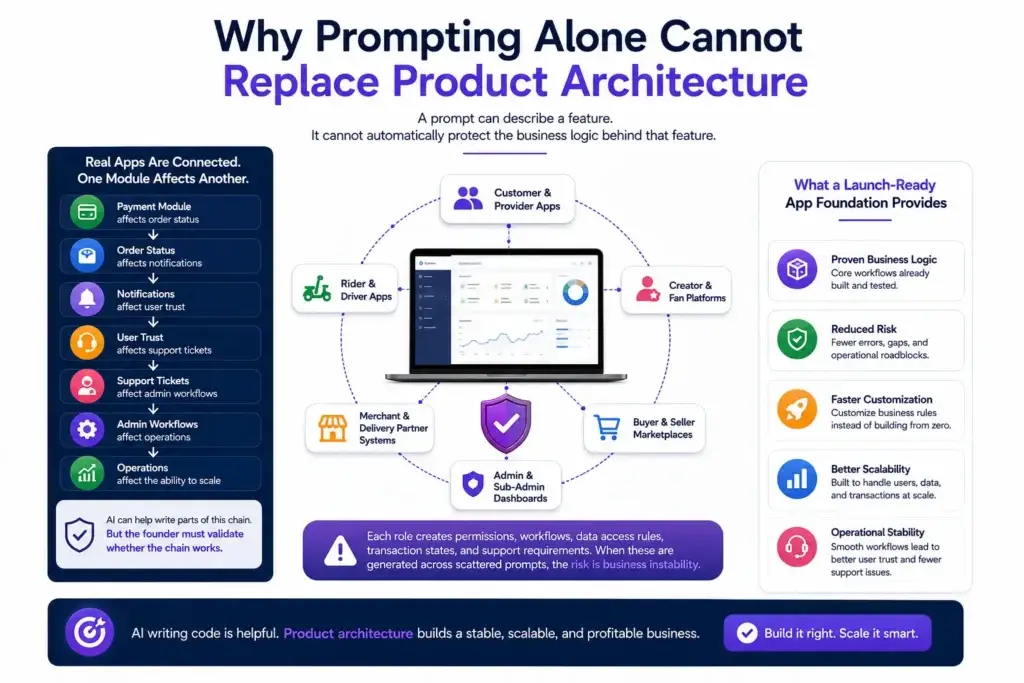
A prompt can describe a feature. It cannot automatically protect the business logic behind that feature.
This matters because real apps are full of dependencies.
A payment module affects order status. Order status affects notifications. Notifications affect user trust. User trust affects support tickets. Support tickets affect admin workflows. Admin workflows affect operations. Operations affect whether the founder can scale without chaos.
AI can help write parts of that chain. But the founder still needs to validate whether the chain works.
This is especially important for apps with multiple user roles:
- Customer and provider apps
- Rider and driver apps
- Creator and fan platforms
- Merchant and delivery partner systems
- Buyer and seller marketplaces
- Admin and sub-admin dashboards
Each role creates permissions, workflows, data access rules, transaction states, and support requirements. When these are generated across scattered prompts, the risk is not just messy code. The risk is business instability.
A launch-ready app foundation reduces that risk because the essential operating logic already exists. The founder can then customize business rules rather than invent every workflow from scratch.
Mistakes Founders Should Avoid When Building With AI
Mistakes Founders Should Avoid
Mistake 1: Measuring Progress by Lines of Code
AI can generate a lot of code quickly, but code volume is not the same as launch progress. Measure working flows, deployment readiness, admin control, and user testing instead.
Mistake 2: Letting the AI Redesign the Architecture Every Session
When each prompt introduces new assumptions, the app becomes harder to maintain. Founders should protect core architecture decisions and avoid letting every fix rewrite the product foundation.
Mistake 3: Ignoring Admin Workflows Until the End
Many AI-built prototypes focus on user screens and forget the operator layer. Without admin control, the founder cannot manage users, payments, disputes, content, commissions, or reporting properly.
Mistake 4: Treating Hallucination Debugging as Free
Every wrong API, broken dependency, and inconsistent schema consumes founder time. Even if the AI tool is inexpensive, the hidden cost of verification can become expensive.
When AI Prompting Still Makes Sense
This report is not arguing that founders should stop using AI.
AI is valuable when used in the right layer of the workflow. It can help founders:
- Draft product requirements
- Explore feature logic
- Generate test cases
- Write documentation
- Create onboarding copy
- Review simple code snippets
- Brainstorm monetization models
- Prepare investor or demo material
- Automate small internal workflows
The problem starts when AI is expected to replace the entire product foundation.
A founder should use AI to accelerate decisions, not to endlessly compensate for missing architecture.
A practical approach is to combine both:
- Use a proven app foundation for the core product.
- Customize workflows around the business model.
- Use AI for content, admin efficiency, user support, internal automation, or intelligent product features.
- Keep the founder focused on launch, feedback, revenue, and iteration.
That is a healthier use of AI because it supports the product instead of becoming the product bottleneck.
The Real Cost Is Not Prompting. It Is Delayed Market Feedback
The most expensive part of endless prompting is not the AI subscription.
It is the delay between idea and market feedback.
Every week spent debugging a local build is a week without user conversations, merchant onboarding, creator acquisition, driver recruitment, partner outreach, pricing tests, investor updates, or paid traffic experiments.
Founders do not win because they wrote the most prompts. They win because they reach the market with a usable product, learn faster, and improve based on real behavior.
This is why ready-made architecture can be a strategic advantage. It compresses the distance between idea and validation.
Miracuves’ white-label approach is built around that exact founder need: start with a product foundation, rebrand it, customize it, own the source code, and move toward launch faster than a ground-up build.
Final Thoughts: Stop Measuring Prompts, Start Measuring Launch Readiness
The hidden cost of endless prompting is not that AI is useless. AI is useful.
The hidden cost is believing that generated code automatically equals business progress.
For solo founders, the danger is spending months in a loop of prompting, debugging, re-prompting, and rebuilding context while competitors are already learning from real users. The Prompt Fatigue Variable exposes that risk clearly: once verification and debugging consume more time than product progress, the founder is no longer moving faster.
They are simply working harder.
The smarter decision is to separate experimentation from architecture. Use AI where it creates leverage. But for the core product foundation, consider whether a ready-made, white-label, source-code-owned app solution can get you closer to launch faster.
The founder who launches, learns, and improves has a stronger advantage than the founder still trying to fix yesterday’s hallucinated code.
FAQs
What is AI developer fatigue?
AI developer fatigue is the exhaustion that happens when founders or developers spend more time correcting, debugging, verifying, and re-prompting AI-generated code than making real product progress.
What is prompt fatigue in app development?
Prompt fatigue is the point where prompting stops feeling like leverage and starts becoming repetitive operational work. It often appears when the AI forgets context, creates inconsistent code, or produces fixes that break other parts of the app.
Does AI coding actually save time for founders?
AI coding can save time on isolated tasks, simple screens, documentation, and early prototyping. But for complex apps, productivity depends on architecture, context, integration quality, testing, and the founder’s ability to verify output. Public research shows AI productivity gains vary by setting.
Why does Cursor prompting become slower over time?
Cursor prompting can become slower as the codebase grows because the founder must preserve context, explain prior decisions, verify changes, manage dependencies, and fix regressions. The larger the system becomes, the more expensive each wrong assumption becomes.
What is the Prompt Fatigue Variable?
The Prompt Fatigue Variable is a practical decision model that measures re-prompting hours, debugging hours, context rebuild time, regression fixes, and opportunity cost. It helps founders decide when DIY AI coding is delaying launch.
Is a white-label app better than building with AI?
A white-label app can be better when the founder needs a stable, launch-ready foundation quickly. AI is still useful for ideation, documentation, automation, and enhancements, but a pre-built app architecture can reduce the risk of fragmented development.
When should a founder stop prompting and choose pre-built architecture?
A founder should consider pre-built architecture when debugging takes more time than feature creation, the launch date keeps slipping, admin workflows are missing, integrations are unstable, or the app still cannot be tested by real users after several weeks.
How does Miracuves help founders avoid prompt fatigue?
Miracuves helps founders start with ready-made, white-label, source-code-owned app foundations that include core workflows, branding support, admin control, and faster deployment, reducing the need to build every module from scratch.
Miracuves is an independent software development company. We are not affiliated with, connected to, sponsored by, or endorsed by any company or product named in this article.
Terms such as “X Clone” are used descriptively. It is how the software industry refers to building a platform with functionality comparable to a known service, and how clients search for it.
The entire design and codebase of our products is built by our own team. Our products contain no code, design, graphics, or content originating from any third-party website or applications.
All third-party names and marks referenced in this article are the property of their respective owners, referenced solely to identify the services discussed.