
Key Takeaways
- Companies can waste substantial budgets on AI experiments when projects begin without clear business objectives, measurable success criteria or a practical path to production deployment.
- AI return on investment (ROI) should measure verified financial benefits against the total costs of development, integration, infrastructure, maintenance and ongoing operations.
- Successful AI evaluation requires comparing performance against existing workflows while tracking productivity improvements, cost reductions, revenue impact and operational risks.
- A structured AI ROI framework helps businesses prioritize valuable use cases, identify underperforming experiments and make evidence-based decisions about scaling or discontinuing AI initiatives.
Why AI Experiments Fail to Deliver Measurable Business Value
- AI projects often struggle when organizations focus on impressive demonstrations or technical capabilities without identifying specific business problems and expected financial outcomes.
- Hidden expenses such as data preparation, model evaluation, software integration, employee training, human review and infrastructure usage can significantly increase the actual cost of AI adoption.
- Poor data quality, unreliable model outputs, limited employee adoption and weak integration with existing systems can prevent promising AI prototypes from delivering practical improvements.
- Without baseline measurements, defined project ownership and clear evaluation milestones, companies may continue funding experiments that generate activity but little measurable business value.
AI ROI Calculation Framework and Investment Decisions
- Calculate AI ROI by subtracting total AI investment costs from verified financial benefits, dividing the result by total investment costs and multiplying by 100 to express the return as a percentage.
- Financial benefits should include measurable labor cost savings, avoided expenses, incremental profit and productivity improvements that translate into actual economic value without double-counting results.
- AI cost calculations should account for initial implementation, data engineering, model usage, cloud infrastructure, system integration, security, monitoring and ongoing maintenance over a consistent evaluation period.
- Businesses should use pilot results, realistic financial assumptions, risk-adjusted forecasts and predefined performance thresholds to decide whether to expand, improve or discontinue an AI investment.
Companies are investing heavily in artificial intelligence, but investing in AI and generating financial returns from AI are two very different achievements.
A company might launch an intelligent customer service assistant, experiment with automated document processing, introduce predictive analytics, and test several generative AI tools across different departments. Each experiment may demonstrate impressive technical capabilities. Employees may report improved productivity, presentations may show encouraging results, and project teams may celebrate successful demonstrations.
Yet months later, the finance team may still be unable to answer a fundamental question: How much measurable business value did these investments actually create?
This is where AI experimentation becomes financially dangerous. Organizations can spend substantial amounts on technology evaluations, integrations, licenses, infrastructure, consulting, and employee training without establishing whether the results justify those expenses.
The problem is not necessarily that the AI technology fails. Sometimes the technology works exactly as expected, but the business case never becomes profitable.
For businesses navigating this challenge, the real priority is connecting technological innovation with measurable financial outcomes. Miracuves helps founders and enterprises turn digital product ideas into practical business solutions, with an emphasis on implementation readiness, operational efficiency, and long-term scalability. However, before committing resources to any AI initiative, decision-makers must establish whether the expected business benefits can realistically outweigh the total investment.
Calculating AI return on investment (ROI) requires more than comparing software costs with estimated hours saved. Companies must measure actual process improvements, account for implementation and operating costs, validate whether productivity gains become economic benefits, and establish clear rules for expanding or stopping experiments.
This guide explains why AI experiments consume budgets without generating measurable returns and introduces a practical framework for calculating the true financial impact of AI investments before scaling them across an organization.
Why Companies Spend Millions on AI Experiments Without Seeing Financial Returns
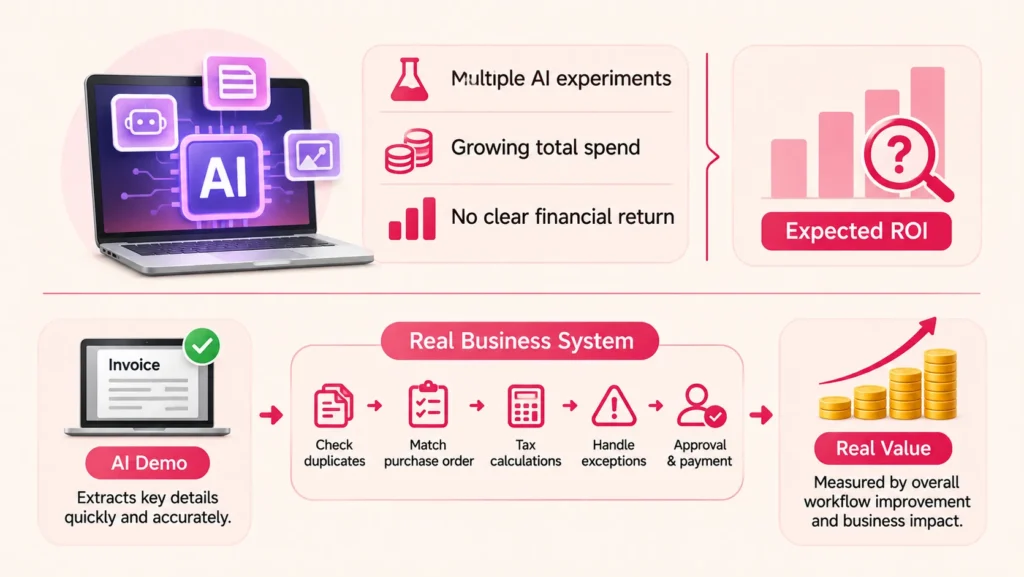
Artificial intelligence creates a difficult investment environment because demonstrations are relatively easy to produce, while sustainable business improvements are much harder to establish.
A prototype can summarize documents, answer customer questions, classify invoices, or generate marketing content within minutes. Showing that capability to executives can make a project appear successful before anyone has measured whether it improves an existing business process.
The distinction becomes especially important when an organization operates multiple AI initiatives simultaneously. Individual experiments may appear affordable, but their combined spending on employees, infrastructure, vendors, integrations, and management can become substantial.
Research published in 2025 by MIT’s Project NANDA highlighted the gap between enterprise generative AI experimentation and measurable financial performance. Its findings should be interpreted within the study’s specific sample and methodology, not as a universal failure rate for every AI investment. Nevertheless, the research illustrates a genuine management challenge: successful experimentation does not automatically translate into measurable profit-and-loss improvements.
The Difference Between an Impressive Demo and a Valuable Business System
Imagine a financial operations team manually reviewing thousands of invoices every month. An AI demonstration extracts supplier names, amounts, and payment dates with impressive accuracy.
From a technical perspective, the experiment appears promising.
However, the real business workflow may require additional checks for duplicate invoices, purchase-order matching, tax calculations, exception handling, and authorization before payment.
If employees must review every extracted field, correct frequent exceptions, and manually transfer results into existing systems, the apparent automation benefit may be much smaller than expected.
The financially relevant measurement is not how quickly the model extracts text. It is how much the complete invoice-processing workflow improves after accounting for review, corrections, integration, and operating expenses.
Founder insight: The value of AI comes from changing an economic outcome, not from demonstrating that a model can complete an isolated task.
Seven Ways AI Experiments Quietly Drain Company Budgets
AI investment losses rarely come from a single dramatic mistake. More often, they accumulate through small decisions that appear reasonable in isolation but undermine the overall business case.
1. Starting With AI Technology Instead of a Financially Important Problem
Many organizations begin with questions such as, “Where can we use generative AI?” or “Which department should receive an AI assistant?”
These questions encourage experimentation without identifying the economic problem that the investment should solve.
A stronger starting point is to identify an expensive or inefficient process. For example, a company might investigate why customer support cases require multiple transfers, why invoices take days to process, or why inaccurate demand forecasts create excess inventory.
Each problem has a potential financial consequence. That consequence provides the foundation for estimating whether AI can produce an attractive return.
2. Running Too Many Pilots Without Clear Priorities
When departments independently experiment with AI tools, an organization may end up funding overlapping initiatives that solve similar problems.
One team may introduce document summarization while another purchases a separate knowledge assistant. Different business units may adopt incompatible automation systems, creating duplicate subscriptions and additional integration work.
Decentralized experimentation can be useful for discovering opportunities, but it becomes costly when there is no shared evaluation process.
Companies need a portfolio view of AI spending that compares expected benefits, implementation complexity, data availability, operational risk, and time to measurable value.
3. Treating Employee Productivity as Guaranteed Cost Savings
Suppose an AI assistant helps employees complete a reporting task 30% faster. Management might multiply that time reduction by employee salaries and report the resulting amount as annual savings.
That calculation may significantly overstate the return.
If employees continue receiving the same salaries and their available time is not redirected toward measurable productive work, the organization may not experience a corresponding reduction in expenses.
The improvement could still be valuable. Employees may complete additional customer requests, reduce backlogs, improve quality, or avoid future hiring. But those outcomes must be measured separately.
AI productivity measurement should distinguish between capacity created, costs actually removed, and incremental business value generated.
4. Ignoring Data Preparation and Integration Expenses
AI experiments are frequently evaluated using the cost of the model or software subscription. That is only one part of the investment.
Business data may require cleaning, labeling, validation, formatting, permission management, or migration before an AI system can use it reliably.
Connecting the system to internal applications can also involve engineering time, API modifications, workflow changes, security reviews, and testing.
These expenses are particularly important when extending existing enterprise software. Organizations considering this approach can separately examine how intelligent features can be introduced into existing business systems without a complete rebuild.
For ROI calculations, the financial lesson is straightforward: integration and data preparation are part of the investment, even when they do not appear on the initial software invoice.
5. Measuring Technical Performance Instead of Business Performance
Model accuracy, processing speed, response quality, and successful API calls are useful technical indicators. However, they do not independently demonstrate financial success.
A forecasting model may achieve an impressive statistical score while failing to reduce excess inventory. A chatbot may resolve routine questions accurately but create more expensive escalations for complicated requests.
Technical metrics should be connected to operational outcomes such as lower rework, faster order completion, reduced support costs, improved conversion, or fewer preventable losses.
6. Underestimating the Cost of Human Oversight
AI systems often require human review, particularly when errors could affect customers, financial records, safety, or regulatory obligations.
Employees may need to verify AI-generated recommendations, investigate unusual results, correct inaccurate classifications, and handle exceptions that the system cannot resolve.
These activities have financial costs. An experiment that appears highly automated may actually shift work from one team to another.
Organizations should measure the full process, including quality assurance and escalation activity, instead of recording only the time spent by the original employee.
7. Continuing Experiments After Their Business Case Has Weakened
AI projects can become difficult to stop because teams have already invested money, time, and professional effort.
Leadership may approve another experimental phase in the hope that additional training, improved prompts, or a different model will eventually produce worthwhile results.
Sometimes further investment is justified. But without predefined success thresholds, a pilot can continue indefinitely.
A disciplined organization establishes its continuation, redesign, and termination criteria before the experiment begins. Past spending should not justify new spending unless the expected future benefits exceed the remaining costs and risks.
What Is AI Return on Investment, and What Should It Actually Measure?
AI return on investment measures the financial value attributable to an artificial intelligence initiative relative to the investment required to create and operate it.
The basic calculation resembles the ROI calculation used for other business investments. The challenge lies in identifying which benefits are genuine, which expenses are relevant, and how confidently the organization can attribute those benefits to AI.
AI ROI Formula
AI ROI (%) = [(Realized Financial Benefits − Total AI Investment) ÷ Total AI Investment] × 100
Use benefits and costs measured over the same evaluation period.
Consider an illustrative organization that realizes $150,000 in attributable financial benefits from a deployed AI workflow and incurs $100,000 in total investment during the same evaluation period.
Its calculation would be:
AI ROI = (($150,000 − $100,000) ÷ $100,000) × 100 = 50%
This means the project generated $50,000 more in measured financial benefits than its included investment costs during the period.
However, the calculation is only as reliable as the underlying assumptions. If the organization counted theoretical time savings as actual cash savings, omitted human review expenses, or credited AI for improvements caused by unrelated operational changes, the reported return could be misleading.
Financial ROI, Productivity ROI, and Strategic Value Are Not the Same
Businesses often group several forms of value into a single ROI figure. A stronger approach separates them.
| Value Category | What It Measures | Example | How to Report It |
|---|---|---|---|
| Direct financial savings | Expenses actually eliminated or avoided | Reduced outsourced processing fees | Financial benefit |
| Incremental profit | Additional contribution after related variable costs | Higher sales from improved lead handling | Financial benefit |
| Capacity released | Employee time becoming available | Faster report preparation | Operational benefit until monetized |
| Quality improvements | Reduced errors and rework | Fewer incorrectly processed invoices | Financial when avoided costs are measurable |
| Risk reduction | Lower expected exposure to losses | Earlier identification of suspicious transactions | Risk-adjusted benefit with stated assumptions |
| Strategic value | Longer-term capabilities or flexibility | Faster experimentation with new products | Separate qualitative assessment |
Strategic value should not be dismissed simply because it is difficult to quantify. However, businesses should avoid assigning arbitrary financial amounts to intangible benefits merely to produce a positive ROI.
The REAL AI ROI Framework: Six Steps to Calculate the Financial Value of AI Experiments
The following framework is a practical evaluation model for business leaders. It brings financial measurement and operational validation together before an AI initiative receives a larger investment.
REAL stands for Record the baseline, Estimate the total investment, Attribute measurable benefits, and Learn before scaling. Two additional steps strengthen the process: adjusting for uncertainty and making a formal investment decision.
Step 1: Record the Existing Business Performance Before Introducing AI
Every credible AI ROI calculation begins with a baseline. Without reliable information about current operations, an organization cannot confidently measure improvement.
The baseline should describe the process as it operates today, including the number of tasks completed, time required, employee effort, error rates, costs, and customer outcomes.
For a customer support workflow, useful baseline metrics might include average handling time, cost per resolved case, escalation rate, first-contact resolution, and customer satisfaction.
For invoice processing, the baseline may include processing volume, manual handling time, error correction, average completion time, and payments delayed by exceptions.
Baseline measurements should cover a representative period and account for seasonal demand, unusual workloads, and significant process changes.
Practical rule: If the organization cannot explain what the workflow costs today, it is not ready to claim how much AI will save tomorrow.
Step 2: Estimate the Fully Loaded Cost of the AI Initiative
The second step is to capture the full cost of introducing and operating the AI capability. Software licensing or model inference represents only part of the economic commitment.
A comprehensive investment model includes both initial costs and continuing expenses.
| Cost Component | What to Include | Cost Behavior |
|---|---|---|
| Experimentation | Research, testing, internal staff time, evaluations | Initial and potentially repeated |
| Data readiness | Cleaning, validation, labeling, preparation | Initial and recurring |
| Engineering and integration | Application changes, APIs, workflow integration | Mostly initial, with upgrades |
| Model usage | Inference, processing, API requests, retries | Usage-dependent |
| Infrastructure | Compute, storage, networking, monitoring | Recurring |
| Human oversight | Review, correction, escalation, quality assurance | Recurring |
| Security and governance | Access control, risk reviews, audits, privacy safeguards | Initial and recurring |
| Training and adoption | Employee onboarding, workflow redesign, change management | Initial and periodic |
| Maintenance | Evaluation, updates, incident handling, model changes | Recurring |
Finance teams should use actual invoices, internal labor allocations, and documented assumptions wherever possible. Existing shared infrastructure should be allocated consistently rather than automatically charged in full to every project.
Businesses planning a new AI product can also review the separate AI application cost breakdown covering infrastructure, APIs, and engineering resources. That analysis helps establish cost inputs, while this framework focuses on whether the overall investment produces sufficient financial benefits.
Step 3: Attribute Measurable Financial Benefits to AI
The third step is often the most difficult because businesses must determine which financial improvements were actually caused by the AI initiative.
Imagine that a customer support department reduces its average handling time after introducing an intelligent assistant. During the same period, the company also changes its staffing schedule, updates its knowledge base, and removes a complicated refund process.
It would be misleading to attribute the entire performance improvement to AI.
Where practical, companies should compare similar groups, workflows, or periods. A controlled experiment might allow one group to use the AI capability while another continues with the existing process.
The company can then evaluate whether improvements are meaningfully different after accounting for workload, employee experience, and other relevant factors.
Financial benefits should be classified as realized savings, verified avoided costs, incremental contribution, or other clearly defined outcomes. Benefits that remain hypothetical should be reported as projections rather than earned returns.
Step 4: Adjust the Forecast for Adoption, Reliability, and Uncertainty
A technically successful AI system does not create value if employees rarely use it, customers reject it, or errors require extensive manual correction.
Forecasts should therefore account for the difference between ideal performance and realistic operational performance.
Suppose a system could theoretically save 10,000 employee hours annually. If only 60% of the intended workload is eligible for automation and actual usage reaches 75% of that eligible workload, the maximum expected effect becomes substantially smaller.
Some tasks may also require human review, and some time savings may not be converted into economically useful capacity.
To avoid false precision, businesses should develop conservative, expected, and optimistic forecasts based on explicit assumptions. Each scenario should identify the required adoption level, quality threshold, processing volume, and unit economics.
Importantly, these adjustment factors must not double-count the same reduction. If actual time savings already include failed attempts and correction work, those costs should not be deducted again without justification.
Step 5: Learn From a Controlled Pilot Before Expanding
A well-designed pilot should test a specific business hypothesis, not simply demonstrate that an AI application functions.
For example, a useful hypothesis might be: “Automating the first stage of invoice processing will reduce the fully loaded cost per correctly processed invoice while maintaining the required accuracy and approval standards.”
This hypothesis can be evaluated by measuring the total processing cost, completion time, exception rate, employee review requirements, and accuracy of the resulting records.
A controlled pilot should have a defined duration, representative workload, operational owner, measurement process, and agreed exit criteria.
Successful experiments provide evidence that the company can compare against the original financial forecast. Unsuccessful experiments reveal which assumptions were incorrect and whether redesigning the workflow is worthwhile.
Step 6: Make a Scale, Redesign, or Stop Decision
The final step converts experimental evidence into an investment decision.
Companies should not expand an AI solution merely because users enjoyed the demonstration or the model achieved its technical targets.
Expansion should depend on whether the system produces acceptable economic results, satisfies operational requirements, and remains manageable at a larger scale.
AI Investment Decision Framework
Expand when attributable financial benefits exceed the agreed investment hurdle, users adopt the workflow, quality remains acceptable, and operating costs are predictable.
Revise when potential value is credible but adoption, integration, accuracy, or process economics prevent the expected outcome.
Discontinue when updated evidence shows that expected future benefits cannot justify remaining costs and risks, or when critical safety or operational requirements cannot be met.
A Practical AI ROI Calculation Example: From Employee Time Savings to Real Financial Value
Consider a hypothetical enterprise evaluating AI assistance for a high-volume document-processing workflow.
The organization processes 120,000 documents annually. Employees currently spend an average of eight minutes handling each document.
Management expects AI to reduce manual processing time by 40%. However, only part of the released employee capacity is expected to be converted into an economically useful outcome.
The following example uses illustrative assumptions for teaching the calculation. The figures are not actual project results, industry averages, or Miracuves pricing.
Calculate the Existing Manual Workload
Annual processing volume: 120,000 documents
Average processing time: 8 minutes
Total annual processing hours = 120,000 × 8 ÷ 60
Existing annual workload = 16,000 hours
Calculate the Expected Capacity Released
Assume the completed workflow, including its normal review and correction steps, achieves a verified 40% reduction in labor hours.
Annual hours released = 16,000 × 40%
Annual capacity released = 6,400 hours
At an illustrative loaded labor rate of $35 per hour, the theoretical value of that capacity equals $224,000.
However, that figure should not automatically be presented as financial savings. The business must explain what happens to the released capacity.
Adjust for Realized Economic Value
Suppose the company can credibly convert only half of the released hours into avoided temporary labor, avoided future hiring, or separately measured additional output.
Economically useful hours = 6,400 × 50%
Economically useful hours = 3,200
Attributed financial value = 3,200 × $35
Estimated annual financial benefit = $112,000
For this illustration, assume those 3,200 hours correspond to documented, financially recognized benefits. Without that evidence, $112,000 would remain a potential capacity value rather than verified savings.
Include the Complete AI Investment
Assume the organization incurs $36,000 in one-time preparation and implementation expenditure and $46,000 in attributable first-year operation, maintenance, oversight, and governance costs.
| Financial Input | Illustrative Amount |
|---|---|
| One-time implementation and preparation | $36,000 |
| First-year operating and support expenses | $46,000 |
| Total first-year investment | $82,000 |
| Attributed annual financial benefits | $112,000 |
| Net first-year benefit | $30,000 |
Calculate the First-Year AI ROI
AI ROI = (($112,000 − $82,000) ÷ $82,000) × 100
ILLUSTRATIVE FIRST-YEAR AI ROI
36.6%
Estimated $30,000 net financial benefit on $82,000 invested during the first year, assuming all projected benefits are realized and recognized.
This calculation provides a clearer investment picture than simply reporting the theoretical $224,000 value of employee hours released.
It also demonstrates why assumptions matter. If the business fails to realize the expected capacity benefits, the return could become negative even when the AI system continues operating successfully.
What Happens if Only 25% of Released Capacity Creates Economic Value?
Instead of converting 50% of the released capacity into measurable financial value, assume the organization achieves only 25%.
Financial benefit = 6,400 × 25% × $35 = $56,000
AI ROI = (($56,000 − $82,000) ÷ $82,000) × 100
Revised first-year ROI = −31.7%
The same AI technology, processing volume, and implementation budget can therefore produce very different financial outcomes depending on whether the organization converts technical improvements into real business value.
This is precisely why AI investment decisions should use measured business outcomes rather than optimistic productivity assumptions.
How to Measure AI ROI When Benefits Are Not Direct Cost Savings
Not every useful AI application is designed to reduce labor expenditure. Some systems aim to increase revenue, improve decisions, prevent losses, or accelerate customer-facing operations.
In these situations, the evaluation framework remains useful, but the financial benefit must be calculated using the economics of the specific workflow.
Revenue-Generating AI Initiatives
An AI recommendation system may help customers discover relevant products. A sales assistant may improve the speed and consistency of lead qualification.
The business should measure incremental conversion or sales attributable to AI and convert that improvement into contribution profit after relevant costs.
For example, an increase in sales revenue does not represent an equivalent increase in financial benefit if the company must pay for additional inventory, fulfillment, payment processing, or sales incentives.
A useful measurement is:
Incremental contribution = AI-attributable additional revenue − associated incremental variable costs
AI for Quality and Error Reduction
Computer vision inspection, document validation, and anomaly detection can produce value by reducing defective outputs or avoidable errors.
The business should establish the existing cost of those errors, measure the change after introducing AI, and subtract any new review, correction, or false-positive expenses.
An error-detection model that catches more problems but generates excessive false alarms may increase workload rather than reduce total costs.
AI for Forecasting and Decision Support
Forecasting tools can help businesses make inventory, staffing, logistics, and resource allocation decisions.
Better forecast accuracy is useful, but the financial return depends on whether that improvement changes actual decisions.
A retailer should measure changes in carrying costs, stockouts, markdowns, and working capital rather than reporting forecast accuracy alone.
Likewise, a logistics business may measure avoidable mileage, fuel expenditure, driver hours, and service reliability after introducing intelligent optimization.
AI for Risk Reduction
Fraud monitoring, cybersecurity assistance, and transaction anomaly detection may create value by reducing the probability or severity of losses.
These benefits are more difficult to quantify because the company must estimate what would have happened without the intervention.
Risk reduction can be evaluated through expected-loss models, historical incident data, validated detection improvements, and sensitivity analysis.
However, uncertain avoided losses should be clearly labeled as modeled benefits. They should not be presented as realized cash savings unless the evidence supports that classification.
The Hidden AI ROI Problem: Saving Time Does Not Automatically Improve Profit
One of the most common mistakes in AI business cases is assuming that every minute of employee time saved has an equal and immediate financial value.
In practice, productivity improvements may lead to several different outcomes.
An employee may complete the same workload faster but remain on the same schedule. A team may handle more customer requests without adding staff. A company may reduce overtime, avoid hiring, or use the freed capacity to launch an additional service.
These outcomes are not financially equivalent.
| Productivity Outcome | Financial Interpretation |
|---|---|
| Employees finish work earlier but no other process changes | Capacity gain; not necessarily a financial saving |
| Overtime payments decrease | Direct cost reduction when verified |
| Future hiring is avoided | Potential avoided cost when supported by a credible staffing plan |
| More orders are completed with unchanged staffing | Potential incremental contribution from additional output |
| Backlogs fall without additional sales or cost reductions | Operational improvement; financial benefit requires further evaluation |
| Errors and rework decline | Potential financial benefit from measurable avoided expenses |
A reliable ROI report should separately present employee time released, operational improvements, and financially realized value. This prevents executives from mistaking operational potential for actual profit.
Which AI Project KPIs Actually Predict Financial Success?
AI initiatives require a combination of technical, operational, financial, and risk-related performance indicators.
Financial metrics show whether the investment creates value. Operational metrics explain where that value comes from. Technical and risk metrics determine whether the system can deliver it reliably.
| KPI | Business Question | Why It Matters |
|---|---|---|
| Cost per successful outcome | What does each correctly completed task cost? | Captures true workflow economics |
| Net financial benefit | How much value remains after total costs? | Shows actual economic contribution |
| AI ROI | What return does the investment generate? | Enables investment comparison |
| Payback period | When does cumulative net cash benefit recover the initial investment? | Shows capital recovery speed |
| Adoption rate | Do intended users actually use the system? | Tests operational acceptance |
| Successful automation rate | How many eligible tasks finish correctly without unnecessary manual effort? | Measures useful automation |
| Correction and escalation rate | How much extra work does AI create? | Reveals hidden costs |
| System reliability | Can the workflow operate consistently? | Protects expected benefits |
| Quality and safety thresholds | Does the system meet required standards? | Prevents unacceptable tradeoffs |
The most useful metric will depend on the business process. A customer support assistant, fraud detection system, and inventory forecasting tool should not be evaluated through identical performance scorecards.
For businesses operating AI-powered products, financial performance also depends on the economics of individual requests and completed tasks. Model inference charges, repeated requests, failed responses, human intervention, and infrastructure consumption can gradually reduce profit margins as usage increases. This makes cost-per-request monitoring and outcome-based evaluation essential for understanding whether an AI system remains financially sustainable at scale. Companies evaluating these challenges can explore the broader principles of AI and data product economics, where cost visibility, evaluation practices, and infrastructure efficiency play a central role in maintaining sustainable operations.
Nevertheless, every financially significant initiative should connect its operational measurements to a defensible economic outcome.
Why a Positive AI ROI Estimate Can Still Be Misleading
Even when organizations use the correct ROI formula, their financial conclusions may be unreliable if they use inconsistent assumptions or incomplete measurement periods.
The Evaluation Period Is Too Short
A pilot may produce an encouraging result during a carefully supervised trial but perform differently during normal operations.
Conversely, an initial deployment may appear financially weak because it includes temporary training and adoption expenses that will decline over time.
Companies should distinguish pilot economics, first-year ROI, and longer-term projected returns. Benefits and costs must be aligned to the same time horizon.
The Business Counts the Same Benefit Twice
A company might report employee hours saved and also report increased output created by those same hours.
If the financial value of additional output already captures the economic benefit of released capacity, counting the labor value again can exaggerate the total return.
Each benefit should have a clear definition and attribution rule.
The Company Ignores Business-as-Usual Improvements
Operational performance can improve without AI because of better training, staffing, process standardization, demand changes, or conventional software upgrades.
When these factors are ignored, AI receives credit for improvements it may not have caused.
Matched comparisons, controlled rollout groups, and carefully designed before-and-after analysis can improve attribution.
The ROI Model Ignores Risk and Quality
An AI workflow might appear profitable because it processes tasks quickly, but serious errors, privacy incidents, unreliable results, or additional customer disputes can undermine the business case.
Quality and risk controls should therefore be treated as mandatory conditions for deployment rather than optional benefits to consider after a positive ROI calculation.
The NIST AI Risk Management Framework provides a useful reference for identifying, measuring, and managing AI risks alongside technical performance. Financial measurement should operate within an appropriate governance and safety process.
How to Calculate the AI Payback Period and Break-Even Point
ROI tells leaders how much net value an investment generates relative to its cost. The payback period answers a different question: how long does it take to recover the initial investment from net cash benefits?
For a project with relatively stable monthly net cash benefits, a simplified calculation is:
Payback period = Initial investment ÷ Monthly net cash benefit
Suppose an AI initiative requires a $36,000 initial investment and subsequently produces verified annual cash benefits of $112,000 while incurring $46,000 in annual recurring cash costs.
Net annual cash benefit after deployment = $112,000 − $46,000 = $66,000.
Average monthly net cash benefit = $66,000 ÷ 12 = $5,500.
Simple payback period = $36,000 ÷ $5,500 ≈ 6.5 months.
This calculation assumes the annual cash benefits accrue evenly and begin immediately after deployment, with no additional ramp-up delay. Actual payback may be longer when adoption grows gradually or seasonal demand affects savings.
It is also essential to distinguish the initial implementation investment from continuing operating costs. Using gross benefits without subtracting recurring expenses would produce a misleadingly short payback period.
For larger or multiyear investments, businesses should also consider discounted cash flow, net present value, and the opportunity cost of capital. A positive simple ROI does not automatically make a project the strongest available investment.
A 30-60-90 Day Plan to Validate AI Investment Returns
Organizations do not need to commit to an extensive transformation program before testing whether a narrowly defined AI workflow has measurable financial potential.
A staged evaluation can help establish evidence while limiting the amount of capital exposed to uncertain outcomes. The following timeline is an illustrative management framework, not a promised development schedule.
Days 1–30: Establish the Business Case and Measurement Baseline
During the first stage, business leaders should select a specific process, document its existing performance, identify potential financial benefits, and estimate the resources needed for a controlled evaluation.
- Identify the business problem and responsible process owner.
- Measure workload, costs, quality, and processing time.
- Determine which financial outcomes the experiment should improve.
- Review data readiness, workflow constraints, and operational risks.
- Agree on success thresholds and the evaluation budget.
The first stage should end with a written business hypothesis and a clear explanation of how the company will distinguish meaningful improvement from normal operational variation.
Days 31–60: Test the Workflow and Measure Real Usage
The second stage focuses on collecting evidence from representative business activity.
Teams should track completed tasks, processing time, errors, human corrections, system usage, operating expenses, and any operational disruptions.
Rather than relying exclusively on demonstrations or synthetic examples, the evaluation should include realistic workload variation and difficult cases.
If a reliable comparison group is available, the organization should use it to estimate the incremental effect of AI more accurately.
Days 61–90: Recalculate ROI and Decide Whether to Expand
The final stage consolidates the financial and operational evidence.
Finance and operations teams should compare actual results with the original forecast, document any differences, and prepare updated financial scenarios.
The investment review should examine whether observed savings can persist, whether additional usage will change operating expenses, and whether the process requires further integration or oversight.
The resulting decision may be to scale the solution, conduct a focused redesign, extend measurement because evidence is insufficient, or stop additional spending.
Important: Some AI initiatives cannot be evaluated credibly within 90 days because of low transaction volumes, long decision cycles, integration dependencies, or regulatory requirements. The evaluation period should be long enough to produce reliable evidence.
Founder Decision Signals: When Is an AI Experiment Ready for a Larger Investment?
Before expanding an AI initiative, founders and business leaders should examine four practical signals: financial evidence, workflow adoption, operational reliability, and strategic fit.
Founder Decision Signals
Financial Evidence
Can the team demonstrate attributable value after accounting for total implementation and operating costs?
Workflow Adoption
Are employees using the system in normal operations, rather than only during supervised demonstrations?
Operational Reliability
Does the system deliver acceptable accuracy, security, consistency, and exception handling under realistic workloads?
Strategic Fit
Will expanding the initiative improve an important business process without creating disproportionate complexity or risk?
An experiment that performs well in all four areas deserves serious consideration for expansion. Weakness in one area does not always justify termination, but it should trigger a specific investigation before more money is committed.
How Businesses Can Reduce AI Experimentation Waste Before Spending More
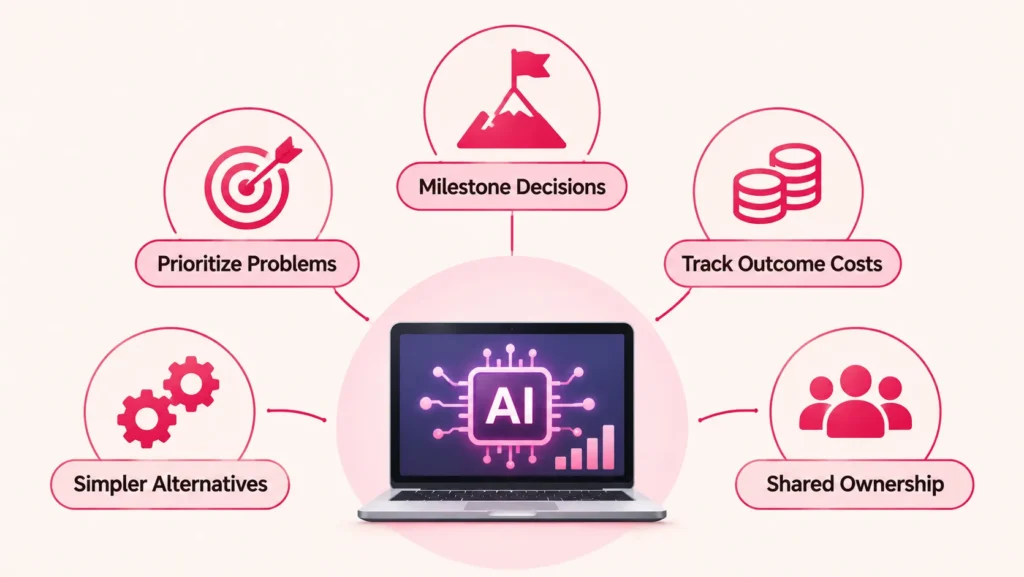
The goal of responsible AI experimentation is not to eliminate failure. Experiments exist to test uncertain assumptions, and some will produce negative results.
The goal is to ensure that experiments generate useful evidence at a reasonable cost, allowing the business to make better investment decisions.
Prioritize Problems With Measurable Economics
High-frequency, repetitive, and expensive processes can provide useful starting points because their current performance is often easier to measure.
However, high transaction volume alone does not guarantee attractive returns. Automation quality, exception handling, data availability, and integration complexity still matter.
Compare AI Against Simpler Alternatives
Not every operational challenge requires an advanced AI model. Many repetitive business activities, including data entry, invoice reconciliation, approval routing, scheduled reporting, and information transfers between applications, can be improved through structured workflows and rule-based systems. Before investing in AI experimentation, organizations should determine whether business process automation can achieve the desired operational improvement at a lower total cost. Comparing conventional automation with AI-powered alternatives helps decision-makers identify where advanced intelligence creates meaningful additional value and where simpler technology offers a stronger financial return.
Companies should compare the expected economic performance of AI against these alternatives rather than assuming that a sophisticated model must be the preferred solution.
A simpler system that reliably solves the problem at lower total cost may produce a stronger financial return.
Use Milestone-Based Investment Decisions
Instead of approving a large budget entirely upfront, businesses can divide AI initiatives into financial and operational milestones.
Each milestone should test a meaningful assumption: data quality, achievable automation, actual user adoption, integration feasibility, or unit economics.
Further funding can then depend on the evidence produced by the previous stage.
Track the Cost of Successful Outcomes
Cost per API request is not always a meaningful economic measure. A low-cost model can become expensive when it produces errors, requires repeated attempts, or increases human correction work.
A more useful measure is the complete cost of producing one acceptable business outcome.
For an invoice-processing workflow, that means the full cost per correctly processed invoice. For customer support, it may mean the cost per successfully resolved case, including escalations and quality checks.
This measurement helps businesses identify situations where paying more for reliable model performance could actually reduce overall operating expenses.
Create Financial Ownership Across Departments
AI performance should not be evaluated exclusively by the technology department.
Operations leaders understand process constraints, finance teams validate economic assumptions, engineering teams assess reliability, and risk owners evaluate acceptable operating boundaries.
Shared ownership reduces the likelihood that a technically impressive project advances without a credible business case.
When Should a Company Move From AI Experimentation to Production?
The transition from experimentation to production should occur only when the business has enough evidence to justify a larger commitment.
A successful pilot may establish that the workflow is technically feasible, but production introduces additional requirements: sustained user adoption, operational monitoring, data security, exception handling, maintenance, accountability, and reliable integration with business systems.
These requirements are not merely engineering concerns. They affect the financial sustainability of the initiative.
For example, an AI workflow may generate positive returns during limited testing but become less economical if production usage increases model costs, creates new support requirements, or exposes difficult cases that were absent from the original sample.
Before scaling, companies should therefore validate a production-oriented financial model with realistic activity volumes, operating expenses, maintenance responsibilities, and performance safeguards.
At this stage, implementation planning becomes relevant. Miracuves helps organizations translate validated use cases into operational systems, and businesses can explore its approach to delivering production-ready AI systems once the expected business value and technical requirements are clearly defined.
For suitable ready-made platforms, Miracuves offers a six-working-day launch route. Custom AI projects follow separately scoped development timelines. A faster deployment can reduce time to validation, but delivery speed alone does not establish a positive financial return.
The strongest implementation decision is the one that preserves the connection between the original business problem, the validated economic benefit, and the production system’s ongoing performance.
What Should an AI Investment Scorecard Include?
An investment scorecard helps executives compare AI opportunities consistently instead of evaluating each project through a separate set of assumptions.
The scorecard should combine financial potential with the practical conditions required to achieve that potential.
| Assessment Area | Question to Answer | Evidence Required |
|---|---|---|
| Business problem | What costly or valuable process is being improved? | Defined process and economic consequence |
| Baseline | What happens without AI? | Measured existing performance |
| Expected value | Which financial benefits are realistic? | Documented benefit assumptions |
| Investment | What is the complete cost of ownership? | Initial and recurring cost model |
| Technical feasibility | Can the system perform reliably? | Representative evaluation results |
| Operational readiness | Will employees and systems use it effectively? | Adoption and workflow evidence |
| Risk controls | Are important failure modes managed? | Security, quality, and governance review |
| Financial result | Does the return meet the investment hurdle? | ROI, payback, and scenario analysis |
| Decision | Should the business scale, redesign, or stop? | Approved recommendation and owner |
The scorecard should be revisited after deployment because actual usage, costs, and economic benefits can change.
AI investment governance is therefore an ongoing management activity, not a calculation performed once during project approval.
Final Thoughts: Make AI Prove Its Business Value Before Scaling It
Companies do not waste money on AI simply because they experiment. They waste money when experimentation becomes disconnected from measurable business outcomes.
An AI initiative should begin with a financially meaningful problem, establish the existing operational baseline, and define the economic improvement required to justify the investment.
Its ROI calculation should include the complete cost of implementation and operations while distinguishing real financial benefits from theoretical productivity gains.
Most importantly, organizations need the discipline to act on their evidence. Some experiments will justify expansion. Others will require redesign. Some should be stopped before additional capital is committed.
For founders and business leaders, the most useful question is not whether artificial intelligence can perform a task. It is whether the complete AI-enabled workflow can deliver reliable, measurable, and sustainable economic value.
AI becomes a stronger investment when its business case is validated before its deployment is scaled.
FAQs
How do you calculate AI return on investment?
Calculate AI ROI by subtracting the total AI investment from the financial benefits attributable to the initiative, dividing the result by the total investment, and multiplying by 100. Benefits and costs must cover the same period. Include development, integration, operations, human oversight, and maintenance, and distinguish realized savings from theoretical productivity gains.
Why do AI experiments fail to deliver financial returns?
AI experiments often fail to generate measurable returns because companies lack clear business objectives, reliable performance baselines, complete cost estimates, operational integration, and user adoption. Some projects demonstrate strong technical performance but never improve the economic results of the workflows they were designed to support.
What costs should businesses include in AI ROI calculations?
Businesses should include experimentation, engineering, data preparation, integrations, model usage, infrastructure, security, employee training, human review, monitoring, and maintenance. Costs should be allocated consistently and measured over the same period as the financial benefits.
Does saving employee time automatically create positive AI ROI?
No. Saving employee time creates capacity, but that capacity does not automatically become a financial saving. Businesses need to verify whether the released time reduces expenses, avoids future staffing costs, enables measurable additional output, or generates another economic benefit.
How can a company measure the ROI of an AI pilot?
Begin with a measured baseline and a defined business hypothesis. Run a controlled experiment using representative tasks, track operating costs and outcome quality, and compare the results with the existing process. Calculate attributable financial benefits, account for the complete investment, and decide whether the evidence justifies expansion.
What is a good ROI for an artificial intelligence project?
There is no universal ROI threshold that makes every AI project worthwhile. The required return depends on investment risk, available alternatives, cost of capital, cash flow timing, and strategic importance. Companies should establish an investment hurdle before starting and assess ROI alongside payback, quality, reliability, and risk.
How long does it take to measure AI ROI accurately?
The evaluation period depends on the use case, transaction volume, adoption speed, and financial measurement cycle. High-volume repetitive processes may produce useful evidence relatively quickly, while forecasting, risk reduction, and enterprise transformation initiatives can require longer observation periods. The goal is reliable evidence, not an arbitrary deadline.
When should a business stop investing in an AI experiment?
A business should consider stopping when credible updated forecasts show that future benefits cannot justify remaining costs and risks, when required quality or safety conditions cannot be met, or when a simpler alternative offers stronger economics. Decisions should consider future value rather than attempting to recover money already spent.
Miracuves is an independent software development company. We are not affiliated with, connected to, sponsored by, or endorsed by any company or product named in this article.
Terms such as “X Clone” are used descriptively. It is how the software industry refers to building a platform with functionality comparable to a known service, and how clients search for it.
The entire design and codebase of our products is built by our own team. Our products contain no code, design, graphics, or content originating from any third-party website or applications.
All third-party names and marks referenced in this article are the property of their respective owners, referenced solely to identify the services discussed.