Key Takeaways
- Managing 50,000 SKUs is a data quality challenge, not just a storage problem. Multi-vendor marketplaces must handle inconsistent titles, missing attributes, duplicate listings, incorrect categories, and incompatible seller data formats.
- AI can automate repetitive catalog cleaning tasks. Natural language processing, machine learning, and computer vision help normalize product information, extract attributes, suggest categories, and detect potential duplicates.
- Product identity and seller offers must remain separate. Equivalent products can be grouped for better discovery, but seller-specific SKUs, prices, inventory, warranties, and fulfillment details must be preserved.
- AI recommendations require validation before publication. Approved taxonomies, mandatory attribute rules, confidence evaluation, and human review help prevent incorrect categories, unsupported specifications, and destructive duplicate merges.
- Clean catalog data improves product discovery. Consistent categories, accurate filters, structured specifications, and reliable product comparisons help customers find relevant listings across multiple sellers.
- Measure catalog accuracy before expanding automation. Track attribute completeness, classification accuracy, duplicate detection precision, human correction rates, publishing time, and unresolved catalog exceptions.
- Build scalable marketplace operations with controlled AI integration. Miracuves provides customizable buyer, seller, and admin marketplace foundations, while advanced AI catalog categorization, historical data cleanup, and specialized validation workflows require separate assessment and implementation.
Managing 50,000 product SKUs sounds like a sign of marketplace growth. More products mean more choices, more sellers, and potentially more transactions. But behind a large product catalog lies a challenge that many marketplace operators underestimate: keeping thousands of seller-generated listings accurate, consistent, searchable, and properly categorized.
Imagine 200 vendors uploading their products to the same marketplace. One seller lists a product as “Wireless Earbuds,” another calls it “Bluetooth Earphones,” and a third uploads an identical item under “Audio Accessories.” Some listings have missing dimensions, inconsistent colors, incorrect categories, or duplicate product identifiers. Others contain outdated information copied from supplier spreadsheets.
At 500 products, a catalog manager might correct these issues manually. At 50,000 SKUs, the same approach becomes difficult to sustain. Businesses evaluating scalable multi-vendor marketplace infrastructure need to consider not only how sellers upload products, but also how those products remain organized and discoverable as the catalog expands.
This is where artificial intelligence can make a meaningful difference. AI-powered product catalog management combines machine learning, natural language processing, computer vision, data validation, and automation to identify catalog inconsistencies, recommend categories, extract attributes, and reduce repetitive administrative work.
However, AI is not a replacement for data governance. A reliable catalog operation also needs a clearly defined taxonomy, trustworthy product identifiers, approval rules, audit trails, and human review for uncertain decisions.
In this guide, we explore how multi-vendor marketplaces can use AI to clean and categorize 50,000 product SKUs, what a practical processing workflow looks like, which mistakes to avoid, and how to measure whether automation is actually improving catalog quality.
Why Managing 50,000 Product SKUs Becomes a Marketplace Operations Challenge
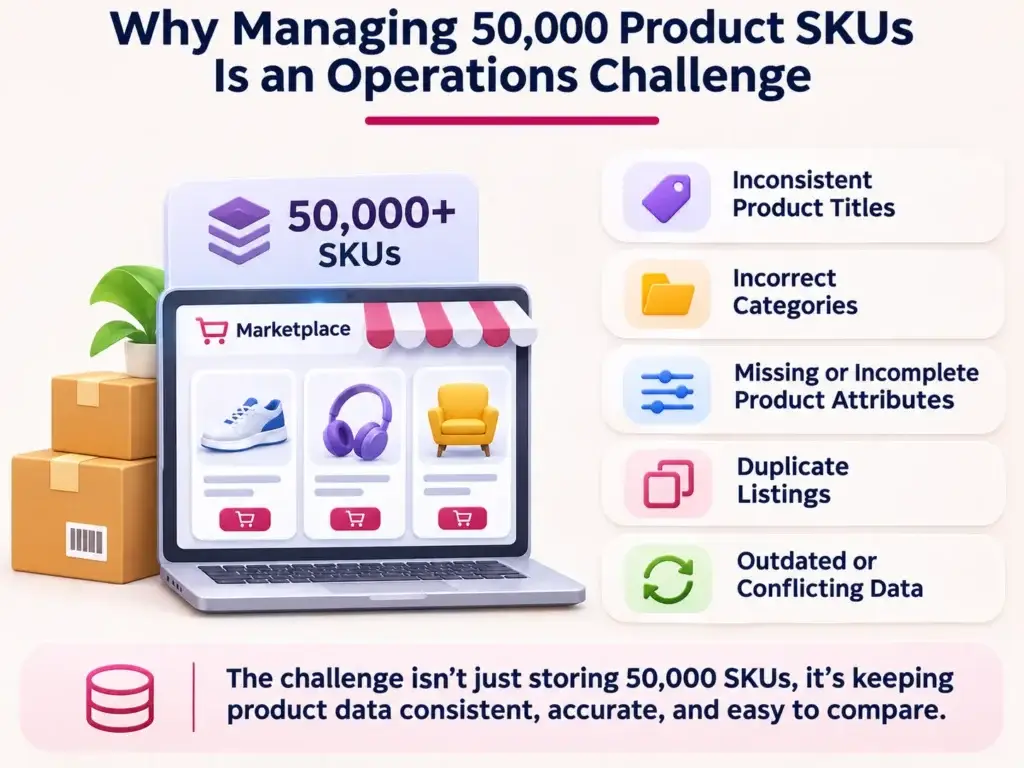
A marketplace catalog is fundamentally different from the inventory database of a single-brand store.
In a traditional online store, one organization generally controls how products are named, photographed, categorized, and described. In a multi-vendor marketplace, independent sellers contribute information using different standards, software systems, and naming conventions.
A fashion seller may upload product information from a spreadsheet. An electronics distributor may submit an API feed. A home goods vendor may copy titles and descriptions from an older inventory system. Even when sellers offer similar products, their data structures can be completely different.
The marketplace must combine these feeds into a consistent shopping experience without losing important product distinctions.
The Difference Between a SKU, a Product, a Variant, and a Seller Offer
Before discussing automation, marketplace teams need to distinguish four commonly confused concepts.
| Entity | Meaning | Example |
|---|---|---|
| Product | The underlying item or product model | Trail running shoe, Model A |
| Variant | A specific combination of product options | Model A, blue, size 9 |
| SKU | An inventory identifier assigned within a seller or inventory system | SHOE-BLU-09 |
| Seller offer | A seller-specific commercial listing linked to an item | Vendor 27 offering the blue shoe for $79 |
This distinction matters because two sellers may use different SKUs for the same underlying product. Conversely, identical SKU strings from two independent sellers do not necessarily identify the same item.
A marketplace that merges records using seller SKUs alone could accidentally combine unrelated products. A marketplace that never recognizes equivalent products may display multiple nearly identical product pages, fragmenting reviews and making comparison difficult.
For a 50,000-SKU catalog, reliable product identity should therefore consider the seller, product identifiers, manufacturer information, variant attributes, and supporting evidence rather than depend on a single text field.
The Most Common Problems in Large Multi-Vendor Catalogs
- Inconsistent product titles: Sellers describe equivalent items using different terminology, abbreviations, and keyword combinations.
- Incorrect categories: Products appear in broad, unrelated, or outdated taxonomy branches.
- Missing attributes: Important information such as material, capacity, dimensions, compatibility, or size is absent.
- Duplicate listings: Equivalent products appear multiple times under different names or vendor identifiers.
- Inconsistent units: Some sellers use inches while others use centimeters, creating unreliable comparisons.
- Broken variant relationships: Product sizes, colors, or configurations appear as unrelated items instead of belonging to the correct parent product.
- Invalid or conflicting identifiers: Manufacturer codes and barcodes may be missing, mistyped, or attached to the wrong products.
- Outdated catalog information: Supplier updates do not reach every listing consistently.
These issues affect more than administrative efficiency. They influence search results, customer trust, product comparisons, seller onboarding speed, and the accuracy of marketplace reporting.
The central challenge is not simply storing 50,000 SKUs. It is maintaining a coherent product information system as sellers continually introduce new data.
What Is AI-Powered Product Catalog Management?
AI-powered product catalog management is the use of machine learning and related automation techniques to process, classify, enrich, validate, and maintain product information at scale.
Instead of relying entirely on administrators to review each uploaded listing, an AI-assisted workflow analyzes incoming data and recommends structured improvements.
For example, a seller might submit a listing titled “Mens Cotton Tee Navy XL.” A classification system can recognize the product type, identify the likely apparel category, extract the color and size, and propose a normalized title.
The system can then check whether the proposed category exists, whether the required attributes are complete, and whether a closely matching product is already present.
Different technologies handle different parts of this process.
| Technology | Catalog Management Role |
|---|---|
| Natural language processing | Interpret product names, descriptions, materials, specifications, and seller terminology |
| Machine learning classification | Predict suitable categories from approved taxonomy labels |
| Computer vision | Extract visual product clues from submitted images |
| Entity matching | Identify potentially equivalent products and duplicate records |
| Generative AI | Suggest normalized descriptions, titles, and structured attribute values |
| Rule-based validation | Enforce identifier formats, mandatory fields, allowed values, and category requirements |
The most dependable approach combines these technologies. AI provides flexible interpretation, while deterministic validation prevents unsupported values and invalid classifications from being published automatically.
For example, an AI model may recognize that a product belongs in “Women’s Running Shoes.” A validation engine must still confirm that this category exists in the marketplace taxonomy and that the product meets the category’s minimum data requirements.
How AI Cleans Product Data Across 50,000 SKUs
Catalog cleaning is the foundation of reliable product categorization. If incoming data contains inconsistent fields, missing identifiers, and unstructured descriptions, even a sophisticated classification system can produce unreliable outcomes.
A practical AI catalog cleanup process can be divided into several interconnected operations.
1. Standardizing Product Titles and Descriptions
Different sellers may describe the same type of product using incompatible naming conventions.
Consider three listings for a similar type of backpack:
- “Laptop Bag Black 15in Waterproof”
- “Water Resistant Office Backpack for 15 Inch Laptop”
- “Black Business Computer Rucksack 15-inch”
An AI system can identify common concepts such as product type, laptop size, color, and intended use. It can then recommend a consistent title structure, such as product type, distinguishing feature, size, and color.
However, it should not automatically convert “water resistant” into “waterproof.” Those terms communicate different performance claims. The system must preserve seller-provided facts and request evidence when attributes conflict.
A well-designed normalization process improves readability without inventing product specifications or removing meaningful differences between items.
2. Extracting Missing or Unstructured Product Attributes
Product specifications are frequently buried inside long descriptions rather than stored in dedicated fields.
For example, a seller may write: “This stainless steel bottle holds 750 ml, comes in matte black, and is suitable for everyday travel.”
An AI extraction engine can identify structured values:
| Attribute | Extracted Value |
|---|---|
| Product type | Water bottle |
| Material | Stainless steel |
| Capacity | 750 ml |
| Color | Matte black |
| Intended use | Everyday travel |
These values can populate structured attributes used by filters and product comparisons.
Crucially, attribute extraction is different from attribute prediction. Extracting “750 ml” from the description is supported by the source data. Guessing a bottle’s insulation duration from an image is not.
Marketplaces should distinguish verified attributes, extracted attributes, inferred suggestions, and missing information. Values without sufficient evidence should be flagged for seller confirmation rather than silently published.
3. Normalizing Measurements, Colors, and Product Terminology
Catalog inconsistency often involves different representations of the same value.
One seller may upload a dimension as “10 inches,” another as “25.4 cm,” and another as “254 mm.” When appropriate, a normalization layer can convert these to a standard display unit while preserving the original source value.
Colors and materials require similar treatment. “Dark blue,” “navy,” and “navy blue” may belong to the same search filter, but the marketplace may still need to preserve the exact manufacturer shade for product identification.
Industry terminology also varies. A seller might refer to a product as a “sofa,” another as a “couch,” and another as a “three-seater lounge.” AI can map related terms to a consistent product concept while preserving useful descriptive details.
Normalization should support both accurate filtering and faithful product representation. A broad search category must not erase a specific product attribute that matters to a buyer.
4. Detecting Duplicate and Near-Duplicate Product Listings
Duplicate detection is one of the most valuable applications of AI in a large multi-vendor catalog.
Two sellers may offer an identical product with different titles, images, prices, stock quantities, and internal SKUs.
A simple text comparison may not recognize the relationship. AI-assisted entity matching can compare manufacturer identifiers, brand names, model numbers, structured attributes, text similarity, and image characteristics to determine whether the records represent the same underlying item.
Nevertheless, similarity is not proof of identity. A 128 GB storage device must not be merged with a 256 GB version simply because the product images and model family are similar.
A safer workflow distinguishes between exact matches, probable matches, and unresolved conflicts. It also maintains separate seller offers so prices, availability, warranties, and fulfillment terms remain accurate.
Marketplaces should avoid destructive automatic merges unless the matching evidence is exceptionally strong and the resulting change is reversible.
5. Identifying Incomplete, Conflicting, or Suspicious Data
AI can help detect anomalies that ordinary field validation may miss.
Examples include an appliance listed with an implausible weight, incompatible size descriptions, a product photograph that appears inconsistent with the claimed category, or specifications copied from another model.
These observations should produce review flags, not automatic accusations of seller misconduct. Unusual data can arise from formatting errors, different regional units, missing context, or genuinely specialized products.
The objective is to prioritize investigation and prevent unreliable information from reaching buyers.
How AI Categorizes Thousands of Marketplace Products Automatically
Cleaning product information addresses consistency. Categorization determines where each product belongs within the marketplace’s navigation structure.
At 50,000 SKUs, category management becomes challenging because sellers may select broad or inaccurate categories, especially when the available taxonomy contains hundreds of branches.
Step 1: Define a Marketplace-Specific Product Taxonomy
A taxonomy is the hierarchical organization of products into categories and subcategories.
For example:
Electronics
  Audio
    Headphones
      Wireless Headphones
      Wired Headphones
    Speakers
      Portable Speakers
      Home Speakers
  Computers
    Laptops
      Business Laptops
      Gaming Laptops
This structure provides a defined set of destinations for classification models.
However, a good taxonomy is not simply the deepest possible category tree. Excessively detailed categories can confuse sellers, fragment inventory, and create additional maintenance work.
The taxonomy should reflect actual buyer navigation behavior, meaningful product distinctions, and the attributes needed for filtering.
Step 2: Analyze Product Titles, Descriptions, Attributes, and Images
AI classification models evaluate available product information to estimate the most appropriate taxonomy category.
Text-based models interpret product descriptions and semantic relationships. Image models can contribute additional evidence when the written information is incomplete or ambiguous.
For example, the word “charger” could refer to a phone accessory, a vehicle charging device, or equipment for rechargeable batteries. A model should use product specifications, connector type, compatible devices, and available images before selecting a category.
Combining multiple information sources can make classification more robust, provided the sources are trustworthy and conflicting evidence is handled explicitly.
Step 3: Generate Category Predictions With Confidence Scores
Instead of forcing every product into one category, a classification system can generate a ranked list of possible categories.
For example, a hypothetical model might return:
| Suggested Category | Illustrative Model Score |
|---|---|
| Electronics > Audio > Wireless Headphones | 0.96 |
| Electronics > Audio > Wired Headphones | 0.03 |
| Electronics > Accessories | 0.01 |
These numbers are hypothetical and should not be interpreted as calibrated probabilities unless the model has been tested accordingly.
Confidence scores are useful for deciding which classifications deserve additional review. However, confidence alone is insufficient. A model can be highly confident and still be wrong when product data is misleading or the taxonomy contains ambiguous categories.
Step 4: Apply Business Rules Before Publishing
Once AI suggests a category, deterministic checks should verify that the classification complies with marketplace requirements.
For instance, electronics may require compatibility information, fashion may require size and material attributes, and products involving regulated claims may require additional documentation or approval.
A product should not automatically become publishable merely because the AI model selected a plausible category.
Catalog governance rules should determine whether the item can be published, must be returned to the seller for correction, or requires administrative verification.
Step 5: Use Human Review for Uncertain Decisions
Human-in-the-loop validation allows catalog specialists to examine decisions where the automated system lacks reliable evidence.
Reviewers should see the original listing, proposed category, supporting product attributes, matching candidates, validation errors, and reasons for the suggested decision.
The final decision can then be recorded and used to improve future classification performance.
This creates a feedback loop in which automation handles repetitive cases while human experts focus on ambiguous, high-risk, or commercially important products.
A Practical AI Catalog Processing Workflow for 50,000 SKUs
The most effective way to manage a large catalog is to treat product information as a controlled data pipeline rather than a collection of independent seller uploads.
A practical workflow might look like this:
Seller Uploads / Supplier Feeds
             ↓
      Data Ingestion
             ↓
    Schema Validation
             ↓
   Field Normalization
             ↓
  AI Attribute Extraction
             ↓
    Taxonomy Prediction
             ↓
  Duplicate / Entity Matching
             ↓
     Business Rules
             ↓
 Confidence & Risk Review
         ↙       ↘
Auto-Approve   Human Review
         ↘       ↙
    Approved Catalog
             ↓
 Search / Filters / Discovery
             ↓
 Quality Monitoring & Feedback
Each stage should have a defined responsibility, a measurable success condition, and a clear exception-handling process.
Phase 1: Ingest and Validate Seller Data
The system receives product information from seller dashboards, CSV files, external inventory feeds, or APIs.
Every import should include source identification, timestamps, seller ownership, and version information where available. These details help operators identify which seller submitted a record and which data source should be considered authoritative.
At this stage, schema validation checks whether required fields exist, values use acceptable formats, and incoming files can be processed safely.
Invalid records should be isolated with actionable error messages rather than causing an entire import to fail unnecessarily.
Phase 2: Normalize and Enrich Product Records
The next stage standardizes terminology, units, field formats, and supported attribute values.
AI extraction can then suggest structured attributes from product descriptions or images. Importantly, the system should retain the original submission and record the source of every suggested change.
If a seller disputes an automatically generated value, administrators should be able to trace it back to the original data and reverse the change.
Phase 3: Classify and Match Products
After normalization, the classification service proposes an approved taxonomy category, while the matching service searches for existing equivalent products.
These functions should operate independently enough to make their decisions auditable. A correct category prediction does not establish that two records are the same product.
Where a match is confirmed, the marketplace can associate multiple seller offers with a canonical product record while retaining each seller’s commercial information.
Phase 4: Approve, Reject, or Escalate
Not every record should follow the same approval path.
A common operational approach is to establish three decision groups: low-risk records eligible for automated approval, uncertain records requiring human verification, and records that fail mandatory validation and must be corrected before publication.
Approval criteria should be calibrated using representative historical data, not arbitrary confidence thresholds chosen during initial setup.
Phase 5: Publish and Monitor Catalog Quality
Approved records are written to the product catalog and made available to downstream systems such as on-site search, product recommendations, filters, and seller analytics.
Changes should be versioned and propagated through reliable update mechanisms. Inventory availability and seller prices may change much more frequently than stable product attributes, so they should not necessarily follow the same processing schedule.
Continuous monitoring then checks whether new imports are reducing catalog quality, whether classification errors are increasing, and whether certain sellers or categories need additional attention.
What Happens When AI Processes 50,000 SKUs? An Illustrative Example
Consider a fictional multi-vendor retail marketplace with 50,000 active seller SKUs submitted by 250 vendors.
Some sellers maintain well-structured inventory systems. Others upload spreadsheets containing incomplete descriptions, inconsistent measurements, and duplicated records.
The marketplace operator wants to improve catalog consistency without requiring administrators to edit every record manually.
Initial Catalog Quality Audit
Suppose the initial audit identifies the following conditions:
| Audit Finding | Illustrative Count | Share of Catalog |
|---|---|---|
| SKUs missing at least one required attribute | 12,000 | 24% |
| SKUs flagged for possible incorrect categorization | 7,500 | 15% |
| SKUs flagged as potential duplicates | 4,000 | 8% |
| SKUs with inconsistent measurement or terminology formats | 10,000 | 20% |
All figures in this example are hypothetical. The issue groups may overlap, so their percentages must not be added together.
After reviewing the problems, the marketplace creates a staged cleaning pipeline rather than attempting to rewrite all records simultaneously.
Processing the Catalog in Controlled Batches
The team divides the catalog into ten batches of 5,000 SKUs each. Each batch passes through the same normalization, classification, matching, and validation stages.
Suppose a pilot batch produces the following operational outcomes:
| Processing Outcome | Illustrative SKUs |
|---|---|
| Passed automated checks | 3,800 |
| Referred for human review | 850 |
| Returned for mandatory seller correction | 350 |
| Total | 5,000 |
In this hypothetical pilot, 76% of records pass automated checks without manual intervention, while 24% require additional action. The exact proportions in a real marketplace will depend on seller data quality, category complexity, regulatory requirements, and the strictness of the approval policies.
The team should validate whether automated approvals are actually correct before expanding processing to the remaining batches.
Estimating the Administrative Workload
Consider a simplified workload comparison. If manually reviewing all 50,000 records takes an average of three minutes per record, the initial effort would equal 150,000 minutes, or 2,500 staff-hours.
If a validated automation workflow reduces the proportion needing full human review to 24%, then 12,000 records remain for manual processing. At the same three-minute average, that represents 600 staff-hours.
The simplified difference is 1,900 staff-hours. This is not a forecast of actual savings because it excludes implementation, sampling, supervision, corrections, ongoing monitoring, and differences in review complexity.
Nevertheless, the calculation illustrates why automating routine catalog checks can be valuable even when human oversight remains essential.
How AI Catalog Categorization Improves Product Discovery
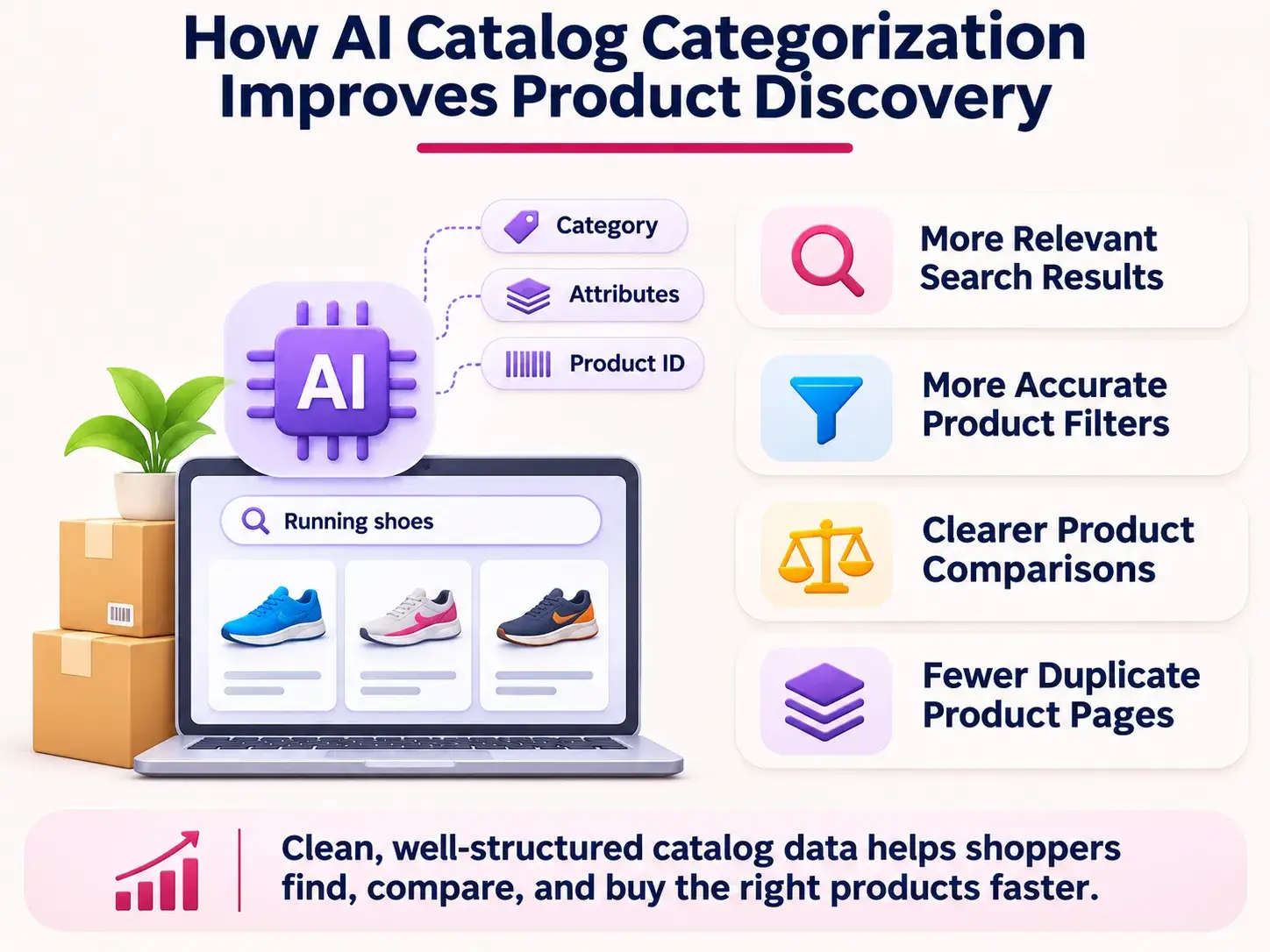
The business value of clean catalog data extends beyond reducing administrative workload. Product information directly influences how customers discover, compare, and evaluate marketplace listings.
More Relevant Search Results
Marketplace search systems depend on structured attributes, category assignments, and searchable text.
When a customer searches for “blue running shoes size 9,” the system needs reliable product type, color, and size information to return suitable results.
If those attributes are missing or inconsistent, relevant products may be excluded while unrelated listings appear.
Improved catalog data makes it easier for search systems to interpret customer requirements. It does not automatically guarantee higher conversions, but it creates a more reliable foundation for product discovery.
More Accurate Product Filters
Filters are only useful when product attributes follow consistent definitions.
If a customer filters laptops by RAM capacity, listings that store memory values as unstructured text may be excluded from the results.
AI-assisted extraction and normalization help make these attributes usable across seller catalogs.
For large fashion catalogs, the challenge is especially visible in size, fabric, color, fit, and seasonal attributes. Operators planning seller-heavy apparel platforms can explore the separate guide on multi-vendor fashion marketplace cost considerations for broader commercial planning; the catalog workflow discussed here remains focused on product data quality.
Clearer Product Comparisons
Customers comparing products need consistent specifications. If one seller describes dimensions in centimeters and another uses inches, the marketplace should present them in a comparable form.
Structured product information also allows buyers to compare materials, capacities, technical specifications, and compatible configurations.
Better comparisons can reduce the effort required to evaluate alternatives and help buyers identify the items that match their requirements.
Fewer Confusing Duplicate Product Pages
When the same product appears under numerous titles, customers may struggle to understand whether the listings represent separate items or different seller offers.
Canonical product identity enables a marketplace to group equivalent offers where appropriate while preserving differences in price, stock, delivery options, and seller terms.
The objective is not to remove legitimate seller choice. It is to reduce unnecessary catalog fragmentation and make purchasing decisions easier.
How to Measure AI Catalog Data Quality and Automation Performance
Implementing AI does not automatically mean a product catalog is improving. Operators need measurable indicators that show whether automated processing is producing useful and trustworthy results.
A practical catalog quality dashboard should monitor both data completeness and classification correctness.
| Metric | What It Measures | Why It Matters |
|---|---|---|
| Required attribute completeness | Percentage of applicable mandatory product attributes populated with valid values | Supports filtering and product evaluation |
| Category accuracy | Percentage of audited classifications matching an approved reference label | Measures actual classification quality |
| Duplicate detection precision | Share of flagged duplicate pairs that are truly equivalent | Helps prevent incorrect product merges |
| Duplicate detection recall | Share of known duplicate pairs successfully identified | Shows whether matching misses important duplicates |
| Automated approval rate | Share of processed records approved without manual intervention | Measures automation coverage |
| Review correction rate | Share of reviewed AI proposals changed by humans | Highlights model weaknesses and edge cases |
| Time to publish | Time between valid submission and approved listing availability | Reflects seller onboarding efficiency |
| Catalog exception backlog | Unresolved records awaiting correction or review | Identifies operational bottlenecks |
These metrics should be segmented by category, seller, product source, and processing stage. An overall accuracy number can hide serious problems in specific product groups.
For example, a classification model might perform well on everyday apparel but struggle with specialized industrial components. A marketplace handling both categories should not rely on one blended accuracy score to justify automatic approval.
Example: Measuring Required Attribute Completeness
Suppose a catalog audit contains 200,000 applicable required attribute fields, of which 168,000 contain valid values.
Attribute completeness = (168,000 ÷ 200,000) × 100 = 84%
After normalization, seller corrections, and verified AI-assisted extraction, suppose 190,000 fields contain valid values.
Updated completeness = (190,000 ÷ 200,000) × 100 = 95%
In this hypothetical example, completeness improves by 11 percentage points. The calculation assumes the same set of applicable required fields before and after processing.
It is important to measure valid and supported values rather than merely counting populated fields. An AI-generated guess should not improve the quality score simply because it fills an empty cell.
Choosing Between Rules, Machine Learning, and Generative AI
Not every catalog management problem requires a large AI model. Some tasks are better handled through conventional software logic, while others benefit from language understanding and predictive classification.
Choosing the appropriate method can improve reliability and control processing costs.
| Approach | Best Uses | Important Limitations |
|---|---|---|
| Rule-based processing | Mandatory fields, unit conversion, allowed values, identifier validation | Cannot easily interpret ambiguous descriptions |
| Traditional machine learning | Category classification, pattern recognition, structured attribute prediction | Requires suitable training or evaluation data |
| Language models | Parsing varied descriptions, semantic matching, title suggestions, complex attribute extraction | May invent unsupported details or produce inconsistent outputs |
| Computer vision | Image-based product identification and visual attribute suggestions | May confuse visually similar products and variants |
| Hybrid processing | Combining flexible AI suggestions with enforceable data quality controls | Requires orchestration, monitoring, and governance |
For many marketplaces, a hybrid strategy is preferable. Deterministic rules handle straightforward checks, while AI models focus on tasks that require interpretation.
This also helps avoid unnecessary model calls. A straightforward unit conversion does not require generative AI, and an invalid barcode checksum should be handled by an appropriate validation algorithm rather than a language model.
A well-designed pipeline uses the least complex reliable method for each task.
Building Human-in-the-Loop Quality Control for Large Marketplace Catalogs
Large-scale catalog automation works best when human reviewers handle the cases where machine-generated decisions carry meaningful uncertainty or risk.
Rather than reviewing every SKU equally, the marketplace can prioritize records according to confidence, business impact, and the potential consequences of incorrect information.
Which Catalog Records Should Receive Human Review?
Human review is especially appropriate for products with conflicting manufacturer identifiers, ambiguous category assignments, unsupported technical claims, uncertain duplicate matches, or attributes relevant to safety and compliance.
High-value products may also deserve additional checks when incorrect specifications could lead to significant customer disputes.
For marketplaces handling premium goods, catalog accuracy supports—but does not replace—other controls such as seller verification and buyer qualification. These are separate trust functions, explored in the Miracuves guide to buyer qualification in luxury marketplaces.
Make AI Decisions Explainable to Reviewers
Reviewing a product becomes more efficient when administrators can see why the system made a recommendation.
A useful review interface displays the original seller fields, normalized values, suggested category, confidence information, similar products, validation results, and data provenance.
Reviewers should be able to approve, edit, reject, or request seller clarification. Every decision should create an auditable record.
These corrections also help identify persistent problems in seller feeds, category definitions, and model behavior.
Prevent Automation From Repeating the Same Errors
If a model repeatedly assigns similar products to the wrong category, the team should investigate whether the problem originates in training examples, taxonomy ambiguity, poor source data, or decision thresholds.
It is not enough to manually fix individual records while leaving the underlying pipeline unchanged.
High-quality catalog operations require a feedback system that converts recurring exceptions into improvements to the rules, taxonomy, model evaluation, or seller submission process.
A 90-Day Roadmap for Introducing AI Catalog Automation
Marketplace operators do not need to automate all 50,000 SKUs at once. A phased implementation reduces the risk of widespread classification mistakes and gives the team time to validate the results.
The following 90-day roadmap is an illustrative planning framework, not a guaranteed deployment timeline. Actual effort depends on source-data quality, integrations, taxonomy complexity, and the approval requirements of the business.
Days 1–15: Audit and Establish Catalog Standards
Begin by evaluating the current catalog structure and identifying the most common quality problems.
Determine which categories contain the greatest number of missing attributes, which sellers introduce the most inconsistent data, and where duplicate products cause operational problems.
During this stage, document the approved taxonomy, required category-specific attributes, product identity rules, and the authoritative source for important fields.
Expected deliverable: A catalog quality baseline, data dictionary, taxonomy specification, and prioritized problem list.
Days 16–30: Create a Controlled Pilot Dataset
Select a representative sample of products covering different sellers, categories, data formats, and known quality problems.
Human reviewers should establish reliable reference classifications and duplicate labels. These will form the evaluation dataset used to test automated decisions.
The sample should include difficult cases, such as products with ambiguous names, nearly identical variants, and conflicting attributes.
Expected deliverable: A validated reference dataset and documented baseline performance.
Days 31–45: Test Cleaning and Classification Workflows
Introduce normalization rules, attribute extraction, category prediction, and duplicate candidate generation within a controlled environment.
Compare the automated outputs with human-approved reference data. Measure classification correctness, false duplicate matches, attribute extraction quality, and the proportion of cases requiring human review.
Do not evaluate success based solely on how quickly the system processes records.
Expected deliverable: A tested processing workflow with documented error patterns and preliminary approval criteria.
Days 46–60: Integrate Human Review and Seller Corrections
Connect the automated workflow to administrative review queues and seller correction mechanisms.
Ensure that uncertain classifications can be escalated, rejected values can be corrected, and reviewers can restore previous versions when necessary.
Establish ownership for exception queues and define when unresolved records should be escalated to catalog specialists or sellers.
Expected deliverable: A controlled approval workflow with auditable decisions and recovery procedures.
Days 61–75: Expand Processing to Additional Categories
Once the pilot meets agreed quality requirements, introduce additional catalog segments in manageable batches.
Track performance separately for each category, monitor processing failures, and pause expansion if the error rate exceeds acceptable limits.
Previously approved products should remain recoverable through version history or other rollback mechanisms.
Expected deliverable: A broader processed catalog with stable quality metrics and documented exception handling.
Days 76–90: Establish Continuous Catalog Governance
The final stage moves the workflow from a one-time cleanup exercise into an ongoing operating process.
New seller uploads should pass through appropriate validation, normalization, categorization, and approval steps. Existing records should be reprocessed selectively when source information changes or taxonomy rules are updated.
Create dashboards for completeness, category accuracy, exception backlog, seller correction frequency, and processing throughput.
Expected deliverable: A maintained catalog quality program rather than a temporary data cleaning project.
What Does AI Catalog Automation Cost Operationally?
The economics of catalog automation depend on the structure and quality of the data, the complexity of the taxonomy, the technologies used, and the volume of records that require human intervention.
Unlike broader marketplace implementation budgets, the relevant question here is how much it costs to process, validate, and maintain product data accurately.
The main operating cost drivers include:
- Initial data preparation: Auditing records, mapping supplier fields, and defining approved attribute structures.
- AI processing: Model inference for classification, extraction, matching, and content suggestions.
- Infrastructure: Storage, batch processing, queue management, monitoring, and data synchronization.
- Human validation: Reviewing uncertain classifications, duplicate candidates, and conflicting claims.
- Ongoing maintenance: Updating taxonomies, adapting to new sellers, monitoring model performance, and resolving exceptions.
Operators should separate initial cleanup expenses from recurring costs. Cleaning 50,000 historical records is a different workload from maintaining thousands of new or modified records every month.
Before selecting a technology, estimate the cost per successfully validated record, the expected human review burden, and the expense of correcting wrong decisions.
A cheaper AI model is not necessarily the more economical choice if its errors create additional administrative work or increase the risk of incorrect product information reaching customers.
Common Mistakes When Automating Large Product Catalogs
AI catalog automation can introduce new problems when it is implemented without sufficient operational controls.
Automatically Publishing Every AI-Generated Attribute
AI models may produce plausible descriptions or specifications without adequate evidence. Publishing unsupported values can create misleading listings and customer disputes.
Separate supported extraction from inferred suggestions, and require confirmation where necessary.
Using a Poorly Designed Category Tree
Even an accurate model cannot compensate for an ambiguous or outdated taxonomy. Categories should be reviewed for overlapping meanings, unnecessary depth, and missing distinctions.
Taxonomy design should precede large-scale automated classification.
Confusing Product Similarity With Product Identity
Visually similar products may have different specifications, warranties, materials, or compatibility requirements.
Duplicate detection should use available identity evidence and preserve uncertainty rather than automatically merging every close match.
Ignoring Seller-Specific Commercial Information
Two sellers offering the same product may have different prices, fulfillment arrangements, stock quantities, or return policies.
Catalog consolidation must preserve these seller-specific details and avoid treating equivalent product identities as identical commercial offers.
Measuring Automation Volume Instead of Accuracy
Processing 50,000 SKUs quickly is not useful if thousands receive incorrect categories or fabricated attributes.
Success should be evaluated through accuracy, valid attribute completeness, review rates, and downstream catalog usability—not throughput alone.
Treating Catalog Cleanup as a One-Time Activity
Marketplace catalogs continuously change as sellers add products, update descriptions, modify variants, and discontinue inventory.
Without ongoing validation and monitoring, quality problems will reappear even after a successful initial cleanup.
How Different Marketplace Categories Affect AI Catalog Requirements
A single categorization policy rarely works equally well across every marketplace category.
Fashion marketplaces depend heavily on size, color, material, gender or fit categories, and variant relationships. Electronics marketplaces require accurate technical specifications, compatibility information, manufacturer identifiers, and model distinctions.
Home goods catalogs need reliable dimensions, materials, assembly requirements, and product configuration details. Industrial marketplaces may depend on part numbers, technical standards, specifications, and supplier documentation.
These differences influence which fields are mandatory, what evidence is acceptable, and when manual verification is necessary.
Businesses examining industry-specific digital platform requirements should define category-specific data policies rather than expect one generic catalog schema to accommodate every product type without modification.
For multi-category marketplaces, this often means maintaining a common product identity framework alongside specialized attribute schemas for each major category.
When Should a Marketplace Introduce AI Catalog Automation?
There is no universal SKU threshold at which AI becomes mandatory.
A marketplace with 5,000 highly technical products and inconsistent supplier specifications may need sophisticated catalog validation earlier than a marketplace with 50,000 simple, standardized products.
The decision should be based on operational complexity rather than product count alone.
AI-assisted catalog operations deserve serious consideration when:
- Seller onboarding queues are growing faster than the catalog team can review them.
- A significant share of imported products consistently lacks required attributes.
- Customers report incorrect categories or unreliable filtering.
- Duplicate products create fragmented search results or confusing comparisons.
- Catalog corrections are repeatedly performed by hand.
- New sellers frequently submit incompatible data formats.
- Category-specific product rules are becoming difficult to maintain manually.
- The marketplace needs a repeatable quality process for recurring bulk imports.
The goal should not be to automate every catalog decision. It should be to automate repeatable, verifiable tasks while preserving human judgment where errors carry meaningful consequences.
How Miracuves Can Support AI-Ready Marketplace Catalog Operations
For marketplace businesses, catalog automation is most useful when it works within existing seller, administrative, and product discovery workflows.
A catalog processing system may need to receive bulk seller uploads, maintain stable product identifiers, expose structured attributes to search services, provide exception queues for administrators, and synchronize approved changes with the product database.
Miracuves offers ready-made and customizable marketplace foundations that can support buyer, seller, and administrative operations. Its published six-working-day delivery proposition applies to the defined ready-made marketplace base, with customization and additional integrations scoped separately.
For a business handling 50,000 product SKUs, the relevant next step is to assess whether its catalog workflow requires additional data preparation, automated classification, external product information services, or specialized review controls.
Advanced AI categorization and historical catalog cleanup should be evaluated as distinct requirements rather than assumed to be included in a standard six-day platform delivery.
Final Thoughts: Clean Product Data Is the Foundation of a Scalable Marketplace
Managing 50,000 product SKUs is not primarily a storage problem. It is a data quality, classification, and operational governance challenge.
As multi-vendor marketplaces grow, inconsistent product descriptions, missing attributes, duplicate records, and incorrect categories can weaken the shopping experience and create unnecessary work for catalog teams.
AI can help address these problems by extracting structured information, recommending categories, identifying potential duplicates, standardizing terminology, and directing uncertain cases to the right reviewers.
But successful automation depends on more than model performance. Marketplace operators also need clear product identities, reliable data sources, category-specific rules, human oversight, and continuous quality measurement.
For businesses planning long-term catalog growth, these operational requirements should influence decisions about seller onboarding, administrative workflows, product search, and the broader platform foundation. Miracuves’ buyer, seller, and admin marketplace systems provide a relevant starting point for discussing how these components can work together, including where specialized catalog automation may require additional implementation.
The ultimate objective is not simply to process 50,000 SKUs faster. It is to maintain a dependable product catalog that sellers can manage efficiently and customers can search with confidence.
Frequently Asked Questions
How can AI help manage 50,000 product SKUs?
AI can assist with title normalization, attribute extraction, product categorization, duplicate detection, and quality checks. A reliable workflow combines these capabilities with validation rules and human review for uncertain records.
Can AI automatically categorize products from different marketplace sellers?
Yes. AI models can analyze titles, descriptions, structured attributes, and sometimes images to suggest categories from an approved taxonomy. Automated publication should depend on tested accuracy, data completeness, and appropriate approval rules.
How does AI identify duplicate product listings?
AI-assisted matching compares product identifiers, manufacturer details, descriptions, attributes, and sometimes images to identify potentially equivalent items. Probable matches should be verified before records are merged, and seller-specific offers must remain distinct.
What is the difference between product categorization and catalog data cleaning?
Catalog cleaning corrects inconsistent, incomplete, or incorrectly formatted information. Product categorization assigns items to appropriate taxonomy categories. Both processes are connected, but they solve different data quality problems.
Can AI fill missing product attributes automatically?
AI can extract attributes from existing descriptions, images, or trusted supporting documents. However, unsupported attributes should not be invented. Missing or conflicting specifications may require seller confirmation or manual verification.
Does a marketplace need AI for every product listing?
No. Straightforward checks such as required fields, identifier formats, and unit conversion can use deterministic rules. AI is most useful when information is unstructured, ambiguous, or difficult to interpret through fixed rules.
How do marketplaces measure AI product classification accuracy?
Marketplaces can compare model predictions with human-verified reference labels and track category accuracy, precision, recall where appropriate, correction rates, and error patterns by category. Confidence scores alone do not establish correctness.
How long does it take to clean a catalog of 50,000 SKUs using AI?
The timeline depends on data quality, taxonomy complexity, model performance, integration requirements, and human review workload. A controlled pilot should establish realistic processing rates before the entire catalog is scheduled for cleanup.
Will AI catalog automation eliminate manual catalog management?
No. Automation can reduce repetitive processing, but human oversight remains important for ambiguous classifications, conflicting product identities, unsupported specifications, compliance-sensitive information, and ongoing data governance.
What should marketplace operators prepare before introducing AI catalog automation?
Operators should establish a product taxonomy, define mandatory attributes, identify authoritative data sources, audit existing catalog quality, prepare human-verified examples, and document approval and exception-handling policies.
Miracuves is an independent software development company. We are not affiliated with, connected to, sponsored by, or endorsed by any company or product named in this article.
Terms such as “X Clone” are used descriptively. It is how the software industry refers to building a platform with functionality comparable to a known service, and how clients search for it.
The entire design and codebase of our products is built by our own team. Our products contain no code, design, graphics, or content originating from any third-party website or applications.
All third-party names and marks referenced in this article are the property of their respective owners, referenced solely to identify the services discussed.