Key Takeaways
- Luxury marketplace buyer qualification should focus on buyer quality, not inquiry volume. The goal is to identify credible purchasing opportunities rather than simply increase the number of messages sellers receive.
- Budget alignment is only one qualification factor. Purchase timeline, asset requirements, decision-making authority, and willingness to complete an appropriate next step also help determine buyer readiness.
- Use progressive qualification instead of demanding sensitive information immediately. Buyers can move from public discovery to structured inquiries, qualified discussions, verification, and transaction stages as their intent becomes clearer.
- Contact verification helps establish basic accountability but does not prove purchase intent. Verified contact information should be treated as an initial screening layer rather than a complete buyer credibility assessment.
- Proof-of-funds checks should be proportional to transaction risk. Financial verification may be appropriate before confidential access, costly viewings, exclusive negotiations, or restricted bidding, but should not automatically be required at the first interaction.
- Privacy-conscious buyers should not automatically be treated as suspicious. Luxury buyers may use representatives, financing arrangements, confidential communication, or alternative verification methods.
- Buyer intent scoring can help sellers prioritize inquiries. Scores can consider budget alignment, timeline, asset fit, decision authority, verified contact information, and engagement with the next appropriate step.
- Qualification rules should remain explainable and reviewable. Staff should be able to understand why an inquiry received a particular priority and correct inaccurate or unusual cases.
- Confidential asset information should be released according to buyer status. Private ownership records, detailed maintenance documents, locations, valuations, and other sensitive materials can require additional verification or seller approval.
- Automation should support human judgment, not replace it. Automated workflows can verify contacts, collect requirements, identify duplicates, assign lead stages, and flag unusual activity, while complex or exceptional cases should remain reviewable by qualified staff.
- The strongest luxury marketplace buyer qualification process balances accessibility, seller protection, confidentiality, and buyer trust. The objective is not to create unnecessary barriers, but to ensure serious buyers receive the right attention while sensitive information and seller resources remain protected.
Selling a luxury yacht, rare automobile, premium property, private aircraft, or collectible asset online creates a challenge that ordinary ecommerce businesses rarely face: attracting attention is relatively easy, but identifying who is genuinely prepared to buy is far more complicated.
Every inquiry can appear promising at first. A potential buyer requests more photographs, asks detailed questions, schedules a conversation, or expresses interest in a private viewing. Yet that same person may have no realistic budget, no purchasing authority, no financial readiness, or no intention of completing a transaction.
For sellers, brokers, and luxury marketplace operators, these interactions consume time that could otherwise be spent supporting serious customers. Miracuves recognizes that effective marketplace platform workflows need to connect buyer interest with appropriate qualification, secure communications, and seller-controlled access rather than treating every inquiry as an equally valuable lead.
The objective is not to make luxury purchases unnecessarily difficult. It is to create a buying environment where legitimate customers receive professional attention, sellers protect their time, and sensitive transaction information is disclosed at the appropriate stage.
This guide explains how luxury marketplaces can qualify buyer inquiries, recognize purchasing intent, use identity and financial verification responsibly, manage inquiry quality, and prevent time-wasters without discouraging genuine buyers.
Why Selling High-Ticket Assets Online Requires a Different Buyer Qualification Strategy
In conventional online retail, the path from product discovery to purchase is usually straightforward. A customer compares items, reviews a price, places an order, and completes checkout.
High-ticket asset sales involve a more complicated decision. Buyers may need specialist inspections, financing approval, ownership documentation, legal review, transportation arrangements, insurance, or advice from professional representatives before making an offer.
For example, someone considering a premium vehicle may want service records, accident history, authenticity documentation, and an independent inspection. A potential yacht buyer may need a survey, vessel documentation, insurance information, and confirmation that a viewing can be arranged. A property investor may require legal due diligence, financing discussions, and approval from other decision-makers.
These requests are not inherently suspicious. They are normal parts of serious purchasing decisions.
The difficulty arises when a marketplace cannot distinguish a genuine buyer conducting due diligence from someone collecting information without realistic purchasing intent.
Why More Inquiries Do Not Automatically Mean Better Marketplace Performance
A marketplace can attract considerable traffic and still deliver disappointing results for premium sellers. When users can submit unlimited anonymous inquiries without providing any context, brokers may spend hours responding to vague messages, repeated requests, and conversations that never progress.
This creates several operational problems. Sellers become less responsive because they no longer trust inquiry quality. Genuine buyers receive slower responses. Marketplace administrators struggle to identify which leads deserve attention. Over time, dealers may question the value of paid listings or subscriptions.
The more useful success measure is not the volume of messages received. It is the proportion of inquiries that progress into meaningful conversations, verified purchasing interest, inspections, offers, and completed transactions.
What Makes Someone a Qualified Buyer in a Luxury Marketplace?
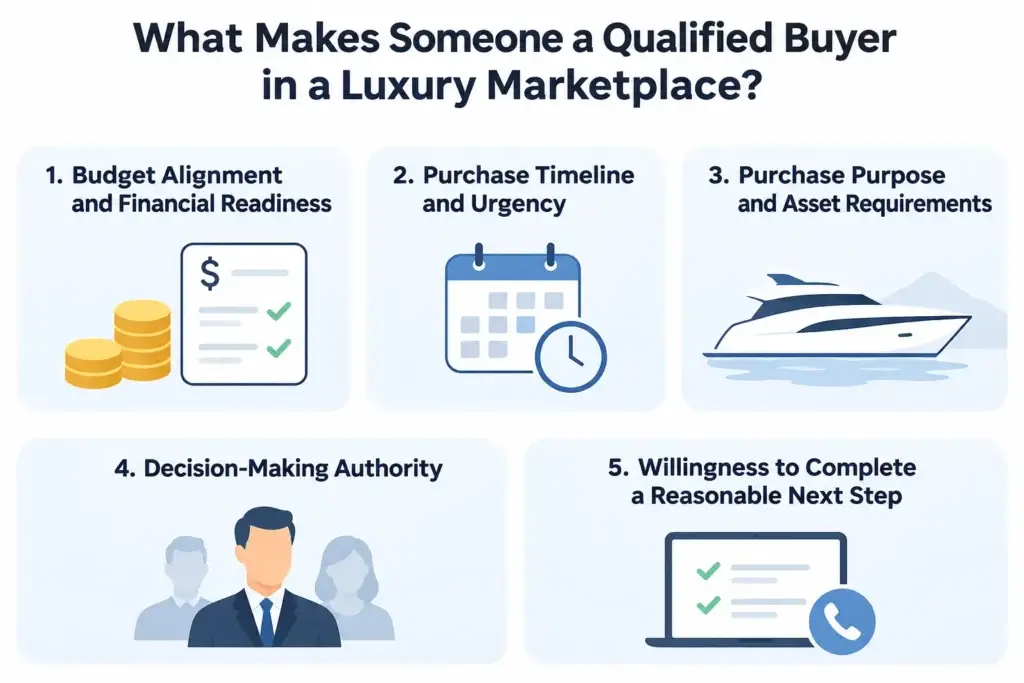
A qualified luxury buyer is not necessarily someone who can pay immediately. High-value purchases often require planning, negotiation, financing, and detailed investigation. Qualification should establish whether the inquiry represents a credible commercial opportunity and whether the person is ready for the next appropriate step.
Five dimensions are particularly useful when evaluating purchasing readiness.
1. Budget Alignment and Financial Readiness
A buyer interested in a high-value asset should have a realistic understanding of its price range and the total financial commitment involved. Depending on the category, this may include taxes, insurance, transportation, maintenance, inspection fees, storage, or ongoing operational expenses.
Early qualification does not always require collecting bank statements. A simple question about the intended acquisition budget or financing status may be sufficient to understand whether the buyer and seller are broadly aligned.
2. Purchase Timeline and Urgency
Someone looking to complete a transaction within the next month requires a different level of attention than a buyer researching options for a purchase next year. Both can be legitimate prospects, but they should not necessarily follow the same sales process.
Classifying buyers by purchase timeline helps sellers prioritize near-term opportunities while keeping longer-term prospects engaged through relevant updates, saved searches, and future follow-ups.
3. Purchase Purpose and Asset Requirements
Serious buyers can often explain what they are looking for, even if they have not finalized every specification. Their requirements might involve investment objectives, personal use, business operations, collection strategy, geographic preferences, or technical features.
A detailed inquiry is not proof of financial readiness, but specific and consistent requirements can help a seller identify a conversation worth developing.
4. Decision-Making Authority
Luxury transactions may involve family offices, business partners, investment committees, legal representatives, or professional purchasing agents. Marketplace operators should understand whether the person submitting the inquiry is the intended buyer, an authorized representative, or someone conducting preliminary research.
Representatives should not automatically be treated as low-quality leads. What matters is whether their role is transparent and whether they have a credible route to an actual purchasing decision.
5. Willingness to Complete a Reasonable Next Step
A buyer may show stronger intent by agreeing to a scheduled call, providing relevant acquisition criteria, requesting an inspection, confirming representation, or completing verification when justified.
However, reluctance to share sensitive financial documents during an initial conversation should not automatically be considered suspicious. A privacy-conscious buyer may have legitimate concerns about where documents are stored and who can access them.
Qualification works best when each request is proportional to the stage of the transaction.
How Luxury Marketplaces Can Qualify Buyer Inquiries Step by Step
The most effective approach is progressive qualification. Rather than demanding extensive documentation before a buyer can express interest, the marketplace asks for additional information as the commercial relationship becomes more serious.
| Stage | Buyer Action | Qualification Method | Seller Benefit |
|---|---|---|---|
| Discovery | Views public asset details | No intrusive checks | Maintains accessibility |
| Initial inquiry | Requests information | Verified contact and structured questions | Reduces incomplete messages |
| Qualified discussion | Discusses budget and purchase plans | Intent assessment and human review | Prioritizes serious conversations |
| Sensitive access | Requests private documents or viewings | Identity, authority or funds verification where justified | Protects confidential information |
| Offer and transaction | Submits a formal offer | Enhanced due diligence and appropriate transaction checks | Supports safer deal progression |
Step 1: Replace Generic Contact Forms With Meaningful Inquiry Questions
A basic form requesting only a name, email address, and message provides limited insight into buyer readiness. A better approach is to ask a small number of questions directly connected to the asset and the buyer’s intended next step.
For instance, an inquiry form for a luxury vehicle might request the preferred purchase timeline, geographic location, inspection interest, and whether financing has been arranged. A private aircraft marketplace might ask about intended use, operating preferences, and whether the buyer is acting personally or on behalf of an organization.
These questions should be optional or appropriately staged where possible. The goal is to create useful context, not to build an unnecessarily long application form.
Step 2: Confirm Contact Authenticity
Email confirmation, phone verification, rate limits, and spam detection can help reduce automated or obviously fabricated inquiries. These safeguards establish a basic level of accountability before sellers begin substantial follow-up.
Contact verification alone does not establish genuine purchase intent. A verified telephone number can still belong to someone who is simply browsing, while a legitimate purchaser may prefer an authorized representative to handle early communication.
Platforms should treat contact verification as an initial screening step rather than a complete credibility assessment.
Step 3: Match Buyer Requirements Against the Actual Asset
An inquiry becomes more meaningful when the buyer’s stated criteria align with the listing. If someone has a budget significantly below the advertised price, the marketplace might suggest alternative inventory instead of immediately consuming a broker’s time.
Similarly, if a buyer requires an asset in a different region, delivery timeline, or configuration, the platform can clarify those constraints before arranging a direct introduction.
This is a useful role for structured matching and basic automation. Instead of declaring the buyer unqualified, the system can identify mismatches and offer an opportunity to update preferences.
Step 4: Introduce Deeper Verification Before Sensitive Access
Detailed ownership records, private asset locations, confidential financial information, and exclusive viewing arrangements should not necessarily be available to every anonymous visitor.
When buyers request this type of access, the marketplace can apply additional checks, such as identity confirmation, proof of authority, financial readiness verification, or a confidentiality agreement where appropriate.
The verification requirement should reflect the value of the asset, the sensitivity of the information, and the practical risks involved. Not every expensive product requires the same process.
Step 5: Route Qualified Inquiries to the Appropriate Human Representative
Once sufficient context has been collected, the inquiry should reach someone who can meaningfully advance the conversation. That may be the owner, authorized broker, sales adviser, dealer, or specialist representative.
The recipient should understand which asset the buyer requested, the buyer’s stated requirements, which verification steps were completed, and what action is expected next.
For a deeper discussion of converting specialized marine inquiries into broker-ready opportunities, see the related Miracuves guide on turning yacht inquiries into qualified broker leads.
How Proof-of-Funds Verification Helps Prevent Unproductive Luxury Sales Conversations
Proof of funds is a method of evaluating whether a buyer appears to have financial resources consistent with a proposed acquisition. In some high-value marketplaces, buyers may be asked to verify financial capacity before gaining access to particular listings, sensitive documents, or advanced transaction stages.
The principle is straightforward: a seller should not have to disclose confidential information or commit substantial professional resources to a prospective buyer without reasonable evidence that the transaction is financially realistic.
However, proof of funds must be implemented with care. It is not a guarantee that funds will remain available, that they are legally transferable, or that the transaction will close.
Which Financial Evidence Might Be Appropriate?
Depending on the asset category, financing structure, and applicable rules, a marketplace may accept confirmation from a financial institution, a professional adviser, a financing provider, or a secure third-party verification service.
The platform should avoid collecting more financial information than necessary. A verified status or an appropriately limited capacity range may be more useful to the seller than unrestricted access to someone’s bank statements.
Where possible, sensitive verification should be handled by an appropriate specialist provider, with restricted staff access, clear retention policies, and records of consent or another applicable lawful basis for processing.
When Should Luxury Marketplaces Request Proof of Funds?
Requiring detailed financial evidence at the first page view is likely to discourage many genuine prospects. A more balanced approach introduces verification when the buyer wants a privilege that creates additional risk or cost for the seller.
- Before receiving a confidential information memorandum.
- Before accessing restricted ownership or location details.
- Before arranging a costly private viewing or specialist inspection.
- Before entering an exclusive negotiation stage.
- Before participating in a restricted bidding process, when appropriate.
For financed purchases, a credible pre-approval, lender confirmation, or other documented financing path may be more appropriate than demanding evidence of liquid cash alone.
The key is to verify financial capacity fairly and proportionately rather than assuming all legitimate purchasers use the same payment structure.
Preventing Time-Wasters Without Rejecting Genuine Luxury Buyers
One of the most common mistakes in premium sales is treating every buyer who is not immediately ready to transact as a time-waster. This oversimplifies purchasing behavior and can result in valuable long-term relationships being lost.
A buyer exploring options today may be planning an acquisition several months later. Someone requesting detailed information may be conducting legitimate due diligence. A purchaser who refuses to upload personal financial documents to an unfamiliar website may simply be protecting their privacy.
A strong qualification system distinguishes limited readiness from suspicious behavior.
| Buyer Behavior | Possible Interpretation | Recommended Response |
|---|---|---|
| Researching a future acquisition | Early-stage but potentially genuine | Provide educational information and nurture |
| Asking many technical questions | Possible due diligence | Clarify requirements and offer a specialist discussion |
| Requesting confidential documents immediately | Requires additional screening | Explain access conditions and verify appropriately |
| Providing repeatedly inconsistent information | Potential reliability concern | Pause sensitive disclosure and request clarification |
| Declining to upload a bank statement | Possible legitimate privacy concern | Offer an approved alternative verification path |
| Repeatedly requesting viewings without meaningful engagement | Possible unproductive inquiry | Require an appropriate scheduling or qualification step |
Rather than relying on a single warning signal, platforms should consider the full context. Automated screening can flag unusual behavior, but consequential decisions—particularly those affecting legitimate buyers’ access—should allow review and correction.
Using Buyer Intent Scoring to Prioritize High-Value Inquiries
Buyer intent scoring helps marketplace operators organize incoming inquiries based on their likely readiness for a meaningful sales conversation. It should support human judgment rather than replace it.
A practical scoring model can consider the completeness of the inquiry, suitability of the requested asset, stated purchase timeline, whether an authorized decision-maker is involved, and completion of relevant verification steps.
An Illustrative Buyer Qualification Scorecard
The following model is an example founders can adapt during testing. These weights are illustrative operational choices, not industry benchmarks or guaranteed predictors of sales.
| Qualification Dimension | Illustrative Weight | What to Evaluate |
|---|---|---|
| Budget and financing alignment | 25 points | Is the expected acquisition realistic? |
| Purchase timeline | 20 points | Is there a defined purchasing window? |
| Asset requirement match | 20 points | Does the asset meet stated needs? |
| Decision authority | 15 points | Can the buyer or representative progress the decision? |
| Verified contact and consistent information | 10 points | Can the marketplace establish reliable contact? |
| Appropriate next-step engagement | 10 points | Has the buyer accepted a relevant next action? |
In this example, high-scoring inquiries might receive prompt specialist follow-up, medium-scoring inquiries might receive clarification questions, and early-stage buyers might receive educational material and future listing updates.
These scores should not serve as an automatic rejection system. A family office acting through a representative, for example, may be highly credible without disclosing the ultimate purchaser’s details during initial contact.
Marketplace teams should also test whether their criteria unfairly disadvantage particular buyer groups or financing arrangements. Scores should be adjustable, explainable to staff, and reviewed against actual downstream outcomes.
Protecting Confidential Asset Information During Buyer Screening
Luxury sales often involve information that should not be publicly available. Private property details, ownership records, collection locations, confidential valuations, aircraft documentation, and sensitive commercial information may expose sellers to privacy, security, or negotiation risks.
Marketplaces should therefore distinguish information suitable for public discovery from materials that require a verified relationship.
Public Listing Information
Public content should provide enough detail for a legitimate buyer to evaluate relevance. This might include asset category, general location, broad specifications, condition summaries, asking-price guidance where appropriate, and professionally approved images.
Restricted Buyer Information
Additional materials may include detailed maintenance documents, private addresses, ownership records, exclusive media, inspection reports, financial schedules, or confidential seller instructions.
Access can be restricted according to verified buyer status, seller approval, confidentiality requirements, or the stage of negotiation. Access should be logged and revocable where technically practical.
Buyer qualification becomes more effective when a marketplace also maintains clear standards for seller credibility. A financially prepared buyer may still hesitate if asset ownership, seller identity, or listing authenticity cannot be established. Marketplace operators should therefore consider buyer screening alongside seller verification, listing moderation, and dispute management. Together, these safeguards help both sides assess transaction credibility before sharing sensitive information or committing substantial time.
Secure Communication and Document Handling
Sending sensitive documents through uncontrolled email chains can make permission management and incident investigation difficult. A more structured approach may use encrypted transmission, access-controlled documents, limited sharing permissions, document expiry, audit histories, and secure third-party verification.
Security must extend beyond document access to seller accounts, payment workflows, and admin permissions. For related guidance, see Miracuves’ article on security controls for luxury marketplace transactions.
Identity checks, financial data processing, and transaction monitoring also need to follow applicable laws and contractual requirements. Final compliance obligations vary by jurisdiction, asset category, payment method, and operating model.
How Buyer Screening Should Differ Across Luxury Asset Categories
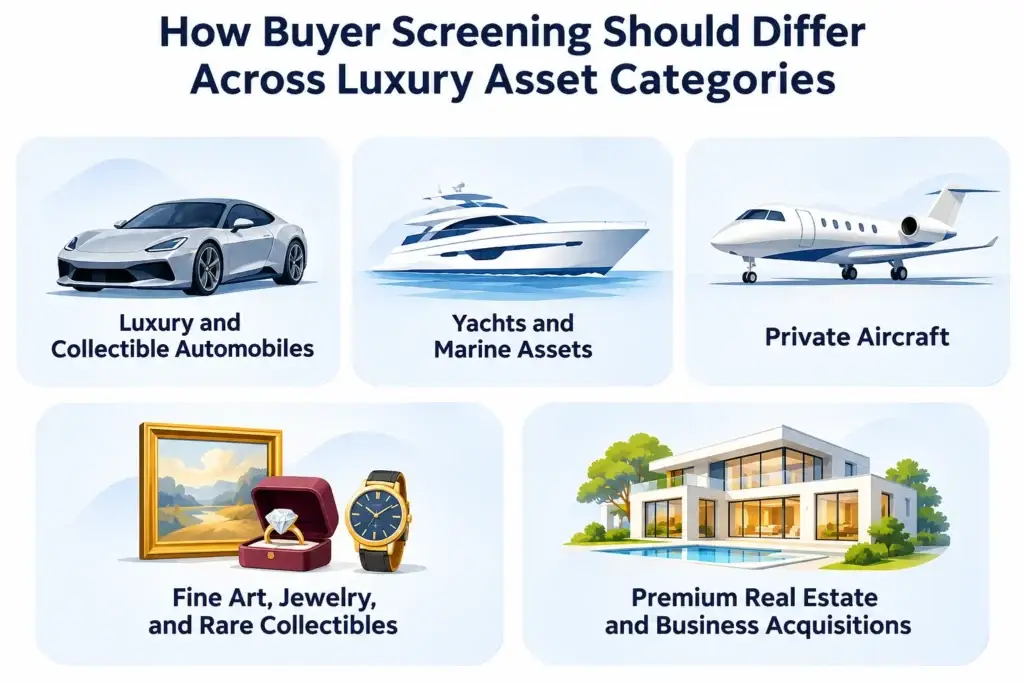
Although premium marketplaces share the same goal of connecting serious buyers with credible sellers, a single qualification policy is unlikely to fit every asset category.
Luxury and Collectible Automobiles
High-value vehicle buyers often focus on provenance, originality, maintenance history, condition, availability, and inspection arrangements. Screening should clarify purchase intentions and prevent unnecessary private viewings while allowing enthusiasts and collectors to conduct legitimate research.
Yachts and Marine Assets
Marine acquisitions may require extensive specifications, surveys, financing, location-specific arrangements, and specialist coordination. Brokers benefit when inquiries include intended usage, vessel criteria, purchase timing, and buyer representation details.
A serious yacht buyer may also demonstrate purchasing intent by requesting a professional survey, reviewing insurance requirements, or exploring suitable financing arrangements. These actions provide additional context beyond a simple inquiry form. For founders operating marine marketplaces, understanding how to connect buyers with surveyors, insurance specialists, transport providers partners can help distinguish meaningful transaction preparation from casual browsing.
Because attracting credible demand is also important, marketplace operators can complement qualification with the strategies explained in this guide to attracting high-intent yacht buyers.
Private Aircraft
Aircraft inquiries may involve intended usage, operational requirements, maintenance status, inspections, registration, and specialist advisers. The marketplace should establish whether the buyer has a practical acquisition path without unnecessarily exposing ownership and operational information.
Fine Art, Jewelry, and Rare Collectibles
In collectible markets, authentication, condition, provenance, insurance, and secure handover arrangements may be as important as price. Qualification should protect sensitive collection information and ensure that detailed seller disclosures are shared with appropriately screened parties.
Premium Real Estate and Business Acquisitions
Property and business acquisitions can involve lenders, legal teams, investor groups, and confidential negotiations. These marketplaces may need authorization checks, financial capacity evidence, confidentiality agreements, and clearly documented access policies before sharing sensitive records.
The common principle is consistent across categories: qualification criteria should reflect actual transaction risk, rather than applying intrusive requirements simply because the asset is expensive.
The Role of Automation and Human Judgment in Luxury Buyer Qualification
Automated workflows can reduce repetitive administrative tasks, but luxury transactions still rely heavily on human relationships, discretion, and specialist judgment.
Automation is useful for confirming contact information, identifying duplicate inquiries, collecting structured requirements, assigning follow-up priority, flagging unusual activity, and reminding staff when important conversations need attention.
It can also help classify inquiries into stages such as new, awaiting clarification, qualified, verification pending, viewing requested, negotiating, and closed.
Human review remains important when a buyer uses an intermediary, submits unusual but legitimate financing evidence, needs a confidential introduction, disputes a screening decision, or requests exceptional access to sensitive information.
Automated risk indicators should never be treated as conclusive proof of fraud. A suspicious pattern may justify extra review, but it should not automatically become a permanent exclusion.
Why Follow-Up Accountability Matters After Qualification
Even a highly qualified lead can be lost when the assigned representative responds late or fails to follow up. Once a buyer passes the appropriate screening stage, the marketplace should record who owns the inquiry, when the next response is due, and whether the conversation progresses.
For operators working with specialist brokers, Miracuves has a separate guide explaining how response-time analytics improves broker accountability. Keeping that subject in a dedicated resource avoids overloading the buyer qualification process with unnecessary operational detail.
The Business Value of Qualified Buyer Inquiries for Luxury Marketplace Operators
Better qualification is not only a convenience for sellers. It can directly affect how a premium marketplace demonstrates value to the professionals who supply its listings.
If a broker receives hundreds of messages but only a small number are suitable for commercial follow-up, the marketplace may appear active without being especially useful. By contrast, a platform that supplies fewer but better-contextualized inquiries can help sellers allocate their time more effectively.
That difference matters when a marketplace earns revenue through dealer subscriptions, premium placements, broker memberships, qualified introductions, or transaction-related services.
Buyer qualification is also closely connected to how a premium marketplace positions itself in the market. Businesses selling expensive assets need to attract relevant prospects rather than relying only on broad traffic acquisition. This principle also appears in go-to-market strategies for luxury marketplaces, where credible sellers, carefully selected audiences, transparent information, and trust-building experiences help support qualified demand.
Operators should avoid charging for leads using opaque quality claims. Sellers need clear definitions of what constitutes a verified contact, qualified inquiry, viewing-ready buyer, or financially screened prospect.
Each qualification label should represent a specific completed check, not an implied promise that the transaction will succeed.
Metrics That Reveal Whether Buyer Qualification Is Working
- Valid inquiry rate: The share of inquiries with usable and authentic contact details.
- Qualified inquiry rate: The proportion meeting defined buyer readiness criteria.
- Inquiry-to-conversation rate: How often submitted inquiries progress into meaningful seller discussions.
- Inquiry-to-viewing rate: How many leads result in inspections, demonstrations, or private viewings.
- Verification completion rate: How many eligible buyers finish necessary checks.
- Verification abandonment rate: How often buyers leave during the verification process.
- Seller time per qualified opportunity: The amount of effort required to identify and advance a credible prospect.
- Qualified inquiry-to-offer rate: How frequently qualified conversations lead to formal commercial proposals.
Operators should compare these metrics by asset category, listing value, traffic source, and buyer stage. A highly restrictive verification process may reduce spam while also suppressing genuine interest. Measuring both outcomes helps prevent the platform from optimizing for screening efficiency at the expense of business growth.
Founder Decision Signals: Choosing the Right Qualification Experience
Buyer Experience
Can a legitimate visitor express interest without unnecessary documentation or excessively long forms?
Seller Protection
Can sellers restrict confidential information and avoid resource-intensive interactions with unqualified prospects?
Operational Control
Can staff review exceptions, change qualification policies, assign inquiries, and audit sensitive decisions?
Market Validation
Can the team measure genuine buying interest rather than judging marketplace performance by inquiry volume alone?
The appropriate starting point depends on the marketplace’s target category and operating model. A small, invitation-based luxury platform may use manual screening because inquiry volume is manageable. A larger multi-category business may need structured intake, configurable qualification stages, and automated administrative alerts.
Founders should begin by identifying which seller interactions are costly, which buyer information is genuinely necessary, and where confidential access needs protection. These findings should drive the qualification process—not the assumption that every sophisticated marketplace needs the same verification technology.
Common Mistakes That Create Poor Buyer Experiences or Waste Seller Time
Treating Every Inquiry as Sales-Ready
When all incoming messages receive identical priority, sellers may spend excessive time on preliminary research conversations while overlooking buyers ready to take immediate action. Basic qualification stages make follow-up more intentional without removing access for early-stage prospects.
Demanding Financial Documents Too Early
Requiring bank statements before a visitor can ask a simple question may create unnecessary privacy concerns. Sensitive verification should be reserved for situations where it is justified by the requested access or transaction stage.
Confusing Privacy With Suspicious Intent
Legitimate high-net-worth buyers may prefer intermediaries, confidential communication, or limited disclosure. Platforms should offer professional verification alternatives rather than assuming that reluctance to share personal information means a buyer is not serious.
Making Lead Scores Impossible to Review
An unexplained scoring decision can discourage buyers and create problems for sellers. Staff should be able to review unusual cases, correct inaccurate information, and understand why an inquiry was assigned a particular priority.
Collecting More Sensitive Data Than Necessary
Identity documents, financial statements, and personal contact details create storage, access, and retention responsibilities. Collecting unnecessary information increases risk without necessarily improving qualification.
Ignoring Seller Feedback
Qualification rules should evolve based on actual seller experience. If brokers consistently report that certain inquiries are incomplete, the marketplace can refine its questions. If genuine buyers frequently abandon the process, the platform should investigate whether its requirements are excessive.
A Practical Buyer Qualification Policy for a New Luxury Marketplace
Founders do not need a complicated scoring engine from the first day. A clear operating policy can establish the foundation for a trustworthy inquiry process.
- Define seller expectations. Identify which inquiries sellers consider useful and what information is needed before direct contact.
- Separate public and restricted asset details. Decide which documents and viewing privileges require additional screening.
- Create a short initial inquiry form. Capture relevant purchasing criteria without overwhelming visitors.
- Apply basic authenticity checks. Use verified contact details and spam-prevention controls.
- Document escalation criteria. Clarify when identity, authority, confidentiality, or financial checks become appropriate.
- Offer alternative verification routes. Accommodate legitimate representatives, financing arrangements, and privacy-sensitive buyers.
- Assign clear lead statuses. Keep early research, qualified interest, pending verification, and transaction-ready discussions separate.
- Measure actual outcomes. Review whether qualification improves seller efficiency without creating excessive buyer abandonment.
- Review the policy regularly. Use seller feedback, complaints, conversion data, and regulatory guidance to improve the process.
This policy can initially be supported by human staff and simple digital tools. More advanced automation becomes valuable when transaction volume, asset complexity, or the number of marketplace participants makes manual management difficult.
The important decision is not how much software to introduce immediately. It is whether the marketplace understands the right balance between accessibility, confidentiality, operational efficiency, and buyer trust.
How Miracuves Can Help Founders Put Buyer Qualification Into Practice
For founders creating a premium asset marketplace, inquiry qualification should be considered alongside listing management, buyer and seller communication, permission controls, and administrative oversight.
Miracuves offers ready-made and customizable marketplace foundations that can provide a starting point for buyer, seller, and administrator workflows. A luxury-marketplace implementation may require additional qualification questions, access restrictions, verification integrations, specialized lead statuses, or confidential document handling depending on its business model.
For eligible ready-made marketplace bases, Miracuves promotes a six-working-day build process. Advanced identity verification, financial screening, custom access policies, and category-specific operational requirements should be reviewed and scoped separately rather than assumed to be included in that timeline.
The practical opportunity is to start with a clear business policy and then determine which processes need software support. This reduces the risk of building features that add complexity without improving lead quality or buyer trust.
Final Thoughts: High-Ticket Marketplace Growth Depends on Buyer Quality, Not Just Inquiry Volume
Selling high-ticket assets online requires a balance that ordinary ecommerce rarely demands. Sellers need protection from unproductive interactions, while genuine buyers expect discretion, transparency, and a professional process that respects their time and privacy.
The most sustainable approach is to qualify inquiries progressively. Start by understanding purchase requirements, establish credible contact, verify sensitive information when justified, and direct serious prospects toward suitable human representatives.
Luxury marketplaces should not measure success by how many people click an inquiry button. They should examine whether those inquiries represent meaningful commercial opportunities, whether sellers can respond effectively, and whether the buyer experience encourages confidence.
For founders looking to turn these principles into a practical platform, Miracuves’ approach to Marketplace Development Company provides a relevant starting point for evaluating how listings, communication, operational controls, and custom qualification requirements can fit together.
Ultimately, the strongest luxury marketplace is not the one that creates the most barriers. It is the one that knows when to welcome interest, when to ask better questions, and when to protect the time and confidentiality of everyone involved.
Frequently Asked Questions
How do luxury marketplaces qualify serious buyers?
Luxury marketplaces qualify buyers by reviewing contact authenticity, purchasing requirements, budget alignment, purchase timeline, decision authority, and readiness to complete relevant next steps. Sensitive verification can be introduced later in the transaction process.
What is the best way to prevent time-wasters when selling expensive assets online?
Use structured inquiry forms, basic contact verification, clear qualification stages, appropriate access restrictions, and human review for unusual cases. The goal is to reduce unproductive seller interactions without blocking legitimate buyers.
Should luxury marketplaces require proof of funds from every buyer?
Not necessarily. Proof-of-funds checks are most useful when buyers request confidential information, resource-intensive private viewings, restricted bidding access, or advanced negotiations. Requirements should match the asset, transaction risk, and applicable rules.
Can a buyer be genuine without being ready to purchase immediately?
Yes. Some legitimate buyers research assets months before making an acquisition. Marketplaces should classify these prospects as early-stage rather than automatically rejecting them, and provide suitable follow-up opportunities.
How can luxury marketplaces protect buyer financial information?
They can limit sensitive data collection, use secure verification providers where appropriate, encrypt data in transit and storage, restrict staff access, maintain audit histories, and follow applicable privacy and retention requirements.
How does buyer intent scoring work for high-value asset marketplaces?
Buyer intent scoring combines indicators such as budget alignment, purchase timeline, asset suitability, decision authority, and next-step engagement. Scores help prioritize follow-up but should allow human review and should not be treated as guarantees of purchase.
What metrics should luxury marketplaces track to evaluate lead quality?
Useful metrics include valid inquiry rate, qualified inquiry rate, verification completion, inquiry-to-conversation conversion, inquiry-to-viewing conversion, qualified inquiry-to-offer conversion, and seller time spent per qualified opportunity.
Can a new luxury marketplace begin with manual buyer qualification?
Yes. Early-stage operators can use structured intake forms, documented review criteria, restricted document sharing, and manual follow-up. Automation becomes more useful as inquiry volume, transaction complexity, and operating requirements increase.
Miracuves is an independent software development company. We are not affiliated with, connected to, sponsored by, or endorsed by any company or product named in this article.
Terms such as “X Clone” are used descriptively. It is how the software industry refers to building a platform with functionality comparable to a known service, and how clients search for it.
The entire design and codebase of our products is built by our own team. Our products contain no code, design, graphics, or content originating from any third-party website or applications.
All third-party names and marks referenced in this article are the property of their respective owners, referenced solely to identify the services discussed.