Key Takeaways
- An unanswered fare offer can result from pricing differences, limited driver supply, pickup distance, expired requests, or notification failures.
- The platform should identify the likely failure reason before recommending a fare increase, wider driver search, or alternative booking method.
- Valid counteroffers should remain available for a limited period and display the proposed fare, driver details, and estimated pickup time.
- Clear booking states help prevent expired acceptances, duplicate assignments, conflicting retries, and inaccurate information after connectivity loss.
- Riders should receive practical recovery choices instead of being left on an indefinite searching screen.
Failed-Bid Recovery Signals
- Verify offer delivery, driver eligibility, counteroffers, response-window expiry, and rider status before starting another search.
- Suggest fare revisions only when eligible drivers received the request and available evidence indicates that pricing affected acceptance.
- Expand the driver search in controlled stages using estimated pickup time, vehicle compatibility, service zones, and current availability.
- Refresh driver eligibility before every retry and avoid repeatedly sending an unchanged offer to drivers who already declined it.
- Track initial acceptance, recovery success, time to match, counteroffer selection, post-match cancellations, and duplicate-booking incidents.
Real Insights
- Increasing the fare cannot solve missing driver supply, incorrect eligibility, notification failures, or impractical pickup conditions.
- A wider search area is useful only when additional drivers can reach the rider within an acceptable pickup time.
- The backend must remain the authoritative source for booking validity when riders or drivers reconnect after losing internet access.
- Safe retries require unique request identifiers, idempotency protection, atomic driver assignment, and accurate recovery-event records.
- Miracuves develops fare-bidding ride-booking platforms with rider and driver apps, configurable negotiation, dispatch controls, fallback workflows, and administrative reporting.
A rider opens a ride-booking app, selects a destination, and proposes a fare. Nearby drivers receive the request, but nobody accepts. The rider waits, checks the screen, and wonders whether to increase the offer, search again, or cancel.
This situation creates an important challenge for fare-negotiation platforms: what should happen when the first driver-matching attempt fails?
An unanswered fare offer does not necessarily mean drivers are unavailable. The proposed price may not meet driver expectations, the pickup location may be inconvenient, or the request may expire before someone responds.
A reliable booking system needs intelligent fallback logic that evaluates the failure, identifies a suitable recovery action, and helps riders continue without confusion or unnecessary waiting.
This guide explains how bid-based ride booking fallback logic works, how platforms can recover unanswered fare requests, and what founders should consider when designing a dependable booking experience.
Why Some Fare Offers Never Receive Driver Acceptance
Negotiated-fare ride booking introduces independent decisions for riders and drivers. The rider proposes an amount, while the driver evaluates whether the journey is worthwhile.
That decision may depend on expected earnings, pickup distance, journey duration, traffic conditions, and available alternatives.
When these factors do not align, the booking can remain unanswered. However, treating every unanswered request as a pricing problem can lead to ineffective recovery decisions.
1. The Proposed Fare Does Not Match Driver Expectations
Suppose a rider offers an amount that nearby drivers consider insufficient for the expected distance, travel time, and pickup effort.
Even with several drivers online, the request may receive no acceptance.
In this situation, the platform can offer fare guidance based on relevant trip conditions. However, the rider should decide whether to revise the proposed amount.
2. Available Drivers Are Too Far From the Pickup Location
A driver may find the journey attractive but consider the pickup distance unreasonable.
For example, an otherwise profitable ride might require an extended journey through congested roads before the passenger can be collected.
In this case, expanding the candidate search or recalculating pickup expectations may be more appropriate than immediately recommending a higher fare.
3. Online Drivers Are Not Necessarily Eligible
A driver marked online may already be handling another request, operating outside the relevant service zone, or unavailable for the selected vehicle category.
Driver availability can also change between the moment a request is generated and the moment an acceptance is attempted.
The matching engine should verify current eligibility before sending additional requests.
4. The Request Expires Before Drivers Respond
A driver may receive a request but fail to respond before its validity window closes.
Notification delays, weak connectivity, and limited response time can contribute to this situation.
The platform should distinguish an explicit driver rejection from an expired request or an unsuccessful notification delivery. These events should not automatically trigger the same fallback action.
Read More: Build a Ride-Hailing App Like InDrive for Emerging and Global Markets
What Should Happen Immediately After a Ride Bid Goes Unanswered?
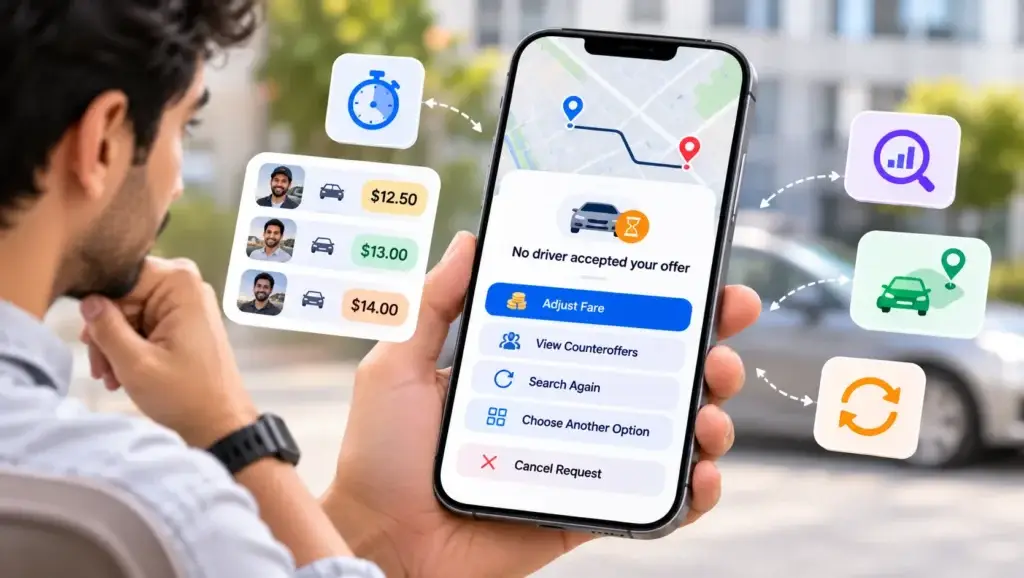
When no driver accepts an initial fare, the booking system should begin a controlled recovery process rather than restarting the request without explanation.
The first step is determining the actual request state. The system needs to know whether the offer was delivered, whether valid counteroffers exist, whether the response window has ended, and whether the rider still wants to continue.
Step 1: Establish a Clear Driver Response Window
Every fare offer should have a defined validity period during which drivers can respond.
Very short windows may expire before drivers can properly evaluate a journey. Excessively long windows may leave riders waiting without useful feedback.
For illustration, an operator might test a 30-second initial response window. This is an example configuration, not a universal recommended timeout. The appropriate duration depends on driver behavior, notification performance, and local operating conditions.
Step 2: Check Whether Valid Counteroffers Exist
No driver accepting the exact proposed fare does not always mean the negotiation has failed.
A driver may have submitted an alternative amount that the rider has not yet reviewed.
When valid counteroffers are available, the app can present the fare, driver information, vehicle category, and estimated pickup time.
Counteroffers should have expiry conditions so that unavailable drivers and outdated amounts cannot be selected later.
Step 3: Identify the Most Likely Failure Reason
The dispatch system should examine relevant evidence to determine whether the problem involves driver supply, pricing, eligibility, connectivity, or request expiration.
This classification matters because increasing the fare is unlikely to resolve failed notifications, while expanding the search area may not resolve persistent price resistance.
Step 4: Present an Appropriate Recovery Option
Once the system understands the current situation, it can present a limited number of meaningful actions.
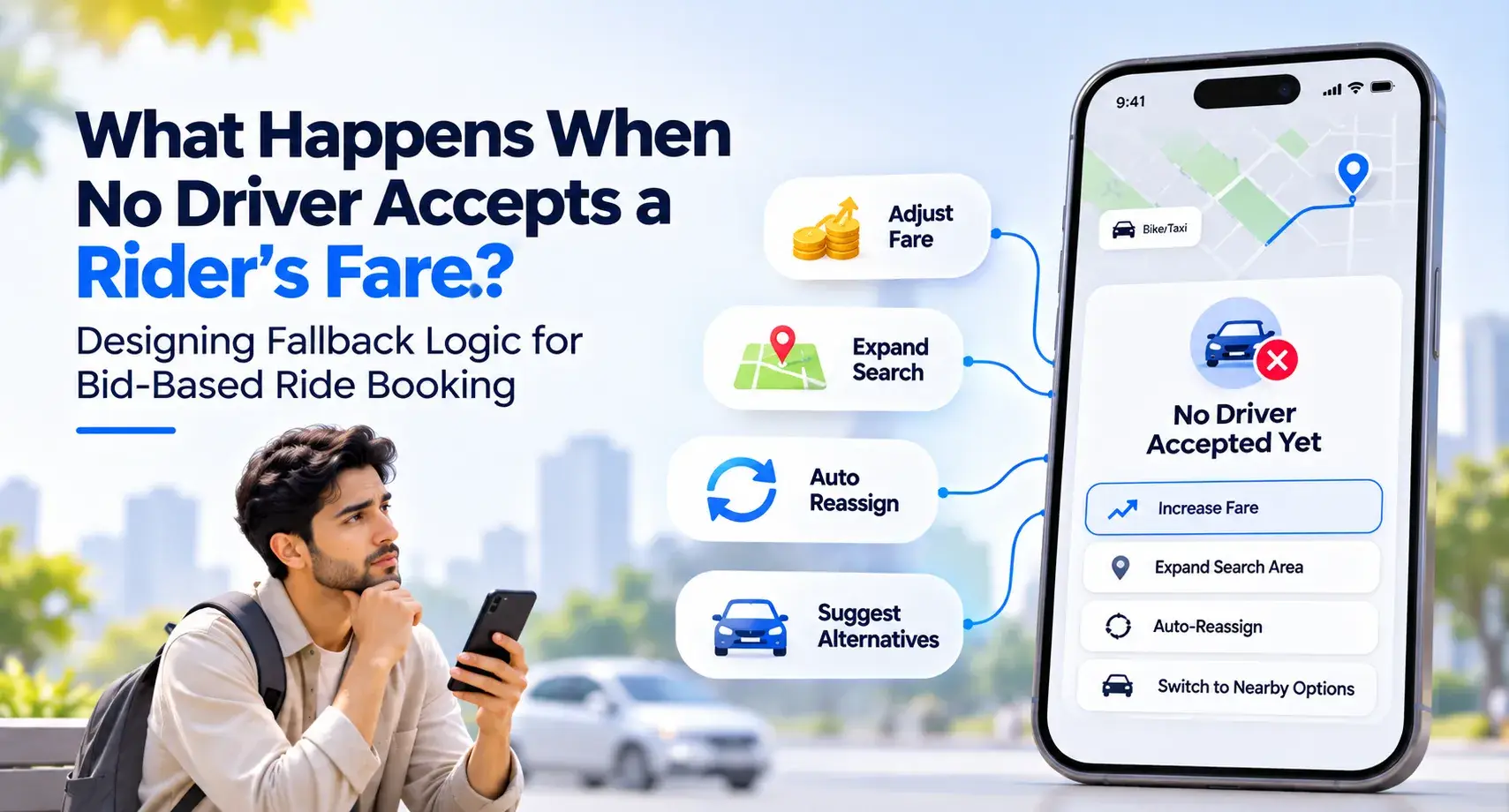
- Revise the proposed fare.
- Review available counteroffers.
- Continue searching for eligible drivers.
- Select another supported booking method.
- Cancel the request.
For example, the interface might explain: “No driver accepted your current offer. You can adjust the fare or search again for available drivers.”
Clear communication gives the rider control instead of leaving the booking screen stuck on an indefinite loading animation.
Designing an Intelligent Fallback Decision Engine
A fallback decision engine determines the next appropriate action when an initial matching attempt does not produce a confirmed driver.
The important design principle is that different failure conditions require different responses.
A booking with valid counteroffers should not be handled like a booking with no eligible drivers. Similarly, a notification failure should not automatically be interpreted as a rejected fare.
Fallback Decision Matrix
| Booking Condition | Possible Cause | Recommended Recovery |
|---|---|---|
| Drivers decline the offered fare | Price expectations differ | Offer optional fare guidance |
| No eligible drivers are available | Limited local supply | Expand the search within operational limits |
| Valid counteroffers are available | Drivers prefer alternative fares | Let the rider review and select an offer |
| Notifications are not delivered | Connectivity or delivery failure | Retry dispatch safely |
| Multiple attempts remain unsuccessful | Persistent matching difficulty | Offer another supported booking option |
| No suitable recovery remains | Service unavailable | Close the request with a clear explanation |
Founder insight: The best fallback is not necessarily the action that keeps the rider searching the longest. It is the action most likely to produce a valid booking without creating misleading expectations, unnecessary delays, or operational conflicts.
When Should the Platform Suggest Increasing the Rider’s Fare?
Fare adjustment can help recover some unsuccessful requests, but it should not be the default response to every failed match.
The platform should first establish whether eligible drivers received the offer and whether the proposed price appears to be contributing to the lack of acceptance.
Use Relevant Signals to Generate Fare Guidance
A fare recommendation may consider several operational factors.
- Estimated journey distance and duration.
- Pickup distance from available drivers.
- Current supply of eligible vehicles.
- Historical acceptance outcomes for comparable journeys.
- Changes in local demand and supply.
- Applicable fare limits and operator-defined pricing rules.
These signals can support fare guidance, but they cannot guarantee driver acceptance. Platforms with limited historical data should avoid presenting highly precise predictions without sufficient evidence.
Preserve the Rider’s Pricing Decision
Suppose a rider proposes ₹180 for a journey and no driver accepts.
Based on available signals, the platform might suggest trying ₹210, assuming both amounts are permitted by applicable fare rules.
These amounts are hypothetical examples rather than recommended market prices.
The rider should still be free to retain the original amount, revise it manually, review a counteroffer, or stop searching.
Important: Fare guidance should not become an unauthorized price increase. Material changes should follow the platform’s consent rules and applicable pricing requirements.
Avoid Endless Fare Escalation
Repeatedly asking riders to increase their offers can make negotiation frustrating.
Operators should consider limiting automated suggestions, explaining why an adjustment is proposed, and providing alternative recovery paths when repeated revisions fail.
Expanding the Driver Search Radius Without Creating Longer Waits
Another recovery option is searching for additional eligible drivers outside the initial candidate area.
If nearby drivers do not accept, the dispatch engine may consider other service zones, provided those drivers can reach the pickup location within a reasonable time.
Pickup ETA Matters More Than Straight-Line Distance
A driver located three kilometers away may arrive sooner than another driver located two kilometers away because of road layout, congestion, or access restrictions.
Matching decisions should therefore consider actual road-network travel time, driver availability, vehicle compatibility, and service boundaries.
Expand the Search in Controlled Stages
Instead of broadcasting every request across an entire city, operators can configure controlled search expansion.
An initial candidate group may be followed by a wider search when the first attempt fails. The system should stop expanding when projected pickup times or operational conditions exceed acceptable limits.
Unlimited expansion may technically find more drivers while producing pickup times that riders are unwilling to accept.
Avoid Repeatedly Contacting Drivers Who Already Declined
Sending an identical request to the same drivers after they decline can increase notification fatigue without improving the outcome.
A retry should be based on a meaningful change, such as a revised fare, updated trip conditions, or a different eligible driver group.
Refresh Driver Eligibility Before Every Retry
Driver availability can change while a request is being processed.
A driver who was available during the initial search may have accepted another trip before the next attempt begins.
Rechecking availability helps prevent wasted notifications and invalid booking offers.
Should the Platform Switch to a Fixed-Fare Booking Option?
Sometimes another round of negotiation is not the most useful recovery action.
If the platform supports fixed-fare booking, it can present this option when the original negotiated request remains unsuccessful.
This can be useful for riders who prefer booking certainty over continued negotiation.
Offer the Alternative Instead of Switching Automatically
A rider may have selected negotiated pricing because they wanted direct control over spending.
Automatically confirming a different amount could violate that expectation.
The interface should clearly display the alternative fare, relevant pickup details, and a confirmation action.
For example: “Your fare offer was not accepted. A fixed-fare booking option is available. Review the fare before continuing.”
Prevent the Original Request From Producing Another Booking
Switching booking modes creates a risk if the previous request remains active.
A driver might attempt to accept the original offer while the rider confirms an alternative booking.
The backend must coordinate these requests so that only one valid trip can be confirmed.
Failure to handle this properly can result in duplicate assignments, driver inconvenience, cancellation disputes, and payment problems.
How Booking States Prevent Failed-Bid Recovery Errors
A dependable fallback process requires explicit booking states that define which actions remain valid throughout the request lifecycle.
Without clear state management, late driver responses and repeated rider actions can create inconsistent bookings.
Example Booking State Model
| Booking State | Meaning | Next Action |
|---|---|---|
| REQUESTED | A valid trip and fare are submitted | Begin matching |
| SEARCHING | Eligible drivers are being contacted | Receive responses or expire |
| COUNTEROFFERS_AVAILABLE | At least one valid alternative offer exists | Review or select an offer |
| RECOVERY_PENDING | Initial matching ended without a selected driver | Revise, retry, switch, or cancel |
| MATCHED | One valid driver assignment is confirmed | Proceed to pickup |
| EXPIRED | Offer validity has ended | Start a new valid attempt |
| CANCELLED | The request has been closed | No further matching |
| UNAVAILABLE | No supported recovery option remains | Explain failure |
This is an illustrative state model, not a claim about the internal architecture of any specific commercial platform.
Reject Late Driver Acceptances
A driver may press the acceptance button at almost the same moment an offer expires.
The backend must verify that the offer is still active before confirming the request.
A notification still visible on a device does not prove that the booking remains valid.
Prevent Multiple Drivers From Confirming the Same Trip
Several drivers may attempt to accept an offer simultaneously.
Where the booking process requires one confirmed driver, the system should use atomic assignment controls so that only one valid confirmation succeeds.
Use Idempotency for Safe Booking Retries
Mobile applications regularly encounter delayed responses, repeated button taps, and network interruptions.
If a rider presses “Try Again” twice, the system should not generate two independently active booking requests.
Unique request identifiers and idempotency protections help make retries safe. Similar controls should apply to booking confirmation, cancellation, and payment operations.
Maintain Accurate Recovery Event Records
The platform should record relevant events such as request creation, notification delivery, driver rejection, counteroffer submission, expiry, retry attempts, and final booking outcomes.
These records help dispatch teams investigate disputes and understand recurring matching failures.
Practical Example: Recovering an Unaccepted Ride Bid
Consider a rider requesting a trip from a residential neighborhood during an evening demand peak.
The rider offers ₹240, but the initial search produces no driver acceptance.
The following illustrates one possible recovery sequence. All amounts and timings are hypothetical.
- Initial request: The rider submits a valid trip request with a proposed fare of ₹240.
- First matching attempt: Eligible nearby drivers receive the offer during a configured response window.
- Failure evaluation: No driver accepts. The system checks notifications, responses, availability, and expiry.
- Search expansion: Another group of eligible drivers is considered, subject to practical pickup times.
- Optional fare guidance: If available signals support it, the system may suggest ₹270, assuming the amount is permitted under relevant fare rules.
- Rider decision: The rider can revise the offer, review valid counteroffers, select another supported booking option, or cancel.
- Final resolution: One valid booking is confirmed, or the request closes with a clear explanation.
The important lesson is that recovery actions should depend on the current booking condition.
Repeatedly sending the same request without changing the candidate pool, fare, or relevant conditions is unlikely to solve a persistent matching problem.
Read More: White-Label inDrive App Security: Risks, Standards & Best Practices 2026
How to Keep Riders Informed During Failed Matching
A fallback workflow can be technically reliable and still create a frustrating rider experience if communication is unclear.
Riders should understand whether the platform is searching, evaluating responses, presenting alternatives, or closing the request.
Show Meaningful Search Progress
Messages such as “Finding available drivers nearby” are helpful while dispatch is active.
After the initial search ends, the message should change to reflect the actual next step.
An indefinite loading animation can make an expired request appear active.
Explain Why the Next Action Matters
If an offer has not received acceptance, the platform can communicate that fact without pretending to know every driver’s motivation.
When limited supply is the issue, presenting a higher fare as the only recovery option may be misleading.
Avoid Too Many Recovery Choices
A screen containing too many options can make a simple booking unnecessarily complicated.
The interface should prioritize choices relevant to the observed failure condition.
Keep Cancellation Understandable
Riders should be able to stop an unsuccessful negotiation according to the applicable booking and cancellation rules.
Any cancellation fees should be disclosed clearly instead of appearing unexpectedly.
What Happens If the Rider Loses Connectivity During Recovery?
Connectivity interruptions introduce another class of booking failure.
A rider may lose internet access after submitting a fare. Meanwhile, a driver could respond, or the request could expire.
When the rider reconnects, the app should retrieve the authoritative server-side status rather than assume the previous screen remains accurate.
Restore the Actual Booking State
The app should determine whether the booking is active, whether valid responses are available, and which actions remain permitted.
Prevent Confirmation of Expired Offers
If an offer expires during a connectivity interruption, the app should not allow confirmation from outdated local information.
Apply the Same Controls to Drivers
A driver reconnecting after an offer expires should not be able to confirm an invalid assignment.
Technical principle: Real-time notifications improve responsiveness, but the backend must remain the authoritative source for booking validity.
Which Metrics Reveal Whether Fallback Logic Is Working?
A fallback process should be measured by its ability to recover valid bookings, not merely by the number of dispatch retries it generates.
Operators need to distinguish an unsuccessful initial attempt from an unsuccessful final booking.
| Operational Metric | What It Measures | Why It Matters |
|---|---|---|
| Initial acceptance rate | Requests accepted during the first attempt | Shows initial matching effectiveness |
| Failed-bid recovery rate | Initially unmatched requests later confirmed | Measures fallback effectiveness |
| Time to match | Time from request creation to driver assignment | Shows rider waiting burden |
| Fare revision acceptance rate | Revised offers producing confirmed rides | Helps assess fare guidance |
| Search expansion effectiveness | Matches recovered after expanding the candidate pool | Evaluates extended dispatch value |
| Counteroffer selection rate | Valid counteroffers selected by riders | Measures alternative fare usefulness |
| Post-match cancellation rate | Confirmed trips subsequently cancelled | Highlights potentially poor matches |
| Duplicate booking incidents | Conflicting confirmations associated with a request | Reveals state-management failures |
Analyze Performance by Area and Time
An overall matching rate may appear healthy while specific neighborhoods or time periods consistently produce failed requests.
Operators should segment outcomes by pickup zone, time of day, vehicle category, initial fare range, and driver availability.
If requests in a particular area repeatedly fail despite having eligible drivers nearby, operators can investigate pricing expectations, pickup accessibility, and dispatch eligibility rules.
Measure the Operational Cost of Recovery
Every additional dispatch attempt consumes notification capacity, processing resources, and driver attention.
A fallback workflow that recovers more bookings but creates excessive retries may still be inefficient.
Recovery results should therefore be evaluated alongside retry counts, elapsed time, and final trip outcomes.
Common Mistakes That Make Failed Ride Bids Harder to Recover
Automatically Increasing Every Unaccepted Fare
Higher prices cannot resolve missing driver supply, inaccurate pickup information, or notification failures.
Fare adjustments should be based on relevant signals and require appropriate rider consent.
Repeatedly Broadcasting the Same Offer
Sending unchanged requests to drivers who already declined can increase notification fatigue without improving matching results.
Keeping Expired Offers Active
Expired offers should not remain available for confirmation. Every acceptance or counteroffer selection must be validated against the current backend state.
Expanding Search Without Considering Pickup Time
A larger search radius may produce more candidates while creating pickup times that riders do not consider practical.
Treating Every Timeout as Fare Rejection
An expired offer can result from delayed notifications, insufficient supply, or technical interruptions.
Accurate failure classification helps prevent inappropriate recovery actions.
Ignoring Recovery Analytics
If a platform records only completed and cancelled trips, operators may struggle to determine what happened during unsuccessful negotiations.
Intermediate dispatch and fallback events provide the data needed to understand and improve the process.
What Platform Operators Should Verify Before Launch
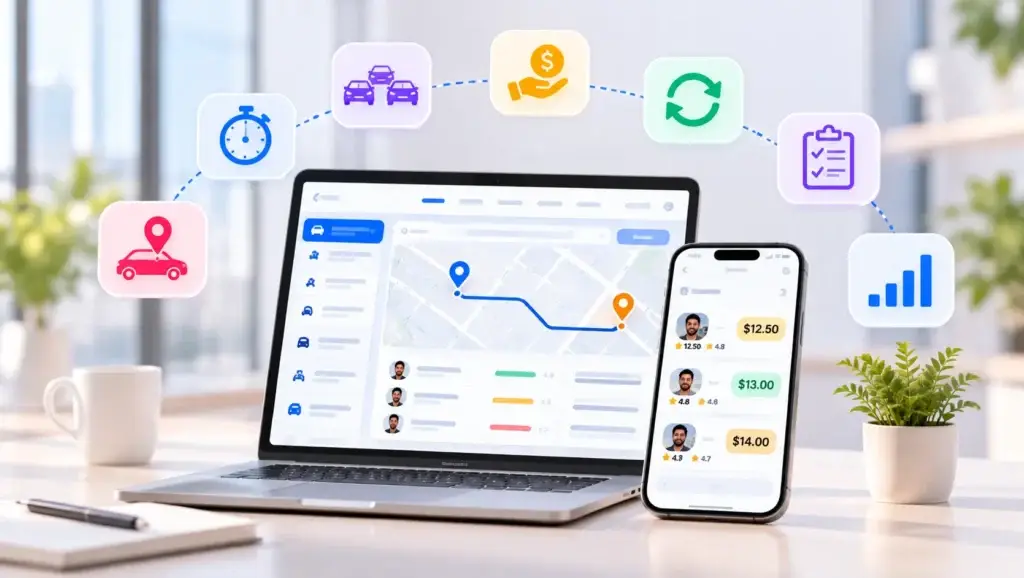
Founders evaluating a negotiated-fare mobility platform should test unsuccessful booking journeys as carefully as successful ones.
A demonstration in which every driver accepts immediately does not reveal how the software behaves during limited supply, late responses, failed notifications, or conflicting acceptances.
The following questions are useful during platform evaluation.
- Can the operator configure driver response windows and offer validity rules?
- What happens when no eligible driver is available?
- Can valid counteroffers be displayed after the initial fare goes unanswered?
- Does the system distinguish rejected, expired, and undelivered offers?
- Can the dispatch process retry safely with refreshed driver eligibility?
- Can dispatch staff inspect failed requests and intervene when appropriate?
- Can alternative booking modes be offered with rider approval?
- Are late acceptances and duplicate confirmations prevented?
- Are matching and recovery outcomes available for operational reporting?
These capabilities should be verified in the actual software configuration rather than assumed to exist in every ready-made platform.
For founders evaluating the broader product foundation behind these workflows, Miracuves provides a ready-made fare-bidding ride-hailing platform with rider and driver applications, configurable bidding capabilities, dispatch controls, and an administrative environment.
The standard ready-made offering is positioned for delivery in six working days. Additional fallback automation, specialized dispatch behavior, or workflow modifications should be evaluated against the included scope and confirmed separately before deployment.
The objective is to select a product foundation that supports the intended booking experience while giving operators appropriate control over pricing, driver matching, and future operational improvements.
Final Thoughts: A Failed Fare Offer Should Not Mean a Failed Booking Experience
Unanswered fare offers are an expected possibility in a system where riders and drivers independently decide whether a proposed price is acceptable.
The challenge is not eliminating every rejection. It is ensuring that unsuccessful matching does not automatically lead to confusion, unnecessary waiting, inconsistent booking records, or unauthorized fare changes.
An effective fallback workflow evaluates the likely cause of non-acceptance, identifies relevant recovery options, respects rider decisions, and closes unsuccessful requests safely.
For mobility founders, the reliability of a booking platform is defined not only by how successfully it confirms rides, but also by how consistently it handles requests that cannot be confirmed.
Miracuves helps mobility businesses evaluate ready-made booking workflows and identify where additional operational logic may be needed for their market.
Frequently Asked Questions
What happens if no driver accepts a rider’s proposed fare?
The booking platform may allow the rider to revise the fare, continue searching for eligible drivers, review valid counteroffers, or select another supported booking option. If no suitable match is available, the request should expire or close clearly. The exact behavior depends on the platform’s configured fallback rules.
Why do drivers reject or ignore some ride bids?
Drivers may consider the proposed amount insufficient, find the pickup inconvenient, be unavailable, or prefer another journey. Unanswered requests can also result from notification delays, connectivity issues, or expired offers. The platform should avoid assuming that price is always the cause.
How long should a ride-booking app wait for driver acceptance?
There is no universal timeout suitable for every service. Operators should configure response windows based on driver availability, notification performance, booking urgency, and measured acceptance behavior. The platform should prevent expired offers from being confirmed.
Should the fare automatically increase when no driver accepts?
In a negotiated-fare workflow, riders should generally review and approve material fare changes. The platform may suggest a different amount using relevant trip and availability signals, but should not silently replace the rider’s original offer with a higher fare.
Can expanding the driver search radius recover an unsuccessful booking?
Yes, when additional eligible drivers are available within a reasonable pickup area. Search expansion should consider actual road-network travel time, vehicle compatibility, driver availability, and service boundaries. Unlimited expansion can create longer waits without improving the booking experience.
What is the difference between a rejected ride bid and an expired ride request?
A rejected bid means a driver explicitly declined an offer. An expired request means its response period ended without the required confirmation. These situations should be recorded separately because they may require different recovery actions.
How can a ride-booking platform prevent duplicate driver confirmations during fallback?
The backend should validate offer expiry, use atomic assignment controls, and apply idempotency protections to repeated booking operations. When a new booking attempt replaces an earlier request, the system must prevent the earlier request from producing a conflicting confirmed trip.
Which metrics help operators improve failed-bid recovery?
Useful metrics include initial acceptance rate, failed-bid recovery rate, time to match, fare revision acceptance rate, counteroffer selection rate, and post-match cancellation rate. Segmenting results by location, time, and vehicle category can reveal where dispatch or pricing guidance needs improvement.
Miracuves is an independent software development company. We are not affiliated with, connected to, sponsored by, or endorsed by any company or product named in this article.
Terms such as “X Clone” are used descriptively. It is how the software industry refers to building a platform with functionality comparable to a known service, and how clients search for it.
The entire design and codebase of our products is built by our own team. Our products contain no code, design, graphics, or content originating from any third-party website or applications.
All third-party names and marks referenced in this article are the property of their respective owners, referenced solely to identify the services discussed.