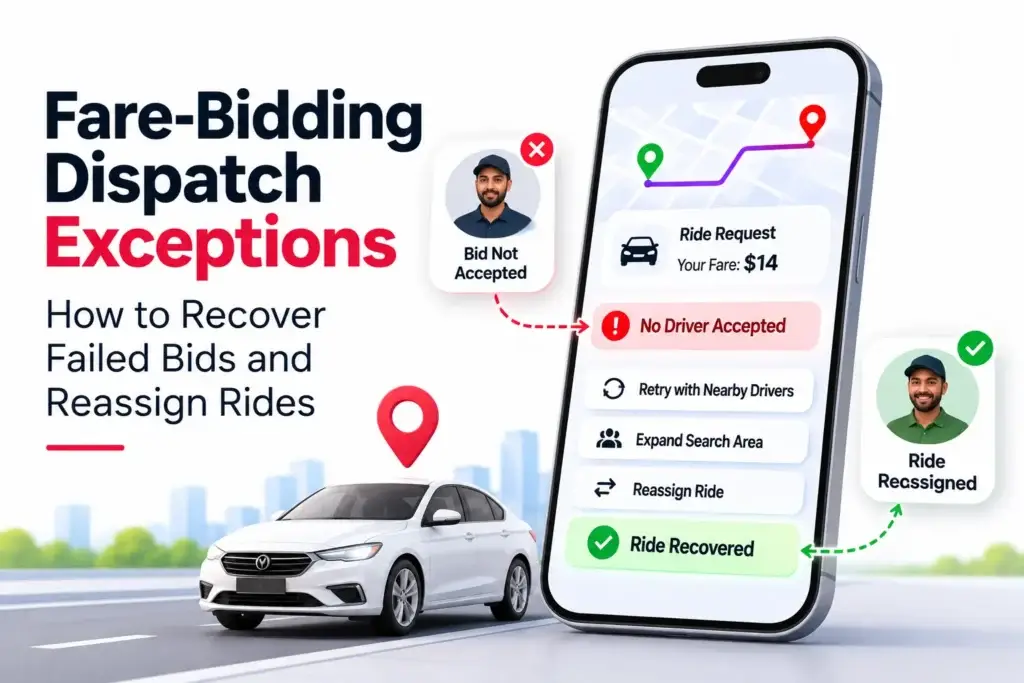
Giving riders the freedom to propose a fare sounds simple. A passenger enters a destination, suggests a price, and nearby drivers decide whether to accept or negotiate. But what happens when a rider’s offer is too low to make the trip worthwhile? What if multiple drivers submit counteroffers that are considerably higher than the expected fare?
Without clear boundaries, fare negotiation can become unpredictable. Riders may lose confidence in pricing, drivers may ignore unprofitable requests, and operators may struggle to resolve disagreements over the amount agreed before a trip.
This challenge becomes particularly relevant in an inDrive-style fare negotiation model, where riders propose their preferred fares and drivers can accept or submit counteroffers. For platform operators, the real challenge is maintaining fair pricing boundaries without taking negotiation freedom away from either party.
This is where fare-bid guardrails in ride-hailing become important.
Fare-bid guardrails establish sensible boundaries around minimum offers, counteroffers, and maximum fares while keeping the final booking decision with the rider and driver.
The objective is not to replace negotiation with fixed pricing. It is to make negotiated fares transparent, economically reasonable, and operationally manageable.
For mobility founders, the challenge is to develop pricing policies that balance three competing priorities: rider affordability, driver earnings, and platform sustainability.
Key Takeaways
- Fare-bid guardrails protect against unreasonable pricing without requiring every journey to have a fixed fare.
- Minimum bid floors should account for applicable regulations and operating conditions rather than rely on arbitrary percentages.
- Soft pricing guidance can preserve more user choice than unnecessary hard restrictions.
- Driver counteroffers should be transparent, time-limited, and subject to appropriate pricing boundaries.
- Riders should explicitly approve the final negotiated fare before a booking is confirmed.
- Operators should evaluate bid acceptance, driver earnings, negotiation delays, and pricing complaints when refining policies.
What Are Fare-Bid Guardrails in Ride-Hailing?
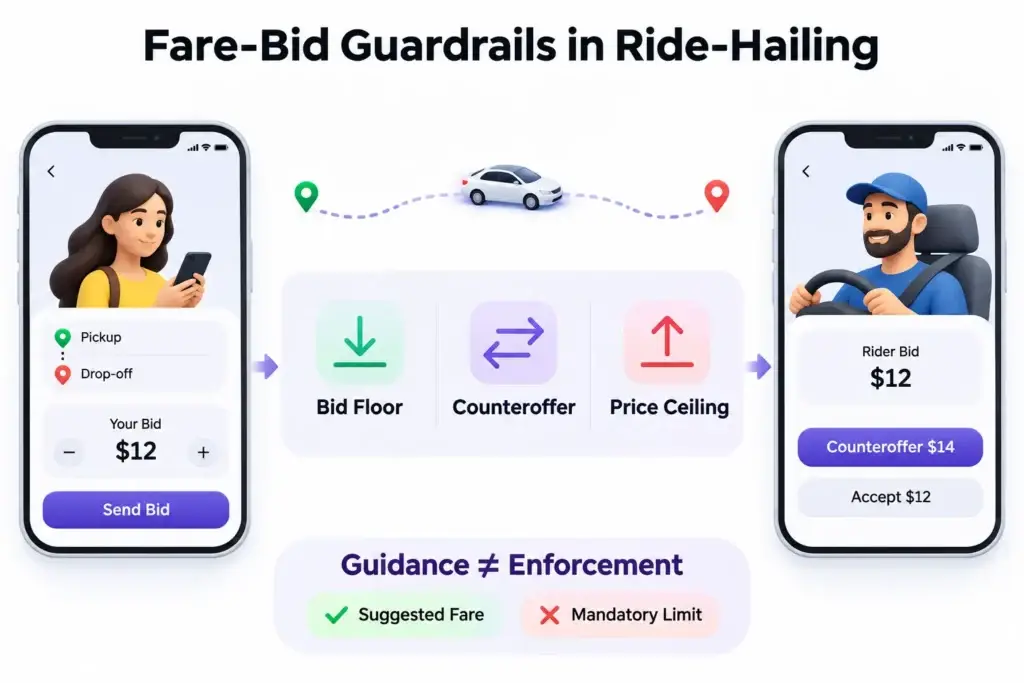
Fare-bid guardrails are pricing rules that determine which fare offers can enter a ride negotiation, when an offer should trigger a warning, and when a proposed price must be rejected.
They generally involve three controls:
- Bid floors: The lowest permissible fare offer for a particular ride, subject to applicable rules.
- Counteroffer controls: Rules governing how drivers respond to rider offers, including permitted values, expiry, and acceptance.
- Pricing ceilings: The maximum fare that can be proposed or charged within the relevant policy and regulatory framework.
Consider a passenger requesting a relatively long trip during a busy period.
The passenger may prefer a low fare, but the driver must consider fuel, travel time, pickup distance, and the opportunity cost of accepting that journey.
Allowing unlimited negotiation does not guarantee that either party receives a useful outcome. Extremely low bids may receive no responses, while unexpectedly high counteroffers can discourage riders from completing bookings.
Well-designed guardrails reduce these problems without determining every fare on behalf of users.
Fare Guidance Is Different From Fare Enforcement
Not every recommended price needs to become a restriction.
A suggested fare can help riders understand the approximate value of a trip. A mandatory price boundary, however, prevents offers outside an approved range.
The distinction matters because a suggested fare should inform the user’s decision, not automatically eliminate otherwise valid choices.
For example, an operator might recommend a particular fare based on journey distance and expected driving time while still allowing lower offers that meet applicable requirements. Drivers remain free to decide whether those offers are worthwhile.
This approach preserves negotiation as a meaningful part of the booking experience.
How to Set Minimum Fare-Bid Floors Without Undermining Choice
A bid floor establishes the minimum amount that a rider may propose. However, selecting that minimum requires more thought than applying a universal percentage to every journey.
1. Start With Applicable Fare Regulations
Regulatory requirements should take precedence over commercial pricing preferences.
Some jurisdictions establish minimum fares, maximum charges, permitted dynamic-pricing ranges, or specific rules for vehicle categories.
For instance, India’s Motor Vehicle Aggregator Guidelines, 2025 establish a framework for fare regulation, while the rules that apply to an individual operation must be assessed against the relevant state requirements.
Operators should confirm local requirements before applying minimum or maximum values. A platform configuration is not a substitute for legal review.
2. Understand the Driver’s Trip Economics
The lowest acceptable fare from a driver’s perspective depends on more than the distance between pickup and destination.
Relevant factors can include:
- Estimated journey distance and duration.
- Distance and time required to reach the passenger.
- Fuel or electricity consumption.
- Vehicle operating and maintenance costs.
- Tolls and other applicable charges.
- Platform deductions and the driver’s expected net earnings.
A short journey with a lengthy pickup distance may be less attractive than a longer trip with minimal unpaid travel.
Operators should therefore avoid treating a single per-kilometre figure as a complete measure of driver viability.
A broader understanding of ride-hailing market economics can help founders evaluate the relationship between pricing, driver supply, and service reliability.
3. Separate Mandatory Floors From Recommended Minimums
A useful policy differentiates between restrictions that must be enforced and suggestions designed to improve the likelihood of a successful match.
| Pricing Boundary | Purpose | Recommended Treatment |
|---|---|---|
| Regulatory Minimum | Prevent prohibited low fares. | Mandatory where applicable. |
| Operator Policy Floor | Enforce a documented operating rule. | Mandatory only where lawful and justified. |
| Recommended Fare | Help riders understand expected pricing. | Advisory |
| Driver’s Preferred Minimum | Reflect individual earnings expectations. | Driver-controlled decision. |
| Maximum Permitted Fare | Prevent offers exceeding applicable limits. | Mandatory where applicable. |
This separation is important for platforms that promise users meaningful negotiating freedom.
If every suggested price becomes mandatory, the service may effectively recreate fixed pricing under a different interface.
4. Avoid One Minimum Fare Across Every Service Zone
Travel conditions vary between city centres, airports, residential neighbourhoods, and areas with limited driver availability.
A pricing policy should consider differences in:
- Vehicle category.
- Journey length and expected duration.
- Service zone.
- Pickup conditions.
- Locally applicable fare rules.
The appropriate response is not necessarily to charge riders more whenever demand increases.
Instead, operators should review whether existing guidance accurately represents journey conditions and whether drivers have sufficient information to decide.
How Should Driver Counteroffers Work?
Counteroffers allow drivers to respond with a different fare when a rider’s initial offer does not meet their expectations.
They are central to voluntary negotiation, but unrestricted counteroffers can create confusion if the process lacks clear rules.
Allow Drivers to Accept, Decline, or Propose Another Fare
A driver should be able to review the proposed journey and respond according to the options offered by the service.
A practical negotiation flow is:
- The rider enters pickup and destination details.
- The platform displays relevant fare guidance and applicable boundaries.
- The rider submits a permissible offer.
- Nearby eligible drivers review the request.
- A driver accepts, declines, or submits a permitted counteroffer.
- The rider reviews available responses and selects an acceptable option.
- The agreed fare is confirmed before the trip proceeds.
Neither party should be required to accept an offer simply because it falls within a permitted range.
The platform’s responsibility is to facilitate an understandable exchange, not force an agreement.
Set Sensible Counteroffer Boundaries
Counteroffers may need to satisfy regulatory ceilings and other clearly disclosed operational rules.
For example, a driver proposing an amount above the maximum permitted fare should receive a clear explanation that the offer exceeds the permitted range.
Where a proposed amount is merely above a recommended fare, the operator may choose to present guidance instead of blocking the offer, provided it remains lawful.
This distinction avoids unnecessarily restricting drivers.
Prevent Endless Negotiation Rounds
Unlimited back-and-forth bidding can increase booking delays.
Operators may experiment with limited counteroffer rounds or short offer-validity windows, but these should be tested against actual user behaviour rather than treated as universal requirements.
A useful policy can include:
- Expiry of unanswered offers after a defined period.
- Clear notification when a counteroffer is no longer valid.
- Prevention of duplicate or conflicting acceptances.
- A simple way to decline without penalty where appropriate.
- A fresh negotiation process when a ride request materially changes.
The objective is to reduce waiting and confusion without artificially pushing either party toward an unwanted price.
Give Riders Meaningful Choices
When multiple valid counteroffers are available, riders should be able to compare the information most relevant to their decision.
Price is one factor. Pickup time, vehicle details, and driver information may also influence the choice.
A lower fare with a considerably longer pickup time may not be preferable to a slightly higher offer from a closer driver.
The selection interface should present relevant options clearly rather than automatically framing the highest-priced offer as the preferred choice.
How to Set Maximum Fare Limits Without Making Negotiation Rigid
A pricing ceiling defines the highest permissible amount for a negotiated trip.
Its primary purpose is to prevent prohibited or unreasonable pricing outcomes, not to impose an identical maximum on every journey.
Base Limits on the Relevant Operating Context
A maximum fare policy may need to account for:
- Applicable statutory caps.
- Journey type and vehicle category.
- Distance and expected duration.
- Local fare structures.
- Service-zone rules.
- Charges that must be included or separately disclosed.
Operators should distinguish between the amount used for negotiation and the total amount ultimately payable.
If tolls, waiting charges, or additional stops can affect the final amount, those conditions must be explained clearly.
A negotiated base fare should not become a mechanism for hiding additional charges.
Avoid Undisclosed Price Changes After Agreement
A rider should know the total agreed amount and the circumstances under which it may change.
Where a route change or additional service alters the price, the platform should explain the adjustment and obtain any required consent before proceeding.
For disputed charges, an accessible fare history is more useful than relying on conversations between riders and drivers.
A transparent system should retain the original offer, counteroffers, final agreement, and subsequent approved adjustments.
Example: A Fare-Bid Policy That Preserves Negotiation
Consider a hypothetical ride with a reference fare of 240 currency units.
| Policy Element | Example Value | How It Works |
|---|---|---|
| Reference Fare | 240 | Helps both parties understand the suggested price. |
| Applicable Hard Minimum | 180 | Offers below this amount are rejected. |
| Recommended Negotiation Band | 210–300 | Guidance rather than an automatic restriction. |
| Applicable Hard Maximum | 360 | Offers above this amount are rejected. |
| Rider’s Initial Offer | 205 | Allowed because it exceeds the hard minimum. |
| Driver’s Counteroffer | 260 | Allowed because it remains within permitted limits. |
| Final Agreement | 260, if accepted | Booking proceeds only after the rider agrees. |
This example demonstrates why advisory pricing ranges and mandatory limits should remain distinct.
The rider is not forced to start at 210 simply because the platform recommends that amount.
The driver is not forced to accept 205.
Both parties can negotiate within the permissible range, and the rider retains the ability to reject the counteroffer.
The platform maintains boundaries without choosing the final price for either user.
The Pricing Rules Operators Should Configure Behind the Scenes
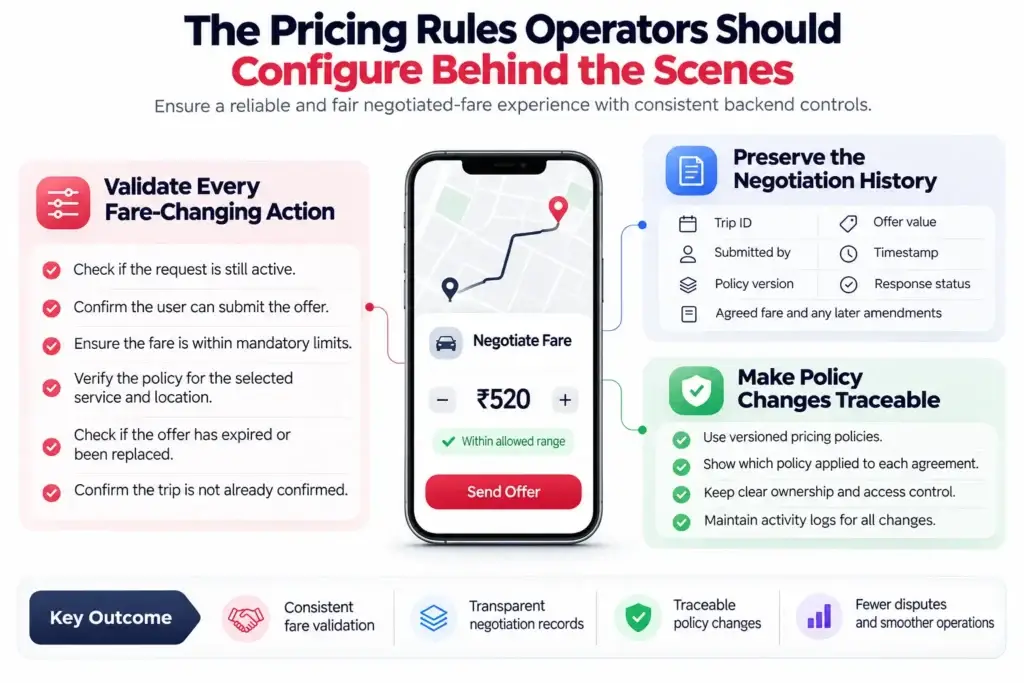
A reliable negotiated-fare experience requires consistent backend validation.
It is not sufficient to show minimum and maximum values in the mobile interface. Every submitted offer must be checked against the applicable server-side policy.
Validate Every Fare-Changing Action
The pricing system should verify:
- Whether the request is still active.
- Whether the user can submit the proposed offer.
- Whether the fare falls within mandatory boundaries.
- Whether the pricing policy applies to the selected service and location.
- Whether the offer has expired or been superseded.
- Whether the trip has already been confirmed.
These checks help prevent inconsistent results when users act simultaneously or when an outdated offer remains visible.
Preserve the Negotiation History
For dispute resolution and operational review, retain records of important pricing events.
A practical audit record may include the trip identifier, offer value, submitting party, timestamp, applicable policy version, response status, agreed fare, and any later amendments.
Access to these records should follow role-based permissions and privacy-conscious retention policies.
For teams planning rider, driver, and operator workflows, fare validation and reliable transaction records deserve attention alongside booking, tracking, and payments.
Make Policy Changes Traceable
Operators may eventually change recommended pricing bands or permitted bidding behaviour.
An admin dashboard should make it possible to identify which policy applied when a particular agreement was made.
Changes to pricing rules should have clear ownership, appropriate access controls, and activity logs.
Without versioned records, resolving historical fare disputes can become unnecessarily difficult.
Designing a Fair Fare-Bidding Experience for Riders and Drivers
The visual presentation of a fare can influence behaviour as much as the underlying pricing policy.
A negotiation system should explain consequences accurately without creating artificial pressure.
For example, an interface may neutrally explain that a lower offer might receive fewer driver responses. It should not make unsupported promises about acceptance probabilities or use manipulative design to push riders toward higher amounts.
An official Indian consumer-protection action concerning misleading pricing prompts highlights why these distinctions matter.
Practical Principles for Neutral Negotiation Interfaces
- Explain the limit. When a user enters a prohibited amount, identify the relevant restriction rather than displaying a vague error.
- Keep the controls balanced. Do not use colour, positioning, or unequal interaction ranges to unfairly encourage higher offers.
- Protect voluntary consent. Riders should actively approve the final negotiated amount.
- Make declining straightforward. Neither rider nor driver should need to navigate confusing screens to reject an offer.
- Separate negotiation from tipping. Optional tips should not be disguised as mandatory fare increases. Local requirements governing when tips may be requested must be followed.
These safeguards support informed decisions and reduce the risk of dissatisfaction after a trip.
How to Know Whether Fare-Bid Guardrails Are Working
Founders should avoid evaluating pricing rules solely by their effect on average trip value.
A higher fare does not necessarily mean a healthier marketplace if fewer riders complete bookings or drivers experience longer idle periods.
A more balanced measurement framework considers both sides of the transaction.
| Metric | What to Measure | Why It Matters |
|---|---|---|
| Bid-to-Match Rate | Accepted bookings divided by valid ride requests. | Indicates how often negotiations produce a match. |
| Counteroffer Acceptance | Accepted counteroffers divided by counteroffers presented. | Reveals how often revised prices satisfy riders. |
| Time to Agreement | Time from initial offer to fare acceptance. | Shows whether negotiation causes booking friction. |
| Driver Net Earnings | Earnings after relevant deductions and operating costs. | Helps assess the sustainability of accepted rides. |
| Price-Related Complaints | Fare disputes relative to completed trips. | Measures transparency and customer confidence. |
| Post-Agreement Cancellations | Cancellations after a fare is accepted. | Can reveal mismatches between expectations and outcomes. |
| Out-of-Range Attempts | Offers rejected or warned about by policy. | Identifies confusing or overly restrictive boundaries. |
Measurements should be segmented by vehicle category, service zone, trip length, and time period where sufficient data is available.
Comparing all trips together can conceal local problems.
For example, a minimum fare policy might perform adequately in a dense city centre but result in fewer matches in a lower-demand neighbourhood.
Test Changes Before Applying Them Everywhere
Rather than making large, frequent changes to platform-wide settings, operators can begin with a controlled pilot.
Define the problem first.
Is the goal to reduce ignored low offers, improve driver earnings, lower cancellation rates, or shorten negotiation time?
Next, select the smallest policy adjustment likely to address that problem.
Measure the results against a suitable baseline, including unintended effects on the other side of the marketplace.
This disciplined approach is more informative than assuming that tighter restrictions will automatically produce better outcomes.
Common Fare-Bidding Mistakes Operators Should Avoid
Pricing flexibility can become a source of friction when policies are overly restrictive, difficult to understand, or insufficiently monitored. The following mistakes deserve attention before scaling a fare-negotiation service.
| Common Mistake | Business Risk | Better Approach |
|---|---|---|
| Treating Every Suggested Fare as Mandatory | Users lose meaningful negotiation freedom. | Use hard limits for justified restrictions and soft guidance where choice can remain available. |
| Protecting Only One Side of the Transaction | Low offers may discourage drivers, while high counteroffers may reduce rider confidence. | Evaluate affordability, driver economics, and marketplace reliability together. |
| Using Identical Rules for Every Journey | One policy may not reflect differences in local operating conditions. | Review service zones, distance, vehicle category, and local requirements. |
| Encouraging Unnecessary Fare Increases | Misleading prompts can reduce trust and create consumer-protection risks. | Use neutral guidance and support any acceptance-related claims with evidence. |
| Failing to Record Agreed Prices | Fare disagreements become difficult to investigate. | Retain offer history, final acceptance, and subsequent approved adjustments. |
| Measuring Revenue Without Matching Quality | Higher average fares may conceal lower booking completion. | Track conversion, earnings, reliability, and complaints together. |
Founder Decision Signals: When Should You Review Your Fare Policy?
Certain patterns indicate that an operator may need to revisit fare guidance, boundaries, or negotiation behaviour.
| Observed Pattern | Possible Explanation | Useful Next Step |
|---|---|---|
| Many Low Offers Receive No Responses | Suggested fares may not reflect driver economics. | Review guidance against pickup time and earnings. |
| Riders Abandon After Counteroffers | Revised amounts may exceed rider expectations. | Review offer visibility and price distribution. |
| Negotiations Take Too Long | Offer windows or repeated bidding may create friction. | Test shorter, clearer negotiation flows. |
| Fare Disputes Are Increasing | Charges or final acceptance may be unclear. | Improve breakdowns and audit records. |
| Outcomes Vary Between Zones | One policy may not fit every operating area. | Review location-specific rules. |
| Users Repeatedly Hit Mandatory Limits | Boundaries may be unclear or overly restrictive. | Improve explanations and review policy justification. |
These signals do not automatically establish the cause of a problem.
They indicate where the operator should investigate before making changes.
How Miracuves Can Support Configurable Fare Negotiation
For founders considering a negotiated-fare mobility business, pricing rules should be part of the product evaluation process.
A useful foundation needs rider and driver negotiation flows, operator oversight, and reliable fare records. It should also allow the team to assess which boundaries can be configured and which changes require additional engineering.
Miracuves offers a ready-made fare-negotiation platform that provides a starting point for these workflows, with rider, driver, and operator components.
Its existing solution includes configurable bid-range controls. More specialised behaviour—such as a particular soft-warning policy, custom threshold calculation, or additional negotiation restriction—should be confirmed against the available configuration and separately scoped when necessary.
Miracuves also provides mobility product development services for teams with requirements extending beyond a ready-made foundation.
For the standard ready-made solution, Miracuves offers a 6-working-day delivery timeline, subject to the agreed deployment scope and required launch inputs. Custom pricing logic and integrations may require additional development time.
The most useful first step is to define the fare rules the business genuinely needs rather than introducing restrictions simply because they can be configured.
Final Thoughts: Protect the Marketplace Without Taking Away Negotiation
Fare bidding works best when users have enough information to make independent decisions and the platform maintains reasonable boundaries around those decisions.
For founders, successful fare governance is not about forcing every rider and driver toward one preferred price.
It is about understanding which restrictions are necessary, which suggestions should remain optional, and how pricing decisions affect marketplace reliability.
A sound policy combines applicable regulatory boundaries, transparent guidance, voluntary counteroffers, explicit acceptance, and reliable audit records.
That foundation makes it easier to refine pricing as real market data becomes available.
Frequently Asked Questions
What is a bid floor in a ride-hailing app?
A bid floor is the lowest fare that a rider can submit for a particular journey under the applicable pricing policy. It may reflect regulatory requirements or a justified operational restriction. A recommended minimum is different: it guides the user but does not necessarily prevent lower, legally permissible offers.
How can ride-hailing operators set minimum fares without removing rider choice?
Operators can separate mandatory minimums from suggested prices. Hard restrictions should be limited to justified policy or legal requirements, while advisory ranges help riders understand expected trip costs. Drivers should remain able to evaluate individual offers, and riders should retain the option to reject counteroffers.
Should drivers be allowed to counteroffer above the suggested fare?
They may be allowed to do so when the counteroffer remains within applicable pricing limits and the platform’s disclosed rules. A suggested fare is not necessarily a maximum. The rider should be able to see and accept or reject the proposed amount voluntarily.
How many counteroffers should a ride request allow?
There is no universally appropriate number. Operators can test a limited negotiation process based on booking speed, rider behaviour, and driver response patterns. The goal is to prevent excessive delays without making genuine negotiation unnecessarily difficult.
What happens if a rider submits a fare below the minimum permitted amount?
The platform should reject the offer with a clear explanation of the applicable minimum and allow the rider to revise it. If the offer is below a recommended amount but above the mandatory minimum, an advisory message may be more appropriate than rejection.
Can fare-bidding limits differ between cities or vehicle categories?
Yes, where permitted by applicable regulations. Pricing policies may need to account for differences in local fare requirements, operating conditions, vehicle types, and journey characteristics. Operators should validate the requirements of each market before configuring these rules.
When should a negotiated ride fare become final?
The final fare should be confirmed when the rider and driver have agreed under the platform’s booking process. The system should record that agreement and clearly explain any conditions that may subsequently change the amount, such as approved extra stops or applicable additional charges.
How can operators measure whether fare-bid guardrails are effective?
Useful indicators include bid-to-match rate, counteroffer acceptance, time to fare agreement, driver net earnings, post-agreement cancellations, and price-related complaints. Reviewing these metrics together helps operators determine whether the rules support both user choice and marketplace sustainability.
Miracuves is an independent software development company. We are not affiliated with, connected to, sponsored by, or endorsed by any company or product named in this article.
Terms such as “X Clone” are used descriptively. It is how the software industry refers to building a platform with functionality comparable to a known service, and how clients search for it.
The entire design and codebase of our products is built by our own team. Our products contain no code, design, graphics, or content originating from any third-party website or applications.
All third-party names and marks referenced in this article are the property of their respective owners, referenced solely to identify the services discussed.