
Key Takeaways
- Investor Lifetime Value Property Platforms can create more long-term business value by supporting investors beyond their first property transaction through repeat investments, portfolio management, distributions, and relevant financial services.
- Investor lifetime value should be measured using platform revenue minus lifetime variable servicing costs, rather than treating total investor capital or assets under management as platform revenue.
- Repeat property investments can extend the commercial relationship and help spread the original customer acquisition expense across a longer period of investor activity.
- Rental distributions, portfolio reporting, ownership records, and meaningful investment updates can create legitimate reasons for investors to return to the platform even when they are not making a new investment.
- A broader product ecosystem can support cross-product engagement, but more products do not automatically mean higher lifetime value. Product relevance, investor suitability, operating costs, compliance requirements, and actual demand must be evaluated.
- Trust is a foundation of retention. Accurate ownership records, transparent reporting, clear fees, distribution information, and realistic liquidity disclosures can make the platform more useful throughout the investor lifecycle.
- Founders should track metrics such as repeat investment rate, time to second investment, cross-product adoption, contribution margin, investor acquisition cost, retention by cohort, and support cost per active investor.
- A connected investor profile, accurate financial records, event-based analytics, and permission-based communication can provide the technical foundation for measuring and improving long-term investor relationships.
- The strongest multi-product strategy starts with a reliable core investment experience, validates one adjacent product at a time, and expands only when investor usefulness, product economics, operational controls, and regulatory readiness have been demonstrated.
Acquiring a property investor is an important milestone for any real estate investment platform. However, the first completed investment does not necessarily represent the full commercial value of that relationship. Investors may return to diversify their portfolios, reinvest rental distributions, explore different asset categories, access property-related financial services, or manage existing holdings over several years. The platforms that support these activities can create more opportunities for long-term engagement than those focused exclusively on the initial property transaction.
This is why multi-product property ecosystems deserve attention from founders looking beyond investor acquisition. Instead of treating each investment as an isolated transaction, they can connect property ownership, financial activity, portfolio management, and related services within a continuing investor relationship. For businesses evaluating this approach, a multi-product property investment platform provides a useful reference for understanding how different investment and financial workflows can operate within one digital ecosystem.
The business opportunity is not simply to introduce more products. It is to give investors relevant reasons to return, provide consistent visibility into their financial activity, and reduce unnecessary friction when they are ready for another decision. Done correctly, this approach can strengthen investor retention, improve repeat participation, and increase the contribution generated by an investor relationship over time.
This article explores how multi-product property platforms increase investor lifetime value, the behavioral mechanisms behind repeat investment, which products support different stages of the investor journey, and how operators can measure whether expansion is creating sustainable business value.
Why the First Property Investment Is Only the Beginning of Investor Value
A traditional property investment journey often revolves around a relatively narrow process. An investor discovers an opportunity, reviews the asset, completes verification, transfers funds, and receives documentation confirming participation. Once the transaction is complete, the business may communicate primarily through distribution updates or occasional portfolio notifications.
This creates a commercial limitation. The platform has already invested resources in attracting and onboarding the investor, yet the relationship may produce very little subsequent activity. If the investor wants exposure to another asset category or requires a related financial service, they may need to move to a different provider.
Multi-product property platforms approach this differently. They recognize that investor needs evolve after the first transaction. A person who initially participates in one rental property may later seek additional income-producing assets, a different risk profile, more flexible investment allocations, or assistance with a separate property purchase.
The platform’s role can therefore expand from facilitating an isolated purchase to supporting an ongoing set of investment decisions.
The Difference Between Transaction Value and Relationship Value
Transaction value describes the economic activity associated with a particular purchase or investment. Relationship value considers the revenue and costs associated with an investor across the full duration of their engagement with the business.
These figures should not be confused. An investor who allocates a large amount to a property does not automatically generate an equally large amount of revenue for the platform. Depending on its operating model, the business might earn a transaction fee, ongoing servicing income, an administration charge, or a fee linked to a permitted financial service.
An investor who participates in several appropriate opportunities over multiple years may contribute more total revenue than someone who makes a single larger investment and never returns. However, profitability also depends on the expenses of servicing that relationship.
For founders, the strategic question becomes: how can the business create enough lasting usefulness that investors voluntarily maintain their relationship with the platform?
What Investor Lifetime Value Means for Property Investment Platforms
Investor lifetime value, often shortened to investor LTV, represents the estimated economic contribution a platform receives from an investor throughout the customer relationship. For internal decision-making, contribution-based LTV is particularly useful because it accounts for variable costs rather than treating all revenue as profit.
For property investment businesses, lifetime value may include initial investment-related fees, ongoing administration or servicing revenue, eligible repeat transactions, and revenue from additional financial products where these are legally permitted and commercially appropriate.
The calculation becomes more meaningful when the operator also accounts for payment-processing charges, customer support expenses, verification costs, servicing costs, and other variable expenses.
A Practical Formula for Investor Lifetime Value
Investor LTV = Lifetime Platform Revenue − Lifetime Variable Servicing Costs
For acquisition economics, operators can also calculate acquisition-adjusted lifetime contribution by subtracting the cost of acquiring the investor.
This definition helps operators avoid a common reporting mistake: confusing investment volume or assets under management with platform revenue. Investor capital belongs to the investor or relevant investment structure. It should not be treated as revenue earned by the technology or investment platform.
Another important distinction is the difference between realized and projected lifetime value. Realized LTV measures contribution already earned. Projected LTV estimates future contribution using retention assumptions, customer behavior, product adoption, and expected servicing costs.
Projected LTV is useful for planning but should never be represented as guaranteed future income.
An Illustrative Investor Lifetime Value Calculation
Consider a hypothetical platform with the following economics. The figures are illustrative assumptions used to explain the calculation, not market benchmarks or actual platform performance.
| Lifetime activity | Illustrative platform revenue |
|---|---|
| First property investment | $100 |
| Two additional property investments | $160 |
| Ongoing servicing revenue | $120 |
| Eligible additional financial services | $60 |
| Total platform revenue | $440 |
| Lifetime variable servicing costs | −$130 |
| Lifetime contribution before acquisition cost | $310 |
| Customer acquisition cost | −$90 |
| Acquisition-adjusted lifetime contribution | $220 |
Compare this with an investor who participates only once. If the initial transaction produces $100 of platform revenue, $30 of variable costs, and $90 of acquisition cost, the relationship would contribute negative $20 after acquisition. Subsequent engagement can change those economics without requiring the platform to acquire an entirely new customer for every eligible activity.
Of course, expanding services also creates costs. New products can require additional customer support, risk management, partner integrations, regulatory processes, and marketing. The objective is therefore to grow profitable lifetime contribution, not simply increase the number of transactions displayed on an investor dashboard.
How Multi-Product Property Platforms Create Opportunities for Higher Investor Lifetime Value
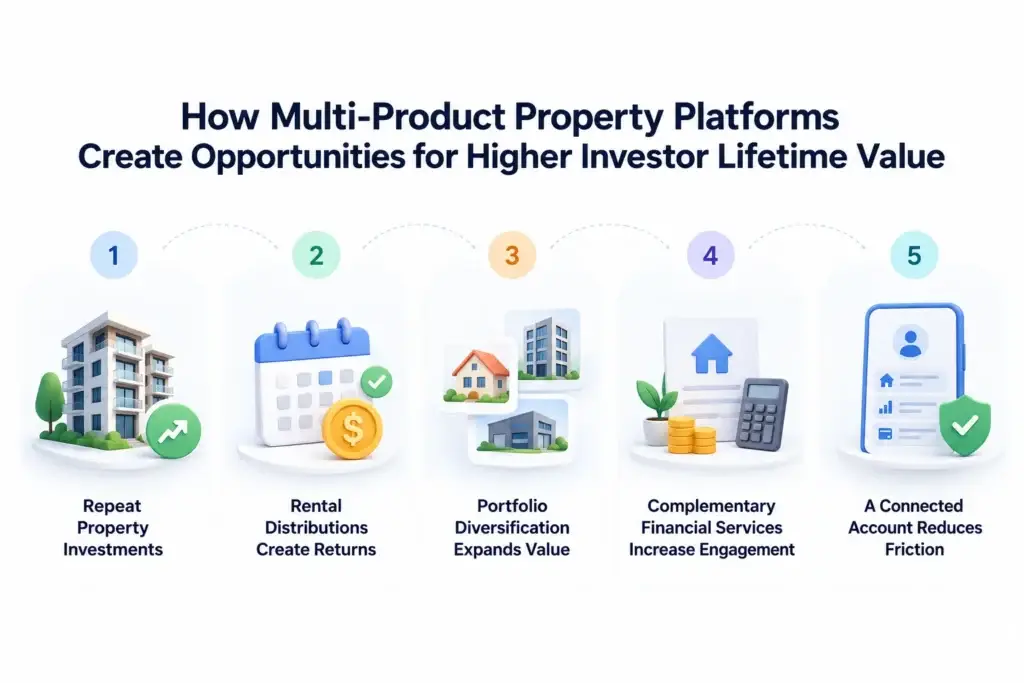
Multi-product ecosystems can improve long-term business economics through several connected mechanisms. Each one addresses a different reason an investor might continue interacting with a platform after the first property allocation.
1. Repeat Property Investments Extend the Commercial Relationship
The most direct opportunity is repeat investment. Once an investor has completed verification, reviewed ownership documentation, and experienced the platform’s reporting process, a second investment may require less orientation than the first.
That does not mean the investor should be encouraged to invest repeatedly regardless of suitability. Each opportunity still requires an appropriate assessment of risk, concentration, investment objectives, and available liquidity.
However, when the platform provides clear access to suitable opportunities, repeat participation becomes a natural possibility. An investor may want to diversify across property locations, asset categories, income profiles, or investment durations.
From the operator’s perspective, repeat investment can increase transaction frequency while spreading the original acquisition expense over a longer period of activity.
2. Rental Distributions Create Meaningful Reasons to Return
Rental income and other investment distributions create recurring moments of engagement. Investors may return to review payments, compare actual results with earlier projections, download statements, or assess whether to retain or change their exposure.
These interactions are valuable because they are connected to an existing financial relationship rather than an unrelated promotional campaign. A platform that provides accurate distribution records and clear explanations can become a regular point of reference for investors.
Where the investment structure permits it, investors may also choose to reinvest eligible distributions. A reinvestment journey should explain available opportunities, applicable fees, restrictions, risks, and whether the investor has sufficient accessible funds outside the investment.
The commercial benefit comes from facilitating informed investor choices, not from assuming that every distribution should immediately be reinvested.
3. Portfolio Diversification Expands the Relationship Beyond One Asset
A single-property platform may remain relevant only while an investor is interested in that particular class of opportunity. Multi-product ecosystems can support investors whose financial priorities change over time.
For example, an investor initially interested in income-producing property may later explore a different real estate segment, an eligible fractional investment structure, or another supported asset category. A broader catalogue makes the platform more useful across several investment decisions.
Nevertheless, adding products does not guarantee diversification. Multiple offerings may still expose investors to correlated property markets, interest rates, developers, or geographic risks. Operators must present these relationships accurately instead of assuming that a larger product catalogue automatically reduces financial risk.
The value of product variety depends on the relevance and quality of the opportunities, not the total number of categories.
4. Complementary Financial Services Create Additional Engagement Opportunities
Property ownership often connects to financial needs beyond the investment itself. Depending on the jurisdiction and operating model, investors may require mortgage assistance, estate planning support, investment documentation, residency-related services, or access to other eligible financial products.
A platform that coordinates appropriate services can become more useful across a wider portion of the property ownership journey.
Consider an investor who initially participates in a fractional property opportunity. Over time, the same person might seek financing for a separate property purchase or professional guidance about succession planning. If the platform offers access to reputable, properly authorized providers, it can facilitate the next step without requiring the investor to begin an entirely unrelated discovery process.
These services may support referral, placement, or service revenue where permitted. Their inclusion should be driven by genuine investor needs, appropriate licensing, and transparent compensation arrangements.
The platform must also distinguish between investment products, third-party services, and administrative tools. Combining them in one interface does not make them legally equivalent or remove the need for separate disclosures and consent.
5. A Connected Account Can Reduce Repeated Administrative Friction
Repeated account creation, document uploads, identity checks, and unfamiliar payment processes can discourage investors from exploring additional offerings.
A connected platform can reduce some of this friction by maintaining a consistent account experience, appropriate identity records, transaction history, and accessible portfolio documents.
However, a previously completed identity check is not necessarily sufficient for every new product. Updated KYC information, suitability assessments, source-of-funds checks, and product-specific agreements may still be required.
Good platform design makes these additional requirements understandable without forcing investors to repeat unnecessary administrative steps.
Lower friction can support conversion, but the advantage should be measured through actual completion rates, processing costs, customer satisfaction, and control effectiveness.
Why Investor Retention Depends on Trust Before Product Variety
A multi-product catalogue may attract attention, but long-term investor relationships depend on confidence in the underlying business. Property investments can involve long holding periods, changing valuations, inconsistent cash flows, and limited exit opportunities.
Investors need reliable information about these realities. They are unlikely to expand their relationship simply because more financial products appear inside the same application.
Clear Ownership Records Reduce Uncertainty
Investors should be able to understand what they own, which investment vehicle holds the underlying asset, how their rights are recorded, and what documentation establishes those rights.
Some property investment structures use a special purpose vehicle, or SPV, to hold an asset on behalf of participating investors. Depending on the structure, investors may hold shares, securities, or other contractual interests associated with that vehicle.
Accurate ownership information helps investors monitor their holdings and supports confidence in later transactions. For a detailed examination of the recordkeeping layer, see how SPV ownership registers support property investment records.
The lifetime value connection is indirect but important: understandable records can reduce uncertainty and servicing friction, creating better conditions for long-term relationships.
Transparent Reporting Makes the Platform Worth Revisiting
Investors need more than an attractive portfolio value displayed on a dashboard. Useful reporting should distinguish invested capital, realized income, estimated valuations, fees, expenses, pending distributions, and confirmed transactions.
Where investments are illiquid, the platform should avoid presenting estimated values as immediately withdrawable balances. Similarly, forecast returns should be separated from actual distributions.
When investors can find reliable information without repeatedly contacting support, the product becomes easier to use and the operating business may benefit from fewer routine service requests.
Exit Clarity Influences Willingness to Invest Again
Investors may hesitate to make additional allocations if they do not understand how their existing holdings could eventually be sold or transferred.
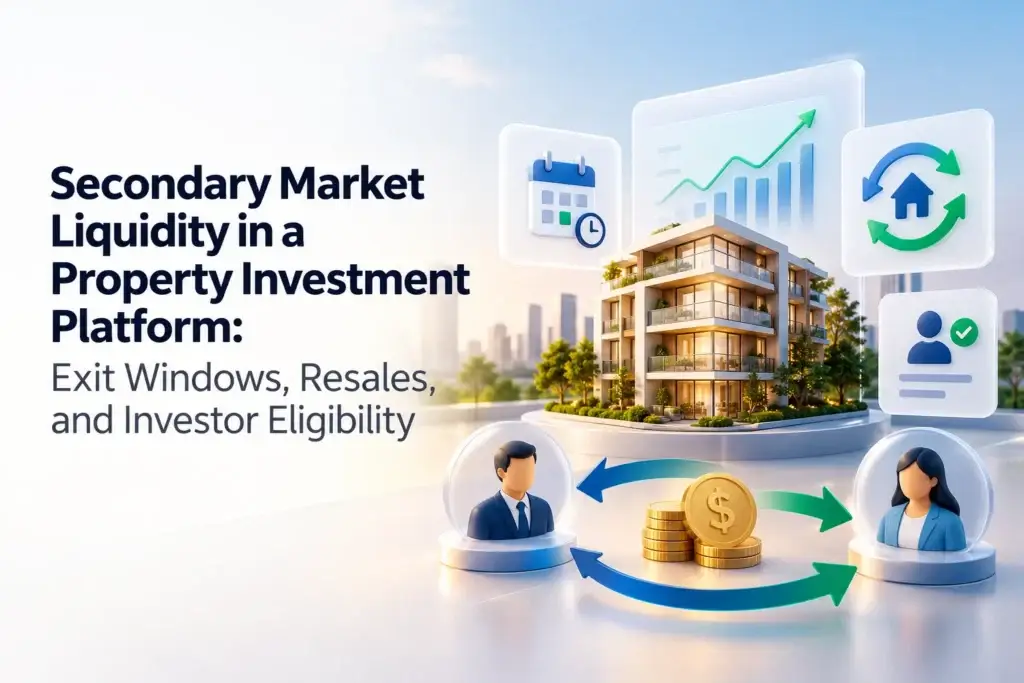
Secondary marketplaces, scheduled exit windows, and asset-sale processes can provide possible paths for transferring or realizing an investment, depending on the legal structure and market conditions.
However, a secondary marketplace does not guarantee an available buyer, immediate execution, or a favorable sale price. Liquidity must be described in terms of actual trading arrangements, eligibility rules, market participation, and transaction restrictions.
Operators planning a longer investor relationship should understand the role of secondary-market liquidity in property investment, particularly how exit mechanisms influence investor confidence and long-term platform engagement.
Mapping the Investor Lifecycle Across Multiple Property and Financial Products
One of the most useful ways to design a multi-product strategy is to map investor needs by lifecycle stage. This prevents the platform from treating every registered user as a prospect for every available service.
An investor who has just completed verification has different needs from someone who has received distributions for several years. Similarly, someone seeking portfolio diversification may not be interested in mortgage services or succession planning.
| Investor stage | Primary investor need | Relevant platform experience | Potential business outcome |
|---|---|---|---|
| Discovery | Understand opportunities and risks | Clear asset information and educational content | Qualified investor acquisition |
| First investment | Complete a trustworthy transaction | Verification, agreements, confirmations, and records | Initial commercial relationship |
| Portfolio monitoring | Track existing holdings | Statements, distributions, and performance updates | Continued engagement |
| Repeat participation | Explore suitable additional investments | Relevant opportunities and portfolio context | Additional transaction contribution |
| Broader financial needs | Access related services | Eligible financial and property services | Cross-product adoption |
| Exit or maturity | Understand and execute available options | Exit information, documentation, and settlement support | Trust and possible future reinvestment |
This model shows why investor lifetime value cannot be maximized through product availability alone. The relevance, timing, and quality of each interaction matter.
A founder should define the investor’s next legitimate need before deciding which product, service, or message to introduce. The platform should also respect investors who prefer to hold a single asset without making further transactions.
Which Additional Products Can Strengthen a Property Investor Relationship?
Different product categories support different moments in the investor journey. Some encourage appropriate repeat participation, while others help investors manage existing assets or access complementary services.
The choice should be based on investor demand, operational capability, regulatory feasibility, and the economics of each product line.
| Product category | Investor use case | Potential lifetime value mechanism | Key consideration |
|---|---|---|---|
| Additional property investments | Expand or adjust a property portfolio | Repeat transaction contribution | Suitability and concentration risk |
| Fractional ownership opportunities | Participate in selected assets with smaller allocations | Broader investment participation | Ownership structure and fees |
| Distribution reinvestment | Allocate eligible income to another opportunity | Repeat engagement without new acquisition | Investor consent and liquidity needs |
| Secondary-market access | Seek a permitted transfer or exit | Service engagement and eligible transaction fees | No guaranteed execution or price |
| Mortgage assistance | Explore financing for property-related needs | Eligible referral or service income | Lender approval and disclosure requirements |
| Additional investment products | Explore another suitable asset category | Cross-product engagement | Different risks and regulatory obligations |
| Estate and succession services | Plan how interests will be handled in the future | Long-term relationship usefulness | Professional legal advice and jurisdiction |
A useful distinction is that some products create transaction frequency, while others create relationship depth. Estate planning, for example, may be used only occasionally, but it can make the overall investor experience more complete.
Similarly, a secondary-market service may be more important for confidence and flexibility than for immediate revenue generation. Founders should avoid judging every product solely by the number of transactions it generates.
How to Increase Repeat Investment Without Aggressive Cross-Selling
Cross-product growth can become counterproductive when an investment platform treats every account interaction as an opportunity to promote another transaction. Financial decisions require more consideration than ordinary consumer purchases.
An effective investor engagement strategy should support decision quality, preserve trust, and give individuals meaningful control over the communications they receive.
Use Investor Goals Rather Than Generic Product Promotions
A platform can allow investors to indicate whether they prioritize recurring income, long-term capital growth, diversification, access to liquidity, or broader financial planning.
These preferences can improve the relevance of educational material and investment discovery. They should not replace formal suitability or eligibility assessments where required.
For example, someone seeking predictable reporting and long holding periods may appreciate updates about portfolio performance and income schedules. An investor concerned about exit flexibility may benefit more from an explanation of holding restrictions and secondary-market conditions.
Connect Engagement to Meaningful Lifecycle Events
Not all engagement should be driven by promotional emails. Important moments include distribution statements becoming available, documents requiring review, investment terms approaching maturity, and new information affecting an existing property.
These communications give investors a practical reason to return. They can also help operators identify unanswered questions, reporting problems, or concerns before they turn into disengagement.
The priority should be timely, accurate communication. Product recommendations should be introduced only when relevant to the investor’s needs and permitted under the operating model.
Make the Second Investment Easier to Understand
An investor may be satisfied with the first transaction but uncertain about participating again. The platform can help by explaining how a new opportunity differs from current holdings, which documents are required, what costs apply, and whether the new allocation would increase concentration in a particular market.
A clear comparison process reduces decision friction without manufacturing urgency. This approach is more sustainable than promotional countdowns or unsupported claims about future returns.
Support Investors Who Choose Not to Reinvest
Retention is not the same as forcing repeat transactions. Some investors will hold existing investments until maturity, and others may stop allocating new capital because their financial circumstances have changed.
These individuals can still maintain valuable relationships with a platform when it provides reliable documents, transparent account information, responsive support, and clear exit procedures.
A successful retention strategy respects these choices rather than treating inactivity as a reason for increasingly aggressive sales activity.
The Metrics Founders Should Track to Measure Investor Lifetime Value
A growing user base does not necessarily mean a property investment platform is becoming more profitable. Founders need metrics that connect investor behavior to contribution, engagement quality, and operating costs.
Because property investments often have long holding periods, conventional monthly purchase-frequency metrics can be misleading. The measurement framework should reflect investment duration, product availability, and the investor’s reasonable opportunity to participate again.
| Metric | What it measures | Why it matters |
|---|---|---|
| Investor lifetime contribution | Revenue minus variable servicing costs across the relationship | Shows long-term economic value |
| Repeat investment rate | Share of eligible investors completing a second investment | Indicates repeat participation |
| Time to second investment | Time between first and second completed allocations | Helps interpret investment cycles |
| Cross-product adoption | Share of eligible investors using another product category | Evaluates diversification of engagement |
| Contribution margin by product | Revenue remaining after product-specific variable costs | Identifies sustainable product economics |
| Investor acquisition cost | Acquisition spending divided by acquired qualified investors | Supports acquisition efficiency analysis |
| Distribution reinvestment rate | Eligible distributions voluntarily reinvested | Measures one form of repeat participation |
| Retention by acquisition cohort | Continued relationship activity for groups acquired in the same period | Separates improvement from audience mix |
| Support cost per active investor | Investor servicing expense over a defined period | Reveals operational efficiency |
Why Cohort Analysis Matters More Than a Single LTV Average
Suppose a platform attracts new investors through different channels over several quarters. A single average lifetime value can hide important differences between those groups.
Investors acquired through an educational webinar may behave differently from investors attracted by a time-sensitive campaign. Similarly, investors entering through a property-income product may have different future needs from those initially seeking property financing.
Cohort analysis groups investors by a meaningful starting event, such as their first completed investment, and tracks their subsequent contribution and engagement over time.
To make comparisons useful, operators should account for how long each cohort has been observed. A group acquired three months ago should not be expected to have the same realized lifetime contribution as a group active for three years.
Cohort reporting can also reveal whether product expansion is genuinely improving retention or whether an apparent increase in LTV is explained by higher fees, larger investment amounts, or a change in investor demographics.
Measure the Incremental Value of Additional Products
A higher number of product interactions does not prove that a new product caused higher lifetime value. Investors who adopt multiple products may already be more engaged or financially active.
Founders should compare comparable investor groups and examine the incremental contribution created after introducing a product. Where appropriate, controlled tests can help evaluate onboarding improvements, communication strategies, or educational experiences without pressuring investors into unnecessary financial decisions.
The key measurement question is whether a new product produces additional, sustainable contribution after accounting for operating costs, potential substitution of existing revenue, and any new compliance burden.
Why Multi-Product Expansion Can Improve Acquisition Economics
Acquiring qualified property investors typically requires more than generating website visits. Prospective investors may review documentation, assess risks, compare opportunities, complete identity verification, and seek clarification before committing funds.
The resulting acquisition expense can be significant for a business, particularly when the investor completes only one eligible transaction.
Multi-product engagement creates an opportunity to earn additional contribution from a relationship already established through that acquisition process.
This does not mean subsequent transactions have no marketing or servicing cost. Investors still require support, updated disclosures, and appropriate product assessments. However, a continuing relationship may reduce some of the costs associated with introducing the business to an entirely new customer.
Understanding the LTV-to-CAC Relationship
The relationship between lifetime value and customer acquisition cost helps founders assess whether growth spending is economically sustainable.
Investor Acquisition Economics
LTV-to-CAC ratio = Lifetime contribution before acquisition cost ÷ Customer acquisition cost
Both values must use consistent definitions and time horizons. The ratio is a planning indicator, not a guaranteed measure of profitability or a universal benchmark.
For example, a business might discover that an investor segment has relatively low initial transaction revenue but strong long-term servicing contribution. Another segment may generate more immediate fees yet require disproportionately expensive acquisition and support.
These differences should influence marketing investment, onboarding priorities, and product development decisions.
Founders should also evaluate the time required to recover acquisition spending. A projected LTV that depends on revenue many years in the future may not solve immediate cash-flow constraints.
The Technology and Data Foundations That Support Long-Term Investor Relationships
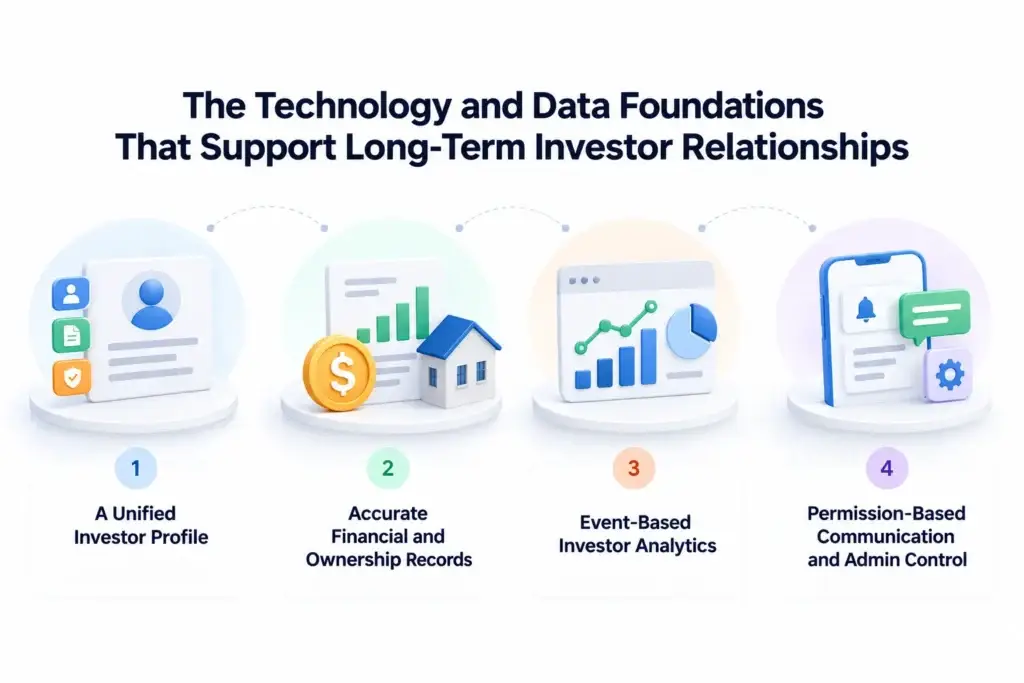
Increasing investor lifetime value is primarily a business challenge, but the platform’s technical foundation determines whether the strategy can be executed consistently.
When investment activity, portfolio records, service interactions, and communications are scattered across disconnected systems, the operator may struggle to understand the complete investor relationship.
A connected architecture can improve visibility, reduce duplicate administrative work, and make it easier to measure performance across product categories.
A Unified Investor Profile
The platform should maintain a consistent identity for each investor across permitted products while preserving separate legal and operational requirements where necessary.
This profile can connect contact preferences, verified identity information, appropriate eligibility data, document status, and product participation history. Access should be limited according to legitimate business purposes and applicable privacy requirements.
As property investment businesses expand beyond their first investment offering, maintaining a connected investor experience becomes increasingly important. A unified investor profile helps businesses organize portfolio activity, investment records, transaction history, and engagement across different property opportunities.
For founders exploring ready-made real estate investment platforms, a centralized investor experience can provide a practical foundation for supporting repeat investments, improving portfolio visibility, and maintaining long-term customer relationships without creating disconnected workflows for every new product.
A unified profile helps the operator understand the relationship without creating multiple conflicting records for the same individual.
Accurate Financial and Ownership Records
Property investments, fees, wallet movements, distributions, and investment transfers need accurate records. The system should distinguish between investor funds, platform revenue, investment ownership, and any amounts held or processed by regulated partners.
Reconciliation controls, audit logs, role-based permissions, and appropriate approval workflows are important for maintaining reliable operations.
For operators exploring the broader category of digital investment platform solutions, these foundational workflows are relevant to both the investor experience and the ongoing management of financial products.
Event-Based Investor Analytics
Analytics should connect meaningful events throughout the relationship: verification completed, first investment settled, statement viewed, distribution received, second investment completed, service adopted, and eligible exit processed.
These events allow founders to identify where users encounter friction and which experiences correspond with stronger engagement.
Analytics should distinguish financial transactions from ordinary interface activity. Viewing a property listing is not equivalent to completing an investment, and a simulated wallet balance should never be counted as settled funds.
Permission-Based Communication and Admin Control
Communication systems should support appropriate preferences, transaction notifications, service updates, and educational messages. Operators also need administrative controls for managing approvals, resolving account issues, reviewing transactions, and monitoring unusual activity.
Where products are regulated, KYC, AML, suitability, and reporting workflows must be configured to match the relevant jurisdiction and operating structure. Software can support those controls but cannot itself grant a license or guarantee regulatory compliance.
How Founders Should Prioritize Products Before Expanding the Ecosystem
Core Experience First
Strengthen investor trust before expanding the product catalogue. Prioritize accurate statements, clear ownership documentation, transparent fees, reliable distributions, and responsive support. A dependable investment experience creates a stronger foundation for long-term investor relationships.
Repeat Investment Readiness
Make suitable property opportunities easier to discover, compare, and evaluate. Simplify investment workflows, improve portfolio visibility, and communicate risks clearly. Focus on removing unnecessary barriers to repeat participation rather than encouraging investments that may not suit investor goals.
Adjacent Product Validation
Test one complementary financial product with a clearly defined investor segment before expanding further. Measure actual adoption, additional contribution, support demand, investor feedback, and compliance requirements. Validate sustainable demand instead of relying only on registrations or page views.
Scalable Expansion Decisions
Expand the investment ecosystem only when product economics, operational controls, and investor usefulness are demonstrated. Choose a configurable platform architecture that supports phased growth while maintaining legal compliance, reliable service delivery, and manageable operating costs.
Why Regional Investor Behavior Changes the Lifetime Value Strategy
Investor lifetime value is influenced by local purchasing power, available investment structures, preferred payment methods, expected reporting standards, and regulatory conditions.
For example, a platform serving investors in Gulf markets may need to consider Arabic-language support, local currencies, regional payment infrastructure, and market-specific investor eligibility rules.
These decisions affect more than the first transaction. Investors who cannot conveniently access statements, understand fees, or manage distributions in their preferred language may find the platform less useful over time.
Operators targeting these markets can explore the GCC real estate investment app localization guide for a deeper discussion of language, currency, payment, and interface considerations.
Localization should therefore be viewed as a continuing relationship capability. It supports investor understanding and service accessibility throughout the holding period, not only during acquisition.
Common Mistakes That Reduce Investor Lifetime Value
Confusing a Larger Product Catalogue With Better Retention
A platform may introduce several investment categories without providing a better experience for its existing customers. If users cannot understand the differences between offerings, product variety can create decision fatigue rather than engagement. Founders should validate demand and prioritize clarity over the number of products displayed.
Measuring Investment Volume as Platform Revenue
Total invested capital and assets under management can be useful operating indicators, but they are not equivalent to earned platform revenue or profit. Investor lifetime value should be based on the economics of the business relationship, including relevant fees and costs, rather than counting investor capital as company income.
Encouraging Reinvestment Without Considering Suitability
Frequent product recommendations can damage trust when they are disconnected from an investor’s financial situation, risk tolerance, or liquidity requirements. Communications should be transparent, proportionate, and appropriate to the operating model. A higher short-term transaction count is not worth weakening long-term investor relationships.
Ignoring the Cost of Additional Financial Products
New products may require specialist integrations, legal documentation, compliance oversight, partner management, and additional customer support. If these costs exceed the contribution generated, expansion can reduce overall profitability. Product-level contribution analysis should be part of every expansion decision.
Overpromising Liquidity or Investment Outcomes
Secondary markets and portfolio diversification tools do not eliminate investment risk. Property valuations may decline, buyers may be unavailable, and financial returns can differ from forecasts. Clear disclosures and accurate performance reporting are necessary for preserving trust over a long investment relationship.
Overlooking Investors Who Remain Inactive for Legitimate Reasons
Some investors make one allocation and hold it for years. Treating every period without a new investment as churn can lead to misleading retention reports and inappropriate marketing activity. Platforms should distinguish between dormant accounts, active long-term holdings, exited investors, and investors eligible for additional products.
A Practical 90-Day Framework for Evaluating Investor Lifetime Value Opportunities
Founders do not need to launch several new product categories to begin improving lifetime value. A structured review of the existing investor journey can reveal which changes are most likely to create genuine value.
Days 1–30: Establish the Baseline
Start by defining the relevant investor population and the time horizon used for measurement. Separate first-time investors, repeat investors, active holders, and investors who have fully exited.
Review acquisition cost, revenue per investor, variable servicing costs, portfolio activity, distribution-related engagement, and available retention data.
Interview investors or analyze support interactions to understand what prevents them from returning. The main constraint may be unclear reporting, limited suitable opportunities, dissatisfaction with service, or simply the long duration of property investment cycles.
Days 31–60: Improve One High-Impact Journey
Choose one experience linked to an identified problem. Examples include making distribution statements easier to understand, improving the visibility of ownership documents, simplifying a permitted repeat-investment process, or providing clearer information about exit restrictions.
Define the outcome before implementing changes. Suitable measures may include fewer unresolved support requests, improved document access, reduced processing delays, or better completion rates among eligible investors.
Days 61–90: Evaluate a Complementary Product Opportunity
Use investor research and baseline data to identify one adjacent service worth evaluating. Assess the audience, regulatory requirements, partner dependencies, operating costs, and expected incremental contribution.
Where appropriate, conduct a limited pilot with clear disclosures and qualified participants. Review actual behavior rather than relying solely on expressions of interest.
By the end of the period, the business should have a clearer view of its existing retention economics and a more evidence-based basis for deciding whether product expansion is justified.
When a Multi-Product Property Ecosystem Makes Business Sense
A multi-product model is most attractive when the business already serves an identifiable investor audience with continuing financial needs. It can also be relevant when the operator has established access to suitable investment opportunities and wants to coordinate related services through one experience.
However, the strategy may be premature for a founder who has not validated investor demand, developed reliable operational processes, or established the necessary legal structure.
The right expansion decision depends on the quality of the existing investor relationship, not simply the ambition to create a large financial ecosystem.
Miracuves helps founders evaluate ready-made and white-label investment software foundations that can be configured around their intended business model. For appropriate ready-made solutions, its six-day delivery approach can accelerate the deployment of an initial product foundation, while integrations, customization, regulatory readiness, and production operations remain dependent on the agreed scope.
This distinction matters because faster software delivery and stronger investor lifetime value are not the same outcome. Technology can enable the strategy, but demand, investor trust, product suitability, and operating discipline determine its long-term effectiveness.
Final Thoughts: Long-Term Investor Relationships Create More Value Than Isolated Transactions
The first property investment establishes a relationship, but it does not determine how valuable that relationship may become. Investors can continue interacting with a platform through portfolio monitoring, distributions, suitable additional investments, financial-service needs, and eventual exit decisions.
Multi-product property platforms can support these interactions within a connected experience. When the product mix reflects genuine investor needs, operators gain opportunities to increase repeat participation, strengthen retention, and improve lifetime contribution without depending entirely on constant new-customer acquisition.
Yet the strongest business model is not necessarily the one with the most products. Sustainable growth depends on accurate records, transparent economics, appropriate investment choices, useful communication, and disciplined measurement. Platforms that solve these underlying problems are better positioned to remain relevant beyond an investor’s first transaction.
For founders considering how to translate that strategy into a digital business, Miracuves offers a white-label multi-product real estate investment solution that can serve as a starting point for evaluating connected investor experiences, configurable product workflows, and future platform expansion. The objective should be to build an investment relationship that investors find useful over time, rather than treating every property purchase as the end of the journey.
Frequently Asked Questions
What is investor lifetime value in a property investment platform?
Investor lifetime value estimates the economic contribution a property investment platform earns from an investor throughout the customer relationship. It can include initial transaction revenue, eligible repeat investments, ongoing servicing fees, and complementary services, minus the relevant variable servicing costs. It should not be confused with the investor’s total invested capital.
How do multi-product property platforms increase investor lifetime value?
Multi-product property platforms can increase lifetime value by supporting repeat investments, portfolio diversification, ongoing portfolio management, reinvestment opportunities, and relevant additional financial services. The actual improvement depends on investor demand, product suitability, operational costs, and the quality of the overall experience.
Why is investor retention important for real estate investment platforms?
Investor retention helps property investment businesses maintain relationships with customers they have already acquired and verified. Continued engagement can create opportunities for repeat transactions and servicing revenue while potentially spreading acquisition costs over a longer relationship. Retention is especially important when investment cycles are long.
Which products can encourage repeat engagement after the first property investment?
Depending on investor needs and regulatory permissions, relevant offerings may include additional property opportunities, fractional ownership investments, distribution reinvestment, secondary-market services, mortgage assistance, and estate planning support. The strongest product mix is determined by suitability and usefulness rather than the number of categories offered.
How should a platform calculate investor lifetime value?
A practical approach is to calculate the total platform revenue generated throughout the investor relationship and subtract the variable costs of providing those services. Operators can also subtract customer acquisition cost to determine acquisition-adjusted lifetime contribution. Projected values should use explicit assumptions and be distinguished from realized results.
Does a secondary market guarantee better investor retention?
No. A secondary market may improve access to potential exit processes and make investment terms easier to understand, but it cannot guarantee buyer availability, transaction completion, or a favorable price. Investor retention depends on the overall credibility, transparency, and usefulness of the platform.
Can a unified investor account improve cross-product adoption?
A unified account can make additional products easier to access by reducing duplicate records and unnecessary administrative steps. However, separate suitability checks, updated verification, disclosures, and product agreements may still be necessary. Cross-product adoption should be measured against its additional contribution and operating costs.
Should property investment founders launch multiple products from the beginning?
Not necessarily. Founders should first validate investor demand, establish reliable ownership and financial records, and deliver a trustworthy core investment experience. Additional products can then be introduced when there is evidence of investor need, viable contribution economics, and adequate regulatory and operational readiness.
Miracuves is an independent software development company. We are not affiliated with, connected to, sponsored by, or endorsed by any company or product named in this article.
Terms such as “X Clone” are used descriptively. It is how the software industry refers to building a platform with functionality comparable to a known service, and how clients search for it.
The entire design and codebase of our products is built by our own team. Our products contain no code, design, graphics, or content originating from any third-party website or applications.
All third-party names and marks referenced in this article are the property of their respective owners, referenced solely to identify the services discussed.