

Key Takeaways
- AI App Builder Platform Ownership gives founders deeper control over source code, branding, hosting, users, billing, AI models, usage limits, and long-term product direction.
- Hosted AI app builders are useful for prototypes, demos, experiments, and internal tools where speed matters more than platform-level control.
- Exporting generated app code is not the same as owning the complete AI builder platform, admin system, billing logic, workspaces, and model infrastructure.
- Ownership becomes more important when the AI builder itself is the branded product, revenue engine, enterprise offering, or long-term software asset.
- Founders should compare source-code rights, data control, monetization flexibility, infrastructure, AI provider access, scalability, and migration freedom before choosing a platform model.
Ownership Signals
- Choose platform ownership when you need your own brand, domain, subscriptions, credit rules, user permissions, templates, and commercial terms.
- Source-code ownership matters when founders need freedom to customize, migrate, extend, optimize, or scale the platform without depending on a hosted provider.
- AI usage controls should track prompts, generations, credits, model access, and provider costs so growth does not reduce margins.
- Owned platforms should provide admin visibility across users, plans, credits, templates, payments, model access, errors, and support activity.
- Hosting and data control become especially important for agencies, enterprise teams, private workflows, sensitive projects, and custom deployment requirements.
Real Insights
- Hosted convenience is valuable early, but it can become restrictive when pricing, users, data, infrastructure, and roadmap control become central to the business.
- The cheapest launch option is not always the most cost-efficient long term if it creates vendor dependency, migration limits, or rebuilding risk.
- Platform ownership creates more monetization flexibility through subscriptions, usage credits, team plans, enterprise workspaces, premium templates, and white-label licensing.
- Scalability includes more than traffic; founders must plan for users, projects, prompts, AI usage, billing events, generated files, workspaces, admin actions, and support operations.
- The strongest decision path is: use hosted tools for experimentation → choose ownership when the builder becomes the business → customize what creates differentiation → scale infrastructure and AI workflows as demand grows.
AI app builders have made software creation faster. A founder can describe an idea, generate screens, preview workflows, create code, and move from concept to working product direction in much less time than traditional development.
But speed creates a second question.
Should you use a hosted AI App Builder Platform Ownership as a tool, or should you own the platform behind the experience?
That difference matters more than many founders realize. A hosted AI app builder is useful when you want fast creation, quick experiments, or internal prototypes. Platform ownership becomes important when the AI builder itself becomes your business model, revenue engine, branded product, or enterprise offering.
For AI startups, agencies, SaaS operators, education platforms, product studios, and enterprise teams, this is not only a software decision. It affects source code, hosting, user data, model access, pricing control, scalability, security, and long-term independence.
Miracuves helps founders build ready-made and white-label AI app builder platforms with source-code ownership, admin control, monetization logic, and scalable product foundations. This guide compares hosted AI app builders with platform ownership so founders can choose the right path without overbuilding too early or getting locked into the wrong system.
What Is a Hosted AI App Builder?
A hosted AI app builder is a cloud-based platform where users create applications through prompts, visual editing, code generation, templates, or automated workflows. The software runs on the provider’s infrastructure. Users log in, generate projects, preview output, and often deploy or export the result depending on the platform’s rules.
This model is attractive because it removes setup friction. You do not need to manage servers, install environments, configure AI providers, or maintain the core builder system. The provider handles the platform layer while the user focuses on creating apps.
A hosted AI app builder is useful for:
- Rapid prototyping
- Internal tools
- Landing pages
- Early demos
- Workflow experiments
- Founder ideation
- Non-technical product exploration
- Quick proof-of-concept builds
For many users, that is enough.
But for founders building a commercial AI platform, the hosted model has limits. You may not control the full platform experience, pricing structure, model configuration, usage metering, customer data policies, deployment infrastructure, or long-term roadmap.
That is where platform ownership becomes a different strategic path.
What Does Platform Ownership Mean in AI App Builder Development?
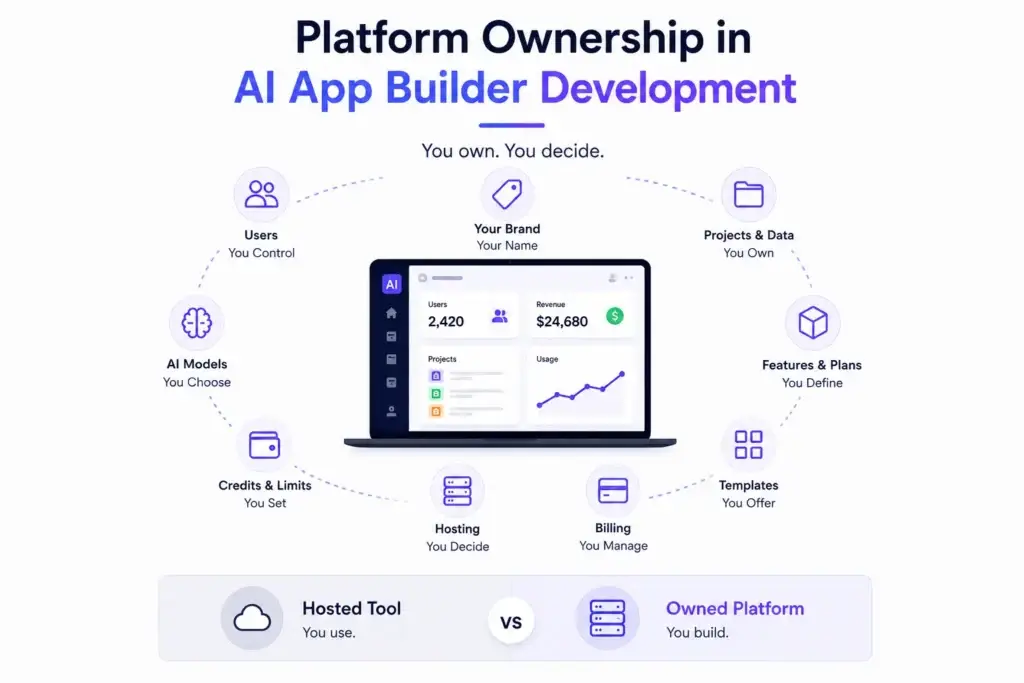
Platform ownership means you control the AI app builder as a business asset.
Instead of only using another company’s hosted tool, you operate your own branded AI app builder platform. That usually includes source code, admin controls, user management, billing logic, AI model configuration, templates, project workspaces, usage rules, hosting setup, and monetization workflows.
Owning the platform means you can decide:
- What the platform is called
- Which users can access it
- Which AI models are available
- How credits or usage limits work
- What subscription plans include
- How projects are stored
- Where the platform is hosted
- How users are billed
- Which templates are offered
- What features agencies, teams, or enterprises receive
- How the platform scales as usage grows
This matters when the builder is not just a tool you use, but the product you sell.
A hosted AI app builder helps you create software. A source-code-owned AI app builder platform helps you build a business around software creation.
Hosted AI App Builder vs Platform Ownership: Quick Comparison
Hosted AI App Builder vs Platform Ownership
| Comparison Area | Hosted AI App Builder | Owned AI App Builder Platform | Founder Impact |
|---|---|---|---|
| Speed | Very fast to start because the platform is already hosted. | Requires setup, branding, configuration, and deployment. | Hosted tools are better for quick creation; ownership is better for long-term product control. |
| Source Code | You may export generated project code depending on platform rules. | You own the platform source code if the build includes proper handover. | Owning generated output is different from owning the builder platform itself. |
| Branding | Usually limited to the hosted provider’s environment. | Can run under your brand, domain, interface, and commercial terms. | Ownership is stronger when the platform is part of your startup identity. |
| Monetization | You follow the provider’s pricing and access rules. | You can create subscriptions, credit packs, team plans, and licensing models. | Ownership gives founders more pricing control and revenue model flexibility. |
| AI Provider Control | Provider access depends on the hosted platform’s configuration. | You can choose provider strategy, model access, routing, and usage limits. | Provider control helps manage cost, quality, and reliability. |
| Data and Hosting | Data runs through the hosted platform’s infrastructure. | The platform can be deployed on infrastructure you control. | Ownership is important for teams with data, privacy, or enterprise security concerns. |
| Scalability | Scale depends on the provider’s limits, pricing, and product roadmap. | Scale can be planned around your own users, usage, hosting, and business model. | Owned platforms offer more long-term control but require stronger operational discipline. |
Why Source Code Ownership Is Not the Same as Code Export
Many founders confuse code export with source-code ownership.
A hosted AI app builder may allow users to export the code generated for a specific project. That can be useful. It means you may be able to take the generated app files and continue development elsewhere.
But that does not mean you own the AI builder platform.
The full platform includes much more than the generated app output. It includes the system that accepts prompts, manages users, controls workspaces, connects AI models, tracks credits, stores projects, manages billing, handles admin permissions, and supports deployment workflows.
A founder should ask two separate questions:
- Do I own the code generated by the AI tool?
- Do I own the platform that creates, manages, monetizes, and controls those AI-generated projects?
The first question matters for users building individual applications. The second question matters for founders building an AI app builder business.
If your product strategy depends on selling AI-powered app creation to your own users, agencies, schools, developers, teams, or enterprise clients, then platform ownership becomes more important than simple export access.
Where Hosted AI App Builders Work Best
Hosted AI app builders are not bad. They are highly useful when the goal is speed and simplicity.
A founder should consider a hosted AI app builder when:
- The goal is a prototype, not a full commercial platform.
- The product idea is still unclear.
- The team needs quick demos for investors or internal users.
- The founder wants to test multiple directions quickly.
- The app does not handle sensitive workflows.
- The business does not require custom pricing or branded access.
- The team is not ready to manage infrastructure.
- The project is temporary, experimental, or internal.
The biggest advantage is low setup effort.
You can start building quickly and learn whether the idea has value. For founders exploring product direction, that speed is useful. But as soon as users, revenue, brand, data, and operations become central to the business, hosted convenience may become a control limitation.
Where Platform Ownership Becomes the Smarter Choice
Platform ownership becomes stronger when the AI app builder is part of your business model.
You should consider owning the platform when:
- You want to sell AI app creation under your own brand.
- You need your own pricing plans and credit rules.
- You want user, project, billing, and admin control.
- You need to manage AI provider keys and model access.
- You want to serve agencies, teams, or enterprise users.
- You need private or self-hosted deployment options.
- You want full source-code handover.
- You want to avoid long-term vendor dependency.
- You plan to add custom templates, integrations, or workflows.
- You want the platform to become a long-term company asset.
A source-code-owned AI app builder platform gives founders more control over the business layer. It allows the platform operator to shape product packaging, access rules, credit limits, support workflows, user permissions, and monetization.
That control is difficult to build if every major decision depends on a hosted provider’s roadmap.
For founders evaluating a launch-ready route, this source-code-owned AI app builder platform from Miracuves can be reviewed as the commercial next step without making this blog target the money-page keyword.
Control: The Real Difference Between Using a Tool and Owning a Platform
Control is the most practical difference between a hosted AI app builder and an owned platform.
When using a hosted tool, you may control the project you create. But the platform provider controls the environment, roadmap, pricing structure, usage policies, model availability, performance limits, and platform-level experience.
When you own the platform, you can control the product around the user.
That includes:
- User registration and onboarding
- Plan access and subscription rules
- Free credits and paid credits
- Model access per plan
- Workspace permissions
- Project limits
- Template categories
- Admin dashboards
- Payment workflows
- Feature flags
- Usage reports
- Support and moderation workflows
- Branding and domain setup
For a solo builder, these may not matter. For a startup founder, they can decide whether the platform becomes a scalable business.
A hosted tool helps users build apps. An owned platform helps founders operate an AI app builder business.
Scalability: What Founders Should Check Before Choosing
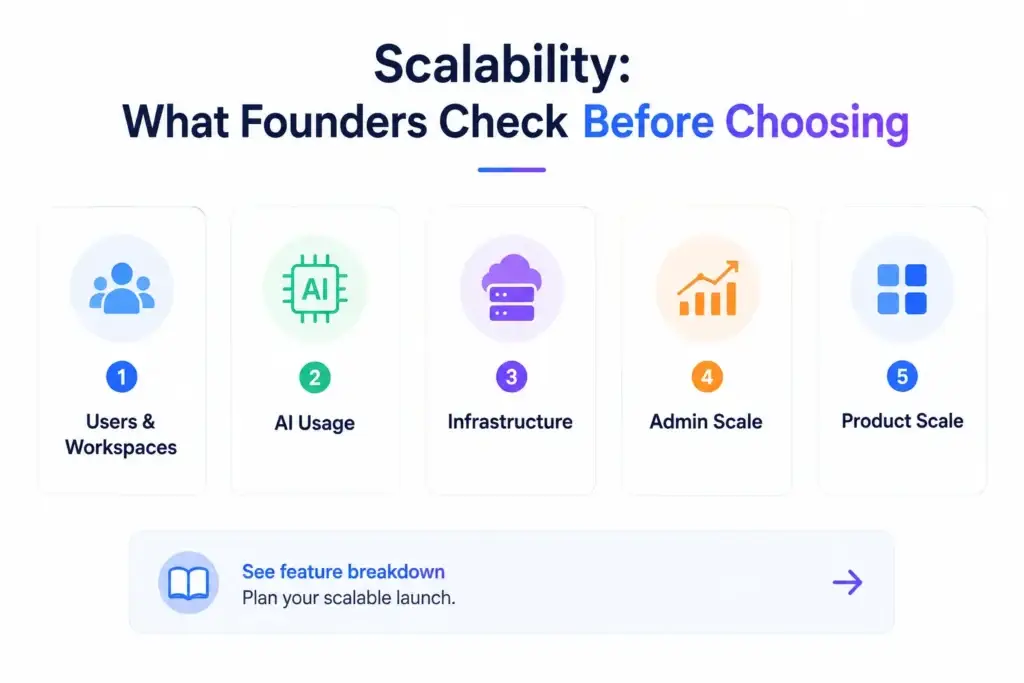
Scalability is not only about whether the server can handle traffic. For AI app builders, scalability includes users, projects, prompts, model usage, credits, billing events, generated files, preview environments, database records, support tickets, and admin decisions.
A scalable AI app builder needs clarity across several layers.
1. User and Workspace Scale
The platform should manage users, roles, teams, projects, and workspaces without becoming messy. If agencies or enterprise users are part of the plan, workspace-level control becomes important.
2. AI Usage Scale
Every prompt, generation, refinement, and preview can create model cost. Without usage tracking, credit controls, and plan limits, growth can hurt margins instead of improving them.
Founders planning usage-based revenue can review this AI app builder business model guide to understand how credit packs, subscriptions, team plans, and licensing can work together.
3. Infrastructure Scale
Hosted platforms hide infrastructure complexity, but they also limit control. Owned platforms require more setup but allow founders to make hosting, data, provider, and performance decisions based on their own business.
4. Admin Scale
As the platform grows, the admin dashboard becomes the control center. Operators need visibility into users, plans, credits, templates, model access, payments, errors, and support issues.
5. Product Scale
A platform may start with simple prompt-to-app generation, but later need templates, integrations, mobile previews, export options, team workflows, custom branding, advanced analytics, or enterprise controls.
For a deeper module-level view, founders can explore this AI app builder feature breakdown and compare which capabilities matter for their launch scope.
Hosted vs Owned AI App Builder: Cost Is More Than the Build Price
Founders often compare hosted and owned platforms by upfront cost. That is useful, but incomplete.
A hosted AI app builder may be cheaper to start because there is no platform setup. But the long-term cost can grow through subscriptions, usage limits, export restrictions, user seats, hosting rules, or provider dependency.
An owned AI app builder platform may require more setup, but it can create a long-term software asset. The founder controls pricing, hosting, credit rules, model access, and customer packaging.
Cost should be compared across the full lifecycle:
- Setup cost
- Monthly platform cost
- AI model usage cost
- Hosting cost
- Payment gateway cost
- Maintenance cost
- Customization cost
- Support cost
- Team access cost
- Export or migration cost
- Opportunity cost of delayed launch
- Risk of rebuilding later
The cheapest path at the start is not always the most cost-efficient path for a startup.
If you are comparing setup, hosting, provider strategy, and long-term operating cost, this AI app builder development cost breakdown can help you understand which cost drivers matter before launch.
Security and Data Control: Why Hosting Choice Matters
AI app builders can touch sensitive information. Users may submit app ideas, internal workflows, business logic, database structures, API keys, product concepts, or proprietary code. That makes hosting and data control important.
A hosted AI app builder may be acceptable for experiments or simple public-facing prototypes. But when enterprise teams, agencies, internal engineering teams, or regulated workflows are involved, founders should review how data is stored, processed, and accessed.
Important security questions include:
- Where is the platform hosted?
- Who controls API keys?
- Can users bring their own AI provider keys?
- Are admin permissions role-based?
- Are activity logs available?
- Can the operator monitor usage?
- Are payment workflows secure?
- Can access be limited by plan, role, or workspace?
- What happens if the hosted provider changes terms?
- Can the platform move to another infrastructure setup?
Security should not be treated as a marketing add-on. For an AI app builder, it affects trust, sales cycles, enterprise adoption, and platform reputation.
Monetization: Why Ownership Gives Founders More Business Model Flexibility
If you are only using an AI app builder for internal projects, monetization may not matter. But if you are launching your own AI app builder platform, monetization is central.
Platform ownership allows founders to test and refine models such as:
- Free trial with limited credits
- Monthly subscriptions
- Usage-based credit packs
- Agency accounts
- Team plans
- Enterprise workspaces
- Custom templates
- Paid integrations
- White-label licensing
- Implementation services
This is difficult when using someone else’s hosted tool because the provider already controls the pricing structure.
The most important monetization layer is usage control. AI generation costs money. If users can generate without limits, the platform may grow usage faster than revenue. A strong admin system should let operators define credit consumption, plan access, model permissions, and usage reporting.
For founders, monetization is not only about charging users. It is about protecting margins while giving users enough value to keep building.
Founder Decision Signals: Which Path Should You Choose?
Choose Hosted
Use a hosted AI app builder when you need speed, low setup effort, prototypes, demos, or internal tools without managing infrastructure.
Choose Ownership
Own the platform when users, pricing, branding, admin control, data handling, and monetization are part of your business model.
Choose Hybrid
Start with a ready-made foundation when you need faster launch, then customize workflows, templates, pricing, integrations, and enterprise controls.
Choose Custom
Go custom when your differentiation depends on proprietary AI workflows, advanced infrastructure, mobile experiences, or unusual product architecture.
When Custom AI Development Becomes Necessary
Platform ownership does not always mean a ready-made platform is enough. Some startups need custom AI development because their workflows are too specific for a standard foundation.
Custom development may be the better route when:
- The platform needs proprietary AI orchestration.
- The app uses private datasets or internal knowledge systems.
- The product needs complex permissions or compliance workflows.
- The founder wants mobile-first AI app creation experiences.
- The platform requires custom deployment environments.
- The business depends on technical differentiation.
- The startup has already validated demand and needs deeper engineering.
For proprietary workflows, model-driven automation, NLP features, AI agents, or advanced generative AI layers, Miracuves’ custom AI development support can help define the right architecture before development begins.
If the product needs native mobile apps, mobile dashboards, project monitoring, or custom device-level workflows around the AI builder experience, a custom mobile app development team may be the better path.
The key is not to overbuild too early. Build custom when the differentiator is clear. Use a ready-made platform when the goal is faster validation and structured ownership.
Mistakes Founders Should Avoid
Assuming Hosted Convenience Equals Long-Term Control
A hosted tool can be excellent for quick creation, but it may not give you control over platform pricing, user access, model configuration, hosting, or commercial packaging.
Confusing Exported App Code With Platform Ownership
Exporting generated project files is useful, but it is not the same as owning the AI builder system, admin panel, usage ledger, billing logic, and provider management layer.
Ignoring Usage Economics
AI app builder platforms must control token usage, credits, provider cost, and plan access. Without metering, growth can increase cost faster than revenue.
Leaving Admin Controls for Later
Admin control should be part of the platform foundation. Operators need visibility into users, plans, payments, credits, features, templates, and platform activity from the beginning.
Choosing Custom Development Before Validating Demand
Custom development is valuable when the product needs unique architecture. But building too much before market validation can slow learning and increase runway risk.
How Miracuves Helps Founders Move From Hosted Tool Thinking to Platform Ownership
Miracuves helps founders think beyond the first generated app.
For an AI App Builder business, the product is not just the app output. The product is the entire creation environment: prompts, workspaces, templates, models, credits, users, subscriptions, admin controls, hosting, and support workflows.
Miracuves can help founders choose between:
- Hosted tool usage for experimentation
- Ready-made AI app builder platform ownership
- White-label platform launch
- Custom AI development
- Hybrid architecture
- Mobile extension development
- Enterprise or agency-focused platform models
If you want help comparing providers, source-code handover, usage metering, platform governance, and deployment options, Miracuves can act as your AI app builder development partner and help define the right launch scope before you commit.
Final Thoughts: Hosted Tools Help You Start, Platform Ownership Helps You Scale
A hosted AI app builder is a strong starting point when the goal is speed. It helps founders test ideas, create prototypes, and understand how prompt-based app creation can support product planning.
But when the AI builder becomes your product, ownership matters.
Platform ownership gives founders more control over source code, branding, users, hosting, billing, model access, usage limits, admin workflows, and long-term scalability. It turns the AI app builder from a tool you use into a software asset you operate.
The right choice depends on your stage.
Use hosted tools for experimentation. Choose platform ownership when users, revenue, branding, and control matter. Choose custom development when your product requires proprietary workflows or deep technical differentiation.
For many AI startups, the smartest path is hybrid: launch faster with a ready-made foundation, customize the parts that create market differentiation, and scale deeper once the business model is validated.
FAQs
What is an AI App Builder?
An AI App Builder is a software platform that helps users create applications through prompts, AI-generated code, templates, workflows, visual editing, or automated development assistance. Some builders focus on prototypes, while others support app logic, integrations, previews, deployment, and source-code output.
What is the difference between a hosted AI app builder and an owned AI app builder platform?
A hosted AI app builder runs on another provider’s platform. You use their infrastructure, pricing rules, and product environment. An owned AI app builder platform is deployed under your brand with deeper control over source code, users, billing, model access, hosting, and admin operations.
Is exporting generated code the same as owning the platform?
No. Exporting generated app code means you may be able to take a project outside the builder. Platform ownership means you own the system that generates projects, manages users, controls subscriptions, tracks usage, connects AI models, and operates the full business layer.
When should startups use a hosted AI app builder?
Startups should use hosted AI app builders for prototypes, demos, internal tools, early experiments, and quick validation when infrastructure control, monetization, and platform ownership are not yet critical.
When should startups own an AI app builder platform?
Startups should use hosted AI app builders for prototypes, demos, internal tools, early experiments, and quick validation when infrastructure control, monetization, and platform ownership are not yet critical.
Why does source-code ownership matter for AI app builder startups?
Source-code ownership gives founders more freedom to customize, scale, migrate, optimize, and extend the product. It also reduces long-term dependency on a hosted provider’s pricing, roadmap, and platform rules.
Why does source-code ownership matter for AI app builder startups?
Source-code ownership gives founders more freedom to customize, scale, migrate, optimize, and extend the product. It also reduces long-term dependency on a hosted provider’s pricing, roadmap, and platform rules.
Can an owned AI app builder support monetization?
Yes. An owned AI app builder can support subscriptions, usage-based credits, team seats, enterprise workspaces, premium templates, white-label licensing, and implementation services depending on how the platform is configured.
Is platform ownership always better than hosted AI tools?
No. Hosted tools are better for speed and experimentation. Platform ownership is better when the AI builder becomes your branded product, revenue channel, enterprise offering, or long-term software asset.
Miracuves is an independent software development company. We are not affiliated with, connected to, sponsored by, or endorsed by any company or product named in this article.
Terms such as “X Clone” are used descriptively. It is how the software industry refers to building a platform with functionality comparable to a known service, and how clients search for it.
The entire design and codebase of our products is built by our own team. Our products contain no code, design, graphics, or content originating from any third-party website or applications.
All third-party names and marks referenced in this article are the property of their respective owners, referenced solely to identify the services discussed.