Finding a professional nearby is easy. Finding someone who is nearby, qualified, available, and capable of arriving at the promised time is a different challenge.
Consider a customer booking a plumber for an urgent leak or requesting a cleaner for tomorrow morning. Several professionals may operate in the same neighborhood, but some could be completing earlier appointments, traveling between jobs, or unavailable during the requested time.
This is where home service job matching becomes important.
Rather than selecting professionals based only on their distance from the customer, a well-designed dispatch workflow evaluates location, working hours, service skills, travel time, and existing commitments before recommending or assigning a job.
For home service marketplace operators, these decisions influence how reliably appointments are fulfilled, how efficiently professionals use their working hours, and how customers experience the platform. Founders evaluating a home services marketplace foundation should understand how these operational rules support the broader booking experience.
This guide explains how local service dispatching works, why proximity and availability must be considered together, and what happens when an assignment cannot proceed as planned.
Operational insights
Key Takeaways
- Proximity alone does not determine the best match. Availability, service skills, travel time, and existing commitments also influence eligibility.
- Availability calendars must reflect actual working capacity. Service duration, breaks, and travel buffers help prevent overlapping appointments.
- Cleaning and handyman assignments require different scheduling assumptions. Routine cleaning can often use predictable service windows, while repairs may require greater flexibility.
- Acceptance and confirmation are separate stages. A proposed assignment should not automatically become a confirmed appointment.
- Reliable dispatching requires recovery rules. Rejections, delays, cancellations, and unexpected service durations should trigger appropriate next steps.
What Is Home Service Job Matching?
Home service job matching is the process of connecting a customer request with a suitable service professional based on predefined eligibility and scheduling conditions.
A customer might request bathroom cleaning, appliance repair, furniture assembly, plumbing, or another household service. The platform must identify which professionals can perform the requested work at the customer’s location and preferred time.
The matching process generally considers five questions:
- Location: Does the professional operate within the customer’s service area?
- Availability: Is there enough free time to complete the appointment?
- Skills: Is the professional qualified to handle the requested service?
- Travel: Can the professional reach the address within the required time?
- Assignment status: Is the professional able and willing to accept the job?
A platform may use these conditions to display eligible professionals for customer selection, suggest the most appropriate candidates to an operator, or support automatic assignment.
These are different dispatch models, but all depend on accurate location and scheduling information.
Why the Nearest Handyman or Cleaner Is Not Always the Right Match
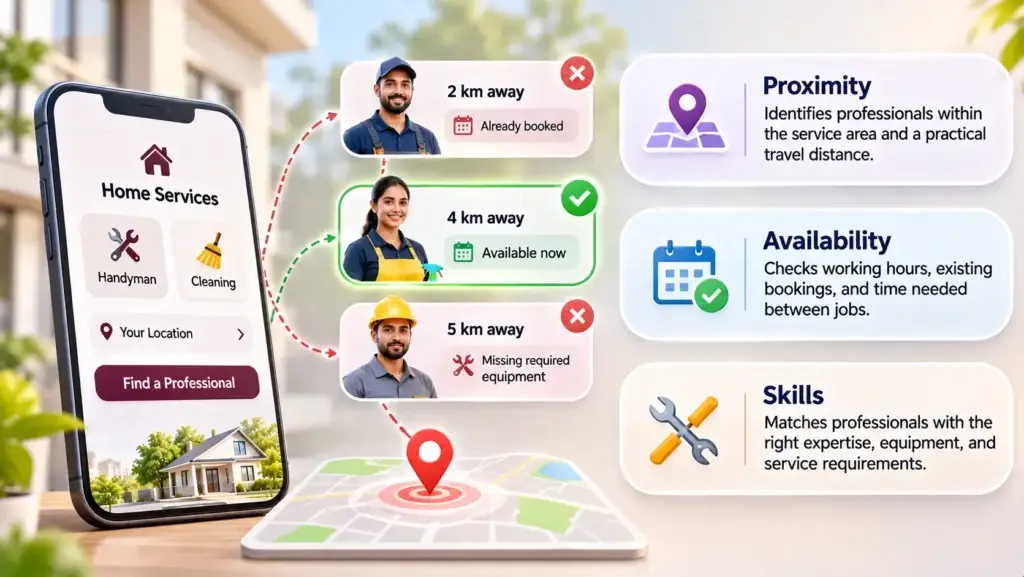
Imagine three service professionals working in the same city.
One is located two kilometers away but already has a scheduled appointment. Another is four kilometers away and can start immediately. A third is slightly farther away but lacks the required equipment.
Automatically assigning the closest person could create a delay or result in an unsuccessful appointment.
A more reliable approach evaluates several conditions together.
Proximity Determines Which Professionals Are Geographically Eligible
The first stage is often location filtering.
When a customer enters an address, the system identifies professionals whose service areas include that location.
A service radius can help narrow the candidate pool. For example, a cleaner may accept bookings within a limited neighborhood, while an appliance repair technician may serve a wider geographical area.
However, geographical distance does not always equal travel time. Road networks, traffic, restricted access, and the professional’s current location can affect how quickly they can arrive.
Availability Determines Whether the Appointment Fits
A professional being online does not necessarily mean they can accept another appointment.
Availability should account for working hours, confirmed bookings, remaining job time, breaks, and travel commitments.
A cleaner who is available at 3 p.m. might still be unsuitable for a two-hour appointment if another booking begins at 4 p.m.
Similarly, a handyman finishing a repair at noon may not be ready for another appointment at 12:15 p.m. if the next customer is across town.
Skills Determine Whether the Professional Can Complete the Work
Location and scheduling are only useful when the professional is capable of providing the requested service.
A general handyman may handle minor household repairs, while certain electrical, plumbing, or technical tasks require specific training, equipment, or licenses depending on local rules.
Cleaning assignments also vary. Routine home cleaning, deep cleaning, and specialized cleaning may require different preparation times and capabilities.
A sensible dispatch system filters out unqualified professionals before ranking the remaining candidates.
How Home Service Apps Match Nearby Jobs Step by Step
A local dispatch workflow typically follows a sequence of checks before an appointment becomes confirmed.
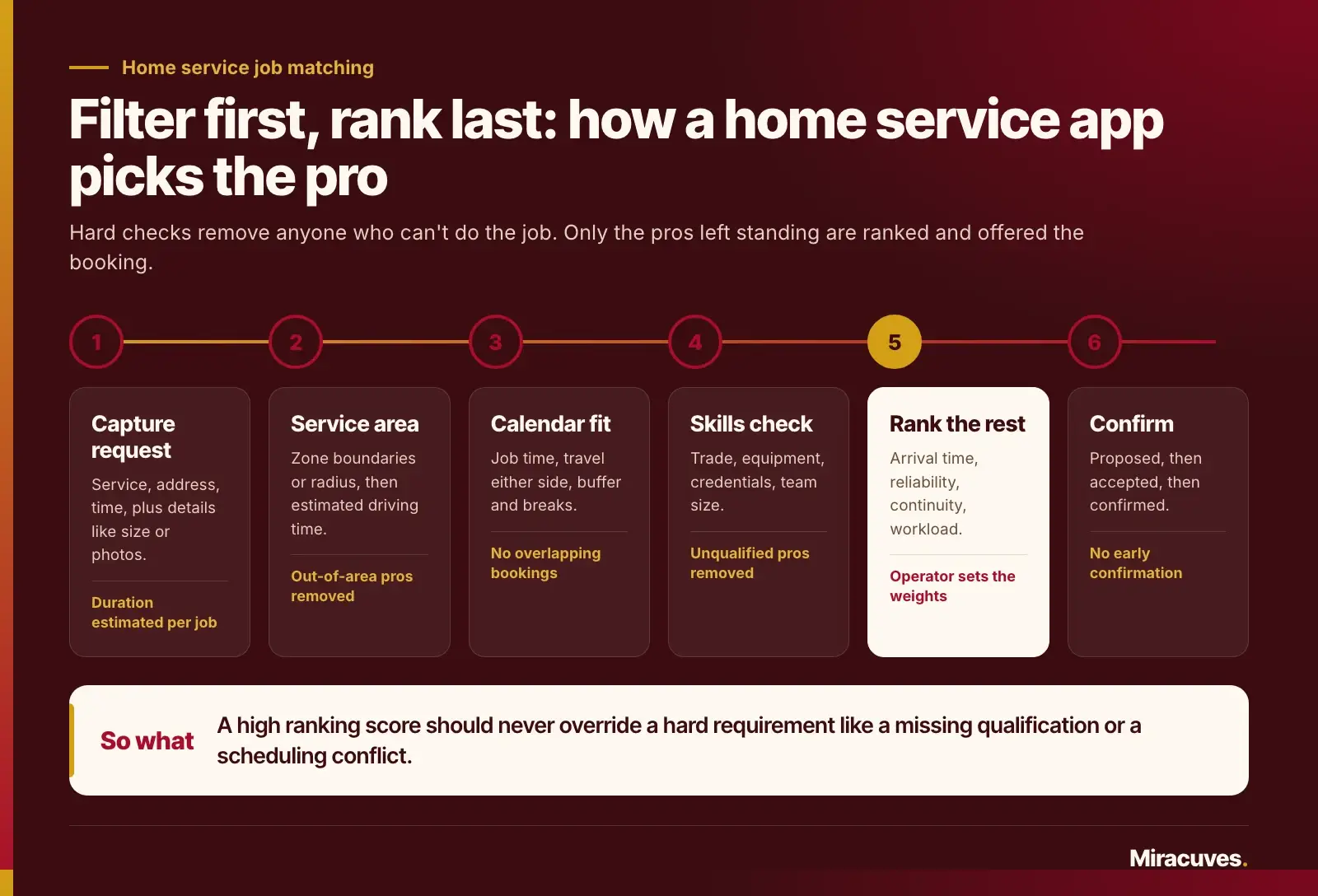
Step 1: Capture the Customer’s Request
The customer selects the required service, provides an address, and chooses a preferred appointment time.
Depending on the service, the request may include property size, photographs, access instructions, urgency, and a description of the issue.
These details matter because a simple repair and a complex repair should not automatically receive the same duration estimate.
For example, a routine cleaning appointment might be scheduled using predefined service duration rules, while an unfamiliar repair may require additional clarification before a realistic time slot can be offered.
Step 2: Identify Professionals Within the Service Area
The dispatch system evaluates the customer’s address against the geographical areas served by registered professionals.
This can involve service-zone boundaries, radius-based filtering, or both.
Professionals outside the eligible area are removed from consideration.
The platform may then estimate driving time for the remaining candidates. This is more useful than relying exclusively on straight-line distance, especially in cities where nearby neighborhoods have very different road access.
Step 3: Check Working Hours and Existing Bookings
The next step is determining whether the professional can complete the job without overlapping another commitment.
This requires more than checking whether the requested starting time appears free.
The available slot must accommodate:
- The estimated service duration.
- Travel from the preceding appointment.
- A reasonable preparation or recovery buffer.
- Travel to the following appointment, where applicable.
- Any working-hour or break restrictions.
If the complete assignment cannot fit, the professional should not be offered that time slot without a scheduling adjustment.
Step 4: Apply Service Skills and Operational Restrictions
The platform checks whether each remaining candidate can actually carry out the job.
A cleaning request may require a professional trained for a particular service category. An equipment repair request may require a specialist with the right tools.
Additional restrictions may include team size, access requirements, customer preferences, and verified credentials.
This stage helps prevent a technically available professional from being assigned to work outside their capabilities.
Step 5: Rank Eligible Professionals
After filtering, several candidates may remain.
The system can rank them according to operational priorities such as:
- Estimated arrival time.
- Reliability and acceptance history.
- Appointment schedule compatibility.
- Relevant expertise.
- Balanced workload distribution.
- Customer preference for a previously used professional.
The platform operator decides how these factors should influence recommendations.
For urgent repairs, arrival time may receive greater weight. For recurring household cleaning, customer continuity and a predictable schedule may matter more.
Step 6: Send the Assignment and Confirm Acceptance
An eligible professional may receive a job notification containing the service category, location, preferred time, customer instructions, and relevant work details.
The assignment should become confirmed only when the required acceptance conditions are satisfied.
Some marketplaces allow customers to choose from available professionals. Others use dispatcher-assisted or automated allocation.
The workflow should distinguish between a proposed assignment, an accepted job, and a confirmed booking.
This prevents customers from receiving a misleading confirmation before the professional has committed to the appointment.
Step 7: Monitor the Job and Handle Changes
Dispatching continues after acceptance.
A professional may encounter traffic, finish an earlier appointment late, or discover that a repair requires additional time.
The system should support status updates, revised arrival estimates, communication, and reassignment when appropriate.
Without these operational controls, an initially correct match can still become a missed appointment.
Read More: Best Thumbtack Clone Script in 2026: Features & Pricing Compared
Practical Example: Choosing Between Three Available Professionals
Consider a customer requesting a two-hour home cleaning appointment at 2 p.m.
The following scenario is illustrative, not a record of an actual platform transaction.
Illustrative Cleaning Appointment
Requested start: 2 p.m. | Expected duration: 2 hours
| Professional | Approximate distance | Schedule and skills | Dispatch decision |
|---|---|---|---|
| Cleaner A | 1.5 km | Has another booking that overlaps the requested appointment | Exclude |
| Cleaner B | 4 km | Qualified, available for the full slot, with sufficient travel time | Strong candidate |
| Cleaner C | 2 km | Available for only one hour before the next commitment | Exclude |
Cleaner A is geographically closest, but the schedule does not work.
Cleaner C is also nearby, but the appointment would overlap another commitment.
Cleaner B is farther away yet can complete the cleaning without creating a scheduling conflict.
This distinction is important for platforms that want predictable appointment completion rather than simply fast-looking matching results.
How Availability Calendars Prevent Double Bookings
An availability calendar should represent the professional’s actual capacity, not just a collection of selectable start times.
Each booking consumes a time interval. That interval must remain unavailable to competing booking requests unless the platform explicitly supports sufficient team capacity.
For example, a cleaner with one scheduled appointment from 10 a.m. to noon cannot simultaneously accept another independent job at 11 a.m.
The calendar should also account for travel before and after appointments.
Working Hours Are Different From Bookable Hours
A professional may set working hours from 9 a.m. to 6 p.m., but that does not mean customers can book every minute within that period.
Bookable slots depend on confirmed appointments, travel, job duration, breaks, and service requirements.
If a handyman finishes an appointment at 1 p.m. and needs 30 minutes to reach the next address, a booking beginning at 1 p.m. would not be realistic.
Temporary Reservations Help Manage Concurrent Requests
Another challenge arises when two customers attempt to book the same professional at almost the same time.
Simply checking the calendar on each customer’s screen is insufficient because both screens could display an available slot before either booking is confirmed.
A robust booking workflow can temporarily reserve capacity during confirmation and use a database transaction or equivalent concurrency control to prevent overlapping confirmed assignments.
If the first reservation is confirmed, the other customer should receive an updated availability result rather than a conflicting appointment.
This is especially important during periods of high booking activity.
How Dispatch Rules Differ for Cleaners and Handymen
Although both categories rely on geographical and scheduling information, their work patterns are not identical.
| Dispatch consideration | House cleaning | Handyman and repair services |
|---|---|---|
| Job duration | Often estimated from service package or property details | May depend on diagnosis and repair complexity |
| Repeat appointments | Recurring visits may be common | Frequently individual requests or follow-ups |
| Skill matching | Cleaning type, equipment and team requirements | Trade specialization, tools and credentials |
| Scheduling preference | Predictable slots and preferred professionals | Flexibility for urgent or uncertain jobs |
| Travel planning | Efficient sequencing of scheduled visits | Travel time plus potentially variable service duration |
| Assignment risk | Overlapping long appointments | Unexpected repair time or missing parts |
Cleaning Dispatch Often Benefits From Predictable Scheduling
Cleaning services can often define appointment duration using standardized tasks and property information.
This makes it easier to plan consecutive visits, allow reasonable travel buffers, and preserve the customer’s preferred cleaner for repeat bookings.
For recurring services, consistency can be an important assignment condition alongside proximity.
Handyman Dispatch Requires Greater Flexibility
Repair requests can be less predictable. That is one reason many handyman marketplaces let customers pick a specific pro after comparing rates and reviews, the model behind a TaskRabbit-style task marketplace, rather than auto-assigning the job.
A customer may describe a plumbing issue as a minor leak, but the professional might discover a more complicated repair after inspecting the property. The actual work can require additional time, specialized equipment, or a follow-up appointment.
Because the duration of some repair assignments is uncertain, dispatch workflows should support adjustable appointment estimates, realistic buffers, and communication when the original schedule changes.
Urgent repair requests may also require a different priority system from routine appointments. A platform could prioritize professionals who are available sooner, have the right qualifications, and can reach the customer within a reasonable response window.
However, urgent jobs should not automatically displace confirmed appointments without clear business rules, customer notification, and an appropriate rescheduling process.
How Proximity-Based Dispatching Works Behind the Scenes
Matching local professionals to customer locations usually requires a combination of address information, geographical filtering, scheduling records, and travel-time calculations.
The matching logic does not necessarily need to begin with a complex optimization engine. A platform can start with clear eligibility rules and introduce more advanced ranking as transaction volume and operational requirements increase.
Geolocation Converts Addresses Into Searchable Locations
Before proximity can influence dispatching, the system needs usable location information.
A customer’s service address can be associated with geographical coordinates. Professionals may maintain approved service zones, business locations, or current positions where location sharing is appropriate and authorized.
The application can then evaluate which professionals cover the requested address.
For scheduled cleaning appointments, an approved service area may be more important than continuously tracking the professional’s phone. For immediate dispatch, a suitably permissioned current location can be useful when estimating travel time.
Geospatial Queries Reduce the Candidate Pool
Searching every professional in a large marketplace for every new booking would create unnecessary processing work. In practice this is a spatial index: a radius query such as PostGIS ST_DWithin on a geography column, or a grid system such as the open-source H3 index, which buckets professionals into hexagonal cells so the app only checks nearby cells.
Cell size is the main tuning choice. According to the H3 resolution table, a resolution-8 cell averages about 0.74 square kilometers and a resolution-7 cell about 5.2 square kilometers. A cleaning marketplace in a dense city might index professionals at resolution 8, search the customer’s cell plus the ring of cells around it, and widen the ring only when too few candidates come back. With PostGIS, the equivalent is an ST_DWithin radius query on a geography column backed by a spatial index.
Geospatial filtering can narrow the search to professionals within an approved service radius or geographical boundary before more detailed scheduling checks begin.
This staged approach allows the system to perform relatively inexpensive eligibility checks before evaluating more detailed routing and ranking information.
Travel-Time Estimates Improve Assignment Accuracy
Two professionals may live at similar distances from a customer while facing very different journeys.
A direct geographical measurement does not represent road closures, traffic congestion, one-way streets, or the location of the professional’s previous appointment.
Where accurate routing information is available, the platform can consider estimated travel duration instead of choosing solely by distance.
The travel estimate should be treated as an operational prediction rather than a guaranteed arrival time. For appointments that must begin within a narrow window, scheduling buffers remain important.
Example: Building a Travel-Time Matrix With a Maps API
Travel time is usually calculated after the spatial filter, because routing calls cost more than a radius query. Suppose the filter returns 12 cleaners for a 2 p.m. job. The platform can send one matrix request with the 12 cleaners as origins and the customer’s address as the destination, which is 12 elements. Google’s Routes API Compute Route Matrix accepts up to 625 elements per request, or 100 when traffic-aware optimal routing is requested, so one call covers a typical candidate list.
- Choose the origin per professional. For someone between jobs, use the address of the appointment that ends before the new one, not their home base.
- Set the departure time. For a scheduled job, ask for the estimate at the time the professional would actually leave, not the current time.
- Apply the buffer after the estimate. Drop anyone whose travel time plus buffer misses the requested start, then rank the rest.
- Cache briefly. Reuse a result for a few minutes when the same customer refreshes the slot list, so repeated searches do not repeat paid calls.
Teams that prefer to self-host routing can get the same kind of duration table from the open-source OSRM table service running on OpenStreetMap data, at the cost of maintaining the map data and servers themselves.
Dispatch Ranking Should Follow Eligibility Checks
A crucial distinction exists between determining whether someone can take a job and deciding which eligible professional should receive it.
Eligibility rules should remove candidates who are outside the service area, unavailable, unqualified, inactive, or otherwise unsuitable.
Only after those checks should the system rank candidates using softer preferences such as travel efficiency, customer history, workload balancing, or historical acceptance behavior.
This prevents a high ranking score from overriding an essential requirement such as a missing qualification or a scheduling conflict.
How to Distribute Jobs Fairly Between Professionals
Pure ranking tends to send most work to the same few top-scored professionals. Newer professionals then get too few jobs to build a rating, and leave. Most marketplaces add a distribution rule on top of the ranking, applied only among candidates who already passed every eligibility check.
- Round-robin within a tie band. Treat candidates whose estimated arrival is within, say, 10 minutes of the best as equivalent, and rotate offers among them.
- Capacity-based share. Weight offers by the hours each professional has made available, so someone offering 40 hours a week sees more jobs than someone offering 10.
- Idle-time boost. Raise the priority of professionals who have gone longest without an offer that day.
- Careful use of acceptance rate. Count declines over a rolling window, ignore declines for jobs outside a professional’s stated skills, area or hours, and show professionals the rule. A penalty they can’t see feels arbitrary and drives people off the platform.
- Customer continuity first. For recurring cleaning, a customer’s preferred professional should usually override the rotation when they are eligible.
If you operate in the European Union, write these rules down. The Platform Work Directive (EU) 2024/2831 requires platforms to inform the people working through them about automated monitoring and decision-making systems and to give trained staff authority to override automated decisions, and member states must transpose it into national law by 2 December 2026, as CMS’s summary of the directive notes. National rules will set the details, so confirm them with local counsel.
What Happens When a Professional Declines or Misses a Job?
No dispatch system can assume that every assignment will be accepted or completed exactly as expected.
A cleaner may become unavailable because of a personal emergency. A handyman may reject a request because the description does not match their specialization. A previously accepted appointment may be delayed by unexpected repair work.
For these situations, the platform needs a recovery workflow rather than leaving the booking in an unresolved state.
Use Defined Acceptance Windows
When a professional receives a proposed assignment, the platform can provide a defined period for responding.
If the professional declines or does not respond within that period, the system can release the proposal and evaluate another eligible candidate.
The appropriate response window depends on the service type. An urgent repair request may need a faster decision than a cleaning appointment scheduled for the following week.
Recheck Availability Before Reassignment
When an assignment fails, the next candidate should not automatically be selected from an outdated list.
Availability may have changed since the original search. Another customer could have booked a previously eligible professional, or the estimated travel time may no longer fit the requested appointment.
Reassignment should therefore include updated eligibility and scheduling checks.
Keep the Customer Informed
A dispatch change affects the customer’s expectations.
If a different professional is selected, the platform should communicate the revised appointment status and any meaningful changes to arrival time, service details, or agreed pricing.
If no suitable professional is available, offering an alternative time or allowing the customer to cancel may be more useful than repeatedly attempting unsuccessful assignments.
A Practical Reassignment Workflow
When a proposed assignment cannot proceed, the platform should make a controlled transition rather than silently changing the confirmed appointment.
Different Dispatch Models for Local Home Services
Not every home service marketplace needs the same assignment process.
The appropriate approach depends on whether customers expect immediate service, prefer choosing their own professional, or book appointments through an established local service company.
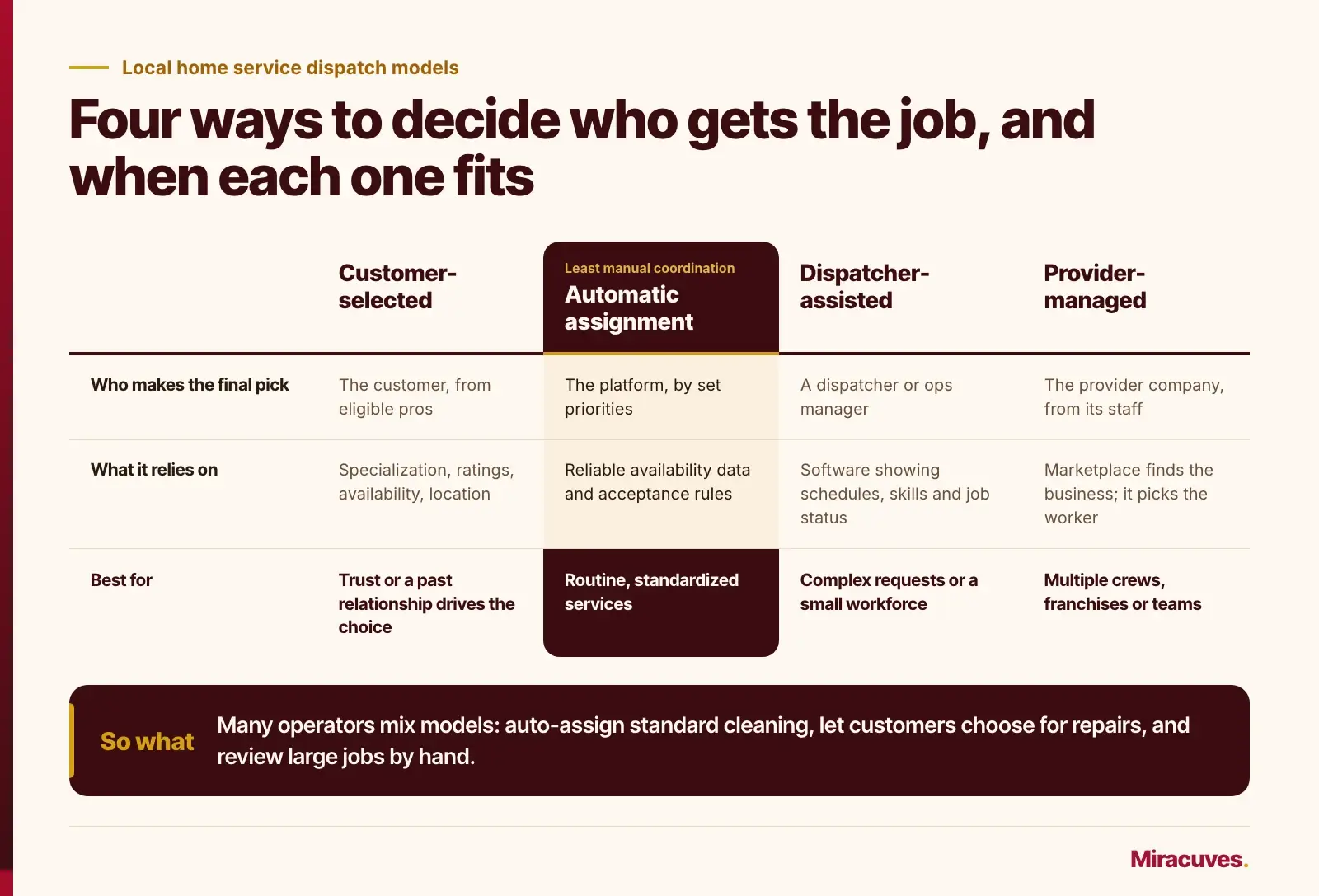
Customer-Selected Booking
In this model, the platform displays eligible professionals and allows customers to make a selection.
Customers may compare service specialization, ratings, appointment availability, location, and other relevant information before requesting a booking.
This approach can be particularly useful when trust, previous customer relationships, or individual professional preferences influence the decision.
Automatic Assignment
In an automatic assignment model, the platform evaluates eligible professionals and selects a candidate according to configured dispatch priorities.
Customers may care more about receiving the requested service within a suitable time window than about selecting a specific individual.
Automatic assignment can reduce manual coordination for routine, standardized services. However, it needs reliable availability data, clear acceptance rules, and a process for handling exceptions.
Dispatcher-Assisted Allocation
Some businesses prefer a dispatcher or operations manager to review the available options before assigning a job.
This may be appropriate when service requests are complex, the professional workforce is small, or individual appointments require special handling.
The software can still support the decision by displaying geographical eligibility, schedules, professional qualifications, and current job status.
The main difference is that a human operator makes or approves the final assignment.
Provider-Managed Staff Dispatch
A marketplace may connect customers with service companies rather than individual independent professionals.
In this structure, the provider company accepts the customer booking and assigns a suitable member of its own workforce.
The marketplace-level matching process identifies the eligible provider business, while the provider’s internal dispatch process determines which cleaner, technician, or handyman will perform the visit.
This distinction matters for operators managing multiple crews, franchise locations, or service teams. The broader operational structure is relevant to professional and on-demand service businesses that need both customer booking and workforce coordination.
Read More: How to Overcome Common Challenges in Home Services App Development
How Well-Known Platforms Use These Models
Public product pages show that the large home service marketplaces made different choices about who picks the professional.
| Platform | Dispatch model | How a professional gets the job | What it suggests for your design |
|---|---|---|---|
| TaskRabbit | Customer-selected booking | The customer enters the task and location, sees nearby Taskers with upfront hourly rates, and compares them by rate, skills and reviews. | Your matching engine builds a ranked shortlist; the customer makes the final choice, so profile quality and accurate availability matter most. |
| Urban Company | Automatic assignment | The customer picks a service and time slot, and the platform assigns a professional automatically based on availability, experience and ratings. | The platform owns the match, so calendars, skill data and reassignment rules have to be reliable before launch. |
| Thumbtack | Lead-based matching | Pros are charged for leads that match their job preferences, within a weekly budget they set, and the customer decides whom to hire. | Matching controls which pros see a request; budgets and lead pricing shape supply as much as distance does. |
Many operators combine models: automatic assignment for standardized cleaning packages, customer selection for repairs where trust and price comparison matter, and dispatcher review for large or unusual jobs.
Which Dispatch Metrics Should Marketplace Operators Monitor?
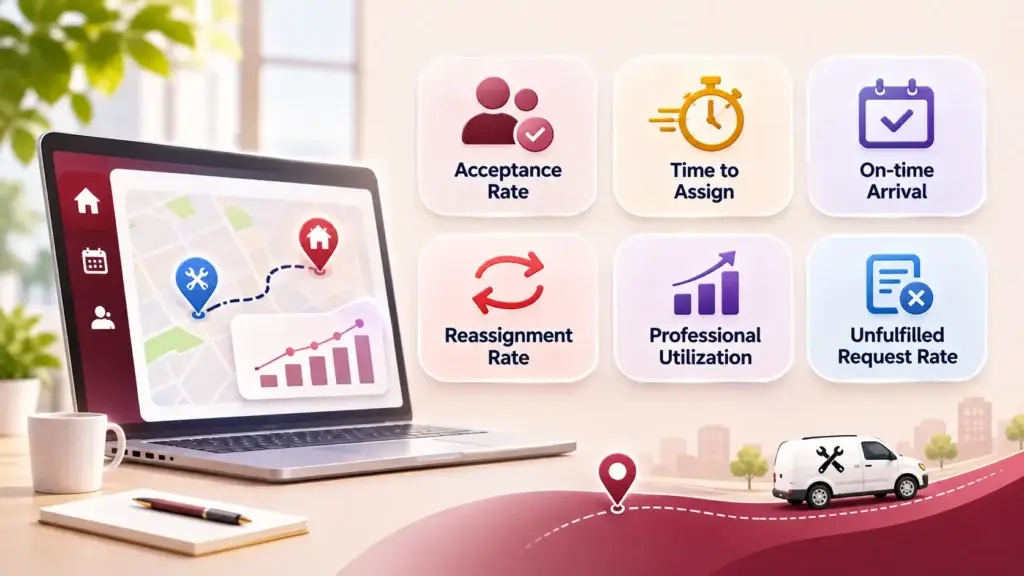
Matching logic should be evaluated using actual operational outcomes, not simply the number of professionals displayed in a search result.
A dispatch system may appear efficient because it sends notifications quickly, but those notifications offer limited value if professionals frequently decline assignments or fail to arrive within the agreed appointment window.
Several performance measures can help operators understand whether matching rules are producing reliable results.
| Metric | What it measures | Why it matters |
|---|---|---|
| Assignment acceptance rate | Share of offered jobs accepted by professionals | Shows whether offers are being sent to suitable, willing professionals |
| Time to confirmed assignment | Duration between customer request and confirmed professional acceptance | Helps identify delays in matching and response workflows |
| On-time arrival rate | Share of appointments starting within the agreed arrival window | Indicates how accurately dispatch rules account for travel and scheduling |
| Reassignment rate | Share of jobs requiring replacement professionals | Reveals acceptance, scheduling, and reliability issues |
| Professional utilization | How much available working capacity is used for productive appointments | Helps balance demand, travel, and idle time |
| Unfulfilled request rate | Share of valid requests that cannot be served | Highlights gaps in geographical coverage, skills, or availability |
These measures should be interpreted together.
For example, aggressively increasing professional utilization could reduce available buffers and make arrivals less reliable. Similarly, always choosing the fastest available professional may leave other providers with uneven workloads.
The objective is not to maximize one metric at the expense of the entire service experience. It is to balance availability, reliable completion, professional capacity, and customer expectations.
Common Dispatching Mistakes That Create Scheduling Problems
Even a marketplace with a large number of registered professionals can struggle to fulfill appointments when its underlying dispatch assumptions are inaccurate.
Treating Online Status as Confirmed Availability
A professional may be logged into the application without being free for the requested appointment.
Dispatch rules should check actual working capacity, not merely whether the professional’s account is active or recently online.
Ignoring Travel Between Existing Appointments
A professional may appear to have a free hour between two jobs, but that hour may be required for travel.
Without realistic travel buffers, the system can create schedules that look valid on a calendar but cannot be completed in practice.
Using the Same Duration for Every Service
Different cleaning packages and repair categories require different amounts of time.
Using a single duration for all appointments can result in underbooking, unnecessary idle time, or repeated scheduling conflicts.
Duration rules should reflect the service category and the information available about each request.
Sending Jobs to Professionals Without the Required Skills
A geographically eligible candidate is not automatically qualified.
Service specialization, equipment needs, credentials, and other important eligibility conditions should be checked before an assignment is offered.
Confirming Bookings Before Capacity Is Reserved
Displaying an available slot does not guarantee that it will remain available while a customer completes the booking process.
Concurrent booking requests require reliable reservation and confirmation controls to prevent two customers from receiving the same professional’s time.
Failing to Plan for Declined Assignments
Professional acceptance should not be taken for granted.
If a request is declined, the platform should have a defined next step, including updated candidate selection, alternative appointment options, or customer communication.
How Founders Can Evaluate Dispatch Readiness Before Launch
For a founder entering a local home service market, the first dispatch challenge is often operational clarity rather than algorithmic complexity.
Before introducing automatic assignment, the business should define who can accept each category of work, which locations professionals serve, and how confirmed appointments affect future availability.
It is also important to decide whether customers select professionals directly, whether provider companies manage their own staff, or whether the platform coordinates individual assignments.
These choices influence the required scheduling information, booking states, notification workflows, and administrative controls.
A business operating in one neighborhood with a small group of service professionals may begin with straightforward eligibility and manual dispatch checks. As demand expands across service zones and appointment volume increases, automated matching can become more valuable.
For businesses evaluating broader implementation requirements, on-demand application development services provide a relevant starting point for understanding how booking workflows, professional management, and operational integrations fit together.
Founder decision signals
Four Questions to Ask Before Automating Dispatch
Service coverage
Can the platform reliably identify which professionals serve a customer’s address, including geographical restrictions and service-zone boundaries?
Scheduling capacity
Are available appointment slots calculated using real commitments, expected work duration, and travel requirements?
Work eligibility
Are professional qualifications, specializations, equipment requirements, and operational restrictions checked before assignment?
Exception handling
What happens when a professional declines, a booking overlaps, an appointment runs late, or no suitable candidate can be found?
Using Dispatch Data to Plan Growth
It also helps distinguish between genuine supply shortages and scheduling inefficiencies. If a neighborhood repeatedly has unfulfilled requests, the operator can investigate whether there are too few qualified professionals, unrealistic appointment windows, excessive travel requirements, or poorly distributed working hours.
For marketplace founders, this information can guide decisions about professional recruitment, service-zone expansion, booking policies, and operating hours.
Miracuves offers ready-made, white-label home service platforms with customer, provider, serviceman, and administrative workflows. Its applicable ready-made offering is positioned around a six-working-day deployment process, while additional customization and advanced dispatch requirements should be evaluated separately against the selected product scope.
The important distinction is that a ready-made marketplace foundation can provide core booking and administrative workflows, while any specific proximity-ranking algorithm, travel-time optimization feature, or advanced automatic reassignment process should be confirmed through a product demonstration and written scope before launch.
Final Thoughts: Reliable Home Service Matching Requires More Than Distance
Dispatching a local handyman or cleaner is not simply a matter of identifying who is closest to the customer.
An effective home service job matching process considers geographical eligibility, appointment availability, professional skills, realistic travel requirements, and the ability to accept and complete the assigned work.
Cleaning services often benefit from predictable appointment windows and recurring professional relationships. Handyman and repair services may need greater flexibility because task duration and technical requirements can change after the professional reaches the property.
Both models need accurate calendar management, clear booking states, and recovery procedures for declined assignments, delays, and cancellations.
For founders, the strongest dispatch strategy is not necessarily the one with the most complicated algorithm. It is the one that consistently matches the right professional to a realistic appointment and gives the business enough visibility to respond when circumstances change.
Frequently Asked Questions
How do home service apps find nearby handymen and cleaners?
They convert the customer’s address into coordinates and use a spatial index, such as a radius query or hexagonal grid cells, to find professionals whose service area covers it. This proximity step only builds a shortlist. The app then checks availability, skills and travel time before suggesting or assigning a professional, which is what proximity-based job assignment means in practice.
Why is the nearest professional not always assigned to a job?
The nearest professional may already be busy, may not have the required skills, or may not be free for the full appointment once travel time is included. The platform therefore treats distance as a filter and assigns the closest eligible professional, not simply the closest one overall.
How do apps distribute jobs fairly between professionals?
Most apply a distribution rule after ranking, only among candidates who passed every eligibility check. Common rules include rotating offers among candidates with similar arrival times, weighting offers by the hours each professional makes available, boosting those who have waited longest, and counting declines only for jobs that matched a professional’s stated skills, area and hours.
How do cleaning service apps prevent double bookings?
They track confirmed appointments, working hours, service duration and travel buffers. Before confirming a new booking, the system temporarily reserves the slot and uses a database transaction or similar control, so two customers booking at the same moment cannot both receive the same cleaner’s time.
How does handyman dispatch differ from cleaner scheduling?
Cleaning jobs are easier to schedule because duration can be estimated from standard packages and property details. Handyman jobs may need specific skills, tools, diagnosis or extra time, so dispatch needs flexible estimates and skill-based matching, and many handyman marketplaces let the customer choose the pro.
What is the difference between customer-selected, automatic and lead-based dispatch?
In customer-selected booking, used by TaskRabbit, the customer compares nearby pros and picks one. In automatic assignment, used by Urban Company, the platform assigns a professional to the booked slot. In lead-based matching, used by Thumbtack, pros pay for leads that fit their preferences and the customer decides whom to hire.
What happens if a home service professional rejects an assigned job?
The platform rechecks eligibility with fresh availability data and offers the job to the next suitable professional. If nobody is available, the customer should be offered another appointment time or the option to cancel rather than being left with an unconfirmed booking.
Can a home service app automatically assign jobs without a dispatcher?
Yes, when it has accurate information about professional availability, location, skills, service areas and existing bookings, plus clear acceptance and reassignment rules. Complex jobs or unusual situations may still need a dispatcher to review or approve the assignment before the customer is told it is confirmed.
What should founders prioritize when introducing home service dispatch automation?
Start with accurate service areas, professional skills, appointment durations, availability and clear booking rules. Then monitor time to confirmed assignment, acceptance rates, on-time arrivals, reassignments and unfulfilled requests, and adjust ranking weights or fairness rules only once those basics are reliable in day-to-day operation.
How can Miracuves help build a home service app with automated dispatch?
Miracuves offers ready-made home service platforms with customer booking, provider profiles, location-based matching, availability management, payments, notifications and admin controls. Specific dispatch rules, such as proximity ranking, travel-time optimization or automatic reassignment, should be confirmed in a product demonstration and a written scope before launch.
Miracuves is an independent software development company. We are not affiliated with, connected to, sponsored by, or endorsed by any company or product named in this article.
Terms such as “X Clone” are used descriptively. It is how the software industry refers to building a platform with functionality comparable to a known service, and how clients search for it.
The entire design and codebase of our products is built by our own team. Our products contain no code, design, graphics, or content originating from any third-party website or applications.
All third-party names and marks referenced in this article are the property of their respective owners, referenced solely to identify the services discussed.