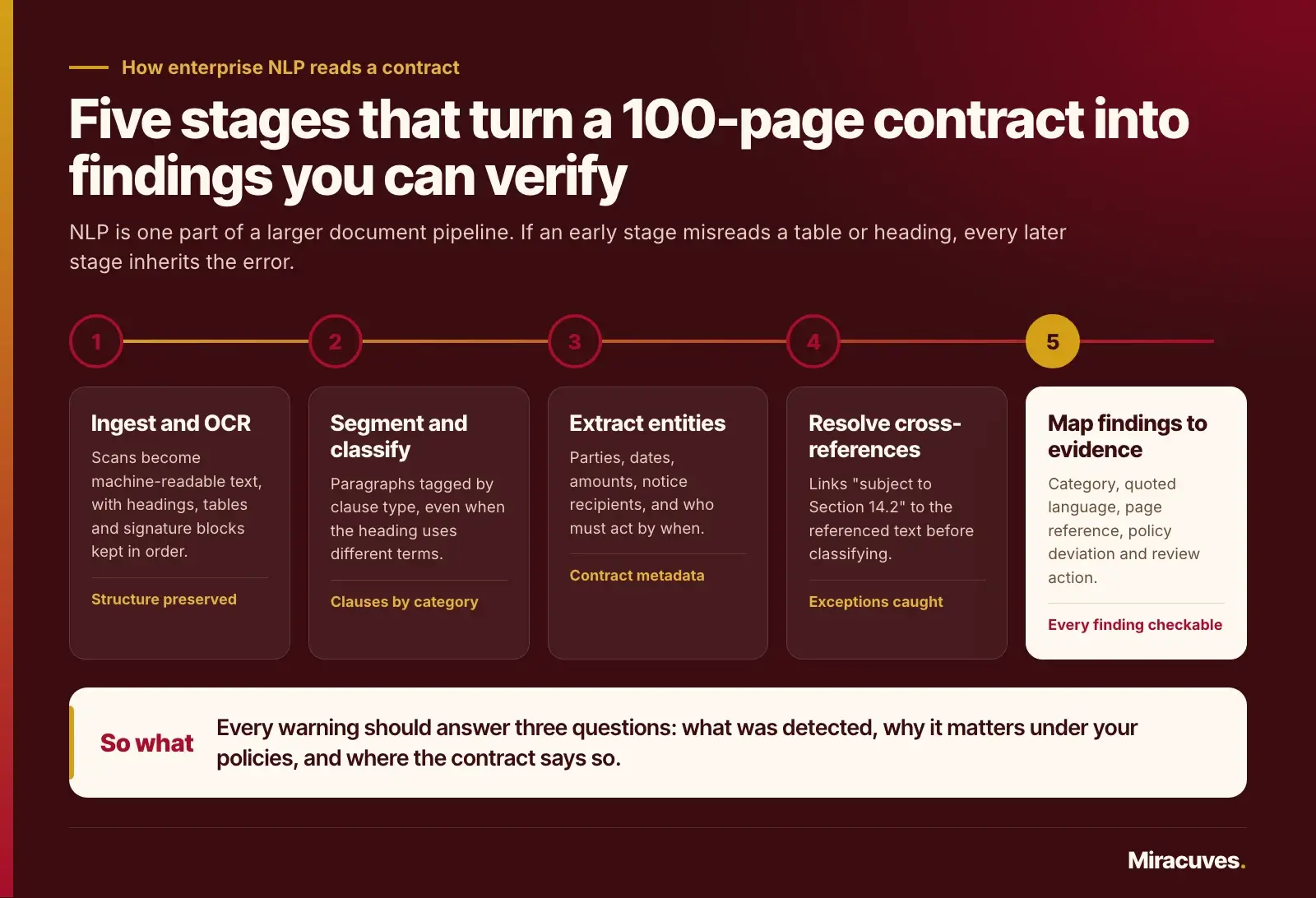
A 100-page enterprise contract rarely contains 100 pages of equally important information. Somewhere between the definitions, schedules, commercial terms, and legal conditions may be a liability exception, an automatic renewal provision, or a termination notice deadline that materially affects the business.
Finding those details manually takes careful reading, especially when agreements contain amendments, cross-references, and language that differs from standard templates.
Enterprise natural language processing (NLP) offers another approach. Instead of treating a contract as a static PDF, an NLP-powered system converts its contents into structured information that legal, procurement, and compliance teams can search, compare, and verify.
Modern document-processing pipelines can complete initial extraction rapidly, sometimes in seconds for suitable documents. However, processing speed depends on document quality, model architecture, and infrastructure. A fast machine-generated analysis is not the same as a completed legal review.
The real opportunity is to identify critical terms earlier, make potential risks visible, and direct human attention toward decisions that require judgment.
Why Reviewing a 100-Page Contract Is More Complicated Than Finding Keywords
Business agreements are rarely written in a consistent structure. A supplier contract may place payment obligations near the beginning, liability limitations in the middle, and renewal conditions inside a schedule near the end.
Some provisions only make sense when interpreted alongside definitions or exceptions located elsewhere in the document.
Consider a contract that contains the following terms:
- An initial service term of 24 months.
- An automatic extension for another 12 months.
- A requirement to provide written notice 90 days before the current term ends.
- A price adjustment mechanism linked to each renewal.
- A liability exclusion that applies differently to certain categories of claims.
These are not simply five independent pieces of information. They interact.
The renewal mechanism may affect future expenditure. The notice period determines when the organization must act. The pricing provision can change the financial impact of inaction, while liability exceptions may influence the overall risk assessment.
Searching for the word “renewal” might locate one clause. It will not necessarily reveal the complete relationship between those provisions.
That is why enterprise contract analysis must go beyond keyword matching.
How Enterprise NLP Reads and Interprets Long Contracts
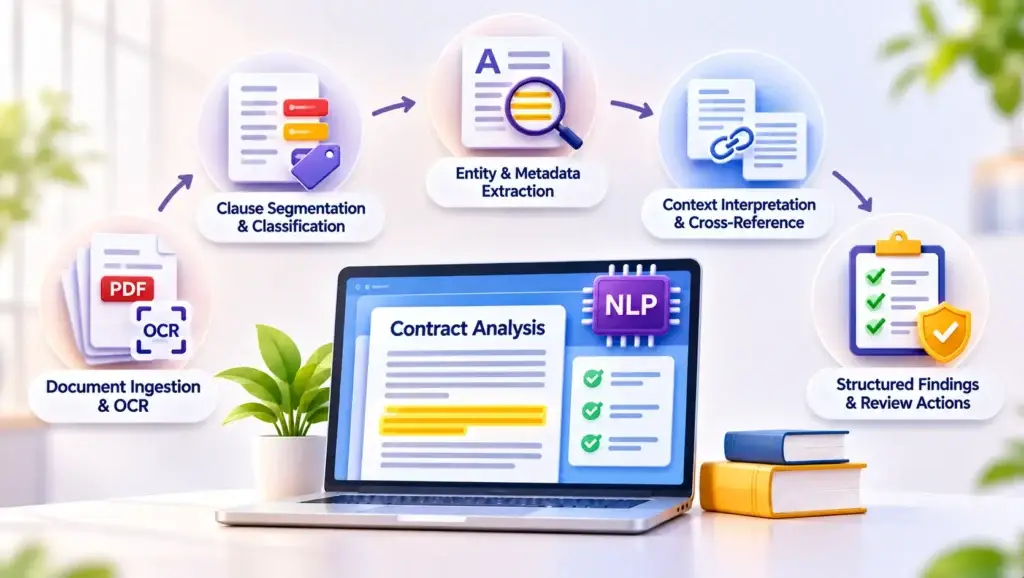
Natural language processing enables software to analyze written language and identify patterns, entities, relationships, and meaning within documents.
In contract intelligence, NLP is typically one component of a larger document-processing workflow. Other components may include optical character recognition, layout analysis, language models, structured extraction, business rules, and verification mechanisms.
1. Document Ingestion and Text Recognition
The workflow begins when an agreement is uploaded or retrieved from a document repository.
A digitally generated PDF may already contain readable text. A scanned agreement requires optical character recognition (OCR) to convert the visible text into machine-readable characters.
The system may also identify:
- Document titles and section headings.
- Page numbers and paragraph boundaries.
- Tables containing commercial information.
- Signature blocks and appendices.
- Defined terms and references to other sections.
Preserving document structure matters. If a table is read in the wrong order or a heading becomes detached from its contents, the extracted interpretation may be incorrect.
2. Clause Segmentation and Classification
Once the text is available, the system separates it into meaningful sections and classifies contractual provisions.
For example, it may recognize a paragraph as a limitation-of-liability provision even if the heading uses different terminology.
Common classifications include:
- Confidentiality and information security.
- Indemnification and liability limitations.
- Payment and price adjustment provisions.
- Termination and cancellation rights.
- Automatic renewal and notice requirements.
- Intellectual property ownership.
- Service levels and performance obligations.
- Governing law and dispute resolution.
Classification makes the document easier to navigate. Rather than searching through every page, reviewers can inspect the identified clauses by category.
3. Named Entity and Contract Metadata Extraction
Named entity recognition and related extraction techniques identify specific information embedded within legal language.
A contract intelligence system may extract the contracting parties, agreement dates, monetary amounts, currencies, service locations, or specified notice recipients.
More specialized extraction identifies contractual relationships, such as which party must perform an action, when that action is required, and what conditions trigger the obligation.
The distinction is important: extracting a date is relatively straightforward compared with determining whether that date represents the signature date, the effective date, the end of the current term, or a deadline for sending notice.
4. Contextual Interpretation and Cross-Reference Resolution
Enterprise agreements frequently contain phrases such as “subject to Section 14.2” or “except as otherwise provided in Schedule B.”
These references can materially change the meaning of a clause.
A reliable review workflow should attempt to connect the original provision with the referenced text before assigning a final classification.
For example, a liability cap may appear to limit exposure to the previous 12 months of fees. Another paragraph may exclude certain claims from that cap.
Reading only the first paragraph could create a misleading assessment of the organization’s contractual exposure.
Context-aware analysis reduces that risk by examining related provisions together rather than treating each sentence as an isolated statement.
5. Structured Findings and Evidence Mapping
The final extraction stage produces structured results rather than an unorganized summary.
A typical finding may contain:
- The extracted clause category.
- A short explanation of the provision.
- The original quoted language.
- The page or section reference.
- Any identified policy deviation.
- A confidence or verification status.
- A recommended human-review action.
This structure allows reviewers to check where a conclusion came from and decide what to do next.
Classic NLP Pipelines vs Long-Context LLMs in Contract Review
Until recently, contract analysis meant a chain of specialized models: OCR, a clause classifier trained on labeled examples, entity extraction and hand-written rules. Large language models changed two things.
The first is scale. Using OpenAI’s rule of thumb that 100 tokens is about 75 words, a 100-page contract at roughly 500 words a page comes to around 65,000 to 70,000 tokens. That fits inside current context windows: Anthropic’s documentation lists windows of up to 1 million tokens, and up to 600 PDF pages per request, depending on the model. The second is setup. A team can describe a new clause type in instructions instead of labeling hundreds of examples, which matters because, as the CUAD paper points out, large labeled datasets in specialized fields require expensive expert annotators.
Fitting a contract into the window is not the same as reading it reliably. The “Lost in the Middle” study found that model performance significantly degrades when the relevant information sits in the middle of a long input, and Anthropic’s documentation notes that accuracy and recall degrade as token count grows. That is why most production systems still split contracts into sections, retrieve the sections relevant to each question, and require every answer to quote its source text.
| Aspect | Classic NLP pipeline | Long-context LLM | Common hybrid |
|---|---|---|---|
| Adding a new clause type | Labeled examples and retraining | Written instructions and a few examples | Instructions first, then a labeled test set to measure accuracy |
| Cross-references such as “subject to Section 14.2” | Needs explicit rules to link sections | Can read both sections when both are in context | Retrieve the referenced section together with the clause |
| Consistency between runs | Same input gives the same output | Output can vary with wording and settings | Fixed prompts, a structured output schema and regression tests |
| Evidence for each finding | Text positions come with the extraction | Must be requested and then checked | Require a quoted passage and page reference, and verify the quote exists in the document |
| Cost pattern | Low per document once trained | Priced per token on every run | Cheaper models for triage, larger models for hard clauses |
Which Contract Clauses Can NLP Extract and Analyze?
The most useful clauses depend on the agreement type and the organization’s risk priorities.
A procurement team may prioritize renewal dates and pricing changes, while a security team may focus on data handling and incident notification obligations.
| Clause Category | Information Extracted | Business Significance |
|---|---|---|
| Limitation of liability | Liability caps, exclusions, exceptions | Helps reviewers assess potential financial exposure |
| Indemnification | Indemnified parties, triggering events, scope | Highlights obligations to cover particular losses or claims |
| Termination | Termination rights, notice requirements, penalties | Clarifies exit options and operational commitments |
| Automatic renewal | Renewal period, triggering conditions, notice window | Supports timely renewal or cancellation decisions |
| Payment obligations | Fees, due dates, escalation provisions | Improves visibility into commercial commitments |
| Confidentiality | Protected information, permitted disclosures, duration | Supports information-handling reviews |
| Data protection | Processing duties, security obligations, notification terms | Identifies commitments requiring privacy and security review |
| Intellectual property | Ownership, licensing rights, usage restrictions | Clarifies control over assets and deliverables |
Extraction does not establish whether a provision is legally enforceable or commercially acceptable. It makes the relevant language easier to find and evaluate.
How NLP Identifies Potential Risks Hidden Inside Contract Language
Risk identification is one of the most valuable applications of automated contract analysis, but it is also one of the most easily misunderstood.
A clause is not necessarily risky because it contains a particular word. Risk depends on the contract’s context, the organization’s position, its policies, and the consequences of accepting the provision.
Detecting Deviations From Approved Contract Language
Many organizations maintain contract playbooks that define preferred clauses, acceptable alternatives, and conditions requiring escalation.
An NLP-powered review workflow can compare extracted provisions against those approved positions.
For example, a company’s procurement policy might require supplier agreements to include a defined liability cap and an acceptable termination notice period.
If an agreement contains substantially different wording, the system can flag the provision for review.
The system should explain which policy was triggered and display the source language. That is more useful than assigning an unexplained “high risk” label.
Identifying Missing or Unclear Provisions
Missing clauses can be important, especially when an agreement is expected to follow a known template.
A system may compare the detected clauses against a checklist for that document type and report that a required provision was not located.
However, “not found” should not automatically mean “absent.”
A provision might be expressed using unusual language, incorporated through another document, or located in an amendment that was not included in the review.
Such findings require further verification before they are treated as contractual omissions.
Recognizing One-Sided Contractual Obligations
Some contracts create asymmetrical rights or responsibilities.
For instance, one party may have broad termination rights while the other must satisfy restrictive conditions.
Similarly, indemnification obligations may apply to only one party, or liability exceptions may be unevenly allocated.
Contextual analysis can help identify these differences and direct reviewers toward potential negotiating issues.
How Enterprise NLP Extracts Renewal Dates and Prevents Missed Notice Windows
Renewal clauses are particularly important because they create time-sensitive business obligations.
A contract can continue automatically even when the organization no longer needs the service, provided the agreement allows automatic extension and the relevant notice requirements have not been satisfied.
NLP can help identify those provisions, but reliable renewal tracking requires more than capturing a contract’s expiration date.
Understanding the Difference Between Expiration and Notice Deadlines
Consider this illustrative scenario:
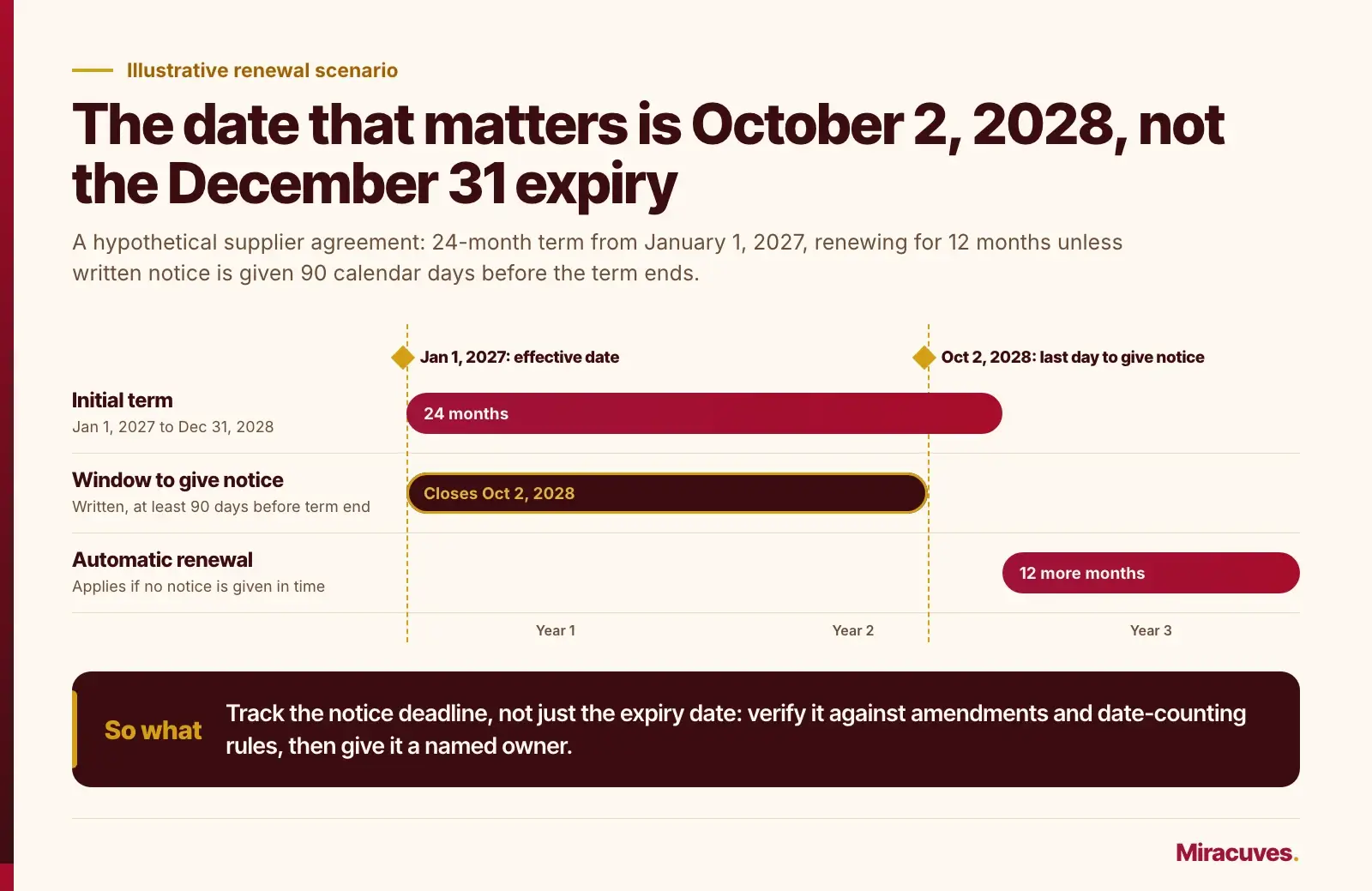
A supplier agreement begins on January 1, 2027, has an initial term of 24 months, and renews automatically for one year unless written notice is given at least 90 calendar days before the current term ends.
Assuming the initial term ends on December 31, 2028, the operationally important date is not simply the end of the contract.
Under the stated assumptions, the 90-day notice threshold falls on October 2, 2028.
The correct deadline still needs verification against the agreement’s date-counting rules, notice provisions, amendments, and applicable legal requirements.
A useful system should preserve both the calculated date and the wording that supports the calculation.
Worked Example: From Clause Text to Extracted Fields
Here is how that illustrative agreement might be worded, and what a structured extraction should return. The clause was written for this example and is not taken from a real contract.
12.1 Term. This Agreement commences on January 1, 2027 (the “Effective Date”) and continues for an initial term of twenty-four (24) months. 12.2 Renewal. Thereafter, this Agreement renews automatically for successive periods of twelve (12) months unless either party gives the other written notice of non-renewal at least ninety (90) calendar days before the end of the then-current term. 12.3 Notices under this Section shall be sent as set out in Section 18.
| Field | Extracted value | Source | Check before approval |
|---|---|---|---|
| Effective date | January 1, 2027 | Section 12.1 | Matches the signature page and any later amendment |
| Initial term | 24 months | Section 12.1 | No amendment has changed it |
| Current term end | December 31, 2028 | Calculated from 12.1 | Confirm the term ends the day before the anniversary |
| Renewal | Automatic, 12-month periods | Section 12.2 | Any price change tied to renewal is captured separately |
| Notice period | 90 calendar days, written | Section 12.2 | Any holiday or business-day rule in the definitions |
| Last day to give notice | October 2, 2028 | Calculated | Deemed-receipt rules in Section 18 |
| Notice method and recipient | As set out in Section 18 | Sections 12.3 and 18 | Cross-reference resolved, not left blank |
The two calculated rows are where most errors appear, so a good system labels them as calculated, shows the arithmetic and routes them to a reviewer. The last row shows why the model needs Section 18 in front of it, not only Section 12.
Turning Renewal Clauses Into Actionable Records
Once the renewal information is validated, it can be represented as structured data:
- Agreement owner and counterparty.
- Current contractual term end.
- Automatic renewal status.
- Renewal duration.
- Required notice period.
- Calculated notice deadline.
- Required notice method and recipient.
- Internal decision owner.
- Verification and approval status.
This information can then support calendar alerts, procurement review tasks, and contract management workflows.
The key is to assign responsibility before the notice window closes, rather than merely storing the date in a dashboard.
Why Amendments Must Be Reviewed Before Renewal Dates Are Finalized
Suppose an original agreement specifies a 60-day cancellation notice, but a later signed amendment changes the requirement to 120 days.
A system that analyzes only the original contract may generate an incorrect deadline.
Enterprise workflows should therefore identify related amendments, establish document versions, and determine which provisions have been superseded.
Where precedence is unclear, the finding should be escalated rather than silently resolved by the model.
What Happens After a 100-Page Contract Is Analyzed?
The value of contract intelligence becomes clearer when extracted information moves into a controlled business workflow.
Imagine a procurement manager reviewing a lengthy software services agreement.
After the document is processed, the system presents a structured review queue rather than requiring the manager to interpret an isolated AI-generated summary.
The queue might contain the following illustrative findings:
| Finding | Suggested Status | Next Action |
|---|---|---|
| Automatic renewal with advance notice | Deadline verification required | Confirm term dates and assign reminder owner |
| Liability clause differs from approved playbook | Legal review required | Compare the exception and related provisions |
| Annual fee adjustment provision | Commercial review required | Assess budget implications |
| Referenced security schedule not uploaded | Insufficient evidence | Retrieve missing attachment |
| Standard confidentiality provision | Preliminarily aligned | Verify and record reviewer approval |
These are illustrative examples, not results from an actual document or a claimed Miracuves deployment.
The system’s purpose is to make review more focused. Instead of manually locating every provision, a reviewer can prioritize unresolved risks, inspect evidence, and approve or correct extracted findings.
Why Human Verification Remains Essential in Automated Contract Review
Language models and document extraction systems can make mistakes, especially when agreements contain complex exceptions, poor scans, unusual terminology, or conflicting provisions.
Some errors are easy to identify, such as an incorrectly extracted date. Others are more serious because the generated interpretation sounds reasonable even when it misses a critical qualification.
Enterprise teams should use a review process that distinguishes between low-risk factual extraction and decisions requiring legal judgment.
Use Source-Linked Findings
Every material finding should point back to the original contract section, page, or verified text passage.
A reviewer must be able to open the document and confirm that the quoted evidence supports the conclusion.
Escalate Ambiguous or High-Impact Clauses
Unusual indemnification terms, liability exceptions, conflicting deadlines, and unclear termination rights should be routed to appropriately qualified reviewers.
An automated risk score should support prioritization, not replace the final decision.
Maintain an Audit Trail
For governance purposes, the review record should preserve the document version, extracted findings, reviewer decisions, amendments, and relevant timestamps.
This gives an organization a clearer record of how a contractual issue was identified and handled.
Protect Confidential Contract Information
Contracts may contain commercially sensitive pricing, personal information, trade secrets, and confidential business arrangements.
Organizations should evaluate encryption, access controls, data retention, model-provider terms, permitted processing locations, and whether uploaded documents can be used for model training.
Security and regulatory requirements depend on the organization’s jurisdiction, contractual obligations, and deployment environment.
What Can Go Wrong When NLP Reviews Complex Contracts?
Most extraction errors come from a handful of predictable situations.
Scanned Documents With Poor Recognition Quality
Faint text, handwritten changes, skewed pages, and complicated tables can cause OCR errors.
When extracted source text is unreliable, subsequent clause analysis may also be unreliable.
A quality gate should detect problematic pages and route them for reprocessing or manual inspection.
Clauses That Refer to Missing Documents
A master agreement may refer to an external schedule, statement of work, privacy addendum, or policy.
If that document is unavailable, the system should explicitly identify the missing evidence rather than invent the missing terms.
Outdated Versions and Superseded Provisions
Analyzing several versions of an agreement without distinguishing their status can produce contradictory results.
Review workflows need version metadata and a method for connecting executed amendments to the relevant original agreements.
Overconfident Risk Classification
An AI system may incorrectly classify a provision as acceptable because its language resembles approved wording.
Small differences such as “except,” “unless,” or “notwithstanding” can materially change contractual meaning.
For important findings, review should examine the complete provision and any relevant exceptions.
Unreliable Renewal Calculations
Notice periods may be expressed in calendar days, business days, or months, and may depend on deemed-receipt provisions or other contractual rules.
Date calculations should use clearly defined logic and identify cases where human interpretation is required.
How Enterprises Should Measure Contract Extraction Reliability
Organizations evaluating automated contract intelligence should look beyond impressive document-processing speed.
Accuracy must be measured against reviewed contracts that reflect the actual types of agreements the organization handles. Public benchmarks are a useful first check: the Contract Understanding Atticus Dataset (CUAD) labels 41 clause categories, including renewal term, notice period to terminate renewal and cap on liability, across 510 commercial contracts, so a team can see how a model handles those clauses before testing it on its own agreements.
| Evaluation Metric | What It Measures | Why It Matters |
|---|---|---|
| Extraction precision | How many extracted findings are correct | Reduces incorrect flags and unnecessary review |
| Extraction recall | How many expected findings were successfully identified | Helps identify dangerous omissions |
| Source attribution accuracy | Whether findings point to the correct contractual evidence | Supports verification and reviewer trust |
| Renewal deadline accuracy | Whether validated notice deadlines are calculated correctly | Reduces operational deadline errors |
| Human correction rate | How often reviewers must change extracted findings | Reveals recurring model or workflow weaknesses |
| Review turnaround time | Elapsed time from ingestion to approved review | Measures operational improvement, not just model speed |
These metrics should be evaluated by contract type and risk category. A system may perform well on standardized confidentiality agreements but struggle with heavily negotiated procurement contracts.
High-impact errors deserve separate attention. Missing a termination notice requirement may be more consequential than incorrectly classifying a minor administrative clause.
Where Automated Contract Intelligence Creates Business Value
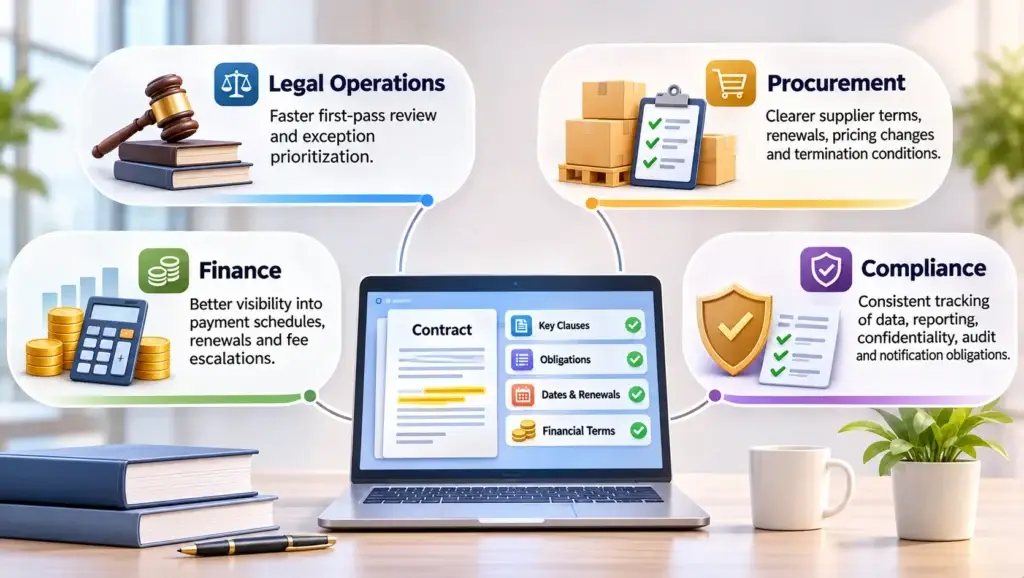
The benefits of enterprise contract analysis extend beyond legal departments.
Legal Operations: Faster First-Pass Review
Legal teams can use structured extraction to locate relevant provisions, compare them against approved contract positions, and prioritize exceptions for detailed analysis.
This can reduce time spent searching for clauses while preserving professional oversight of the final interpretation.
Procurement: Better Supplier Contract Visibility
Procurement teams may use extracted terms to monitor supplier commitments, renewal windows, pricing changes, and termination conditions.
Centralized visibility becomes especially useful when several departments manage contracts with the same supplier.
Finance: Earlier Awareness of Commercial Commitments
Finance teams can benefit from clearer records of payment schedules, renewal commitments, fee escalation provisions, and other contractual financial terms.
These records can support budgeting and forecasting, subject to verification against the governing agreements.
Compliance: More Consistent Obligation Tracking
Compliance teams can identify clauses relating to data handling, reporting responsibilities, confidentiality, audit rights, and notification requirements.
Extracted obligations can then be assigned to appropriate owners for ongoing review.
When Does NLP Contract Analysis Make Sense for an Enterprise?
Not every organization requires a complex contract intelligence platform.
The business case is usually stronger when contract review involves recurring workflows, significant document volumes, and clear operational consequences if key terms are missed.
Enterprise Decision Signals
Contract volume: Your team repeatedly reviews lengthy agreements or manages a substantial contract repository.
Clause consistency: Similar agreements contain recurring provisions that can be evaluated against documented internal policies.
Renewal exposure: Missing a notice window could create unwanted commitments or prevent timely renegotiation.
Review accountability: Multiple stakeholders need access to verified contractual facts and assigned actions.
Information control: Contract confidentiality, document permissions, and traceable reviewer decisions are important.
For organizations with only a few straightforward agreements, a well-maintained contract calendar and standardized review checklist may be sufficient.
For enterprises handling larger volumes of complex contracts, automated extraction can become a useful foundation for repeatable review and obligation management.
Buy, Configure or Build
Once the case is clear, there are three common routes. The right one depends less on the model than on where your contracts live and how unusual they are.
| Approach | Usually fits when | Watch for |
|---|---|---|
| Contract management software with built-in AI | Agreements are fairly standard and the legal team also wants a repository, approval workflows and e-signature | A fixed clause list, where the vendor hosts and processes data, and per-seat pricing as usage grows |
| Add AI extraction to systems you already use | Contracts already sit in a document repository or procurement tool and you need a defined set of fields, such as renewal dates and liability caps | Integration effort, permission mapping, and who maintains the prompts and test set over time |
| Build a custom pipeline | Contract types are unusual, playbooks are your own, data must stay in a specific location, or extracted contract data feeds another product | You need labeled test contracts, an evaluation process and a named owner after launch |
The second route is often the fastest way to prove value, because it leaves the existing repository in place; AI integration services cover that kind of work. The third route makes more sense when structured contract data becomes an asset in its own right, as with AI data products. Whichever route you choose, test it on contracts your team has already reviewed by hand before trusting it with new ones.
Connecting Contract Intelligence With Existing Enterprise Workflows
Extracting contractual information is only the beginning. The operational value increases when verified findings can move into systems that employees already use.
Potential integration points include document repositories, contract management applications, procurement systems, workflow tools, and internal approval processes.
For example, a confirmed renewal deadline could create a review task for the contract owner. A deviation from the organization’s approved liability position could trigger a legal approval request.
Similarly, verified payment obligations could be made available to authorized finance users.
These integrations require careful attention to document permissions, version control, source attribution, and approval responsibilities.
Organizations exploring this use case can review Miracuves’ enterprise AI implementation capabilities to understand the broader engineering expertise involved in document processing and workflow automation.
For more detail about reliable document retrieval and source-grounded answers, the Miracuves article on enterprise knowledge retrieval reliability explains why document structure, access controls, and evidence quality matter in production systems.
How Long Does It Take to Introduce NLP-Based Contract Analysis?
There is an important difference between the time required to analyze an individual document and the time required to introduce a reliable enterprise review workflow.
Initial machine processing may be fast once a functioning system is in place. However, an enterprise rollout also requires document preparation, clause taxonomy definitions, validation against real agreements, permission controls, and workflow testing.
Miracuves offers a six-working-day delivery timeline for eligible ready-made AI platforms. That timeline should not be interpreted as a guarantee that a custom contract intelligence workflow can be designed, integrated, validated, and deployed in six days.
Custom requirements, including organization-specific legal playbooks, existing software integrations, and document security policies, must be assessed separately.
For decision-makers, the more useful question is not simply how quickly the AI can process a PDF. It is how reliably the resulting information can enter business processes without creating new risks.
Final Thoughts: Faster Contract Intelligence Requires More Than Faster Reading
The purpose of enterprise NLP is not to make legal review disappear. It is to reduce the manual effort required to locate, organize, and verify important contractual information.
For a 100-page agreement, that means identifying relevant clauses, connecting related provisions, extracting renewal obligations, highlighting possible policy deviations, and making the evidence accessible to authorized reviewers.
The strongest workflows combine efficient document processing with clear business rules, reliable source references, controlled approvals, and human judgment.
When those elements work together, lengthy contracts become easier to navigate, deadlines become more visible, and teams can focus their attention on decisions that carry meaningful operational or legal consequences.
Frequently Asked Questions About NLP Contract Analysis
Can NLP analyze a 100-page contract in seconds?
Some systems can process and extract information from suitable documents within seconds, depending on file format, infrastructure, model configuration and processing requirements. Complete contractual verification and legal approval take longer, so fast extraction should not be confused with a finalized legal review.
What is the difference between NLP and LLM contract review?
Classic NLP pipelines use separate models trained on labeled examples for each task, such as clause classification and entity extraction. Large language models can follow written instructions and read a whole contract at once, which makes new clause types faster to add. LLM output can vary between runs and must cite its source text, so most production systems combine both approaches.
What contract clauses can enterprise NLP identify?
Enterprise NLP can be configured to identify confidentiality, liability, indemnification, termination, payment, intellectual property, renewal and data protection clauses, among others. Public benchmarks such as CUAD cover 41 clause categories. Effectiveness still depends on the document types, extraction methods and validation process used.
How does NLP detect risky clauses in legal agreements?
A contract analysis system compares extracted provisions with an organization’s approved legal or commercial playbook, flags unusual terms, and identifies potential omissions or one-sided obligations. Each flag should show the policy it triggered and the source language. A qualified reviewer decides whether the flagged language creates an unacceptable risk.
Can AI identify automatic renewal and cancellation deadlines?
Yes. Automated extraction can identify renewal periods, notice requirements and relevant dates. A separate calculation and validation step is needed to turn them into actionable deadlines, particularly where amendments, business-day rules, deemed-receipt provisions or cross-referenced notice sections apply. Each deadline should then be assigned to a named owner.
Which contract types are hardest for AI to analyze?
Heavily negotiated agreements with many amendments, master agreements that rely on separate schedules or statements of work, scanned contracts with handwritten changes, and documents with complex tables are the hardest. Standardized agreements such as confidentiality agreements are usually easier because their clauses follow familiar patterns.
How accurate is NLP-based contract clause extraction?
Accuracy varies with document quality, contract structure, clause complexity and the system’s configuration. Organizations should measure precision, recall, source attribution and human correction rates against representative, human-reviewed agreements, by contract type, before relying on automated results. High-impact misses, such as a skipped notice period, deserve separate tracking.
Can enterprise NLP review scanned PDF contracts?
Yes, when the workflow includes OCR or another document recognition step. Poor scan quality, handwritten edits, complex tables and unusual formatting can reduce extraction reliability, so low-quality pages should be flagged for reprocessing or manual verification before their findings are used.
Does automated contract review replace lawyers?
No. Automated analysis can help locate clauses, extract information, identify exceptions and organize review tasks. Legal interpretation, negotiation strategy, enforceability assessments and final approval still require appropriately qualified professionals who can check each finding against the source text and decide what the business should accept.
How can enterprises protect confidential contracts during NLP processing?
Evaluate encryption, permission-based access, audit logs, data retention, model-provider terms, processing locations, deletion procedures and whether uploaded documents can be used for model training. Controls should match internal policies, contractual confidentiality obligations and applicable legal requirements in every jurisdiction where the documents are processed or stored.
Miracuves is an independent software development company. We are not affiliated with, connected to, sponsored by, or endorsed by any company or product named in this article.
Terms such as “X Clone” are used descriptively. It is how the software industry refers to building a platform with functionality comparable to a known service, and how clients search for it.
The entire design and codebase of our products is built by our own team. Our products contain no code, design, graphics, or content originating from any third-party website or applications.
All third-party names and marks referenced in this article are the property of their respective owners, referenced solely to identify the services discussed.