Key Takeaways
- Monetization is a stack, not a price. A nutrition app earns from plan tiers, trials and coupons, paid coaching, store margin and corporate packages, and each line has its own cost and its own metric.
- Three tiers cover most operators. A free tier that builds the habit, a premium tier for self-guided members and a coaching tier with a human in the loop gives you a clear upgrade ladder.
- Trials are a lever, not a gift. According to the State of Subscription Apps 2026 report, the Health and Fitness median for trial-to-paid conversion is 37.7%, so trial length and timing deserve a deliberate test.
- Coaching is your highest price and your highest cost. Coach pay can be a retainer, a per-member fee, a per-session fee or a commission, so model it before you set the coaching tier price.
- A health store adds margin and engagement. Own products with compare-at prices, shipping zones and coach-attributed sales turn recommendations into a second income line.
- The payment route changes the math. Card processing and app store billing carry different published fees, so check the current rates before you fix prices.
- Read contribution, not revenue. Track conversion, churn, coach cost per coaching member and store margin by line, then double down on the one that pays back fastest.
A nutrition app can have thousands of daily food logs and still fail as a business. The usual reason is simple: nobody decided, on purpose, how each member would eventually pay. Revenue was treated as a single subscription price chosen in the last week before launch, and every other possibility, from coaching fees to a product shelf to employer packages, was left for later.
This guide is an operator playbook for nutrition app monetization. It walks through the plan ladder, trials and coupons, paid coaching tiers, coach commission, a health store, corporate packages, payment costs, pricing experiments and the metrics that tell you which line is actually working. It is written for dietitians, coaching businesses, clinics and founders who plan to run their own branded app, not for readers who want to study another company’s accounts.
If you are still choosing a platform, the ready-made nutrition coaching platform from Miracuves was built so that every line in this article can be set up from an operator console instead of a code change. That matters for monetization, because pricing is a thing you will edit many times in the first year.
What Nutrition App Monetization Really Includes
Most founders picture one revenue line: a monthly subscription. A mature nutrition business usually runs four or five at the same time, and they behave very differently. Subscriptions are predictable and scale with members. Coaching fees are higher per member but are limited by coach time. Store margin is lumpy and depends on traffic. Corporate packages arrive in large, slow deals.
Before you set a single price, list the lines you intend to run and decide which one carries the business in year one. A solo dietitian may lean on coaching fees. A subscription-first operator may use coaching only as a premium tier. A clinic may care most about retention of existing patients and treat the store as a convenience.
| Revenue line | How it earns | Who sets the price | Main risk |
|---|---|---|---|
| Subscription tiers | Monthly or annual fee for free, premium and coaching plans | Operator, edited from the console | Churn after the first month |
| Trials and coupons | Lower the entry barrier and pull in a cohort or partner | Operator: trial days per tier, percentage coupons with caps | Giving away margin to people who never convert |
| Paid coaching | A named human coach alongside the AI layer, plus booked sessions | Operator, tied to the coaching tier | Coach cost grows with every member added |
| Coach commission | Coach-attributed store sales and commission-based pay | Operator, per product and per coach | Pay models that outrun the revenue they create |
| Health store | Physical goods listed with a sale price, an original price and a stock count | Operator | Slow-moving stock and shipping cost |
| Corporate packages | Employer-funded access for a group of employees | Operator, as a negotiated bundle; per-seat billing via the corporate wellness portal add-on | Long sales cycle, support load |
Notice that three of the six rows are about cost control as much as income. That is deliberate. In a coaching business the line items that feel like revenue, such as the coaching tier, are the ones that carry the largest people cost. A monetization plan has to be read as contribution, meaning what is left after coach pay, card fees and refunds, not as gross billing.
Design a Plan Ladder Members Understand
A plan ladder is the set of tiers a member can climb. The goal is not to maximize the number of tiers. The goal is that a member can explain the difference between two neighboring tiers in a single sentence.
The three-tier pattern
MXHealthy, the platform behind the Miracuves nutrition coaching solution, ships with three plan tiers: free, premium and coaching. The operator sets a monthly and an annual price for each, plus a trial length per tier, all at runtime. Meal plans are limited on the free tier and full on premium and coaching. Human coach messages and appointments sit on the coaching tier.
- Free. Food logging, the daily budget and a taste of the lessons. Its job is to build a habit, not to earn money.
- Premium. Full meal plans, recipes, shopping lists, the complete lesson library and the AI coach. Its job is to be the default paid plan for self-guided members.
- Coaching. Everything in premium plus a human coach, appointments and priority messaging. Its job is to lift revenue per member and to be the tier you are proud to recommend.
Rules for pricing the rungs
Keep the gap between rungs large enough to feel like a real step. If coaching costs only slightly more than premium, members pick coaching, your coaches become overloaded and the average revenue per coaching member falls below the cost of serving them. If the gap is huge, almost nobody climbs.
Give each rung one clear reason to exist. Free exists to create the habit. Premium removes friction from the work of eating better. Coaching adds accountability from a person. Anything that does not strengthen one of those reasons is a candidate for the store or an add-on, not another tier.
Price in the currency your members earn in. MXHealthy includes rupee checkout alongside Stripe, so an India-first operator can charge in rupees and an operator with international members can charge by card. Round prices to figures that feel natural in that currency, and keep the annual price clearly lower than twelve months of the monthly one.
Annual plans change the shape of cash
An annual plan brings cash forward and cuts the number of renewal moments where a member can leave. The trade is a lower effective monthly price and a larger refund exposure. Offer annual alongside monthly on every tier, show the monthly equivalent beside the annual price, and watch how many members choose it. The console shows revenue by plan and MRR so you can see whether annual members are growing as a share of the base.
| Tier | Typical member | Pricing logic | What to watch |
|---|---|---|---|
| Free | New or undecided member | No charge; capped features | Share who log food for 7 days |
| Premium | Self-guided member who wants structure | Monthly and annual, with trial days | Trial-to-paid conversion and month-two churn |
| Coaching | Member who wants a person | Highest price; limit by coach capacity | Coach cost as a share of coaching revenue |
Trials, Annual Offers and Coupons
Trials and coupons are the two tools operators use to reduce the friction of the first payment. They are often set once and forgotten, which wastes their value. Treat both as experiments with a clear question attached.
What the benchmarks say
Subscription benchmarks give a useful starting point. The State of Subscription Apps 2026 report lists a median trial-to-paid conversion of 37.7% for the Health and Fitness category, with a top quartile above 51.4%. Looking across all categories, it also shows that trial length matters: trials of 5 to 9 days converted at a median of 37.4%, against 25.5% for trials of 4 days or less. The same report gives a Day 35 download-to-paid median of 2.9% for Health and Fitness, and, again across all categories, a median of 10.7% for hard paywall apps against 2.1% for freemium ones.
Some of these figures describe the whole Health and Fitness segment and some cover every category; none is specific to nutrition coaching apps, and all come from a single publisher’s dataset. Use them to sense-check your own numbers, not as promises. The useful lesson is directional: a trial that is long enough for the member to feel progress converts better than one that ends before the first weekly review.
Setting trial days per tier
Because the trial days belong to each tier in the operator console, you can run a longer trial on the coaching tier than on premium, or no trial on a heavily discounted annual plan. A sensible default is a trial that spans at least one weekly review, since the weekly average weight trend and the adherence view only mean something after a week of entries.
Be careful with the order of events inside the trial. A member who signs up and never logs a meal will not convert however long you extend the trial. The engagement nudges and the coach alerts in the platform exist to catch that member on day two or three, not on the last day.
Using coupons well
A percentage coupon with a cap and a redemption count is a precise tool. Use it in four ways:
- Launch cohort. A time-limited code for your first members, with a redemption cap so the offer ends by itself.
- Partner and referral. A named code for a gym, clinic or community partner, so you can see how many of their people became paying members.
- Win-back. A code sent to members whose plan was cancelled, aimed at the plan they left.
- Store promotion. A code that applies to a shelf order, used to move a product that has been sitting still.
Name every code so that a redemption tells you where a member came from. A code that is shared everywhere teaches you nothing, and an uncapped code is a standing discount you will forget to remove.
Paid Coaching Tiers: What You Are Really Selling
The coaching tier is where a nutrition business stops being a software subscription and becomes a service. Members are not paying for a chat window. They are paying for the experience of someone who has their food log, targets and messages open before they reply.
If you are starting a coaching practice from scratch, our guide to starting an online nutrition coaching business covers niche, offer design and hiring in depth. Here the focus is narrower: how to price and package the coaching tier once the app exists.
Define the unit of coaching
Decide what one coaching member gets each month and put it on paper. For example: unlimited messages with a response-time promise, a number of scheduled appointments, a weekly review of the diary, and a monthly goal check. Each appointment is stored with its slot, state and a link to join, so sessions can run on whatever call tool your team already uses.
A precise unit lets you calculate cost. If a coach can serve about forty members at that level of attention, then a coaching tier priced below a certain figure cannot cover that coach’s pay, whatever the headline subscription numbers look like.
Make the AI layer support the coach, not replace the price
The AI coach replies using the member’s own diary and trend, and it offers general guidance only; it is not medical advice. A panel tells members what the coach can see. Commercially, it keeps people engaged between sessions and spares the human coach repetitive questions. A daily ceiling on calls and tokens for each member keeps its running cost predictable.
Do not sell the AI as a substitute for the coach unless your offer genuinely works that way. A cleaner position is that premium members get the AI and coaching members get the AI plus a person.
Package for different buyers
- A starter coaching package with fewer appointments for members who want accountability on a budget.
- A full coaching package with weekly review and priority response.
- A goal-based block, such as a fixed number of weeks tied to a target date, which the assessment’s target date field supports.
Three packages is plenty. More than that and the sales conversation turns into a menu reading exercise.
If you want to extend coaching into live formats later, live video coaching and group classes are available as an add-on to the platform, so join-link appointments can move to in-app video sessions without a replatform.
Coach Pay and Commission: Protect the Margin
Every coaching tier carries a cost line, and the way you pay coaches shapes your margin as much as the way you charge members. MXHealthy supports four coach pay models: a retainer, a per-member fee, a per-session fee and a commission. Rate cards live in the operator console, and settlements are produced monthly with line items you can check. Payouts to coaches can be sent through Stripe Connect.
| Pay model | How it works | Good fit | Watch out for |
|---|---|---|---|
| Retainer | Fixed monthly amount per coach | Stable, full-time coaches | You pay the same when the caseload is light |
| Per member | Amount for each assigned coaching member | Coaches with a defined caseload | Margin falls if the tier price is cut |
| Per session | Amount for each completed appointment | Part-time or specialist coaches | Costs rise with member activity |
| Commission | Share of attributed sales | Coaches who recommend store products | Needs clear attribution rules |
Note the direction of money. Commission is a cost the operator pays coaches. It is not a fee the platform takes from them. Miracuves takes no revenue share from your subscriptions, coaching fees or store margin, so the math on your side stays between you and your coaches.
A worked example, with invented numbers
The figures below are illustrative inputs, not benchmarks, and exclude hosting, AI usage, marketing and refunds. They show how to read a month. Assume 2,000 members: 1,500 on free, 400 on premium at $12 a month and 100 on coaching at $60 a month. Assume two coaches paid per member, $15 for each of the 100 coaching members, and 150 store orders averaging $28 at a 35% product margin.
| Line | Calculation | Monthly amount |
|---|---|---|
| Premium subscriptions | 400 x $12 | $4,800 |
| Coaching subscriptions | 100 x $60 | $6,000 |
| Store gross margin | 150 x $28 x 35% | $1,470 |
| Coach pay (per member) | 100 x $15 | -$1,500 |
| Card fees on subscriptions | 2.9% of $10,800 plus $0.30 x 500 charges | -$463 |
| Card fees on store orders | 2.9% of $4,200 plus $0.30 x 150 orders | -$167 |
| Contribution before other costs | Sum of the lines above | $10,140 |
Two readings stand out. Coach pay is 25% of coaching revenue in this example, which is a number you can set a ceiling on and monitor. And the store, small as it is, covers its own card fees and adds about an eighth of the contribution after its card fees. Change one input at a time and you will see which lever the business is most sensitive to.
For a rupee-priced view of the same ideas, including how coach payouts flow in an India-first app, see the revenue model of a rupee-priced diet app guide.
Turn a Health Store Into a Real Revenue Line
A store inside a nutrition app is more than a shop window. When the member has just finished a lesson on portion sizes, a portion plate is a natural next step. The store works best when it follows the coaching, not when it competes with it for attention.
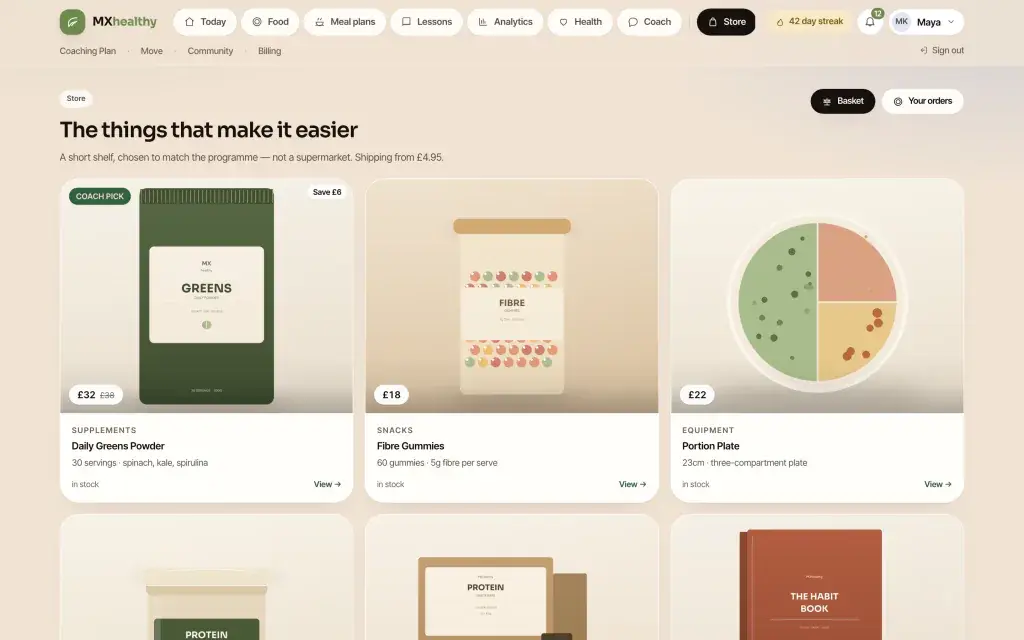
MXHealthy includes a native store: product listings that carry categories, a sale price against an original price, stock status, SKU, weight, a featured flag and an image gallery. The basket is held on the server and shared between the web app and the mobile apps, and checkout collects an address and applies a shipping zone by country with a rate, a free-shipping threshold and a delivery estimate.
What to stock
- Tools for the habit. Portion plates, shaker bottles, food containers, kitchen scales and printed recipe booklets.
- Digital-adjacent items. Meal prep planners and journals that reinforce what the lessons teach.
- Consumables, with care. Supplements and similar items are sensitive in many markets. Check local health-claim rules, avoid any claim about results, and remember that compliance is the operator’s job.
Price the shelf deliberately
Use the compare-at price to show a reduction only when it is real. Set a free-shipping threshold slightly above your average basket so that members add one more item. Mark one product as a coach pick, because a recommendation from a named coach lifts trust. Orders move through five tracked stages (placed, paid, packed, shipped, delivered), and an order can also end as cancelled or refunded, so your team can see where an order is stuck.
Attribution turns coaches into sellers
The coach id travels with the basket line into the order, so a sale a coach influenced can be attributed to them and paid as commission, with a rate you set per product and per coach. This is a cost for you and income for them, and it aligns the people closest to members with the store’s success. Keep the rule simple: commission is only paid on delivered, non-refunded orders in your policy, so coaches are never rewarded for sales that reverse.
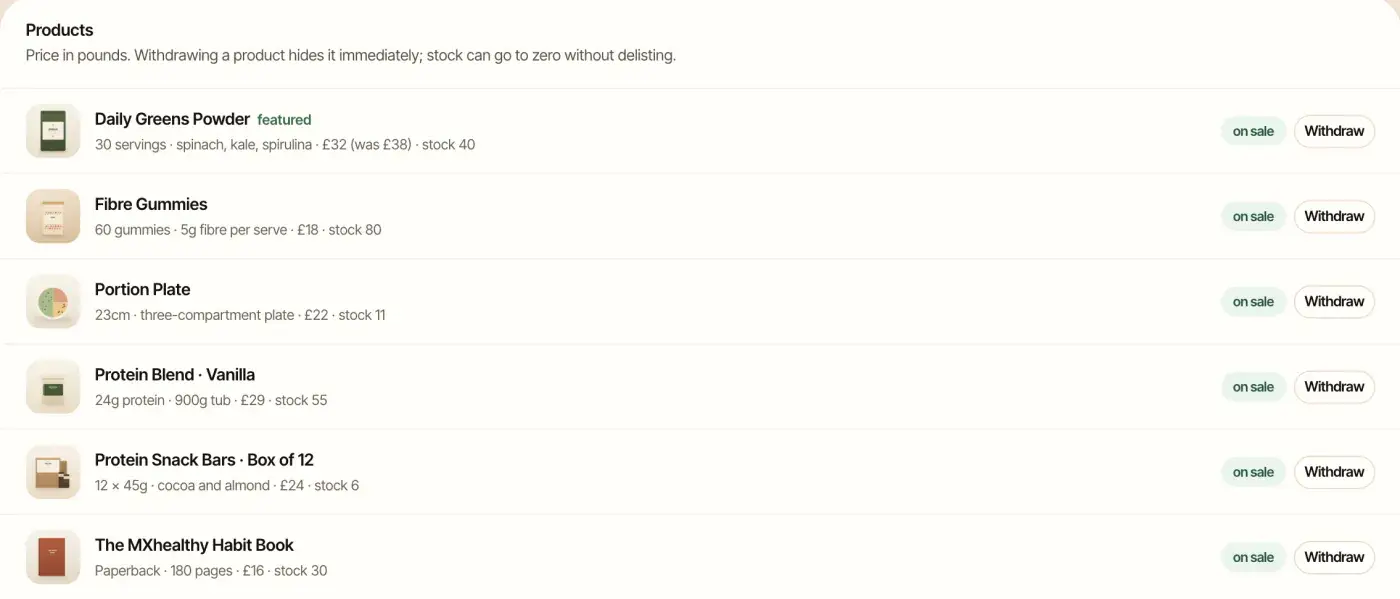
Inventory and fulfillment stay in the operator console, where orders can be updated with a carrier and tracking details. If you start with a handful of products and your own fulfillment, the store carries almost no setup cost and tells you quickly whether your members want a shelf at all.
Corporate and Group Packages
Employer and group deals are attractive because one conversation can bring in dozens of members. They also come with a different set of demands: invoices, reporting and a person who is not the member paying the bill.
A corporate buyer can be served on your existing plans from day one. A practical route is a negotiated bundle delivered with a named, capped coupon code for the group, so you can count how many employees redeemed it. When the employer wants seat-based billing, team challenges and HR reporting, the corporate wellness portal add-on brings them into the platform.
Decide three things before you pitch a group:
- What the employer sees. Aggregate participation is useful. Individual food logs are private and should stay that way.
- What the employee gets. A coaching tier or premium access, and for how long.
- What you charge. A flat fee for a defined group, or a price per participant with a minimum (per-seat billing runs through the corporate wellness portal add-on).
Group packages also reward the engagement features. Challenges, circles and a rewards ledger give a cohort a reason to stay active together, and a cohort that stays active is the best evidence you can show at renewal.
A dietitian practice has a similar pattern in miniature: the clinic pays for nothing, the client pays for a plan, and the app is the glue between sessions. Our article on a branded nutrition client app for dietitians explains how that works in a small team.
Payments, Store Fees and Rupee Checkout
Gross price is not what you keep. Each place a member can pay has its own cost, and those costs differ enough to change which plan prices make sense.
| Payment route | Published cost | Source |
|---|---|---|
| Card payments through a payment processor | Stripe’s standard US rate for domestic cards is 2.9% plus 30 cents per transaction (pricing page) | Processor pricing page |
| Apple in-app purchases for qualifying small businesses | A reduced 15% commission when prior-year proceeds are at most 1 million USD (small business program) | Platform program page |
| Google Play subscriptions | For subscriptions in the US, UK, EEA, Japan and Australia, Google charges 10% with an added 5% billing fee; elsewhere the subscription rate is 15% (service fees help page) | Platform help page |
Published fees change over time, so check the current pages before you fix prices. The point for monetization is that a coaching plan paid through a card processor and one paid through a store billing system do not leave you the same margin, so price after you know your route.
MXHealthy supports both payment routes for plans: App Store and Google Play billing inside the mobile apps, and Stripe checkout, which settles subscriptions, trials and store orders to the Stripe account you connect, with rupee checkout included for members in India. Card numbers stay with the payment provider and never sit in your database. For India-first operators, offering a rupee price removes a conversion barrier that foreign-currency pricing often creates.
Keep refunds in the model
Refund policy is a monetization decision. A generous annual refund window can lift annual uptake and also lift refunds. The finance view reports net revenue, gross revenue, refunds, payouts and contribution by month, and a month close freezes the period, so you can compare cohorts without the numbers changing under you.
Pricing Experiments Without Burning Members
Because the console works at runtime, prices, trial days and coupons can change without an app release. The risk is that you change too many things at once. A good experiment changes one variable, for one cohort, for long enough to read.
An experiment you can run in a month
- Question. Does a longer premium trial improve trial-to-paid conversion without raising month-two churn?
- Change. Extend trial days on premium for new sign-ups only. Leave existing members alone.
- Read. After a full trial plus one billing cycle, compare conversion and the share still active.
- Decide. Keep the change only if contribution per sign-up improves, not just conversion.
What to test, in order
- The price of the premium monthly plan.
- The gap between premium and coaching.
- The annual discount and how it is displayed.
- Trial length per tier.
- A coupon that targets lapsed members.
- The store free-shipping threshold.
Rules that prevent regret
Never raise a price for people who already pay without telling them clearly. Do not run two pricing tests on the same cohort. Record the result, including the tests that failed, so a future you does not repeat them. And remember that small samples mislead: a test with a handful of conversions tells you almost nothing.
The Metrics That Tell You Which Line Works
A dashboard full of numbers is not a monetization system. You need a few measures tied to decisions. The finance and CRM views in the operator console give you most of them: revenue by plan, MRR, month-on-month change, payouts and refunds, and a CRM stage that marks members as new, at risk after a week without a log, and churned once cancelled.
| Metric | What it answers | Action if it is weak |
|---|---|---|
| Trial-to-paid conversion | Does the trial create paying members? | Adjust trial days or the first-week experience |
| Month-two churn | Do members stay after the first payment? | Strengthen the weekly review and nudges |
| Share on annual plans | Is cash coming forward? | Change how the annual price is presented |
| Coach cost as a share of coaching revenue | Is the coaching tier profitable? | Reprice, cap caseloads or change the pay model |
| Store margin per order | Does the shelf pay for itself? | Cut slow stock, raise the free-shipping threshold |
| Coupon redemptions by code | Which sources bring members? | Stop weak codes, repeat strong ones |
| Contribution per month | What is left after coach pay and fees? | Fix the largest line first |
Read these by cohort, not as one blended number. A coupon cohort and an organic cohort can look very different, and a blend hides it. When a metric is weak, the fix is usually in the first week of the member’s experience, which is why the at-risk queue and weekly nudges matter commercially as well as clinically.
Founder Decision Signals: Is Your Monetization Plan Ready?
Every Line Has an Owner
Can you name who sets and reviews the price of each tier, coupon, coaching package and store product?
Coach Cost Is Capped
Do you know the maximum share of coaching revenue you will spend on coach pay, and have you modeled it?
Fees Are in the Math
Does your pricing subtract card or store billing fees and refunds before you call it margin?
Experiments Are Planned
Do you have one pricing test written down, with a question, a cohort and a read date?
How Miracuves Helps
Miracuves builds the nutrition coaching platform that this whole article assumes. It is built on MXHealthy and sold for one fixed payment of $3,399, and it includes the full source code, Android and iOS apps together, a browser app for members, a separate coach workspace and an admin console covering 14 areas. The stack is Next.js, TypeScript, PostgreSQL and Flutter, with Stripe and rupee checkout, an English and Hindi interface and Indian dishes in the food catalog.
The monetization controls described above are the heart of the nutrition coaching platform: three plan tiers with monthly and annual prices and trial days, percentage coupons, four coach pay models with monthly settlements, a native store with coach-attributed commission, and finance reporting by month. Everything is set from the console without a release, and every change to a plan, price or payout lands in an audit trail.
A ready-made build goes live in 6 working days of Miracuves work, with store review as a separate step. Custom work such as a new plan type or report is scoped in writing and takes 15 to 30 days, and up to 45 to 60 days for larger scope. Support runs 60 days of dedicated platform guidance, then 6 months of priority bug resolution, alongside 12 months of continuous product evolution.
When your plan calls for more, six paid add-ons extend the base: wearable adapters, smart scale and CGM sync, live video coaching and group classes, a video lesson studio, a corporate wellness portal and regional language packs. Each one is an add-on, not part of the base build, so you only pay for what your plan needs.
You can also browse more options in our healthcare solutions category, or open the live demo from the product page and try the console as an operator.
Final Thoughts
Monetizing a nutrition app is a sequence of small, deliberate decisions: how many tiers, how long a trial, what coaching includes, how coaches are paid, what the shelf stocks, which group you serve. Each decision becomes easier when the numbers are visible and the controls are in your hands.
Start with the simplest version that earns: a free tier, a premium plan and a coaching tier. Measure conversion, churn and coach cost for a quarter. Then add the store, a coupon program and a corporate package where the data supports them. Miracuves gives you the platform to run that sequence, so the work of building is done and the work of running the business can begin.
Frequently Asked Questions
How do nutrition apps make money?
Most combine several lines: subscription tiers with monthly and annual prices, a paid coaching tier, a product store, coach-attributed commission and corporate or group packages. The right mix depends on whether your business is software-led or service-led. Measure contribution after coach pay and payment fees, not just gross billing.
How many subscription tiers should a nutrition app have?
Three is a strong default: a free tier that builds the habit, a premium tier for self-guided members and a coaching tier with a human coach. Each rung should have one clear reason to exist, and the price gap between neighbors should be large enough that members can explain the difference.
What trial length works for a nutrition app?
Long enough for a member to complete one weekly review, since progress only shows after a week of entries. Cross-category benchmarks suggest trials of about 5 to 9 days convert better than very short ones, but test this with your own members and read contribution as well as conversion.
How should I pay coaches in a nutrition coaching business?
Choose between a retainer, a per-member fee, a per-session fee or a commission on attributed sales. Retainers suit full-time coaches, per-member fees suit defined caseloads and commission suits coaches who recommend store products. Model coach pay as a share of coaching revenue before you set the coaching tier price.
Should a nutrition app sell physical products?
It pays off when the products support the habits you coach, such as portion plates and kitchen tools. Start small, set a free-shipping threshold above your average basket and track margin per order. Be careful with supplements and avoid any claim about results, because local health-claim rules apply.
Can I sell corporate wellness packages with a nutrition app?
Yes. You can serve a group on your existing plans with a capped coupon code and count redemptions, or add the corporate wellness portal add-on when the employer wants seat-based billing, team challenges and HR reports. Keep individual food logs private from the employer.
What payment fees should I include in my pricing?
Include your card processor’s per-transaction fee and, if you sell through an app store billing system, that store’s commission. Rates differ by region and change over time, so check current published terms. Refunds also belong in the model because they reduce net revenue.
How do I test prices without upsetting existing members?
Change one variable for new sign-ups only, run it for a full trial plus one billing cycle and compare contribution per sign-up. Do not raise prices for paying members without clear notice, and never run two pricing tests on the same cohort.
What does the Miracuves nutrition coaching platform include for monetization?
It includes three plan tiers with monthly and annual prices and trial days, percentage coupons, four coach pay models with monthly settlements, a native store with coach-attributed commission, rupee checkout alongside Stripe and finance reporting by month. Prices are listed on the solution page.
Miracuves is an independent software development company. We are not affiliated with, connected to, sponsored by, or endorsed by any company or product named in this article.
Terms such as “X Clone” are used descriptively. It is how the software industry refers to building a platform with functionality comparable to a known service, and how clients search for it.
The entire design and codebase of our products is built by our own team. Our products contain no code, design, graphics, or content originating from any third-party website or applications.
All third-party names and marks referenced in this article are the property of their respective owners, referenced solely to identify the services discussed.