

Key Takeaways
- The crypto exchange cold-start problem occurs when a new trading platform struggles to attract users because its order books lack sufficient liquidity, competitive prices and reliable trade execution.
- Shared liquidity arrangements can help new exchanges access external trading depth, potentially reducing the need to establish an entirely independent liquidity pool from the beginning.
- Market makers support trading activity by placing buy and sell orders, helping maintain tighter bid-ask spreads and improving available order book depth under suitable market conditions.
- New exchanges can study Binance’s emphasis on liquidity, trading pairs and market participation while developing their own transparent, compliant and sustainable liquidity strategies.
Shared Liquidity, Order Books and Market Maker Strategies
- Shared liquidity models can connect an exchange with external liquidity providers or trading venues, allowing eligible orders to access additional available buy and sell interest.
- An order book organizes active buy and sell orders by price and quantity, helping traders evaluate market depth, bid-ask spreads and potential execution costs before placing trades.
- Professional market makers use defined quoting strategies, inventory controls and risk limits to provide liquidity across selected trading pairs without guaranteeing continuous execution.
- Exchange operators should evaluate liquidity provider reliability, API connectivity, execution latency, settlement arrangements and pricing transparency before integrating external liquidity services.
The Binance Playbook and Sustainable Exchange Growth
- New exchanges can draw lessons from Binance’s growth model by prioritizing active trading markets, accessible trading pairs, competitive transaction fees and a reliable user experience.
- Rather than listing numerous illiquid assets, founders should prioritize trading pairs with genuine market demand, sufficient liquidity support and transparent listing standards.
- Exchange performance should be evaluated through bid-ask spreads, order book depth, slippage, execution success rates, genuine trading volume and customer retention.
- A sustainable crypto exchange liquidity strategy requires strong risk management, market surveillance, safeguards against wash trading, regulatory compliance and dependable trading infrastructure rather than artificial volume or misleading liquidity claims.
Launching a cryptocurrency trading platform creates a challenge that even a well-engineered trading system cannot solve on its own: nobody wants to trade in a market where there are not enough buyers and sellers.
A new exchange might offer a responsive interface, reliable deposits, competitive trading fees, and a technically capable matching engine. Yet when its first customers arrive, they may discover an almost empty order book. Buying a relatively small amount of cryptocurrency moves the displayed price, selling becomes difficult, and the spread between buyers and sellers makes each transaction unnecessarily expensive.
The challenge becomes even more important when founders choose between different cryptocurrency trading models. Centralized order-book exchanges depend on consistent buying and selling activity, while peer-to-peer marketplaces rely more directly on users creating available trading opportunities. Understanding these differences across cryptocurrency trading platform models helps founders identify the right liquidity strategy before committing resources to market activation.
The solution is not simply to publish more trading pairs or attract sign-ups through marketing. New exchange operators need an intentional liquidity strategy built around shared liquidity arrangements, order-book management, professional market makers, reliable execution, and carefully designed trading incentives.
This guide explains how those mechanisms work together, why liquidity quality matters more than headline volume, what can go wrong during implementation, and how founders can move from externally supported markets toward sustainable trading activity.
Why New Crypto Exchanges Face a Liquidity Cold-Start Problem
Every marketplace depends on participants creating value for one another. A trading venue is a particularly demanding example because the quality of each transaction depends on the availability of another participant willing to trade at an acceptable price.
Consider a newly launched exchange listing a popular cryptocurrency against a stablecoin. Early visitors may create accounts, complete identity verification, and deposit funds. But if very few sell orders are available, a buyer cannot execute a meaningful transaction without accepting increasingly unfavorable prices.
Similarly, a seller may find only a handful of bids, all significantly below the prevailing market price. Even if the interface works perfectly, the market feels unreliable.
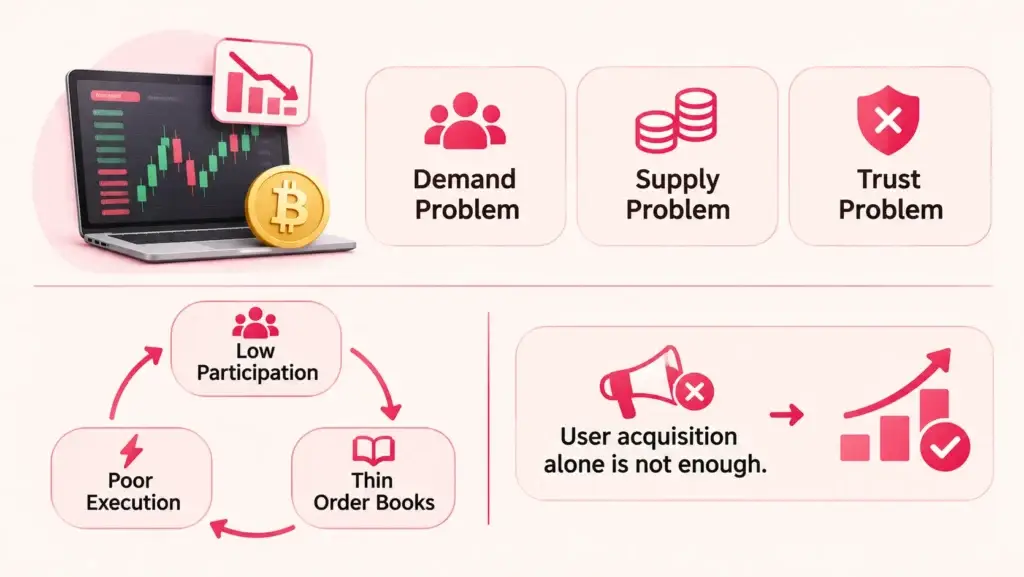
This creates three connected problems:
- Demand problem: Traders hesitate to deposit or execute orders when market conditions look unfavorable.
- Supply problem: Liquidity providers hesitate to allocate inventory to a venue without predictable order flow.
- Trust problem: Poor execution encourages early traders to leave, preventing the exchange from developing a reputation for reliable trading.
The resulting cycle is difficult to reverse. Low participation produces thin order books; thin order books produce poor execution; poor execution discourages participation.
Why User Acquisition Alone Cannot Solve the Problem
Founders sometimes assume that enough marketing activity will eventually generate the liquidity their exchange needs. More traffic can certainly help, but website visits, registered accounts, funded balances, and completed trades are not interchangeable measurements.
An exchange can attract thousands of interested visitors without developing balanced buying and selling demand. If most visitors want to purchase the same asset at the same time, the venue still needs someone willing and able to sell.
Liquidity planning therefore needs to begin before aggressive user acquisition. The first objective should be to make the initial markets usable. Marketing becomes more productive when new customers encounter dependable execution rather than an empty trading screen.
What Healthy Order-Book Liquidity Actually Looks Like
To understand liquidity bootstrapping, founders first need to distinguish an active-looking trading interface from a genuinely liquid market.
In a central limit order book, buyers submit bids showing the prices they are willing to pay. Sellers submit asks showing the prices they are willing to accept. The highest available bid and lowest available ask form the top of the book.
The difference between those prices is the bid-ask spread. A narrow spread can make trading less expensive, but it does not necessarily mean that sufficient volume is available at those prices.
A market might display an attractive spread for a tiny quantity while offering very little additional liquidity behind the best bid or ask. The next substantial order can move through several price levels and receive a much worse average execution price.
An Illustrative Order-Book Example
Imagine two hypothetical markets for the same asset. Both display a reference price close to $100, but their order books contain very different amounts of available selling interest.
| Market Characteristic | Thin Market | Deeper Market |
|---|---|---|
| Best Bid | $99.50 | $99.95 |
| Best Ask | $100.50 | $100.05 |
| Quoted Spread | 1.00% | 0.10% |
| Available Asks Near Reference Price | Limited quantity | Greater cumulative quantity |
| Impact of a Larger Market Buy | Consumes multiple price levels, increasing potential slippage | Can absorb more trading volume near the reference price |
| Execution Predictability | Relatively weak | Relatively strong |
Illustrative figures only. These are not live market quotations or recommended operating targets.
The difference is not merely visual. If a user submits a market order that exceeds the quantity available at the best ask, the matching engine must consume additional sell orders at progressively higher prices. The user receives an average fill price determined by the available depth, not simply the price displayed at the top of the screen.
For operators, this makes cumulative order-book depth an essential monitoring metric. Depth should be measured around the reference price at relevant percentage distances and order sizes rather than judged from the best quote alone.
Five Liquidity Metrics Founders Should Understand
- Bid-ask spread: The difference between the best buying and selling prices, commonly measured in basis points or percentage terms.
- Order-book depth: The cumulative buy and sell quantity available within a defined distance of the reference price.
- Slippage: The difference between the expected execution price and the actual average fill price.
- Quote availability: The proportion of time meaningful two-sided quotations remain available under defined market conditions.
- Fill quality: How consistently orders execute at acceptable prices, with measurable latency, rejection rates, and partial-fill behavior.
These measurements should be evaluated together. A narrow spread supported by negligible size may be less useful than a slightly wider market with sufficient depth to handle the actual orders customers want to place.
The Plus or Minus 2% Depth Benchmark
The most widely used public yardstick for order-book depth is ±2% depth: the dollar value of resting bids within 2% below the mid price, and of asks within 2% above it. CoinGecko introduced the metric with its Trust Score in May 2019, alongside bid-ask spread, to test whether reported volume reflects executable liquidity, and its exchange Trust Score methodology still evaluates venues on order-book depth relative to their peers.
For a new exchange, ±2% depth works well as both a dashboard metric and a contract term. It is simple to measure, easy to compare with larger venues that list the same pair, and hard to inflate with one small order at the top of the book. A practical rule is to set a minimum ±2% depth for each launch pair, sized as a multiple of the largest order you expect customers to place, and to report it hourly. Track a tighter band, such as ±1%, for major pairs where customers expect close-to-market execution.
How Shared Liquidity Helps New Exchanges Avoid Empty Markets
Shared liquidity is one way for a new trading venue to offer access to existing buying and selling interest without relying entirely on its own early customer base.
The concept is straightforward: instead of waiting for every bid and ask to originate locally, the exchange establishes a commercial and technical relationship with an external liquidity source. Depending on the arrangement, the external provider may supply executable quotes, maintain funded orders on the local book, or support external execution when a customer trades.
However, shared liquidity does not mean that two exchanges automatically share the same funds, balances, or matching engine. The implementation depends on the commercial agreement, custody arrangements, risk model, and order-routing design.
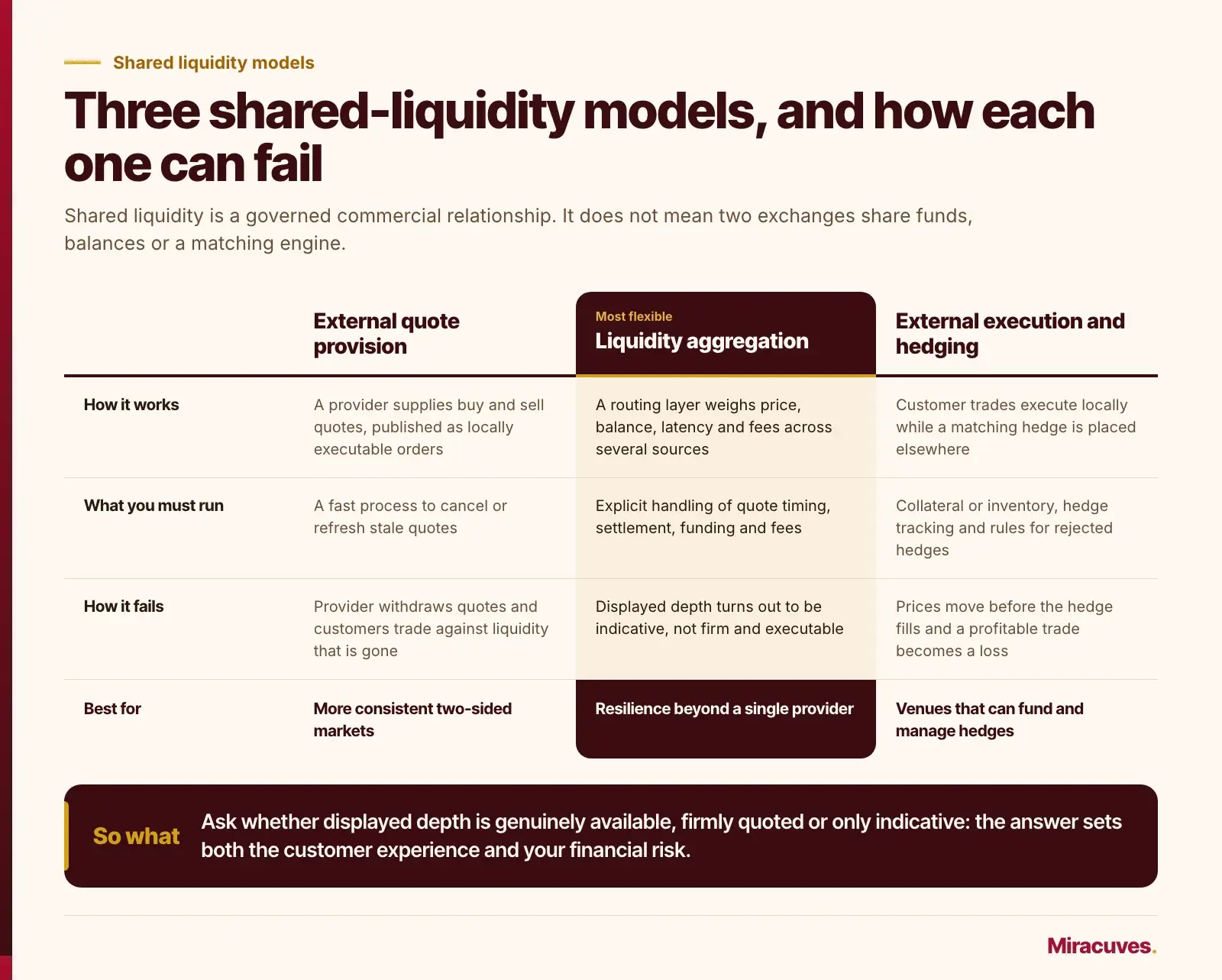
Model 1: External Quote Provision
In this arrangement, a liquidity provider supplies buy and sell quotes to the new venue. Those quotes may be published as locally executable orders or used to determine prices offered through a controlled trading workflow.
The provider must be able to honor the quoted quantities under the agreed execution rules. If the provider withdraws or changes its quotes, the exchange needs a process to cancel or refresh stale prices before customers can trade against unavailable liquidity.
Quote provision can help a new exchange develop more consistent two-sided markets. Its effectiveness depends on quote size, uptime, inventory, the provider’s tolerance for volatility, and the exchange’s ability to process order updates quickly.
Model 2: Liquidity Aggregation Across External Sources
Liquidity aggregation connects multiple eligible liquidity sources through a routing or quotation layer. Instead of depending on a single provider, the venue can evaluate available prices and quantities across several relationships.
For example, one source may provide favorable prices for smaller trades, while another offers greater depth for larger transactions. An aggregator can evaluate these sources according to executable price, available balance, latency, fees, and predefined risk limits.
Aggregation improves flexibility, but combining prices from several providers does not automatically create one consolidated, immediately executable order book. Differences in quote timing, settlement, account funding, fees, and execution rules must be handled explicitly.
Founders should ask whether displayed depth represents genuinely available orders, firm executable quotations, or indicative market information. That distinction affects both customer experience and the financial risk carried by the operator.
Model 3: External Execution and Hedging
Some venues offer customer-facing liquidity while managing their exposure through trades with an external counterparty. When a customer order executes locally, the operator or its liquidity partner may place a corresponding hedge elsewhere to reduce the resulting market risk.
This approach requires more than a market-data connection. The venue must maintain adequate collateral or inventory, monitor execution costs, track hedge confirmations, and define what happens if a hedge is rejected or only partially completed.
A profitable-looking customer trade can become a loss if external market prices move before the hedge executes. This is why hedging latency, balances, price tolerance, and emergency risk limits matter as much as the quoted spread.
What Shared Liquidity Cannot Guarantee
External connections do not guarantee unlimited depth, uninterrupted quotes, or identical execution conditions across venues. Providers can change their spreads, reduce quote sizes, withdraw liquidity during volatility, or experience technical outages.
A sound shared-liquidity strategy therefore includes funding requirements, quote freshness checks, failover behavior, trading limits, transparent fee calculations, and procedures for handling unavailable external markets.
For founders, shared liquidity should be treated as a carefully governed commercial relationship supported by reliable technology, not as a shortcut that permanently eliminates the need for genuine trader participation.
The Role of Professional Market Makers in Building Early Liquidity
Market makers are participants that provide liquidity by placing buying and selling quotations. Their activity allows other traders to execute orders without waiting for a naturally occurring counterparty to appear at exactly the right moment.
A professional market maker typically manages a portfolio of assets, pricing models, automated trading systems, and inventory limits. It may adjust quotations as market prices change, trades are executed, or its available inventory becomes unbalanced.
For a new exchange, an external market maker can provide an early foundation for trading activity while organic participation develops. But the market maker is not a permanent replacement for customer demand. Its willingness to remain active depends on economic incentives, operational reliability, available capital, and risk.
How Two-Sided Market Making Works
Suppose a digital asset has an external reference value near $50. A market maker could quote a bid at $49.95 and an ask at $50.05, with defined quantities available on each side. These numbers are illustrative, not an expected spread or service commitment.
If a customer buys from the ask, the market maker sells inventory. If another customer sells into the bid, the market maker acquires inventory. The market maker continually evaluates its holdings and adjusts prices to manage exposure.
When buying and selling demand remains reasonably balanced, the provider may earn revenue from the spread and applicable fee arrangements. When demand becomes one-sided or market prices change abruptly, it may face inventory losses or the cost of hedging elsewhere.
This explains why a market maker cannot responsibly promise a permanently fixed spread or limitless liquidity under every market condition.
What Should a Market-Making Agreement Define?
An exchange founder should evaluate a market maker using measurable service expectations rather than promises of high trading volume.
| Agreement Element | What the Operator Should Evaluate | Why It Matters |
|---|---|---|
| Quoted Spread | Maximum target spread under defined normal market conditions | Influences trading costs and price competitiveness |
| Minimum Depth | Executable order quantity within agreed price ranges | Supports meaningful customer order sizes |
| Quote Uptime | Expected quote availability and permitted exceptions | Reduces extended periods of empty markets |
| Inventory and Collateral | Funding sources, custody responsibilities, and trading limits | Determines whether quoted orders can be honored |
| Volatility Exceptions | Conditions allowing spreads to widen or quoting to pause | Establishes realistic expectations during market volatility |
| Monitoring and Reporting | Market-quality records, performance tracking, and independent verification | Ensures transparency and accountability |
| Termination and Fallback | Notice periods and procedures following provider withdrawal | Reduces operational dependence and trading disruptions |
Contracts should also clarify whether the provider is trading on its own account, managing exchange-owned inventory, or acting through another legally permitted relationship. These arrangements can carry different financial, custody, conflict-of-interest, and regulatory consequences.
How Market-Maker Deals Are Structured and What They Cost
Four commercial models cover most liquidity arrangements a new exchange will be offered. Token issuers see the same models when they negotiate listings, so it helps to know which side of the deal carries the risk.
| Deal Model | How It Works | Cost to the Operator | Main Risk |
|---|---|---|---|
| Retainer (service fee) | The exchange pays a fixed monthly fee for agreed quoting obligations: spread, depth and uptime per pair | A cash fee every month, plus any maker rebates the venue offers | Paying for quotes that disappear in volatility unless KPIs and reporting are enforceable |
| Token loan with call options | A token issuer lends inventory to the market maker, which later returns the tokens or buys them at agreed strike prices | Little or no cash, but inventory and upside are given away | Incentives can diverge from the issuer, and activity with loaned tokens is hard to monitor |
| Maker rebate program | The venue pays reduced or negative maker fees to any participant that meets published volume or depth thresholds | Rebates scale with volume, so cost rises as liquidity grows | Rewards volume rather than depth unless criteria include spread and uptime |
| Exchange-funded inventory | The operator quotes from its own balance sheet, directly or through an affiliate | Capital at risk plus hedging costs | Conflicts of interest and losses during one-sided markets |
Cointelegraph’s 2025 investigation into market-maker deals found that loan-and-option contracts often lack clear performance targets, while retainers are less risky but cost more cash up front. Public price lists are rare: retainer fees, rebate tiers and option terms are negotiated per pair and per venue. Treat any figure you hear as a quote to confirm in writing, and compare providers on cost per unit of verified ±2% depth rather than on the headline fee.
Whatever the model, put the anti-manipulation terms in the contract: no wash trades, no self-matching between affiliated accounts, disclosure of every account the provider uses on your venue, and your right to audit its order and trade logs.
Wash trading, fictitious transactions, misleading volume creation, and other manipulative practices are not legitimate liquidity solutions. A trustworthy liquidity program should prioritize independently verifiable quotations, real execution capacity, and lawful market conduct.
Wash Trading and Market Manipulation Rules in 2026
In the European Union, Title VI of the Markets in Crypto-Assets Regulation (MiCA, Regulation (EU) 2023/1114) has applied since December 30, 2024. Article 91 prohibits orders and trades that give false or misleading signals about the supply, demand or price of a crypto-asset, or that hold its price at an abnormal or artificial level. Article 92 requires anyone professionally arranging or executing crypto-asset transactions to run systems that detect and report suspicious orders and trades. The transitional period that let existing providers operate without MiCA authorization ended by July 1, 2026 at the latest, so an exchange serving EU users needs that surveillance in place now.
In the United States, prosecutors have treated paid volume as fraud. In October 2024 the Justice Department charged 18 people and entities after an FBI operation that created its own token to catch firms selling wash trading, the first criminal charges against financial services firms for crypto market manipulation and wash trading. For an operator, the practical response is the same in every market: self-trade prevention, flags on affiliated and incentivized accounts, retained order logs, and a named owner for suspicious-activity reports.
Shared Liquidity vs. Market Makers vs. Organic Trading: Which Model Fits a New Exchange?
There is no universal liquidity arrangement suitable for every trading venue. The appropriate model depends on the assets listed, customer segment, initial funding, exchange structure, expected order sizes, and applicable rules.
In practice, these approaches are often complementary. A new venue may use external market makers to support its first trading pairs, connect additional liquidity sources for resilience, and gradually attract independent traders who create their own bids and asks.
| Liquidity Model | Primary Advantage | Main Limitation | Practical Role |
|---|---|---|---|
| External Market Making | Provides dedicated two-sided buy and sell quotations | Contract costs and dependence on liquidity providers | Establishes initial market liquidity |
| Shared Liquidity / Aggregation | Provides access to external market pricing and order-book depth | Routing complexity, funding requirements, and counterparty risks | Expands available executable liquidity |
| Exchange-Funded Inventory | Offers direct control over allocated trading capital | Balance-sheet exposure and potential conflicts of interest | Provides limited, controlled supplemental liquidity |
| Organic Trader Orders | Encourages independent buying and selling activity | Takes time to develop without an established user base | Supports long-term market liquidity and sustainability |
| Maker-Fee Incentives | Encourages eligible traders to place limit orders | May attract temporary, incentive-driven trading activity | Supports early market participation and order-book depth |
One important distinction is that decentralized liquidity pools operate differently from centralized order-book venues. Automated market makers use pool reserves and pricing mechanisms rather than conventional two-sided limit-order quoting. Their capital efficiency, incentive structures, and risk exposures require a separate evaluation.
For a founder planning a centralized exchange, the immediate challenge is usually to make a small number of order-book markets consistently usable before expanding into less liquid assets or more complex trading products.
The Binance Playbook: What the Largest Exchange Actually Did
Binance is often held up as the model for exchange liquidity, but its scale is not something a new venue can copy. What transfers are the specific programs it has documented publicly.
1. Maker Rebates Tied to Measured Market Share
Binance runs a Spot Liquidity Provider Program that pays makers according to their measured share of weekly maker volume. Under the tiers updated in September 2024, Tier 1 required a 0.05% weekly maker volume share (or USD 25 million of weekly maker volume) and carried a 0% maker fee, while Tier 4 required a 1% share and earned a maker rebate of 0.008%. In June 2025 Binance added a separate liquidity program for altcoin pairs, where thin order books are most common.
The lesson is the structure, not the numbers. Incentives are paid after the fact, against measured maker activity, in published tiers. A new exchange cannot match that rebate budget, but it can publish clear maker tiers and pay only for liquidity that was actually provided.
2. Liquidity Sharing Sold as a Product
In February 2020 Binance announced Binance Cloud, a white-label exchange product that, according to CoinDesk’s report, would offer the matching engine, security controls and liquidity of the main Binance.com exchange. In September 2025 it launched Crypto-as-a-Service, which gives licensed banks, brokerages and exchanges access to Binance spot and futures markets, custody and compliance tools under their own brand.
This is the shared-liquidity model described earlier, offered by a large exchange. It fills an empty book quickly, but the operator then depends on the partner’s commercial terms, its regulatory standing in each market and its willingness to keep the arrangement running.
3. Compliance Became Part of the Cost of Growth
Rapid growth also carried a regulatory bill. In November 2023 Binance and its then-CEO pleaded guilty in the United States to anti-money-laundering and sanctions violations, and the company agreed to pay about $4.3 billion, as InvestmentNews reported. For founders, the takeaway is that liquidity programs, listings and onboarding need surveillance and compliance controls from the first day of trading, not after volume arrives.
Why Launching Fewer Liquid Trading Pairs Is Often Smarter
A common early-stage mistake is treating the number of available trading pairs as a measure of competitiveness.
Listing dozens of assets may make an exchange appear comprehensive, but every additional pair creates another market that needs buyers, sellers, monitoring, appropriate pricing, and operational support. If available capital and order flow are limited, spreading them across too many markets can make each market less useful.
Consider two hypothetical launch strategies. The first exchange lists 50 trading pairs but has enough market-making support for only a handful. The second launches with five carefully selected pairs and allocates sufficient resources to maintain meaningful depth and competitive execution.
The second venue may deliver a better customer experience even though its asset catalog is smaller. Users generally care more about whether an order executes reliably than whether hundreds of inactive markets appear in a dropdown menu.
How to Prioritize Initial Trading Pairs
Pair selection should begin with the intended audience and expected trading behavior. Founders can assess the following questions before committing liquidity resources:
- Which assets do target users actively trade or hold?
- Is reliable external liquidity available for those assets?
- Can the venue support deposits, withdrawals, and settlement safely?
- What trade sizes are customers likely to submit?
- Can the selected liquidity partners support those sizes?
- Does the expected trading activity justify the inventory and provider costs?
- Are the assets and trading services permitted in the target jurisdiction?
New pairs can be introduced when there is evidence of genuine customer demand, adequate liquidity support, and sufficient operational capacity. Expansion should follow measured market readiness rather than cosmetic pressure to display a larger catalog.
The Hidden Risks of Connecting an Exchange to External Liquidity
External liquidity can improve market access, but it also creates dependencies that founders must understand before launch.
The most significant risks are not limited to whether a provider offers an attractive price. They include whether quotations are fresh, whether the counterparty can complete an execution, whether sufficient collateral exists, and whether the operator can respond safely when a connection fails.
Stale Quotes and Price Dislocation
Digital asset markets can move rapidly. If an external source updates its prices faster than a new exchange refreshes its local quotations, users may see prices that are no longer executable under the original assumptions.
Where the operator or provider bears the execution risk, stale quotes can result in unfavorable fills and losses. Quote timestamps, maximum allowable age, market-data sequence checks, and automatic cancellation rules help reduce this exposure.
Liquidity Provider Outages
A liquidity partner can experience connectivity failures, planned maintenance, inventory constraints, or temporary trading suspensions. If the exchange depends on that partner for nearly all available depth, a single outage can leave customers without meaningful trading opportunities.
Depending on the trading model, appropriate responses may include alternative providers, reduced order-size limits, controlled order cancellation, or temporary suspension of affected markets. The correct behavior must be specified and tested in advance.
Insufficient Hedge Balances
External hedging often requires funded accounts or available credit. An attractive market-data feed does not mean the exchange has sufficient accessible assets to complete the corresponding trade.
Risk monitoring should account for available balances, unsettled positions, provider exposure, withdrawal requirements, and maximum hedge capacity. Operators also need a reconciliation process that distinguishes their own inventory from customer assets.
One-Sided Demand and Inventory Pressure
A market maker can encounter substantial directional demand. If customers predominantly buy an asset, the provider may become short of the inventory required to continue quoting at the previous size.
It may respond by widening spreads, adjusting its bids and asks, hedging externally, or reducing available order quantity. These changes are not automatically signs of poor service; they can be necessary risk-management actions.
Founders should evaluate quote quality during stressful market conditions instead of judging a provider solely by normal-period demonstrations.
Manipulation and Misleading Liquidity Signals
Visible order-book quantity can be misleading when orders are repeatedly posted and canceled without genuine trading intent. Similarly, recorded trading volume may be distorted by wash trading or related manipulation.
Exchange operators need surveillance, audit logs, account-level activity monitoring, and escalation procedures appropriate to their operating model. Market-quality dashboards should distinguish genuine customer execution from incentivized or affiliated trading activity.
For founders entering the wider digital asset ecosystem, liquidity is only one part of a dependable trading operation. Custody arrangements, transaction settlement, balance reconciliation, and market-risk controls must work together to support trustworthy execution. Understanding the operational requirements of Web3 and cryptocurrency trading platforms can help founders identify which responsibilities belong to the exchange operator and which depend on external liquidity relationships.
A Practical Liquidity Bootstrapping Framework for New Exchanges
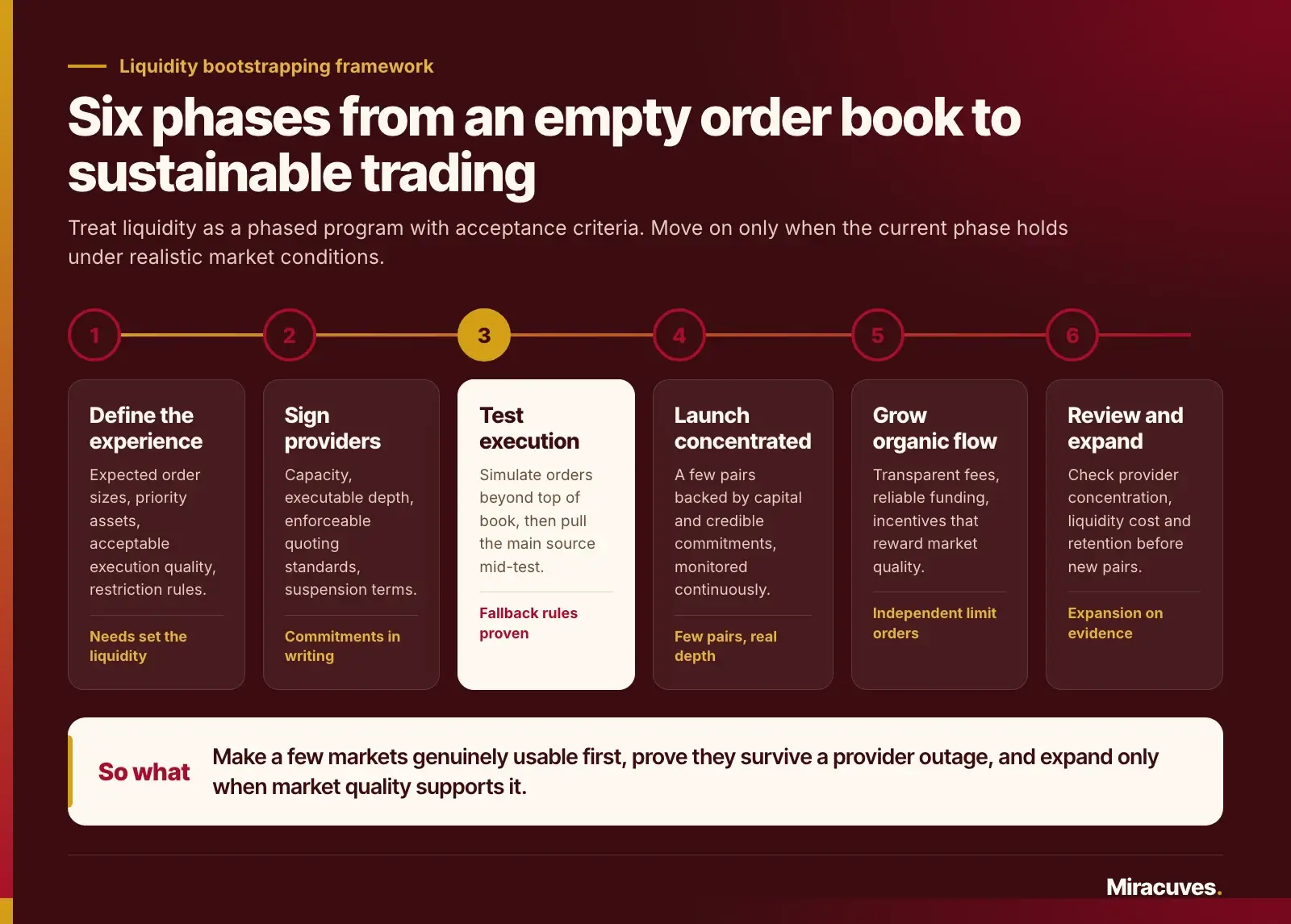
The most reliable approach to overcoming the cold-start problem is to treat liquidity as a phased operational program with measurable acceptance criteria.
Instead of assuming that a liquidity provider automatically solves the problem, founders should define the customer experience they want to deliver, determine which counterparties can support it, and test whether that experience survives realistic market conditions.
Phase 1: Define the Minimum Viable Trading Experience
Start with the intended customer. A platform designed for occasional small purchases has different execution requirements from one targeting active traders or larger professional orders.
Identify expected order sizes, priority assets, acceptable execution quality, customer funding methods, and the conditions under which trading should be restricted. These requirements will determine what kind of liquidity is actually necessary.
The important question is not how many orders can appear on screen. It is whether customers can complete the transactions they reasonably expect without unacceptable slippage or unreliable fills.
Phase 2: Establish Liquidity Provider Relationships
Evaluate potential counterparties for financial capacity, executable depth, operational history, permitted jurisdictions, technical reliability, and willingness to commit to defined quoting standards.
Commercial negotiations should address fees or rebates, funding requirements, custody, exposure limits, execution responsibility, settlement, reporting, and the circumstances under which quoting can be suspended.
A provider that quotes aggressively during a demonstration but has no enforceable commitment or clearly defined execution arrangement may not offer the resilience a new exchange requires.
Phase 3: Test Execution Before Opening to Customers
Before enabling production trading, the venue should simulate market buys and sells at several sizes, including orders that exceed the quantity available at the top of the book.
Tests should verify price calculations, order matching, partial fills, fee deductions, external execution, ledger consistency, failed hedges, and recovery after interrupted connections.
A particularly useful test is to remove the primary liquidity source during a simulated busy period. The system should respond according to its documented fallback rules rather than continue offering quotes that cannot be honored.
Phase 4: Launch With a Concentrated Market Strategy
Begin with a limited set of pairs supported by available capital and credible liquidity commitments. Monitor execution quality continuously, and avoid introducing additional markets simply to make the exchange appear larger.
Early customer feedback should be connected to measurable trading outcomes. If customers complain that orders are expensive to execute, inspect spreads, depth, routing behavior, and fee calculations before assuming the issue is purely a user-interface problem.
Phase 5: Develop Organic Participation
Externally supported liquidity creates the initial conditions for trading, but long-term sustainability depends on attracting independent participants who have genuine reasons to buy, sell, and provide orders.
Exchange operators can encourage participation through transparent fee schedules, reliable funding and withdrawal processes, suitable order types, responsive support, and liquidity incentives that reward legitimate market quality rather than artificial activity.
As organic trading develops, the operator can examine whether it is possible to reduce reliance on contractual quoting support without materially damaging execution quality.
Phase 6: Review Provider Dependence and Expand Selectively
Once the initial markets demonstrate stable participation, assess the concentration of trading activity, liquidity costs, provider reliability, and customer retention. Expansion should follow evidence of sustained demand.
A new pair should have a documented liquidity source, expected user demand, sufficient operational monitoring, and defined circumstances for suspension or delisting.
This disciplined approach produces a more credible market than launching a large collection of weakly supported trading pairs.
How to Measure Whether a Liquidity Strategy Is Working
Liquidity programs should be measured through execution outcomes rather than marketing metrics. Registered users, displayed orders, and reported volume may be useful context, but none of them independently demonstrates that customers can trade efficiently.
A founder-focused monitoring framework should connect market data to the actual experience of submitting an order.
| Metric | What It Reveals | Founder Decision |
|---|---|---|
| Median and High-Percentile Spread | Measures trading costs during normal and volatile market conditions | Review market-maker quoting performance and spread consistency |
| Depth Within Defined Price Bands | Shows available buy and sell order quantities near the current market price | Evaluate whether liquidity supports expected trade sizes |
| Realized Slippage by Order Size | Measures actual execution quality and price differences during trades | Identify insufficient order-book depth or routing inefficiencies |
| Two-Sided Quote Availability | Tracks the consistency of buy and sell quotations | Assess liquidity provider reliability and market availability |
| Order Rejection and Partial-Fill Rates | Indicates how reliably customer orders are executed | Improve order limits, matching processes, and execution handling |
| External Execution and Hedge Failures | Highlights liquidity provider dependencies and infrastructure risks | Strengthen failover mechanisms and exposure controls |
| Independent Trader Participation | Measures the growth of genuine buying and selling activity | Determine when external liquidity incentives can be reduced |
| Liquidity Cost per Legitimate Filled Volume | Evaluates the financial sustainability of liquidity support | Optimize provider fees, market-making agreements, and incentive strategies |
These measurements should be separated by trading pair, order size, and market condition. An exchange may provide satisfactory execution for small orders during calm periods while performing poorly for larger orders during volatility.
There is no universally appropriate spread or depth threshold for every asset. Targets should reflect asset volatility, legitimate customer behavior, external market conditions, and the exchange’s risk tolerance.
Operators should also preserve historical records. Comparing market quality before and after fee changes, provider additions, or new listings makes it easier to determine whether operational decisions actually improved the trading experience.
When Does a New Exchange Become Less Dependent on Market Makers?
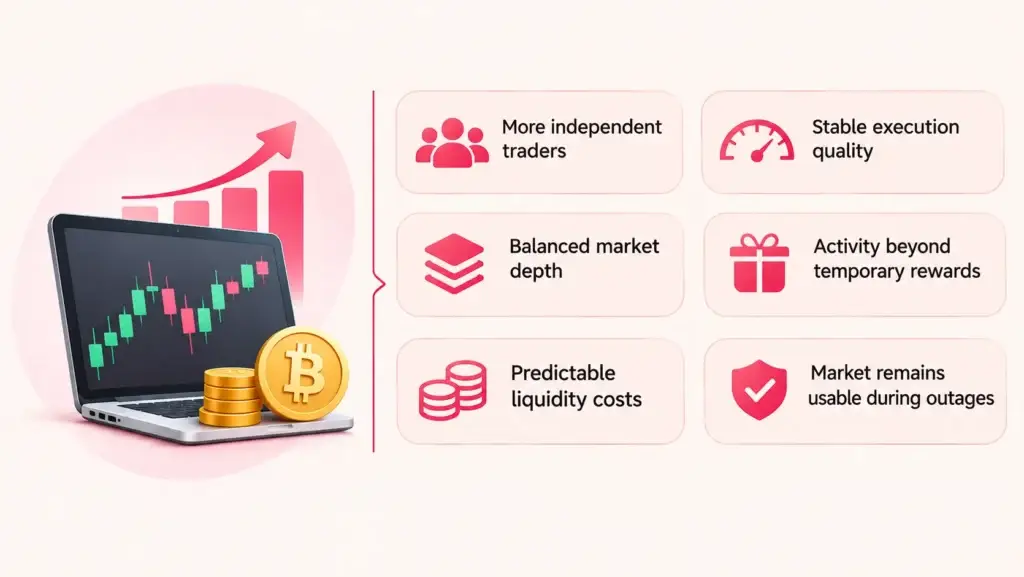
A successful liquidity program should eventually produce more than attractive quotations. It should create conditions where real participants contribute to the market because they find the venue useful.
Organic liquidity develops as traders gain confidence in execution, funding reliability, asset availability, customer support, and the consistency of market operations. Some participants begin posting their own limit orders, while others contribute trading flow that professional liquidity providers consider economically worthwhile.
Building sustainable liquidity also depends on attracting genuine traders who return to the platform and participate consistently. Even when market makers provide initial order-book depth, an exchange needs effective user acquisition, community engagement, and retention strategies to develop organic trading activity. A well-planned crypto exchange marketing strategy after launch can help founders turn early market availability into sustained trader participation and gradually reduce reliance on externally supported liquidity.
However, growth in trading volume does not automatically mean an exchange can eliminate professional market-making support. Even mature venues may rely on external liquidity providers to maintain consistent depth across less active markets or during difficult conditions.
Signs That Liquidity Is Becoming Sustainable
- More independent participants regularly place genuine limit orders.
- Execution quality remains acceptable during ordinary changes in trading demand.
- Market depth no longer depends overwhelmingly on a single counterparty.
- Customer activity is less dependent on temporary rewards or rebates.
- Liquidity support costs become more predictable relative to legitimate trading activity.
- Provider outages do not automatically eliminate all available trading opportunities.
Founders should evaluate these signals over time and under different market conditions. A temporary increase in volume during a promotional campaign is not enough to establish that a market has become self-sustaining.
Founder Decision Signals: Is Your Exchange Ready for Real Trading?
A trading venue should be considered market-ready only when its operational capabilities match the promises made to customers. This requires more than deploying an exchange interface and receiving confirmation that a liquidity API is connected.
Liquidity Readiness
Are executable two-sided quotes available for the order sizes your intended customers are likely to submit?
Counterparty Resilience
Is there an agreed response when a liquidity provider stops quoting, a hedge fails, or collateral becomes insufficient?
Market Integrity
Can your operations team distinguish genuine trading activity from misleading volume, abusive orders, or manipulation?
Economic Sustainability
Can the business support liquidity-related fees and capital requirements while organic participation develops?
These questions help distinguish software deployment from operational launch readiness. A venue can be technically ready while still lacking an adequate liquidity agreement, funded execution accounts, or necessary regulatory permissions.
Common Liquidity Bootstrapping Mistakes Founders Should Avoid
Mistake 1: Assuming an Order Book Creates Liquidity
An order book displays and organizes available orders. It cannot manufacture genuine demand. If nobody is willing to trade, building a sophisticated matching interface will not make the market liquid.
Mistake 2: Selecting Providers Only by Quoted Spread
A provider offering a narrow spread may still supply insufficient depth, unreliable quotes, or restrictive execution conditions. Compare executable outcomes, available funding, downtime behavior, and commercial obligations.
Mistake 3: Launching Too Many Markets Too Early
Adding more trading pairs creates additional liquidity and monitoring obligations. If resources are limited, a concentrated set of useful markets can provide a stronger foundation than numerous inactive listings.
Mistake 4: Confusing High Volume With Healthy Markets
Volume alone says little about trading costs, available depth, or market integrity. Prioritize genuine participation, low execution friction, and verifiable liquidity quality rather than artificial activity designed to make a venue look popular.
Mistake 5: Ignoring Liquidity Costs After Launch
Liquidity arrangements can involve fees, rebates, collateral requirements, inventory exposure, external execution costs, and ongoing monitoring. These obligations must be incorporated into the operating plan rather than treated as one-time setup expenses.
Mistake 6: Depending on One External Counterparty
Overdependence on one liquidity provider can create operational concentration risk. Where commercially feasible, founders should evaluate alternatives and establish appropriate fallback behavior before customers are affected by a provider outage.
Why Liquidity Strategy and Exchange Infrastructure Must Work Together
Liquidity cannot be separated entirely from the technology that processes customer orders. A strong provider agreement delivers limited value if market data arrives late, order updates are mishandled, balances are inaccurate, or execution reports fail to reconcile.
The trading foundation should support accurate order-state changes, reliable market-data handling, provider-specific limits, clear execution records, and operational controls for unusual market conditions. It should also provide enough visibility for an operations team to investigate discrepancies without relying on guesswork.
This is where implementation decisions become commercially important. Founders evaluating exchange infrastructure and liquidity integration should look beyond whether an API connection exists and consider how routing, reconciliation, failure handling, and market-risk reporting will operate in production.
Miracuves supports the technical foundation for these workflows through configurable trading infrastructure, such as its Binance-style exchange platform, and external liquidity connectivity. The commercial arrangements with market makers and other liquidity providers remain the responsibility of the exchange operator.
For teams considering a ready-made deployment, Miracuves also offers a 6-working-day solution delivery option where the agreed product scope fits its ready-made foundation. That timeline refers to the software deployment; funding arrangements, liquidity partnerships, licensing, and external approvals may require additional time.
Liquidity spending also has to fit the revenue plan. Maker rebates, market-maker fees and listing costs are paid out of the same trading-fee income, so model them together with the crypto exchange business model before you commit to incentive levels.
Final Thoughts: Liquidity Must Be Built Into the Market Strategy
The cold-start problem is one of the most important challenges facing a new cryptocurrency exchange because it directly affects the first real transaction a customer attempts to make.
A technically capable trading platform can still disappoint users if buyers and sellers cannot find reasonable prices or sufficient executable depth. Conversely, an exchange that begins with a carefully defined set of markets, reliable liquidity relationships, strong monitoring, and realistic risk controls has a better foundation for earning trader confidence.
Shared liquidity can provide access to outside depth. Professional market makers can support continuous two-sided quotations. Well-designed incentives can encourage legitimate order placement. But none of these approaches removes the need for sustainable customer demand, reliable execution, and responsible market operations.
For founders, the strongest strategy is to solve the immediate execution problem without creating uncontrolled long-term dependence. Start with the trading experience customers actually need, measure liquidity honestly, protect the venue against provider failures, and expand only when market quality supports it.
Ultimately, a successful exchange is not defined by the number of markets displayed on its homepage. It is defined by whether people can trade confidently, consistently, and under conditions they understand.
FAQs
What is the cold-start problem in a crypto exchange?
The cold-start problem occurs when a new exchange has too few active buyers and sellers to provide dependable execution. Traders hesitate to participate because liquidity is limited, while liquidity providers may hesitate because trading demand is uncertain. Exchanges can address this through market-making agreements, external liquidity arrangements, and focused market activation.
How do new crypto exchanges get their first liquidity?
New exchanges commonly source early liquidity through professional market makers, external liquidity providers, and aggregation or routing arrangements. Some also introduce maker-fee incentives or carefully controlled inventory support. The appropriate combination depends on target assets, customer order sizes, capital, operational design, and applicable regulations.
How does shared liquidity work for a crypto exchange?
Shared liquidity arrangements give a venue access to external trading interest through executable quotes, funded orders, or external order execution. Depending on the model, trades may be matched locally or routed and hedged through a partner. Shared liquidity requires appropriate agreements, funded accounts, execution controls, and monitoring; it does not automatically combine exchange balances.
Why are market makers important for new exchanges?
Market makers provide two-sided buying and selling quotations, helping customers find counterparties before organic trading becomes established. Their effectiveness depends on executable quote size, spreads, uptime, inventory management, and the terms of their liquidity agreement. A common way to measure their contribution is plus or minus 2% depth, the value of orders resting within 2% of the mid price.
Can a crypto exchange launch without market makers?
Yes, but it needs another credible source of buying and selling interest. A venue with an active existing trading community may generate organic orders, while another may rely on aggregation or an alternative execution model. Launching a general-purpose order-book exchange without adequate liquidity is likely to produce poor execution for early users.
What is the difference between trading volume and order-book liquidity?
Trading volume measures the quantity traded over a period. Order-book liquidity concerns the executable orders available at particular prices and quantities. High reported volume does not guarantee narrow spreads, sufficient depth, or low slippage, and it can be inflated by wash trading. Operators should monitor both market depth and actual execution outcomes.
How much do crypto market makers charge?
There is no public price list. Market makers usually work on a monthly retainer for agreed spread, depth and uptime targets, on token loans with call options (mostly for token issuers), or through maker rebates paid by the venue. Terms are negotiated per pair and per venue, so request written quotes and compare them on cost per unit of verified plus or minus 2% depth rather than on the headline fee.
Is shared order book liquidity legal?
Sharing liquidity is a commercial arrangement and is not banned in itself, but the exchange and its partner must each be authorized where they serve customers. Routing also has to meet local rules on best execution, custody, conflicts of interest and market abuse, such as the MiCA market-abuse provisions in the EU. Take legal advice for each market before connecting an external order book.
What happens when a liquidity provider stops quoting?
The exchange may experience wider spreads, reduced order-book depth, or temporarily unavailable markets. Depending on its architecture and risk policies, it may switch to alternative providers, cancel stale orders, reduce order-size limits, or suspend affected markets. These procedures should be tested before production launch.
How can an exchange reduce long-term dependence on market makers?
Operators can encourage genuine limit-order participation, maintain reliable trading and funding operations, develop relevant asset markets, and evaluate incentives against real execution quality. Dependence may decrease as organic participation grows, although professional market makers can remain valuable in mature markets.
Miracuves is an independent software development company. We are not affiliated with, connected to, sponsored by, or endorsed by any company or product named in this article.
Terms such as “X Clone” are used descriptively. It is how the software industry refers to building a platform with functionality comparable to a known service, and how clients search for it.
The entire design and codebase of our products is built by our own team. Our products contain no code, design, graphics, or content originating from any third-party website or applications.
All third-party names and marks referenced in this article are the property of their respective owners, referenced solely to identify the services discussed.