
Subscriptions are not the only way to generate revenue from a dating platform. Some users are willing to pay for ongoing premium access, while others prefer smaller purchases tied to a specific moment: sending a virtual gift, increasing profile visibility, or attending an organized dating event.
For founders, this creates an opportunity to build a more flexible revenue model.
Dating app monetization beyond subscriptions focuses on converting meaningful user actions into optional purchases rather than relying entirely on recurring membership fees. For founders exploring these revenue opportunities, a ready-made dating app solution can provide a practical foundation for introducing monetization features. However, introducing more payment options does not automatically create a profitable business. Every transaction needs to deliver recognizable value, preserve user trust, and cover its operational costs.
This guide explores three monetization opportunities—virtual gifting, paid profile boosts, and pay-per-date services—and explains when to use them, how to measure their performance, and which risks founders should address before scaling.
Key Takeaways
- Dating app microtransactions allow users to pay for specific experiences without committing to a recurring plan.
- Virtual gifting can monetize expressions of interest, particularly when gifts enhance an existing social interaction.
- Profile boosts sell temporary visibility, but their usefulness depends on sufficient relevant, active members.
- Pay-per-date models are most practical when connected to clearly defined services, such as optional events or reservations, rather than payments for romantic access.
- Net revenue, repeat purchasing, refund rates, user satisfaction, and marketplace health matter more than transaction volume alone.
- A hybrid model can combine subscriptions with occasional purchases, provided free users still have a meaningful dating experience.
Why Dating Apps Are Exploring Revenue Beyond Monthly Subscriptions
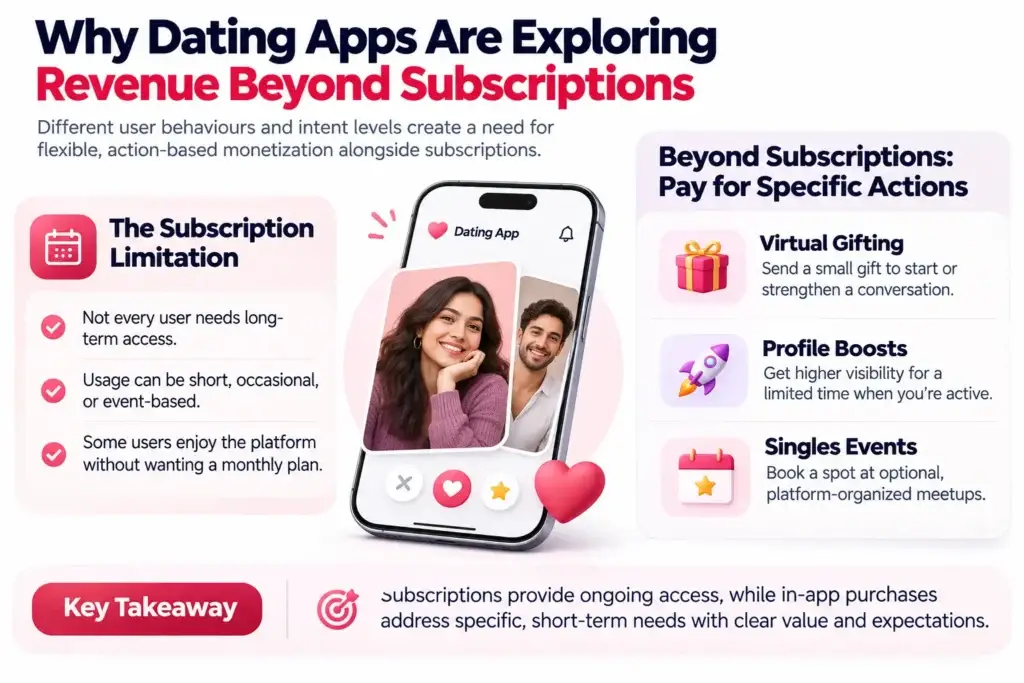
Subscription-based monetization is straightforward: users pay for premium benefits over a fixed billing period. This model can provide predictable recurring revenue, but it assumes that enough members see ongoing value in maintaining a paid plan.
Dating behavior is not always consistent enough to support that assumption.
A person might use an app frequently for two weeks, meet someone, and stop browsing. Another might return occasionally and want temporary visibility for a particular evening. A third may enjoy social features but have no reason to purchase a monthly subscription.
These users have different willingness to pay.
Microtransactions give operators an opportunity to serve them without converting every member into a subscriber.
The difference between paying for access and paying for an action
A subscription typically provides access to a bundle of benefits. An individual purchase addresses a more immediate need.
For example:
- A member sends a small virtual gift to personalize a conversation.
- A member purchases a limited visibility boost during an active browsing period.
- Two consenting adults book places at an optional, platform-organized singles event.
Each transaction has a specific purpose.
The important distinction is that users should understand what they are purchasing and what outcome the platform can reasonably deliver.
Selling extra visibility is different from guaranteeing a match. Selling event admission is different from selling access to another person.
This distinction influences not only the business model but also user satisfaction, refund policies, and platform reputation.
Virtual Gifting: Monetizing Social Interaction Without a Monthly Commitment
Virtual gifting allows a member to purchase and send a digital item to another user. Gifts may include stickers, animated icons, themed illustrations, or other forms of digital expression.
Unlike a subscription, a gift purchase is usually associated with a particular interaction.
A user might want to celebrate a conversation, acknowledge a meaningful connection, or send a friendly gesture.
For operators, gifting creates an optional revenue opportunity around existing engagement.
How virtual gifting generates revenue
A simple virtual gifting transaction involves four stages:
- A member chooses a digital gift from a catalog.
- The member purchases the gift directly or uses previously purchased credits.
- The recipient receives the digital item, subject to their preferences and platform settings.
- The operator records the transaction and recognizes revenue according to its accounting and payment arrangements.
A credit-based model can simplify the purchasing experience for returning users.
For instance, a member might purchase a bundle of credits and spend them across several gifts. The operator must maintain an accurate credit ledger and distinguish purchased credits from credits already redeemed.
Which virtual gift formats make business sense?
| Gift format | User motivation | Monetization opportunity | Main consideration |
|---|---|---|---|
| Simple stickers | Friendly expression | Low-friction purchases | Avoid overwhelming the conversation |
| Animated gifts | Memorable interaction | Higher-value digital items | Manage animation and delivery costs |
| Seasonal gifts | Timely social gesture | Limited-time engagement | Avoid artificial pressure |
| Personalized gifts | Individual expression | Optional premium customization | Protect privacy and moderate content |
| Live-session gifts | Participation in interactive experiences | Frequent small purchases | Higher moderation and fraud exposure |
Not every dating product needs every gift category.
A community focused on meaningful conversations may perform better with thoughtful, low-pressure gifts than with expensive animations designed primarily to create spending competition.
What determines virtual gifting profitability?
Gift revenue depends on more than how many items are purchased.
Founders should evaluate:
Purchase conversion: What percentage of eligible active members buy a gift?
Average transaction value: How much does a typical gift purchase generate?
Repeat purchase rate: Do users purchase additional gifts after their first successful transaction?
Net contribution: What remains after applicable payment fees, refunds, taxes, variable infrastructure expenses, and moderation costs?
Recipient experience: Do recipients welcome gifts, ignore them, or report unwanted interactions?
A gifting system that produces revenue but increases harassment reports may create more long-term damage than value.
The risks of an unrestricted gifting economy
Virtual gifting becomes sensitive when users can convert gifts into cash or receive financial rewards.
Cash-convertible gifts introduce different concerns from purely decorative items, including fraud, payout eligibility, tax reporting, money-transfer rules, and the possibility of manipulative interactions.
Founders should avoid assuming that a standard digital gift catalog and a cash-payout gifting system can operate under the same rules.
A practical starting approach is to offer optional, non-redeemable gifts, allow recipients to restrict gifting, clearly disclose prices, and establish refund and abuse-reporting procedures.
Cash payouts should only be considered after appropriate payment-provider approval, legal review, and operational safeguards.
Profile Boosts: Turning Temporary Visibility Into a Paid Feature
A profile boost temporarily increases a member’s exposure within the platform’s discovery experience.
The value proposition is simple: users purchase an opportunity to be seen by more relevant members during a defined window.
However, a boost can only be useful when there is an active audience available to see the promoted profile.
How paid profile boosts work
A well-designed boost usually involves:
- A clearly defined promotion period.
- Eligibility based on geographic and preference settings.
- Additional exposure within relevant discovery results.
- Transparent rules on how promotion affects ranking.
- A purchase receipt and a record of the boost’s activation and expiration.
Operators should avoid promising a guaranteed number of matches or conversations.
Visibility can be increased through product logic. Another member’s interest cannot be guaranteed.
Why marketplace activity matters more than the boost button
Imagine two dating communities.
The first has a large number of registered profiles but relatively few active members within a particular city.
The second has fewer total registrations but a healthy concentration of active, compatible members.
A visibility boost may deliver more meaningful exposure in the second community because there are more relevant people browsing at the same time.
This illustrates an important principle:
Increasing promotion inventory before improving marketplace participation can disappoint paying members.
For a deeper look at the importance of local user density, Miracuves’ guide to post-launch marketing for dating apps explores geographically focused acquisition and early community engagement.
How should founders price profile boosts?
Boost pricing can be tested across several dimensions.
| Pricing dimension | Possible approach | What to measure |
|---|---|---|
| Duration | Short or extended exposure window | Useful profile impressions per purchase |
| Purchase frequency | Single boost or multi-boost package | Repeat usage and satisfaction |
| Geographic market | Region-specific pricing experiments | Conversion and market activity |
| Timing | Optional promotion during active periods | Incremental exposure compared with baseline |
| User eligibility | Boosts offered after profile completion | Downstream engagement quality |
Founders should not automatically charge more when demand increases.
The actual value of an additional boost may decline when too many promoted profiles compete for limited attention.
The risk of selling too much visibility
Every discovery screen has limited attention.
If promoted profiles dominate the experience, unpaid members may receive less exposure, while paying members may not gain the advantage they expected.
This creates a difficult trade-off.
Monetization should not make the core matching experience ineffective for free members.
Useful controls include promotion-frequency caps, exposure limits, relevance thresholds, and regular reviews of match quality.
Operators should also explain sponsored placement clearly enough that members understand how discovery works.
Pay-Per-Date Models: Monetizing Real-World Dating Services Responsibly
Pay-per-date is an ambiguous term.
It may refer to optional matchmaking events, reservation services, or pay-per-booking experiences. It can also be interpreted as paying someone to go on a romantic date.
These are materially different business arrangements.
For mainstream dating platforms, the more defensible approach is to charge for a legitimate, clearly described service while preserving free choice and mutual consent between participants.
A dating platform should never imply that a payment entitles someone to another person’s time, affection, contact, or romantic participation.
Model 1: Paid singles events
A platform may organize optional in-person activities for interested adults.
Examples include moderated speed-dating sessions, community mixers, hobby-based meetups, or ticketed social gatherings.
Revenue can come from event admission fees or legitimate partnerships.
The operator is selling an organized experience, not a romantic outcome.
Key operational requirements include attendance policies, age eligibility, event cancellation procedures, accessibility considerations, attendee privacy, and clear refund rules.
Model 2: Restaurant or venue reservation partnerships
A dating platform might offer optional reservation assistance after two users independently agree to meet.
Revenue may be generated through a disclosed referral arrangement or a permitted booking service fee.
The model should make clear:
- What service the fee covers.
- Whether the fee is refundable.
- Which business provides the booked service.
- Whether a referral commission exists.
- What happens when a venue cancels.
Both participants must remain free to decline or cancel the meeting.
Model 3: Optional curated matchmaking experiences
Some dating businesses may provide a paid human-assisted matchmaking or event coordination service.
The customer pays for defined work, such as consultation, scheduling, or organized introductions.
The service must not promise that another individual will accept a date or form a relationship.
Clear deliverables, participant consent, screening standards, and appropriate cancellation policies are essential.
Pay-per-date revenue models compared
| Model | What the customer purchases | Potential revenue stream | Important safeguards |
|---|---|---|---|
| Singles event | Event admission | Ticket revenue | Safety, cancellations, venue management |
| Venue reservation | Booking-related service | Service fee or permitted referral commission | Fee disclosure and refund clarity |
| Curated introduction | Defined matchmaking service | Service charge | Consent, screening, no outcome guarantees |
| Premium group activity | Optional social experience | Event or participation fee | Age checks, event moderation |
These models can create opportunities for founders targeting local communities or relationship-focused audiences.
However, they introduce operational responsibilities that are different from selling digital gifts or boosts.
Why pay-per-date should not be the first revenue model for every dating app
Digital purchases can be fulfilled inside the application.
Real-world services introduce venues, scheduling, cancellations, refunds, attendance management, and potentially additional legal obligations.
A founder without an established local community may struggle to fill events consistently.
For that reason, pay-per-date services are often more suitable as an expansion model once users are actively connecting and there is evidence of demand for offline experiences.
They should not be introduced merely because the platform needs another payment button.
Comparing Virtual Gifting, Profile Boosts, and Pay-Per-Date Models
Each monetization mechanism captures a different form of willingness to pay.
| Evaluation factor | Virtual gifting | Profile boosts | Pay-per-date services |
|---|---|---|---|
| User motivation | Express interest | Gain visibility | Participate in a defined experience |
| Revenue type | Digital microtransaction | Digital microtransaction | Event or service transaction |
| Operational complexity | Low to moderate for non-cash gifts | Moderate | Often higher |
| Depends on active audience | Yes | Strongly | Strongly, usually locally |
| Refund/dispute exposure | Digital-purchase disputes | Performance expectation disputes | Booking, service, and cancellation disputes |
| Primary risk | Unwanted or manipulative gifting | Unfair or ineffective visibility | Safety and service-delivery issues |
| Practical starting point | Engaged social communities | Active matching markets | Established local communities |
There is no universal winner.
A founder should choose based on user motivation, product maturity, operational capacity, and the type of experience the platform wants to encourage.
How to Calculate Revenue From Dating App Microtransactions
Gross purchases can make a monetization feature appear successful even when the business receives little economic benefit.
A stronger evaluation separates transaction revenue from associated variable costs.
Step 1: Estimate purchase volume
For a specific purchase type:
Step 2: Calculate gross transaction revenue
Step 3: Estimate contribution after variable costs
This is an illustrative contribution calculation, not necessarily accounting net income. Tax treatment, revenue recognition, partner payouts, and other expenses need separate consideration.
Example: A hypothetical virtual gifting experiment
Assume a dating platform has:
- 10,000 eligible monthly active users.
- A 3% purchasing conversion rate.
- Two gift purchases per purchasing user per month.
- An average purchase value of $2.
The estimated results would be:
| Metric | Illustrative calculation | Result |
|---|---|---|
| Paying users | 10,000 × 3% | 300 |
| Monthly transactions | 300 × 2 | 600 |
| Gross purchase value | 600 × $2 | $1,200 |
| Assumed refunds | 2% of gross | $24 |
| Assumed processing/store costs | 15% of gross | $180 |
| Other assumed variable costs | Illustrative allowance | $96 |
| Contribution before fixed costs | $1,200 − $24 − $180 − $96 | $900 |
These are hypothetical inputs for demonstrating the calculation, not industry benchmarks or promised results. Actual platform fees vary by payment method, geography, program eligibility, and applicable policies.
The important lesson is that $1,200 in purchases does not necessarily mean $1,200 in business contribution.
Founders should also evaluate whether the transaction improves or damages future engagement.
Which Monetization Model Should Founders Introduce First?
The decision should begin with observed member behavior rather than the popularity of a particular revenue feature.
Start with virtual gifts when conversations are already active
A gifting experiment may be appropriate when members regularly interact, recognize one another, and appear interested in personalized forms of expression.
The first experiment could focus on a small catalog of optional gifts.
Measure first purchases, repeat gifting, recipient preferences, refund requests, and abuse reports before expanding the catalog.
Test boosts when discovery has sufficient liquidity
A visibility experiment becomes more credible when members consistently see relevant, active profiles.
Start with limited boost inventory and compare exposure and subsequent engagement against appropriate non-purchasing baselines.
A useful experiment should measure whether users receive additional meaningful exposure, not simply whether the promotion appears in the interface.
Add date-related transactions when offline demand exists
Optional events or venue services become more attractive when a community already has enough local participation.
Start with a narrowly defined offering, reliable partners, and transparent service terms.
Measure completed bookings, attendance, refunds, participant satisfaction, and operating costs.
Avoid expanding to new locations until existing events demonstrate repeatable demand.
Founder Decision Signals: What to Validate Before Scaling
A practical monetization decision involves four factors.
1. User readiness
Are members already receiving meaningful value from the free product? If not, additional paid features may create resistance rather than revenue.
2. Transaction quality
Are customers buying voluntarily, understanding the benefit, and returning because the experience was worthwhile?
3. Operational control
Can the platform accurately record purchases, maintain credit balances, resolve disputes, prevent abuse, and identify suspicious activity?
4. Marketplace health
Do paid features improve the user experience without undermining discovery, communication, or fairness for everyone else?
These factors can be more important than the headline conversion rate.
A revenue model should strengthen the platform’s long-term sustainability, not depend on making normal interactions unnecessarily difficult.
What Technical and Operational Controls Do These Models Require?
Founders often think about the visible purchase feature first.
However, sustainable microtransaction revenue depends on reliable processes behind the purchase.
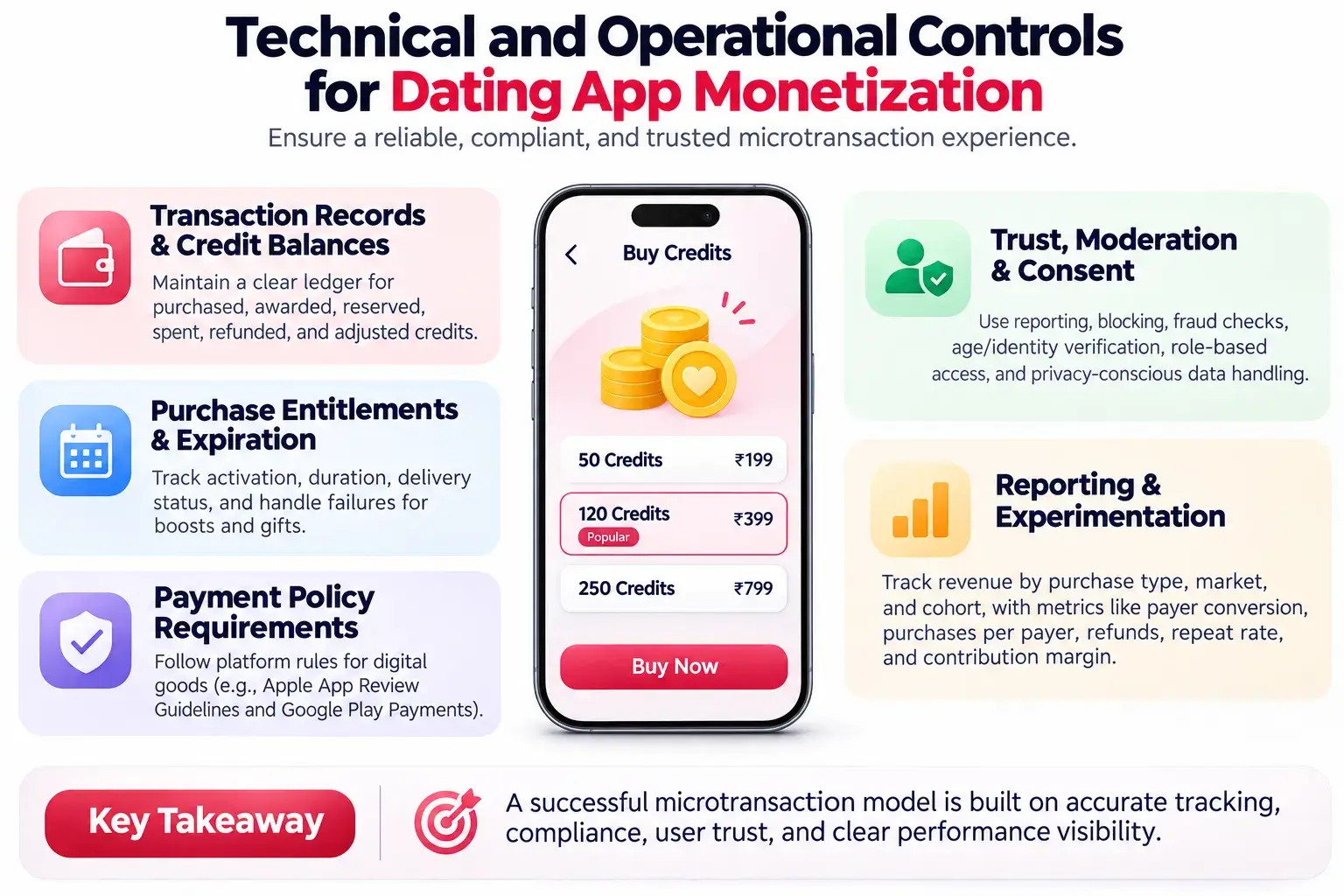
Transaction records and credit balances
A credit-based purchase system should maintain a traceable transaction history.
It needs to distinguish credits purchased, awarded, reserved, spent, refunded, and adjusted.
Repeated payment notifications should not credit a wallet multiple times. A failed redemption should not consume purchased credits permanently.
A reliable ledger and reconciliation process are essential, particularly when transactions increase.
Purchase entitlements and expiration
A profile boost requires more than successful checkout.
The platform needs to know when the boost begins, how long it remains active, whether it has been delivered, and what happens if activation fails.
Gift purchases require similarly reliable delivery records.
Payment policy requirements
Digital goods and in-app functionality are subject to the payment policies of the stores through which an application is distributed.
For example, digital gifts, virtual credits, and profile boosts generally fall within in-app purchase requirements, subject to applicable regional exceptions or permitted alternative billing arrangements.
Physical services, real-world events, and eligible person-to-person services may be treated differently.
Founders should review the current Apple App Review Guidelines and Google Play Payments policy before implementing checkout flows.
Trust, moderation, and consent
Dating platforms handle sensitive social interactions.
Useful safeguards include member reporting, blocking, fraud monitoring, age and identity verification appropriate to the target market, role-based administrative permissions, and privacy-conscious data handling.
No verification method eliminates all abuse.
Miracuves’ article on intent matching and reducing unproductive dating interactions provides additional context on why better user outcomes matter beyond raw activity volume.
Reporting and experimentation
Founders should be able to compare revenue by purchase type, geographic market, user cohort, and period.
Useful measurements include payer conversion, purchases per payer, refunds, repeat purchase rates, contribution margin, and moderation incidents associated with paid interactions.
Without this visibility, it becomes difficult to distinguish a scalable revenue stream from a short-lived promotion.
Common Mistakes That Weaken Dating App Monetization
Charging before users experience value
Introducing multiple purchase prompts during onboarding may discourage members before they understand the product.
A healthier sequence is to establish basic engagement, introduce relevant optional purchases, and measure whether users perceive real value.
Treating purchased visibility as guaranteed romantic success
A boost can increase exposure, but it cannot guarantee interest, compatibility, or a response.
Unrealistic promises create dissatisfaction and can increase refund requests.
Making the free experience intentionally ineffective
Free members are an important part of a dating community.
Over-restricting core functionality can reduce participation, which may also reduce the usefulness of paid features.
Ignoring fraud and abuse
Paid attention, virtual currencies, and date-related transactions can attract scammers or manipulative behavior.
Moderation and dispute management need to grow alongside transaction volume.
Expanding monetization without cohort analysis
A temporary increase in purchases does not prove long-term success.
Founders should monitor whether buyers remain active, whether non-buyers experience declining value, and whether the purchases produce sustainable contribution.
How a Ready-Made Platform Can Support Monetization Experiments
A founder does not necessarily need to build every basic dating interaction from scratch before testing a monetization strategy.
An existing product foundation can shorten the path to evaluating user behavior, provided its available modules and limitations match the proposed experiments.
For example, a platform with matching, messaging, credit purchases, gift delivery, promotion settings, and administration provides several relevant components for a digital microtransaction model.
Miracuves offers a ready-made dating platform foundation with a credit wallet, virtual gifting, upgrades, and administrative tools. Its ready-made deployment is positioned around a six-working-day timeline for the included scope, while additional customizations and app-store approvals require separate consideration.
For founders, the advantage is not simply launching faster. It is spending more time validating pricing, engagement, and revenue assumptions instead of rebuilding standard product flows.
A pay-per-date booking or event marketplace should not be assumed to be included in that foundation. Scheduling, payments, venue partners, event operations, and related safeguards would need an explicit scope review.
The broader dating and social discovery industry overview also provides context on platform trust, moderation, and product planning.
Final Thoughts: Monetize Meaningful Actions, Not User Frustration
Dating app monetization beyond subscriptions is ultimately about understanding when users willingly pay for additional value.
Virtual gifts can enhance social expression. Profile boosts can provide temporary visibility when the community is active enough. Pay-per-date services can generate transaction revenue from legitimate events, reservations, and curated experiences.
But none of these revenue streams works independently of the underlying community.
A platform with weak matching, unreliable payments, or poor user trust may struggle to retain paying members regardless of how many monetization features it introduces.
For founders, the stronger strategy is to establish a valuable free experience, test one revenue mechanism at a time, track contribution rather than gross sales alone, and expand only when the results support it.
Frequently Asked Questions
What is dating app monetization beyond subscriptions?
It refers to generating revenue from optional purchases or services rather than relying entirely on recurring membership fees. Examples include virtual gifts, profile boosts, credit packs, paid events, and eligible booking-related services.
How do virtual gifts generate revenue in dating apps?
Members purchase digital gifts directly or use previously purchased credits to send gifts during interactions. The platform earns revenue from eligible purchases, subject to payment costs, refunds, taxes, and applicable accounting treatment. Cash-redeemable gifts introduce additional legal and operational requirements.
Are paid profile boosts profitable for dating platforms?
They can be, particularly when the app has enough active, relevant members to deliver additional exposure. Profitability depends on purchasing conversion, repeat purchases, payment costs, promotional inventory, and user satisfaction. Boosts should not promise guaranteed matches.
What is a pay-per-date dating app business model?
The term can describe transactions for legitimate, optional dating-related services, including singles events, venue reservations, or curated introductions. It should not be interpreted as purchasing another person’s romantic participation or consent. Services need transparent terms, appropriate safeguards, and applicable legal review.
Can a dating app combine subscriptions and microtransactions?
Yes. A hybrid model can offer ongoing premium memberships alongside optional purchases such as gifts or boosts. Founders should test the models separately to understand whether they serve distinct user needs or merely shift revenue between payment options.
How should startups price virtual gifts and profile boosts?
Pricing should reflect user-perceived value, actual purchase behavior, transaction costs, and the available market. Small, controlled experiments are preferable to relying on assumed industry averages. Operators should compare conversion, repeat purchasing, refunds, and contribution margin across different offers.
What metrics should founders track for dating app microtransactions?
Important metrics include eligible active users, payer conversion, average revenue per paying user, purchase frequency, refund rate, repeat purchase rate, contribution margin, and paid-feature-related complaints. Retention and the overall health of the matching experience should also be monitored.
What should a founder check before adding a new dating app payment feature?
Confirm that the paid feature delivers clear value, that payment and fulfillment workflows are reliable, that platform billing policies are followed, and that users retain control over interactions. Review moderation, privacy, refunds, fraud prevention, and the operational work needed to support the feature.
Miracuves is an independent software development company. We are not affiliated with, connected to, sponsored by, or endorsed by any company or product named in this article.
Terms such as “X Clone” are used descriptively. It is how the software industry refers to building a platform with functionality comparable to a known service, and how clients search for it.
The entire design and codebase of our products is built by our own team. Our products contain no code, design, graphics, or content originating from any third-party website or applications.
All third-party names and marks referenced in this article are the property of their respective owners, referenced solely to identify the services discussed.