Key Takeaways
- mobility super app careem grab model. It can connect transport, delivery, rentals, and other location-based services through shared infrastructure.
- Shared infrastructure should not mean identical operations. Identity, payments, location, and notifications can be shared while each service keeps its own business rules.
- Service-aware dispatch is essential. Providers should be filtered by availability, vehicle type, permissions, timing, and service eligibility before assignment.
- Driver capacity must be protected across services. Passenger bookings, deliveries, and scheduled trips should not create overlapping commitments.
- A shared wallet needs strong financial architecture. Customer balances, payments, refunds, commissions, partner earnings, and promotional credits should remain traceable.
- A transaction ledger is critical. Financial events should be recorded consistently so the platform can reconcile payments and investigate disputes or duplicate transactions.
- Idempotency and controlled state transitions prevent operational errors. Stable booking and transaction identifiers help avoid duplicate assignments and charges during retries or network failures.
- More services do not automatically mean more profit. Founders should measure assignment success, cancellations, payment reliability, utilization, and contribution margin by service.
- Mobility expansion should happen in phases. Establish reliable core ride operations before introducing additional services that compete for the same provider capacity.
- Ready-made platforms can accelerate the foundation. A prebuilt mobility platform can provide common booking, identity, location, payment, and administrative capabilities while specialized requirements are customized separately.
- The strongest Careem- or Grab-style model is an integrated operating ecosystem. Its success depends on coordinating customer demand, provider capacity, service-specific workflows, and financial transactions rather than simply adding multiple services to one app.
A modern mobility business may start with taxi bookings, but its long-term opportunity can extend into parcel delivery, scheduled transport, vehicle rentals, and other location-based services. Bringing these operations into one application sounds straightforward until different types of demand begin competing for drivers, payments move between multiple service categories, and cancellations affect both customer balances and partner earnings.
This is where mobility super app architecture becomes a business-critical decision. A successful multi-service platform needs more than several booking options on one home screen. It needs a coordinated dispatch environment, consistent customer identity, reliable payment processing, and a financial record that accurately tracks every transaction. Entrepreneurs evaluating a White label ride hailing platform should understand these operational dependencies before expanding into multiple services.
The real advantage of an integrated mobility ecosystem comes from connecting services where shared infrastructure creates value while keeping specialized operations independent. A passenger ride, a scheduled rental, and a parcel delivery may use location data, dispatch infrastructure, and payment services, but each has different completion requirements, operational risks, and financial rules.
For founders, this raises two important questions: How should a platform allocate resources across different service categories without affecting reliability? And how can customers use a shared in-app wallet while the business maintains accurate revenue, refund, and settlement records?
This guide explains the architecture, operational decisions, financial workflows, and expansion principles behind these challenges. The focus is on publicly observable super app patterns and sound system-design practices, not claims about any particular company’s undisclosed internal technology.
What Makes a Mobility Super App Different From a Standard Ride-Booking Platform?
A traditional ride-booking application focuses on connecting passengers with suitable drivers. Its primary operational cycle includes booking creation, fare estimation, driver assignment, trip tracking, payment confirmation, and support.
A mobility super app extends this model by coordinating several services through a shared digital environment. The customer may use one account to book transport, request a delivery, manage a scheduled journey, or access another available service.
Although these activities appear connected from the customer’s perspective, each service follows a different operational sequence.
A passenger trip typically involves pickup confirmation, route navigation, and arrival at a destination. A parcel delivery may require sender instructions, recipient information, proof of handover, and unsuccessful-delivery handling. A rental booking may depend on vehicle availability across several hours rather than the nearest driver at a particular moment.
Trying to manage every service with identical booking and dispatch rules introduces unnecessary complexity. The platform should share common infrastructure while respecting the business logic of each service.
The Shared Foundation of a Multi-Service Mobility Ecosystem
At the platform level, several capabilities can be reused across services: customer authentication, provider identity, geolocation, notifications, payment instruments, transaction history, customer support, and administrative reporting.
This shared foundation reduces the need for customers to maintain separate accounts and helps operators develop a connected view of service activity. It can also make future expansion more manageable because a new service does not necessarily require rebuilding every foundational component.
However, shared infrastructure does not mean every service should share every database table, business rule, or operational permission. Financial and fulfillment boundaries must remain explicit.
| Operational Layer | Shared Platform Responsibility | Service-Specific Responsibility |
|---|---|---|
| Customer identity | Account and authentication | Service eligibility and preferences |
| Booking | Request identification and notifications | Booking states and requirements |
| Dispatch | Provider availability and allocation coordination | Eligibility, priority, and fulfillment logic |
| Payments | Payment instruments and ledger services | Fares, fees, refunds, and settlement rules |
| Operations | Monitoring, permissions, and support | Service-level performance and exception handling |
This distinction forms the foundation of scalable mobility super app architecture: a connected platform that avoids forcing fundamentally different services into one rigid operating model.
How Multi-Service Dispatch Works Inside a Mobility Super App
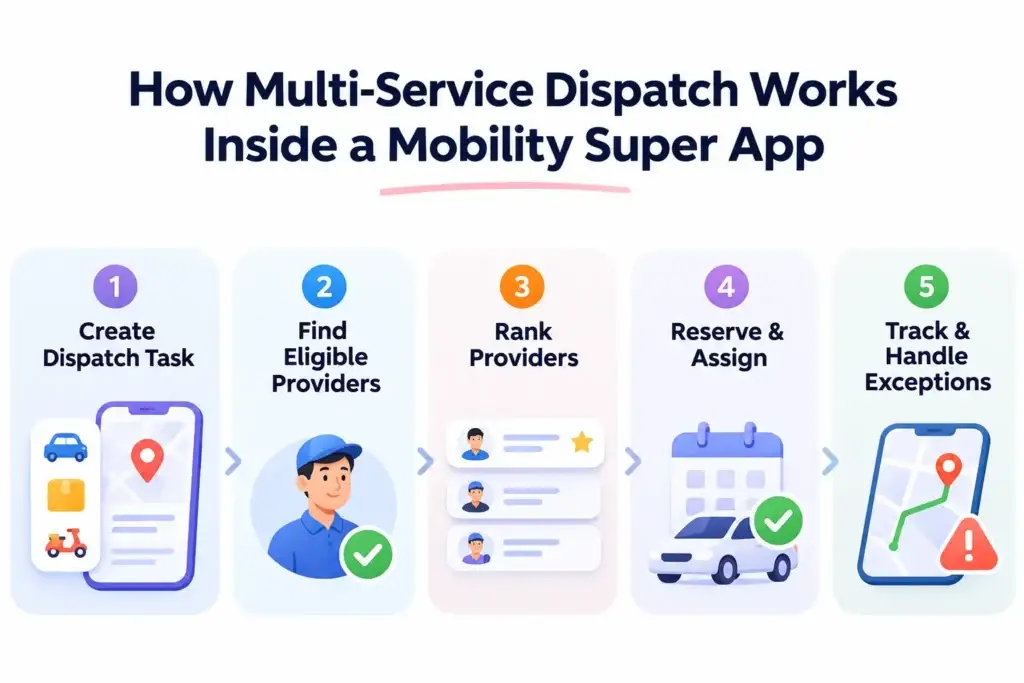
Dispatch is the operational mechanism that decides which available provider should receive a service request, under what conditions, and at what time.
In a single-service business, dispatch decisions may concentrate on driver proximity, availability, vehicle category, and expected arrival time. A multi-service platform must evaluate additional conditions because the same provider network may support different types of work.
For example, a driver may be available for passenger transport but not authorized or equipped to deliver a particular category of goods. Another provider may accept scheduled jobs but not immediate requests. Some vehicles may satisfy multiple service requirements, while others can operate in only one category.
The dispatch system must understand these distinctions before assigning a request.
Step 1: Convert Each Request Into a Structured Dispatch Task
When a customer submits a request, the relevant service creates a booking record containing the information needed for fulfillment.
A passenger booking might contain the pickup location, destination, requested vehicle category, schedule, and accessibility preferences. A parcel request might additionally include package characteristics, receiver details, handling instructions, and proof-of-delivery requirements.
The platform should transform these records into a dispatch task with a common set of operational fields, such as request identifier, service type, location, timing, and eligibility requirements.
Service-specific details remain available to the relevant execution system. This allows central dispatch coordination without eliminating the differences between passenger transport and delivery operations.
Step 2: Identify Eligible Providers Before Ranking Them
Proximity alone is not enough to determine suitability. Before ranking possible providers, the system should apply eligibility rules.
- Is the provider currently available?
- Is the vehicle appropriate for the requested service?
- Does the provider have the necessary permissions or qualifications?
- Can the provider meet the pickup time or delivery window?
- Does an existing assignment prevent accepting another job?
- Are there geographic, fleet, or operational restrictions?
Only providers satisfying the applicable conditions should enter the allocation process. This prevents the system from offering assignments that cannot be fulfilled reliably or legally.
Step 3: Rank Providers According to Service Priorities
After eligibility filtering, a dispatch engine can rank potential providers using operational factors such as estimated arrival time, current location, workload, pickup distance, service-level commitments, and applicable fleet rules.
The weighting should vary by service. An immediate passenger booking may place significant emphasis on pickup time. A scheduled parcel delivery may prioritize an achievable delivery window and provider capacity. A rental booking may depend on vehicle availability over an extended period.
This is why a single universal dispatch score can become unreliable as new categories are introduced. A better architecture supports service-specific decision policies while using a common provider availability system.
Step 4: Reserve Capacity and Confirm Assignment
Once an eligible provider is selected, the platform must prevent conflicting assignments. Two independent service requests should not claim the same driver for overlapping commitments unless the operating model explicitly supports compatible multi-stop work.
A capacity reservation can temporarily hold an eligible provider while the system waits for acceptance or confirms the assignment. The reservation must have a clear expiration rule so unavailable or unresponsive providers do not remain blocked indefinitely.
Assignment records should use versioning or comparable concurrency controls to ensure that retries, simultaneous requests, and delayed messages cannot create conflicting active jobs.
Step 5: Monitor Fulfillment and Handle Exceptions
Dispatch does not end when a driver accepts the request. The platform must track progress until the service reaches a legitimate terminal state.
Depending on the service, this can include arrival confirmation, pickup, journey progress, delivery handover, completion, cancellation, or manual intervention.
If a provider cancels, becomes unreachable, or cannot complete the assigned work, the system needs a controlled recovery path. That may involve reallocation, customer notification, revised pricing, or support-team intervention.
A reliable dispatch environment is therefore both an allocation mechanism and an exception-management system.
Illustrative Multi-Service Dispatch Flow
Customer Request → Service Validation → Dispatch Task → Eligible Provider Pool → Allocation → Capacity Reservation → Acceptance → Fulfillment Tracking → Completion
Exception path: Rejection, timeout, or cancellation → Release reservation → Reassess eligibility → Reassign or cancel with appropriate customer and payment updates.
Why Shared Driver Networks Need Service-Aware Dispatch Rules
One potential advantage of a mobility super app is better utilization of available providers. A driver who completes a passenger trip might encounter a suitable delivery opportunity nearby instead of remaining idle.
However, this benefit is conditional. It depends on vehicle eligibility, geographical demand, contract terms, working-hour limits, service permissions, and the economic value of the additional assignment.
Offering every available task to every driver can create confusion and lower acceptance rates. The platform needs rules that determine which service categories each provider can perform and how assignments should be prioritized.
Avoiding Conflicts Between Passenger and Delivery Demand
Consider a driver approaching the end of a passenger journey. The system detects a parcel request nearby while another passenger requests a pickup in the same area.
The correct assignment is not automatically the closest or highest-priced job. The platform must consider whether the current trip is complete, whether the provider can handle the parcel, the delivery deadline, the passenger pickup commitment, and the driver’s expected availability.
A scheduling engine can evaluate the feasible options and make an assignment according to the service’s policies. Where the platform supports combined routes, it must also verify that accepting additional work does not violate promised arrival times or service constraints.
These decisions influence cancellation rates, provider earnings, customer satisfaction, and overall utilization.
Balancing Immediate Requests With Scheduled Bookings
Scheduled work introduces another complexity. A vehicle that appears free now may already be committed to a future rental or timed pickup.
The dispatch environment should distinguish immediate availability from future capacity. A provider should not receive a new job that jeopardizes a confirmed scheduled commitment.
Founders need to define acceptable scheduling buffers, estimated task duration, handover time, and recovery rules when a previous job runs late.
This planning is especially important for platforms serving airport transfers, business transportation, intercity journeys, or time-sensitive deliveries.
When Separate Provider Pools Make More Sense
Not every mobility service should use the same workforce. Specialized vehicles, regulated transportation categories, heavy freight, and sensitive deliveries may require distinct provider groups.
The platform can still share customer accounts, monitoring tools, and payment infrastructure while maintaining separate allocation pools where necessary.
This approach protects service quality and prevents the pursuit of theoretical utilization gains from introducing operational or safety risks.
Some mobility businesses may benefit from establishing dedicated passenger transport operations before expanding into broader service orchestration. A customizable taxi booking platform can provide a focused starting point for understanding driver availability, booking coordination, fleet oversight, and customer payment workflows. Those operational lessons can inform decisions about how additional service categories should share or separate provider capacity.
How a Shared In-App Wallet Supports Multiple Mobility Services
A shared wallet is one of the most visible features of an integrated service ecosystem. From the customer’s perspective, it creates a consistent payment experience across eligible transactions.
Instead of repeatedly entering payment information for separate services, customers may access supported payment methods, view their balances, receive eligible refunds, and review transaction history through a common interface.
However, a shared wallet is not merely a number displayed on a screen. Behind that balance, the platform needs reliable transaction records, payment-provider integration, refund rules, and financial reconciliation.
The customer interface can be unified while the accounting and settlement rules remain service-specific.
One Payment Experience Does Not Mean One Revenue Account
Imagine a customer pays for a taxi journey and later uses the same supported wallet balance to cover a parcel delivery.
Although both payments originate from the same customer account, they may involve different service providers, commission agreements, tax treatments, refund policies, and payout schedules.
The accounting system must identify which service earned the payment, which provider fulfilled it, what the platform retained, and whether any funds remain subject to refund or settlement obligations.
Mixing these amounts without proper attribution creates financial reporting and reconciliation problems.
Why an Internal Transaction Ledger Matters
A well-designed ledger records financial movements as traceable entries rather than updating balances without a transaction history.
When a customer adds value to a stored-balance wallet, the platform records the confirmed funding event and corresponding liability. When eligible wallet value is used for a booking, the ledger records the transfer or reservation according to the applicable settlement model.
A double-entry accounting approach helps ensure that financial events remain balanced and auditable. The exact accounts and legal treatment depend on whether the wallet is operated directly, through a licensed provider, or through another permitted arrangement.
Founders should never assume that a normal payment gateway automatically provides a regulated stored-value wallet. The ability to hold, transfer, redeem, or refund customer funds depends on the payment provider’s capabilities and applicable local rules.
Distinguishing Wallet Balances From Payment Methods
A mobility platform may present cards, bank-linked payments, cash, and wallet credit within the same checkout interface. These are not financially identical.
A card payment typically requires an authorization or charge through an external payment provider. A stored-value wallet debit depends on available eligible funds and the structure of the underlying wallet arrangement. A cash booking may require a driver collection record and a subsequent settlement adjustment.
Promotional credits create another distinction because they may be restricted to selected services, have expiration conditions, or be non-withdrawable.
Customer balances, promotional incentives, external payment transactions, and partner earnings should therefore be represented separately even when displayed through a unified account interface.
The Payment Lifecycle of a Multi-Service Booking
Every service request creates a connection between operational fulfillment and money movement. The payment system must understand when a booking is created, when a service is confirmed, when the final charge becomes known, and what should happen if the transaction changes.
This relationship is particularly important when estimated charges differ from final amounts or when a service is cancelled after the payment has been authorized.
1. Establish the Estimated Charge
At booking time, the service calculates an estimated charge using its own pricing rules. Passenger trips may involve distance, time, and demand adjustments. Deliveries may account for distance, weight, handling, or urgency.
The platform should preserve the pricing basis and any customer-facing conditions so that subsequent changes can be explained.
2. Authorize or Reserve the Required Funds
Depending on the payment method and provider capabilities, the system may authorize a card payment, reserve eligible wallet funds, or record that the booking will be settled through cash.
Any reservation should be associated with a unique booking and transaction identifier. Its status must remain visible to the service workflow so the platform does not confuse reserved money with completed revenue.
3. Confirm Fulfillment and Determine the Final Amount
After the service is completed, the final charge may differ from the original estimate. A trip might include waiting time, while a delivery may involve an authorized service adjustment.
The system needs clear rules for collecting additional amounts, releasing unused authorization, or requesting a separate payment. These actions must respect the payment provider’s capabilities and the customer terms accepted at checkout.
4. Record Platform Fees and Partner Earnings
When a transaction becomes eligible for settlement, the financial system calculates amounts owed to the relevant parties under their configured agreements.
The records may distinguish gross customer charges, taxes, platform fees, provider earnings, promotional subsidies, and adjustments.
These figures should remain linked to the completed service record so operational and financial teams can investigate discrepancies without manually reconstructing every transaction.
5. Process Refunds and Reversals Correctly
Cancellations and disputes can occur before or after payment settlement. The financial response depends on the timing, original payment instrument, applicable policies, and whether the provider has already received funds.
A pending card authorization may be voided or released, while a completed payment may require a refund. Wallet-funded bookings may require a corresponding ledger reversal. Some refunds may need approval or reconciliation with an external payment provider.
The crucial principle is that financial corrections should be traceable. Removing an original transaction record and simply changing a balance can make audits and dispute investigation significantly harder.
Illustrative Shared Wallet Transaction Flow
Booking Created → Payment Method Selected → Funds Authorized or Reserved → Service Completed → Final Charge Confirmed → Ledger Recorded → Partner Settlement
If cancelled: Cancellation Policy Checked → Authorization Released or Refund Initiated → Financial Adjustment Recorded → Customer Notified.
The precise flow depends on the selected payment provider, legal arrangement, and service type.
How Shared Wallets Affect Refunds, Commissions, and Partner Settlements
The most difficult financial work often begins after the customer has completed a booking. A platform may need to settle transactions with drivers, fleet owners, delivery partners, and payment providers under different agreements.
One shared customer wallet can coexist with multiple settlement policies, but the system must maintain clear accounting boundaries.
Separate Customer Funds From Platform Earnings
Funds collected from customers are not necessarily immediately available as platform revenue. Depending on the business model, some amounts may be owed to service providers, held against future fulfillment, or subject to refund obligations.
Operators need to distinguish customer-funded balances, pending settlements, completed payments, platform fees, and partner liabilities.
This separation helps prevent inaccurate revenue reporting and supports clearer financial controls.
Apply Service-Level Commission Agreements
A platform may use different commercial arrangements for passenger transport, fleet operations, and parcel delivery.
Commission calculations should reference the booking category, provider agreement, applicable fees, and final transaction amount. Changes to an agreement should not retroactively alter historical transaction records without an explicit adjustment.
For a broader explanation of how service categories influence platform economics, founders can explore the multi-service mobility business model. The present discussion focuses specifically on recording and settling financial obligations accurately.
Payment settlement also needs to reflect how each service generates revenue. Passenger bookings, scheduled transport, and delivery transactions may involve different platform fees, provider agreements, and revenue-sharing arrangements. Founders evaluating these commercial differences can explore revenue streams across multi-service mobility platforms to understand how monetization decisions influence the financial rules that a shared wallet must support.
Reconcile External Payments With Internal Records
Payment gateways, banking partners, and wallet providers may report transactions through their own settlement statements and asynchronous status notifications.
The operator should reconcile those external records against internal booking and ledger entries. Differences may result from processing delays, failed payments, refunds, chargebacks, fees, or repeated notifications.
Automated reconciliation can identify unmatched transactions, while administrative workflows should provide controlled resolution paths for exceptions.
Keep Payout Schedules Independent From Customer Checkout
A customer may pay immediately, but a provider might receive earnings at the end of a daily or weekly settlement cycle. Another provider may have contractual conditions requiring a different schedule.
Customer payment completion and partner payout are therefore separate events. Treating them as the same action makes reconciliation, disputes, and negative-balance recovery more difficult.
The platform should preserve the connection between each earning, the corresponding service, and the payout that eventually settles it.
The Architecture That Connects Dispatch, Bookings, and Wallet Transactions
Multi-service mobility products benefit from clear separation between the systems responsible for customer interactions, service execution, dispatch coordination, and financial accounting.
These components can be implemented using different technical approaches. A modular application may be sufficient at an early stage, while larger operations may require independently scalable services. The appropriate design depends on booking volume, team capabilities, reliability requirements, and the number of active service categories.
Adopting a complicated distributed architecture before operational demand justifies it can increase development effort and failure modes without creating meaningful business value.
The Role of a Shared Identity Layer
Customers benefit from a consistent account and login experience across available services. Providers and administrative users may also need separate identities, roles, and permissions.
Identity management should support authentication, authorization, consent, and account lifecycle operations. Sensitive information should be accessible only to components and staff roles that genuinely need it.
The Role of Booking and Dispatch Services
A booking component manages the lifecycle of service requests, while dispatch coordinates allocation to suitable providers.
The booking component should preserve the service’s authoritative state. Dispatch can then react to booking events and update assignment information through controlled interfaces.
This separation makes it easier to revise allocation rules without changing every payment or customer-account workflow.
The Role of Payment and Ledger Components
The payment layer communicates with authorized payment providers, manages payment intents or equivalent transaction requests, and records the outcome of payment processing.
The ledger maintains financial events and balances according to the platform’s operating model. It should receive clearly identified transaction instructions and preserve immutable or append-only audit records where appropriate.
Financial correctness requires explicit handling of partial failures. A completed booking should not automatically be assumed paid, and a successful payment should not silently mark a failed service as completed.
Why Event-Driven Coordination Can Help
Booking state changes can trigger other workflows. When an assignment is accepted, the customer may receive a notification. When a trip completes, the billing system may calculate final charges. Once settlement is confirmed, reporting and payout processes can update their records.
An event-driven approach can reduce tight coupling between these activities. However, events may be duplicated, delayed, or processed out of order.
For that reason, consuming systems should use idempotency controls, durable processing, retry policies, and clearly defined event versions. Financial actions in particular must not be duplicated simply because a message is delivered twice.
How to Prevent Double Assignments, Duplicate Charges, and Payment Failures
A connected mobility ecosystem creates several forms of concurrency. Customers can make simultaneous bookings, providers can receive overlapping offers, and payment notifications may arrive after network interruptions.
Without careful controls, these situations can create double assignments, inconsistent booking states, or duplicate financial activity.
Use Stable Request and Transaction Identifiers
Each booking and payment operation should have a unique identifier that remains consistent throughout retries and related workflows.
An idempotency key allows the system to recognize a previously submitted operation and return the appropriate existing result rather than creating a second charge or assignment.
This is particularly useful when mobile networks become unreliable or customers repeatedly tap a payment button.
Enforce Valid Booking State Transitions
A booking should move between defined operational states rather than allowing arbitrary updates.
For example, a completed booking should not return to an active pickup state without an authorized corrective workflow. A cancelled assignment should not remain reserved against the provider’s capacity.
Controlled transitions reduce ambiguity between operations teams and the payment system.
Design Recovery for Partial Failures
Consider a booking that completes successfully while its payment processor temporarily fails to respond. The platform should record the operational completion and maintain an unresolved financial state requiring retry or intervention.
It should not invent a successful payment response or repeatedly charge the customer without checking the previous transaction status.
Reliable recovery uses provider status verification, controlled retries, reconciliation queues, and clear escalation rules.
What Founders Should Measure Before Adding More Mobility Services
Adding a new service can create additional customer activity, but it also increases operational responsibilities. Founders should measure whether the expansion improves the business rather than assuming that more categories automatically increase profitability.
A useful performance dashboard should combine dispatch quality, customer experience, financial reliability, and service-level economics.
| Metric | What It Measures | Founder Decision |
|---|---|---|
| Assignment success rate | Requests receiving a valid provider assignment | Is enough suitable supply available? |
| Time to assignment | Delay between request and confirmed allocation | Is dispatch responsive? |
| Provider utilization | Productive work relative to available capacity | Does the new service improve resource use? |
| Completion and cancellation rates | Operational fulfillment quality | Are customers receiving the promised service? |
| Payment success rate | Successful payment processing | Is checkout reliable? |
| Reconciliation exceptions | Unmatched or disputed financial events | Can finance trust the records? |
| Contribution margin by service | Revenue less attributable variable costs | Does the service create economic value? |
| Cross-service repeat usage | Customers using more than one category | Is integration improving customer usefulness? |
These figures should be segmented by city, service category, provider group, and booking period. A healthy average may hide poor performance in a particular market or service.
Operators should also compare results before and after introducing a new category. Increased transaction volume may not justify expansion if it reduces service reliability or creates substantial additional support expenses.
How a Shared Wallet Can Improve Cross-Service Retention Without Hiding Costs
A connected payment experience can make repeat usage more convenient. Customers who already have an account and an eligible payment method may encounter less friction when trying another service within the same ecosystem.
This convenience can support cross-service adoption, but it is not a guarantee of retention. Customers will continue using the platform only when the additional service is relevant, reliable, and competitively valuable.
Founders should distinguish payment convenience from actual demand. A unified wallet does not compensate for poor dispatch, delayed delivery, or unclear pricing.
Use Transaction History to Improve Transparency
A consolidated transaction history can help customers understand payments across different categories. Each record should identify the service, amount, date, payment method, and relevant refund status.
This reduces ambiguity and can improve support efficiency because customers do not need to reconstruct which service generated a particular charge.
Make Credits and Promotions Understandable
Promotional balances may be useful for introducing customers to additional services, but eligibility rules must be clear.
A discount restricted to delivery should not appear as unrestricted cash. Expiration dates, minimum spending requirements, and exclusions should be communicated before checkout.
Accurate separation of promotional value from customer-funded balances also improves financial reporting and reduces disputes.
Measure Incremental Value, Not Just Wallet Adoption
High wallet usage does not automatically mean higher profitability. Promotions, funding fees, refund processing, and support costs can offset apparent gains in transaction frequency.
Founders should evaluate the incremental contribution from customers using multiple services and compare it with the financial and operational cost of supporting the wallet.
Security, Privacy, and Regulatory Considerations for Shared Mobility Payments
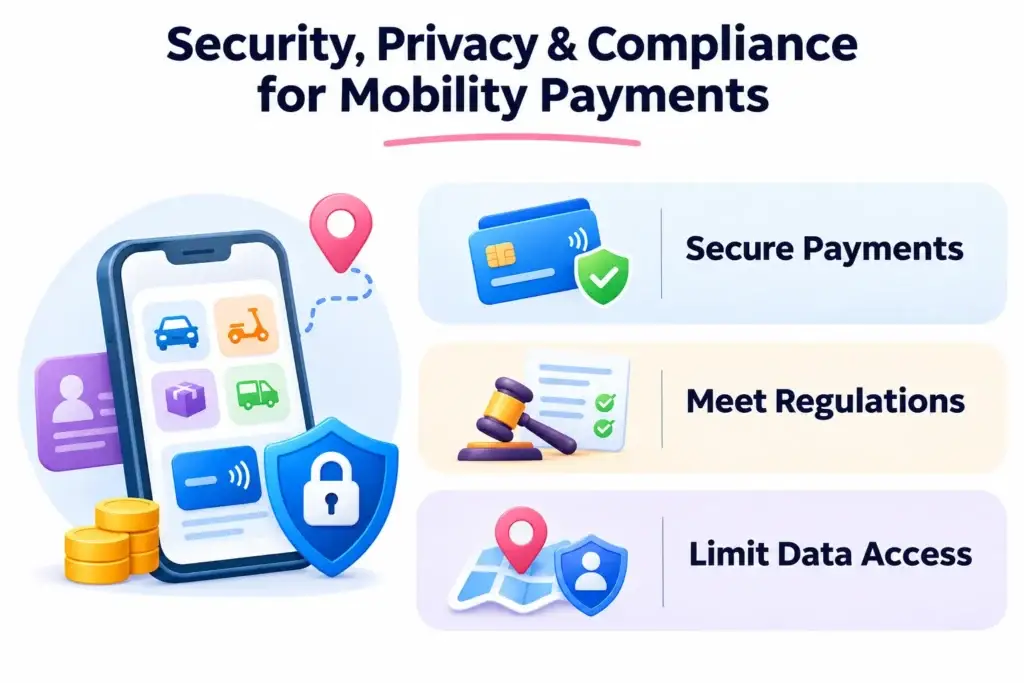
Mobility platforms process sensitive combinations of identity information, location history, contact details, and financial records. Combining several services increases the importance of clear access controls and responsible data handling.
A shared account should not imply unrestricted access to every customer record. Administrative users, providers, and service applications should receive only the permissions required for their roles.
Protect Financial Information Through Approved Payment Integrations
Platforms should avoid unnecessarily storing raw card details. Using a suitable payment provider can support tokenized payment methods and reduce the scope of sensitive payment information handled directly by the application.
Access to payment records should be restricted, sensitive data should be protected in transit and at rest, and important financial actions should generate audit records.
Understand the Rules Governing Stored Customer Funds
Operating a true stored-value wallet may trigger payment-services, safeguarding, licensing, consumer-protection, or identity-verification obligations depending on the country and business model.
Some businesses can offer wallet-like experiences through an authorized payment partner instead of directly holding customer funds. The available approach must be confirmed with relevant legal and payments specialists.
Technical readiness does not constitute regulatory approval. Founders should establish the permitted payment arrangement before promising wallet funding, transfers, withdrawals, or multi-service redemption.
Limit Location and Account Data Exposure
Dispatch relies on location information, but different service providers do not necessarily need access to the same amount of customer data.
Access should depend on the active assignment and applicable operational needs. Once a task ends, continued use or retention of precise location data should be controlled by documented policies and relevant privacy requirements.
These controls protect customers while reducing unnecessary exposure across the platform.
The Operational Mistakes That Make Mobility Super Apps Difficult to Scale
Multi-service expansion can create growth opportunities, but introducing new categories without operational readiness can weaken the original business.
Treating Every Service as Another Booking Button
A new category requires more than an additional icon on the customer home screen. It may need distinct eligibility checks, pricing, dispatch policies, fulfillment states, support workflows, and financial treatment.
Founders should map the entire operational lifecycle before treating a category as launch-ready.
Using One Dispatch Policy for Every Service
Passenger transport and scheduled delivery do not always have the same allocation priorities. A shared engine should support configurable policies instead of imposing one rigid ranking formula across unrelated workloads.
Updating Wallet Balances Without a Reliable Ledger
Direct balance changes without traceable financial events make it difficult to investigate discrepancies, refunds, and duplicate operations.
Every financially meaningful adjustment should be attributable to a documented transaction or authorized correction.
Ignoring Failed Assignments and Incomplete Payments
Successful booking flows receive the most design attention, but real operations involve unavailable drivers, network outages, disputed fares, failed payment attempts, and customer cancellations.
Exception handling should be designed before expansion because operational problems become more difficult to isolate when several services depend on the same infrastructure.
Measuring Growth Without Service-Level Profitability
Adding more transactions can create the appearance of rapid growth while increasing support, payment processing, fleet incentives, and fulfillment costs.
Founders should monitor contribution margin by category and identify whether each expansion improves the overall business.
A Practical Roadmap for Expanding From Ride Booking to a Multi-Service Ecosystem
A successful super app does not necessarily launch every category at once. Founders can reduce operational complexity by introducing services in stages and expanding shared infrastructure when demand justifies it.
Phase 1: Establish Reliable Core Mobility Operations
Start by validating the essential booking cycle: customer requests, provider eligibility, reliable assignment, trip completion, payment handling, and support.
The goal is to understand actual supply and demand within the initial operating area. Poor dispatch reliability should be addressed before introducing additional services that may compete for the same drivers.
Founders assessing broader market opportunities can review transportation and mobility platform use cases to identify adjacent service categories without assuming that every category belongs in the first release.
For operators whose first priority is passenger transportation, understanding the core ride-sharing ecosystem is an important starting point. The booking, dispatch, driver availability, and trip-completion workflows used in ride-sharing platform solutions can establish an operational foundation before introducing additional categories with different fulfillment requirements.
Phase 2: Introduce an Operationally Compatible Service
The next category should solve a genuine customer need and fit the operating model. For some businesses, scheduled transport may be a natural extension. For others, parcel delivery may be more relevant.
Before launch, establish the required provider capabilities, fulfillment states, cancellation rules, pricing methods, and service-specific reporting.
A new category should be evaluated based on successful fulfillment, not simply initial booking demand.
Phase 3: Improve Shared Payment and Financial Controls
As transaction categories increase, finance teams need reliable attribution and reconciliation. Develop or strengthen common payment interfaces, transaction identifiers, ledger controls, and refund processing.
If stored-value functionality is commercially necessary, verify the permitted regulatory and provider arrangement before enabling it.
Do not assume that an existing checkout integration automatically supports customer wallet balances or transfers.
Phase 4: Introduce Service-Aware Resource Optimization
Once sufficient operational data is available, dispatch can be improved through better eligibility filtering, forecasting, capacity planning, and allocation policies.
Any optimization should preserve safety, scheduled commitments, and provider permissions. A theoretical increase in resource utilization is not worthwhile if it produces more cancellations or missed service windows.
Phase 5: Expand Geographically or Add Further Categories
Expansion should follow evidence of repeatable operating performance. A service that performs well in one city may face different supply density, payment infrastructure, licensing requirements, or customer expectations elsewhere.
Founders should model each new market independently, adapting service availability, dispatch rules, and payment options where required.
Founder Decision Signals: Is Your Mobility Platform Ready to Expand?
Dispatch Reliability
Can the platform assign and complete existing requests without frequent manual intervention?
Provider Capacity
Is suitable supply available for the new service without harming established commitments?
Payment Accuracy
Can customer payments, refunds, platform fees, and partner earnings be reconciled reliably?
Commercial Viability
Does the new category have a credible path to positive contribution margin?
Where a Ready-Made Platform Fits Into Mobility Super App Planning
Understanding dispatch architecture and wallet operations helps founders make better implementation decisions. Not every business needs to develop its foundational booking, authentication, location, and administrative workflows entirely from the beginning.
Before choosing a platform foundation, founders should understand which operational capabilities are already available and which require additional customization. Reviewing mobility platform features and pricing considerations can help clarify the relationship between booking workflows, dispatch functionality, administrative controls, and implementation scope. This is especially useful when a business plans to introduce several services gradually rather than activating every category at launch.
However, a ready-made foundation should be evaluated against the actual service scope. Supporting several booking categories does not automatically mean the platform includes every advanced dispatch policy, regulated wallet capability, or settlement integration required for a broader ecosystem.
Founders should distinguish existing functionality from additional customization and independently verify critical workflows through demonstrations and technical review.
Miracuves helps mobility businesses evaluate adaptable product foundations and implementation requirements through its ride-hailing platform development services. This can help founders plan a practical launch scope while preserving room for future operational expansion.
For its applicable ready-made mobility solution, Miracuves offers a six-working-day delivery commitment for the defined base scope. More advanced multi-service orchestration, custom integrations, regulated stored-value wallet capabilities, and other modifications must be confirmed separately. External payment-provider approvals and app-store reviews can also affect public launch timing.
The important commercial benefit of a ready-made foundation is not simply faster software delivery. It is the opportunity to spend more time validating service demand, managing providers, and improving financial operations instead of rebuilding standard application flows unnecessarily.
Final Thoughts: Build a Connected Mobility Business, Not Just a Collection of Services
A mobility super app becomes valuable when its services work together operationally and financially. A connected interface may improve convenience, but dependable dispatch, clear provider eligibility, trustworthy payment records, and accurate settlement are what make the ecosystem sustainable.
The strongest architecture does not force every service into identical workflows. It provides shared identity, payment coordination, and operational visibility while preserving the rules that each service requires.
For founders, the challenge is deciding which infrastructure should be shared, which service operations must remain independent, and when the business is ready to expand. The answers should come from actual demand, dispatch performance, payment reliability, and service-level economics.
Entrepreneurs planning a connected transport and delivery ecosystem can evaluate Miracuves’ White label ride hailing platform as a starting point, while confirming any specialized dispatch or wallet requirements before deployment.
Ultimately, building a mobility super app is not about adding as many services as possible. It is about creating an operating system in which customer requests, provider capacity, and financial transactions remain coordinated as the business grows.
Frequently Asked Questions
What is mobility super app architecture?
Mobility super app architecture is the arrangement of shared and service-specific software components that support multiple transportation or delivery services within one platform. Common components may include customer identity, booking coordination, dispatch, payments, notifications, and administrative reporting.
How does multi-service dispatch work in a super app?
Multi-service dispatch converts requests into structured tasks, filters providers by eligibility and availability, ranks suitable providers, reserves capacity, and monitors fulfillment. Different services can use different allocation rules while sharing common location and availability infrastructure.
Can one driver handle both passenger trips and parcel deliveries?
Potentially, if the driver, vehicle, contractual arrangements, and applicable rules permit both services. The dispatch system must avoid overlapping assignments and verify that service commitments can be fulfilled safely and reliably.
How does a shared wallet work across multiple mobility services?
A shared wallet can present a consistent customer payment experience across eligible services while keeping separate ledger records for each transaction. The platform must track payments, refunds, partner earnings, and applicable service-level financial obligations. Stored-value functionality depends on the payment provider and regulatory arrangement.
Why is a transaction ledger important for mobility payments?
A transaction ledger creates an auditable record of financial activity, including funding, charges, reversals, commissions, and settlement obligations. It helps prevent unexplained balance changes and supports reconciliation with payment-provider records.
What happens when a driver cancels a multi-service booking?
The system should release the provider’s reserved capacity, determine whether reassignment is appropriate, update the booking state, notify affected parties, and apply the relevant payment or refund policy. The exact response depends on the service and cancellation conditions.
Does a mobility super app need a regulated wallet provider?
A genuine stored-value wallet may require a licensed or otherwise authorized payment arrangement depending on jurisdiction and functionality. Standard card checkout does not automatically authorize a business to hold transferable customer funds. Legal and payment-provider requirements should be reviewed before launch.
Which metrics matter most when expanding a mobility super app?
Important metrics include assignment success rate, time to assignment, provider utilization, completed bookings, cancellations, payment success, reconciliation exceptions, contribution margin by service, and cross-service repeat usage. Expansion should follow evidence that operational quality and economics remain sustainable.
Miracuves is an independent software development company. We are not affiliated with, connected to, sponsored by, or endorsed by any company or product named in this article.
Terms such as “X Clone” are used descriptively. It is how the software industry refers to building a platform with functionality comparable to a known service, and how clients search for it.
The entire design and codebase of our products is built by our own team. Our products contain no code, design, graphics, or content originating from any third-party website or applications.
All third-party names and marks referenced in this article are the property of their respective owners, referenced solely to identify the services discussed.