

Key Takeaways
- Why users leave traditional dating apps is closely connected to repetitive conversations, unclear relationship expectations, ghosting, overwhelming choice, trust concerns, and difficulty turning matches into meaningful connections.
- More matches do not necessarily create better experiences. A large number of connections can become frustrating when users must repeatedly evaluate profiles and conversations that rarely progress.
- Unclear relationship intentions can create avoidable mismatches. Users may share interests or attraction while wanting fundamentally different types of relationships.
- Ghosting cannot be completely eliminated by technology. Dating platforms can reduce some avoidable misunderstandings through clearer expectations and respectful communication tools, while preserving each user’s ability to disengage.
- Intent-based matching adds relationship goals and communication expectations to the recommendation process instead of relying primarily on appearance, proximity, or shared interests.
- Intent should not be treated as a rigid profile label. Relationship goals, preferred communication pace, availability, and willingness to explore different connections can provide useful context, but users should retain flexibility and control.
- Better matching should focus on relevance rather than match volume. Platforms can evaluate reciprocal conversations, user-reported match relevance, conversation drop-offs, safety, and satisfaction instead of measuring success through swipes and matches alone.
- Trust and safety are part of retention. Profile authenticity, reporting, blocking, moderation, privacy controls, and secure handling of relationship preferences can influence whether users feel comfortable participating.
- AI matchmaking should support decisions, not promise relationship success. AI can rank recommendations using available signals, but incomplete data and changing human preferences make guaranteed compatibility claims inappropriate.
- The goal should not be endless swiping. A stronger dating experience helps users spend less energy on avoidable mismatches and more attention on connections they genuinely want to pursue.
Dating apps have made meeting new people easier, but they have not necessarily made building meaningful relationships simpler. For many users, the excitement of discovering potential partners eventually gives way to repetitive conversations, unclear expectations, unanswered messages, and emotional exhaustion. What begins as an opportunity to connect can turn into a frustrating cycle of swiping, matching, chatting, and starting over.
This growing frustration is creating an important question for dating-platform operators: What if the problem is not the number of available matches, but how those matches are selected? Founders exploring dating-like app can use this shift in user expectations to rethink how compatibility, relationship intentions, and communication quality influence the dating experience.
Intent-based matching offers a different approach. Instead of relying primarily on visual attraction, proximity, or superficial interests, it considers what people actually want from a connection. Someone looking for a committed relationship should not repeatedly encounter people whose immediate priority is casual conversation, unless both have expressed openness to that arrangement.
However, matching people with similar intentions does not automatically eliminate ghosting. Relationships remain unpredictable, and individuals can change their minds. The opportunity lies in reducing avoidable misunderstandings, making expectations clearer, and designing interactions that feel less exhausting.
This article explores why users abandon dating platforms, how intent matching works, which product decisions may reduce ghosting, and what founders should measure when building a more relationship-focused experience.
Why Dating App Fatigue Is Becoming a Serious User Experience Problem
Dating app fatigue describes the mental and emotional exhaustion people experience after repeatedly using digital matchmaking platforms without feeling that their efforts are producing worthwhile connections. It may appear as boredom, frustration, reduced motivation, or reluctance to respond to new matches.
At first, an extensive dating pool can seem empowering. Users can discover people outside their existing social circles and express interest without the pressure of an immediate face-to-face interaction. Yet the same convenience can create an overwhelming stream of possibilities.
A user might open an app to meet someone compatible, review dozens of profiles, exchange messages with several people, and finish the evening without understanding whether any conversation is likely to progress. Over time, that uncertainty can make each additional interaction feel like another task.
Research into dating-app burnout provides a useful perspective. A longitudinal study of dating-app users found that emotional exhaustion and feelings of inefficacy increased over the observation period. The research does not establish that every dating app produces the same outcomes, but it helps explain why continuous participation should not be confused with sustained satisfaction.
When More Choices Create Less Confidence
Having more potential matches is not always the same as having more useful choices. When users must repeatedly evaluate profiles with limited context, their attention becomes divided between comparing options and actually developing connections.
Someone who has already started a promising conversation may continue exploring alternatives because the interface makes discovering another person almost effortless. Meanwhile, the person waiting for a response has no way of knowing whether the conversation is progressing or has effectively ended.
This is not necessarily a problem caused by deliberate manipulation or poor intentions. It can emerge naturally when product design makes starting a new interaction easier than investing in an existing one.
Why Repetitive Conversations Become Exhausting
Many dating conversations begin with familiar questions about work, hobbies, location, and weekend plans. These topics can be useful introductions, but repeating them across numerous matches can make the experience feel mechanical.
The frustration becomes stronger when users discover, after several days of messaging, that they wanted fundamentally different things. One person may have expected to meet soon, while the other was only interested in occasional conversation. Neither necessarily communicated dishonestly; the platform simply failed to make those expectations clear early enough.
For product teams, this reveals an important opportunity. Matching quality should account for the likelihood that two people want a compatible type of interaction, not merely whether they have enough overlapping interests to start chatting.
Seven Reasons Users Stop Using Dating Apps
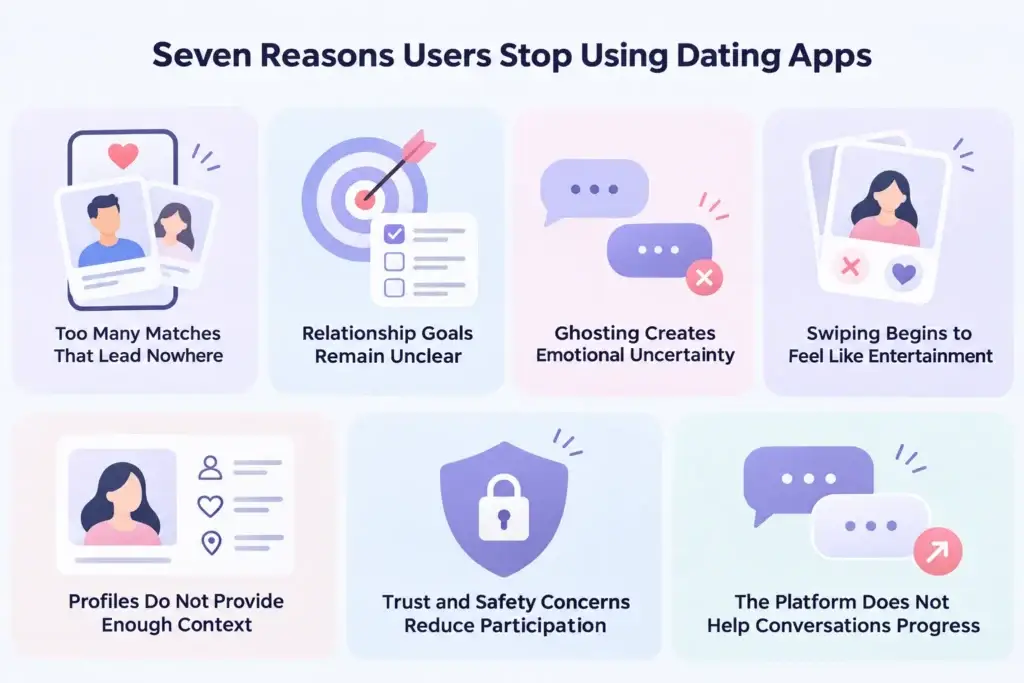
Users do not abandon dating services for one universal reason. Their experiences depend on relationship goals, location, available matches, personal circumstances, and how the platform manages interactions. Nevertheless, several recurring sources of frustration deserve particular attention.
1. Too Many Matches That Lead Nowhere
Matching can provide an immediate sense of progress, but that feeling disappears when conversations rarely develop. A large number of connections becomes less meaningful if users must invest considerable effort to identify which people are genuinely interested in communicating.
The product challenge is to distinguish interest in a profile from interest in a real interaction. Those are related signals, but they are not interchangeable.
2. Relationship Goals Remain Unclear
Two people may share interests, attraction, and similar lifestyles while wanting entirely different relationships. One may be seeking long-term commitment, while the other prefers casual dating or is still exploring personal expectations.
When these differences surface only after significant conversation, users may feel that their time was wasted. Clear, voluntarily declared intentions can help people make informed decisions earlier.
3. Ghosting Creates Emotional Uncertainty
Ghosting occurs when someone unexpectedly stops communicating without providing an explanation. Although not every unanswered message qualifies as ghosting, an abrupt disappearance after sustained interaction can leave the other person confused about what happened.
Repeated experiences can also change how people approach future matches. Some become reluctant to invest emotionally; others disengage early because they anticipate another disappointing outcome.
Platforms cannot require genuine romantic interest, and they should never penalize someone for withdrawing from an uncomfortable situation. They can, however, make voluntary communication and respectful closure easier when it is safe to do so.
4. Swiping Begins to Feel Like Entertainment
Swipe-based discovery can encourage quick decisions based on limited information. This can be convenient, but it may also reward rapid browsing instead of careful consideration of compatibility.
If the easiest activity in an app is browsing profiles, users may continue browsing even when their original goal was to establish a meaningful connection. The interface can become engaging without necessarily helping users achieve the outcome they wanted.
5. Profiles Do Not Provide Enough Context
Photographs, short biographies, and interest tags can introduce a person, but they rarely explain how someone approaches relationships. Important considerations such as communication frequency, readiness to meet, lifestyle compatibility, or openness to a long-distance relationship may remain hidden.
Without that context, users must discover potentially important incompatibilities through extended conversations. A more thoughtful profile experience can reduce this burden without requiring people to disclose every personal detail publicly.
6. Trust and Safety Concerns Reduce Participation
Misleading profiles, unwanted messages, impersonation, harassment, and suspicious activity can undermine the entire dating experience. Users who do not feel safe may avoid responding, limit their visibility, or leave altogether.
Trust also affects the interpretation of silence. Someone may stop responding because they feel uncomfortable or unsafe rather than because they are uninterested. Any effort to reduce ghosting must preserve the right to disengage, report abuse, and block unwanted contact.
7. The Platform Does Not Help Conversations Progress
A successful introduction is only the beginning. Users still need to discover shared values, establish trust, and decide whether to continue communicating.
When an app offers little support beyond opening a chat window, users may struggle to move from initial interest to genuine connection. Thoughtful conversation prompts, shared-interest context, and optional next-step suggestions can help. These features should reduce friction without turning personal relationships into rigid, automated workflows.
What Is Intent-Based Matching in Dating Platforms?
Intent-based matching is an approach to connecting people that considers their stated relationship goals and expectations alongside other compatibility factors. Rather than assuming that attraction or shared hobbies are sufficient, the platform evaluates whether the people involved are looking for reasonably compatible experiences.
For example, two people might both enjoy travel, fitness, and outdoor activities. However, if one is actively seeking a serious partnership and the other only wants casual conversations, recommending them primarily because of their shared interests may create avoidable frustration.
An intent-aware system could give greater weight to compatible relationship goals before considering secondary preferences. This would not make the pair inherently incompatible as individuals, but it could reduce the likelihood of presenting a connection that neither person would have chosen with more complete information.
Relationship Intent Is More Than a Single Profile Label
It is tempting to treat intent as a simple choice between serious and casual dating. Real relationship expectations are more complex.
A person might be seeking long-term commitment while preferring several weeks of conversation before meeting. Another might want the same long-term outcome but prefer meeting quickly to assess compatibility. Both have similar relationship goals, yet their preferred pace could create communication difficulties.
Useful intent information can include relationship objectives, preferred pace, communication expectations, availability to meet, and willingness to explore certain types of connections. Not every preference should become a strict requirement. Some people are flexible, while others have boundaries they do not want to compromise.
Declared Intent and Observed Behavior Are Different Signals
Declared intent is what a user voluntarily communicates about their goals. Observed behavior reflects how they interact with the platform, such as whether conversations are reciprocal or whether they frequently leave exchanges unfinished.
Both may provide useful context, but they require careful interpretation. An individual who replies slowly may be busy, cautious, or managing personal circumstances. Slow replies should not automatically be interpreted as a lack of interest or evidence of dishonesty.
Behavioral signals are most useful when applied thoughtfully, evaluated for fairness, and combined with user-controlled preferences. They should not become hidden judgments about someone’s character or emotional availability.
How Intent Matching Can Reduce Avoidable Ghosting
Intent matching cannot control how people behave after an introduction. It can, however, address some conditions that make conversations more likely to end without progress.
The most useful strategy is not to promise that everyone will respond. It is to help users begin conversations with clearer expectations, relevant matches, and fewer avoidable reasons to disengage.
Aligning Expectations Before a Conversation Begins
When relationship intentions are visible and incorporated into matching, users can make more informed decisions before expressing interest.
Imagine two people who are both interested in a committed relationship, live within a practical distance, and prefer regular communication. Their shared intentions do not guarantee attraction, but they provide a stronger basis for beginning a conversation than proximity alone.
Equally important, users who prefer different arrangements can still find compatible connections within their own stated preferences. The purpose is not to rank one relationship goal above another. It is to improve alignment.
Reducing Low-Relevance Recommendations
A matchmaking platform can become less exhausting when recommendations account for meaningful preferences rather than continuously maximizing the number of profiles displayed.
For example, a user who identifies long-term commitment as a firm preference could choose whether to see only people with aligned goals or also people who have expressed flexibility. This creates a useful distinction between non-negotiable preferences and characteristics the user is willing to explore.
Recommendation relevance also depends on whether the platform has an adequate pool of eligible, active users. Extremely restrictive filtering in a small community may produce very few introductions. Founders therefore need to balance compatibility precision with sufficient opportunities for discovery.
Making Communication Preferences More Transparent
People have different expectations about messaging frequency, response times, and when to meet. These differences can create frustration even when relationship goals are compatible.
A platform might allow users to share whether they prefer gradual conversations, occasional check-ins, or relatively quick introductions. Such preferences should be optional and editable because communication styles change according to schedules, comfort, and relationship stage.
Transparency can reduce misinterpretation. It cannot eliminate uncertainty, but it can help prevent a slow response from immediately being mistaken for disinterest.
Creating Opportunities for Respectful Closure
Some conversations end because one person realizes the match is not suitable. That decision is a normal part of dating. The difficulty often comes from communicating it.
Optional conversation-closing messages can make respectful disengagement easier. A user might select a neutral response indicating that they do not wish to continue. The interface can close the interaction without inviting an argument or requiring an explanation.
These tools must remain optional. Users experiencing pressure, harassment, or safety concerns should always be able to block or leave immediately. A product that makes closure compulsory risks turning a well-intentioned feature into another source of discomfort.
Swipe-First Discovery vs. Intent-Aware Matching: What Changes for Users?
The difference between swipe-first discovery and intent-aware matching is primarily about the information used to recommend people and the outcomes the platform prioritizes. These approaches are not mutually exclusive. A well-designed product can preserve simple browsing while adding more meaningful compatibility information.
| Evaluation Area | Swipe-First Discovery | Intent-Aware Matching |
|---|---|---|
| Initial discovery | Often emphasizes quick profile evaluation. | Adds relationship expectations to the evaluation. |
| Relationship goals | May be secondary or discovered through chat. | Can become an explicit compatibility signal. |
| Recommendation objective | May optimize profile interest or mutual likes. | Can incorporate mutual expectations and conversation quality. |
| Conversation context | Often begins with broad introductory questions. | Can surface relevant common goals or communication preferences. |
| User effort | More compatibility discovery may happen after matching. | Some incompatibilities may be identified earlier. |
| Potential weakness | High choice volume can overwhelm users. | Overly restrictive preferences can reduce match availability. |
| Measure of success | Frequently includes profile views, likes, and matches. | Can emphasize reciprocal conversations and user-reported relevance. |
These are illustrative design differences, not universal descriptions of every dating product. Some swipe-based services already incorporate detailed preferences, while intent-focused services can still struggle with weak recommendations or limited user activity.
The larger lesson is that a discovery interface alone does not determine whether users build meaningful relationships. Matching rules, expectations, safety, community quality, and communication design all contribute to the experience.
The Product Features That Can Support More Meaningful Dating Conversations
Improving dating experiences requires more than introducing an intention filter and assuming the problem is solved. The most promising approaches treat matching, communication, and user protection as connected parts of the same experience.
Intent-Aware Onboarding
Onboarding is an opportunity to understand what users want before presenting recommendations. Asking about relationship objectives, preferred interaction pace, and important boundaries can provide useful context.
However, excessive onboarding can create its own friction. Users may abandon registration if they are asked to complete a long personality assessment before seeing any value.
A practical approach is progressive profiling: collect a small number of important preferences initially, then invite users to add more context over time. Essential safety and eligibility checks should remain separate from optional compatibility questions.
Quality-Focused Recommendations
Matching systems can consider several categories of information, including stated goals, compatible preferences, location flexibility, interests, and the current availability of active profiles.
More advanced systems may use feedback about whether users found recommendations relevant or whether interactions became reciprocal. These signals should be evaluated carefully because behavior can reflect accessibility issues, personal schedules, or social differences rather than true compatibility.
Founders interested in the deeper technical side can explore Miracuves’ guide to AI matchmaking with limited daily recommendations, which examines eligibility filtering, compatibility ranking, and related design considerations.
Thoughtful Conversation Prompts
Conversation prompts can reduce the pressure of beginning an interaction from nothing. The strongest prompts reveal something useful about a person’s interests, values, or communication preferences without making the interaction feel like an interview.
For example, instead of suggesting another generic greeting, an app could surface a mutual interest already present in both profiles. It might invite users to discuss a favorite activity or a shared preference about how they spend their free time.
The goal should be to help people communicate naturally. Automated prompts should not impersonate users, fabricate messages, or create an artificial sense of personal interest.
For some dating communities, meaningful interaction may extend beyond text-based conversations. Optional live video sessions, interest-based virtual rooms, and moderated group discussions can create opportunities for users to understand personalities and communication styles before pursuing one-on-one connections. Founders exploring these experiences can examine how interactive live-streaming platforms support real-time participation and community engagement. However, live interaction should remain optional, privacy-conscious, and aligned with users’ relationship intentions rather than becoming another source of pressure.
Flexible Discovery Limits
Showing fewer recommendations may encourage some users to consider each profile more carefully. However, limited discovery is not automatically better. The result depends on recommendation relevance, community size, and how much freedom users expect.
A small, highly compatible set of suggestions could be useful in a dense local community. The same restriction might frustrate users in a smaller market where eligible profiles are already scarce.
Instead of assuming one model is suitable for everyone, founders should test whether adjustable discovery limits improve satisfaction without restricting legitimate opportunities to connect.
Profile Authenticity and User Protection
Relationship intentions are only useful when users trust the people and profiles they encounter. Identity verification options, account-abuse detection, reporting tools, and responsive moderation can support that trust.
Verification should not create a false promise of complete safety. Even verified users may behave poorly, and identity checks do not establish honesty about romantic intentions.
Platforms should also minimize sensitive data collection. Relationship preferences can reveal personal information that users may not want broadly exposed. Private preference controls, appropriate access restrictions, clear consent, and secure data handling are important considerations.
Why Better Matching Alone Cannot Completely Stop Ghosting
It would be misleading to describe intent-based matching as a complete solution to ghosting. Communication breakdown is influenced by emotional readiness, personal circumstances, social expectations, safety, changing attraction, and events outside the application.
Two people can sincerely want the same type of relationship and still decide that they are not compatible. Someone may become overwhelmed by conversations, experience a personal difficulty, or simply lose interest. The platform cannot reliably determine these motivations from message activity alone.
Research into the relationship between dating-platform design and ghosting suggests that the surrounding interaction environment can influence user behavior. A qualitative study of dating app experiences examines how boredom, platform mechanisms, and interaction patterns can contribute to disengagement.
Distinguishing Avoidable Friction From Personal Choice
Some conversation failures can be reduced through clearer expectations. For example, people seeking incompatible relationship outcomes may benefit from being matched differently.
Other situations are matters of individual autonomy. A person should never be expected to continue a conversation because a system predicted compatibility. Users also need the freedom to leave conversations without explanation when they feel unsafe or uncomfortable.
A responsible dating product therefore aims to improve mutual understanding rather than enforce replies. Respectful optional closure, clear communication preferences, and effective safety controls are more appropriate than compulsory messaging or penalties for silence.
Why User Retention Should Be Measured Beyond Matches and Swipes
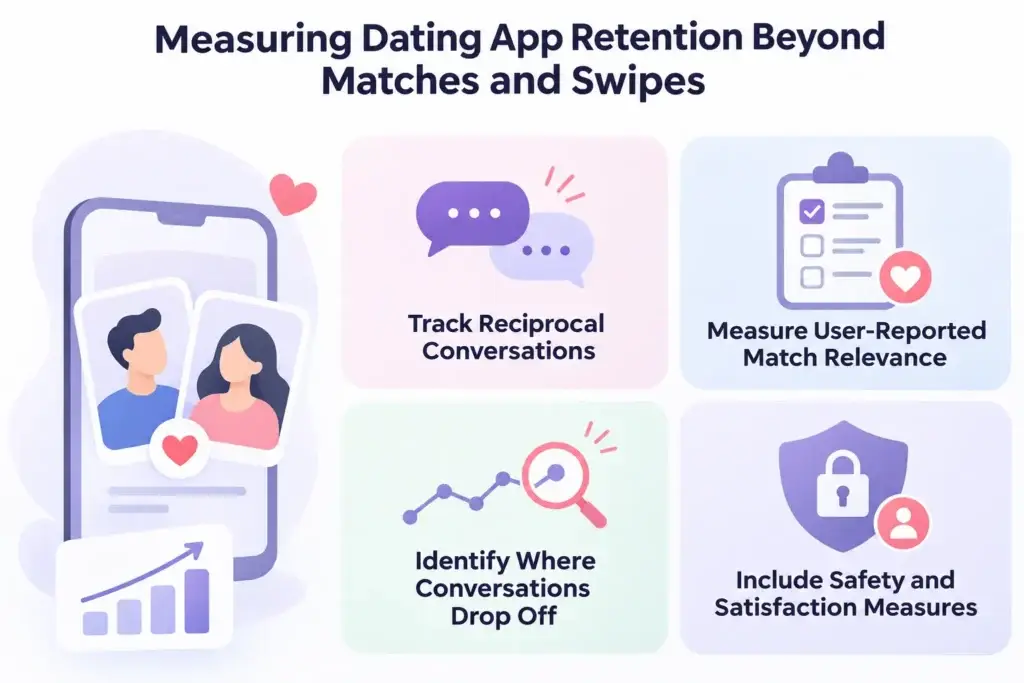
For dating-platform founders, retention can be difficult to interpret. High activity may indicate satisfaction, but it may also reflect repeated attempts to find a suitable connection. Conversely, a person who establishes a meaningful relationship and stops using the app may represent a positive outcome.
This creates a measurement challenge that is different from many entertainment-focused digital products. The objective should not automatically be maximizing time spent in the interface.
Track Reciprocal Conversations
A mutual match indicates initial interest from two profiles. A reciprocal conversation provides additional evidence that both parties were willing to communicate.
Founders can examine the proportion of matches where both people contribute at least one message. They can also evaluate whether conversations continue beyond the first exchange, while avoiding intrusive analysis of private message content.
Measure User-Reported Match Relevance
People are better positioned than an algorithm to explain whether a recommendation felt relevant to their goals. Optional feedback can reveal important problems that engagement metrics miss.
For example, a match may generate a long conversation but still be considered unsuitable because the participants had conflicting expectations. Combining behavioral metrics with explicit feedback creates a more informative view of quality.
Identify Where Conversations Drop Off
Conversation-stage metrics can help operators distinguish between matches that never receive an opening message, conversations that end after one exchange, and interactions that continue before becoming inactive.
These patterns can identify where product changes may be useful. A high proportion of matches without messages might suggest weak intent to communicate. Frequent early drop-offs might indicate poor recommendation relevance or messaging friction.
Neither conclusion should be assumed without additional evidence. Product teams should use experiments and user research to investigate the reasons behind each pattern.
Include Safety and Satisfaction Measures
Conversation volume is not a useful success metric if users are experiencing harassment or unwanted contact. Trust-related metrics, support response quality, complaint resolution, and user-reported comfort should be evaluated alongside engagement.
Retention analysis should also distinguish negative abandonment from positive departures. Optional exit feedback can help determine whether users are leaving because they feel frustrated, are taking a break, or have achieved their personal dating goals.
Founder Insight: Measure Connection Quality, Not Just Activity
Match Relevance
Measure how well recommendations align with users’ relationship goals, communication preferences, and compatibility expectations.
Mutual Engagement
Track whether both users actively participate in conversations instead of simply counting matches, swipes, or messages.
User Trust
Evaluate profile authenticity, communication safety, and how effectively users can report or block unwanted interactions.
Outcome Satisfaction
Understand whether users feel their connections are meaningful and helping them move toward their personal relationship goals.
Key Insight: Dating platforms should prioritize relevant matches, reciprocal conversations, and user satisfaction over endless swiping and screen time.
How Dating Platforms Can Test Intent Matching Without Overcomplicating the Experience
Intent matching should be treated as a product hypothesis that requires validation. A founder may reasonably believe that clearer relationship goals will improve conversations, but the size and direction of that improvement depend on the community and implementation.
Start With a Clear User Problem
The first step is identifying the specific frustration the platform is trying to address. Are people receiving too many incompatible recommendations? Do they struggle to understand relationship goals? Are conversations ending before participants discover shared expectations?
Turning these insights into practical functionality requires careful decisions about onboarding, recommendation rules, profile preferences, and user safety. For founders evaluating implementation, understanding the engineering considerations behind dating platforms can help clarify how compatibility preferences and communication workflows fit into a broader product experience. The priority should remain solving a validated user problem rather than adding complexity simply because the technology is available.
These are different problems and may require different solutions. A founder should not introduce an elaborate matching engine when a clearer profile question could resolve the immediate issue.
Introduce Intent Signals Gradually
A practical first experiment might introduce an optional relationship-goal field and allow users to decide how strongly it influences recommendations.
Over time, additional preferences can be introduced based on demonstrated user demand. This approach reduces onboarding friction and helps product teams understand which signals actually improve the experience.
Test Changes Against Relevant Outcomes
Rather than measuring only whether a new filter receives clicks, operators can evaluate whether eligible users experience more mutually responsive conversations and report better match relevance.
Experiments should compare comparable user groups and account for differences in geography, community size, seasonality, and user intentions. A change that performs well in a densely populated city may not perform equally well in a smaller local market.
Founders should also watch for negative effects. Strict filters might improve perceived recommendation quality while sharply reducing the number of people available to match. A successful change must balance relevance with practical access to potential partners.
Maintain Transparency and User Control
People should understand how their stated preferences influence discovery and be able to update those preferences when their circumstances change.
AI-assisted recommendations should not make unsupported assumptions about sensitive personal traits or pressure users into revealing information. Where meaningful automated decisions are involved, operators should consider the privacy and data-protection obligations relevant to their target markets.
Common Mistakes That Undermine Intent-Based Dating Experiences
Even a well-intentioned matching strategy can create new frustrations if it is implemented without understanding the community. Several mistakes are particularly important for founders to avoid.
Mistake 1: Treating Every Preference as a Non-Negotiable Requirement
People distinguish between preferences they strongly value and characteristics they are willing to explore. A rigid system that treats all answers as mandatory may exclude otherwise suitable matches.
Platforms should allow users to express flexibility wherever appropriate. Firm boundaries must still be respected, especially around age eligibility, consent, and safety.
Mistake 2: Assuming AI Can Predict Relationship Success
AI can help rank recommendations using available information, but it cannot reliably determine whether two people will form a successful romantic relationship.
Compatibility predictions depend on incomplete data, changing preferences, and assumptions about what constitutes a successful outcome. Product teams should avoid exaggerated compatibility claims and treat recommendation scores as decision aids rather than guarantees.
Mistake 3: Using Engagement Metrics Without Context
A matching adjustment that increases daily activity may look successful in a dashboard. Yet if users report more repetitive conversations or greater frustration, the apparent improvement may not represent genuine product value.
Founders should interpret quantitative engagement alongside satisfaction, trust, and user-reported outcomes.
Mistake 4: Making Communication Feel Obligatory
Mandatory replies, public response-rate labels, or penalties for ending conversations can discourage participation and create unnecessary pressure.
Respectful communication features should remain supportive. Users must retain the ability to pause, decline, block, or leave without being punished for setting boundaries.
Mistake 5: Ignoring the Size and Quality of the Dating Community
Even an excellent compatibility system cannot create eligible, available users where none exist. Matching quality is therefore connected to community development, geographic density, user activity, and trust.
Founders should evaluate whether there are enough relevant profiles within each local or interest-based segment before introducing highly restrictive recommendation rules.
What the Shift Toward Intent Matching Means for Dating-Platform Founders
The growing discussion around dating fatigue presents a product opportunity, but it should not be interpreted as evidence that users have rejected digital matchmaking altogether. Instead, it suggests that founders need to understand what users consider a worthwhile interaction
Dating platforms are part of a broader ecosystem of digital communities where user engagement depends on shared interests, trust, and meaningful interactions. Understanding how different social networking platform models encourage connections can help founders evaluate whether their audience needs traditional profile discovery, community-driven engagement, or more intentional relationship matching..
A differentiated dating service does not necessarily need an entirely new discovery interface. It may create value by improving the relationship between user expectations, recommendation relevance, communication, and safety.
Understanding user frustration is only one part of improving a dating platform. Founders must also evaluate whether existing profile systems, matchmaking workflows, messaging functionality, and administrative controls can support a more intentional experience. For additional product context, Miracuves’ guide to dating platform features and software considerations explores the functional foundation behind digital matchmaking applications. This helps connect the behavioral challenges discussed here with the practical capabilities founders may need to evaluate.
For example, a relationship-focused community may benefit from clearer commitment preferences, while a social discovery community may place greater emphasis on conversational comfort and flexible introductions. Neither model is inherently superior. The appropriate experience depends on the expectations of the people it serves.
Miracuves approaches dating products as more than matching interfaces. As described in its dating and social discovery engineering overview, trust, safety, communication behavior, and operational controls are important considerations when evaluating a platform.
The business implication is straightforward: a founder should define the relationship experience first, then decide which matching and communication mechanisms support it. Adding sophisticated recommendation technology without a clear understanding of the community is unlikely to resolve the underlying problem.
The Future of Dating Platforms: Moving From Endless Discovery to Better Connections
The next opportunity in digital matchmaking may be less about showing users the largest possible number of profiles and more about helping them make confident decisions about which interactions deserve their attention.
Several product directions deserve evaluation: greater control over relationship preferences, more transparent recommendations, less repetitive onboarding, optional conversational assistance, and more meaningful measures of user satisfaction.
One potential response to dating app fatigue is the emergence of smaller, purpose-driven communities. Instead of connecting people through broad demographic preferences alone, these platforms can emphasize shared lifestyles, values, professional backgrounds, or relationship goals. This approach is explored further in Miracuves’ analysis of hyper-vertical dating platforms and niche matchmaking, which explains how focused communities can make discovery more relevant to their members.
AI may contribute to this evolution by identifying patterns that conventional filtering misses. However, its role should remain limited by user consent, data quality, transparency, and the reality that human relationships cannot be reduced to predictable formulas.
Platforms that encourage trust and clear expectations may offer a more satisfying experience for certain communities. Whether these improvements produce stronger retention or more meaningful relationships must be established through research and careful measurement rather than assumed from product design alone.
For founders, the guiding question is not simply how to generate more matches. It is how to help people spend less energy on avoidable mismatches and more attention on connections they actually want to pursue.
Final Thoughts: Better Matching Starts With Understanding User Intent
People do not leave dating apps simply because matching technology is imperfect. Many disengage because the experience feels repetitive, their relationship expectations remain unclear, conversations fail to progress, or the effort of meeting compatible people becomes emotionally exhausting.
Intent-based matching addresses an important part of that problem by making relationship goals and communication expectations more visible. When implemented thoughtfully, it can reduce avoidable mismatches and support more relevant introductions. However, it should be combined with user autonomy, privacy, safety measures, and realistic expectations about human behavior.
For founders, the strongest opportunity is to create a dating experience that measures its value through relevance, mutual participation, and user satisfaction rather than match volume alone. Miracuves provides a dating-like app that founders can evaluate as a starting point for a differentiated platform, with specialized matching changes scoped according to their requirements.
The long-term goal should not be to keep people swiping indefinitely. It should be to make each meaningful interaction easier to discover, understand, and pursue.
Frequently Asked Questions
Why are people leaving dating apps?
People may stop using dating apps because of repetitive conversations, incompatible relationship goals, ghosting, overwhelming choices, disappointing interactions, or trust concerns. These factors vary by user, but the common issue is that time spent matching does not always produce meaningful connections.
What is intent-based matching in dating?
Intent-based matching uses declared relationship goals, communication preferences, and other relevant compatibility signals to recommend people with reasonably aligned expectations. It adds context to discovery instead of depending only on appearance, location, or shared interests.
Can intent matching prevent ghosting?
Intent matching may reduce some avoidable mismatches by clarifying expectations before conversations begin. However, it cannot completely prevent ghosting because personal circumstances, changing attraction, safety concerns, and individual choices also influence communication.
How can dating platforms reduce swipe fatigue?
Dating platforms can test more relevant recommendations, optional discovery limits, clearer relationship preferences, useful conversation prompts, and better user feedback. The goal is to reduce repetitive interactions without unnecessarily limiting opportunities to meet compatible people.
Does AI matchmaking create better relationships?
AI can help organize and rank potential matches using stated preferences and carefully evaluated behavioral signals. It does not guarantee compatibility or relationship success. Its usefulness depends on recommendation quality, user trust, fairness, privacy, and measurable outcomes.
What should dating apps measure besides matches?
Useful measures include reciprocal conversations, user-reported match relevance, conversation-stage drop-offs, safety incidents, satisfaction, and reasons for leaving. These signals can help operators distinguish meaningful engagement from activity that does not achieve user goals.
Why are relationship intentions important in dating apps?
Relationship intentions help people understand whether their goals are compatible before investing substantial time in conversation. Clear expectations may reduce misunderstandings, particularly when users differ in their desired relationship type, communication pace, or readiness to meet.
Miracuves is an independent software development company. We are not affiliated with, connected to, sponsored by, or endorsed by any company or product named in this article.
Terms such as “X Clone” are used descriptively. It is how the software industry refers to building a platform with functionality comparable to a known service, and how clients search for it.
The entire design and codebase of our products is built by our own team. Our products contain no code, design, graphics, or content originating from any third-party website or applications.
All third-party names and marks referenced in this article are the property of their respective owners, referenced solely to identify the services discussed.