
Key Takeaways
- Agricultural logistics platform workflows depend on accurate load matching and live tracking to connect produce shipments with suitable transporters and maintain visibility from pickup to delivery.
- Load matching should consider pickup distance, vehicle capacity, route compatibility, commodity type, cold-chain capability, delivery windows, pricing, and transporter reliability.
- Live tracking should provide operational visibility through GPS updates, ETA, trip milestones, geofencing, route deviation alerts, driver status, and delivery confirmation.
- Early-stage platforms can begin with manual or rule-based transporter assignment before introducing weighted scoring, bidding, predictive matching, or AI recommendations.
- The complete shipment loop should connect load creation, matching, pickup confirmation, live movement, delivery proof, admin review, and settlement.
Workflow Signals
- Accurate load data should include commodity, quantity, packaging, pickup and delivery locations, vehicle requirements, timing, cold-chain needs, and settlement conditions.
- Transporter eligibility should be filtered before matching so unsuitable vehicles, routes, capacities, or carriers are excluded from the assignment process.
- Pickup confirmation can combine driver arrival status, geotagging, quantity checks, image proof, documents, packaging condition, and farm logistics load matching.
- Geofencing can automatically record arrival and departure events around farms, collection centres, warehouses, cold rooms, and buyer locations.
- Proof of delivery can use OTP, digital signatures, images, geolocation, timestamps, quantity received, quality notes, and buyer acceptance status.
Real Insights
- Load matching is not simply a search filter; it acts as a decision layer that balances vehicle suitability, route fit, timing, cost, and fulfillment risk.
- Live tracking creates more value when it helps operators detect exceptions and take action rather than simply displaying a moving vehicle on a map.
- AI-led matching should follow real shipment data collection because advanced automation without reliable operational data can produce weak recommendations.
- Rural connectivity should influence driver workflow design, including simple status updates and offline-friendly data capture where required.
- The strongest workflow is: load creation → transporter filtering → matching → pickup confirmation → live tracking → geofence events → delivery proof → settlement.
A farm-to-market logistics business does not run on transportation alone. It runs on the ability to match the right produce load with the right transporter, track the shipment in real time, and give every stakeholder enough visibility to trust the process.
For farmers, the concern is simple: will the vehicle arrive on time and move the produce safely? For transporters, the question is whether the route is profitable and the load details are clear. For buyers, the priority is delivery visibility, quality confidence, and proof that the shipment arrived as expected. For the platform operator, the challenge is controlling every moving part from one admin layer.
That is why load matching and live tracking are two of the most important workflow layers inside an agricultural logistics platform. They decide how shipments move, how transporters are selected, how delays are detected, and how the platform builds trust across farmers, FPOs, buyers, drivers, warehouses, and admins.
This guide explains how load matching and live tracking work inside a farm logistics load matching, which business rules matter, what founders should avoid, and how these workflows support scalable agricultural supply-chain operations.
Why Load Matching and Live Tracking Matter in Farm-to-Market Logistics
Farm-to-market logistics is different from standard parcel delivery. Agricultural produce often moves through farms, FPOs, collection centres, packhouses, warehouses, cold rooms, mandis, processors, exporters, retailers, and institutional buyers.
Each shipment can have different requirements:
- Crop or commodity type
- Weight and volume
- Packaging type
- Pickup location
- Delivery location
- Required vehicle type
- Cold-chain or insulated transport requirement
- Harvest timing
- Delivery window
- Buyer acceptance rules
- Quality inspection requirement
- Payment or settlement conditions
If the wrong transporter accepts the load, the shipment may be delayed, rejected, damaged, or disputed. If tracking visibility is weak, the buyer, farmer, and admin team may spend hours chasing status updates manually.
An agricultural logistics platform solves this by turning the shipment journey into a structured workflow. Load matching decides who should carry the produce. Live tracking shows where the shipment is, whether it is moving correctly, and whether intervention is needed.
Founders planning this category should also understand how agriculture and agritech platform development connects field users, produce workflows, rural operations, and digital supply-chain systems.
What Is Load Matching in Farm Logistics?
Load matching is the process of connecting an available shipment with a suitable transporter, vehicle, or driver.
In a basic logistics marketplace, matching may only look at pickup location and vehicle availability. In farm-to-market logistics, that is not enough. Produce type, route, vehicle capacity, timing, temperature requirements, transporter history, and buyer expectations all affect whether the match is practical.
For example, a fresh vegetable shipment may need fast pickup and temperature-conscious handling. A grain shipment may need high-capacity bulk transport. A dairy shipment may need strict cold-chain visibility. A buyer delivery route may require a transporter with proven reliability on that lane.
A strong transporter matching system should answer:
- Which transporters are available near the pickup point?
- Which vehicles match the load size and commodity type?
- Which transporters already operate on this route?
- Which carrier can meet the delivery window?
- Which transporter has reliable completion history?
- Which option balances cost, speed, and trust?
- Which match gives the platform operator the lowest risk?
This is why load matching is not just a search filter. It is the decision engine behind the logistics workflow.
What Is Live Tracking in Agricultural Logistics?
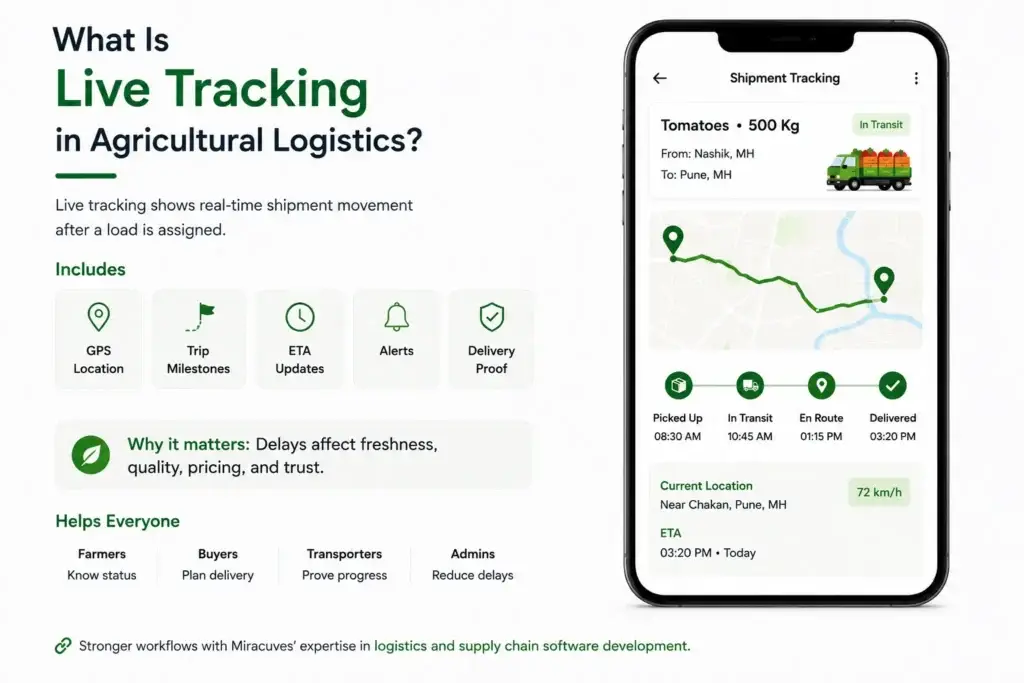
Live tracking gives users and admins visibility into shipment movement after the load is assigned.
It can include GPS location, trip milestones, pickup confirmation, route progress, ETA updates, geofence entry and exit, route deviation alerts, driver status, delivery proof, and exception reporting.
For farm produce, live tracking matters because delays can directly affect freshness, buyer acceptance, and settlement trust. A late shipment is not only a service issue. It can affect product quality, pricing, dispute risk, and repeat usage.
Live tracking helps:
- Farmers know whether pickup is happening
- Buyers prepare for delivery
- Transporters prove movement progress
- Drivers receive clearer route instructions
- Warehouses plan receiving and dispatch
- Admins detect delays and exceptions
- Platform operators reduce manual support calls
Founders building stronger logistics workflows can also explore Miracuves’ experience in logistics and supply chain software development to understand how routing, dispatch, tracking, and fulfillment systems connect.
The Complete Workflow: From Load Request to Delivery Proof
A farm-to-market logistics workflow should be planned as one connected transaction, not separate screens. The typical process looks like this.
Load Matching and Live Tracking Workflow
| Workflow Stage | What Happens | Business Value |
|---|---|---|
| Load Creation | A farmer, FPO, buyer, or admin creates a shipment request with produce type, quantity, pickup point, destination, vehicle need, and delivery window. | Creates structured data so the platform can match the shipment correctly. |
| Transporter Discovery | The system identifies suitable transporters based on location, vehicle type, route, capacity, and availability. | Reduces manual calling and improves fulfillment speed. |
| Matching or Bidding | The platform assigns a transporter, allows bidding, or recommends matches based on scoring rules. | Helps the operator balance cost, speed, route fit, and reliability. |
| Pickup Confirmation | The driver confirms arrival, pickup status, loading details, documents, and optional image proof. | Creates accountability at the first physical handover point. |
| Live Shipment Tracking | The platform updates trip location, milestones, ETA, route progress, and exception alerts. | Improves visibility for farmers, buyers, transporters, and admins. |
| Geofence and Route Events | The system records arrival at pickup, warehouse, checkpoint, cold room, or delivery destination. | Reduces ambiguity around when a shipment entered or left key locations. |
| Delivery Proof | The receiver confirms delivery through OTP, signature, image, geolocation, or timestamped status update. | Supports dispute resolution and settlement confidence. |
| Admin Review and Settlement | The admin reviews completed shipment data, transporter payout, platform fee, buyer invoice, and exceptions. | Connects operational completion with financial closure. |
Step 1: Load Details Must Be Captured Correctly
Every successful match starts with accurate load data. If the platform does not capture the right shipment details, the matching engine will make poor recommendations.
A farm produce shipment should usually capture:
- Crop or commodity name
- Quantity, weight, and volume
- Packaging type
- Pickup location
- Delivery destination
- Pickup date and time
- Delivery window
- Vehicle type
- Cold-chain requirement
- Loading and unloading instructions
- Buyer or warehouse details
- Quality inspection requirement
- Payment or settlement condition
The founder should not treat this as a long form for the sake of collecting data. Each field should help the platform make a better operational decision.
For example, vehicle type affects transporter eligibility. Delivery window affects route priority. Cold-chain requirement affects carrier selection. Commodity type affects handling and urgency. Pickup location affects estimated arrival time. Quality requirement affects buyer acceptance.
Founders who want to compare module-level requirements can review these agricultural logistics platform features before deciding what should be included in the first launch version.
Step 2: The Platform Filters Eligible Transporters
Once the load is created, the platform should filter transporters based on practical eligibility.
A transporter may be available, but still not suitable. The vehicle may be too small. The driver may be too far from the pickup point. The transporter may not handle perishables. The route may not match their operating corridor. The delivery window may be too tight.
A good eligibility layer may consider:
| Matching Factor | Why It Matters |
|---|---|
| Pickup distance | Nearby vehicles reduce waiting time and missed pickup risk. |
| Vehicle capacity | The vehicle must support the produce weight and volume. |
| Vehicle type | Open trucks, closed trucks, reefer vehicles, and small carriers serve different produce categories. |
| Route compatibility | Transporters already moving on the same lane may offer better fulfillment probability. |
| Cold-chain capability | Perishable shipments may need refrigerated or insulated transport. |
| Transporter rating | Past reliability can reduce assignment risk. |
| Delivery window | Time-sensitive produce needs transporters who can meet the required schedule. |
| Price expectation | The match should make economic sense for the transporter and platform operator. |
This filtering stage prevents the platform from showing every load to every transporter. Better matching creates better trust.
Step 3: Matching Can Be Manual, Rule-Based, or Automated
Not every agricultural logistics platform needs advanced automation on day one. The matching model should fit the startup’s stage.
Manual Assignment
In early operations, admins may manually assign transporters after reviewing load details and transporter availability. This works when shipment volume is low and the founder is still learning route behavior.
Manual assignment gives control, but it does not scale well if the number of loads increases.
Rule-Based Matching
Rule-based matching uses predefined conditions. For example, the platform may prioritize transporters within a certain distance, with the right vehicle type, on the right route, and within the required price range.
This is usually the best first scalable version because it is easier to control and explain.
Bidding-Based Matching
In a bidding model, transporters can quote for available loads. The shipper, buyer, FPO, or admin can compare bids based on price, ETA, rating, vehicle type, and service history.
This model works well when transporter supply is fragmented and pricing varies by route, season, and vehicle availability.
Weighted Scoring
Weighted scoring gives each transporter a match score based on selected factors such as route fit, price, vehicle type, reliability, distance, and delivery time.
This is useful when the platform needs smarter recommendations but still wants admin control.
Advanced Matching
Advanced matching may include route clustering, predictive availability, historical lane performance, seasonal demand patterns, AI recommendations, and dynamic pricing signals.
Founders should add advanced logic only after collecting enough real shipment data. Without reliable data, automation may look impressive but produce weak matches.
Step 4: Pickup Tracking Creates the First Trust Point
Pickup is the first physical confirmation in the logistics journey. If the driver arrives late, reaches the wrong location, or picks up the wrong quantity, the entire shipment becomes risky.
A strong pickup workflow may include:
- Driver arrival status
- Geotagged pickup confirmation
- Loading start and completion status
- Quantity confirmation
- Image proof
- Document upload
- Packaging condition note
- Farmer or FPO confirmation
- Admin exception alert if pickup is delayed
This step is especially important in rural routes where address precision and connectivity may be inconsistent. The app should make field actions simple enough for drivers and collection agents to complete quickly.
Step 5: Live Tracking Turns Movement Into Visibility
Once the shipment is in transit, live tracking helps every user understand movement status.
A practical live tracking workflow can include:
- GPS location updates
- Route progress
- ETA updates
- Driver status
- Pickup-to-delivery milestones
- Stop detection
- Route deviation alerts
- Speed or idle alerts
- Geofence entry and exit events
- Public tracking link for approved users
- Admin tracking console
For an agricultural logistics platform, tracking should not be limited to a moving dot on a map. It should answer operational questions.
Is the shipment moving? Is it on the expected route? Has it reached the warehouse? Is it delayed? Is the buyer ready to receive? Is the cold-chain vehicle still within acceptable conditions? Does the admin need to intervene?
Live tracking becomes valuable when it helps the business make faster decisions.
Step 6: Geofencing Helps Control Key Handover Points
Geofencing creates virtual boundaries around important locations such as farms, collection centres, warehouses, cold rooms, mandis, buyer locations, and delivery hubs.
When a vehicle enters or exits a geofenced location, the platform can record the event automatically. This reduces confusion around handovers.
Useful geofence events include:
- Driver arrived at pickup location
- Vehicle left farm or collection centre
- Shipment entered warehouse
- Shipment exited warehouse
- Vehicle reached buyer location
- Delivery attempted
- Route deviation detected
- Unauthorized stop near sensitive cargo route
Geofencing supports accountability because it creates location-based records that do not depend only on manual updates.
Step 7: Delivery Proof Connects Tracking With Settlement
Tracking shows movement. Delivery proof confirms completion.
For farm-to-market logistics, delivery proof may include:
- Receiver OTP
- Digital signature
- Image proof
- Geolocation stamp
- Delivery timestamp
- Quantity received
- Shortage note
- Rejection reason
- Quality inspection reference
- Buyer acceptance status
This matters because settlement often depends on proof. If the buyer claims the shipment was late, short, damaged, or rejected, the platform operator needs records to review what happened.
A strong delivery proof workflow protects farmers, buyers, transporters, and the platform operator.
Read more – GPS Tracking and Geofencing for Agricultural Fleet Operations: How Smart Farm Logistics Work.
How Load Matching and Live Tracking Support Business Logic
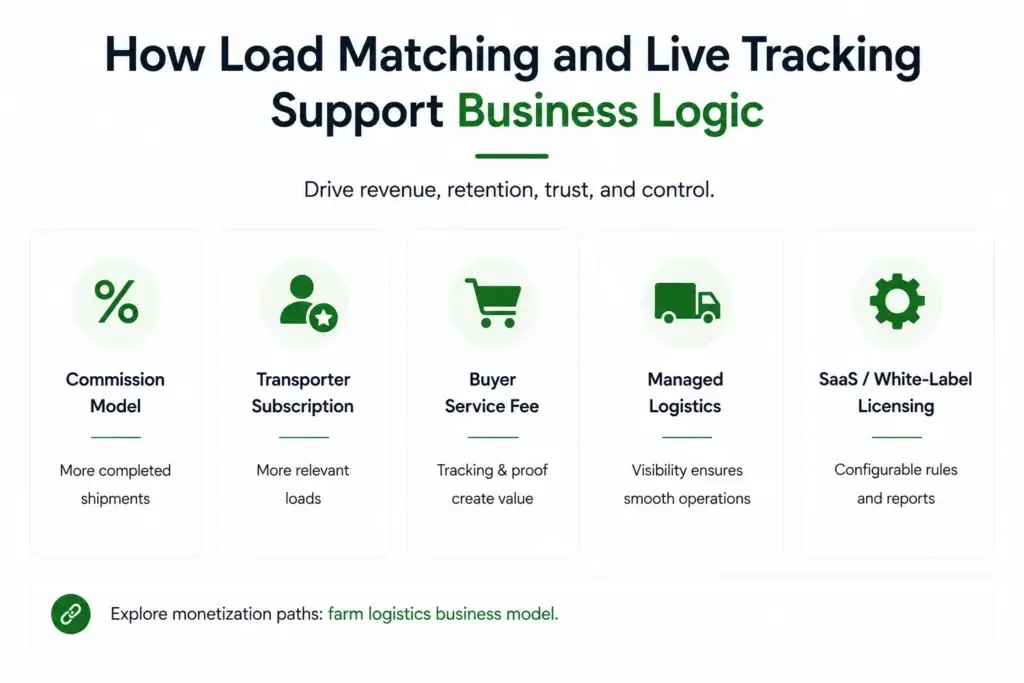
The technical workflow should connect directly to the business model. Load matching and live tracking are not isolated features. They influence revenue, retention, trust, and operational control.
Commission-Based Marketplace
If the platform earns commission on completed shipments, it needs reliable matching and delivery confirmation. Failed matches reduce revenue. Weak proof of delivery can create disputes.
Transporter Subscription Model
If transporters pay for access to loads, the platform must provide enough relevant shipment opportunities. Poor matching can reduce transporter retention.
Buyer Service Fee Model
If buyers pay for supply-chain visibility, live tracking, quality records, and delivery proof become key value drivers.
Managed Logistics Model
If the platform operator manages dispatch directly, admin tracking, exception alerts, and route visibility become critical.
SaaS or White-Label Licensing Model
If the product is used by regional operators, the platform needs configurable matching rules, admin permissions, route settings, and reporting controls.
To explore monetization paths in more detail, founders can review this farm logistics business model breakdown and align workflow design with revenue logic.
Admin Control Is Where the Workflow Becomes Manageable
The admin dashboard is the control layer behind load matching and live tracking.
A founder should not only ask whether users can post loads and track trips. The stronger question is whether admins can control the operational rules when things go wrong.
A practical admin dashboard should help operators manage:
- Load approval
- Transporter verification
- Vehicle records
- Driver assignments
- Route settings
- Matching rules
- Bids and awarded loads
- Live trip status
- Delayed shipments
- Cancelled loads
- Disputes
- Payment status
- Commission settings
- Reports and analytics
Without admin control, the platform may look functional but become difficult to operate at scale. Admin visibility reduces manual chaos and helps the founder understand what is happening across active routes.
Cost Factors for Load Matching and Live Tracking Workflows
The cost of building load matching and live tracking depends on how advanced the workflow needs to be.
A basic version may include manual assignment, simple status updates, and driver-side delivery confirmation. A more advanced version may include weighted matching, bidding, live GPS, geofencing, route deviation alerts, cold-chain telemetry, payment automation, and analytics.
| Cost Driver | Lower-Complexity Version | Higher-Complexity Version |
| Matching logic | Manual assignment or simple filters | Weighted scoring, bidding, route compatibility, automation |
| Tracking | Status updates | Live GPS, ETA, geofencing, route deviation alerts |
| Driver workflow | Basic pickup and delivery status | Offline sync, image proof, digital signature, geotagged events |
| Admin control | Shipment list and manual updates | Live control tower, alerts, exceptions, reports |
| Cold-chain visibility | Manual temperature notes | IoT sensors, temperature alerts, breach records |
| Payments | Settlement status tracking | Commission, invoices, payouts, refunds, multi-party settlement |
| Integrations | Maps and notifications | ERP, telematics, payment gateway, warehouse systems |
For a deeper pricing breakdown, founders can review this farm-to-market logistics app cost guide before requesting a final estimate.
Founder Decision Signals
Speed
Start with the matching and tracking rules needed to complete real shipments. Add advanced scoring, AI suggestions, and IoT workflows after usage data proves the need.
Cost
Cost increases when matching logic, GPS tracking, geofencing, cold-chain alerts, payment automation, and admin analytics become more advanced.
Scalability
A scalable agricultural logistics platform needs flexible route rules, transporter eligibility settings, live trip visibility, admin alerts, and reporting that can grow across regions.
Market Fit
The first version should prove that farmers, buyers, transporters, and admins can complete the shipment loop with less manual coordination than before.
Security and Trust Layers Founders Should Include
Load matching and live tracking involve sensitive operational data: user identities, vehicle information, route movement, delivery proof, invoices, payment records, and shipment history.
Security should be treated as a foundation, not an add-on.
Important trust layers include:
- User verification
- Transporter verification
- Driver verification
- Role-based access control
- Secure payment gateway integration
- Admin approval controls
- Audit logs
- Activity history
- Proof of pickup
- Proof of delivery
- Dispute management
- Privacy-conscious data handling
- Permission-based dashboards
A platform operator should know who created a load, who accepted it, who carried it, where it moved, who confirmed delivery, and what settlement status followed.
Ready-Made Foundation vs Custom Build for This Workflow
Founders can build load matching and live tracking in two ways: start with a ready-made foundation or build custom from zero.
A ready-made foundation is useful when the founder wants faster launch with common logistics workflows already available. The platform can then be customized for crop categories, transporter rules, route logic, payment status, branding, language, user roles, and admin controls.
Custom development is useful when the workflow is highly unique. For example, a platform may need proprietary route scoring, advanced ERP integration, custom telematics, special cold-chain automation, or complex enterprise procurement logic.
For founders comparing build options, Miracuves’ ready-made app solutions can provide a faster starting point than building every workflow from zero.
If your operating model requires highly specific workflows, deeper integrations, or custom product architecture, custom mobile app development may be the better route for long-term flexibility.
For founders who want a launch-ready agricultural supply chain app foundation, Miracuves offers a white-label agricultural logistics solution that can support load matching, transporter coordination, live tracking, admin control, and farm-to-market workflow customization.
Mistakes Founders Should Avoid
Treating Load Matching Like a Basic Search Filter
Matching should consider vehicle type, route, pickup distance, capacity, cold-chain needs, price, timing, and reliability. Simple keyword-style discovery may create poor shipment outcomes.
Adding Advanced Automation Before Real Shipment Data Exists
AI-led matching and predictive recommendations need operational data. Start with rule-based logic, then improve once real usage patterns are visible.
Using Live Tracking Without Exception Alerts
A map is useful, but alerts are what help admins act. Route deviation, long idle time, missed pickup, and delayed delivery should trigger operational attention.
Ignoring Rural Connectivity Conditions
Farm pickup locations and rural routes may have weak network coverage. Driver workflows should support simple updates and offline-friendly capture where needed.
Separating Delivery Proof From Settlement Logic
Proof of delivery should connect to payment, commission, invoice, and dispute workflows. Otherwise, admins may still need manual reconciliation after every shipment.
How Miracuves Helps Founders Plan Smarter
Miracuves helps founders, startups, agencies, and businesses launch ready-made and white-label app platforms with source-code ownership, branded design, admin dashboards, and faster deployment.
For farm-to-market logistics, the goal is not just to create screens for farmers and drivers. The goal is to build a workflow that can match produce loads with suitable transporters, track the shipment journey, record handovers, manage delivery proof, and give admins control over exceptions and settlements.
Businesses that need expert support can work with Miracuves as an agricultural logistics app development company to plan, customize, and launch a platform aligned with their market.
Final Thoughts
Load matching and live tracking are not just technical features inside a farm-to-market logistics product. They are the workflow layers that decide whether users trust the platform.
A farmer needs confidence that the right vehicle will arrive. A transporter needs profitable, clear, and verified loads. A buyer needs delivery visibility. A warehouse needs handover clarity. An admin needs control over delays, disputes, payments, and performance.
The strongest approach is to begin with a practical workflow: accurate load data, clear transporter eligibility, simple matching rules, reliable pickup confirmation, live shipment visibility, delivery proof, and admin reporting. Once that workflow proves demand, the platform can expand into advanced automation, route intelligence, cold-chain telemetry, predictive ETAs, and deeper analytics.
For founders, the real goal is not to build the most complex system on day one. It is to build an agricultural logistics platform that can move real shipments, create trust, and improve with every completed route.
FAQs
What is load matching in an agricultural logistics platform?
Load matching is the process of connecting a farm produce shipment with a suitable transporter based on pickup location, destination, vehicle type, capacity, route, cold-chain requirement, delivery window, pricing, and transporter reliability.
Why is live tracking important in farm-to-market logistics?
Live tracking helps farmers, buyers, transporters, drivers, warehouses, and admins monitor shipment movement. It improves ETA visibility, reduces manual follow-ups, supports delivery accountability, and helps detect route delays or exceptions.
What data is needed for accurate load matching?
Accurate load matching usually needs crop type, quantity, weight, packaging, pickup point, delivery location, vehicle requirement, cold-chain need, delivery window, route details, and transporter availability.
Should a farm logistics platform use manual matching or automated matching?
Early-stage platforms can start with manual or rule-based matching. Automated matching, weighted scoring, and AI-led recommendations are more useful after the platform has enough real shipment data to support better decisions.
How does geofencing help agricultural logistics?
Geofencing creates virtual boundaries around farms, warehouses, collection centres, cold rooms, and buyer locations. It helps record arrival, departure, route deviation, delivery attempts, and key handover events.
What is proof of delivery in farm produce transportation software?
Proof of delivery is a digital confirmation that a shipment reached the receiver. It may include OTP, signature, photo proof, geolocation, timestamp, quantity received, quality notes, or rejection reasons.
What affects the cost of load matching and live tracking features?
Cost depends on the complexity of matching rules, GPS tracking, geofencing, route deviation alerts, offline driver workflows, cold-chain integrations, admin dashboards, payment flows, and third-party APIs.
How can Miracuves help build an agricultural logistics platform?
Miracuves helps founders build ready-made and white-label app platforms with source-code ownership, branded design, admin dashboards, load matching workflows, tracking modules, and customization support. Final scope depends on user roles, integrations, region, and business model.
Miracuves is an independent software development company. We are not affiliated with, connected to, sponsored by, or endorsed by any company or product named in this article.
Terms such as “X Clone” are used descriptively. It is how the software industry refers to building a platform with functionality comparable to a known service, and how clients search for it.
The entire design and codebase of our products is built by our own team. Our products contain no code, design, graphics, or content originating from any third-party website or applications.
All third-party names and marks referenced in this article are the property of their respective owners, referenced solely to identify the services discussed.