Key Takeaways
- Agricultural transport software vs farm logistics marketplace is primarily a choice between managing an existing logistics operation and creating a multi-sided agricultural logistics network.
- Agricultural transport management software is better suited to businesses that already control shipment demand, approved carriers, warehouses, schedules, and internal logistics operations.
- A farm logistics marketplace is designed to connect farmers, FPOs, buyers, transporters, drivers, warehouses, inspectors, and admins through shared digital workflows.
- A hybrid model can combine marketplace-based farmer and transporter connectivity with TMS-style route planning, carrier management, warehouse integration, invoicing, and reporting.
- The right model should be selected around the actual supply-chain bottleneck rather than the number of features available.
Decision Signals
- Choose transport management software when the main goals are shipment planning, carrier assignment, route optimization, freight cost control, documentation, and ERP or WMS integration.
- Choose a farm logistics marketplace when the business needs farmer onboarding, buyer connectivity, transporter discovery, load posting, bidding, tracking, and settlement workflows.
- Marketplace models can support commissions, transporter subscriptions, buyer service fees, premium load placement, regional licensing, and managed logistics services.
- A hybrid agricultural logistics platform makes sense when external marketplace participation must work alongside internal carrier, warehouse, finance, and operational controls.
- Cost and complexity increase with additional user roles, matching logic, live GPS tracking, cold-chain monitoring, quality workflows, payments, integrations, and deeper admin controls.
Real Insights
- A TMS improves an existing logistics operation, while a marketplace helps create connectivity where farmers, buyers, and transporters may not already have structured relationships.
- Choosing a marketplace when the business only needs internal freight control can create unnecessary onboarding, user-role, and operational complexity.
- Choosing TMS-style software when the market needs transporter discovery and farmer-to-buyer connectivity may leave the core supply-chain problem unresolved.
- Admin control is critical in both models, but marketplace admins also need to manage network trust through verification, bids, payments, commissions, disputes, and multi-party permissions.
- The strongest decision path is: identify the supply-chain bottleneck → define required users → map the transaction workflow → choose TMS, marketplace, or hybrid → validate → expand.
Agricultural supply chains need more than vehicle movement. They need visibility, coordination, load availability, transporter trust, buyer communication, quality records, delivery proof, and settlement clarity.
That is why many founders, cooperatives, exporters, food procurement companies, and logistics operators compare two different software models: agricultural transport management software and a farm logistics marketplace.
At first, both may look similar because both deal with shipments, transporters, routes, tracking, documents, and delivery updates. But the business logic is very different.
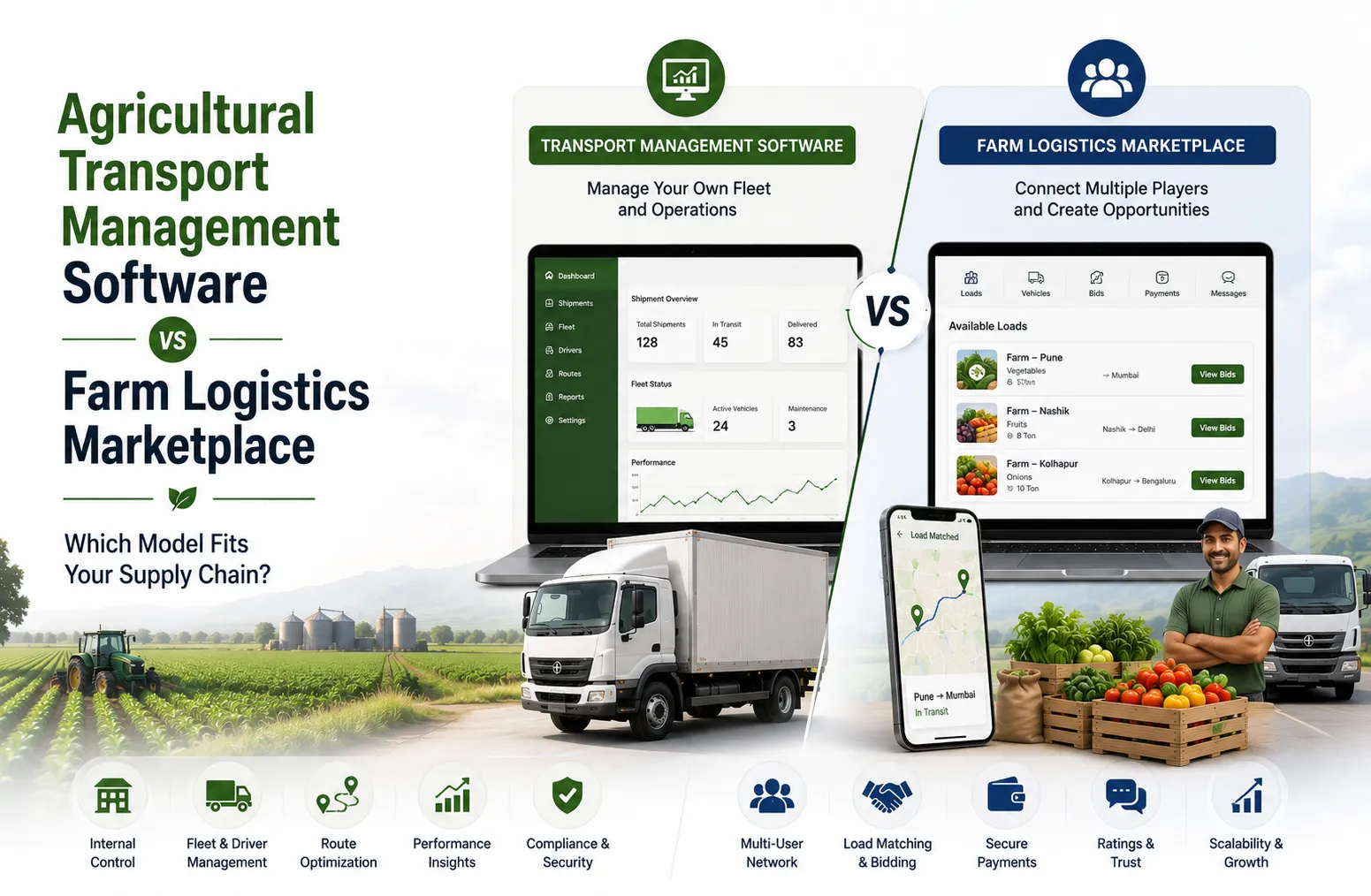
A transport management system is usually built to manage logistics that already exist inside a business. A farm logistics marketplace is built to create and coordinate a multi-sided network between farmers, FPOs, buyers, transporters, drivers, warehouses, and admins.
For founders planning an agricultural logistics platform, choosing the wrong model can create serious product risk. You may build enterprise-style transport software when your market actually needs farmer-to-buyer connectivity. Or you may build a marketplace when your business really needs internal freight control.
This guide explains the difference, where each model works best, what features matter, and how to choose the right platform architecture for your agricultural supply chain.
Why This Comparison Matters for Agricultural Supply Chains
Agricultural logistics is not the same as standard freight management. Farm produce often moves through fragmented networks where farmers, FPOs, transporters, buyers, warehouses, collection centres, cold-chain operators, and quality teams may all participate in the same shipment journey.
A traditional company may already know what needs to be shipped, which carrier will move it, which warehouse will receive it, and which internal team will manage invoicing. In that case, agricultural transport management software may be enough.
But many farm-to-market businesses start from a different reality. They need to create access between farmers and buyers. They need to help transporters discover relevant loads. They need to make produce movement transparent. They need to reduce phone-based coordination. They need to build trust where the network is not yet digitized.
That is where a farm logistics marketplace becomes more useful.
Founders planning this category should also understand how agriculture and agritech platform development supports rural workflows, field users, producer networks, digital crop movement, and agricultural business operations.
What Is Agricultural Transport Management Software?
Agricultural transport management software is a system that helps businesses plan, manage, track, and optimize the transportation of agricultural goods.
It is usually used by companies that already have structured operations. These may include food processors, exporters, wholesalers, distributors, large cooperatives, agri-input companies, procurement businesses, and enterprise supply-chain teams.
A transport management system may help with:
- Shipment planning
- Carrier selection
- Route planning
- Freight booking
- Vehicle allocation
- Delivery tracking
- Documentation
- Freight cost management
- Invoice processing
- Warehouse coordination
- ERP or WMS integration
- Carrier performance reports
- Compliance and audit records
The main purpose is operational efficiency. The business already has the shipment demand. The software helps manage the movement better.
For example, an exporter may already have confirmed produce orders and contracted carriers. The software helps assign routes, track deliveries, manage documents, monitor carrier performance, and control freight costs.
Read more – GPS Tracking and Geofencing for Agricultural Fleet Operations: How Smart Farm Logistics Work.
What Is a Farm Logistics Marketplace?
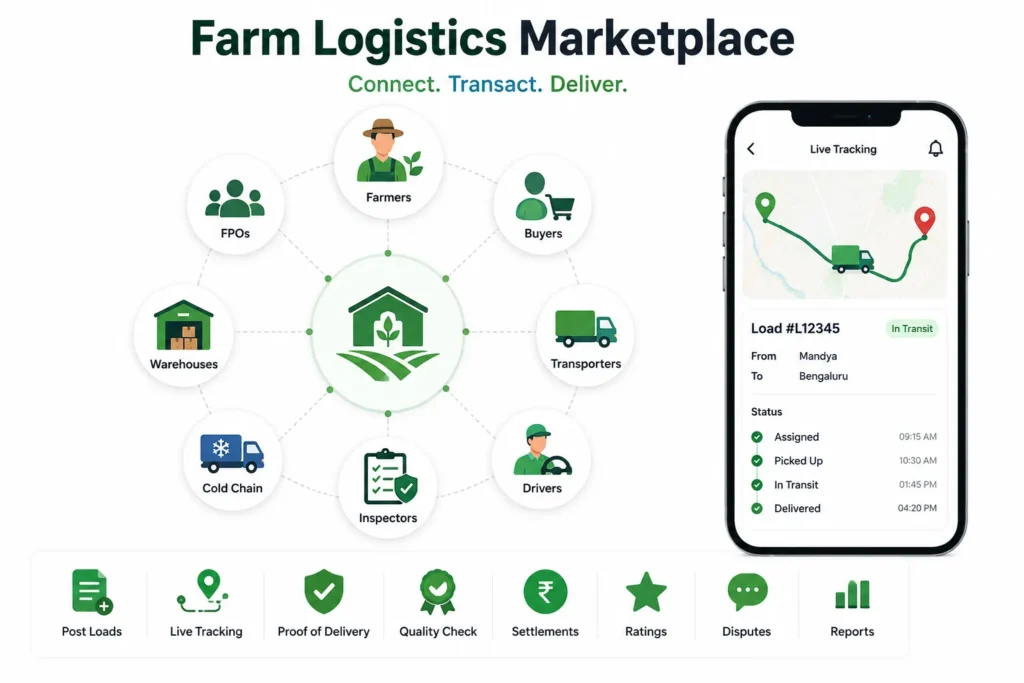
A farm logistics marketplace is a multi-sided digital platform that connects supply, demand, and transport capacity across the agricultural value chain.
Instead of only managing internal transport operations, it helps create transactions between different external users.
A farm logistics marketplace may connect:
- Farmers who need produce pickup
- FPOs aggregating member produce
- Buyers looking for reliable farm supply
- Transporters searching for agricultural loads
- Drivers executing pickup and delivery
- Warehouses managing stock movement
- Cold-chain partners handling perishables
- Quality inspectors recording crop condition
- Admin teams managing users, commissions, disputes, and reports
This model is useful when the business wants to build a network, not just manage transport.
A farm logistics marketplace may include load posting, transporter bidding, live tracking, route visibility, proof of delivery, quality records, settlement tracking, ratings, dispute management, and admin dashboards.
Founders who want to compare module-level requirements can review these agricultural logistics platform features before deciding what should be included in their launch version.
Agricultural Transport Management Software vs Farm Logistics Marketplace: Core Comparison
Agricultural Transport Management Software vs Farm Logistics Marketplace
| Comparison Area | Agricultural Transport Management Software | Farm Logistics Marketplace |
|---|---|---|
| Primary Purpose | Manage, plan, optimize, and track transport operations for an existing supply chain. | Connect farmers, FPOs, buyers, transporters, drivers, and admins in a marketplace-led network. |
| Best Fit | Processors, exporters, distributors, wholesalers, cooperatives, and enterprises with structured freight operations. | AgriTech startups, regional logistics operators, FPO networks, farmer marketplaces, procurement platforms, and farm-to-market businesses. |
| User Model | Mainly internal logistics teams, carriers, warehouse users, finance teams, and enterprise operators. | Multiple external user groups including farmers, buyers, transporters, drivers, warehouses, inspectors, and platform admins. |
| Load Creation | Usually starts from existing orders, purchase plans, or internal shipment requirements. | Can allow farmers, FPOs, buyers, or admins to create load requests and marketplace demand. |
| Transporter Discovery | Often works with known carriers, contracted partners, or approved vendors. | Helps discover, onboard, verify, compare, and match transporters across active routes. |
| Agriculture-Specific Workflows | May need customization for produce grading, harvest timing, FPO aggregation, cold-chain handling, and buyer acceptance. | Can be designed around farm produce movement, route liquidity, quality checks, and settlement trust from the start. |
| Business Model | Usually internal productivity, freight cost control, and operational efficiency. | Can support commissions, subscriptions, service fees, premium load placement, SaaS licensing, or managed logistics revenue. |
| Admin Control | Focused on internal shipment execution, carrier reports, documents, and freight performance. | Focused on network operations, user approvals, marketplace rules, bids, disputes, payments, and multi-party reporting. |
When Agricultural Transport Management Software Makes More Sense
Agricultural transport management software is the better route when the business already controls most of the logistics chain.
This means the company already has shipment demand, supplier relationships, internal operations, carrier contracts, delivery schedules, warehouse processes, and finance teams. The software is not expected to create the marketplace. It is expected to improve execution.
1. You Already Have Structured Shipment Demand
If your business already knows what needs to be shipped, where it needs to go, and which internal team controls dispatch, a transport management system can help optimize the process.
For example, a food processor sourcing crops from fixed suppliers may need better route planning, vehicle scheduling, documentation, and freight cost tracking. It may not need public load posting or open transporter bidding.
2. You Work With Approved Carriers
If transporters are already contracted or pre-approved, the software does not need a large discovery marketplace. Instead, it needs carrier assignment, performance reports, document tracking, and freight cost control.
This model works well for enterprises that prefer controlled vendor networks.
3. You Need Strong ERP or Warehouse Integration
A TMS-style system often fits businesses that need logistics data connected to ERP, procurement, inventory, warehouse, accounting, or billing systems.
For example, a food distribution company may need transport execution tied to purchase orders, stock movement, invoice processing, and warehouse dispatch.
4. Your Main Goal Is Operational Efficiency
Transport management software is useful when the problem is internal inefficiency: delayed dispatch, poor route planning, freight cost leakage, missing documents, weak carrier performance visibility, or manual invoice reconciliation.
In this case, the software improves an existing logistics operation rather than creating a new farm-to-market network.
When a Farm Logistics Marketplace Makes More Sense
A farm logistics marketplace is the better route when the supply chain is fragmented and the business needs to connect multiple sides of the market.
This model is especially relevant for AgriTech startups, cooperatives, procurement platforms, regional logistics operators, food supply-chain platforms, and businesses trying to digitize farm-to-market movement.
1. You Need Farmer-to-Buyer Connectivity
Many agricultural markets still depend on informal communication between farmers, traders, transporters, and buyers. A marketplace model can create a more transparent flow where produce availability, transport demand, and buyer requirements become visible in one system.
This is useful when the platform needs to create market access, not just manage freight.
2. You Need Transporter Discovery and Load Matching
In agricultural logistics, transport availability is often inconsistent. A farm logistics marketplace can help match produce loads with suitable transporters based on pickup location, route, vehicle type, capacity, pricing, reliability, and cold-chain capability.
This is different from assigning a known carrier. The platform must help create liquidity between available loads and available vehicles.
3. You Need Multi-Sided User Workflows
A farm logistics marketplace may need separate workflows for farmers, FPOs, buyers, transporters, drivers, warehouse teams, quality inspectors, finance teams, support teams, and admins.
A traditional TMS may support some of these roles, but it is not always designed as a public-facing multi-user marketplace from the beginning.
4. You Want to Monetize the Network
A marketplace-led agricultural logistics platform can support revenue models such as:
- Commission on completed shipments
- Transporter subscriptions
- Buyer service fees
- Premium load placement
- Cold-chain handling fees
- FPO service packages
- Regional operator licensing
- Managed logistics support
To explore these revenue paths in more detail, founders can review this farm logistics business model breakdown and align monetization with the platform structure.
The Hybrid Model: When You Need Both Marketplace and TMS Logic
Some agricultural businesses need both models.
For example, an exporter may need marketplace-style farmer onboarding and transporter discovery, but also TMS-style backend controls for route planning, carrier performance, warehouse handovers, invoicing, and documentation.
A hybrid agricultural logistics platform may include:
- Farmer and FPO onboarding
- Buyer demand management
- Load posting
- Transporter matching or bidding
- Carrier contract management
- Route planning
- Live tracking
- Warehouse integration
- Quality inspection
- Freight billing
- Invoice workflows
- Settlement tracking
- Admin reporting
- ERP or accounting integration
The hybrid model is useful when the business wants marketplace growth and enterprise-grade operational control.
The key is to avoid building every module from day one. Founders should decide which workflow needs to be validated first: marketplace participation, route execution, warehouse visibility, buyer demand, or financial settlement.
Feature Priorities by Business Model
Not every agricultural logistics platform needs the same feature set. The right modules depend on the model.
| Business Model | Priority Features | Why These Matter |
|---|---|---|
| Enterprise Transport Management | Shipment planning, carrier management, route optimization, freight cost control, documents, ERP/WMS integration | Helps an established business manage existing logistics operations more efficiently. |
| Farm Logistics Marketplace | Farmer/FPO onboarding, load posting, transporter discovery, bidding, live tracking, proof of delivery, settlement tracking | Helps build supply-demand connectivity across a fragmented agricultural network. |
| Managed Logistics Operator | Admin dispatch, driver workflows, route planning, fleet visibility, exception alerts, payment status, dispute control | Gives the operator more control over execution and service quality. |
| Buyer-Led Procurement Platform | Supplier onboarding, produce availability, quality checks, pickup planning, delivery confirmation, invoice workflows | Supports buyers who need reliable sourcing and delivery visibility. |
| FPO-Led Logistics System | Member produce aggregation, group load creation, transporter assignment, warehouse handover, buyer delivery, reports | Helps FPOs coordinate multiple farmers and reduce manual logistics management. |
| Hybrid Marketplace + TMS | Marketplace onboarding plus backend carrier management, warehouse integration, invoices, reporting, and settlement logic | Supports businesses that need both external network growth and internal control. |
Cost Factors Founders Should Compare
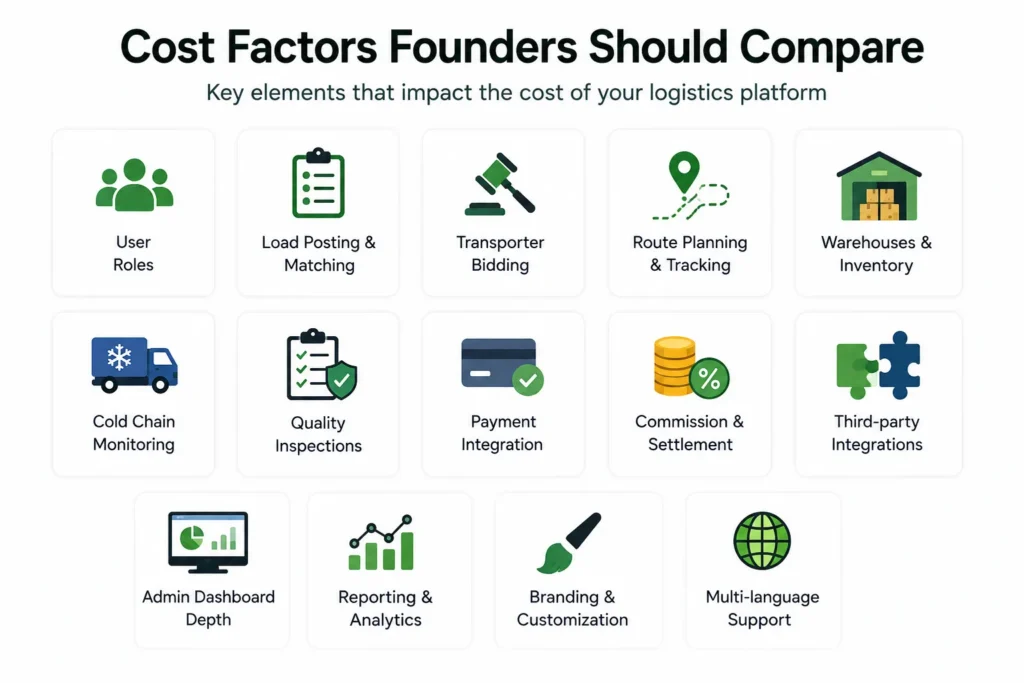
The cost of building agricultural transport management software or a farm logistics marketplace depends on scope. A basic shipment tracking tool is very different from a full multi-user logistics marketplace with bidding, quality workflows, cold-chain alerts, payments, and admin reporting.
Important cost factors include:
- Number of user roles
- Load posting and matching rules
- Transporter bidding logic
- Route planning and GPS tracking
- Warehouse and inventory workflows
- Cold-chain monitoring
- Quality inspection records
- Payment gateway integration
- Commission and settlement logic
- ERP, WMS, telematics, or accounting integrations
- Admin dashboard depth
- Reporting and analytics
- Custom branding and language support
For a deeper pricing breakdown, founders can review this farm-to-market logistics app cost guide before requesting a final estimate.
Admin Control: The Layer Founders Often Underestimate
Whether you choose transport management software or a marketplace model, admin control is the real operating layer.
The admin dashboard should help the platform operator manage:
- User approvals
- Transporter verification
- Vehicle records
- Load status
- Route settings
- Bids and awards
- Driver assignments
- Shipment delays
- Warehouse handovers
- Quality records
- Disputes
- Payment status
- Commission rules
- Reports and analytics
In a TMS-style model, admin control is mainly about operational execution and freight performance. In a marketplace model, admin control is also about network trust: who can join, who can post, who can bid, how payments are handled, and how disputes are resolved.
Founders building stronger dispatch, tracking, and fulfillment workflows can also explore Miracuves’ experience in logistics and supply chain software development to understand how route visibility, shipment coordination, and operational dashboards connect.
Read more- Load Matching and Live Tracking in Farm-to-Market Logistics Platforms: How the Workflow Works.
Security and Trust Workflows That Matter
Agricultural logistics platforms handle sensitive operational data: user identities, vehicle details, shipment locations, delivery records, invoices, quality notes, payment status, and dispute history.
Security should be planned as a foundation, not a marketing add-on.
Important trust layers include:
- User verification
- Transporter verification
- Driver verification
- Role-based access control
- Admin approval workflows
- Secure payment gateway integration
- Activity logs
- Audit logs
- Proof of pickup
- Proof of delivery
- Quality inspection records
- Dispute management
- Permission-based dashboards
- Privacy-conscious data handling
A marketplace especially needs strong trust controls because external participants interact with each other. If verification, proof, payment visibility, and dispute workflows are weak, users may return to phone-based coordination.
Founder Decision Signals
Supply-Chain Control
Choose transport management software if your business already controls shipments, carriers, warehouses, and internal logistics teams.
Marketplace Connectivity
Choose a farm logistics marketplace if your platform needs to connect farmers, FPOs, buyers, transporters, and drivers across a fragmented network.
Cost
Costs increase with more user roles, bidding logic, live tracking, warehouse workflows, cold-chain monitoring, payments, and integrations.
Market Fit
The first version should prove the core workflow: shipment creation, transporter participation, delivery visibility, buyer trust, and settlement clarity.
Which Model Fits Your Supply Chain?
There is no single correct answer. The right model depends on what problem you are solving.
Choose agricultural transport management software if:
- Your business already has shipment demand.
- You already work with known carriers.
- Your main goal is route planning and freight control.
- You need ERP, WMS, or accounting integration.
- You want to reduce internal logistics inefficiency.
- You do not need a public-facing farmer-buyer-transporter marketplace.
Choose a farm logistics marketplace if:
- You need to connect farmers, FPOs, buyers, and transporters.
- You want to create a digital load network.
- You need transporter discovery or bidding.
- You want to improve farm-to-market access.
- You need marketplace monetization.
- You want separate user apps or panels for multiple stakeholders.
- You need trust workflows like verification, delivery proof, ratings, and dispute control.
Choose a hybrid model if:
- You need marketplace onboarding and enterprise transport control.
- You want both external user participation and internal operational visibility.
- You need farmer/FPO workflows plus carrier management.
- You need load discovery plus route planning.
- You need buyer procurement plus warehouse integration.
- You need settlement workflows plus freight documentation.
Ready-Made Foundation vs Custom Development
After choosing the product model, founders must decide how to build it.
A ready-made foundation can help when the business wants faster launch with proven workflows already available. The platform can then be customized for user roles, branding, crop categories, route logic, transporter rules, payment status, language, admin controls, and reporting needs.
Custom development is useful when the product requires highly specific workflows, proprietary logic, deep enterprise integrations, or unusual architecture.
For founders comparing build options, Miracuves’ ready-made app solutions can provide a faster starting point than building every workflow from zero.
If your operating model requires highly specific workflows, deeper integrations, or custom product architecture, custom mobile app development may be the better route for long-term flexibility.
For founders who want a launch-ready agricultural supply chain app foundation, Miracuves offers a white-label agricultural logistics solution</a> that can support farm-to-market workflows, transporter coordination, shipment tracking, marketplace operations, admin control, and business model customization.
Mistakes Founders Should Avoid
Choosing TMS When the Market Needs Connectivity
If farmers, buyers, and transporters are not already connected, internal transport management software may not solve the core market-access problem.
Choosing a Marketplace When the Business Only Needs Internal Control
If your company already controls the supply chain, a full marketplace may add unnecessary user roles, onboarding complexity, and operational overhead.
Ignoring the Admin Dashboard
The admin layer decides whether the operator can manage users, loads, routes, bids, disputes, payments, commissions, and reports without constant manual intervention.
Adding Too Many Features Before Validating the Workflow
Start with the core transaction loop before adding advanced route intelligence, IoT integrations, ERP connections, or predictive analytics.
Separating Product Model From Revenue Model
A TMS usually creates value through efficiency. A marketplace may monetize through transactions, subscriptions, service fees, or licensing. The product architecture should support the revenue logic.
How Miracuves Helps Founders Choose the Right Model
Miracuves helps founders, startups, agencies, logistics businesses, and agricultural operators launch ready-made and white-label app platforms with source-code ownership, branded design, admin dashboards, and faster deployment.
For agricultural logistics, the stronger decision is not simply choosing software with more features. The stronger decision is choosing the product model that matches the real supply-chain bottleneck.
If the bottleneck is internal shipment control, a TMS-style product may be enough. If the bottleneck is fragmented access between farmers, buyers, and transporters, a marketplace model may be stronger. If the business needs both connectivity and operational control, a hybrid model may be the better path.
Businesses that need expert support can work with Miracuves as an agricultural logistics app development company to plan, customize, and launch a platform aligned with their operating model.
Final Thoughts
The difference between agricultural transport management software and a farm logistics marketplace is not only technical. It is strategic.
Transport management software helps businesses manage existing logistics more efficiently. A farm logistics marketplace helps create a connected agriculture logistics network where farmers, FPOs, buyers, transporters, drivers, warehouses, and admins coordinate produce movement through one platform.
For founders, the right decision depends on the supply-chain gap. If the problem is internal route planning, carrier performance, freight cost, and documentation, a TMS-style model may fit. If the problem is fragmented access, transporter discovery, farmer onboarding, buyer connection, and settlement trust, a marketplace model may be stronger.
The best agricultural logistics platform is not the one with the longest feature list. It is the one built around the real operating model, the right users, and the workflow that needs to be validated first.
FAQs
What is agricultural transport management software?
Agricultural transport management software helps businesses plan, execute, track, and optimize the movement of agricultural goods. It is useful for companies that already have structured shipments, approved carriers, warehouse workflows, and internal logistics teams.
What is a farm logistics marketplace?
A farm logistics marketplace is a digital platform that connects farmers, FPOs, buyers, transporters, drivers, warehouses, and admins. It helps users post loads, find transporters, track shipments, manage delivery proof, and coordinate farm-to-market movement.
How is a farm logistics marketplace different from a TMS?
A TMS mainly manages existing transport operations. A farm logistics marketplace helps create and coordinate a multi-sided network. The marketplace model focuses more on farmer onboarding, buyer demand, transporter discovery, load matching, and settlement trust.
Which model is better for AgriTech startups?
A farm logistics marketplace is usually better for AgriTech startups that need to connect farmers, buyers, and transporters. Agricultural transport management software is better for established businesses that already control logistics and need better operational efficiency.
Can one platform combine TMS and marketplace features?
Yes. A hybrid agricultural logistics platform can combine marketplace workflows such as farmer onboarding and load posting with TMS-style capabilities such as route planning, carrier management, documentation, warehouse integration, invoicing, and reporting.
What features should a farm logistics marketplace include?
Important features include farmer or FPO onboarding, buyer panel, transporter app, driver workflow, load posting, transporter matching, live tracking, proof of delivery, quality records, payment status, dispute management, and admin dashboards.
What affects the cost of agricultural logistics platform development?
Cost depends on user roles, matching logic, live tracking, warehouse workflows, cold-chain requirements, quality inspection, payment flows, third-party integrations, admin dashboard depth, and customization scope. Final pricing should be confirmed based on selected modules and launch requirements.
How can Miracuves help build an agricultural logistics platform?
Miracuves helps founders build ready-made and white-label app platforms with source-code ownership, branded design, admin dashboards, logistics workflows, tracking modules, and customization support. Final scope depends on user roles, integrations, region, and business model.
Miracuves is an independent software development company. We are not affiliated with, connected to, sponsored by, or endorsed by any company or product named in this article.
Terms such as “X Clone” are used descriptively. It is how the software industry refers to building a platform with functionality comparable to a known service, and how clients search for it.
The entire design and codebase of our products is built by our own team. Our products contain no code, design, graphics, or content originating from any third-party website or applications.
All third-party names and marks referenced in this article are the property of their respective owners, referenced solely to identify the services discussed.