Key Takeaways
- Freelancers vs Dedicated Development Teams is not simply a choice between lower cost and higher cost. The right structure depends on technical ownership, product complexity, continuity, and long-term development requirements.
- Freelancers can be highly effective for clearly defined features, specialized integrations, performance work, or other isolated engineering requirements when responsibilities and acceptance criteria are clearly established.
- A dedicated development team can provide stronger continuity across interconnected features through shared coding standards, peer reviews, documentation, testing, and ongoing product knowledge.
- Technical debt is usually driven by fragmented ownership, undocumented shortcuts, duplicated logic, weak testing, and inconsistent architecture rather than by freelance status alone.
- Startups should maintain company-controlled repositories, infrastructure access, databases, domains, and critical service accounts so development does not depend on one contributor.
- Establishing a clear technical owner helps maintain architecture consistency, review important changes, document decisions, and understand how new features affect the wider product.
- Code reviews, automated testing, documentation, and repeatable deployments are essential safeguards regardless of whether the startup uses freelancers, an internal team, or an external development team.
- A structured developer handover process should include repository access, setup instructions, architecture information, database details, deployment procedures, known issues, dependencies, and permission inventories.
- A hybrid development model can combine ongoing technical ownership with specialist freelancers when temporary contributors follow the same repository, review, testing, documentation, and handover standards.
- Founders should evaluate development arrangements based on the total cost of maintaining and extending the software, including testing, integration, onboarding, bug fixing, deployment, security maintenance, and future changes.
- The best development structure is the one that preserves code ownership, architectural consistency, knowledge continuity, predictable delivery, and maintainability as the startup grows.
Building software quickly is often a startup’s greatest advantage. Founders must validate ideas, respond to customer feedback, and release improvements before their resources run out. Yet the same pressure to move faster can create a less visible problem: technical debt that makes every future product change slower, riskier, and more expensive.
The challenge becomes particularly noticeable when startups work with multiple independent developers, switch contributors frequently, or expand a product without anyone taking responsibility for its overall technical direction. A feature may work perfectly on delivery, but its implementation can introduce duplicated logic, undocumented dependencies, inconsistent coding standards, and unexpected maintenance requirements.
For founders building products that require continuous improvement, choosing an appropriate long-term software engineering team structure can help establish clearer technical ownership, consistent development practices, and continuity between product releases.
However, avoiding technical debt does not automatically require hiring a large engineering team. Freelancers can deliver excellent work, while poorly managed teams can accumulate serious technical problems. What matters is how responsibilities, architecture decisions, code quality, documentation, and knowledge transfer are managed.
This guide explains why technical debt develops, how different development arrangements influence its accumulation, which warning signs founders should recognize, and what practical steps can keep a startup’s product maintainable as it grows.
What Is Technical Debt, and Why Should Startup Founders Care?
Technical debt describes the future cost created by software design or implementation choices that make later changes more difficult than they otherwise would be.
It can emerge from rushed implementation, incomplete testing, weak architectural decisions, outdated dependencies, missing documentation, or workarounds that remain long after their original purpose has disappeared.
Consider a startup launching an appointment-booking application. To meet an early deadline, a developer places pricing rules directly inside several interface screens instead of managing them through a consistent business-logic layer.
The initial application may function correctly. But when the business introduces location-specific pricing, promotional discounts, and subscription plans, the engineering team must update several disconnected implementations of the same rule.
What originally appeared to save time now increases development effort and the risk of inconsistent pricing behavior.
The problem is not necessarily that the original decision was irrational. Startups often accept compromises to validate demand. Technical debt becomes dangerous when those compromises are undocumented, poorly understood, and repeatedly extended without correction.
Not All Technical Debt Is Equally Harmful
Some temporary shortcuts are reasonable when their limitations are understood and a future correction is planned. A founder may deliberately postpone a sophisticated administrative workflow while validating whether customers need the service at all.
Other shortcuts are significantly riskier. Weak authorization checks, unreliable financial calculations, unsafe database changes, and untested payment workflows can expose users and businesses to immediate harm.
The important distinction is between consciously accepted compromises and uncontrolled implementation weaknesses.
Founders should not ask whether their application contains any technical debt. Most evolving products contain trade-offs. The more useful question is whether the team understands those trade-offs and can change the application safely.
How the Technical Debt Spiral Begins in Early-Stage Startups
Technical debt rarely becomes a major problem after a single imperfect feature. More often, it develops through a repeating cycle in which short-term delivery pressure creates additional maintenance work, leaving progressively less time to improve the underlying software.
A founder requests a new feature. The developer implements it quickly by extending an existing workaround. Because the code has limited test coverage, the change causes an unexpected defect elsewhere. The team spends additional time debugging the issue, pushing the next feature behind schedule.
To recover the lost time, another shortcut is introduced. The resulting application becomes harder to understand, and future changes require increasingly cautious investigation.
Eventually, development speed decreases even though the team appears busier than ever.
The Five Stages of a Technical Debt Spiral
- Delivery pressure: Product requirements and deadlines encourage rushed changes.
- Unrecorded shortcuts: Developers introduce temporary solutions without documenting their limitations.
- Increasing dependencies: New functionality relies on fragile or duplicated components.
- Growing rework: Defects, onboarding difficulty, and unpredictable changes consume engineering capacity.
- Reduced product velocity: The startup struggles to release improvements, increasing pressure for further shortcuts.
The cycle can continue until the company faces a difficult choice between stabilizing the existing product and replacing substantial parts of the implementation.
Preventing this outcome requires clear technical responsibility long before the application reaches a crisis point.
How Different Development Arrangements Influence Technical Debt
Startups generally use several approaches to obtain software engineering capacity. They may work with independent specialists, maintain an internal engineering organization, engage a coordinated external team, or combine these arrangements.
Each option can produce maintainable software when responsibilities are clear. Each can also create technical debt when engineering decisions are fragmented or quality controls are absent.
The primary difference lies in how technical knowledge, product responsibility, and delivery standards are preserved between assignments.
Independent Developers: Flexibility With Greater Coordination Responsibility
Independent developers are often useful for clearly defined tasks. A startup may need a specialist to improve a payment integration, develop a marketing website, review database performance, or implement a particular feature.
This flexibility allows founders to obtain expertise without building a permanent team around every requirement.
Problems can arise, however, when several independent contributors make architectural decisions without a shared technical owner.
One developer may establish a particular API structure, while another introduces a different pattern. A third contributor may add dependencies that overlap with existing functionality. Each implementation may work individually while increasing the difficulty of maintaining the complete application.
The risk is not freelance status itself. It is the absence of an agreed technical direction, review process, and ownership model.
Coordinated Engineering Teams: Continuity With Shared Standards
A coordinated engineering team may provide more consistent ownership across related development tasks. Engineers can work from a shared backlog, follow common coding standards, review one another’s changes, and maintain knowledge of the complete product.
This arrangement can be particularly valuable when features involve interconnected systems, such as user authentication, financial transactions, administrative permissions, reporting, and external integrations.
However, a team structure alone does not guarantee good engineering. Without accountable technical leadership, clear documentation, and sufficient testing, a larger team may produce technical debt faster than a well-managed individual developer.
The objective is coordinated ownership, not simply having more people assigned to the project.
| Engineering Factor | Independent Contributors | Coordinated Product Team |
|---|---|---|
| Technical direction | Requires an explicitly assigned owner | Can be managed through a shared technical lead |
| Code consistency | Depends on enforced project standards | Can benefit from routine peer review |
| Knowledge continuity | Requires structured documentation and handovers | Can be distributed among ongoing team members |
| Testing ownership | Must be specified in each assignment | Can be integrated into team delivery practices |
| Specialized work | Useful for isolated expert tasks | Useful for connected, continuing product changes |
| Primary risk | Fragmented ownership without governance | Coordination overhead without effective leadership |
Neither arrangement removes the founder’s responsibility for ensuring the business owns its code, data, technical decisions, and critical accounts.
Why Fragmented Code Ownership Is More Dangerous Than Team Size
A startup can operate with a small engineering group and maintain a dependable codebase. It can also employ many developers while struggling with inconsistent implementation and difficult handovers.
The differentiating factor is often the presence of clear technical ownership.
Technical ownership means someone is accountable for how components fit together, how decisions are recorded, how code is reviewed, and how changes affect the overall application.
It does not mean one person must write every line of code. A strong ownership model allows engineers to collaborate while preserving consistent standards.
Establish an Architecture Decision Process
When developers need to introduce a new database, service, framework, or integration pattern, the decision should be evaluated against existing architecture and product requirements.
For startups without senior technical leadership, architecture decisions can become fragmented as different contributors introduce their preferred tools, frameworks, and implementation patterns. Establishing technical architecture and engineering leadership can help founders create consistent decision-making standards, document important trade-offs, and reduce the risk of expensive redesigns as the product grows.
Short architecture decision records can document the problem, considered options, chosen approach, trade-offs, and date of the decision.
These records need not become lengthy technical reports. Their value is preserving context so future contributors understand why the software was built a particular way.
Keep the Source Repository Under Company Control
A founder should not discover during a developer transition that the only functioning application exists inside someone else’s personal repository or hosting account.
The company should control the source repository, production environment, database access, domain configuration, backup arrangements, and relevant third-party service accounts.
Developers can receive role-based permissions without becoming the sole administrators of essential systems.
Clear contractual intellectual-property terms and practical access controls help reduce the risk of development disruption when contributors change.
Seven Technical Debt Warning Signs Startup Founders Should Recognize
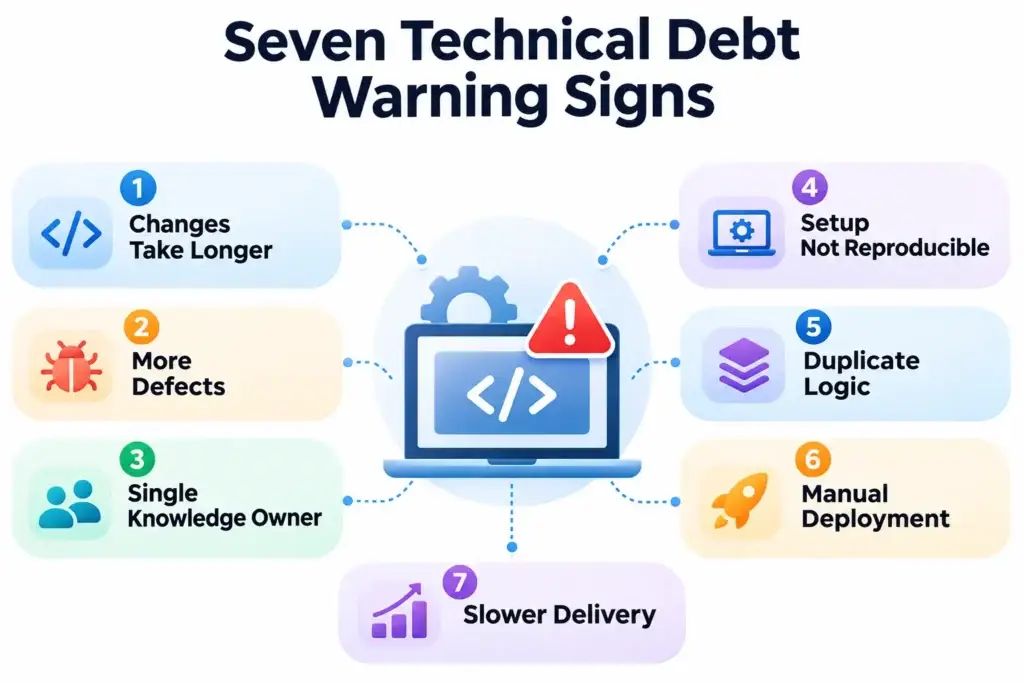
Technical debt does not always appear as a visible defect. Some applications continue operating while becoming increasingly difficult to modify.
Founders should watch for patterns that indicate the engineering process is losing predictability.
1. Small Changes Require Unexpectedly Large Effort
If adding a simple field or changing a pricing rule requires modifications across many unrelated files, the application may contain excessive coupling or duplicated logic.
The warning becomes more significant when similar requests consistently take longer over time.
2. Every Release Creates New Defects
Frequent regressions may indicate insufficient automated testing, unclear dependencies, or unpredictable deployment practices.
Defects should be analyzed for root causes rather than repeatedly treated as isolated incidents.
3. Only One Developer Understands Important Modules
Concentrated knowledge creates operational risk. If one contributor becomes unavailable, the team may struggle to fix critical problems or continue development.
Documentation, peer reviews, shared debugging sessions, and planned knowledge transfer can reduce this dependency.
4. Developers Cannot Reproduce the Application Setup
If a new engineer cannot run the application using documented instructions, onboarding becomes slower and the project depends on undocumented configuration.
Dependencies, environment settings, database migrations, build commands, and test procedures should be reproducible.
5. Business Rules Are Duplicated
Duplicate implementations of authentication, permissions, pricing, or payment calculations can create inconsistencies and additional testing requirements.
A shared implementation is not always appropriate, but repeated logic should be an intentional design choice rather than an accidental consequence of disconnected work.
6. Deployment Depends on Manual Steps Known to One Person
Manual deployments without clear procedures increase operational risk and complicate recovery when changes fail.
Repeatable build, testing, deployment, and rollback processes help reduce dependence on individual knowledge.
7. Feature Delivery Slows While Maintenance Work Increases
A growing proportion of engineering time spent fixing regressions, investigating unfamiliar code, and repairing deployments may indicate that accumulated debt is affecting delivery capacity.
Teams should investigate the trend rather than assuming that slower delivery automatically means developers are underperforming.
How Inconsistent Development Practices Create Hidden Long-Term Costs
Founders often compare development arrangements using hourly or monthly spending. That information matters, but it does not explain the total cost of maintaining the resulting software.
The real cost of development includes implementation, testing, integration, code review, bug fixing, onboarding, security maintenance, deployment, and future changes.
Consider a hypothetical startup that commissions an additional reporting feature. The implementation appears inexpensive because the assigned developer completes the visible functionality quickly.
However, the feature uses direct database queries inside several interface components, duplicates authorization checks, and introduces an undocumented dependency.
When the product later introduces new user permissions and reporting requirements, another engineer must understand and revise those decisions before implementing the requested changes.
The startup pays for the original implementation and then pays again for corrective work made necessary by its structure.
This is the central business effect of technical debt: future development absorbs work that could have been avoided through more deliberate engineering decisions.
| Hidden Cost | Business Consequence |
|---|---|
| Repeated developer onboarding | Time is spent rediscovering existing architecture. |
| Regression fixes | Resources are diverted from new product improvements. |
| Uncontrolled dependencies | Upgrades become risky or require extensive migration. |
| Weak automated testing | Every release requires additional manual checking. |
| Missing documentation | Critical knowledge disappears during personnel changes. |
| Unclear code ownership | Defects and architectural inconsistencies remain unresolved. |
A startup should therefore assess development value based on the cost of safely operating and extending software, not only on the initial price of individual deliverables.
Five Engineering Practices That Prevent the Technical Debt Spiral
Technical debt prevention does not require enterprise-level bureaucracy. Most startups benefit from a small number of consistently applied engineering practices.
1. Establish Coding Standards and Peer Review
A shared coding convention helps developers work within consistent patterns for naming, error handling, authorization, database access, and component structure.
Pull-request reviews provide a second opportunity to detect potential issues before changes enter the main codebase.
A useful review should examine correctness, maintainability, testing, security implications, and compatibility with the existing architecture.
Review requirements should be proportionate to risk. A small documentation update does not require the same scrutiny as a change to financial transactions or user permissions.
2. Introduce Automated Testing for Important Workflows
Automated testing reduces the risk of unintentionally breaking existing behavior when the application changes.
Unit tests can verify individual rules, integration tests can check interactions between components, and end-to-end tests can validate important user journeys.
Startups should prioritize tests around high-impact workflows such as authentication, payments, subscription management, order processing, booking, and permission enforcement.
Testing becomes more effective when it is integrated into the wider development process rather than treated as a final activity before release. A structured software testing and quality assurance approach connects code reviews, automated validation, security checks, and release procedures, helping startups detect defects before they create additional maintenance work.
Test coverage percentages alone are not a sufficient quality measure. Tests must validate meaningful behavior and remain reliable as the software evolves.
3. Document Critical Architecture and Business Logic
Documentation should explain how the application is organized, where important responsibilities live, and how engineers can safely make changes.
The most useful documents often include a system overview, database relationships, API contracts, deployment instructions, important architectural decisions, and known limitations.
Documentation must be maintained as the product changes. An outdated architectural diagram can be more confusing than an intentionally simple and current explanation.
4. Make Deployments Repeatable and Reversible
A defined delivery process should explain how code is built, tested, approved, deployed, monitored, and rolled back when necessary.
Continuous integration can help run automated checks consistently. Deployment automation can reduce manual differences between releases and environments.
Production changes involving databases or persistent data require particular care because restoring an earlier code version may not automatically reverse a schema migration.
As a startup introduces more frequent releases, manual deployment processes can become a source of operational risk and undocumented dependencies. Implementing automated deployment and release management helps teams standardize build pipelines, validate changes consistently, and maintain a clearer record of how software moves from development into production.
The objective is confidence: engineers should understand the steps required to deliver a change and respond if it behaves unexpectedly.
5. Allocate Time to Known Technical Debt
Technical debt should appear in normal product planning instead of remaining an invisible engineering complaint.
Maintain a prioritized record of known issues, including the affected modules, business consequences, likelihood of causing failures, and dependencies on future work.
Some improvements should be completed before introducing related features. Others can be scheduled during routine engineering cycles.
Rather than reserving an arbitrary percentage of every sprint, choose a debt-management approach based on the product’s actual risk, maturity, and delivery needs.
Why Developer Handover Is a Critical Technical Debt Prevention Process
Developer transitions are unavoidable. Freelancers finish assignments, internal employees change roles, businesses reorganize, and product priorities evolve.
A maintainable application should survive these changes without depending on one contributor’s memory.
A structured handover transfers more than source files. Incoming engineers need to understand how the product operates, how it is deployed, where critical business rules are implemented, and which known issues require caution.
What Should Every Development Handover Include?
- Access to the company-controlled source repository and current stable release.
- Application setup instructions and required runtime versions.
- Database schema, migration history, and backup procedures.
- Architecture overview and important integration dependencies.
- Test instructions and current known test failures.
- Deployment, monitoring, and rollback procedures.
- Documented technical limitations and unfinished work.
- Access and permissions inventory for critical services.
- Recent architectural decisions and reasons behind them.
- Outstanding issues prioritized by business risk.
Passwords and API secrets should not be passed around in unsecured documents. Access should be managed through appropriate permission systems, and credentials should be rotated when necessary during a transition.
A practical handover test is to ask an engineer unfamiliar with the project to set up the application, run its tests, and explain a major workflow using the available documentation.
If that exercise cannot be completed without extensive assistance from the outgoing developer, the startup may have a knowledge-continuity problem.
Founders working with existing applications can also use the codebase handoff checklist to examine repository access, architecture visibility, deployment reproducibility, and ownership before transferring work to another engineering provider.
How to Measure Technical Debt Instead of Guessing
Founders do not need to inspect every source file to understand whether technical debt is affecting the business.
Operational patterns can reveal when the codebase is becoming difficult to maintain, although no single metric proves that technical debt is the cause.
Useful signals include longer lead times for similar changes, recurring regressions, repeated deployment failures, prolonged onboarding, and an increasing amount of unplanned maintenance work.
| Metric | What It Can Reveal | How to Interpret It |
|---|---|---|
| Change lead time | Time required to deliver a code change | Compare similar work and account for complexity |
| Change failure rate | Frequency of problematic releases | Investigate testing and release practices |
| Rework volume | Engineering effort spent correcting earlier changes | Distinguish defects from changing product requirements |
| Onboarding time | Difficulty transferring technical knowledge | Assess documentation and setup reproducibility |
| Dependency age | Potential maintenance and security exposure | Prioritize supported versions and actual vulnerabilities |
| Critical test gaps | Important behaviors lacking automated validation | Assess impact rather than raw test count |
Review these signals over time and combine them with engineering observations. A temporary increase in delivery time may reflect an unusually difficult feature rather than worsening code quality.
The purpose of measurement is to support better decisions, not to create simplistic productivity rankings for individual developers.
The Founder’s Technical Debt Register: A Simple Prioritization Framework
Once technical debt is visible, the next challenge is deciding what to address first.
Not every imperfect implementation deserves immediate attention. A low-traffic internal reporting tool may tolerate more limitations than a payment-processing module handling financial transactions.
A technical debt register helps founders and engineers distinguish urgent business risks from improvements that can reasonably wait.
Each entry should describe the issue, affected components, probable impact, evidence, estimated correction effort, responsible owner, and conditions that would increase its priority.
Prioritize Debt Using Business Risk and Future Dependency
A security weakness affecting user access may require immediate correction. A poorly organized module that will be extended repeatedly over the next two months may also deserve early attention because future features depend on it.
Meanwhile, duplicative code inside an isolated and stable administrative feature may be documented and scheduled for later improvement.
This risk-based approach prevents teams from spending excessive time polishing low-impact code while neglecting problems that threaten product reliability or development velocity.
When Does a Startup Need Stronger Engineering Continuity?
The need for sustained engineering continuity generally grows as a product becomes more interconnected and commercially important.
A startup validating a relatively isolated concept may operate effectively with one experienced developer and a clear project scope.
Once the product supports multiple user roles, recurring transactions, complex integrations, and frequent releases, preserving knowledge across engineering activities becomes increasingly valuable.
Important signals include repeated dependency conflicts, frequent handover delays, uncertain architectural ownership, and product changes that require coordination across several modules.
Founders should avoid interpreting these signals as a reason to increase headcount automatically. Sometimes the correct solution is a technical lead, a better testing process, or clearer ownership of an existing team.
In other situations, the business may benefit from a stable group of engineers who share development responsibility across releases.
Where the startup already has technical leadership and needs an additional contributor, remote developers who integrate with an existing engineering workflow may be a more appropriate next step than reorganizing the entire delivery model.
Can a Hybrid Development Model Prevent Technical Debt?
A hybrid model combines ongoing technical ownership with flexible specialist contributions.
For example, a startup might maintain a technical lead and a small core engineering group while using independent specialists for a particular integration, security assessment, or performance investigation.
This approach can preserve continuity without requiring the business to maintain every specialized capability permanently.
The model works when temporary contributors follow the same repository permissions, coding conventions, review standards, and acceptance criteria as the rest of the team.
For startups that already have a technical lead and established coding standards, expanding engineering capacity does not always require restructuring the entire team. A flexible engineering capacity model allows additional specialists to contribute within existing review, documentation, and delivery processes while the startup maintains ownership of its architectural decisions.
Each assignment should include a clear owner, defined deliverables, integration requirements, testing expectations, and knowledge-transfer obligations.
Most importantly, temporary contributors should not create isolated code that only they understand. Their work should become part of the maintainable product foundation.
A 30-Day Plan to Stop Technical Debt From Growing
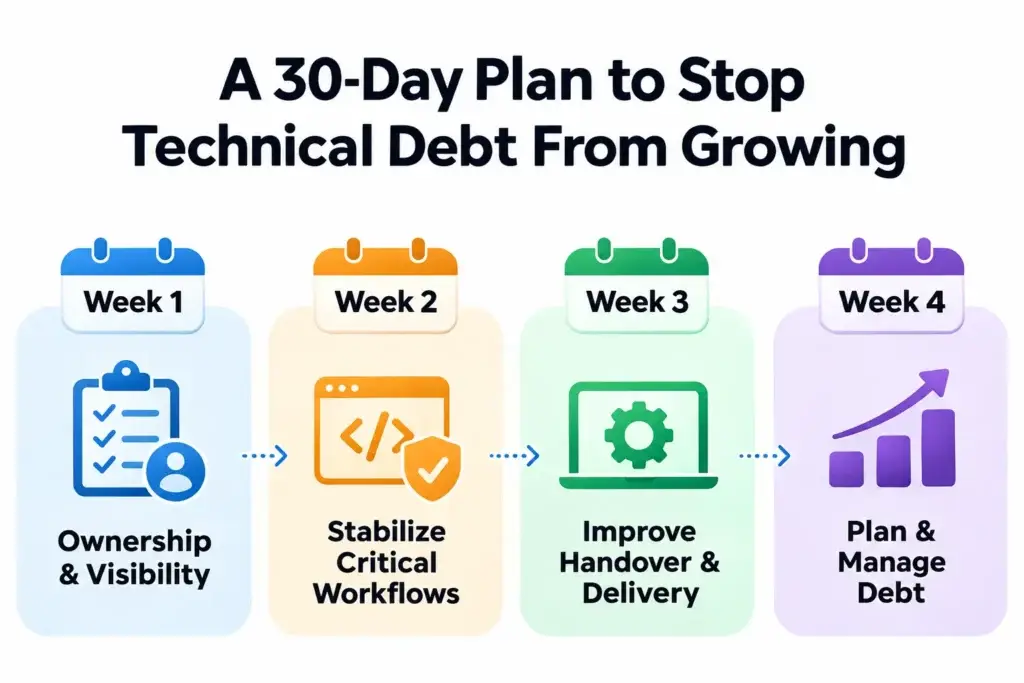
Startups experiencing slower development do not necessarily need an immediate rewrite. A structured month of technical investigation and improvement can help identify which problems require attention and which parts of the product remain healthy.
The following is an illustrative action plan. The actual effort depends on application complexity, available engineering capacity, and the severity of existing problems.
Week 1: Establish Ownership and Visibility
Identify the current technical owner of each major module. Confirm repository access, deployment controls, infrastructure ownership, and documentation availability.
Review recent incidents, recurring defects, developer onboarding issues, and changes that repeatedly require unexpected effort.
Record findings in a shared technical debt register instead of relying on informal conversations.
Week 2: Stabilize Critical Workflows
Identify important business processes that lack appropriate test coverage or have a history of regressions.
Introduce targeted automated tests, document known limitations, and resolve urgent security or data-integrity risks.
Avoid undertaking broad cosmetic refactoring before the team understands the product’s highest-risk areas.
Week 3: Improve Engineering Handover and Delivery Practices
Ensure engineers can reproduce the application from documented setup instructions. Establish appropriate code review rules and verify deployment and rollback procedures.
Document key architectural decisions and assign responsibility for keeping technical information current.
Week 4: Integrate Debt Management Into Product Planning
Prioritize the remaining issues based on business impact, future dependencies, and correction effort.
Define how technical improvements will be planned alongside customer-facing features. Establish review intervals and identify metrics that will indicate whether maintainability is improving.
The desired outcome is not a perfect codebase after 30 days. It is a repeatable process that prevents small weaknesses from accumulating without oversight.
When Should Founders Refactor, Rewrite, or Retain Existing Code?
Technical debt discussions sometimes end with an expensive recommendation to rebuild the entire application.
A rewrite may be justified when an important component is fundamentally unsafe, incompatible with required functionality, or exceptionally difficult to maintain. However, rewriting working software introduces its own delivery risk, migration complexity, and opportunity cost.
Founders should request a module-level assessment rather than accepting a blanket conclusion that the codebase is unusable.
| Decision | When It Makes Sense | Founder Consideration |
|---|---|---|
| Retain | The component is understandable, stable, and adequate for current needs. | Document ownership and maintain normal review controls. |
| Refactor | The behavior is correct but the implementation is difficult to change. | Protect existing behavior with suitable tests. |
| Partially rewrite | A bounded module has serious structural or security problems. | Plan integration, migration, and rollback carefully. |
| Replace | The capability can be replaced with a better-supported component or foundation. | Review ownership, dependencies, licensing, and total maintenance cost. |
The right choice depends on technical evidence, not frustration with previous developers.
A professional engineering assessment should explain which components are safe to retain, which require improvement, and what risks each option creates for the business.
How Founders Can Evaluate Engineering Ownership Before the Next Product Phase
Before beginning a new development phase, founders should review the responsibilities that must remain consistent throughout the project.
The objective is not to identify the largest available engineering team. It is to determine who will maintain architecture consistency, approve important changes, protect application behavior, and preserve knowledge as the product evolves.
Founder Decision Signals
Product Complexity
Are new features increasingly dependent on several interconnected modules and integrations?
Technical Ownership
Is someone accountable for architecture, code quality, and long-term maintainability?
Continuity Risk
Could the product continue safely if a key contributor became unavailable?
Delivery Predictability
Can the team make, test, deploy, and reverse changes through documented procedures?
These questions help founders distinguish a short-term capacity gap from a deeper engineering governance problem.
If the primary issue is one missing technical skill, additional individual expertise may solve it. If the issue is unclear ownership across the product, simply adding another developer may not address the underlying problem.
How Miracuves Supports Engineering Continuity and Maintainable Product Development
For startup founders, the transition from initial development to ongoing product growth requires more than adding new features. The application also needs a dependable process for preserving technical knowledge, maintaining code quality, and handling changes without repeatedly disrupting existing functionality.
Miracuves offers engineering engagement options that allow businesses to obtain individual development capacity or coordinated product delivery based on their existing team structure and requirements.
Its dedicated engineering model emphasizes defined responsibilities, shared development workflows, code review, collaboration, and source-code ownership. These practices can support greater continuity when the project requires ongoing changes across related modules.
For businesses that already have technical leadership, an embedded developer can work inside established repository and review processes without requiring the company to replace its existing organization.
Miracuves also provides eligible ready-made application solutions with a 6-working-day branded launch model. That timeline applies to qualifying ready-made deployments, not to unrestricted custom software development or comprehensive technical debt remediation.
The practical decision depends on the current codebase, roadmap, integration requirements, and the engineering responsibilities the startup needs to strengthen.
Final Thoughts: Prevent the Tech Debt Spiral Before It Controls Your Roadmap
The long-term risk of startup software development is not that every shortcut will fail. It is that too many shortcuts can accumulate without clear ownership, eventually making routine product improvements difficult and expensive.
Independent developers can contribute valuable expertise, and coordinated engineering teams can support continuity. Neither arrangement guarantees maintainable software without deliberate technical standards and accountable decision-making.
Founders should focus on preserving code ownership, documenting important decisions, reviewing changes, testing critical functionality, and maintaining a realistic understanding of existing technical debt.
As the product becomes more interconnected, the business should reassess whether its development structure still supports reliable handovers, architectural consistency, and predictable delivery.
For startups that need greater continuity across ongoing development work, Miracuves’ coordinated product development team solutions provide a relevant next step for evaluating how to structure engineering responsibilities around long-term product growth.
Ultimately, avoiding the technical debt spiral is not about removing every compromise or choosing one universal hiring arrangement. It is about ensuring that each new feature leaves the product understandable, maintainable, and sufficiently reliable for the next stage of the business.
Frequently Asked Questions
What causes technical debt in early-stage startups?
Technical debt develops when software decisions make future changes harder or riskier. Common contributors include rushed implementation, insufficient testing, duplicated business logic, undocumented architecture, outdated dependencies, and unclear technical ownership.
Do freelance developers create more technical debt?
Not inherently. Freelancers can produce highly maintainable software when requirements, architecture ownership, code review, testing, and handover expectations are clear. The greater risk is fragmented development without shared standards or accountability.
How can startup founders prevent technical debt?
Founders can establish technical ownership, maintain company-controlled repositories, require appropriate code reviews, test critical workflows, document important decisions, and prioritize high-risk technical debt alongside product features.
How does a dedicated development team help code maintainability?
A coordinated team can support shared coding standards, peer reviews, architectural continuity, knowledge transfer, and ongoing ownership of related components. The outcome still depends on the quality of engineering practices and technical leadership.
When should a startup refactor instead of rewriting its application?
Refactoring is often suitable when the existing software behaves correctly but its internal structure is difficult to maintain. A partial or full rewrite may be justified when fundamental security, architecture, or data-integrity problems cannot be corrected reasonably through targeted improvements.
What should developers provide during a software handover?
A useful handover includes source repository access, setup instructions, architecture documentation, database details, dependencies, test procedures, deployment instructions, known issues, and an inventory of important service accounts and permissions.
How can founders measure technical debt?
Founders can review change lead times, recurring regressions, deployment failures, onboarding difficulty, rework volume, dependency risks, and gaps in tests for important workflows. These indicators should be interpreted alongside product complexity and changing requirements.
Can startups combine freelancers with an ongoing development team?
Yes. A hybrid arrangement can work when an accountable technical owner maintains common engineering standards and independent specialists contribute through the same repository, review, testing, documentation, and handover processes.
Miracuves is an independent software development company. We are not affiliated with, connected to, sponsored by, or endorsed by any company or product named in this article.
Terms such as “X Clone” are used descriptively. It is how the software industry refers to building a platform with functionality comparable to a known service, and how clients search for it.
The entire design and codebase of our products is built by our own team. Our products contain no code, design, graphics, or content originating from any third-party website or applications.
All third-party names and marks referenced in this article are the property of their respective owners, referenced solely to identify the services discussed.