
Key Takeaways
- Secondary Market Liquidity Property Investment gives eligible investors a potential route to transfer an existing property interest before the underlying asset is sold.
- A secondary marketplace provides liquidity access, not guaranteed liquidity; successful exits still depend on eligible buyers, acceptable pricing, transfer permissions, and completed settlement.
- Scheduled exit windows can organize redemption or resale requests, but their funding source, eligibility rules, timing, and fulfillment limits should be clearly defined.
- Investor eligibility should consider KYC status, investor classification, holding periods, ownership records, jurisdiction, residency, and applicable transfer restrictions.
- A property’s estimated valuation does not automatically determine its resale price. Buyer demand, market conditions, investment terms, fees, and liquidity discounts can affect the final transaction value.
- Reliable secondary transactions require synchronized ownership records, payment reconciliation, transfer approvals, settlement controls, and audit logs.
- Property investment platforms should measure actual liquidity through completed resale volume, listing completion rates, settlement time, pricing outcomes, unfulfilled requests, and settlement exceptions—not simply the number of active listings.
- Clear investor disclosures should explain resale limitations, pricing uncertainty, exit windows, fees, delays, eligibility requirements, and the possibility that an investment interest may remain unsold.
Buying a fractional interest in a property can be relatively straightforward. Exiting that investment is often more complicated. Unlike publicly traded securities, private property interests may not have continuous buyers, standardized market prices, or immediate settlement. This is why secondary market liquidity matters to investors and the businesses operating property investment platforms.
For founders evaluating a Market Liquidity in a Property Investment Platform, the important question is not simply whether investors can list their holdings for resale. It is whether the platform can determine who is eligible to sell, who can buy, when transactions are permitted, how prices are established, and how ownership is transferred after payment.
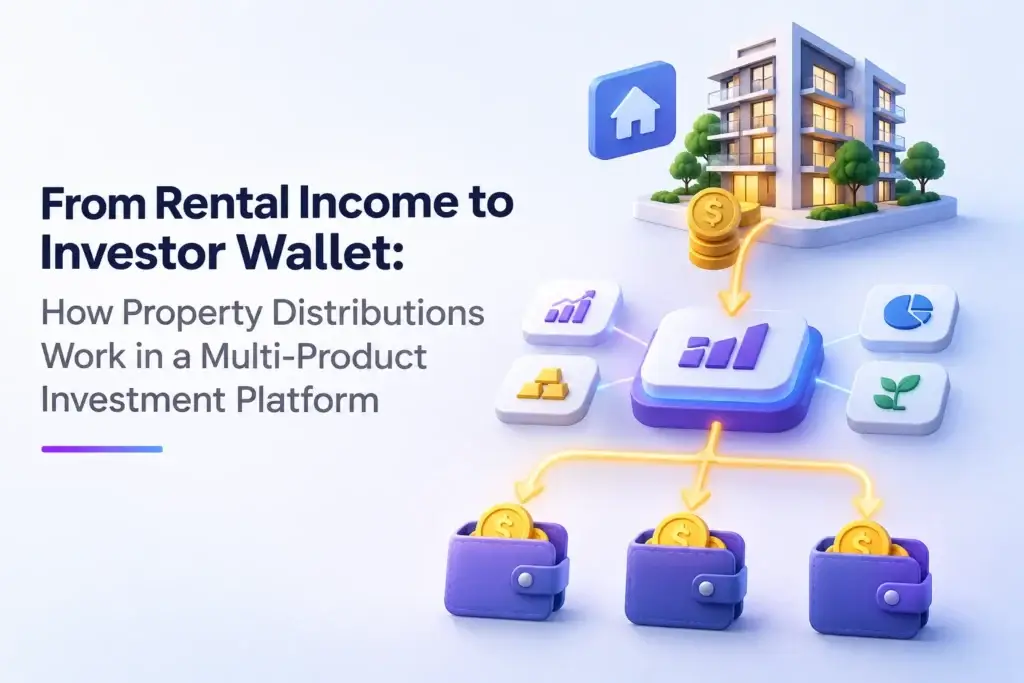
A secondary marketplace can create additional opportunities to exit an investment before the underlying property is sold. Scheduled exit windows can establish defined periods for processing withdrawal or redemption requests where the investment structure allows them. Both mechanisms are useful, but neither automatically creates cash or guarantees that an investor will receive the amount originally invested.
This guide explains how property investment resales work, what happens during an exit window, how investor eligibility affects transactions, and which operational safeguards help create a transparent, dependable liquidity process.
What Is Secondary Market Liquidity in Property Investment?
Secondary market liquidity is the ability of an investor to transfer an existing investment interest to another eligible buyer after the initial investment has been completed. In property investment platforms, the interest might represent shares in a property-owning entity, units in a regulated investment arrangement, or another legally defined ownership or economic entitlement.
For example, an investor might acquire an interest worth $5,000 in a property investment vehicle. Two years later, the investor may want to release some capital for another purpose. If the investment agreement permits transfers and a qualified buyer is available, the investor may be able to sell that interest without waiting for the entire building to be sold.
However, the original investment amount is not necessarily the resale value. The property may have appreciated or depreciated, rental performance may have changed, and potential buyers may demand a discount in exchange for accepting an illiquid investment.
The ability to advertise an investment for resale is therefore only one part of liquidity. An effective secondary market must also support buyer discovery, price agreement, transfer authorization, settlement, and a legally effective update to ownership records.
Liquidity Is Not the Same as Investment Value
A property holding can have a significant estimated value while still being difficult to sell. Consider two investments with similar valuations. One has interested, verified buyers and a clear transfer process. The other has no active buyers and restrictions that prevent transfers until a specified date.
Although their reported valuations may be similar, their practical liquidity is very different.
Investors should distinguish between the latest property valuation, the estimated value of their particular interest, the price at which someone is willing to buy, and the cash they will ultimately receive after fees and other deductions.
Why Fractional Property Interests Are Not Automatically Liquid
Fractional ownership lowers the capital required to participate in a property investment. It does not remove the characteristics of the underlying asset. Real estate transactions depend on valuation, legal documentation, property performance, ownership structure and market conditions.
Additional restrictions may exist when the fractional interests are securities, when the property is held through a special-purpose vehicle, or when investors have contractual obligations that limit transfers. Depending on the jurisdiction, some transactions require investor classification checks, issuer consent, regulated intermediary involvement, or other approvals.
For these reasons, a secondary marketplace should be viewed as a structured opportunity to find liquidity, not as the equivalent of an instantly accessible savings balance.
Why Secondary Market Liquidity Matters to Investors and Platform Operators
Liquidity influences how investors evaluate an opportunity before they commit capital. An attractive rental yield may not be sufficient if investors are uncertain whether they can release their money before the planned property disposal date.
For investors, a transparent resale process provides visibility into potential exit routes, transfer conditions and expected transaction steps. It also makes it easier to distinguish investments designed for long holding periods from those that may offer occasional resale opportunities.
For operators, liquidity management affects investor confidence, customer support, compliance workloads and the quality of ownership records. A poorly explained secondary market can produce disputes when investors discover that listing their shares does not mean they will be sold immediately.
Good liquidity governance cannot eliminate market risk, but it can make the rules predictable. Investors should know what actions they are entitled to request, which conditions apply, and what happens if their preferred exit route is unavailable.
The Difference Between Liquidity Access and Liquidity Assurance
Liquidity access means that an investor has a permitted mechanism for requesting or attempting an exit. Liquidity assurance would imply that the investor can reliably sell or redeem an interest at a specified time or price.
Most secondary marketplaces provide access rather than assurance. Even where a platform schedules redemption windows, actual payment may depend on available cash, approved buyers, reserves, refinancing, asset sales, or other legally permissible funding arrangements.
Founders should make this distinction prominent in investor disclosures. Promising a quick exit without establishing how it will be funded creates expectations that the operating model may be unable to satisfy.
Three Common Ways Investors May Exit a Property Investment
Not every investment arrangement permits every exit mechanism. The available routes depend on the legal structure of the investment, the contractual rights of investors, regulatory permissions, and the platform operator’s policies.
| Exit mechanism | How it works | Main dependency | Primary limitation |
|---|---|---|---|
| Secondary market resale | An existing investor sells an eligible interest to another investor. | Buyer demand and transfer approval | No guaranteed buyer or price |
| Scheduled exit window | The operator processes qualifying exit requests during a defined period. | Available funding, program rules and eligibility | Requests may be capped, deferred or rejected |
| Whole-property sale | The underlying property is sold and proceeds are distributed according to the legal structure. | Asset sale, approvals and settlement | Timing depends on the property disposal process |
1. Investor-to-Investor Resale
Under a resale arrangement, an existing investor offers an eligible interest to another investor. The buyer may accept the proposed price or negotiate a different amount if the marketplace permits negotiations.
When the parties agree, the platform or responsible intermediary checks whether the transaction is permitted. Payment is then settled and the ownership register is updated through the authorized process.
The original investor can potentially exit without requiring the underlying property to be sold. However, the transaction still depends on an available buyer and satisfaction of all applicable conditions.
2. Scheduled Exit Windows
Some property investment arrangements allow investors to submit exit requests during designated periods. These windows might be scheduled quarterly, semiannually, annually, or according to another timetable established in the investment documents.
During a window, the operator evaluates requests under the applicable rules. A redemption-style window may use available cash or another authorized funding source to purchase or cancel interests. A matching-style window may instead connect approved sellers with buyers during a defined trading period.
These are materially different arrangements. A scheduled window should never imply that the operator is obligated to redeem all requests unless the governing agreements expressly establish such an obligation and the necessary funding exists.
3. Disposal of the Underlying Property
A property sale is a different type of exit. Rather than transferring one investor’s interest to another investor, the property-owning entity disposes of the asset and distributes the net proceeds in accordance with the ownership structure and legal agreements.
The transaction may require investor votes, board approval, lender consent or other authorization. The proceeds must account for outstanding obligations, taxes, transaction expenses and applicable distribution priorities before investors receive their share.
A whole-property sale can create liquidity for multiple investors simultaneously, but its timing is influenced by property-market conditions and the ability to complete a suitable sale.
How the Secondary Market Resale Process Works Step by Step
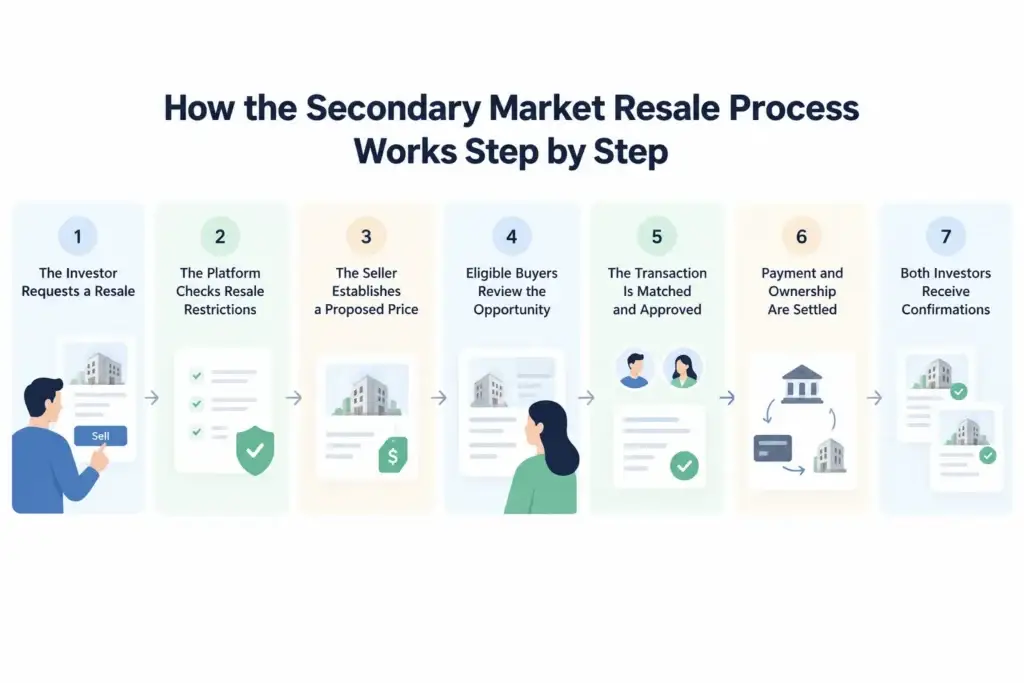
A dependable resale process needs more than an online listing form. The workflow must connect the investor’s actual holding, the buyer’s eligibility, transaction pricing, payment confirmation and the legally recognized ownership record.
Step 1: The Investor Requests a Resale
The seller selects an investment holding and indicates how much they wish to sell. Depending on the investment rules, the platform may allow a full exit or a partial disposal.
Before the listing is accepted, the system should verify that the seller owns the interest, that the intended quantity is available for transfer, and that the holding is not already committed to another pending transaction.
This prevents overselling and reduces the risk of conflicting transfer instructions.
Step 2: The Platform Checks Resale Restrictions
The next step is to assess the applicable restrictions. These may include minimum holding periods, contractual transfer approvals, outstanding legal obligations, suspended accounts, investor classifications or restrictions arising from the original securities offering.
A holding that appears in a portfolio should not automatically become transferable just because an investor presses a sell button.
Step 3: The Seller Establishes a Proposed Price
The proposed price may be informed by the latest independently supported property valuation, the investor’s estimated net asset value, recent transactions, expected income, fees and the seller’s preferred timing.
Depending on the permitted market design, a seller may specify a fixed asking price, accept bids or participate in a controlled matching process. The platform should distinguish an indicative valuation from an executable offer.
Step 4: Eligible Buyers Review the Opportunity
Buyers should receive sufficient information to understand the investment being transferred. Relevant disclosures may include the property profile, current ownership structure, valuation date, financial performance, associated rights, fees, transfer restrictions and material risks.
The buyer must also satisfy any applicable eligibility conditions before proceeding. Passing identity verification does not necessarily establish suitability or legal permission to acquire a particular investment.
Step 5: The Transaction Is Matched and Approved
Once both parties accept the terms, the transaction moves into validation and approval. The responsible operator or authorized intermediary may need to confirm the agreed price, ownership availability, buyer qualification and transaction permissions.
At this stage, the platform should prevent the same interest from being transferred through another pending transaction. Depending on the market structure, funds or holdings may be placed under appropriate controls until settlement is completed.
Step 6: Payment and Ownership Are Settled
Settlement is the stage at which the agreed consideration is paid and the investment interest is transferred through the legally effective process. The platform should reconcile funds, applicable charges, investor entitlements and changes to the ownership register.
A transaction should not be marked as completed merely because an offer has been accepted. Payment failure, missing authorization, settlement exceptions or unsuccessful transfer registration can prevent completion.
Step 7: Both Investors Receive Confirmations
After successful settlement, the seller receives an updated portfolio balance and transaction statement. The buyer receives confirmation of the acquired interest and the corresponding ownership documentation.
The process should also establish how rental distributions and other entitlements are allocated around the transfer’s effective date. Clear recordkeeping prevents confusion when a distribution period overlaps a resale transaction.
How Scheduled Exit Windows Work in Fractional Real Estate
Exit windows introduce a structured timetable for processing permitted liquidity requests. They can help operators manage workloads and establish consistent decision rules, particularly when a continuous trading marketplace is not practical or legally suitable.
Nevertheless, an exit window is a process, not necessarily a cash guarantee. Investors need to understand the type of window being offered, its funding source and the circumstances in which requests may remain unfulfilled.
Defining the Window’s Opening and Closing Dates
Every scheduled window should have clearly communicated dates. The operator should explain when applications can be submitted, whether requests can be amended or withdrawn, when eligibility will be determined, and when accepted requests are expected to settle.
For example, an illustrative arrangement might accept requests over a ten-day period and process approved transactions afterward. This timetable is only an example; actual dates depend on the investment agreement and operating policy.
Applying Minimum Holding Periods
Some investment structures restrict resales or redemptions during an initial holding period. Such restrictions may serve legal, financial or operational purposes. They should be determined by the actual governing terms, not selected as an arbitrary software setting.
If the rules require a specified holding period, the platform should calculate eligibility from the appropriate legally relevant date and communicate the result before an investor submits an exit request.
Determining How Much Liquidity Is Available
An operator may receive more requests than a window can accommodate. The process therefore needs an explicit allocation policy. Depending on the legal arrangement, permitted approaches might include proportional allocations, priority rules, partial fulfillment or deferrals.
Suppose qualifying investors request exits worth $400,000, while the authorized funding available is only $150,000. The operator cannot responsibly represent the entire request amount as payable. It must apply the stated rules and notify investors of the quantities accepted, deferred or declined.
Where requests are matched against incoming buyers, the available liquidity depends on committed purchase demand rather than simply on the number of withdrawal applications.
Pricing and Settlement During an Exit Window
The window should specify how the transaction price is calculated and when that calculation becomes final. Possible approaches include a documented valuation-based method, an agreed transaction price or another method authorized by the governing documents.
Investors should understand any deductions, conditions for settlement, and the possibility of delays. A submitted request, an accepted request and a completed payment are three different transaction states.
Who Is Eligible to Resell or Buy Fractional Property Interests?
Investor eligibility is one of the most important controls in any secondary property investment market. An account may be active and verified while still being ineligible for a particular investment or transfer.
Eligibility must be assessed against the investment’s legal structure, the jurisdiction involved, the investor’s status and the applicable contractual restrictions. There is no single eligibility rule that can be applied safely to every market.
Identity Verification and KYC Status
Know Your Customer checks establish and verify investor identity, subject to the requirements of the relevant market. Depending on the circumstances, platforms may also need sanctions screening, beneficial ownership information, source-of-funds checks and ongoing monitoring.
Previously approved investors may require updated information if documents expire, their circumstances change, or a new transaction creates additional verification obligations.
Investor Classification and Suitability
Some investments are restricted to specific investor categories. A jurisdiction may distinguish retail investors from professional, sophisticated, accredited or other recognized classifications. The applicable definitions and permissions vary.
Where required, platforms should distinguish identity verification from investment eligibility and any separate appropriateness or suitability assessment. Being eligible to open an account does not necessarily mean a person is eligible to purchase every listed interest.
Holding Period and Transfer Restrictions
Transfers can also be limited by statutory restrictions, offering exemptions, shareholder agreements, consent requirements, rights of first refusal or restrictions specific to the issuing entity.
For illustration, securities sold under certain United States crowdfunding rules are generally subject to a one-year resale restriction with specified exceptions. This is not a universal property investment rule, and a platform operating elsewhere must apply its own relevant legal framework.
The correct approach is to derive restrictions from the actual instruments and legal advice, then implement the necessary operational checks.
Seller Ownership and Transferable Balance
A selling investor must hold the interest they intend to transfer. The platform should account for quantities already sold, reserved against open offers, subject to pending settlements, or otherwise restricted.
When partial sales are allowed, the remaining interest must also satisfy applicable minimum holding or transfer rules. This prevents invalid residual balances and ownership discrepancies.
Jurisdiction, Residency and Cross-Border Transfers
Cross-border investment activity may introduce additional requirements involving investor solicitation, securities distribution, tax reporting, payments, currency conversion and personal information.
Regional deployment also involves investor-language preferences and documentation requirements. Founders expanding into Gulf markets can explore the related GCC real estate investment localization guide for broader market-preparation considerations.
A properly designed eligibility workflow should explain why a transaction is allowed, restricted or referred for manual review, rather than displaying a generic failure message.
How Resale Pricing Affects Investor Liquidity
One of the most common misunderstandings about fractional property resales is the assumption that the reported value of an investment is the amount an investor can immediately receive.
In practice, resale prices may differ from valuation-based estimates. A buyer may be willing to pay a premium for a desirable income-producing asset or may demand a discount because of limited information, holding-period risk, expected future expenses or a lack of alternative buyers.
Valuation-Based Reference Pricing
A reference price can help buyers and sellers evaluate a proposed trade. It may draw on the latest property valuation and the economic rights represented by the investment interest.
However, reference prices should include appropriate dates and explanations. A valuation prepared several months ago may no longer reflect current financing conditions, rental occupancy or recent property developments.
Market-Driven Pricing and Liquidity Discounts
When sellers and buyers negotiate, the final price reflects actual willingness to transact. A seller who needs a quick exit may choose a lower price to attract buyers, but reducing the asking price still does not ensure a completed sale.
Low transaction volumes can also make price discovery difficult. A small number of trades should not automatically be treated as sufficient evidence of the value of every investment interest in the same property.
Example: Calculating Net Resale Proceeds
Consider an illustrative investor holding originally acquired for $10,000. The investor agrees to sell for $9,500. Assume the applicable platform transaction fee is 1.5% of the resale price and there are no other deductions in this simplified example.
Illustrative Resale Calculation
| Original investment | $10,000.00 |
| Agreed resale price | $9,500.00 |
| Illustrative transaction fee (1.5%) | −$142.50 |
| Net proceeds before other charges or taxes | $9,357.50 |
| Difference from original invested capital | −$642.50 |
Illustrative figures only. Actual fees, taxes, returns, rental distributions and legal deductions depend on the investment arrangement. The example does not represent a quoted platform fee or an investment forecast.
This example demonstrates why an investor-facing interface should show estimated net proceeds rather than only the gross asking price. Investors also need to understand that sale proceeds are different from total investment returns, which may include prior distributions and other cash flows.
What Happens When There Are No Buyers in the Secondary Market?
A lack of buyers is one of the most important risks in a property investment resale market. Even an eligible investor with a valid holding may be unable to complete a transaction if there is insufficient demand.
The appropriate response depends on the marketplace rules. The seller might keep the listing active, revise the asking price, withdraw the listing or wait for another permitted liquidity event.
Where the investment structure provides scheduled exit windows or a future asset-sale process, these may offer alternative routes. They should not be represented as guaranteed fallbacks unless the relevant agreements expressly provide that protection.
Why an Unfilled Listing Should Remain Visible as Unfilled
Transaction status is especially important when market activity is limited. An investor should be able to distinguish between an active listing, an offer under negotiation, a transaction awaiting approval and an executed sale.
Failing to make these distinctions can create the false impression that capital has already been released. It can also increase customer support disputes and undermine trust in the marketplace.
Should Operators Provide Guaranteed Buybacks?
A guaranteed buyback may sound attractive to investors, but it creates a financial obligation for whichever entity provides the guarantee. Such an arrangement requires a genuine funding source, legally enforceable terms, financial risk management and consideration of applicable regulatory requirements.
Operators should not imply they can provide guaranteed redemptions simply because their software supports resale or exit requests. Any liquidity facility must be evaluated separately from the technology used to administer it.
The Operational Controls Behind Reliable Property Share Transfers
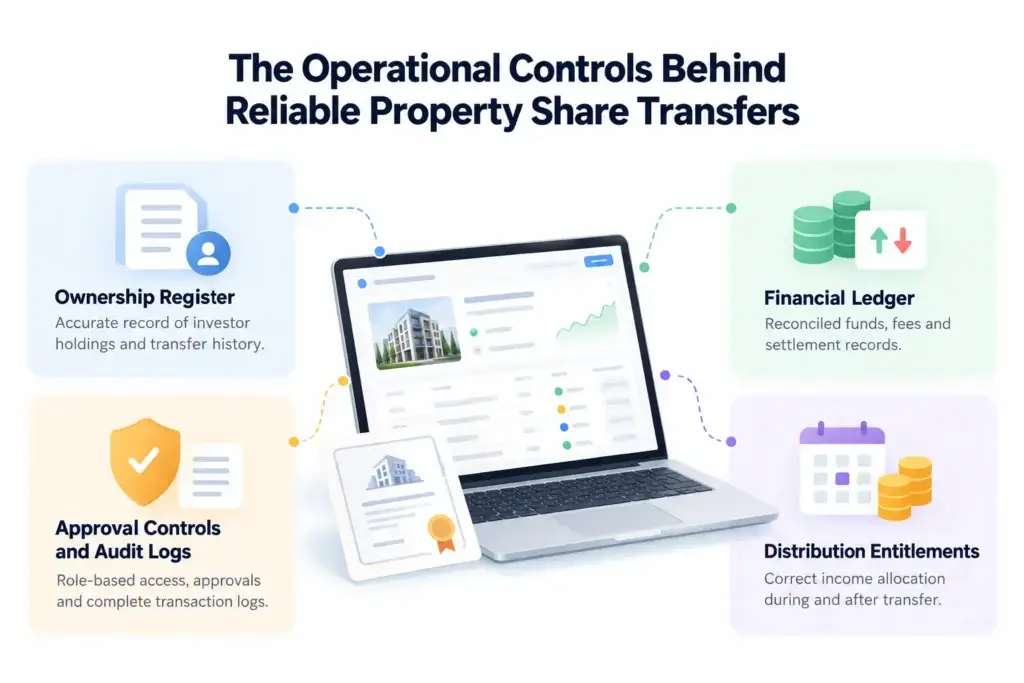
A marketplace interface is the visible part of a secondary transaction. The more consequential work often happens behind the scenes, where the platform must determine who owns an interest, whether it can be transferred, and whether the corresponding money movement has been completed correctly.
These operational concerns also apply to broader digital investment platform workflows, where investor records, eligibility decisions and financial transactions must remain consistent across the investment lifecycle.
An Accurate Ownership Register
The ownership register should provide an authoritative record of each investor’s legally recognized interest, subject to the relevant structure. It should identify the holding, investor, transaction history, transfer status and effective ownership changes.
Where ownership is represented by shares in an SPV, the legal register and any required approvals must remain consistent with the transaction records. A digital certificate or token can support the investor experience, but the technology alone does not determine legal ownership.
A Reconciled Financial Ledger
The financial ledger must record funds received, fees deducted, settlement obligations and payments released. Reconciliation helps ensure that the cash movements correspond with completed ownership transfers.
For instance, if a transaction fails after an investor’s payment has been initiated, the operator needs a controlled process for handling the funds and resolving the unsuccessful transfer. The records should make it possible to identify what happened without reconstructing events from unrelated systems.
Approval Controls and Audit Logs
Higher-risk transactions may require review by authorized staff. Approval workflows help prevent inappropriate transfers, while role-based access controls limit which employees can modify transaction states or approve sensitive financial actions.
Audit logs should record relevant actions, timestamps, status changes, exceptions and approvals. They provide evidence for investor inquiries, internal investigations, reconciliation and regulatory reviews where required.
Distribution Entitlements During a Transfer
Rental income adds another layer of complexity. If a property distributes income while a resale transaction is pending, the governing documents must determine whether the buyer or seller receives the relevant payment.
The platform should apply the documented entitlement date consistently. Otherwise, investors may receive incorrect distributions or the operator may face disputes over payments made around settlement.
How to Measure Whether a Property Secondary Market Is Actually Liquid
A functioning marketplace should be evaluated using completed outcomes rather than the number of listings alone. A large inventory of unsold interests can indicate activity, but it does not necessarily indicate healthy liquidity.
Operators should monitor transaction patterns over time and examine whether investors can realistically find eligible buyers at prices they are willing to accept.
| Liquidity metric | What it measures | Why it matters |
|---|---|---|
| Completed resale volume | Value of successfully settled secondary trades | Shows realized market activity |
| Listing completion rate | Share of eligible listings completed within a defined period | Shows the likelihood of successful matching |
| Time to settlement | Time from listing or accepted offer to completed settlement | Identifies delays and bottlenecks |
| Price versus reference value | Premium or discount relative to a dated valuation reference | Shows the effect of buyer demand on pricing |
| Unfulfilled exit requests | Requests remaining unmatched, deferred or declined | Reveals liquidity pressure |
| Settlement exception rate | Transactions requiring correction or intervention | Highlights operational reliability |
These measures should be interpreted carefully. A marketplace with only a few trades may show a high completion rate even when overall investor demand is weak. Similarly, faster settlements do not compensate for unreasonably large resale discounts.
Founders should assess liquidity performance together with transaction volume, investor concentration, pricing outcomes and the percentage of investors who remain unable to exit.
Why Investor Disclosure and Regulatory Review Matter
Property investment platforms operate in an environment where financial promotions, investment eligibility, ownership structures and transfers may be subject to regulatory requirements. The precise obligations depend on where the platform operates, where investors reside and how the investment is legally structured.
Clear investor communication should explain the potential absence of buyers, pricing uncertainty, transfer restrictions, processing timelines, fees and the possibility that a liquidity request cannot be fulfilled.
The distinction between software functionality and permission to operate is particularly important. A system may technically support secondary listings, matching and settlement, while the operator still needs to determine whether running those activities requires authorization, a licensed intermediary, specific disclosures or other legal arrangements.
Requirements relating to KYC, anti-money laundering controls, sanctions screening, suitability, investor disclosures and financial recordkeeping should be evaluated for the intended jurisdiction and business model. Legal review is necessary before launching a live investment market.
Operators should also avoid describing estimated valuations or potential rental returns as assured outcomes. Liquidity, capital protection and investment performance are separate considerations, and each carries its own risks.
Common Secondary Market Liquidity Mistakes Founders Should Avoid
Liquidity Design Mistakes
Promising immediate exits without buyers
A resale facility does not make an otherwise illiquid investment instantly redeemable. Marketing materials should distinguish listing access from successful execution.
Ignoring transfer restrictions
Eligibility checks must reflect the actual investment agreements and legal requirements. A technically valid transaction can still be legally impermissible.
Treating estimated valuations as executable prices
Investors may need to accept discounts to attract buyers. Showing only optimistic reference values can create misleading expectations.
Failing to reconcile settlement and ownership
Money movement and ownership transfer should follow controlled, auditable workflows. Exceptions must be visible and resolved before final completion.
Launching exit windows without a funding policy
Operators need rules for determining available liquidity, request priority, partial fulfillment, suspension and investor communication.
These mistakes can have consequences beyond a poor user experience. They may create investor disputes, inaccurate reporting, operational losses or regulatory concerns.
Founder Decision Signals
Legal Permission
Confirm that your investment structure allows secondary resales or scheduled exit windows. Check transfer restrictions, investor eligibility, and regulatory permissions before enabling transactions.
Buyer Demand
Evaluate whether enough eligible buyers are available to support investor exits. A resale marketplace can facilitate transactions, but liquidity depends on actual demand and acceptable pricing.
Settlement Integrity
Ensure every resale connects verified ownership, payment confirmation, transfer approvals, and accurate financial records. Reliable settlement controls reduce errors and ownership disputes.
Investor Transparency
Clearly communicate exit windows, holding periods, resale fees, pricing uncertainty, and potential delays. Investors should understand that listing an interest does not guarantee a successful exit.
Businesses evaluating a fractional property investment infrastructure should consider whether ownership, investor verification, settlement and operational oversight can remain synchronized as transaction activity increases.
Questions to Resolve Before Enabling Secondary Trading
- What legal interest will investors transfer, and who maintains the authoritative ownership record?
- Which investors can participate as sellers and buyers?
- Will the market operate continuously, periodically or through operator-managed matching?
- How will prices be displayed, negotiated and confirmed?
- What happens when no acceptable buyer exists?
- How will payment failures, disputed trades and cancelled offers be handled?
- Who will approve restricted transactions and investigate exceptions?
- How will investors be informed about fees, timing, settlement and risks?
Answering these questions helps founders distinguish a workable liquidity model from a feature that is attractive in a demonstration but difficult to operate responsibly.
Building Liquidity Workflows Without Rebuilding the Entire Investment Platform
For a property investment business, secondary trading rarely exists in isolation. It depends on investor accounts, verified identities, property records, investment positions, payment integrations, document management, financial controls and operational approvals.
A disconnected resale module can create reconciliation problems if the marketplace treats a holding as transferable while the authoritative register shows it as restricted or already sold. This is why integrated investment infrastructure matters when planning a broader platform.
Miracuves offers ready-made, white-label investment software foundations that can reduce the need to rebuild core application workflows from the beginning. For suitable ready-made deployments, Miracuves highlights a six-day delivery approach. Actual production readiness still depends on customization scope, integrations, security hardening, legal permissions and the operator’s market requirements.
Founders should assess whether the available platform capabilities match their specific liquidity policies, rather than assuming a generic resale feature satisfies every market’s legal and operational needs.
Final Thoughts: Make Investor Exits Predictable, Not Promised
Secondary market liquidity can make fractional property investment more flexible, but flexibility is not the same as certainty. Investors may be able to sell to another eligible participant, submit a request during a scheduled exit window, or receive proceeds when an underlying asset is sold. Each route has its own pricing method, approval requirements and practical limitations.
The strongest approach is to make those limitations visible before investors commit capital. Clear transfer policies, transparent pricing, appropriate eligibility checks, reliable settlement records and realistic expectations create a more trustworthy investment experience than broad promises of instant liquidity.
For founders moving from policy design to implementation, Miracuves’ property investment platform with secondary-market workflows provides a relevant solution to evaluate alongside the legal, financial and operational requirements of the planned investment business.
Frequently Asked Questions About Property Investment Liquidity
What is secondary market liquidity in a property investment platform?
Secondary market liquidity is the ability to sell an existing property investment interest to another eligible buyer through an authorized transfer process. Actual liquidity depends on buyer demand, pricing, transfer restrictions and settlement conditions. A resale listing does not guarantee a completed sale.
Can investors sell fractional property shares before the property is sold?
Investors may be able to sell their interests before the underlying property is sold if the investment structure permits secondary transfers. The seller must satisfy applicable holding periods and other restrictions, while the buyer must meet the relevant eligibility requirements. A completed sale also depends on an acceptable buyer and successful settlement.
How do exit windows work in fractional real estate investments?
An exit window is a scheduled period during which qualifying investors can submit requests under a defined liquidity process. The operator assesses eligibility, available liquidity, pricing rules and settlement conditions. Requests may be fulfilled, partially fulfilled, deferred or declined depending on the governing terms.
What makes an investor eligible for a secondary market resale?
Eligibility may depend on KYC verification, investor classification, residency, holding periods, ownership status, transfer restrictions and the investment’s legal structure. Buyer and seller requirements can differ. The applicable rules must be determined for the specific investment and jurisdiction.
Is liquidity guaranteed on a property investment secondary marketplace?
No. A secondary marketplace generally provides a mechanism for attempting a resale rather than a guarantee of immediate liquidity. A transaction requires an eligible buyer willing to accept the terms, together with necessary approvals and successful settlement.
How is the resale price of a fractional property interest determined?
Resale prices may be informed by recent property valuations, estimated investment value, rental performance, market demand and negotiated bids. A final selling price can be above or below a reference valuation. Fees and applicable deductions reduce the investor’s net proceeds.
What happens if nobody buys an investor’s property shares?
The listing may remain open, expire or be withdrawn according to the marketplace rules. The investor might revise the asking price or explore another permitted exit route. An exit window or future property sale may provide alternatives, but neither should be assumed to guarantee payment.
Why are ownership registers and settlement controls important for secondary trades?
They help ensure that the seller actually owns the transferable interest, the buyer receives the correct ownership rights, and the financial transaction is accurately recorded. Reconciliation, approvals and audit trails also help operators investigate exceptions and resolve disputes.
Miracuves is an independent software development company. We are not affiliated with, connected to, sponsored by, or endorsed by any company or product named in this article.
Terms such as “X Clone” are used descriptively. It is how the software industry refers to building a platform with functionality comparable to a known service, and how clients search for it.
The entire design and codebase of our products is built by our own team. Our products contain no code, design, graphics, or content originating from any third-party website or applications.
All third-party names and marks referenced in this article are the property of their respective owners, referenced solely to identify the services discussed.