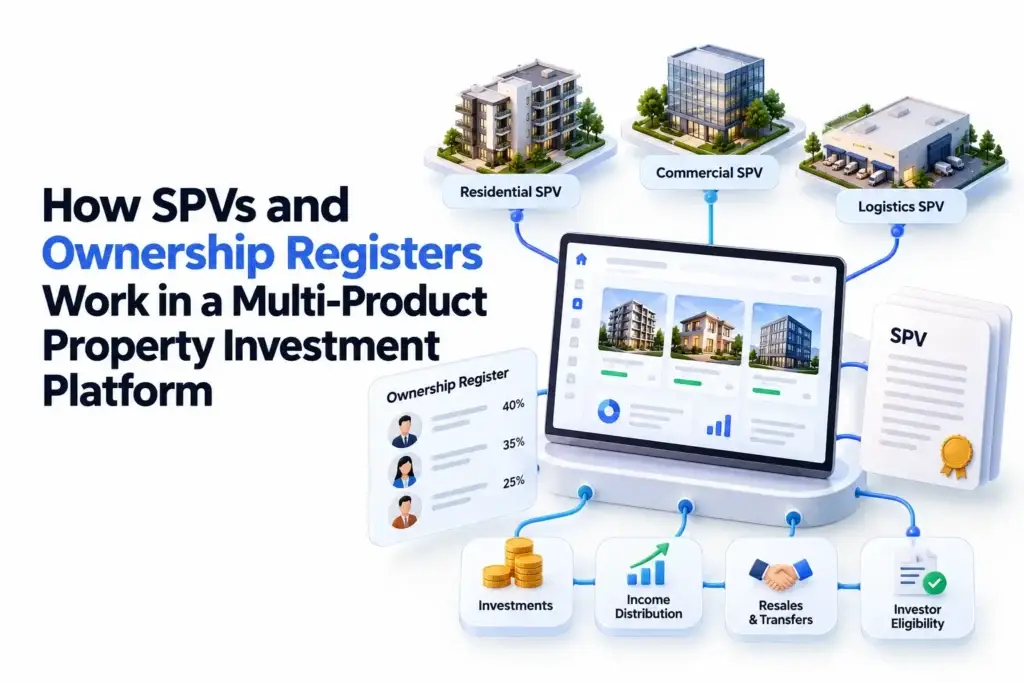

Key Takeaways
- Property distributions involve more than dividing rental income. The process must account for collected rent, property expenses, reserves, ownership entitlements, deductions, approvals, and investor payments.
- A reliable distribution workflow starts by confirming actual rental collections rather than treating invoiced or expected rent as immediately available cash.
- Property-level expenses, financing obligations, maintenance costs, taxes, and permitted reserves should be considered before determining the distributable cash amount.
- Investor entitlements should be calculated using the correct ownership record and applicable cutoff date, especially when investors buy, sell, or transfer property interests during a distribution period.
- A distribution batch can improve financial control by organizing investor entitlements, deductions, approvals, payment processing, and reconciliation into a traceable financial event.
- Investor wallets should clearly distinguish pending distributions, approved distributions, available balances, and withdrawals in progress so investors do not mistake an expected payment for immediately withdrawable funds.
- A reliable financial ledger should connect property distributions with investor entitlements, wallet activity, and external settlement records while preserving an auditable transaction history.
- Failed payments, delayed rental collections, unexpected expenses, and incorrect allocations should be handled as separate exceptions without changing or hiding the original financial record.
- Investors should receive transparent distribution statements showing the property reference, distribution period, eligible ownership, gross entitlement, deductions, net amount, transaction reference, and payment status.
- For multi-product property platforms, the strongest approach is to provide a unified investor experience while preserving separate accounting and financial identities for each property and investment product.
Rental income is one of the most visible benefits of property investing, but transferring that income to investors involves more than collecting rent and dividing it among shareholders. Every distribution must account for operating expenses, ownership entitlements, applicable deductions, payment approvals, financial records, and the movement of funds into investor accounts.
For founders building a multi-product property investment ecosystem, this process becomes particularly important. A single investor may hold interests in several properties while also using other financial products through the same application. The platform must maintain accurate records for each investment without making the wallet experience unnecessarily complicated.
That is why a unified multi-product property investment platform needs more than a payment interface. It requires a coordinated financial workflow that connects rental collections, ownership records, distribution calculations, internal approvals, and investor wallet transactions.
This guide explains how property distributions work from beginning to end, how platforms calculate investor entitlements, what happens when payments are delayed, and how founders can design a distribution experience that supports transparency, operational efficiency, and long-term investor confidence.
What Is Property Income Distribution in an Investment Platform?
Property income distribution is the process through which eligible income generated by a property is calculated, allocated, and paid to the investors entitled to receive it.
In a conventional property investment, an individual owner may receive rental income directly from an occupant or property manager. In fractional ownership structures, several investors participate economically in the same asset, so a defined process is needed to determine what each investor should receive.
The underlying investment may be held through a special-purpose vehicle (SPV), another legal entity, or a structure established under applicable rules. Investors’ rights to income depend on the governing documents, share classes, distribution policies, and legal relationships involved. A percentage displayed in an application does not independently establish a legal right to a particular payment.
For example, imagine a rental property with 100 eligible ownership units distributed among several investors. After collecting rent and calculating available cash, the investment structure may allocate distributions according to the eligible units held by each participant.
However, the process must first determine the actual amount available for distribution. A property generating substantial monthly rental revenue may still distribute a smaller amount because of maintenance, management expenses, financing obligations, or reserves.
The important distinction is that property income distribution is not simply a mathematical percentage calculation. It is an operational and financial process that connects real economic activity to investor entitlements and verified payment records.
Why Rental Distributions Become More Complex in a Multi-Product Investment Platform
A single-property investment portal has a relatively narrow accounting environment. It tracks one asset, one set of investors, and a limited range of financial transactions.
A multi-product investment platform introduces additional complexity because an investor may participate in several property opportunities while maintaining balances and transaction histories across different financial activities.
Consider an investor holding interests in three rental properties. One property distributes income monthly, another distributes quarterly, and the third temporarily retains cash for repairs. Each property follows its own operating economics and distribution schedule.
The investor may still expect one dashboard showing all expected distributions, completed credits, available wallet funds, and pending withdrawals.
That expectation creates several requirements for the platform.
- Income must remain attributable to the correct underlying property.
- Investor entitlements must reflect the applicable ownership records and distribution rules.
- Property expenses must be recognized before eligible cash is distributed.
- Wallet entries must be traceable to approved financial transactions.
- Failed or delayed payout instructions must not create false available balances.
- Investors must be able to distinguish earnings from investment capital and proceeds from asset sales.
A unified wallet can simplify the investor experience, but it should not erase the accounting boundaries between different properties or investment structures.
For founders, the core design principle is straightforward: centralize the investor experience while preserving the financial identity of every underlying investment.
How Rental Income Moves From a Property to an Investor Wallet
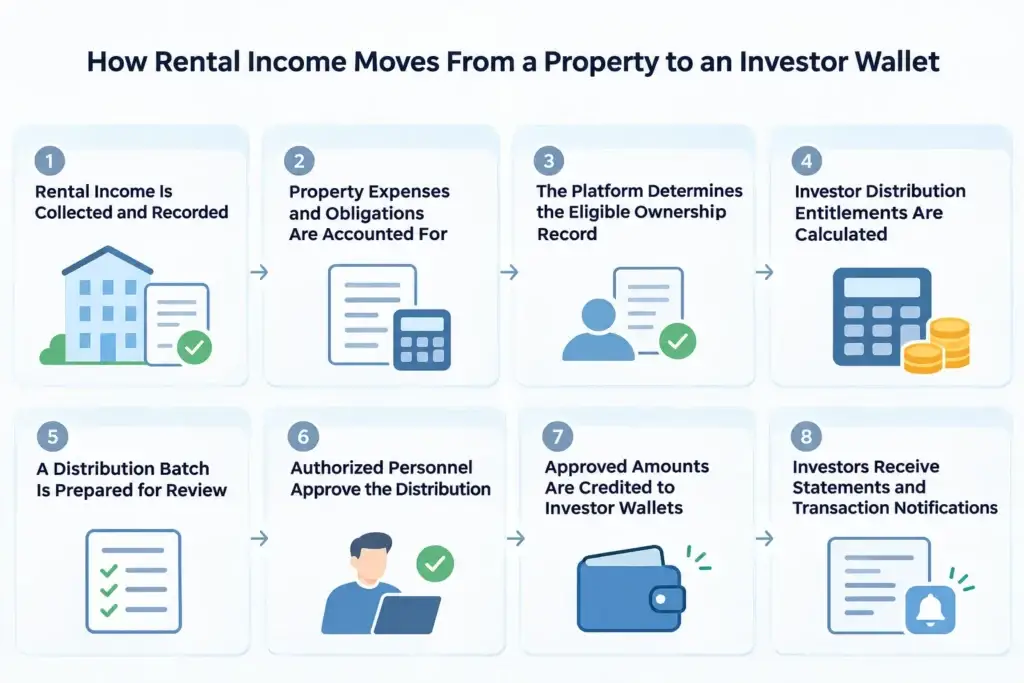
A reliable distribution workflow follows a sequence of identifiable financial and operational events. Although implementation details vary by jurisdiction and investment structure, the following stages provide a useful model.
Step 1: Rental Income Is Collected and Recorded
The process begins when the property generates rental income. The amount due may be recorded in a property management system, while the amount actually received is confirmed through the relevant collection account or payment provider.
These values should not be treated as interchangeable. Rent invoiced is not necessarily rent collected, and an outstanding invoice should not automatically become available cash for investors.
For example, a property may have contracted monthly rent of $24,000 but receive only $21,000 during the current collection period. The missing $3,000 could reflect late payments, vacant space, or another collection issue.
The platform should record the amount billed, the amount received, payment dates, outstanding receivables, and any adjustments. Those records form the starting point for the distribution calculation.
Step 2: Property Expenses and Obligations Are Accounted For
Once rental collections are confirmed, the next stage is to determine how much cash is available after relevant property-level obligations.
Potential deductions include property management charges, maintenance, insurance, service expenses, financing payments, applicable taxes, and reserves for future obligations. The exact treatment depends on the investment agreements, accounting policies, and legal structure.
For instance, a property may collect $21,000 but require $5,000 for operating costs and an additional $2,000 allocation to a permitted maintenance reserve. Subject to other obligations, the remaining amount may form part of its distributable cash flow.
Importantly, taxable profit, accounting profit, and cash available for distribution are not always the same. Noncash expenses, debt repayments, accrued liabilities, and restrictions on distributions can produce different results.
A well-designed platform should maintain these distinctions rather than labeling every rental receipt as investor earnings.
Step 3: The Platform Determines the Eligible Ownership Record
After establishing the distribution amount, the platform must identify who is entitled to receive it.
This is where ownership records become essential. Investors may have purchased additional interests, transferred holdings, or completed an eligible resale during the distribution period.
Simply checking the current portfolio balance may produce an incorrect result if entitlement is determined using an earlier record date or time-weighted ownership rule.
For example, an investor who acquires a property interest on the final day of a month may not be entitled to the same income as an investor who held the interest throughout the month. The governing agreements must establish how such cases are handled.
The platform therefore needs a dependable method for reconstructing ownership at the relevant cutoff date, identifying eligible holdings, and applying any contractual restrictions.
For a deeper explanation of how ownership changes should be recorded, see our guide to SPV ownership registers and property investment records.
Step 4: Investor Distribution Entitlements Are Calculated
With eligible cash and ownership information confirmed, the system can calculate each investor’s entitlement.
For a simple single-class structure with equal economic rights, the calculation may be expressed as:
Investor gross entitlement = Total distributable amount × Eligible investor ownership percentage
This formula is illustrative rather than universal. Different share classes, preferred returns, distribution waterfalls, participation thresholds, or holding-period adjustments can change the calculation.
Any investor-level deductions must then be applied according to the governing documents and applicable rules. These may include withholding amounts or permitted fees that have not already been deducted at the property level.
The system should avoid deducting the same cost twice. Every deduction needs a defined source, calculation method, and accounting treatment.
Step 5: A Distribution Batch Is Prepared for Review
Rather than executing every payment immediately after calculation, investment platforms commonly benefit from organizing distributions into controlled batches.
A distribution batch brings together the payout instructions associated with a particular property and financial period. It allows finance teams to review the proposed totals before money is released.
A useful batch record should identify the property, distribution period, eligible ownership cutoff, calculated gross entitlements, applicable deductions, net payable amounts, and overall batch total.
It should also retain its calculation version and supporting source records. Without these details, the operator may struggle to explain why a historical payment was calculated in a particular way.
Before approval, finance teams can review discrepancies between expected cash, recorded obligations, and planned payouts.
Step 6: Authorized Personnel Approve the Distribution
Approval is a financial control, not merely an administrative button.
An operator may require finance review, management authorization, or additional verification for unusual distributions. The appropriate approval process depends on transaction values, organizational policies, and applicable regulatory requirements.
Role-based access control helps ensure that individuals cannot perform financial actions beyond their authorized responsibilities.
For higher-risk workflows, separating calculation, approval, and execution responsibilities can reduce the risk of accidental or unauthorized payments.
Once a batch is approved, its approved values should remain identifiable even if a later correction becomes necessary. This creates a reliable basis for financial reporting and audit reviews.
Step 7: Approved Amounts Are Credited to Investor Wallets
After approval and the required funding checks, the platform records the distribution for each eligible investor.
In a wallet-based model, the investor may see a new income transaction with the corresponding property reference, distribution period, amount, and status.
However, an internal wallet credit is not automatically equivalent to an external bank payment. It may represent an amount payable to the investor, an available balance held through an authorized payment arrangement, or another legally defined account position.
The platform must distinguish among these states and should not imply that funds are available for withdrawal before the relevant settlement and eligibility requirements are satisfied.
A ledger-backed approach is particularly useful because each financial movement is supported by corresponding accounting entries. The investor-facing balance is then derived from valid records rather than maintained as a number that can be independently changed.
Step 8: Investors Receive Statements and Transaction Notifications
A successful distribution process should produce understandable evidence of what happened.
Investors should be able to identify which property generated the income, the financial period covered, their gross entitlement, applicable deductions, the net amount credited, and any subsequent withdrawal status.
The platform may provide downloadable statements, in-app transaction details, or notifications when a distribution has been processed.
These records are especially important when an investor holds several properties. Without clear references, individual wallet credits can become difficult to interpret and reconcile against portfolio performance.
Example: Calculating Rental Income Distributions for Multiple Investors
Consider a hypothetical commercial property held through an investment structure with 1,000 equally participating eligible units. The property has completed its rental collection period, and the finance team is preparing a distribution.
All figures below are illustrative. They do not represent actual investment returns, property performance, or a guaranteed distribution model.
| Property Cash Flow Item | Amount (USD) |
|---|---|
| Rental income collected | 24,000 |
| Operating and maintenance costs | (3,000) |
| Property management expense | (1,000) |
| Insurance and other obligations | (1,000) |
| Approved reserve allocation | (2,000) |
| Illustrative distributable cash | 17,000 |
The available amount is $17,000 after the expenses and reserves used in this example. We assume that there are no additional financing obligations, entity-level restrictions, or other deductions affecting this illustration.
Now suppose four eligible investors hold all 1,000 units, and each unit carries equal distribution rights.
| Investor | Eligible Units | Ownership Share | Gross Entitlement |
|---|---|---|---|
| Investor A | 400 | 40% | $6,800 |
| Investor B | 300 | 30% | $5,100 |
| Investor C | 200 | 20% | $3,400 |
| Investor D | 100 | 10% | $1,700 |
| Total | 1,000 | 100% | $17,000 |
Investor A’s gross entitlement is calculated as $17,000 multiplied by 40%, producing $6,800.
Suppose the applicable rules require a $680 withholding amount from Investor A’s entitlement. Assuming there are no other investor-level charges, the net credit would be $6,120.
The financial records should preserve all three amounts: gross entitlement of $6,800, withholding of $680, and net investor amount of $6,120. The withheld portion must be recorded and handled according to the relevant tax obligations rather than disappearing from the reconciliation.
This distinction matters because investors may compare their distributions with property-level cash flow reports. A transparent statement explains why an investor’s wallet credit differs from the gross amount initially allocated.
In a production system, calculation rules also need appropriate currency precision, consistent rounding methods, and treatment of any residual amount caused by rounding individual entitlements.
How an Investor Wallet Should Represent Property Distributions
An investor wallet provides a convenient place to review financial activity, but the displayed balance is only useful when its meaning is clear.
Several amounts may exist simultaneously: pending income, approved distributions, settled wallet balances, funds reserved for new investments, and withdrawals awaiting external processing.
Combining every amount into one undifferentiated figure can create confusion. An investor may assume that a distribution shown in the application is immediately withdrawable even though the underlying settlement has not been completed.
Pending Distribution
A pending distribution indicates that an amount has been calculated or provisionally scheduled but has not completed the required financial workflow.
The investor may see an estimated or scheduled amount, provided the application clearly identifies its status and does not present an uncertain payment as guaranteed income.
Approved Distribution
An approved distribution has passed the operator’s required review process. However, approval alone may not mean the investor can spend or withdraw the amount. The actual availability depends on funding, settlement, and the wallet arrangement.
Available Wallet Balance
An available balance should represent funds that the investor is permitted to use under the applicable payment and account rules. This may support future investments or withdrawal requests, subject to eligibility and platform controls.
Withdrawal in Progress
When an investor requests a withdrawal, the platform should track the request separately from the original distribution. A withdrawal may pass through verification, approval, payment initiation, external settlement, and completion.
The distinction between income credit and external withdrawal makes the transaction history easier to understand and helps finance teams identify unsuccessful payment instructions without altering the original income calculation.
Why a Double-Entry Ledger Matters for Investor Payout Accuracy
A wallet balance should not depend on a single editable database field without supporting financial entries.
In investment applications, an unexplained balance change can create disputes, reconciliation problems, and uncertainty about the underlying financial obligation.
Double-entry accounting provides a structured approach by recording corresponding debit and credit entries for financial events. The precise accounts depend on the legal and accounting design, but the fundamental objective is to preserve a balanced and traceable transaction history.
For example, when a distribution becomes payable, the accounting system may record a reduction in an appropriate distributable amount and a corresponding investor liability. When the amount is subsequently settled through the relevant payment arrangement, further entries record that movement.
This helps distinguish the recognition of an obligation from the transfer or availability of actual funds.
A dependable ledger also supports reconciliation between the distribution batch, investor-level entitlements, wallet activity, and external financial accounts.
If a payment instruction is repeated because of a network timeout, an idempotency mechanism should prevent the same distribution from being posted twice. Unique transaction references can help the system recognize previously processed requests.
When corrections are needed, an auditable adjustment or reversal is generally preferable to silently changing the historical transaction. The financial record should continue to show what originally occurred and how the issue was resolved.
How Distribution Batches Improve Financial Control and Reconciliation
Distribution batching allows finance teams to review many investor entitlements as a coordinated financial event instead of relying on disconnected individual payment instructions.
This becomes especially valuable when a platform manages multiple properties with different collection periods, expense schedules, and investor populations.
Each property distribution can be grouped into an identifiable batch, with the associated financial period and calculation rules preserved.
| Batch Stage | Operational Purpose | Required Control |
|---|---|---|
| Draft | Compile cash flow and investor entitlements | Validate source records |
| Calculated | Produce investor-level amounts | Check allocation totals |
| Under review | Investigate exceptions and deductions | Finance review and reconciliation |
| Approved | Authorize the payment event | Role-based approval |
| Processing | Record credits and execute eligible transfers | Idempotency and settlement checks |
| Reconciled | Verify final financial outcomes | Ledger and external account matching |
Batching also provides a useful operational boundary. If one investor’s account is restricted or a payment destination is invalid, the platform can handle that exception without losing the audit history of the wider distribution.
Whether the remaining approved payments can proceed depends on the platform’s financial policies and applicable legal obligations. The system should make these rules explicit instead of assuming that every batch must either succeed completely or fail completely.
Finance teams should be able to identify the difference between a completed distribution batch, a batch with unresolved items, and one that is only partially settled.
How Ownership Changes Affect Rental Distribution Entitlements
Property investments can change hands while a rental period is still underway. This creates an important question: who receives income when an investor sells an ownership interest before the distribution is paid?
The answer depends on the investment agreements, governing documents, transaction terms, and applicable legal rules.
Some structures determine entitlement according to a fixed record date. Others may use a time-based calculation, a contractual adjustment between buyer and seller, or another agreed treatment.
Suppose Investor A owns 10% of a property for most of the quarter and transfers the interest to Investor B shortly before the scheduled payout. If the platform calculates entitlements using only the current ownership percentage, it may allocate income incorrectly.
The system must preserve the history of effective ownership changes and apply the entitlement policy established for that investment.
This is why payout calculations should be connected to authoritative ownership records, not merely to a portfolio screen showing the latest holding quantity.
For related context on how resale transactions and ownership transfers affect investor exits, explore our fractional real estate secondary-market guide.
What Happens When Rental Income Is Delayed or Lower Than Expected?
One of the most important qualities of a trustworthy investment platform is its ability to handle exceptions without creating misleading financial information.
Rental collections are not always predictable. Occupancy levels may change, occupants may pay late, maintenance costs may rise, and unexpected obligations may reduce available cash.
A distribution system should therefore respond to actual financial conditions rather than automatically paying amounts based on earlier projections.
Late Rental Payments
When a rental payment is delayed, the platform should distinguish the outstanding receivable from cash already collected. The investment structure may postpone the distribution, use eligible available reserves where permitted, or apply another arrangement defined in its documents.
Investors should receive clear status information rather than a silent change to an expected payout date.
Unexpected Property Expenses
A major repair or additional operating obligation may reduce the amount available for investors. Finance administrators need supporting records for the expense and should be able to explain its effect on distributable cash flow.
Incorrect Investor Allocation
If an incorrect ownership cutoff or calculation rule is used, the distribution should be investigated before release whenever possible. If the error is discovered afterward, adjustments should follow an approved process and retain the original transaction history.
Failed Wallet or Bank Transfers
An external payment can fail because of invalid account details, payment-provider restrictions, unavailable banking services, or other settlement issues.
The system should retain the original distribution entitlement while separately recording the failed transfer, any outstanding investor liability, and the next permitted resolution step.
Retry mechanisms must be designed carefully so a failed notification or delayed confirmation does not cause duplicate payments.
How Multi-Product Investment Wallets Handle Income Across Different Assets
When investors access multiple investment products from one platform, the wallet becomes a common interface for their financial activity. However, each investment product may have its own accounting, custody, settlement, and regulatory requirements.
For example, rental distributions from a property are economically different from proceeds generated by selling an asset, returning investment capital, or settling a transaction involving another financial product.
A unified application should preserve those distinctions even when all transaction histories appear in one dashboard.
Investors may want to view total available funds, but they should also be able to filter transactions by property, product type, income category, date, and payment status.
For platform operators, the underlying financial system must preserve appropriate account segregation, product-specific liabilities, currency details, and reporting boundaries.
One interface does not mean all assets are legally or operationally held in the same account. Product design should reflect the actual custody and payment arrangements rather than presenting a simplified interface as evidence of unrestricted fund movement.
Founders evaluating this broader operating model can explore Miracuves’ investment platform solution categories to understand how different investment workflows fit within a wider digital product ecosystem.
Should Property Distributions Be Withdrawn or Reinvested?
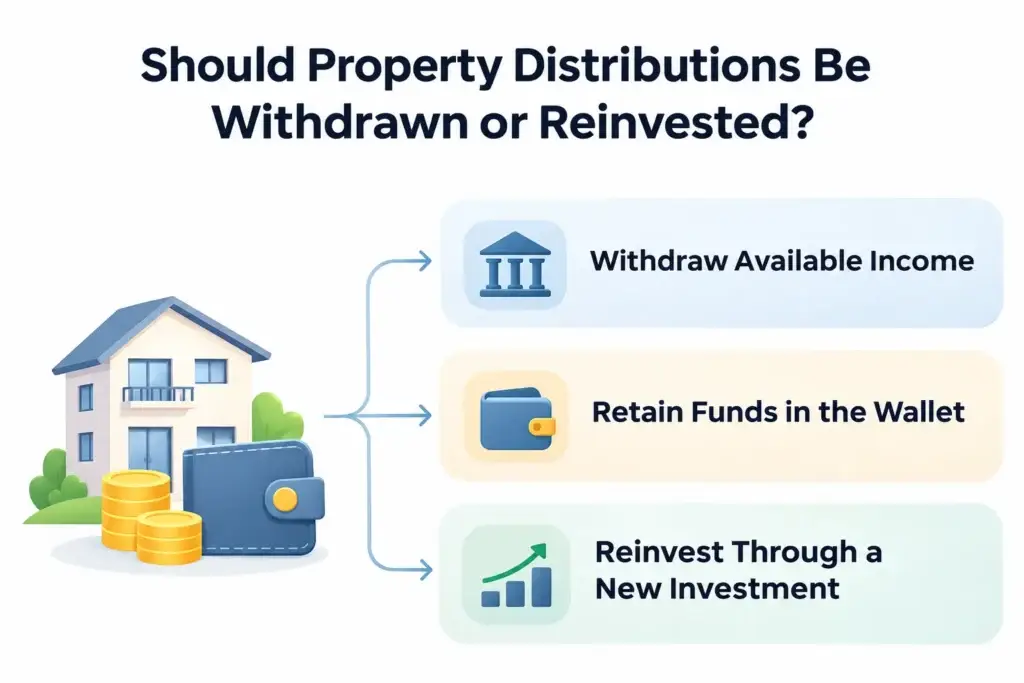
Once eligible income becomes available, investors may prefer different ways to use it.
Some investors want periodic cash income, while others prefer to allocate available funds toward additional investments. Supporting both preferences may improve the overall investment experience, but the platform must not treat reinvestment as an automatic entitlement to new assets.
Option 1: Withdraw Available Income
Investors may request a transfer of eligible wallet funds to a verified external account. The workflow can include identity checks, withdrawal eligibility verification, approval controls, and payment status updates.
The original income statement remains associated with the property, while the withdrawal is recorded as a separate financial event.
Option 2: Retain Available Funds in the Wallet
Investors may choose to leave funds within the permitted wallet or payment arrangement for future transactions. The application should clearly disclose any applicable restrictions, costs, and conditions.
Option 3: Reinvest Through a New Investment Transaction
Where the platform permits reinvestment, an investor may use eligible funds to acquire additional interests in the same property or another opportunity.
Reinvestment should generally involve a distinct investment transaction supported by the relevant disclosures, eligibility checks, subscription records, and allocation process.
If an investor selects an automated reinvestment preference, the platform still needs to verify that the target investment is available, the investor remains eligible, and the required permissions and documentation are in place.
From a founder’s perspective, reinvestment can support recurring engagement, but it should never be marketed as a guarantee of compounding returns or future investment availability.
What Investors Should See in a Property Distribution Statement
Investor confidence improves when a distribution statement explains the origin and treatment of funds without requiring the investor to contact support for every transaction.
A useful statement should make it possible to understand what was earned, what was deducted, and what amount was ultimately made available.
| Statement Field | Why It Matters |
|---|---|
| Property reference | Connects income to the correct asset. |
| Distribution period | Identifies the period that generated the entitlement. |
| Eligible ownership | Explains the basis of the allocation. |
| Gross entitlement | Shows the amount before investor-level deductions. |
| Applicable deductions | Makes fees and withholding amounts understandable. |
| Net amount | Shows the final amount credited or payable. |
| Transaction reference | Supports reconciliation and support investigations. |
| Payment status | Distinguishes processing, completed, and failed movements. |
For investment businesses operating across multiple jurisdictions, tax descriptions, document formats, and reporting requirements may vary. Operators should configure statements according to their legal obligations and seek appropriate professional review.
The objective is not simply to display more data. It is to make the financial history understandable and verifiable.
Security, Reconciliation, and Compliance Controls Behind Property Payouts
Property distributions involve financial obligations and sensitive investor information. Operational security therefore needs to be considered throughout the payout process.
Identity verification helps establish who is participating in the platform. Transaction monitoring and appropriate compliance workflows can support the operator’s responsibilities under applicable laws.
Role-based permissions should restrict access to financial calculations, payment approvals, sensitive account details, and configuration changes.
Encrypted data transmission, appropriate storage protections, audit logs, and secure integrations are also important elements of financial application design.
At the accounting level, reconciliation is essential. A platform should be able to compare the approved distribution total with the corresponding investor entitlements, ledger postings, and confirmed external settlement activity.
Any unmatched amount should be investigated and resolved through a documented process rather than hidden through an unsupported balance adjustment.
Another important consideration is the legal status of the wallet. A software interface does not provide banking, custody, payment, or investment licensing by itself. The operating business must arrange appropriate providers and authorizations according to its jurisdiction and business model.
These controls are particularly significant where platforms combine property investments with other financial services. Shared technology should not bypass product-specific investor protections, licensing conditions, or custody requirements.
Common Mistakes Founders Make When Designing Property Distribution Workflows
Distribution problems often begin with seemingly small product decisions that become expensive once investor activity increases.
Distribution Mistakes to Avoid
1. Treating gross rental collections as immediately distributable cash
Rental collections may need to cover expenses, reserves, financing obligations, and other liabilities. Distributing gross collections can create funding shortfalls.
2. Calculating entitlements from current holdings only
Current holdings may not reflect the correct record date or entitlement period. Historical ownership information and applicable distribution terms must be considered.
3. Updating wallet balances without a reliable ledger
Unexplained balance adjustments make reconciliation, audit reviews, and dispute resolution more difficult.
4. Paying investors before required approvals
Skipping approval and funding checks increases the risk of incorrect or unauthorized transfers.
5. Ignoring unsuccessful payment instructions
Payment failures must be recorded independently of the underlying income entitlement to prevent duplicate payments and misleading statuses.
6. Mixing income with capital movements
Rental income, returned principal, and asset-sale proceeds can have different financial and reporting treatments. They should remain distinguishable.
These mistakes affect more than software reliability. They can undermine investor trust, increase operational workloads, and complicate financial reporting as the platform grows.
How Founders Can Evaluate a Property Distribution Management System
Before selecting or implementing investment platform software, founders should evaluate the distribution workflow using realistic operating scenarios rather than relying only on interface demonstrations.
A useful evaluation begins with several questions: Can the system reconcile real collections against planned payouts? Can it reconstruct ownership at the required cutoff? Can finance teams approve a distribution without modifying historical financial records? Can an investor understand why a payment was lower than originally expected?
The following decision framework can help founders prioritize operational requirements.
Financial Accuracy
Confirm that source cash, deductions, investor entitlements, and wallet entries can be reconciled without unexplained differences.
Operational Control
Check approval permissions, exception workflows, audit histories, and separation between calculation and execution.
Investor Transparency
Review how the platform presents expected income, approved payouts, available balances, withdrawals, and downloadable records.
Future Expansion
Assess whether the system can support additional properties and product lines while maintaining separate economic and accounting records.
A platform that passes these tests is better positioned to support reliable financial operations than one that offers attractive investment screens without adequate accounting controls.
Founders should also assess integration requirements, available implementation documentation, data ownership, payment-provider dependencies, and the ability to investigate historical distributions.
How Miracuves Helps Connect Property Income With Investor Wallet Workflows
For businesses entering the property investment market, developing accurate distribution workflows entirely from the beginning can add significant implementation and testing complexity.
Miracuves offers ready-made, white-label investment software designed around coordinated investor, operator, and financial workflows. Its property investment offering includes the foundations for ownership records, rental distribution processing, wallet activity, financial ledger entries, and administrative review.
The practical benefit is that founders can evaluate a connected product foundation rather than assembling unrelated components for property ownership, income calculation, and investor account activity.
Miracuves positions its ready-made solution for a 6-day branded deployment where the standard delivery scope fits the project. Production financial operations may still require additional configuration, provider onboarding, jurisdiction-specific controls, security reviews, and regulatory approvals.
For founders who want to understand the broader technology category, our white-label fractional real estate platform resource provides further context around property-focused investment software.
Final Thoughts: Reliable Property Distributions Start With Financial Clarity
The journey from rental income to an investor wallet may appear straightforward, but every successful distribution depends on several connected decisions.
Rent must be collected and verified. Property-level obligations must be accounted for. Eligible investors must be identified through reliable ownership records. Distribution calculations must follow the governing terms, and approved financial movements must be reflected accurately in the ledger and investor-facing statements.
For a multi-product investment business, these responsibilities become more important as the number of properties, investors, currencies, and financial transactions increases. A unified dashboard can make the experience simpler, but it cannot replace the controls required behind the scenes.
The strongest long-term approach is to treat rental distributions as a controlled financial process rather than a basic wallet feature.
Founders planning to bring these workflows together can explore Miracuves’ unified property investment and investor wallet solution to understand how an established software foundation can connect property ownership, financial records, and investor experiences within one product ecosystem.
Ultimately, the measure of a dependable distribution system is not how quickly a payment appears on a screen. It is whether every amount can be calculated correctly, explained clearly, reconciled reliably, and traced back to the investment activity that produced it.
Frequently Asked Questions
How is rental income distributed to fractional property investors?
Rental income is collected, eligible property expenses and obligations are accounted for, and the remaining distributable amount is allocated according to investors’ contractual or ownership entitlements. Approved amounts are then recorded and paid through the applicable financial arrangement.
How is an investor’s rental distribution calculated?
In a simple equal-rights structure, an investor’s gross distribution may equal total distributable cash multiplied by their eligible ownership percentage. Actual calculations can also depend on share classes, record dates, distribution waterfalls, fees, and applicable withholding rules.
Is rental income automatically credited to an investor wallet?
Not necessarily. Rental collections generally need to pass through expense calculations, entitlement checks, financial review, and funding or settlement requirements before they become an approved or available investor balance.
What is a distribution batch in a property investment platform?
A distribution batch is a group of investor-level payout calculations associated with a property and financial period. It allows operators to review totals, approve payments, track execution, and reconcile the resulting financial records.
Can investors reinvest their property rental income?
Reinvestment may be available where the platform, investment structure, and applicable regulations permit it. Reinvested income should generally support a separate subscription or allocation process with appropriate eligibility checks and records.
What happens if a rental distribution payment fails?
The platform should preserve the investor’s underlying entitlement, record the unsuccessful payment instruction, identify the outstanding amount, and apply an approved resolution or retry process that prevents duplicate transfers.
How do ownership transfers affect rental payouts?
Ownership transfers can change payout entitlements depending on the applicable record date, holding period, transaction terms, and governing documents. Accurate historical ownership records help determine which investor is entitled to a particular distribution.
Why does a multi-product investment platform need a shared financial ledger?
A coordinated ledger helps connect investor wallet activity with approved financial transactions while preserving the accounting identity of each property and product. It supports accurate balances, transaction histories, reconciliation, and auditability.
Miracuves is an independent software development company. We are not affiliated with, connected to, sponsored by, or endorsed by any company or product named in this article.
Terms such as “X Clone” are used descriptively. It is how the software industry refers to building a platform with functionality comparable to a known service, and how clients search for it.
The entire design and codebase of our products is built by our own team. Our products contain no code, design, graphics, or content originating from any third-party website or applications.
All third-party names and marks referenced in this article are the property of their respective owners, referenced solely to identify the services discussed.