


Key Takeaways
- A load board platform connects shippers, brokers, carriers, and drivers.
- Core workflows include load posting, bidding, matching, and booking.
- Real-time visibility helps reduce empty miles and manual coordination.
- Admin control is needed for users, loads, rates, payments, and disputes.
- Pricing depends on features, integrations, source code, and customization scope.
Freight Platform Signals
- Check load search, filters, lane matching, and equipment types.
- Review carrier profiles, broker verification, ratings, and documents.
- Test bids, booking flows, shipment status, and notifications.
- Verify route visibility, rate management, payments, and invoices.
- Track admin reports, disputes, cancellations, and marketplace activity.
Real Insights
- Load boards succeed when both freight supply and carrier demand stay active.
- Weak verification can create trust issues between brokers and carriers.
- Matching quality matters more than simply listing more loads.
- Private networks can help founders build liquidity before scaling widely.
- Miracuves builds load board platforms with freight, trucking, and admin workflows.
Load board software has become a critical part of modern freight operations. For carriers, brokers, shippers, dispatchers, and trucking entrepreneurs, a load board is no longer just a place to post available freight. In 2026, the strongest freight platforms combine real-time load discovery, carrier verification, route visibility, broker communication, payment workflows, analytics, and admin control into one connected ecosystem.
That is why the search for the best load board software 2026 is not only about comparing existing tools. For many founders and logistics operators, the bigger question is whether they should depend on third-party load boards or launch their own freight and trucking platform.
Large platforms such as DAT, Truckstop, and 123Loadboard continue to dominate many comparison lists because they give carriers and brokers access to freight visibility, search tools, and marketplace data. But the opportunity for new entrants is still strong when the platform solves a specific market gap, such as regional freight lanes, niche equipment types, private carrier networks, broker communities, local dispatching ecosystems, or specialized trucking workflows.
For founders, freight brokers, fleet operators, and logistics startups, the real value is not simply “building another load board.” The stronger opportunity is to create a platform that improves trust, reduces empty miles, simplifies freight matching, supports monetization, and gives the business full control over users, data, branding, integrations, and growth.
Miracuves helps founders launch ready-made and white-label freight platform solutions with source-code ownership, admin dashboards, branded apps, and faster deployment for businesses that want to move from idea to market without building every module from zero.
What Is Load Board Software?
Load board software is a digital freight marketplace where shippers, freight brokers, carriers, owner-operators, and dispatchers can post, search, compare, and book loads. Traditional load boards helped users find freight opportunities. Modern load board platforms go further by adding workflow automation, user verification, route intelligence, pricing data, document handling, payment support, and performance analytics.
A load board platform usually connects three major user groups:
- Shippers or brokers who post available loads
- Carriers and drivers who search and accept loads
- Platform admins who manage users, revenue, disputes, verification, and system rules
For a logistics business, the platform becomes more than a listing board. It becomes a digital operating layer for freight discovery, carrier relationships, transaction visibility, and marketplace revenue.
Why Load Board Software Still Matters in 2026
Freight operations remain fragmented across brokers, carriers, dispatchers, spreadsheets, phone calls, emails, private groups, and legacy tools. A well-built load board platform reduces that fragmentation by creating one structured environment where supply and demand can meet faster.
For carriers, the platform helps discover better load opportunities. For brokers, it helps reach verified capacity faster. For shippers, it improves freight visibility. For platform owners, it creates monetization opportunities through subscriptions, featured listings, transaction fees, advertising, data tools, and premium access.
The best load board software in 2026 is not just a searchable database. It is a freight-tech system that supports marketplace trust, operational speed, admin control, and long-term scalability.
Best Load Board Software 2026: What Makes a Platform Stand Out?
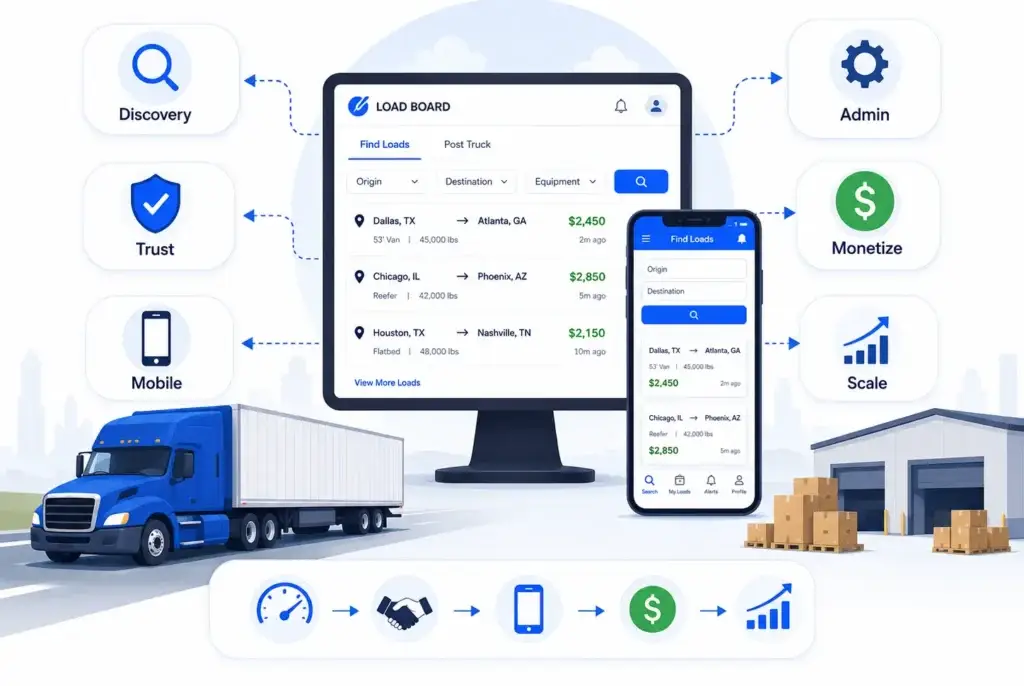
The best load board software should help users make faster and more confident freight decisions. That means the platform must support real-time visibility, accurate filtering, trusted user profiles, mobile usability, and reliable communication.
A strong load board platform should be evaluated across six business-critical areas:
| Evaluation Area | Why It Matters |
|---|---|
| Load discovery | Carriers need relevant freight based on lane, location, equipment type, rate, and availability |
| Carrier and broker trust | Verification, ratings, documents, and profile quality reduce marketplace risk |
| User experience | Drivers need a mobile-first interface that works clearly while they are on the road |
| Admin control | Platform owners need control over users, pricing, listings, payments, and disputes |
| Monetization flexibility | The platform should support subscriptions, featured loads, paid access, and partner revenue |
| Scalability | The system should support more users, more lanes, more listings, and more integrations over time |
Founders should avoid evaluating load board software only by feature count. A long feature list does not guarantee a successful freight platform. The stronger question is whether the platform can create liquidity, build trust, support repeat usage, and give the business enough control to grow.
Read More: What Is a Freight Load Board? How They Work, What They Cost, and How Carriers Get Paid
Existing Load Board Software vs Launching Your Own Platform
Existing load board software is useful when a carrier, broker, or dispatcher needs immediate access to freight opportunities. Platforms such as DAT, Truckstop, and 123Loadboard are commonly discussed in load board comparison guides because they already have marketplace activity, search tools, and industry adoption.
But entrepreneurs, broker networks, dispatching companies, and regional logistics operators may need a different path. If the goal is to control the marketplace, build a private network, monetize users, serve a niche lane, or create a branded freight ecosystem, launching your own platform can be the stronger business decision.
| Option | Best For | Limitation |
| Using an existing load board | Carriers and brokers who need immediate freight access | Limited control over branding, pricing, user data, and marketplace rules |
| Building a custom platform from zero | Enterprises with unique workflows and larger budgets | Longer development cycle and higher planning complexity |
| Launching a white-label load board platform | Founders who want faster market entry with customization | Requires clear business model, launch region, and feature prioritization |
The right choice depends on the business goal. A carrier may simply need access to loads. A founder may need a platform they can own, brand, monetize, and scale.
Core Features Every Load Board Platform Should Include
A scalable load board platform should be built around real operational workflows. The platform needs to serve shippers, brokers, carriers, drivers, dispatchers, and admins without creating unnecessary friction.
Shipper and Broker Features
Shippers and brokers need fast posting, strong carrier visibility, and workflow clarity. Their side of the platform should include:
- Load posting with pickup, drop-off, weight, equipment type, commodity, date, and rate details
- Carrier search and matching
- Load status tracking
- Document uploads
- Broker profile and verification details
- In-app messaging or communication flow
- Rate visibility and quote management
- Load history and reporting
- Payment or settlement workflow support
The broker experience should be designed around speed and trust. If posting freight is complicated, brokers will not use the platform repeatedly. If carrier profiles lack useful information, the platform will struggle to create confidence.
Carrier and Driver Features
Carriers and drivers need a mobile-first interface that helps them find relevant freight quickly. Their side of the platform should include:
- Nearby load search
- Lane-based filtering
- Equipment-based matching
- Rate comparison
- Saved routes and preferred lanes
- Broker profile visibility
- Load acceptance or booking flow
- Document capture for BOL, POD, invoices, or related files
- Earnings history
- Notifications for new loads, accepted loads, cancelled loads, and status updates
The carrier experience should be simple, fast, and practical. Drivers are not sitting at a desk for long sessions. They need clear information, quick actions, and reliable notifications.
Admin Panel Features
The admin panel is where the platform owner controls the business. This is one of the most important layers in load board software because it decides whether the founder can manage operations without depending on developers for every small change.
A strong admin panel should include:
- User management
- Carrier and broker verification controls
- Load listing management
- Subscription and billing controls
- Commission or fee settings
- Featured listing management
- Dispute handling
- Document review
- Reporting dashboards
- Platform activity logs
- Role-based access control
- Notification management
- Integration settings
For a load board business, admin control is not optional. It is the operating center of the marketplace.
Load Board Platform Feature Table
| Feature | Business Value | Founder Impact |
|---|---|---|
| Load Posting | Allows brokers and shippers to publish freight opportunities | Creates the supply side of the marketplace |
| Carrier Search | Helps brokers find available capacity faster | Improves platform utility and repeat usage |
| Smart Filters | Matches loads by lane, vehicle type, rate, and schedule | Reduces friction for drivers and dispatchers |
| Verification Workflows | Supports trust through document and profile checks | Reduces fraud and improves marketplace confidence |
| Admin Dashboard | Centralizes user, load, revenue, and dispute control | Gives the founder operational independence |
| Monetization Controls | Supports subscriptions, featured loads, and paid access | Turns the platform into a revenue-ready business |
Advanced Features That Make Load Board Software More Competitive
Once the core platform is stable, advanced features can help differentiate the product from generic freight listing boards.
Important advanced features include:
- AI-assisted load recommendations
- Predictive rate suggestions
- Route and fuel cost estimation
- Broker and carrier scoring
- Automated document scanning
- Multi-currency payment support
- TMS integration
- ELD or telematics integration
- Fleet dashboard
- Private broker-carrier networks
- In-app chat
- Dispute management
- Sponsored listings
- API access for enterprise users
Not every founder needs all of these features on day one. The smarter decision is to prioritize the features that support the launch strategy. A regional load board may need lane filters and dispatcher tools first. A broker network may need carrier verification and private access controls. A trucking utility platform may need maps, fuel stations, parking data, weigh station visibility, and driver-focused tools.
Load Board Software Architecture: What Founders Should Plan Early
A load board platform needs a stable architecture because it handles live listings, user actions, location data, notifications, payments, documents, and marketplace activity.
Key architecture layers include:
| Architecture Layer | Purpose |
| Mobile apps | Driver, carrier, shipper, or broker access on Android and iOS |
| Web dashboard | Broker, shipper, dispatcher, and admin operations |
| Backend APIs | Handles users, loads, bookings, filters, payments, documents, and notifications |
| Database | Stores users, loads, routes, documents, transactions, and activity records |
| Notification engine | Sends load alerts, booking updates, status changes, and reminders |
| Map and routing layer | Supports location, ETA, route planning, and service visibility |
| Admin control layer | Manages users, revenue, verification, disputes, and content |
| Analytics layer | Tracks usage, revenue, demand, lane activity, and platform health |
Founders should also plan for scalability from the beginning. That does not mean overbuilding every enterprise feature at launch. It means choosing a product foundation that can support growth without forcing a complete rebuild after initial traction.
Security, Verification, and Trust Controls
Freight marketplaces depend on trust. A weak verification process can create risks for brokers, shippers, carriers, and platform owners. Security should not be treated as a marketing add-on. It should be built into the product foundation.
A load board platform should support:
- Encrypted data transfer
- Secure document handling
- Role-based access control
- Activity logs
- Broker and carrier verification
- Admin approval workflows
- Fraud reporting
- Dispute management
- Secure payment gateway integration
- Permission-based dashboards
- Audit logs for operational visibility
Final compliance depends on the region, operating model, integrations, legal review, and business processes. A strong software foundation can support compliance-ready workflows, but founders should confirm legal and regulatory requirements before launch.
Load Board Software Cost in 2026: What Actually Drives Pricing?
The cost of load board software depends on scope. A simple freight listing platform costs less than a full logistics ecosystem with driver apps, shipper dashboards, routing workflows, telematics integrations, payment automation, and enterprise reporting.
The biggest cost drivers include:
- Number of user roles
- Android, iOS, and web dashboard requirements
- Load posting and matching complexity
- Map, GPS, route, and ETA features
- Payment gateway and payout workflows
- Document upload and verification
- Subscription billing
- Admin dashboard depth
- Third-party integrations
- Branding and UI customization
- Cloud deployment requirements
- Support and maintenance scope
Miracuves’ ready-made approach can reduce development time because the foundation already includes core app flows, admin control, and essential modules. Final pricing depends on the selected features, integrations, branding, and customization requirements.
Miracuves Load Board Platform Solution Cost and Tech Stack
Miracuves Pricing for a Load Board Freight and Trucking Platform developed in JavaScript For $4,899 USD (One-Time Price) in just 6 days
Get a fully developed, deployment-ready load board platform built for freight brokers, shippers, carriers, dispatchers, trucking companies, and logistics marketplace operators. Built on a modern JavaScript foundation, this complete package includes everything you need to launch and scale:
Core Workflows: Load posting, truck posting, carrier search, broker registration, shipper onboarding, load matching, freight bidding, booking requests, route details, shipment status updates, and customer notifications.
Built-in Revenue Logic: Broker subscriptions, carrier membership plans, load posting fees, featured load listings, promoted carrier profiles, transaction fees, commission-based bookings, and premium dispatch tools.
Management Hub: Centralized admin dashboard, broker management, carrier management, shipper controls, load approval, booking monitoring, payment records, dispute handling, verification controls, and freight marketplace analytics.
Launch-Ready: Fully prepared for your custom branding, configuration, payment gateway setup, freight category setup, broker-carrier onboarding, load board workflow setup, and immediate market entry.
Why Is Load Board Platform Development More Affordable?
Most freight and trucking platforms become expensive when businesses choose fully custom development from scratch. Building separate workflows for brokers, shippers, carriers, dispatchers, load posting, truck availability, bidding, payments, verification, notifications, and admin controls can increase cost, timeline, and technical complexity.
We took a smarter, more practical approach:
You Aren’t Paying for Ground-Up Development: Our load board marketplace engine is already developed, tested, and ready to deploy. You skip the inflated cost and long waiting period usually required for building a freight marketplace from scratch.
The Power of JavaScript: We built this solution on a modern JavaScript architecture that supports interactive dashboards, scalable freight workflows, fast frontend performance, API-driven integrations, and smooth admin operations.
You get a launch-ready load board platform with practical freight matching, broker-carrier workflows, monetization features, source code access, and faster deployment without the high custom development price tag.
Note: This cost is for the solution, re-branding, deployment, and source code only.
Ready-Made vs Custom Load Board Development
Founders often struggle with one question: should they build from scratch or start with a ready-made platform foundation?
| Build Option | Best For | Advantages | Watch-Outs |
| Custom development from zero | Enterprises with unique workflows and larger planning cycles | Maximum flexibility | Higher cost, longer timeline, more discovery work |
| Ready-made white-label platform | Founders who want faster launch and market validation | Faster deployment, branded experience, source-code ownership | Requires smart customization and clear launch scope |
| Existing third-party load board subscription | Carriers and brokers who need immediate freight access | No development needed | No platform ownership, limited branding, limited monetization control |
For many founders, the best route is not to copy another platform blindly. It is to start with a proven freight platform foundation, customize it for the target market, and launch with the right admin, monetization, and trust layers.
Founder Decision Signals
Speed
If you want to test a regional freight marketplace quickly, a ready-made platform can reduce the delay of building every module from zero.
Cost
If your budget must stay predictable, prioritize must-have workflows first and add advanced integrations after market validation.
Scalability
If you plan to expand across lanes, regions, or user roles, choose a foundation that can support more data, users, integrations, and admin controls.
Market Fit
If your audience is niche, such as hotshot, reefer, local freight, or private broker networks, customize the platform around that segment instead of copying broad load boards.
White-Label Customization Options for Load Board Platforms
A white-label load board platform lets founders launch under their own brand while customizing the product around their market, audience, and monetization model.
Important customization options include:
Branding and User Interface
Founders can customize app name, logo, colors, domain, screen layout, onboarding flow, dashboard structure, and user-facing language. This matters because freight businesses need trust and recognition, especially when targeting carriers, brokers, or regional networks.
Load Posting and Matching Logic
The platform can be customized around equipment type, lane preference, rate visibility, distance, pickup date, delivery location, broker profile, carrier type, or private network access.
Driver and Carrier Tools
Custom modules may include document capture, preferred lanes, earnings dashboard, saved searches, GPS visibility, fuel station data, truck stops, weigh station information, parking visibility, and route support.
Broker and Shipper Controls
Broker-side workflows can include load posting permissions, quote requests, carrier verification visibility, document requirements, shipment status, messaging, and payment workflow support.
Admin and Revenue Controls
Admin customization may include subscription plans, user approval rules, featured loads, commission logic, regional access, reporting dashboards, dispute tools, manual approvals, and role-based access.
Integrations
Possible integrations include maps, payment gateways, analytics tools, accounting systems, TMS platforms, ELD systems, telematics tools, CRM software, SMS/email services, and identity verification providers.
Read More: How Load Board & Freight Marketplace Apps Make Money: The Business Model Explained
Monetization Models for Load Board Software
A load board platform should be monetization-ready from the beginning. Even if founders launch with a free or low-cost model to attract early users, the system should support revenue expansion.
Common monetization models include:
| Revenue Model | How It Works |
| Subscription plans | Carriers, brokers, or dispatchers pay monthly or annually for platform access |
| Featured loads | Brokers pay to improve load visibility |
| Featured carrier profiles | Carriers pay for higher visibility in search results |
| Per-load posting fees | Brokers or shippers pay for each listed load |
| Transaction fees | Platform earns from successful bookings or payments |
| Advertising | Fuel stations, insurance providers, maintenance services, or logistics partners advertise inside the platform |
| Premium analytics | Brokers or fleets pay for lane insights, rate trends, or demand reporting |
| Private network access | Companies pay for closed-group freight marketplaces |
The right monetization model depends on the market. A startup targeting owner-operators may begin with affordable subscriptions. A broker network may monetize private access and featured loads. A trucking utility platform may combine subscription revenue with location-based advertising and partner listings.
Launch Strategy for a Freight and Trucking Platform
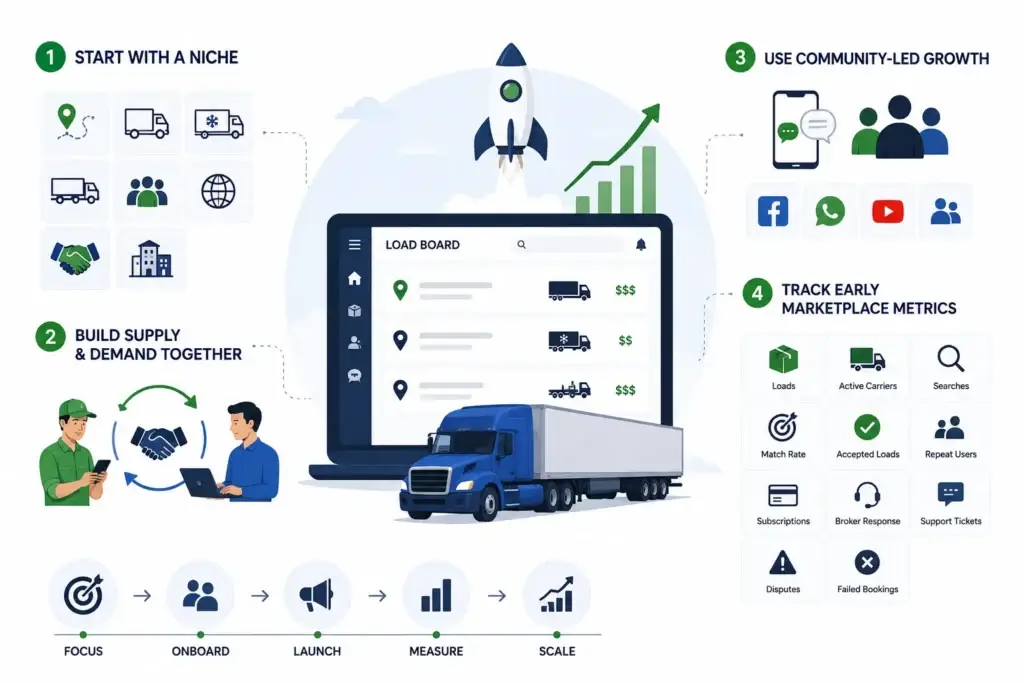
Image Source: AI-generated visual by Miracuves
A successful load board launch depends on marketplace liquidity. This means there must be enough valuable loads for carriers and enough reliable carriers for brokers and shippers.
The smartest launch strategy is usually not nationwide expansion on day one. A focused launch can create stronger adoption.
Start With a Niche or Region
Founders can begin with:
- Specific freight corridors
- Regional trucking networks
- Hotshot or box truck freight
- Reefer, flatbed, dry van, or specialized equipment
- Local dispatching communities
- Broker-carrier private networks
- Cross-border freight lanes
- SME shippers in one market
A narrow launch helps founders build trust, gather feedback, and improve matching quality before scaling.
Build Supply and Demand Together
A load board fails if one side of the marketplace is empty. Founders should onboard both sides before public launch. For example, a broker-focused platform should onboard verified carriers early. A carrier-focused platform should secure broker participation before heavy marketing.
Use Community-Led Growth
Freight and trucking users often rely on relationships, referrals, Facebook groups, dispatchers, WhatsApp groups, YouTube creators, and offline networks. A strong launch plan should combine digital marketing with relationship-driven onboarding.
Track Early Marketplace Metrics
Important early metrics include:
- Number of posted loads
- Number of active carriers
- Load search activity
- Match rate
- Accepted loads
- Repeat users
- Subscription conversion
- Broker response rate
- Support tickets
- Disputes or failed bookings
These numbers help founders understand whether the platform is building real marketplace value.
Mistakes Founders Should Avoid
Trying to compete with every major load board immediately
Large platforms already have broad marketplace activity. A new founder should begin with a focused market, lane, user segment, or private network where the product can create sharper value.
Ignoring verification and trust controls
Freight platforms need broker, carrier, document, and activity controls. Without trust workflows, users may hesitate to rely on the marketplace.
Overbuilding advanced features before validation
AI, telematics, and advanced analytics are useful, but founders should first validate core posting, matching, communication, and monetization workflows.
Launching without a monetization plan
A load board platform should be designed with subscription, featured listing, transaction, or partner revenue options from the beginning.
Why Choose Miracuves for Load Board Platform Development?
Choosing the right development partner matters because freight platforms need more than attractive screens. They need workflow clarity, map logic, user verification, admin control, revenue settings, backend reliability, and a launch strategy that fits the real market.
Miracuves helps founders build ready-made and white-label app solutions with source-code ownership, branded design, admin dashboards, and faster deployment. For logistics founders, this means the platform can be customized around freight posting, carrier matching, route support, driver tools, monetization, and operational control.
With Miracuves, founders can launch a load board-style freight and trucking platform with:
- White-label branding
- Source-code ownership
- Android and iOS app support
- Web and admin dashboard
- Load posting and carrier workflows
- Map and routing-related modules based on scope
- Monetization setup
- Cloud deployment support
- App publishing assistance
- 60 days of post-launch support
- Ready-made deployment timeline starting from 6 days
For founders planning to launch faster, Miracuves offers a practical route between a slow custom build and dependency on third-party load boards.
Final Thoughts
The best load board software in 2026 is not only the platform with the most listings or the longest feature list. For founders, brokers, dispatchers, and logistics operators, the stronger question is whether the platform can solve a clear freight problem, attract both sides of the marketplace, build trust, and generate revenue.
Existing load boards can help users find freight. But if your business goal is to own the marketplace, control the brand, customize workflows, serve a niche segment, or build a long-term freight-tech business, launching your own load board platform can be a more strategic decision.
A ready-made, white-label solution from Miracuves gives founders a faster way to enter the market with branded apps, admin control, source-code ownership, and room for customization. The real advantage is not copying another freight platform. It is using a proven product foundation to launch faster, validate smarter, and scale with better control.
FAQs
What is the best load board software in 2026?
The best load board software depends on the user’s goal. Carriers and brokers may prefer established platforms with existing freight activity, while founders may need a white-label load board platform they can own, brand, monetize, and customize.
Can I launch my own load board platform?
Yes. A founder, broker network, logistics company, or dispatching business can launch a load board platform with load posting, carrier matching, admin control, subscriptions, GPS support, document workflows, and payment integrations based on the selected scope.
How much does load board software development cost?
The cost depends on user roles, app platforms, map features, integrations, admin dashboard depth, payment workflows, customization, and launch scope. Miracuves pricing for a ready-made load board-style platform starts at $4,899, with final pricing confirmed based on selected modules and custom requirements.
How long does it take to launch a load board platform with Miracuves?
Miracuves can deploy a ready-made load board-style freight platform in 6 days for standard white-label launch scope. Custom workflows, integrations, or advanced modules may require additional time.
What features should a load board platform include?
A load board platform should include load posting, carrier search, smart filters, broker and carrier profiles, document uploads, notifications, admin dashboard, monetization controls, verification workflows, and reporting.
Can a load board platform be monetized?
Yes. Common monetization models include subscriptions, featured loads, paid carrier profiles, per-load posting fees, advertising, premium analytics, transaction fees, and private network access.
Is white-label load board software better than custom development?
White-label software is better when the founder wants faster launch, branded deployment, source-code ownership, and a proven product foundation. Custom development may be better for enterprises with highly unique workflows and longer planning cycles.
Can Miracuves customize the platform for a specific trucking niche?
Yes. Miracuves can customize the platform around regional freight lanes, broker networks, carrier types, equipment categories, route workflows, monetization rules, branding, and integrations based on the business model.
Does a load board platform need GPS and route features?
Not every load board needs advanced routing on day one, but GPS visibility, lane filters, location-based search, and route support can improve the driver and dispatcher experience.
What makes a load board platform scalable?
A scalable load board platform needs a reliable backend, structured database, role-based admin control, flexible APIs, secure workflows, cloud deployment, analytics, and architecture that can support more users, listings, routes, and integrations over time.
Miracuves is an independent software development company. We are not affiliated with, connected to, sponsored by, or endorsed by any company or product named in this article.
Terms such as “X Clone” are used descriptively. It is how the software industry refers to building a platform with functionality comparable to a known service, and how clients search for it.
The entire design and codebase of our products is built by our own team. Our products contain no code, design, graphics, or content originating from any third-party website or applications.
All third-party names and marks referenced in this article are the property of their respective owners, referenced solely to identify the services discussed.