


Key Takeaways
- Narrow autonomous agents solve focused business problems efficiently.
- AGI ambitions often delay product launches and ROI.
- Task-specific AI delivers faster enterprise value.
- Specialized agents are easier to monitor and optimize.
- Practical automation outperforms broad AI ambitions.
Agent Strategy Signals
- Assign one agent to one business workflow.
- Use orchestration for multi-step automation.
- Track performance with workflow analytics.
- Apply guardrails to every autonomous action.
- Scale by adding specialized agents instead of larger models.
Real Insights
- Focused AI systems produce more predictable outcomes.
- Workflow automation creates measurable business ROI.
- Enterprise AI succeeds through specialization, not generalization.
- Controlled autonomy reduces operational risk.
- Miracuves builds narrow autonomous agent platforms for scalable enterprise automation.
Every AI founder wants to sound ambitious. So they say they are building a general reasoning engine. They say their platform will automate everything. They say their AI will work across sales, finance, HR, operations, support, compliance, and customer success.
That is not ambition. That is strategic confusion. For most B2B SaaS founders, trying to build Artificial General Intelligence is not a business model. It is a capital destruction strategy dressed up as vision. The companies racing toward AGI are not playing the same game as startups. They are buying compute, hiring world-class researchers, building proprietary models, signing infrastructure partnerships, and investing at a scale that no normal SaaS founder can rationally match.
OpenAI’s stated mission is AGI, and Google DeepMind openly discusses AGI as part of its long-term vision. OpenAI also announced Stargate as a massive AI infrastructure project with a planned investment of up to $500 billion over four years. That is the playing field if your startup claims it wants to compete on general intelligence.
The smarter founder does not chase the biggest possible model.
The smarter founder builds the smallest possible autonomous system that solves one expensive business problem so well that the buyer stops caring whether the underlying model is fashionable.
That is the case for narrow autonomous agents. A narrow autonomous agent is not a chatbot. It is not a wrapper. It is not a dashboard with AI sprinkled into the UI. It is a workflow-specific engine that can understand a defined business process, make bounded decisions, execute tasks across systems, escalate exceptions, and produce measurable operational outcomes.
For founders, consultants, and B2B SaaS entrepreneurs, this is where the opportunity lives . Not in building “AI that can do everything.” In building AI that does one boring, painful, revenue-sensitive task flawlessly.
The Trillion-Dollar Moat: Why You Cannot Out-Compute Sam Altman
The first mistake AI founders make is believing the AGI race is a product race.
It is not. It is a research, infrastructure, distribution, talent, safety, and capital race. A startup can build a clever workflow. A startup can build a powerful vertical product. A startup can build a wedge into an industry. But a startup should be brutally honest about whether it can compete with frontier labs on compute capacity, model training, global distribution, safety research, and platform-level adoption.
OpenAI describes itself as an AI research and deployment company focused on ensuring AGI benefits humanity. Google DeepMind says AI and ultimately AGI could drive one of the greatest transformations in history. These are not casual product positioning statements. They are signals of a category where the winners are likely to be infrastructure-heavy, research-heavy, and globally capitalized.
For a founder, the question is not, “Can we build something impressive with an LLM?”
The question is, “Can we build something customers will pay for repeatedly before Big Tech ships the generic version for free or bundles it into an existing platform?”
Generic AI assistants are exposed. Generalized productivity copilots are exposed. Broad “AI for business” platforms are exposed. The more general your product, the more directly you compete with model providers, cloud platforms, and enterprise software giants.
Narrow agents avoid that trap. A narrow autonomous agent does not try to be smarter than every human at every task. It tries to become operationally indispensable in one workflow where accuracy, context, integrations, exceptions, and trust matter.
That is a much better startup battlefield.
The Valuation Premium of Solving One Boring Problem
The most lucrative AI agent companies may not look exciting from the outside.
They may not promise a new civilization.
They may automate invoice dispute resolution for logistics companies.
They may reconcile medical billing codes for specialty clinics.
They may review insurance documents before claims submission.
They may monitor procurement contracts for renewal leakage.
They may validate compliance documents before vendor onboarding.
They may convert messy operational emails into structured ERP actions.
These are not glamorous categories. That is precisely why they are attractive.
Boring workflows usually have three founder-friendly characteristics:
First, they are painful enough that businesses already spend money on them. Second, they are complex enough that generic software does not fully solve them. Third, they are repetitive enough that automation can create visible ROI.
A narrow autonomous agent can sit inside this gap.
It can understand the workflow, connect to internal tools, read documents, apply business rules, execute routine actions, and escalate edge cases to humans. That makes it more valuable than a chatbot and more defensible than a generic AI wrapper.
The valuation logic is simple: investors and acquirers do not reward “AI novelty” forever. They reward retention, workflow ownership, revenue visibility, integration depth, and category control.
A narrow agent with a painful B2B use case can show:
| Strategic Asset | Why It Matters for SaaS Valuation |
|---|---|
| Workflow ownership | The agent becomes part of daily operations, not a nice-to-have tool. |
| Integration depth | The product connects with CRMs, ERPs, billing tools, ticketing systems, databases, or internal dashboards. |
| Domain specificity | The system understands industry-specific language, rules, exceptions, and documents. |
| Measurable ROI | Buyers can connect the agent to time saved, errors reduced, faster processing, or revenue recovered. |
| Switching cost | Once embedded into workflow logic, the agent becomes harder to replace. |
| Expansion potential | The founder can expand from one workflow into adjacent workflows within the same vertical. |
This is why “small” ideas can become large businesses.
A workflow that looks narrow from the outside may control millions of dollars in operational leakage inside the enterprise.
AGI Is a Commodity Trap for Startups
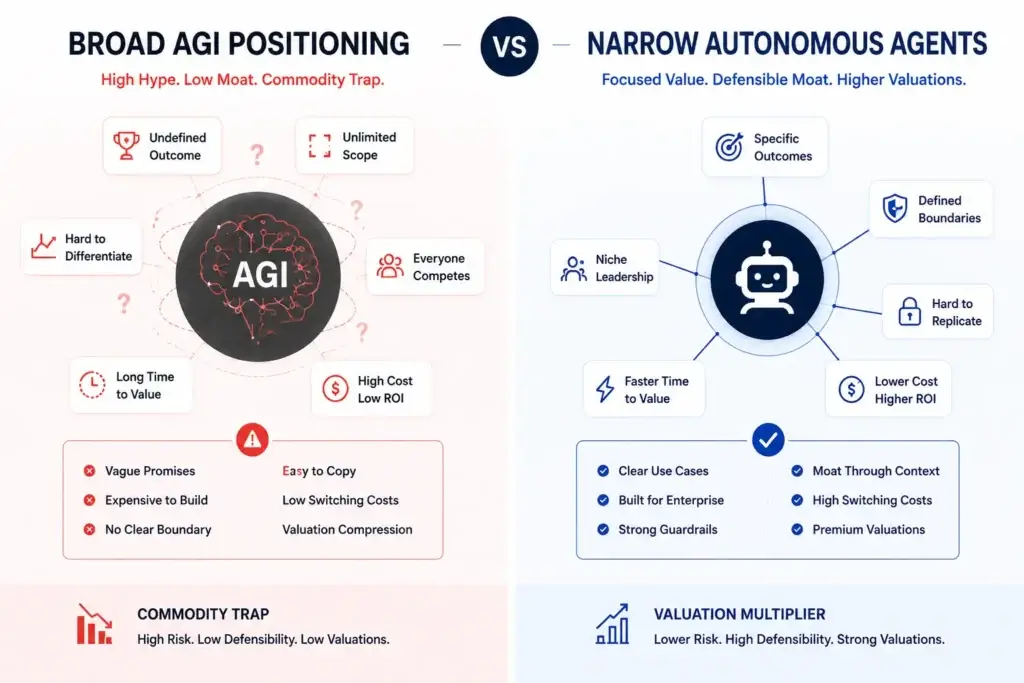
This may sound controversial, but for most startups, AGI ambition creates weak positioning.
When a founder says, “We are building an AI that can handle any business workflow,” the buyer hears uncertainty. Which workflow? Which data? Which system? Which outcome? Which compliance layer? Which approval process? Which failure mode?
Enterprise buyers do not buy abstraction. They buy risk reduction.
They want to know what the product does on Monday morning. They want to know who approves the output. They want to know whether the agent creates an audit trail. They want to know whether it integrates with their existing systems. They want to know what happens when the agent is uncertain.
That is where narrow autonomous agents win.
The narrower the scope, the clearer the promise.
A medical billing reconciliation agent does not need to understand every possible business process. It needs to understand billing rules, payer responses, claim status, denial patterns, adjustment logic, documentation requirements, and escalation rules.
A procurement approval agent does not need to write poetry or code a game. It needs to read vendor contracts, compare spending thresholds, check policy exceptions, route approvals, and log decisions.
A customer onboarding compliance agent does not need to replace an entire operations team. It needs to verify documents, detect missing fields, flag risk signals, update status, and maintain a review trail.
This is the anti-generalization variable:
The narrower the agent, the easier it is to sell, measure, trust, deploy, and defend.
What Narrow Autonomous Agents Actually Do
A narrow autonomous agent is built around a controlled business outcome.
It usually includes five layers:
- Input understanding: The agent reads structured and unstructured inputs such as emails, PDFs, forms, tickets, invoices, contracts, images, spreadsheets, or API data.
- Decision logic: It applies rules, model reasoning, retrieval, workflow context, and business constraints.
- Tool execution: It takes actions across software systems such as CRM, ERP, billing platforms, databases, calendars, dashboards, or internal tools.
- Human escalation: It routes uncertain, high-risk, or exception-heavy cases to the right person.
- Audit and improvement: It logs actions, outcomes, approvals, exceptions, and feedback so the system becomes more reliable over time.
That final layer is where many generic AI products fail.
Enterprise automation is not just about output. It is about control.
A founder building a narrow agent must answer:
- What can the agent do autonomously?
- What requires human approval?
- What data can it access?
- What systems can it update?
- What confidence threshold triggers escalation?
- What logs are available for review?
- What admin controls exist for business owners?
This is why Miracuves’ approach to app foundations, admin dashboards, source-code ownership, and custom workflows matters for AI automation products. Founders do not just need an AI interface. They need a product system around the agent.
Read more : Stop Building B2C AI Apps: The Real Money Is in Closed-Loop Corporate Chatbots
Hyper-Vertical Autonomous Engines Beat Horizontal AI Wrappers
A horizontal AI wrapper depends on the model’s general intelligence.
A hyper-vertical autonomous engine depends on workflow intelligence.
That distinction decides whether the startup has a product or a feature.
A generic AI assistant might say, “I can help your finance team.”
A narrow finance agent says, “I reconcile failed payment records against invoices, gateway logs, and ERP entries, then create exception reports for approval.”
A generic AI assistant might say, “I can help your HR team.”
A narrow HR agent says, “I screen onboarding documents, detect missing compliance fields, route exceptions to HR, and update employee status in the HRMS.”
A generic AI assistant might say, “I can help your logistics team.”
A narrow logistics agent says, “I identify detention charge disputes, compare shipment timestamps, validate supporting documents, and prepare claim packets.”
The second version is sellable.
It has a buyer. It has a workflow. It has a measurable output. It has a clear before-and-after story.
That is what founders should build.
Where the Best Narrow Agent Opportunities Live
The best opportunities are usually hidden inside repetitive, high-friction workflows where enterprises already tolerate manual work because traditional software was too rigid.
| Vertical | Narrow Agent Opportunity | Buyer Pain | Revenue Logic |
|---|---|---|---|
| Healthcare | Medical billing reconciliation agent | Denials, coding errors, delayed reimbursements | Charge per provider, claim volume, or revenue recovered |
| Logistics | Freight invoice dispute agent | Overcharges, detention fees, document mismatch | Subscription plus transaction-based pricing |
| Insurance | Claims intake review agent | Slow review, missing documents, manual triage | Per-claim processing or enterprise license |
| Finance | Vendor payment exception agent | Duplicate invoices, failed payments, approval delays | Monthly platform fee plus automation tiers |
| Legal Ops | Contract obligation monitoring agent | Missed renewals, compliance leakage, manual review | Seat-based or contract-volume pricing |
| Real Estate | Lease abstraction agent | Manual document review and missed clauses | Per-document or portfolio-based pricing |
| HR | Employee onboarding verification agent | Missing documents, compliance delays | Per-employee or HR team subscription |
| Ecommerce | Refund abuse detection agent | Margin leakage, fraud signals, support overload | Order-volume based pricing |
The best founder question is not, “What can AI do?”
It is, “Which workflow is painful enough that a company will pay to make it disappear?”
Founder Decision Signals: When a Narrow Agent Is Worth Building
Founder Decision Signals
Speed
Choose a narrow agent when the workflow can be mapped quickly, tested with real users, and launched as a focused product instead of a broad AI platform.
Cost
A narrow agent reduces wasted build scope because the team focuses on one workflow, one buyer, one data environment, and one measurable business outcome.
Scalability
The agent becomes scalable when workflow rules, integrations, review logs, and escalation paths are designed as repeatable product modules.
Market Fit
If buyers already use spreadsheets, manual review, outsourced teams, or disconnected tools to solve the problem, the workflow may be ready for automation.
AGI vs Narrow Autonomous Agents: The Founder Reality Check
| Dimension | AGI Startup Attempt | Narrow Autonomous Agent |
|---|---|---|
| Competitive field | OpenAI, Google DeepMind, Anthropic, Meta, frontier labs | Vertical SaaS founders, workflow software, legacy tools |
| Capital intensity | Extremely high | Manageable and use-case dependent |
| Buyer clarity | Often vague | Clear buyer and department owner |
| Sales motion | Hard to explain unless platform-level | Easier when tied to a specific workflow |
| Defensibility | Difficult unless model or infrastructure is unique | Built through workflow data, integrations, trust, and domain depth |
| Time to revenue | Long and uncertain | Faster when solving an existing paid pain |
| Product risk | High scope creep | Narrower scope and clearer validation |
| Miracuves fit | Not ideal for most founders | Strong fit for custom workflow automation and white-label AI product foundations |
The conclusion is uncomfortable but necessary.
Most founders should not try to build AGI.
They should build a narrow autonomous agent that becomes the operating layer for one valuable workflow.
The Real Moat Is Not the Model. It Is the Workflow
Many AI founders obsess over model selection.
Should we use GPT? Claude? Gemini? Open-source models? Fine-tuning? RAG? Multi-agent orchestration?
These questions matter, but they are not the moat by themselves.
The moat is the workflow graph.
A strong narrow agent understands the sequence of work:
- What enters the workflow?
- Who reviews it?
- Which systems hold the source of truth?
- What rules apply?
- What exceptions occur?
- What documents support decisions?
- What output is required?
- What must be logged?
- What should never be automated without approval?
That is where enterprise value lives.
A general-purpose model can generate text. A vertical autonomous engine can complete work.
The model is the engine component. The product is the vehicle. The workflow is the road. The buyer pays because the vehicle reliably reaches the destination.
Technical Architecture for a Narrow Autonomous Agent
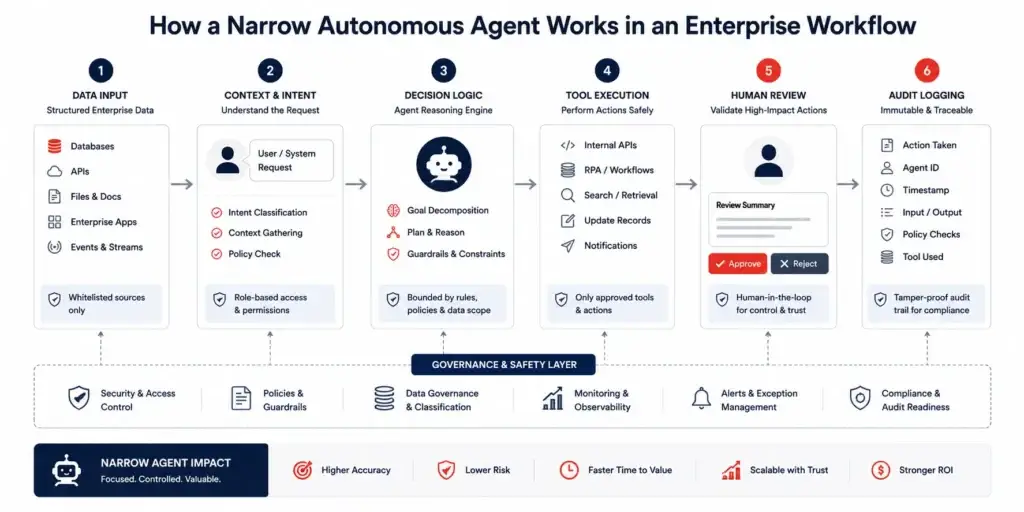
A production-grade narrow autonomous agent should not be built as a loose prompt connected to an API. It needs a reliable product architecture.
Core Architecture Layers for Narrow Autonomous Agents
| Layer | Business Value | Founder Impact |
|---|---|---|
| Workflow Engine | Maps tasks, approvals, decision paths, and escalation rules. | Turns AI from a chatbot into a repeatable automation product. |
| Knowledge Layer | Connects policies, documents, databases, rules, and contextual records. | Improves output relevance and reduces generic responses. |
| Tool Integration Layer | Allows the agent to interact with CRMs, ERPs, billing systems, HR tools, or internal APIs. | Creates stickiness because the product becomes part of operations. |
| Admin Dashboard | Controls users, workflows, permissions, logs, settings, and review queues. | Gives business owners operational control without depending on developers for every change. |
| Human-in-the-Loop Review | Routes uncertain or high-risk cases to human reviewers. | Builds buyer trust and supports safer deployment. |
| Audit Logs | Tracks decisions, inputs, actions, approvals, and exceptions. | Supports enterprise trust, compliance workflows, and accountability. |
| Analytics Layer | Measures processing time, accuracy, exceptions, savings, and automation rate. | Helps founders prove ROI during sales and renewals. |
This is where founders should think beyond the model.
A narrow autonomous agent needs product infrastructure: user roles, workflow states, permissions, reporting, integrations, and exception handling. Miracuves helps founders build launch-ready product foundations that can be customized around these operational layers instead of starting from a blank codebase.
The Best AI Agent Startup Ideas Are Not “AI Ideas”
Here is the strange truth: the best AI agent startup ideas usually begin as workflow problems, not AI problems.
Bad framing:
“We want to build an AI agent platform.”
Better framing:
“Finance teams lose hours every week reconciling failed payment records across Stripe, invoices, ERP entries, and support tickets. We are building an autonomous reconciliation agent that identifies mismatches, prepares exception reports, and routes unresolved cases for approval.”
That second version is fundable, sellable, and buildable.
It gives the founder a real product boundary.
A narrow agent startup should define:
- The exact workflow
- The buyer persona
- The current manual process
- The cost of delay or error
- The systems involved
- The required output
- The approval logic
- The pricing metric
- The expansion path
Without this clarity, the founder is not building an AI company. They are building a demo.
Read more : The Chat UI Death Trap: Why the Best AI Apps Don’t Look Like ChatGPT
Pricing Strategy: Sell the Outcome, Not the Token Usage
Many AI startups price incorrectly.
They think in terms of API cost, token usage, seats, or generic subscription tiers. That may be useful internally, but enterprise buyers care about outcomes.
A narrow autonomous agent can support stronger pricing when tied to a measurable workflow metric.
| Pricing Model | Best For | Example |
|---|---|---|
| Workflow volume pricing | Document-heavy or transaction-heavy agents | Price by claims reviewed, invoices processed, contracts analyzed, or tickets resolved |
| Department subscription | Team-level automation | Monthly fee for finance, HR, legal ops, or support teams |
| Outcome-linked pricing | Revenue recovery or cost leakage use cases | Percentage of recovered revenue, reduced overpayments, or prevented losses |
| Platform plus usage | Enterprise workflows with variable volume | Base platform fee plus usage tiers |
| White-label licensing | Consultants and agencies serving multiple clients | License the agent foundation and customize per client workflow |
The strongest pricing model depends on the buyer’s value perception.
If the agent saves time, price around workload volume.
If the agent recovers money, price around recovered value.
If the agent reduces risk, price around compliance impact, auditability, and operational control.
Do not sell “AI.”
Sell the removal of a business bottleneck.
Mistakes Founders Should Avoid
Mistakes Founders Should Avoid
Building a General AI Assistant With No Workflow Ownership
A broad assistant may look impressive in a demo, but it is easy for buyers to compare against ChatGPT, Gemini, Claude, or bundled enterprise copilots. Without workflow depth, the product becomes replaceable.
Ignoring Admin Control and Audit Logs
Enterprise buyers need visibility into what the agent did, why it acted, who approved it, and what data it accessed. Without logs and permissions, the agent may fail procurement review.
Automating High-Risk Decisions Too Early
The safest path is often bounded autonomy. Let the agent handle routine steps first, then escalate uncertain or high-impact decisions to humans until trust improves.
Choosing a Vertical Without Budget
A painful workflow is not enough. The buyer must already have budget, urgency, and a reason to replace manual work or legacy software.
Why Enterprise Consultants Should Care
Enterprise consultants are in a powerful position.
They already see the broken workflows. They know which departments are overloaded. They know where spreadsheets are hiding inside Fortune 500 operations. They know which processes are outsourced, delayed, or patched together with manual review.
That makes consultants ideal founders for narrow autonomous agents.
Instead of selling advice forever, a consultant can productize a workflow they repeatedly solve for clients.
For example:
- A healthcare consultant can productize a claims documentation review agent.
- A procurement consultant can productize a vendor compliance agent.
- A logistics consultant can productize a freight audit agent.
- A finance transformation consultant can productize a reconciliation agent.
- A legal operations consultant can productize a contract obligation agent.
This is not “AI replacing consulting.”
This is consulting becoming software.
A consultant with vertical insight and a Miracuves-built product foundation can move faster than a generic AI startup because they already understand the buyer, the workflow, the language, and the operational pain.
The Miracuves Perspective: Build the Agent Around the Business Model
The highest-leverage decision is not which model API to use first.
It is choosing the workflow, buyer, control layer, and monetization model.
Miracuves helps founders and consultants turn niche automation ideas into structured product foundations with branded interfaces, admin dashboards, source-code ownership, workflow modules, and integration-ready architecture. That matters because a narrow autonomous agent is not just an AI prompt. It is a SaaS product with users, roles, workflows, billing logic, logs, permissions, and business rules.
For AI-focused founders, relevant Miracuves pathways may include:
- AI development services for custom agentic workflows
- white-label app development for faster product validation
- custom app development company support for founders building workflow-specific SaaS
- contact Miracuves for product scoping and execution planning
The goal is not to imitate OpenAI.
The goal is to build a narrow, monetization-ready automation product that enterprises can understand, test, trust, and buy.
Security and Compliance: Narrow Agents Need Guardrails
Enterprise buyers will not trust autonomous systems just because they are intelligent.
They need boundaries.
For narrow autonomous agents, security and compliance workflows should be designed from the beginning. This does not mean claiming the product is fully compliant in every jurisdiction. It means building a compliance-ready foundation that supports the controls buyers expect.
Important layers include:
- encrypted data transfer
- encrypted data storage
- role-based access control
- audit logs
- admin access controls
- permission-based dashboards
- secure API integration
- activity logs
- human approval workflows
- data retention settings
- exception review queues
For fintech, healthcare, legal, insurance, or procurement workflows, final compliance depends on jurisdiction, legal review, integrations, data handling, and operating model. The founder should treat compliance workflows as a product design requirement, not a final checkbox.
This is another reason narrow beats general.
The narrower the workflow, the easier it is to define permissions, risk levels, escalation paths, and audit requirements.
The Founder Playbook for Building a Narrow Autonomous Agent
A strong narrow agent startup can be planned in seven practical steps.
1. Pick a Workflow With Existing Budget
Do not start with a technology idea. Start with a department that already spends money solving the problem manually.
Good signs include outsourced labor, spreadsheet-heavy processes, recurring errors, compliance pressure, delayed approvals, high document volume, or revenue leakage.
2. Define the Human Workflow Before Automating It
Map the current process in detail.
Who receives the task?
What data do they check?
Which systems do they open?
What decisions do they make?
What exceptions slow them down?
What output do they produce?
If the human workflow is unclear, the autonomous workflow will fail.
3. Decide the Agent’s Autonomy Boundary
The agent should not automate everything on day one.
Define what it can do independently, what it can recommend, and what must be approved by a human. This creates a safer adoption curve for enterprise buyers.
4. Build the Admin and Review Layer
The admin dashboard is not optional.
The buyer needs to manage users, permissions, workflow rules, escalation settings, review queues, integrations, and reports. Without this layer, the product feels like a tool, not a SaaS platform.
5. Integrate With the Systems of Record
The agent becomes valuable when it works inside the buyer’s existing environment.
That may include CRM, ERP, billing software, HRMS, helpdesk tools, payment gateways, document storage, email systems, or internal databases.
6. Prove ROI With Operational Metrics
Track before-and-after outcomes.
Useful metrics include processing time, exception rate, manual hours saved, error reduction, revenue recovered, approval speed, document completion rate, or automation percentage.
7. Expand From One Workflow to Adjacent Workflows
Do not expand horizontally too early.
Win one workflow first. Then expand into adjacent workflows within the same vertical. This creates category depth without losing focus.
Final Thoughts: The Future Belongs to Founders Who Get Narrow First
The next wave of valuable AI SaaS companies will not all come from founders trying to build artificial general intelligence.
Many will come from founders who understand one painful workflow better than anyone else.
They will not win because they have the biggest model. They will win because their agent knows the buyer’s process, data, exceptions, approvals, compliance needs, and business outcomes.
AGI is a frontier lab race. Narrow autonomous agents are a founder race.
The founder who chooses a boring workflow, builds a reliable automation layer, adds admin control, integrates deeply, and proves measurable ROI has a far better chance of building a real SaaS business than the founder chasing a vague general intelligence dream.
Miracuves helps founders make that shift: from broad AI ambition to focused, launch-ready automation products that solve real enterprise problems.
FAQs
1. What are narrow autonomous agents?
Narrow autonomous agents are AI-powered systems designed to perform one specific business workflow with minimal human involvement. Unlike general AI assistants, they focus on a bounded task such as invoice reconciliation, claims review, compliance checks, document processing, or support triage.
2. Why should startups avoid building AGI products?
Most startups lack the compute, research talent, infrastructure budget, and distribution needed to compete with frontier AI labs. A narrow autonomous agent gives founders a more practical path because it targets a specific buyer, workflow, and measurable business outcome.
3. Are narrow AI agents better than chatbots?
For B2B SaaS, narrow agents are often more valuable than chatbots because they can execute workflow steps, connect with business systems, maintain logs, escalate exceptions, and produce operational outcomes. A chatbot answers questions; a narrow agent completes work.
4. What industries are best for narrow autonomous agents?
Strong industries include healthcare, logistics, finance, insurance, legal operations, procurement, HR, real estate, ecommerce, and compliance-heavy services. The best verticals usually have repetitive workflows, high document volume, costly errors, and existing budgets.
5. How do narrow autonomous agents make money?
They can use workflow-volume pricing, enterprise subscriptions, outcome-linked pricing, platform-plus-usage pricing, or white-label licensing. The right model depends on whether the agent saves time, reduces risk, recovers revenue, or processes large transaction volumes.
6. What should founders build first in an AI agent SaaS product?
Founders should first build the workflow foundation: user roles, admin dashboard, input handling, decision rules, review queues, integrations, logs, and reporting. The AI layer should sit inside a controlled product system, not operate as a loose prompt.
7. Can Miracuves help build narrow autonomous agents?
Yes. Miracuves can help founders create white-label and custom app foundations for niche automation products, including admin dashboards, workflow logic, branded interfaces, source-code ownership, and integration-ready architecture.
Miracuves is an independent software development company. We are not affiliated with, connected to, sponsored by, or endorsed by any company or product named in this article.
Terms such as “X Clone” are used descriptively. It is how the software industry refers to building a platform with functionality comparable to a known service, and how clients search for it.
The entire design and codebase of our products is built by our own team. Our products contain no code, design, graphics, or content originating from any third-party website or applications.
All third-party names and marks referenced in this article are the property of their respective owners, referenced solely to identify the services discussed.