
For a FinTech startup, accepting card payments creates an immediate security challenge: how do you let customers pay, save cards, and complete recurring transactions without exposing your application to sensitive card numbers? That question sits at the center of PCI-DSS compliance for FinTech startups.
The answer often begins with payment tokenization, combined with a carefully designed card collection flow.
Rather than receiving and storing a customer’s full card number, your platform can use a payment service provider to collect the card details and return a token. Your application then uses that token for supported payment operations, while the underlying Primary Account Number (PAN) remains within the provider’s controlled environment.
The distinction matters. Simply replacing a card number with a token after your own server has received the original PAN does not mean your server avoided handling cardholder data. To minimize that exposure, the collection process itself needs to be designed correctly.
For founders building wallets, subscription platforms, merchant payment systems or card-enabled financial products, this decision affects far more than database design. It influences security obligations, infrastructure boundaries, provider selection, ongoing maintenance and the complexity of demonstrating PCI DSS compliance.
This guide explains how tokenization works, where it can reduce cardholder data exposure, which PCI DSS responsibilities remain, and how startup teams can design a payment integration that is practical to operate and easier to evaluate. Teams planning the build can also explore implementation support for secure fintech payment workflows.
Key Takeaways
- Tokenization replaces a card’s PAN with a payment reference for authorized transactions.
- Provider-controlled checkout can keep raw card numbers away from startup systems.
- Tokenization can reduce PCI DSS scope, but it does not guarantee compliance.
- Hosted checkout, embedded fields, and direct collection create different security responsibilities.
PCI-DSS Compliance Signals
- Confirm that PAN never reaches servers, logs, analytics, browser storage, or support tools.
- Keep payment actions, API credentials, and amount validation on the server.
- Authenticate webhooks and prevent duplicate payments with idempotency controls.
- Verify the correct assessment route with an acquirer or qualified compliance professional.
Real Insights
- Encrypting PAN after receiving it does not remove the system from card-data handling.
- Payment tokens still require strict permissions, monitoring, and lifecycle controls.
- Secure payment architecture does not replace financial licensing or regulatory approval.
- Embedded checkout pages now need payment-page script controls, so confirm them with your provider.
Why PCI DSS Matters Even When Your Startup Does Not Store Card Numbers
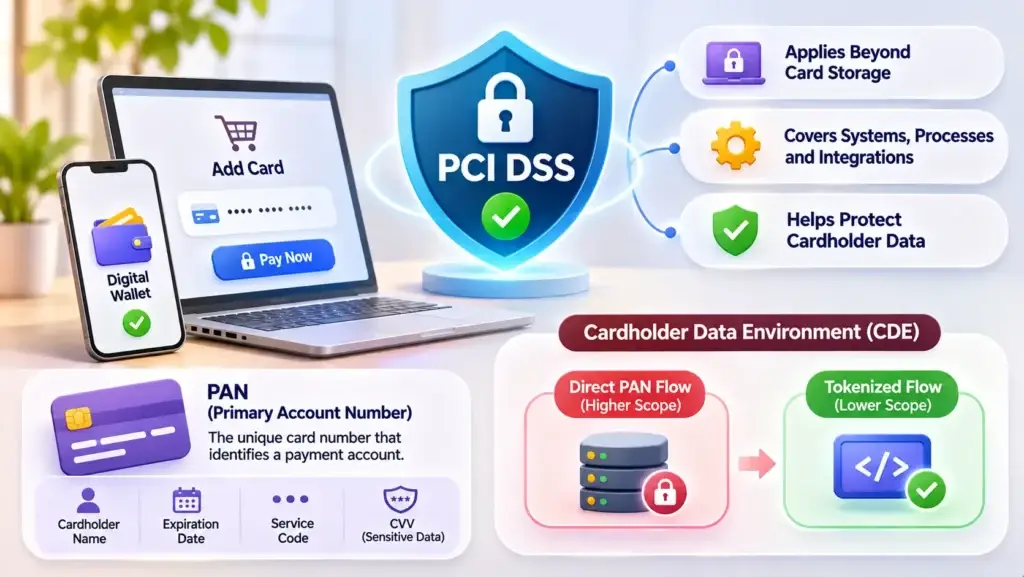
PCI DSS stands for Payment Card Industry Data Security Standard. It is a security framework developed by the PCI Security Standards Council to help protect payment account data.
Its relevance is not limited to traditional banks or large payment processors. A startup that accepts, processes, stores or transmits cardholder data – or whose systems can affect the security of that data – may have PCI DSS responsibilities through its payment arrangements.
Consider a startup offering a digital wallet. Its customer may add a debit card to fund a balance or authorize a purchase. Even if the startup does not intend to store the full card number, the payment flow must still transport that information safely to the entity authorized to process it.
The critical question is not only whether your database contains card numbers.
It is also whether a browser component, mobile application, server, logging system, third-party integration or operational process can access sensitive card data.
Understanding PAN and cardholder data
The Primary Account Number is the identifying number associated with a payment card account. It is usually the long number printed or displayed on the card.
Under PCI DSS, PAN is central to the definition of cardholder data. When PAN is stored, processed or transmitted, the relevant system and supporting components need to be evaluated against applicable requirements.
Other information, such as cardholder name, expiration date and service code, can also be part of cardholder data when associated with PAN.
Sensitive authentication data includes certain information used to authenticate card transactions, such as the card verification code. PCI DSS imposes particularly strict handling requirements on this category, including prohibitions on retaining sensitive authentication data after authorization, even when encrypted, subject to the standard’s specific rules.
For startups, this creates a useful design principle: avoid collecting information that your application does not need.
What is the cardholder data environment?
The cardholder data environment, commonly called the CDE, consists of people, processes and technology that store, process or transmit cardholder data or sensitive authentication data.
PCI DSS scope may also extend to connected or security-impacting components, including systems that could affect the security of the CDE.
Imagine a payment application with a frontend, backend API, database, analytics system, administrative dashboard and payment provider.
If the backend receives a full PAN, it becomes involved in processing cardholder data. That can affect its assessment scope and the scope of connected systems.
If a properly implemented provider-hosted collection flow sends card details directly to the payment provider, your backend may only receive a token and non-sensitive transaction information.
That difference can substantially simplify the architecture and potentially reduce the number of components subject to particular PCI DSS controls.
However, the actual result must be assessed against the complete deployment, not presumed from a vendor’s marketing description.
How Payment Tokenization Works Without Sending PAN Through Your Backend
Tokenization replaces a sensitive value with a surrogate value called a token.
A token can represent a payment credential while preventing the original PAN from being directly exposed to every system that uses it.
For example, a customer enters a card into a provider-hosted payment field. The payment provider receives the card details, creates or returns a token, and provides the startup with a reference that can be used for approved transactions.
A simplified illustrative token might look like card_tok_7F2A9Q.
That string is only an example. Real token formats, permissions and behavior depend on the provider and tokenization model.
The startup can associate the token with a customer account without storing the full PAN in its own database.
A practical seven-step tokenization flow
Card collection to payment confirmation
Illustrative flow using a third-party payment provider
- Customer opens checkout. The application creates a payment session or setup request.
- Secure card collection loads. A payment provider supplies the hosted form or isolated card-entry elements.
- Customer submits card information. The PAN travels to the payment provider without being submitted to the startup’s backend.
- Provider creates a reference. The processor returns a token, payment method identifier or supported equivalent.
- Backend stores the reference. The application associates the identifier with its internal customer record.
- Backend requests payment. An authenticated server-side operation uses the reference within the provider’s authorized flow.
- Provider reports the result. Verified API responses and webhooks update transaction and settlement records.
The precise sequence varies between payment systems. Some providers return a single-use token, some create reusable payment method identifiers, and others require separate setup and authentication operations.
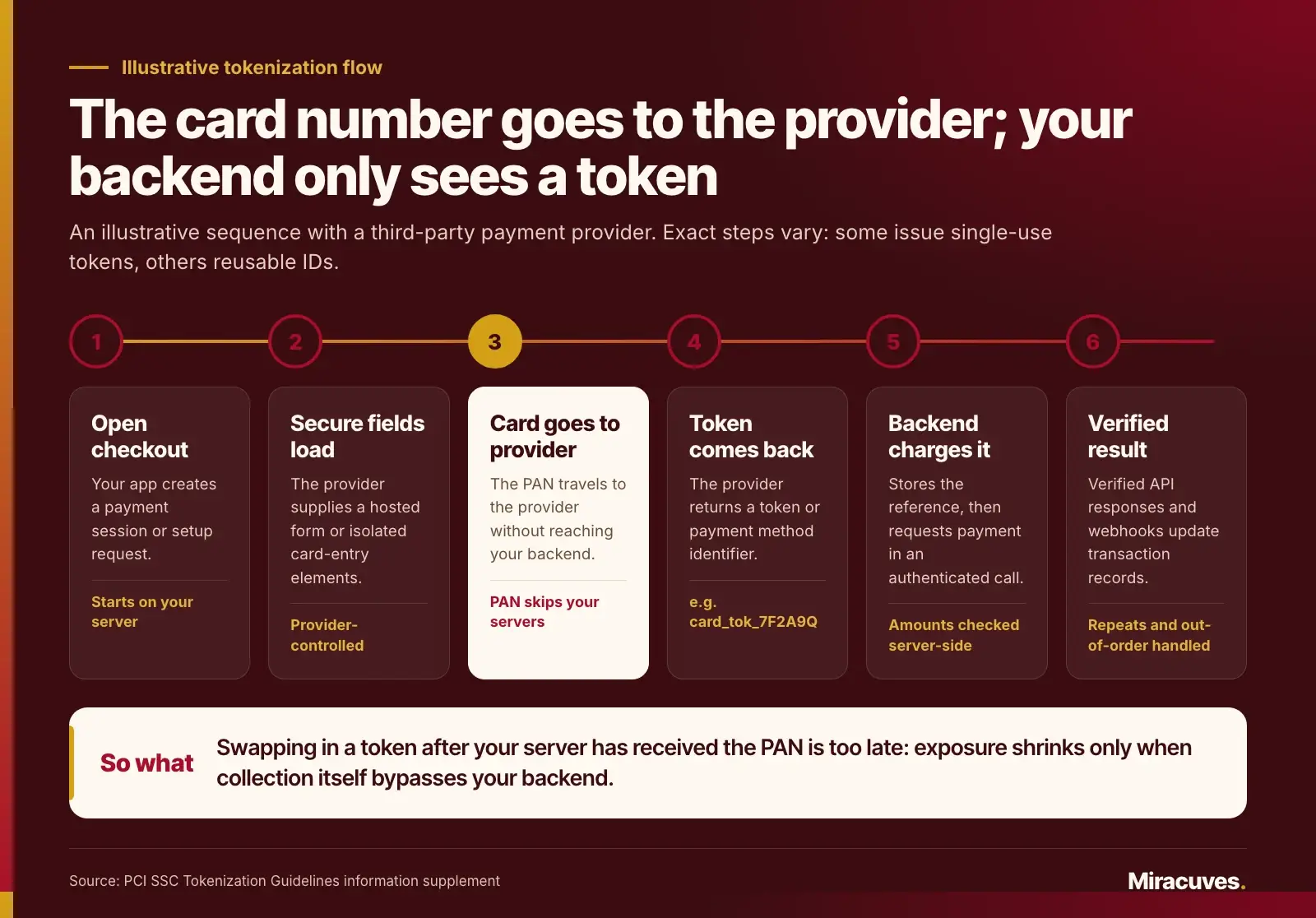
The important architectural objective is consistent: card details should be captured by the party responsible for handling them, not unnecessarily routed through unrelated startup infrastructure.
Why the token is not the same as the original card number
A well-designed token does not simply contain the PAN in an obvious encoded form.
It is a substitute that the appropriate tokenization system can interpret or map to the underlying payment credential.
In a vault-based system, a secure service maintains the association between tokens and original card details. In other systems, token creation and redemption can follow different technical methods.
A stolen token should not reveal the underlying PAN merely through inspection. However, that does not mean every token is harmless.
If a criminal obtains a reusable token together with the credentials needed to initiate a payment, the attacker may still be able to misuse the payment functionality.
That is why tokenization should be considered a data-exposure reduction mechanism, not a substitute for application security.
The PCI SSC’s tokenization guidance also makes clear that the security and scope implications depend on the actual implementation.
Why Tokenization and Encryption Solve Different Problems
Tokenization and encryption are often discussed together, but founders should understand their different purposes.
Encryption transforms readable information into a protected form using a cryptographic method and keys. An authorized party with the appropriate capability can reverse that transformation.
Tokenization substitutes a sensitive value with another value whose relationship to the original is managed through an appropriate tokenization mechanism.
Both can help protect payment information, but they do not create identical security boundaries.
| Consideration | Tokenization | Encryption |
|---|---|---|
| Main purpose | Substitute sensitive data | Protect data through cryptographic transformation |
| Original PAN | Held or recoverable within the authorized tokenization arrangement, depending on method | Recoverable with appropriate decryption capabilities |
| Application storage | May retain a limited-use reference instead of PAN | May retain encrypted PAN |
| Key or vault exposure | Depends on token design and token service controls | Depends heavily on cryptographic key management |
| PCI DSS implications | May reduce scope when PAN is inaccessible to otherwise excluded systems | Encrypted PAN can remain in scope |
| Typical use | Stored payment methods, card-on-file references and selected payment flows | Protecting data in transit or at rest |
A startup may still need encryption even when it uses tokenization.
For example, tokenized payment identifiers should travel over secure connections. Backend credentials, user information and operational records may also require encryption and other protective controls.
The mistake is treating either mechanism as a complete compliance solution.
Why storing encrypted PAN can create greater responsibility
Suppose your application receives the full card number, encrypts it and stores the ciphertext in your own database.
The information may be protected against certain attacks, but your system is still involved in handling PAN. The encryption process, key management, access controls, connected infrastructure and associated operational processes may fall within PCI DSS scope.
Now compare that with a provider-hosted collection design where the startup never receives the PAN.
The startup primarily handles a processor-issued reference, payment status and the information required to operate the product.
The second model can reduce direct cardholder data exposure, assuming the design is implemented correctly and other components cannot retrieve or affect the underlying PAN.
This is why data-flow architecture matters more than simply adding encryption to a database.
Three Ways a FinTech Startup Can Collect Card Payments
Before choosing a tokenization provider, decide how customers will enter card information.
This is one of the most consequential early payment architecture decisions because it influences security responsibilities, user experience and integration flexibility.
Hosted checkout pages
With hosted checkout, the customer is redirected to a payment page operated by a third-party provider.
The provider collects sensitive payment details, handles the supported payment process and returns the customer to the startup’s application.
This approach can be attractive for an early-stage business because the startup does not need to build its own card-entry interface.
It also creates a comparatively clear separation between the startup’s application and the provider’s sensitive payment collection process.
However, the startup still needs to protect its website, validate payment results, secure API credentials and fulfill applicable merchant requirements.
A hosted checkout is not an automatic exemption from PCI DSS.
Embedded payment fields
Embedded fields allow the startup to present payment inputs within its own checkout experience while a qualified payment provider supplies and controls the sensitive entry elements.
Properly implemented iframes can prevent the merchant application from reading the PAN entered into those elements.
This approach can improve design continuity because the customer remains within an interface that resembles the rest of the product.
However, the implementation details are critical.
If the startup creates its own card input field and collects raw PAN before sending it elsewhere, the resulting architecture is very different from a provider-controlled iframe.
The origin of payment page elements, third-party scripts and the precise data flow all need to be evaluated.
Direct card collection
Under direct collection, the startup’s frontend or backend handles raw payment card information before sending it to a payment processor.
This model offers additional control over certain workflows, but it can bring a substantially larger compliance and security burden.
A team may need to account for the cardholder data environment, secure storage or processing, transmission controls, restricted administrative access, monitoring and relevant assessment requirements.
For most startups whose differentiation lies in their financial product rather than card processing infrastructure, collecting raw PAN internally deserves careful justification.
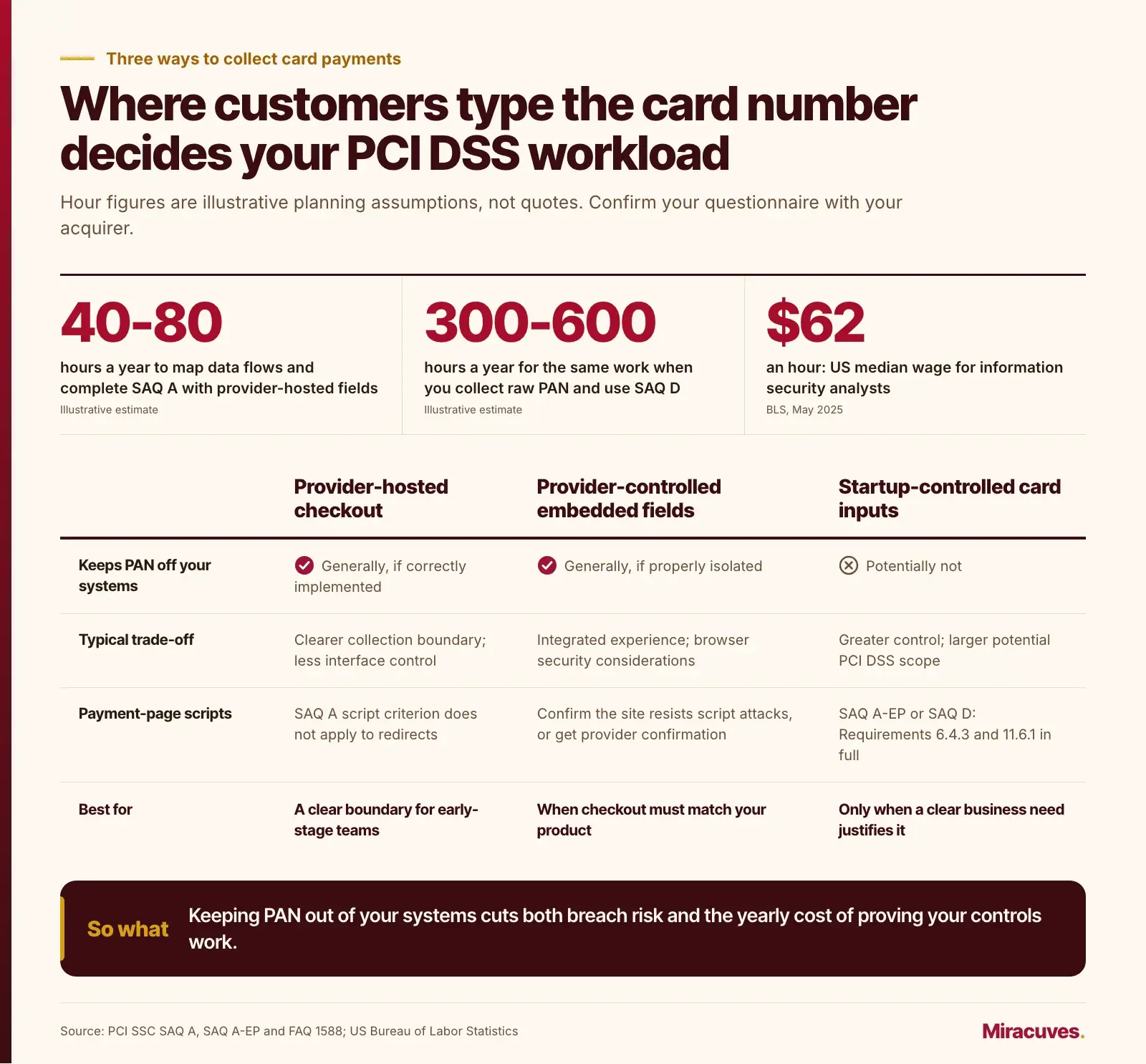
| Approach | Startup receives PAN? | Typical trade-off |
|---|---|---|
| Provider-hosted checkout | Generally no, if correctly implemented | Clearer collection boundary; less interface control |
| Provider-controlled embedded fields | Generally no, if properly isolated | Integrated experience; browser security considerations |
| Startup-controlled card inputs | Potentially yes | Greater control; larger potential PCI DSS scope |
Assessment eligibility depends on all relevant PCI DSS criteria and the real implementation, not solely on the collection method.
For founders, the most useful question is not which interface appears more sophisticated. It is which approach delivers the necessary customer experience without creating unnecessary exposure to sensitive payment credentials.
Understanding PCI DSS Scope Reduction: What Tokenization Does and Does Not Remove
One of the strongest reasons to use tokenization is the possibility of reducing the number of systems that handle cardholder data.
But scope reduction is conditional.
A payment token is not an all-purpose certificate proving that a system sits outside PCI DSS.
The PCI SSC explains that tokenization can simplify compliance efforts when PAN cannot be recovered from systems proposed for exclusion from scope.
For instance, a reporting database that stores only suitable tokens and non-sensitive transaction records may present a different risk profile from a database holding full card numbers.
That does not mean every database containing tokens is automatically out of scope.
The evaluation needs to consider whether those tokens can be used to retrieve PAN, whether tokenization and detokenization services are accessible, and whether the system can affect the security of the cardholder data environment.
Factors that may keep systems within PCI DSS scope
A system may require further assessment where it:
- Stores, processes or transmits actual PAN.
- Can retrieve or detokenize PAN through an authorized interface.
- Performs tokenization itself.
- Holds cryptographic keys or manages sensitive tokenization infrastructure.
- Is connected to cardholder data systems without effective segmentation.
- Can affect the security of payment collection or the cardholder data environment.
- Contains data combinations or privileges that undermine the claimed separation.
System permissions matter as much as database contents.
For example, imagine a startup’s analytics database stores only payment tokens. A backend integration connected to that database also has broad credentials capable of requesting full card data from an external vault.
That architecture needs closer review than a reporting system whose tokens cannot be reversed and whose accounts have no sensitive retrieval permissions.
This is the practical meaning of defining a trust boundary.
Tokenization does not eliminate merchant responsibilities
Even when a payment service provider handles the sensitive collection process, the startup may retain obligations relating to its website, payment integration, vendor management, incident response and other applicable controls.
Outsourcing a function does not mean outsourcing every responsibility.
For e-commerce implementations, current PCI DSS guidance also addresses external vulnerability scanning and protection against payment-page script attacks.
A startup should maintain a written understanding of which controls are performed by the payment provider and which remain its own responsibility.
This shared-responsibility model is more useful than simply asking whether a provider is compliant.
SAQ A, SAQ A-EP and Why Payment Architecture Changes Validation
A Self-Assessment Questionnaire, or SAQ, is one method certain eligible organizations use to report how they meet applicable PCI DSS requirements.
Different SAQs address different payment arrangements.
Founders often hear that adopting a hosted payment provider will allow them to complete SAQ A. That may be possible for some qualifying merchants, but no integration method should be treated as a guarantee of eligibility.
When SAQ A may be relevant
SAQ A is associated with qualifying merchants whose relevant cardholder data functions are outsourced according to the questionnaire’s eligibility criteria.
For certain e-commerce implementations using redirects or compliant provider-supplied payment pages, SAQ A may be the applicable validation route.
However, all eligibility criteria must be satisfied.
PCI SSC guidance states that, for eligible iframe-based payment pages, the elements involved in collecting payment account data must originate from the appropriate validated service provider.
Other merchant requirements can still apply.
Why SAQ A-EP is different
SAQ A-EP addresses certain e-commerce arrangements where a merchant website can affect payment transactions even though the merchant’s systems do not electronically receive account data.
An example is a direct-post model in which the merchant website generates card-entry components that submit data to a payment provider.
The important distinction concerns the payment page and its control boundaries, not simply whether PAN ultimately reaches the provider.
Founders should not select an SAQ based on a developer’s shorthand description of the checkout architecture.
The current SAQ A and SAQ A-EP questionnaires and their eligibility criteria are published in the PCI SSC document library.
What changed for embedded e-commerce payment pages?
PCI DSS v4.0.1 was published by the PCI SSC on June 11, 2024. It is a limited revision with no new requirements, and version 4.0 was retired on December 31, 2024, so v4.0.1 is the active standard. Its future-dated requirements, including the payment-page script controls in Requirements 6.4.3 and 11.6.1, became mandatory on March 31, 2025.
For SAQ A, the Council took a different route. The revised SAQ A removed 6.4.3 and 11.6.1 from its requirement list and added an eligibility criterion instead: a merchant whose web page embeds a provider’s payment form, such as an iframe, must confirm that its site is not susceptible to attacks from scripts that could affect its e-commerce systems. FAQ 1588, announced on February 28, 2025, explains the two ways to meet it: use protective techniques such as those described in 6.4.3 and 11.6.1, or obtain confirmation from a PCI DSS compliant provider that its solution includes those protections when implemented according to its instructions.
That criterion does not apply to merchants that redirect customers to the provider’s payment page or fully outsource payment collection, for example by sending a payment link. Merchants completing SAQ A-EP or SAQ D must implement 6.4.3 and 11.6.1 in full.
Separately, Requirement 11.3.2 covers external vulnerability scans, which must be run by a PCI SSC Approved Scanning Vendor. Whether your questionnaire includes it depends on the SAQ and on what your acquirer asks for, so do not assume outsourcing payment collection removes it.
These distinctions are important for a founder choosing between a redirect, an embedded interface and a customized checkout.
The correct validation approach should be confirmed with the acquirer, relevant payment brand, compliance-accepting entity or qualified assessor.
Which PCI DSS Merchant Level Is Your Startup?
Card brands group merchants into levels by annual transaction volume, and the level decides how you prove compliance. The table below summarizes Visa’s published merchant levels. Mastercard and other brands use similar tiers, and your acquirer can set stricter requirements, so treat this as a starting point rather than your final answer.
| Level | Annual Visa transactions | Typical validation |
|---|---|---|
| Level 1 | Over 6 million (all channels), or designated Level 1 by any Visa region | Annual Report on Compliance (ROC) by a Qualified Security Assessor, quarterly ASV scan, Attestation of Compliance |
| Level 2 | 1 million to 6 million (all channels) | Annual SAQ, quarterly ASV scan, Attestation of Compliance |
| Level 3 | 20,000 to 1 million e-commerce transactions | Annual SAQ, quarterly ASV scan, Attestation of Compliance |
| Level 4 | Under 20,000 e-commerce, or up to 1 million in total | Annual SAQ recommended, ASV scan if applicable, requirements set by the acquirer |
Most early-stage FinTech startups start at Level 4 and validate with an annual SAQ. The level is counted per card brand and per merchant, so a fast-growing product can move up within a year. If your platform processes, stores or transmits card data on behalf of other businesses, you may be a service provider rather than a merchant, which carries its own validation rules. Confirm your classification with your acquirer before you choose an architecture.
How Much Does PCI DSS Compliance Cost a Startup?
There is no single price, because the cost follows your scope. The more systems that can touch card data, the more requirements apply, and the more evidence you have to produce each year. These are the main drivers:
| Cost item | When it applies | What drives the cost |
|---|---|---|
| Scoping and the SAQ | Every merchant that validates with a questionnaire | How many systems touch card data; SAQ A covers far fewer requirements than SAQ A-EP or SAQ D |
| ASV external scans | Quarterly for Visa Levels 1 to 3, and where your acquirer or SAQ requires them | Number of internet-facing IP addresses and domains in scope; priced by the scanning vendor |
| QSA assessment (ROC) | Level 1, or when an acquirer asks for one | Size and complexity of the cardholder data environment and how ready your evidence is; quoted per engagement |
| Payment-page script protection | Embedded checkout under SAQ A, and all SAQ A-EP and SAQ D merchants | Whether your provider confirms coverage or you run your own script inventory and change detection |
| Remediation and upkeep | Whenever a review finds gaps, and after major changes | Engineering time to fix findings, plus repeat testing after checkout or provider changes |
Illustrative estimate, not a quote. Internal time is usually the largest line for a small team. Suppose a startup using provider-hosted fields spends 40 to 80 hours a year mapping data flows, completing SAQ A and collecting evidence. At the US median wage for information security analysts ($129,180 a year in May 2025, about $62 an hour), that is roughly $2,500 to $5,000 of salary cost. A startup that collects raw PAN itself and validates with SAQ D might spend 300 to 600 hours on the same work, about $18,600 to $37,200, before scan fees, penetration testing or a QSA. The hour ranges are planning assumptions; replace them with your own.
The comparison is the practical argument for tokenization: keeping PAN out of your systems reduces not only breach risk but also the yearly cost of proving that your controls work.
The Tokenization Architecture a Startup Should Actually Design
A good tokenization architecture is not simply a payment gateway API attached to a checkout screen.
It is a complete workflow that defines which components handle sensitive information, who can initiate transactions, how events are verified and what happens when something fails.
Frontend: isolate the sensitive collection interface
The frontend should load the provider’s approved payment collection mechanism according to its documented integration instructions.
Custom application code should not try to read sensitive values from provider-controlled fields.
Developers should also review frontend dependencies, tag managers, customer-support widgets and analytics scripts that appear on payment pages.
A script does not need to be explicitly designed for payments to create risk. If it can modify the payment page or redirect customers to an attacker-controlled destination, it may affect payment security.
The frontend should use secure transport and avoid including card details in browser storage, application state snapshots, analytics payloads or error reports.
Backend: keep payment actions server-controlled
The backend normally manages business operations such as creating a payment session, confirming an order, saving a supported payment method reference, handling refunds and updating transaction records.
Sensitive provider API keys should remain on the server or in properly secured secret-management systems.
The backend should verify that the authenticated user is authorized to operate on the payment method and that requested amounts correspond to trusted server-side records.
Do not accept a client-submitted price or token and assume the resulting transaction is authorized.
The backend should also use idempotency protections where supported to reduce the risk of duplicate financial operations during retries.
Database: store the minimum useful payment information
A startup often needs payment records for transaction history, customer support, accounting and dispute handling.
These records can usually be designed without full PAN.
Depending on the provider and purpose, useful fields may include a payment method identifier, transaction reference, amount, currency, timestamp, payment status, consent records and limited display information such as a card brand or last four digits.
Limited card display information must still be handled according to applicable data protection and payment rules, particularly when combined with other account data.
Payment references should be connected to the correct internal customer and provider account. This prevents accidental cross-account use and supports traceable operations.
Webhooks: verify the event before trusting the payment
A webhook is a server-to-server message sent by a payment provider when something changes.
For example, the provider might report that a payment succeeded, failed, was refunded or entered a dispute process.
A secure integration should authenticate the webhook using the provider’s supported mechanism, preserve the relevant information needed for verification and handle repeated or out-of-order events.
A signed webhook is not a substitute for correct business logic.
The backend still needs to identify the transaction being updated and prevent duplicate credits, refunds or order completion events.
A customer should not receive wallet value merely because the browser displays a payment-success screen.
Four Token Types and References That Founders Should Not Confuse
The word token describes several related but distinct payment concepts.
They are not necessarily interchangeable, and assuming otherwise can create engineering and provider-migration problems.
Provider-issued payment method tokens
These references are created by a payment service provider and commonly allow merchants to identify a payment method for supported transactions.
They may be single-use, reusable or restricted to specific customers and operations.
The actual permitted actions depend on the provider’s API and the customer’s authorization.
For many startups, this is the most straightforward tokenization model.
Vault tokens
A vault token represents information managed by a secure tokenization service.
The underlying PAN may be stored within the authorized vault and retrievable only through controlled processes.
The startup should determine whether its own systems can request detokenization and whether that capability is necessary.
Unnecessary detokenization access can undermine the intended scope-reduction strategy.
Network payment tokens
Network payment tokens follow a different model in which payment tokens can be issued through payment network tokenization arrangements.
Their format, provisioning and use are governed by the applicable network arrangements and token service providers.
They may support particular card-on-file and digital payment scenarios.
A payment provider may abstract much of this complexity, but a startup should understand whether the reference it stores is a proprietary processor token or a network payment token.
The distinction can matter during routing, provider changes and lifecycle management.
Authentication and session tokens
Authentication tokens are used to authorize access to application features or identify authenticated sessions.
They are not the same thing as payment tokens.
For example, a customer’s application session token might prove that the customer is logged in. A separate payment method token identifies a payment credential within the processor’s system.
Secure architecture requires protecting both, but for different reasons.
Mixing these concepts in database naming, API documentation or access-control design can create avoidable mistakes.
How Tokenization Supports Real FinTech Business Models
The strongest architecture is one designed around the transactions the business actually needs to perform.
A startup planning one-time merchant payments will have different requirements from a subscription service or a card-funded wallet.
Digital wallet funding
A wallet application may allow users to add cards and fund balances.
Rather than storing PAN, the application can retain a provider-issued payment method reference and use the payment provider’s supported funding flow.
The internal wallet ledger should record the resulting financial events separately from the payment token.
For example, a successful card authorization does not always mean that final settlement has occurred.
The application should distinguish authorization, capture, settlement, refunds and reversals where those stages are relevant.
Tokenization protects sensitive card exposure, but accurate ledger accounting protects the financial integrity of the wallet.
Subscription and recurring payments
Subscription businesses commonly need to charge a customer’s approved payment method more than once.
A supported reusable payment method reference can allow future authorized payments without repeatedly asking the customer to enter full card details.
However, the startup also needs to manage customer consent, authentication requirements, billing schedules, failed payment recovery and cancellation.
Payment tokens are only part of that operational design.
A subscription token should not be used to bypass customer authorization or applicable recurring-payment rules.
Merchant marketplaces
A platform connecting customers and merchants may need to accept payments, deduct platform fees and route settlement through the appropriate licensed partners.
The customer card credential should remain within the suitable processor arrangement.
The marketplace’s own records can reference payment operations, merchants, commissions, refunds and settlement obligations.
A founder must also distinguish card tokenization from fund custody.
Not storing PAN does not authorize a startup to hold customer funds or perform regulated activities without the required permissions.
Card-based lending and financial services
A financial services application may use stored payment references for authorized repayments or related card-based operations.
Here, tokenization helps limit exposure to payment credentials, but it does not address lending authorization, consumer disclosures, collections rules, credit decisions or jurisdiction-specific financial obligations.
Founders should avoid treating a secure technical integration as proof that the entire business model is compliant.
Security architecture and regulatory authorization are related but separate responsibilities.
The Hidden Places PAN Can Leak Even When You Use Tokenization
A startup can choose a suitable payment provider and still accidentally expose cardholder data through surrounding application components.
This is why payment integration reviews should examine the entire data path, including temporary storage, debugging behavior and third-party services.
Debugging and application logs
During development, engineers sometimes log incoming requests to diagnose payment failures.
If raw PAN reaches an endpoint and request bodies are logged, sensitive information may be copied into log storage, monitoring platforms or developer workstations.
A better design prevents unnecessary PAN collection in the first place.
Logging policies should also exclude payment credentials, sensitive authentication data, provider secrets and other protected information. Automated redaction can provide another safeguard, but it should not be the sole protection against a poorly designed collection flow.
Analytics and session replay
Analytics systems often record customer interactions to help product teams understand checkout abandonment.
Session-replay tools may capture user inputs, page structure or browser events unless properly configured.
Payment fields should be isolated, and analytics systems should be configured and tested to ensure they do not receive sensitive card information.
Masking settings need to be verified in practice.
A configuration that works for one payment interface may behave differently after a frontend redesign.
Customer support and screenshots
A support agent may ask a customer to share a screenshot while troubleshooting a failed payment.
Customers sometimes include more information than intended, particularly when using virtual cards or digital wallet screens.
Support procedures should explicitly discourage sharing full card numbers, card verification values and other sensitive payment credentials.
Support platforms should also have procedures for restricting access to and appropriately deleting sensitive information received unexpectedly, consistent with applicable requirements and retention obligations.
Mobile application diagnostics
Mobile payment applications can introduce additional exposure through crash reports, device logs, debugging utilities, insecure local storage and clipboard handling.
Teams should check whether SDKs collect sensitive fields automatically.
Payment collection should use approved provider mechanisms, while application storage should be limited to the records necessary for authorized product operations.
Sensitive values should not remain in temporary files simply because the main database uses tokenization.
Third-party automation
Marketing tools, workflow automation services and customer relationship management platforms can become unintended recipients of payment information.
A payment-success event might legitimately include a transaction identifier, amount and non-sensitive status.
It should not include full PAN or card verification data.
Design event schemas deliberately rather than forwarding entire provider responses to downstream systems.
The goal is to ensure that every integration receives only the information required for its authorized function.
Choosing a Payment Tokenization Provider: A Founder Decision Framework
Provider selection is often approached as a comparison of transaction fees and supported payment methods.
Those factors matter, but they do not reveal whether the provider’s architecture fits the startup’s security and operational requirements.
A more useful assessment considers how card information enters the provider, what token references are created, which operations the startup can perform and how responsibilities are documented.
Confirm the provider’s PCI DSS status and relevant services
Ask the provider for appropriate evidence of its current PCI DSS validation and clarify which services are covered by that validation.
A general claim that a company is secure is not equivalent to evidence that the specific card collection and processing service is covered.
The startup should also obtain the provider’s responsibility documentation, where available.
This helps identify which safeguards the provider performs and which the startup must implement.
Review token permissions and restrictions
A useful token should support the operations that the business actually needs without granting unnecessary capabilities.
Consider whether a payment reference can be restricted to a particular customer, merchant account, transaction purpose or provider environment.
Determine whether tokens can be revoked and how the provider handles expired, replaced or compromised cards.
Also clarify whether the startup can request the original PAN.
For a low-exposure architecture, that capability is often unnecessary and may complicate scope.
Evaluate failure handling
A payment integration is not complete when the first successful transaction works.
The provider should expose enough event information for the startup to handle rejected transactions, network delays, duplicate requests, partial captures, reversals and refunds.
For financial applications, the engineering team must be able to reconcile the provider’s records with its internal transaction state.
A tokenization provider that supports card security but leaves critical payment events difficult to reconcile can create substantial operational friction.
Understand future migration
Provider lock-in can become a significant issue when a startup grows.
If all reusable card references are proprietary to a particular payment provider, moving to another processor may require supported migration arrangements or customer re-enrollment.
A founder should ask whether token portability is supported, which parties can participate in migration, what approvals are required and what happens to recurring payments during the change.
Network tokenization may offer useful capabilities in some arrangements, but it is not a universal guarantee of portability.
The provider’s actual agreements and technical capabilities determine what is possible.
| Evaluation area | Questions to ask |
|---|---|
| Card collection | Does the provider supply hosted checkout or isolated payment fields? |
| Compliance evidence | What current validation documents cover the service being purchased? |
| Token permissions | Can tokens be restricted, revoked or prevented from revealing PAN? |
| Recurring billing | How are consent, authentication and later payments handled? |
| Operational events | Are refunds, disputes, failures and settlement updates available? |
| Data isolation | Can the application operate without PAN or detokenization privileges? |
| Migration | What happens to stored payment methods if the provider changes? |
| Incident response | How are security incidents communicated and investigated? |
| Responsibilities | Which PCI DSS controls belong to the provider and which remain with the startup? |
A founder does not need to become a payment security specialist to ask these questions.
However, the answers should be documented before the provider becomes deeply embedded in the product.
Building a Practical PCI DSS Tokenization Implementation Plan
Treat the rollout as a series of verifiable decisions, so critical compliance questions surface early rather than the week before launch. The durations below are typical for a hosted or embedded integration with an established provider. They are not a quote, and phases 3 to 5 often overlap.
| Phase | Typical duration | What done looks like |
|---|---|---|
| 1. Map every payment data flow | 1 to 2 weeks | A diagram covering browser or app, provider components, backend, databases, logs, support and analytics tools, including failed and retried payments |
| 2. Define prohibited data handling | Under 1 week, alongside phase 1 | A written rule that raw PAN and card verification codes never enter startup systems, plus review gates for any new collection method |
| 3. Integrate the approved collection method | 1 to 3 weeks | Hosted checkout or provider iframes working in test mode with the provider’s test cards, for both success and common failures |
| 4. Secure the token-based backend | 1 to 3 weeks | Tokens bound to authenticated customers, server-side amount checks, restricted and rotated API keys, idempotent payment calls |
| 5. Transaction records and webhooks | 1 to 2 weeks | Verified webhooks, duplicate and out-of-order handling, and records that reconcile with the provider |
| 6. Review security and compliance evidence | 1 to 3 weeks; longer if a QSA is involved | Confirmed SAQ type, provider attestation and responsibility matrix, script protection and scan status where they apply |
| 7. Monitor after launch | Ongoing | Alerts on unusual payment activity and webhook failures, and a repeat review after any checkout or SDK change |
Two rules hold across every phase. Payment amounts and permissions are decided on the server, never taken from the client. And the architecture you review in phase 6 must match what is actually deployed, not the diagram from phase 1.
How to Test Whether Your Application Really Avoids PAN Exposure
An architecture diagram describes the intended behavior. Testing establishes whether the application actually behaves that way.
For a startup claiming that PAN does not enter its backend, evidence should support that claim.
Inspect the browser-to-provider flow
In a controlled test environment, inspect payment collection requests and their destinations using appropriate debugging tools.
Determine whether card data is transmitted directly to the authorized provider or first passes through startup-controlled endpoints.
For an embedded interface, verify that the sensitive fields are genuinely supplied and isolated by the provider.
Do not record real customer PAN during testing.
Use test credentials and test cards supplied by the provider.
Review backend request handling
Examine API schemas, request validation, logging middleware and error handlers.
Look for endpoints accepting raw card numbers or card verification values.
A common architectural warning sign is an application endpoint that accepts the complete card form and forwards it to another provider.
That design may be functional but does not satisfy the intended objective of keeping PAN away from the backend.
Audit persistent and temporary storage
Review databases, caches, message queues, temporary files and log platforms.
Check both successful transactions and failed requests.
For example, a request rejected because of an invalid field may still have been copied into an error-monitoring system.
The absence of a PAN column in the main customer database is not sufficient evidence that PAN is absent from the entire environment.
Validate the frontend after third-party changes
Repeat relevant tests when payment SDKs, scripts, tag managers or major frontend dependencies change.
An unrelated interface update can affect how scripts load or which components receive event information.
Maintain records of security-relevant changes and test results.
This evidence helps teams investigate incidents and explain their payment architecture during compliance reviews.
Review permissions and detokenization capabilities
If the provider offers APIs for revealing original card details, establish whether any startup-controlled account can access them.
Check administrative permissions, service account scopes and integration credentials.
Where the business does not need access to original PAN, remove those capabilities when supported.
The objective is to reduce both routine exposure and the consequences of a compromised credential.
When a Startup May Need More Than Standard Provider-Hosted Tokenization
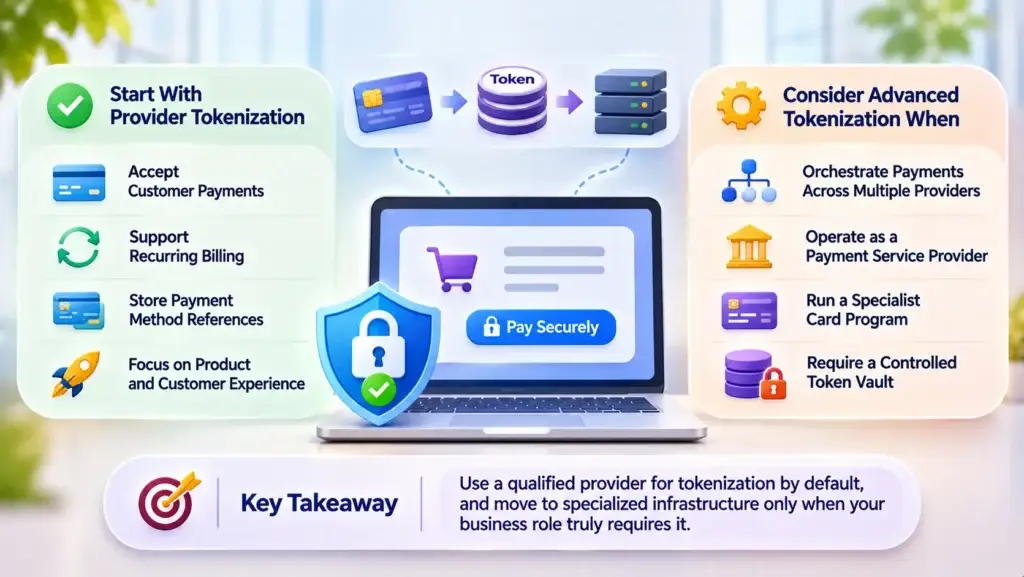
Provider-hosted tokenization is often a practical starting point, but it is not universally appropriate.
Certain businesses have requirements that involve more complex payment infrastructure.
A payment orchestration platform may need to coordinate transactions across multiple processors. A payment service provider may operate systems that process cardholder data directly. A specialist card program may have responsibilities involving issuer or network tokenization arrangements.
These situations can introduce additional architectural, contractual and compliance requirements.
The decision should depend on the company’s actual role in the payment ecosystem.
When standard provider tokenization is usually a sensible starting point
For a business that primarily needs to accept customer payments, store payment method references and support recurring billing, a qualified provider’s existing tokenization capabilities may meet the product’s requirements.
This allows the startup to focus engineering effort on customer experience, product logic, payment state management and commercial differentiation.
It also reduces the need to operate sensitive card storage and tokenization infrastructure internally.
When additional specialist infrastructure may be justified
More specialized arrangements may be appropriate when the business has specific requirements for routing, token portability, direct processor relationships, payment network participation or tightly controlled vault services.
Those choices should be evaluated against their additional security and governance burden.
Operating a token vault or handling raw PAN should never be treated as a simple feature upgrade.
It changes the operational responsibilities of the business and may require substantially more demanding controls, evidence and independent assessment.
A useful founder decision rule is to retain sensitive payment processing with appropriately qualified providers unless a clear business requirement justifies taking on more responsibility.
Where Secure Payment Architecture Meets Product Implementation
By this stage, a startup should be able to define its payment requirements more precisely.
Instead of asking a developer to add card support, the product team can describe the expected security boundary:
The provider should collect raw card information; the application should receive suitable payment references; backend services should authorize payment actions; the transaction ledger should preserve accurate financial records; and administrators should have only the permissions required for their roles.
Those requirements are far more actionable than a generic instruction to make an application PCI compliant, and they make vendor discussions more productive.
For founders moving from an architectural plan to implementation, Miracuves’ secure fintech product implementation services provide a route to discuss payment provider integration, product workflows and compliance-oriented controls.
If the product needs its own checkout orchestration or routing across several providers, Miracuves also offers payment gateway development built around provider-hosted card collection. Provider onboarding, regulatory permissions and external assessments run on their own timelines.
An important distinction remains: a software product that supports tokenized payments is not automatically PCI DSS validated. The responsible business must determine its applicable obligations and obtain appropriate review.
The most productive starting point is therefore a documented payment flow, an agreed responsibility matrix and a clear understanding of which systems will, and will not, handle cardholder data.
A Practical Pre-Launch Tokenization Checklist for Founders
Use the following checklist before approving a card-enabled product for production.
Payment Security Readiness Checklist
Interactive planning aid
Copy checklist
This checklist is a planning aid, not a compliance certification or a substitute for formal assessment.
It becomes more useful when each item has an accountable owner, supporting evidence and a defined review date.
For instance, the engineering team may own payment API testing, the security team may own logging and script reviews, and the compliance function may coordinate applicable PCI DSS validation.
Clear ownership is particularly important for small startups because payment security responsibilities often span multiple roles.
Final Thoughts: Reduce Card Data Exposure Before You Scale Payment Volume
For a FinTech startup, the strongest approach to PCI DSS tokenization is to begin with the payment data flow rather than the token-generation API.
A properly designed provider-hosted collection process can prevent full card numbers from entering startup-controlled backend systems. Suitable tokens can then support authorized payment operations without requiring the application to routinely handle the underlying PAN.
That can reduce sensitive data exposure and potentially simplify PCI DSS scope, but the outcome depends on the architecture, permissions, connected systems and relevant assessment criteria.
Founders should also remember that protecting card data is only one part of operating a trustworthy financial product. Secure authentication, sound transaction accounting, verified payment events, appropriate regulatory permissions and clear provider responsibilities remain essential.
Before developing a card-enabled platform, define who captures PAN, who protects the original credential, how tokens are used and which entity is responsible for each security control.
That clarity reduces avoidable rework and makes the eventual compliance review more meaningful.
Frequently Asked Questions
Does tokenization make my startup PCI DSS compliant?
No. Tokenization can reduce how much card data your startup handles, but it does not make you compliant on its own. Your payment provider’s compliance status does not cover your business. Ask your acquirer or a qualified assessor which questionnaire or assessment applies to your setup.
What PCI DSS level is my startup?
Levels are set by each card brand from annual transaction volume. Under Visa’s levels, merchants with fewer than 20,000 e-commerce transactions, or up to 1 million in total, are Level 4 and usually validate with an annual self-assessment questionnaire. Over 6 million transactions is Level 1, which needs an annual Report on Compliance from a Qualified Security Assessor. Your acquirer confirms your level.
How much does PCI DSS compliance cost a startup?
It depends on scope. With provider-hosted fields and SAQ A, the main cost is internal time, often tens of hours a year. Collecting raw card numbers yourself pushes you toward SAQ D, which can mean hundreds of hours plus scanning, penetration testing and possibly a paid assessor. Keeping card numbers out of your systems is the most reliable way to keep the cost down.
What changed in PCI DSS v4.0.1 for e-commerce startups?
Version 4.0.1, published in June 2024, is the active standard. Its payment-page script requirements became mandatory on March 31, 2025. For SAQ A, merchants embedding a provider’s payment form must now confirm their site is protected from malicious scripts, either with their own controls or through confirmation from their payment provider. Pure redirects are not covered by that criterion.
Can I accept card payments without storing full card numbers?
Yes. Use a payment provider’s hosted checkout or properly configured embedded payment fields. The provider collects the card number and gives your app a token instead. Then test that full card numbers do not reach your servers, logs, analytics tools or support systems.
Can someone misuse a stolen payment token?
Yes, in some cases. A properly designed token does not reveal the full card number, but someone who also steals the right credentials may be able to use it to make a payment. Limit who can access tokens and what they can do with them, and monitor unusual payment activity.
Does reducing PCI DSS scope mean I no longer need to comply?
No. Reducing scope means fewer systems or processes need to be assessed. You may still be responsible for protecting your checkout page, checking your payment provider’s compliance status, completing an annual questionnaire and running external vulnerability scans where your acquirer requires them.
Do hosted payment fields automatically qualify me for SAQ A?
No. Eligibility depends on who provides the payment fields, whether your systems receive card data and how your checkout page is protected from malicious scripts. Confirm the right Self-Assessment Questionnaire with your acquirer or the organization accepting your validation before you rely on SAQ A.
Can I use tokenization for saved cards and subscriptions?
Yes, if your provider supports reusable payment tokens. Your app can use the token for future authorized charges without storing the full card number. You still need to manage customer consent, authentication where required, billing schedules, cancellations and failed payment recovery.
Should my startup build its own token vault?
For most startups, it is better to start with a qualified payment provider. Running your own vault means taking on more responsibility for card data security, access controls, monitoring and PCI DSS assessment. Consider it only if a provider cannot meet a specific business need.
Miracuves is an independent software development company. We are not affiliated with, connected to, sponsored by, or endorsed by any company or product named in this article.
Terms such as “X Clone” are used descriptively. It is how the software industry refers to building a platform with functionality comparable to a known service, and how clients search for it.
The entire design and codebase of our products is built by our own team. Our products contain no code, design, graphics, or content originating from any third-party website or applications.
All third-party names and marks referenced in this article are the property of their respective owners, referenced solely to identify the services discussed.