Key Takeaways
- The ticket is the source document Sequential numbers, indicator-captured weights and versioned corrections make every later figure traceable.
- Shrink has three separate parts Water shrink, handling shrink and drying charges should appear as distinct lines so producers can check them.
- Discount schedules are dated data Each ticket calculates against the schedule in force on its delivery date and keeps a reference to that version.
- Basis splits the cash price Contract types fix futures, basis or both at different times, and each has its own lifecycle and roll events.
- Stored grain is an obligation Open storage and warehouse receipts must stay visible and separate from the elevator's own position.
- Hardware capture beats typing Read weights and grading results directly from devices and allow manual entry only as a flagged fallback.
- Settlements carry outside deductions Checkoff, advances, lienholders and landlord splits need explicit handling so the elevator never pays twice.
- Own the platform only for a real fit gap Multi-site, specialty crop and software-selling businesses gain most from a custom build; simple operations often do better renting.
A country elevator in harvest week can take a truck through the probe, onto the scale and back out every few minutes, and each of those loads becomes a legal record, an inventory movement and a future payment. Grain management software development for an elevator is the work of building one system that holds those three things together: the scale ticket, the grade and discount math, the storage or sale decision, and the settlement check that follows weeks or months later.
Two groups usually start this project. Some are elevator owners who have outgrown spreadsheets and a scale indicator printer. Others are agritech founders who want to sell a modern platform to cooperatives, independent elevators or grain merchandisers. Both groups need the same thing first: a clear picture of how grain actually moves through a facility and where the money is won or lost.
This guide walks through the real mechanics: the inbound flow at the scale house, the moisture and shrink calculations, basis contracts, warehouse receipts, the hardware boundary and the settlement run. The later sections list the features a grain elevator management system needs at each step and weigh owning a custom platform against renting one, including the cases where renting is the better call.
From Probe to Pay Stub: The Inbound Load Lifecycle
Every design decision in an elevator system traces back to the inbound load. If you map it carefully before writing a single screen, the data model almost writes itself. If you skip it, you will spend the first harvest patching edge cases at two in the morning with a line of trucks out to the road. If your harvest bottleneck is trucks rather than the scale house, compare agricultural transport software with farm logistics marketplaces.
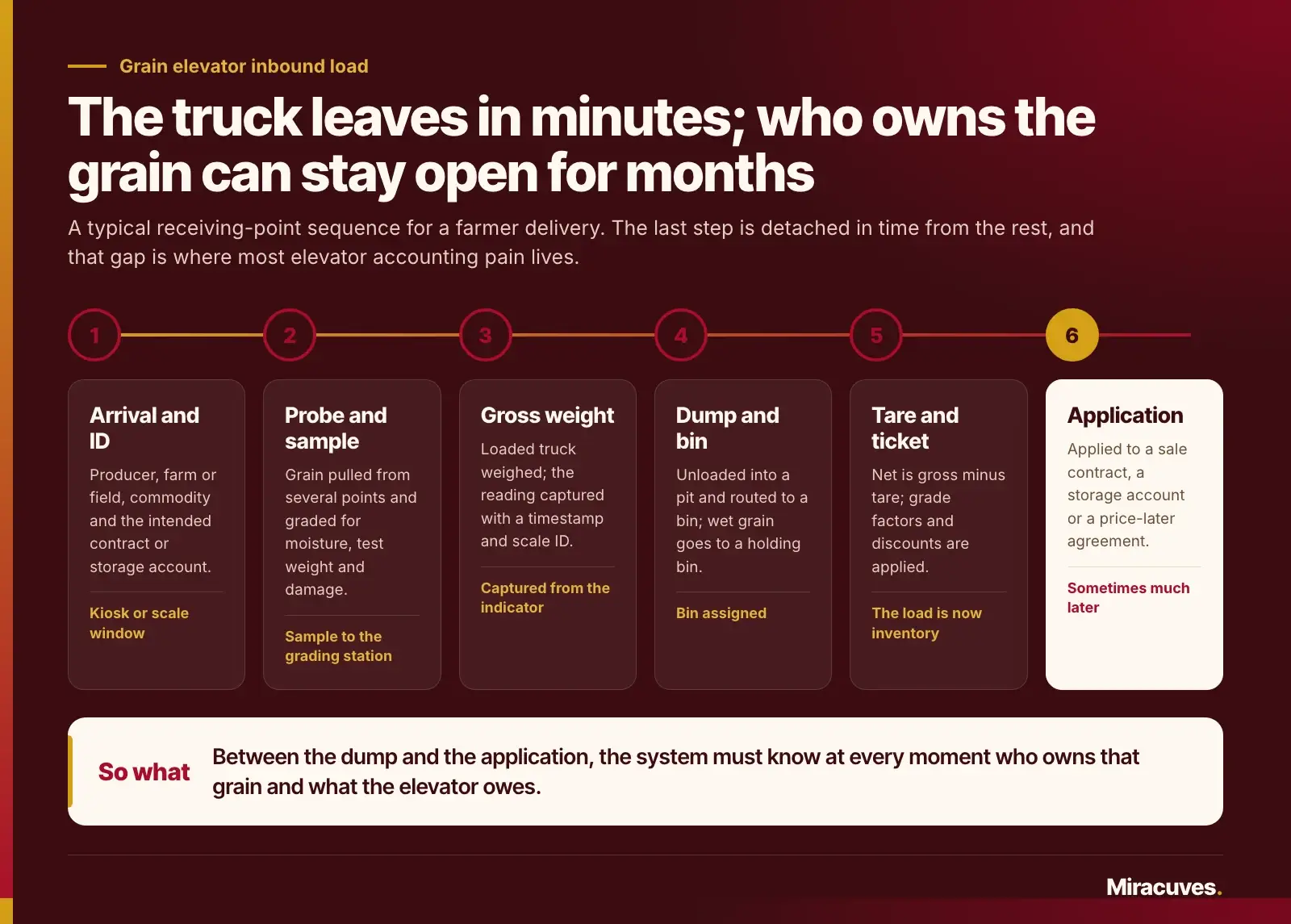
Here is the sequence a typical receiving point follows for a farmer delivery:
- Arrival and identification. The driver pulls up to the kiosk or scale window. The operator identifies the producer, the farm or field, the commodity and, ideally, which contract or storage account the load is meant for.
- Probe and sample. A probe pulls grain from several points in the truck or trailer. The sample goes to the grading station for moisture, test weight, foreign material, damage and any commodity-specific checks.
- Gross weight. The loaded truck is weighed on the inbound scale. The indicator reading is captured with a timestamp and scale identifier.
- Dump and bin assignment. The truck unloads into a pit, and the grain is routed to a bin or tank. Wet grain may go to a wet holding bin ahead of the dryer.
- Tare weight. The empty truck comes back across the scale. Net weight is gross minus tare.
- Ticket completion. Grade factors, discounts and the net quantity are applied. The ticket prints or goes to the driver’s phone, and the load is now inventory.
- Application. Later, sometimes much later, the ticket is applied to a sale contract, a storage account or a price-later agreement, which decides how and when the producer is paid.
Notice that step seven is detached in time from the other six. That gap is where most elevator accounting pain lives. A ticket can sit in open storage for months while the farmer waits for a better price, and the system must know at every moment who owns that grain and what the elevator owes.
Outbound loads run the same path in reverse: tare first, load, gross, then a ticket tied to a sale to a processor, ethanol plant, feedlot, rail car or barge. Transfers between your own locations add a third type that moves inventory without changing ownership. Where outbound freight is booked with outside carriers, load board software with carrier TMS and GPS tracking can post those loads and pass delivery details back to the outbound ticket.
The Scale Ticket Is the System of Record
Treat the scale ticket as an immutable source document, not an editable row. In practice, that means a ticket number issued in strict sequence per location, weights captured directly from the indicator rather than typed, and every later correction stored as a new version with the user, time and reason attached. Auditors, producers and lenders will all ask how a number changed, and the answer should be one query away.
Core entities you will model
- Location and bin. Each facility, its scales, its bins and their capacities, plus which commodities each bin may hold.
- Producer and payee. Farmers, landlords, tenants, lienholders and the split percentages that tie them to a farm or field.
- Commodity and discount schedule. Corn, soybeans, wheat classes, sorghum and so on, each with its own grade factors and a dated schedule of discounts and premiums.
- Ticket and ticket split. One physical load, possibly split across several payees or several applications.
- Contract. Purchase and sale contracts with type, quantity, delivery window, futures month, basis and price status.
- Storage account. Open storage, warehouse receipt or grain bank balances with their charge rules.
- Settlement. The payment document that consumes ticket applications, applies deductions and produces checks or ACH payments.
Splits, voids and the awkward cases
Real operations break clean models quickly. A landlord and tenant share a crop at a fixed percentage. A trucker hauls for three farmers in one day and forgets which field a load came from. A load gets rejected after the sample shows heat damage, and the truck leaves without dumping. Each of these needs a defined path: a split table on the ticket, an edit flow with approval, and a void state that keeps the ticket number in the sequence so nobody can ask where number 48213 went.
Another awkward case is the re-grade. A producer disputes a moisture reading, the retained sample is re-tested, and the discount changes. If the ticket has already been applied to a contract and partly settled, the correction must ripple through to an adjustment on the next settlement rather than silently rewriting a check that has already cleared.
Moisture Discounting, Shrink and Grade Factors
Grade and condition decide how many bushels the producer is actually paid for. In the United States, official grade requirements are set out in the federal grain standards. For corn, for example, U.S. No. 1 requires a minimum test weight of 56.0 pounds per bushel and U.S. No. 2 requires 54.0, alongside limits on damaged kernels and broken corn and foreign material, as listed in 7 CFR 810.404. Moisture is not one of the grade-determining factors in that table, yet it is the factor that moves the most money at a country elevator.
How water shrink works
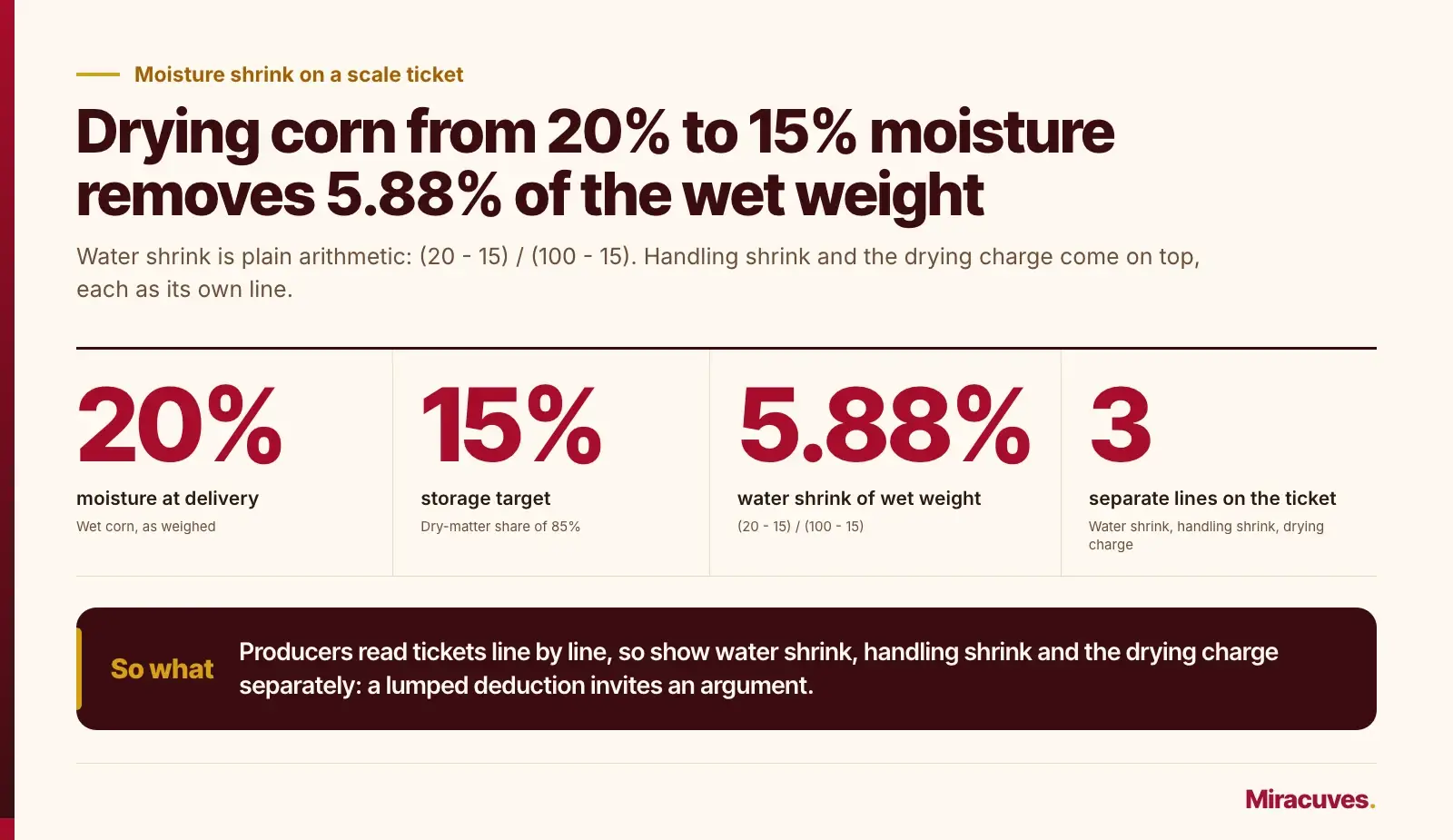
Wet grain is heavier than the dry grain it will become. When an elevator dries corn from 20 percent moisture down to a 15 percent storage target, the water removed is the difference divided by the dry-matter share at the target: (20 minus 15) divided by (100 minus 15), or roughly 5.88 percent of the wet weight. That is pure water loss, and it is just arithmetic.
Most elevators then add an invisible or handling shrink to cover dry matter lost in drying, fines and handling, and they publish a shrink factor per point of moisture rather than the raw formula. On top of shrink sits a drying charge, usually per point of moisture removed and sometimes per bushel. The software has to support all three ideas separately, because producers read their tickets line by line and a lumped deduction invites an argument.
Discount schedules as dated, versioned data
Each commodity needs a schedule that maps a measured factor to a deduction. Test weight below a threshold might cost a set amount per bushel for every half pound short. Damage above a limit adds a stepped discount. Foreign material may be removed as dockage and deducted from the weight before pricing. Some buyers also pay premiums for protein in wheat or oil content in soybeans.
Store these schedules as data with an effective date, never as code. Elevators change them at the start of harvest, mid-season when quality shifts, and per buyer for outbound sales. A ticket must always calculate against the schedule in force on its delivery date, and the ticket should store a reference to that version so a recalculation next spring produces the same answer.
Inbound and outbound must agree
An elevator buys wet, damaged or light grain at a discount and sells blended grain to a processor that grades it again. The margin between what you discounted on the way in and what the buyer discounted on the way out is real profit or loss. Good systems report this by bin and by commodity, so a manager can see whether the discount schedule is too generous before the whole season is booked.
Basis, Futures and the Cash Contract Book
Commodity pricing at an elevator rests on one relationship: the local cash price equals a futures price plus or minus the local basis. Basis reflects freight, local supply and demand, storage costs and the elevator’s own margin. Merchandisers quote bids as a basis against a specific futures month, and the contract book is built on that split.
Contract types the system must handle
- Flat price or cash contract. Both futures and basis fixed. The simplest case, priced at signing.
- Basis contract. Basis fixed now, futures priced later by the producer before a deadline.
- Hedge-to-arrive or futures-only. Futures fixed now, basis set later. The elevator usually places a hedge at signing.
- Delayed price or price later. Grain delivered and title transferred, but the price is set at a later date the producer chooses. Ownership and credit risk change here, which matters for reporting.
- Minimum price and other option-based contracts. A floor price with upside participation, often backed by options the elevator holds.
Each type has a lifecycle: open, partly delivered, fully delivered, partly priced, fully priced, settled, rolled to another futures month, or cancelled. Rolling a hedge-to-arrive contract between months is a frequent request, and it changes the spread the producer captures. Model the roll as an event with its own price fields rather than an edit to the original contract.
The daily position report
Merchandisers live on the position report. It shows, per commodity, how many bushels the elevator owns physically, how many it has bought but not received, how many it has sold but not shipped, how much is priced and unpriced, and how much is hedged with futures. The net exposure tells the manager whether a sharp move in the market will hurt.
Building this report well is harder than it looks. Grain in open storage is in the bins but belongs to farmers. Delayed price grain belongs to the elevator but still carries an obligation. Grain on a rail car in transit has left inventory but not yet been graded at destination. Every one of these states needs a clear rule, and the rules must match how your accountants close the month.
Storage Accounts, Warehouse Receipts and Ownership
Storage is where elevator software turns into a fiduciary ledger. When a producer stores grain, the elevator holds someone else’s property and owes it back in the same quantity and grade on demand, less charges. That obligation has to be visible at any moment and must never be netted against the elevator’s own grain in a way that hides a shortfall.
Open storage versus receipted grain
Open storage is a running balance on the producer’s account. Receipted storage converts some of that balance into a warehouse receipt, a negotiable document the producer can use as loan collateral. For licensed warehouses, federal rules also allow electronic receipts. Under 7 CFR 869.303, an operator issuing electronic warehouse receipts must use one AMS-authorized provider annually, issue receipt numbers from a consecutive range assigned by AMS, and cancel a receipt only while holding it; only one person may be the holder at any time, and no two receipts may carry the same number or represent the same lot.
For your system, that means receipts are not a report: they are a separate state machine with issue, transfer, hold, cancel and replace events, synchronized with the authorized provider and reconciled against the underlying storage balance. State-licensed warehouses follow their own state rules, so the receipt module needs per-location configuration rather than one hard-coded process.
State grain licenses and indemnity funds
Many country elevators hold a state grain dealer or warehouse license rather than, or as well as, a federal one, and several states back those licenses with an indemnity fund that repays farmers when a licensee fails. Coverage depends on the type of transaction and how long ago the grain was delivered, which turns into data the software must track. Two Midwest examples show the pattern.
| State program | What the coverage depends on | What the system must track |
|---|---|---|
| Iowa Grain Depositors and Sellers Indemnity Fund | Up to 90 percent of an eligible loss on stored grain and ordinary cash sales, 75 percent on deferred-pricing contracts and no indemnification on deferred-payment contracts; credit-sale contracts carry a coverage notice | Contract type on every purchase, the credit-sale label and notice printed on the contract, sale dates against the six-month window |
| Illinois Grain Insurance Fund | Grain dealer claims at 100 percent for the first 21 days after delivery, 85 percent up to $250,000 from day 22 to day 160 and nothing after day 160, with a $1,000,000 cap per claimant; price-later licensees must hold grain, rights in grain and proceeds worth at least 90 percent of their obligations | Days since delivery on every unpaid sold load, pre-numbered scale tickets, a daily ratio of price-later assets to obligations |
Sources: the Iowa Department of Agriculture and Land Stewardship coverage page and the Illinois Department of Agriculture Grain Code summary. Rules, caps and per-bushel assessments change by statute or board decision, so store them as dated rates in a per-state profile, the same way discount schedules are stored.
Two reports follow from this. A producer exposure report ages unpaid sold grain into the coverage tiers that apply in each state, so a farmer who has left money with the elevator for months can be warned, and a coverage ratio report shows the price-later position against the state minimum every day. State grain examiners can ask for position and storage records on short notice, so the same ledger that runs settlements should produce them without a spreadsheet.
Storage charges and the season calendar
Storage charges usually combine an initial fee covering a first period with a monthly or daily rate afterwards, sometimes with a cap. Many elevators offer free storage until a set date to win harvest deliveries. The software must accrue these charges per ticket or per account, deduct them when the grain is sold or withdrawn, and show the producer an up-to-date figure in their portal so the decision to sell or keep waiting is an informed one.
Grain banks add another twist. Livestock producers deliver grain and later withdraw it as feed, often processed through a feed mill. That turns the storage account into a two-way ledger with commodity conversions, and it tends to be where generic inventory tools fail first.
Physical inventory versus book inventory
Bins are measured periodically, by hand or with level sensors, and the measured quantity rarely matches the book quantity exactly. Shrink, mis-sorted loads and measurement error all show up as a variance. The system should record each measurement, compute the variance per bin and commodity, and keep the elevator’s own position separate from obligations to depositors, so a loss is visible on the company side before it threatens what is owed to farmers.
Bin inventory, temperature cables and blending to grade
Elevator operators expect the system to know more about a bin than its bushels. A useful bin record carries the commodity and crop year, a running quality profile built from the inbound tickets that filled it (weighted moisture, test weight, damage and foreign material), a status such as wet holding, drying, storage or out of condition, and the history of every fill, draw and transfer.
Condition monitoring belongs on the same record. Grain is checked with permanently installed temperature cables or with a probe, and the Canadian Grain Commission advises checking bin temperature every two weeks and aerating when outside air is cooler than the grain. Software can import cable readings by sensor depth, chart them per bin, log each aeration run, and alert the location manager when a sensor warms against its previous readings. Cables only read the grain next to them, so the alert should prompt a physical check rather than replace one.
Blending is where the quality profile pays for itself. Merchandisers combine bins so the outbound load just meets the buyer’s grade instead of giving away quality. U.S. No. 2 corn, for example, allows at most 5.0 percent total damaged kernels under 7 CFR 810.404. As an illustration, 40,000 bushels at 7.0 percent damage blended with 60,000 bushels at 3.0 percent gives a weighted average of 4.6 percent, inside the limit. A blend planner can run that arithmetic per factor and propose draw rates per bin. Percentage factors such as damage and foreign material average reasonably well, but test weight does not blend in a straight line, so treat the plan as a target and grade a sample of the outbound load before it ships.
Scale Indicators, Moisture Meters and the Hardware Boundary
Any grain scale ticketing software is only as trustworthy as its connection to the weighing and grading equipment. Weights and moisture readings used in commerce come from devices covered by the national weights and measures specifications. The current edition of NIST Handbook 44, the specifications, tolerances and technical requirements for weighing and measuring devices, includes a code for scales and separate codes for grain moisture meters and near-infrared grain analyzers. State weights and measures officials inspect the devices, so your software does not replace that process. It must simply capture what the device reports without altering it.
Integration patterns that hold up at harvest
- Read the indicator directly. Capture weights over the serial or network output of the scale indicator, with a motion check so a reading is only accepted once the scale is stable.
- Lock manual entry. Allow a typed weight only for a documented fallback, flag it on the ticket and require a reason.
- Import grading results. Pull moisture and test weight from the grain analyzer output where possible, rather than asking a grader to retype numbers under pressure.
- Identify trucks automatically. RFID tags, license plate cameras or driver QR codes cut time at the window and reduce wrong-producer errors.
- Run offline at the scale house. A rural internet outage cannot stop receiving. Keep a local service that issues tickets and queues them for sync, with ticket number ranges reserved per scale.
Unattended kiosks are increasingly common at remote sites and after hours. They raise their own questions: how the driver confirms the producer and contract, how a sample is linked to the right truck when no grader is present, and what happens when a load fails the moisture limit. Design those exception paths with the people who run the scale, not from a whiteboard.
Roles, Settlements and the Producer Portal
An elevator touches several distinct users, and each one needs a different slice of the same data. Getting role design right early prevents the common situation where everybody has admin access because the permission model was an afterthought.
- Scale operator. Creates tickets, captures weights, prints or sends receipts. Should not edit grade factors after completion or touch prices.
- Grader. Records sample results and can flag a load for rejection or re-test.
- Merchandiser. Writes contracts, sets bids, prices basis and hedge-to-arrive contracts and watches the position report.
- Accountant or settlement clerk. Applies tickets, runs settlements, manages deductions and posts to the general ledger.
- Location manager. Approves edits, voids and exceptions, and reviews bin variances.
- Producer. Sees tickets, contracts, storage balances, settlements and tax documents in a mobile app or web portal, and may accept offers or price contracts online.
Inside a settlement run
A settlement pulls together priced ticket applications, subtracts discounts, drying, storage and freight, then handles deductions that sit outside the grain itself: commodity checkoff assessments, advances, lien payees named on the check, and landlord or tenant splits. The result is a payment by check or ACH and a settlement statement the producer can reconcile against their own records. Farmer cooperatives run a similar chain of pickup, grading and member payment, described in this guide to grading, dispatch and member settlement.
Lien handling deserves its own design attention. Lenders often hold security interests in crops, and an elevator that pays only the farmer when a lender should be a co-payee can end up paying twice. Store lienholders against the producer and crop year, warn the clerk at settlement, and keep the evidence that the check was issued correctly.
The producer portal is where a modern platform earns loyalty. Farmers want to see a ticket within minutes of leaving the scale, check the moisture reading, compare today’s bid against their unpriced bushels and price a contract from the cab. Each of those features needs the back office to be right first, which is why the portal usually comes after the ticket and settlement core is stable.
Grain Elevator Management System Feature Checklist
Buyers comparing packaged products work from a feature list, and a custom build should be scoped against the same list. The split below shows what an elevator needs before its first harvest on the new system and what can follow.
| Module | Needed before the first harvest | Can follow later |
|---|---|---|
| Scale house | Sequential tickets per location, direct indicator capture, analyzer import, offline service with reserved number ranges | Unattended kiosks, RFID or plate recognition, driver QR check-in |
| Grading and discounts | Dated discount schedules, water shrink, handling shrink and drying charges as separate lines, re-grade flow | Protein and oil premiums, identity-preserved programs |
| Producers and payees | Landlord and tenant splits, lienholders by crop year, payment details | Producer onboarding in the app |
| Contracts and position | Flat price, basis, hedge-to-arrive and delayed price contracts, daily position report | Minimum price and option-backed contracts, roll tools, futures broker feed |
| Storage and receipts | Open storage, storage charges, grain bank, warehouse receipts through the authorized provider | Storage offers and auto-pricing rules |
| Bins and quality | Bin inventory with quality profile, measured versus book variance | Temperature cable import, aeration log, blend planner |
| Settlements and compliance | Settlements with checkoff, advances and liens, ACH files, state coverage labels and aging reports | Year-end tax documents in the portal |
| Producer experience | Ticket notice by text or email | Mobile app with tickets, balances, bids and online contract pricing |
Grain Management Software Development: When to Build and When to Rent
Off-the-shelf grain elevator software exists for good reasons, and for many single-location elevators it is the right answer. Rented systems come with years of edge cases already handled, accountants who know them, and integrations with common scale indicators. Building your own only makes sense when your operation, or your business model, does not fit what is already on the market.
The table below compares the two paths on the points that matter most to an elevator owner or an agritech founder.
| Decision point | Renting an existing platform | Owning a custom platform |
|---|---|---|
| Contract types | Standard flat, basis, hedge-to-arrive and delayed price usually covered | Needed when you offer unusual programs, pooled pricing or custom option-based contracts |
| Commodities and specialty crops | Strong on major grains and oilseeds | Better for identity-preserved, organic, pulse or seed programs with their own quality tests |
| Scale and analyzer integration | Works with the devices the vendor already supports | You choose devices, kiosks and identification methods across every site |
| Producer experience | Portal design and features follow the vendor roadmap | Branded mobile app and portal shaped around your farmers and your offers |
| Data ownership | Exports and API access set by the vendor contract | Full source code and direct database access stay with you |
| Cost pattern | Recurring fees, often per location or per user | Upfront build, then hosting and upkeep you pay for directly |
| Speed to first harvest | Faster if your processes match the product | Slower, and only worth it if the fit gap is real |
| Selling software to other elevators | Not possible | Required if you plan a commercial agritech product |
Owning tends to win when
- You run several locations with mixed equipment, rail and truck loading, and transfer flows that a packaged product handles awkwardly.
- Your margin comes from specialty or identity-preserved programs where quality factors, premiums and segregation rules are your competitive edge.
- You want the farmer relationship to live in your own app, with your bids, offers and messages, not inside a third-party portal.
- You are an agritech founder who intends to license or sell the platform to elevators and cooperatives.
Renting is usually smarter when
If you operate one or two locations with conventional corn, soybean and wheat business, your contracts are standard, and your accountant already knows a packaged product, renting is likely cheaper and less risky. A custom build has to pay for discovery, testing through a full harvest and long-term upkeep. Be honest about whether the gap is a real business constraint or a list of nice-to-have screens.
A middle path also exists: keep a proven accounting and contract core, and build a custom producer app, kiosk flow or analytics layer around it through its APIs. If you are weighing options across the wider farm and food chain, our overview of software for agriculture businesses covers adjacent systems such as farm management and input marketplaces.
Failure Modes to Design Out Before Harvest
Elevator systems fail in predictable ways, and almost all of them show up under harvest load. Plan for these explicitly in the specification and in testing.
Throughput collapse at the scale
If ticket creation needs a round trip to a distant server for every keystroke, the line backs up when the connection slows. Load test the scale house flow with realistic peak volumes and simulate a dropped link. Measure seconds per truck, because operators certainly will.
Schedules that change mid-season
When a new discount schedule is loaded, tickets already completed must not recalculate on their own. Only an explicit, approved re-grade should change them, with the adjustment flowing to the next settlement.
Ownership confusion
Grain moving from open storage to a delayed price contract, or from storage to a sale, changes who owns it. Each move should be a posted transaction with a date, a quantity and both accounts, so the position report and the depositor obligations stay correct.
Year-end and tax documents
Producers often defer payment into the next tax year. The system must record the agreed payment date, avoid releasing funds early, and produce correct year-end statements. Get your accountant to review the deferred payment and reporting logic before go-live, not after the first January.
Data migration from the old system
Open contracts, unpriced tickets, storage balances and receipts must move over exactly. Run the old and new systems in parallel for a period, reconcile balances producer by producer, and only cut over when the numbers match to the bushel.
How Long Grain Management Software Development Takes
The calendar that matters is the harvest. A custom elevator system should go live early enough to run in parallel with the old one and close a month before the trucks start lining up. The phases below assume one company with a few locations, and a team of a product lead, two or three backend engineers, a frontend and mobile engineer and a tester. Week ranges are typical, not promises, and they overlap.
| Phase | What it covers | Typical weeks | What makes it longer |
|---|---|---|---|
| Discovery | Ticket samples, discount schedules, contract list, storage programs, state licenses, scale and analyzer inventory | 3 to 4 | Several states, undocumented contract programs |
| Scale house core | Tickets, indicator and analyzer capture, discount schedules, producers and splits, offline service | 8 to 12 | Mixed indicators, kiosks, many locations |
| Contracts and position report | Contract types and lifecycles, rolls, bids, position report | 6 to 8 | Option-backed contracts, futures feed integration |
| Storage, receipts and settlements | Storage accounts and charges, electronic receipts, settlements, liens, ACH, general ledger posting | 6 to 10 | Grain banks, feed mill withdrawals, several payee types |
| Parallel run and reconciliation | Migration of open contracts, unpriced tickets and balances, producer-by-producer reconciliation | 4 to 8 | Poor data in the old system |
| Producer app and portal | Tickets, balances, bids, online pricing | 6 to 8 | Offers, messaging, e-signature |
With overlap, the core usually needs six to nine months from discovery to cutover, so a project aimed at a fall go-live should start by late winter. For a rough budget, convert time into hours. As an illustrative estimate, five to six people for 26 to 38 weeks is about 5,200 to 9,120 hours. At the median wage for software developers, quality assurance analysts and testers, which the US Bureau of Labor Statistics puts at $64.44 an hour (May 2025), that is roughly $335,000 to $588,000 in wages alone, before benefits, overhead, kiosk and sensor hardware or any partner margin. Teams in other regions cost less per hour, so multiply the hours by the rate you are actually quoted.
How Miracuves Builds an Elevator Platform
Miracuves approaches an elevator project from the scale house outward, whether the starting point is a ready-made platform or a fully custom build. The first release usually covers inbound and outbound ticketing with direct indicator capture, versioned discount schedules with moisture shrink and drying charges, and the producer and payee model with splits. Contracts, storage accounts and settlements follow on that foundation, because each one consumes tickets.
The delivery includes Android and iOS apps for producers and drivers, a web admin panel for scale operators, graders, merchandisers and accountants, and full source code that stays with you. Typical integrations are scale indicators and grain analyzers at each site, truck identification through RFID or QR codes, the authorized provider for electronic warehouse receipts where you issue them, your futures price feed for bids and the position report, your general ledger, and ACH payment files. An offline-capable scale service is planned from day one for rural sites.
Grain elevator software development touches producer bank details, settlement history and personal records, so access rules, logging and encryption are designed in from the first sprint. Miracuves builds that layer to the ISO 27001 controls and the SOC 2 controls, plus the GDPR requirements whenever European individuals appear in your data. Should the elevator later want ISO 27001 certification of its own or a SOC 2 attestation, that engagement runs between your company and independent audit partners, and the document names your elevator business as its holder. Our share of the audit groundwork is settled per project during scoping; background on this approach sits in our compliance record.
Pricing for a custom build follows a discovery session with the people who run your scale, grading and settlement desks, and each quote reflects that specific operation. If your producers also need help moving grain from the field to your scale, our agricultural logistics platform with field mapping and offline data capture can run beside the elevator system. Either way, bring your ticket samples, discount schedules and contract list to the first conversation with Miracuves.
Frequently Asked Questions
What does grain elevator software actually manage?
It manages scale tickets, grade factors and discounts, storage accounts, purchase and sale contracts, inventory by bin, and producer settlements. Many systems also include a producer portal where farmers see tickets and balances, and a daily position report that shows merchandisers how much grain is owned, priced, unpriced and hedged.
What features should a grain elevator management system include?
At minimum: sequential scale tickets with direct indicator capture, versioned discount schedules with shrink and drying charges, producer and payee splits, contract types from flat price to delayed price, open storage and warehouse receipt accounts, bin inventory with variance tracking, settlements with lien and checkoff deductions, an offline scale service and a producer portal.
How is moisture shrink calculated on a scale ticket?
Pure water shrink equals the moisture points removed divided by 100 minus the target moisture. Drying corn from 20 to 15 percent removes about 5.88 percent of the wet weight. Most elevators then add a handling shrink for dry matter lost in drying and handling, plus a separate drying charge, and show each as its own line.
Is moisture a grade factor for corn?
No. The federal corn grade table in 7 CFR 810.404 uses test weight, damaged kernels, heat damaged kernels and broken corn and foreign material. Moisture is handled through the elevator’s own discount schedule, shrink factors and drying charges, which is why the software must store those schedules as dated data rather than code.
Can the software issue electronic warehouse receipts?
A licensed warehouse issues electronic receipts through an AMS-authorized provider, so your system integrates with that provider rather than replacing it. The receipt module should track issue, transfer, cancel and replace events and reconcile them with storage balances, using the consecutive receipt number range AMS assigns.
Can the system track grain by bin and blend to grade?
Yes, if each bin keeps a quality profile built from the tickets that filled it, such as weighted moisture, test weight, damage and foreign material. A blend planner then averages those factors across bins to propose draw rates that just meet the buyer’s grade. Test weight does not blend linearly, so the outbound load should still be sampled and graded before it ships.
How long does grain elevator software development take?
A custom core for a few locations typically needs six to nine months from discovery to cutover: discovery, the scale house, contracts and the position report, storage and settlements, then a parallel run that reconciles balances producer by producer. Plan backward from harvest so go-live lands before the first trucks arrive. A producer app and portal usually follow in another six to eight weeks.
How much does it cost to build grain elevator software?
It depends on locations, contract programs, storage types and integrations. As an illustrative estimate, five to six people for 26 to 38 weeks is about 5,200 to 9,100 hours; at the US median developer and tester wage of $64.44 an hour reported by the Bureau of Labor Statistics, that is roughly $335,000 to $588,000 in wages alone. Rates in other regions are lower, so use the rate you are quoted.
Should a single-location elevator build its own system?
Usually not. If your contracts and commodities are standard, a rented platform is typically cheaper and lower risk. A custom build makes sense when you run several sites with mixed equipment, depend on specialty or identity-preserved programs, want your own producer app, or plan to sell the software to other elevators.
What does Miracuves deliver in a grain elevator project?
Miracuves delivers Android and iOS apps for producers and drivers, a web admin panel for scale operators, graders, merchandisers and accountants, and full source code that stays with you. Scope and price are quoted per project after a discovery session with the people who run your scale, grading and settlement desks.
Miracuves is an independent software development company. We are not affiliated with, connected to, sponsored by, or endorsed by any company or product named in this article.
Terms such as “X Clone” are used descriptively. It is how the software industry refers to building a platform with functionality comparable to a known service, and how clients search for it.
The entire design and codebase of our products is built by our own team. Our products contain no code, design, graphics, or content originating from any third-party website or applications.
All third-party names and marks referenced in this article are the property of their respective owners, referenced solely to identify the services discussed.