
Key Takeaways
- Solo Creators vs Large Creator Networks is mainly a decision about audience ownership, creator supply, discovery, monetization, moderation, payouts, and operational complexity.
- A solo creator model works best when one creator already has strong audience demand, trust, premium content potential, and direct fan reach.
- A curated creator network can balance variety and control by bringing selected creators together around one niche or audience category.
- Large creator networks require stronger discovery, moderation, payment, payout, support, trust, and admin systems because both creator supply and subscriber demand must grow together.
- Founders should choose the model that matches current demand, monetization strategy, operational capacity, and launch timeline rather than building marketplace complexity too early.
Creator Model Signals
- Solo platforms should prioritize creator branding, premium memberships, fan conversion, direct messaging, live access, community features, and retention.
- Curated networks need creator onboarding, profile approval, category discovery, creator-specific pricing, bundles, payouts, moderation, and analytics.
- Large networks need marketplace discovery, search, recommendations, creator verification, commission controls, scalable payouts, moderation queues, and platform governance.
- Audience ownership changes by model: creators bring demand in solo platforms, creators and the platform share demand in curated networks, and large networks must build marketplace-level demand.
- Admin complexity rises as creator count increases because approvals, disputes, refunds, payouts, content reports, commissions, and user support become harder to manage.
Real Insights
- A solo creator platform avoids the marketplace cold-start problem because the creator already acts as the main demand driver.
- A curated network often gives founders a practical middle path by reducing dependence on one creator without creating the full complexity of an open marketplace.
- Large networks create more upside only when creator acquisition, subscriber growth, discovery, moderation, payouts, and trust systems are strong enough to support scale.
- Payout transparency matters across every model, but multi-creator networks need more detailed earnings, commission, refund, withdrawal, and transaction tracking.
- The strongest decision path is: identify who owns the audience → validate creator supply → define monetization → estimate admin complexity → plan moderation and payouts → choose solo, curated, or large network → expand only when demand and operations justify it.
Not every paid creator business should be built as a large network. Some founders imagine a platform with thousands of creators, millions of subscribers, endless content categories, and marketplace-style discovery from day one. That model can work, but it is not always the smartest starting point. Large creator networks require supply, demand, trust, moderation, payments, payouts, support, discovery, and community management at the same time.
A Subscription-Based Platform is different. It focuses on one creator, one brand, one audience, and one direct fan relationship. Instead of solving marketplace liquidity, the business focuses on converting an existing audience into paying subscribers, members, buyers, or community participants.
Between these two models, there is also a middle path: a curated creator network. This can work for agencies, studios, educators, coaches, fitness communities, fan clubs, media brands, and creator collectives that want multiple creators without becoming an open marketplace.
This guide explains how solo creators, curated creator groups, and large creator networks differ, which model fits different founder situations, and what product, monetization, admin, and trust layers matter before launch.
If your team already knows which direction it wants to validate, Miracuves offers a ready-made creator monetization foundation that can support paid access, creator profiles, wallet flows, messaging, moderation, admin control, and source-code ownership.
Why the Platform Model Matters Before You Build
A paid creator business is not only a content library. It is a relationship system.
Subscribers pay because they want access, identity, exclusivity, convenience, community, interaction, entertainment, or deeper connection with a creator or brand. The product model should match that relationship.
Readers who need basic product context can also review this guide on how paid creator platforms work before choosing between a solo creator app, curated network, or larger creator marketplace.
If one creator already owns demand, a solo platform may be more practical. The founder does not need to attract thousands of creators first. The challenge becomes subscriber conversion, retention, paid content strategy, app experience, and creator-owned branding.
If the founder controls a group of creators, a curated network may be stronger. The platform can focus on one niche, one audience type, or one content category while still offering variety.
If the founder wants to build a broad creator marketplace, the platform must solve a much bigger problem. It needs creators, subscribers, discovery, moderation, payments, trust, payout management, content rules, and ongoing engagement at scale.
The platform model decides what you build first, what you monetize first, how much admin control you need, and where operational risk appears.
Solo Creator, Curated Network, or Large Creator Network?
Each model can work, but each one has a different growth logic.
| Model | Best Fit | Main Advantage | Main Challenge |
|---|---|---|---|
| Solo creator platform | One creator, expert, entertainer, coach, educator, athlete, artist, or public personality with loyal followers. | Audience already exists, so the platform can focus on conversion, retention, and direct monetization. | The business depends heavily on one creator’s consistency, reputation, and audience trust. |
| Curated creator network | A small or medium group of selected creators around a niche, agency, studio,fitness category, or media vertical. | Offers variety without the operational chaos of an open creator marketplace. | Requires creator onboarding, quality control, consistent content standards, and payout management. |
| Large creator network | Founders building a broad marketplace with many creators, categories, subscribers, payment flows, and discovery needs. | Can scale across many creator types and revenue streams if supply and demand are strong. | Requires heavy acquisition, moderation, search, ranking, payments, trust, support, and platform governance. |
When a Solo Creator Platform Makes More Sense
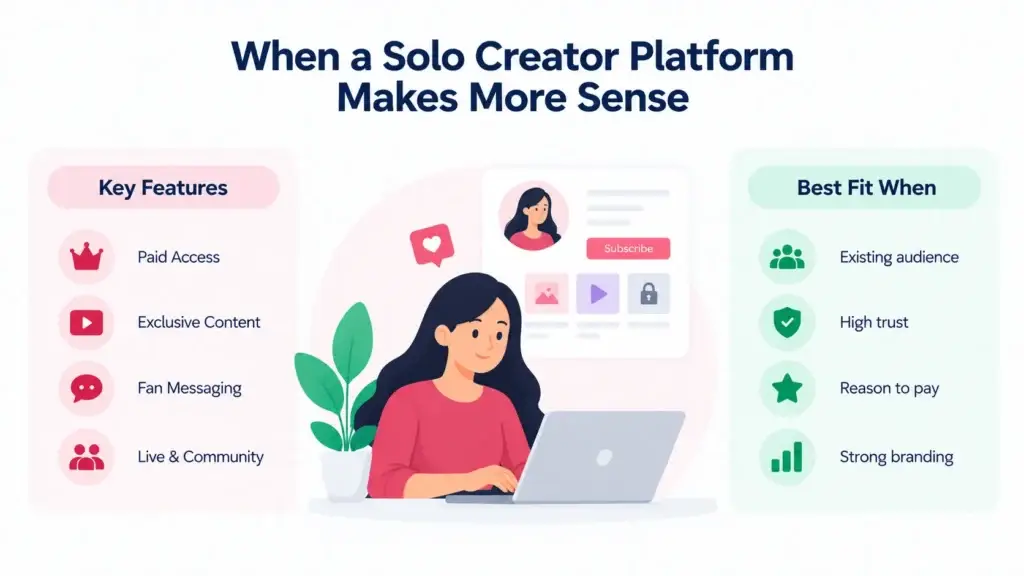
A solo creator platform works best when the creator already has attention.
This could be a fitness coach with a loyal audience, a finance educator with strong trust, a musician with superfans, a sports personality with community pull, a chef with paid learning demand, a comedian with exclusive content potential, or a public figure with a direct fan base.
The business does not need to begin by convincing creators to join. The creator is the product magnet. The platform exists to turn existing attention into direct revenue.
A solo creator model can support:
- Paid memberships
- Exclusive posts
- Locked videos
- Private communities
- Paid messages
- Live sessions
- Premium courses
- Digital products
- Creator shop
- Events or workshops
- Fan badges
- Tips and gifts
- Community access
- Loyalty tiers
The key advantage is focus. Every screen, message, subscription tier, and campaign can be designed around one brand and one audience.
However, solo platforms are not risk-free. They depend heavily on creator consistency. If the creator stops publishing, loses audience trust, changes direction, or fails to promote the platform, growth can slow quickly.
A solo model fits best when the creator has:
- Clear audience demand
- High trust with followers
- A reason for fans to pay directly
- Consistent content production ability
- Strong personal branding
- Premium content or community value
- Willingness to promote the platform
- A long-term plan beyond one launch campaign
For founders, agencies, and creator managers, this model can be more focused than trying to build a broad creator network immediately.
When a Curated Creator Network Fits Better
A curated creator network sits between a solo platform and a large open marketplace.
It works when the founder can bring together a selected group of creators around one niche, category, or audience. Instead of onboarding everyone, the platform chooses creators carefully.
This model works well for:
- Fitness creator groups
- Lifestyle communities
- Coaching networks
- Entertainment collectives
- Influencer agencies
- Media-led membership communities
- Creator studios
- Sports or hobby communities
- Regional creator groups
- Premium fan clubs
Founders exploring agency-led creator communities, influencer groups, or niche fan networks can also review Miracuves’ influencer platform solution options to compare creator profiles, paid access, fan engagement, and payout workflows.
The advantage is balance. The platform is not dependent on only one creator, but it also avoids the chaos of a broad marketplace. Subscribers get variety within a trusted category. Creators get a platform that feels curated, not overcrowded.
A curated creator network should support:
- Creator onboarding
- Creator verification
- Profile approval
- Category-level discovery
- Subscription tiers
- Creator-specific pricing
- Bundle access
- Paid content unlocks
- Wallet payments
- Creator earnings dashboards
- Payout requests
- Moderation workflows
- Community rules
- Admin controls
- Analytics by creator and category
The challenge is quality control. If creators are too different, the platform loses positioning. If quality varies too much, subscribers lose trust. If payout workflows are unclear, creator satisfaction drops.
A curated model is strongest when the founder can define a clear niche and maintain standards.
For example, a platform for premium fitness creators should not feel like a generic creator directory. It should support workout plans, paid videos, live sessions, progress communities, and trainer-specific subscription tiers. A platform for finance educators may need courses, webinars, community access, and stronger disclaimers. A platform for entertainers may need locked media, live engagement, fan chat, and merchandise.
The more specific the creator category, the easier it becomes to design a product that feels useful.
When a Large Creator Network Is the Right Model
A large creator network can be powerful, but it is the most demanding model.
This structure works when the founder wants to support many creators, many subscriber segments, many content categories, and many monetization formats. It is closer to a marketplace than a single-brand product.
Large creator networks require the strongest operating system because the platform must manage both sides of the market.
Creators need:
- Profile creation
- Subscription pricing
- Paid content tools
- Messaging tools
- Audience insights
- Earnings dashboards
- Payout tracking
- Content status updates
- Support access
- Promotional tools
Subscribers need:
- Discovery
- Search
- Categories
- Creator recommendations
- Safe payments
- Clear content access
- Renewals and cancellations
- Purchase history
- Reporting tools
- Account controls
Admins need:
- User management
- Creator verification
- Content moderation
- Report handling
- Commission settings
- Wallet and payout monitoring
- Refund and dispute workflows
- Category management
- Featured creator controls
- Analytics
- Role-based access
- Audit-friendly records
A large network can create more upside, but it also creates more cold-start risk. If the platform does not have enough creators, subscribers do not stay. If it does not have enough subscribers, creators do not stay. If discovery is poor, good creators get buried. If moderation is weak, trust declines.
Founders should choose this model only when they have a serious plan for creator acquisition, subscriber growth, content safety, payment operations, and long-term platform governance.
Audience Ownership: The Most Important Difference
The biggest difference between solo creator platforms and creator networks is audience ownership.
In a solo model, the creator usually brings the audience. The platform’s job is to convert that audience into paid members, repeat buyers, community participants, or premium content subscribers.
In a large network, the platform must build audience ownership at the marketplace level. It must become the destination where subscribers discover many creators. This is much harder because users need a reason to return even when they are not following a specific creator.
In a curated network, audience ownership is shared. Creators bring some of their own followers, while the platform builds category-level trust.
This affects every growth decision.
A solo platform needs:
- Strong creator branding
- Fan migration strategy
- Direct promotion
- Simple subscription access
- Premium content calendar
- Retention campaigns
A curated network needs:
- Category positioning
- Creator quality standards
- Cross-creator discovery
- Bundle pricing
- Community engagement
- Shared audience campaigns
A large network needs:
- Discovery algorithm
- Search and filtering
- Creator acquisition
- Subscriber acquisition
- Trust systems
- Content moderation
- Marketplace-level brand building
Founders should not choose a model based only on ambition. They should choose based on who already owns demand.
Monetization Models by Creator Platform Type
Different models need different monetization systems.
| Revenue Layer | Solo Creator Platform | Curated Creator Network | Large Creator Network |
|---|---|---|---|
| Recurring membership | Usually creator-branded and focused on one audience. | Can support creator-level or category-level plans. | Needs flexible plans across many creators and categories. |
| Paid content unlocks | Useful for premium drops, archives, courses, or exclusive media. | Useful across selected creators with category-specific pricing. | Requires entitlement tracking across many creators and users. |
| Tips and gifts | Works well when creator-fan loyalty is strong. | Useful when creators have engaged micro-communities. | Requires wallet, transaction visibility, and fraud monitoring. |
| Paid messaging | Can be positioned as premium access to one creator. | Can work for coaching, expert, or fan interaction models. | Needs controls for abuse, pricing, creator availability, and support. |
| Live sessions | Works well for exclusive events, workshops, or fan moments. | Can power scheduled classes, creator events, or group sessions. | Requires scale planning, moderation, access control, and scheduling. |
| Platform commission | May be replaced by setup, licensing, or creator-owned revenue logic. | Can vary by creator, agency, or plan type. | Usually needs configurable commission rules by revenue stream. |
A solo creator platform can be simpler, but it still needs strong revenue tracking. A curated creator network needs creator-level payout clarity. A large creator network needs the most advanced commission, wallet, refund, and payout controls.
Founders who want to go deeper into monetization planning can review this creator platform business model breakdown for paid access, creator earnings, wallets, commissions, and recurring revenue logic.
Product Features That Change by Model
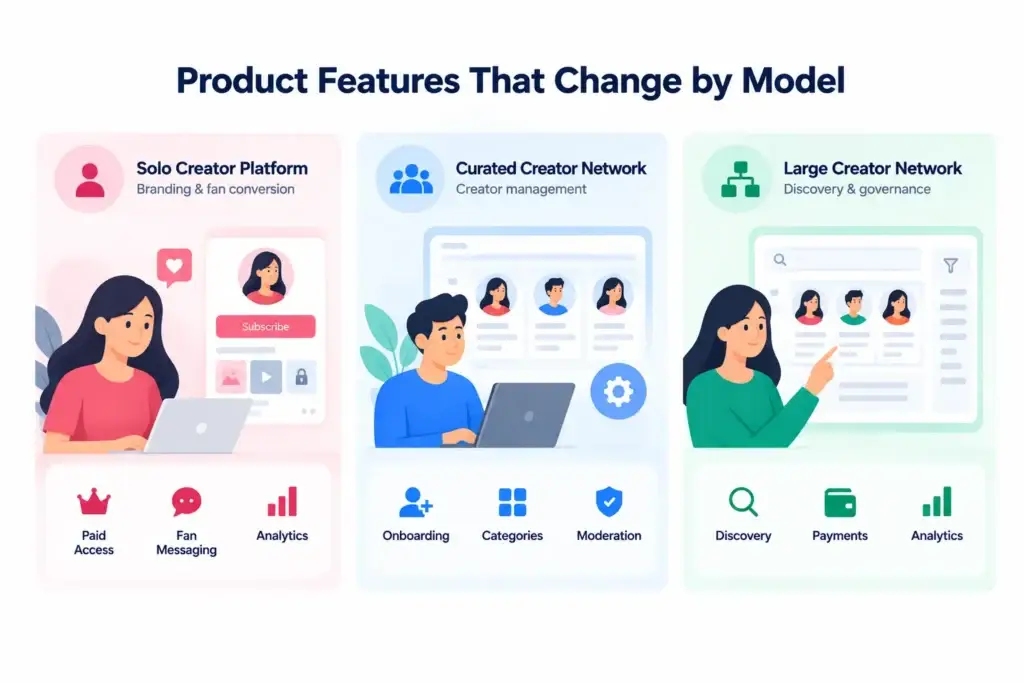
A solo creator platform should not blindly copy the feature needs of a large creator network.
A solo platform needs strong branding and fan conversion. A curated network needs creator management and category experience. A large network needs discovery, moderation, ranking, and platform governance.
Solo Creator Platform Feature Priorities
- Creator-branded home screen
- Paid membership tiers
- Locked posts and media
- Fan community access
- Paid direct messaging
- Live session access
- Creator shop or digital products
- Fan wallet
- Notifications
- Creator analytics
- Payout visibility
- Simple admin control
Curated Creator Network Feature Priorities
- Creator onboarding
- Profile approval
- Category pages
- Creator-specific subscription pricing
- Bundle access
- Paid content unlocks
- Creator analytics
- Multi-creator payments
- Payout requests
- Content moderation
- Reports and disputes
- Admin dashboard
Large Creator Network Feature Priorities
- Creator discovery
- Search and filters
- Recommendations
- Creator verification
- Content moderation queues
- Wallet and payment flows
- Subscription lifecycle
- Refund and dispute workflows
- Commission configuration
- Payout operations
- Role-based admin access
- Platform analytics
- Safety controls
- Scalable media handling
For founders comparing product scope, Miracuves’ creator monetization feature modules page can help map paid access, wallet flows, creator dashboards, messaging, live engagement, moderation, and admin controls to your preferred model.
Admin Complexity: Where Large Networks Become Harder
Admin complexity increases sharply as the platform moves from solo creator to large network.
A solo platform may need one creator dashboard and basic fan management. A curated network needs creator onboarding, creator approval, category management, payout tracking, and content standards. A large network needs full platform governance.
Admin complexity usually includes:
- User account management
- Creator approval
- Creator verification
- Subscription plan review
- Content moderation
- Report handling
- Refund review
- Wallet transaction visibility
- Payout request approval
- Commission settings
- Featured creator placements
- Category management
- Role-based access
- Analytics and reporting
- Activity logs
- Support workflows
The danger is underbuilding admin tools. A platform may look beautiful to users but become impossible to operate when disputes, failed payments, creator questions, content reports, and payout requests begin.
Technical readers can also explore this developer guide for paid creator platform architecture to understand media handling, subscriptions, messaging, payments, admin workflows, and scalable backend planning.
Founders should treat admin control as a business requirement, not a backend extra.
Trust, Safety, and Content Governance
Paid creator platforms need trust workflows from day one.
The exact controls depend on the niche, content category, region, payment partners, and legal review. A fitness community may need different rules from a fan-media product. But every model needs some trust structure.
Important trust and safety layers include:
- Creator verification
- Subscriber account controls
- Content reporting
- Abuse reporting
- Moderation queues
- Policy-based content removal
- Age-gating where relevant
- Geo-controls where relevant
- Copyright or ownership reporting
- Payment dispute visibility
- Role-based admin access
- Audit-friendly records
Solo platforms need brand protection because one creator’s reputation is central. Curated networks need quality control because one poor creator experience can affect the category. Large networks need stronger moderation infrastructure because scale increases risk.
Founders should avoid promising that software alone guarantees legal or policy compliance. The platform can provide workflows that support safer operations, but final requirements depend on market, business model, content category, payment partners, and legal review.
Payout Operations and Creator Trust
Creators stay active when they trust earnings and payout records.
This matters in all three models, but payout complexity changes by model.
In a solo creator platform, payout logic may be simpler because there is one main creator or one brand. But the system still needs to track subscriptions, paid content, tips, wallet spending, refunds, fees, and settlement records.
In a curated network, each creator needs clear earnings visibility. The platform must show what came from subscriptions, paid unlocks, messages, live sessions, tips, gifts, or shop sales.
In a large network, payout operations become a serious business layer. The platform needs creator balances, pending earnings, available earnings, commission deductions, payout requests, withdrawal approval, refund impact, and transaction history.
A strong creator payout system should include:
- Creator earnings dashboard
- Revenue source breakdown
- Platform commission deduction
- Pending balance
- Available balance
- Wallet transaction records
- Payout request workflow
- Withdrawal status
- Refund impact visibility
- Admin payout review
- Exportable reports
- Audit-friendly payment records
If creators cannot understand their earnings, they will not trust the platform.
Growth Strategy by Model
Each model needs a different growth strategy.
Solo Creator Growth Strategy
A solo platform grows through the creator’s existing channels. The creator drives traffic from social platforms, email lists, communities, podcasts, events, public appearances, or paid campaigns.
The main growth levers are:
- Exclusive launch offer
- Founding member access
- Limited-time premium content
- Private community access
- Paid live session
- Member-only archive
- Fan badges
- Direct creator messaging
- Renewal incentives
The goal is to convert loyal fans into paying members.
Curated Creator Network Growth Strategy
A curated network grows by combining creator-led distribution with category-level trust. Each creator brings an audience, while the platform creates a stronger reason for users to explore more creators in the same niche.
The main growth levers are:
- Creator bundles
- Category memberships
- Expert collections
- Community events
- Cross-creator promotions
- Group live sessions
- Niche-specific content calendars
- Audience segmentation
The goal is to build a focused category destination.
Large Creator Network Growth Strategy
A large network grows by solving marketplace discovery. It needs both creator acquisition and subscriber acquisition.
The main growth levers are:
- Creator onboarding campaigns
- Referral programs
- Discovery feeds
- Search optimization
- Personalized recommendations
- Featured creator placements
- Category campaigns
- Subscriber retention journeys
- Platform-wide promotions
The goal is to build marketplace liquidity, which takes more time and operational investment.
Founder Decision Signals
Audience
Choose a solo model when one creator already has strong demand. Choose a network model only when you have a clear plan to acquire both creators and subscribers.
Speed
Solo and curated models are usually easier to validate quickly because the product scope is more focused. Large networks need heavier discovery, moderation, payout, and support systems.
Control
The more creators you add, the more admin control you need. Creator approvals, content reports, commissions, payouts, refunds, and disputes must be manageable from the backend.
Monetization
A solo model can monetize direct fan loyalty. A curated model can monetize niche access. A large network can monetize marketplace activity, but only after trust and liquidity improve.
Build Path: Ready-Made, Custom, or Hybrid?
The right development path depends on your model.
A solo creator platform may not need marketplace-scale features at launch. It may need strong branding, membership access, paid content, fan messaging, wallet payments, and creator analytics.
For a broader platform-selection checklist, read this guide on choosing a subscription platform before launch before deciding between a ready-made, custom, or hybrid development path.
A curated network may need creator onboarding, approval workflows, category pages, creator dashboards, payouts, moderation, and bundle logic.
A large creator network may need advanced discovery, search, ranking, moderation, commission rules, scalable media handling, and stronger admin governance.
| Build Path | Best For | Founder Advantage | Founder Watchout |
|---|---|---|---|
| Ready-made foundation | Founders who want faster launch with core paid creator workflows already connected. | Reduces time spent rebuilding subscriptions, paid access, wallets, messaging, dashboards, and admin controls. | Customization scope should be confirmed before launch. |
| Custom development | Businesses with unusual workflows, deep integrations, unique creator roles, or complex media architecture. | Gives more flexibility around highly specific product requirements. | Usually needs more planning, budget, testing, and delivery time. |
| Hybrid approach | Founders who want to start with a ready-made base and customize around a specific creator or network model. | Balances launch speed with differentiation. | Requires clear prioritization to avoid adding unnecessary marketplace complexity too early. |
If your platform requires highly tailored creator workflows, regional payment rules, custom media handling, or specialized engagement features, Miracuves also offers custom mobile app development services.
Common Mistakes Founders Should Avoid
Choosing a Large Network Without Creator Supply
A large network needs enough creators to attract subscribers and enough subscribers to retain creators. Without a supply plan, the platform may launch empty.
Building Marketplace Complexity for One Creator
A solo creator platform may not need advanced marketplace discovery, ranking, and multi-category systems at launch. Overbuilding can slow validation and increase cost.
Ignoring Payout Transparency
Creators need clear earnings, deductions, pending balances, available balances, payout requests, and transaction history. Poor payout visibility damages creator trust.
Leaving Moderation Until After Launch
Content reports, creator verification, abuse handling, policy rules, and admin review queues should exist before growth begins, especially in multi-creator environments.
What Founders Should Ask Before Choosing a Model
Before deciding between a solo creator platform, curated network, or large creator network, ask practical questions.
Audience Questions
- Does one creator already have a loyal fan base?
- Can creators drive traffic from their own channels?
- Will subscribers pay for one creator or multiple creators?
- Is the platform solving a niche problem or building a broad marketplace?
- Is there enough demand to justify multiple creators at launch?
Monetization Questions
- Will revenue come from memberships, paid unlocks, messaging, tips, live sessions, shops, or bundles?
- Will the platform charge commission?
- Will the creator own most of the revenue?
- Will pricing be creator-specific or platform-controlled?
- Will there be free and paid tiers?
Product Questions
- Does the app need one creator profile or many creator dashboards?
- Does the platform need search and discovery?
- Are categories required at launch?
- Will content be text, image, video, audio, live, or downloadable?
- Will the platform need wallet payments or direct checkout?
Operations Questions
- Who approves creators?
- Who reviews content reports?
- Who handles refunds and disputes?
- How are creator payouts reviewed?
- What admin roles are needed?
- What records should be exportable?
Ownership Questions
- Will you receive source-code ownership?
- Can the product be rebranded?
- Can pricing and commission rules be customized?
- Can payment gateways be changed later?
- Can the platform support future creator categories?
For founders comparing budget and scope, the creator platform development cost guide can help clarify how features, customization, payment flows, media infrastructure, and launch requirements affect planning.
How Miracuves Helps Founders Launch Faster
Miracuves helps founders build white-label creator monetization platforms with paid access workflows, creator profiles, wallet payments, messaging, live engagement, moderation, payout visibility, admin control, and source-code ownership.
For suitable ready-made solution scopes, Miracuves can support 6-day delivery. This helps founders validate a solo creator platform, curated creator network, or larger creator business faster than starting every module from zero. Final scope, integrations, compliance requirements, moderation rules, and customization should still be confirmed before deployment.
If your team is comparing execution partners, this guide on choosing a creator platform development partner can help evaluate technical readiness, delivery process, ownership, and support expectations.
Final Thoughts
The right creator platform model depends on demand.
A solo creator platform makes sense when one creator already has the audience, trust, and content strategy needed to convert fans into paying members. A curated creator network works when a founder can organize a specific creator category with quality control and shared audience value. A large creator network fits founders who are prepared to solve marketplace supply, subscriber demand, discovery, moderation, payouts, and platform governance at scale.
The smartest founder decision is not always to build the largest platform first. It is to choose the model that matches the audience, monetization plan, operational capacity, and launch timeline.
Miracuves helps founders move faster with white-label creator platform foundations that support paid access, creator tools, wallet flows, admin control, source-code ownership, and 6-day delivery for suitable ready-made scopes.
FAQs
What is the difference between a solo creator platform and a creator network?
A solo creator platform is built around one creator, brand, or public personality. A creator network supports multiple creators, profiles, subscription plans, content categories, and payout workflows. The solo model focuses on direct fan conversion, while the network model focuses on creator supply, subscriber discovery, and platform-level trust.
Which model is better for a new founder?
A solo or curated model is often easier to validate when the founder has access to a strong creator or a specific creator category. A large network can work, but it usually requires more capital, creator acquisition, subscriber acquisition, moderation, and operations.
When should a founder choose a solo creator app?
A founder should choose a solo creator app when one creator already has a loyal audience, strong brand trust, premium content potential, and willingness to promote direct fan access. This model avoids the early cold-start problem of onboarding many creators.
When does a curated creator network make sense?
A curated creator network makes sense when the platform can bring together selected creators around one niche, such as fitness, coaching, entertainment, lifestyle, regional content, or premium communities. It provides variety without becoming an open marketplace.
What features are important for a creator network?
A creator network needs creator onboarding, profile management, subscription pricing, paid content unlocks, wallet payments, earnings dashboards, payout tracking, discovery, categories, moderation, report handling, dispute workflows, and admin controls.
Why is admin control important for paid creator platforms?
Admin control helps the operator manage users, creators, payments, subscriptions, content reports, refunds, payouts, commissions, categories, analytics, and support workflows. Without strong admin control, platform operations become difficult as creators and subscribers increase.
Can one platform support both solo creators and creator networks?
Yes, a flexible creator monetization foundation can support a solo creator model first and later expand into a curated or larger network. The platform should be built with configurable creator profiles, pricing, paid access, wallet flows, moderation, and admin controls.
How can Miracuves help launch a creator monetization platform?
Miracuves helps founders launch ready-made and white-label creator monetization platforms with paid access workflows, creator dashboards, wallet payments, messaging, live engagement, moderation tools, admin control, source-code ownership, and 6-day delivery for suitable ready-made scopes.
Miracuves is an independent software development company. We are not affiliated with, connected to, sponsored by, or endorsed by any company or product named in this article.
Terms such as “X Clone” are used descriptively. It is how the software industry refers to building a platform with functionality comparable to a known service, and how clients search for it.
The entire design and codebase of our products is built by our own team. Our products contain no code, design, graphics, or content originating from any third-party website or applications.
All third-party names and marks referenced in this article are the property of their respective owners, referenced solely to identify the services discussed.