


Key Takeaways
- A Subscription Platform for Founders should support monetization, creator workflows, subscriber access, payments, payouts, moderation, admin control, and future growth.
- Founders should compare subscriptions alongside paid content, tips, messaging, live sessions, wallets, creator earnings, and commission controls.
- Creator experience should make publishing, pricing, subscriber management, earnings tracking, and payout requests easy to manage.
- Subscriber experience should provide clear paid access, smooth payments, renewal controls, cancellations, purchase history, and reliable support.
- Ownership, customization, scalability, moderation, and launch support should be evaluated before committing to a platform.
Platform Decision Signals
- Monetization depth should match the creator category, audience behavior, and long-term revenue strategy.
- Payment systems should clearly track subscriber payments, commissions, creator balances, refunds, withdrawals, and payouts.
- Admin teams need control over creators, subscribers, content reports, payments, commissions, disputes, analytics, and platform settings.
- Source-code ownership and white-label flexibility provide more control over branding, payment integrations, policies, and future modules.
- Ready-made platforms support faster validation, while custom development is better suited to highly specialized workflows and integrations.
Real Insights
- The best platform is not necessarily the one with the most features; it should match the actual business model and creator workflow.
- Moderation and creator verification should be planned before launch rather than added only after the platform starts growing.
- Media-heavy platforms need reliable storage, processing, content delivery, access control, backups, and performance planning.
- A weak admin panel can create unnecessary developer dependency for everyday operational decisions.
- The strongest evaluation path is: compare monetization → creator experience → subscriber journey → payments and payouts → safety → admin control → ownership → scalability → launch support.
Choosing a Subscription-Based Platform is not just about adding a paywall to content. For founders, the real decision is whether the platform can support creators, subscribers, payments, payouts, content access, moderation, reporting, and growth without creating operational gaps after launch.
A paid creator or membership business depends on repeat trust. Subscribers need smooth access, secure payments, and clear renewal controls. Creators need publishing tools, earnings visibility, payout confidence, and audience engagement features. Platform operators need admin control, content rules, user verification, revenue settings, dispute workflows, and analytics.
This guide explains what founders should compare before launching a subscription-led digital platform, especially when the roadmap includes gated content, recurring memberships, pay-per-view unlocks, paid messaging, live engagement, creator wallets, and branded community experiences.
If you are evaluating a faster launch path, Miracuves offers a ready-made creator monetization foundation that can support branded subscriptions, paid content access, wallet flows, admin controls, and source-code ownership.
Why Founders Should Compare More Than Subscription Pricing
Many founders begin by asking one simple question: “Can creators charge monthly?”
That is important, but it is not enough. A serious subscription business needs more than recurring billing. It needs a full operating layer around content access, audience engagement, creator earnings, payment reliability, refund handling, moderation, and platform governance.
Readers who need basic product context can also review this guide on subscription-based creator platform platforms work before comparing monetization, content access, wallet flows, and admin control.
A basic subscription setup may work for a small private community. But once creators, subscribers, paid media, messages, live sessions, wallet spending, and payouts enter the model, the platform must handle more complex flows.
Founders should compare platforms based on business readiness, not just feature count.
A good evaluation should answer:
- Can creators set and manage paid access?
- Can subscribers renew, cancel, upgrade, and unlock content easily?
- Can the platform operator configure commission rules?
- Can payments, wallets, refunds, and payouts be tracked clearly?
- Can content be moderated before and after publishing?
- Can the admin team manage creators, reports, disputes, and platform settings?
- Can the product be branded, customized, and extended later?
The platform you choose becomes the operating base of the business. If the foundation is weak, every growth milestone creates new friction.
Core Comparison Areas Before Launch
| Comparison Area | What Founders Should Check | Why It Matters |
|---|---|---|
| Monetization depth | Subscriptions, gated content, one-time unlocks, tips, paid messages, live access, and creator commerce. | A platform with multiple monetization paths can support different creator categories and fan spending behaviors. |
| Creator tools | Profile setup, pricing controls, content upload, audience messaging, earnings dashboard, and payout requests. | Creators need operational control if they are expected to treat the platform as a real revenue channel. |
| Subscriber experience | Discovery, subscription access, renewals, cancellations, saved content, wallet spending, and support flows. | Subscriber friction directly affects conversion, retention, and repeat payments. |
| Payment and payout logic | Wallet funding, payment gateway integration, refund records, creator balance, commission deductions, and withdrawal status. | Money movement must be clear, traceable, and easy to reconcile. |
| Trust and safety | Creator verification, age-gating where relevant, content moderation, abuse reporting, geo-controls, and policy enforcement. | Trust systems protect users, creators, brand reputation, and long-term platform stability. |
| Admin control | User management, creator approvals, content reports, revenue settings, transaction visibility, disputes, and analytics. | The operator needs control over the business, not just a front-end app. |
| Ownership and customization | Source-code ownership, white-label branding, custom payment flows, regional settings, and future feature expansion. | Subscription businesses evolve quickly, so ownership affects long-term flexibility. |
1. Compare the Monetization Model, Not Just Monthly Subscriptions
Recurring subscriptions are usually the foundation of a creator membership business. But many platforms fail when they rely only on one monthly plan.
Creators often need multiple ways to earn. A fitness coach may sell monthly access and one-time programs. A musician may offer paid behind-the-scenes content. A consultant may monetize private messages or live sessions. A creator agency may need creator-level pricing, wallet transactions, and campaign tools.
A stronger platform should support several monetization surfaces:
- Monthly subscriptions
- Multi-month access bundles
- Free and paid creator profiles
- Locked posts and premium media
- One-time content unlocks
- Paid private messages
- Tips and virtual gifts
- Paid live sessions
- Audio or video call monetization
- Creator storefronts
- Promotional placements
- Platform commission controls
The founder’s decision is not whether every feature must launch on day one. The better question is whether the platform can grow into these monetization paths without needing a full rebuild.
For readers who want a deeper revenue planning view, Miracuves’ subscription-based creator business model breakdown explains how platform commission, recurring access, unlocks, tips, wallets, and paid engagement can fit together.
2. Compare Creator Experience Before Comparing Design
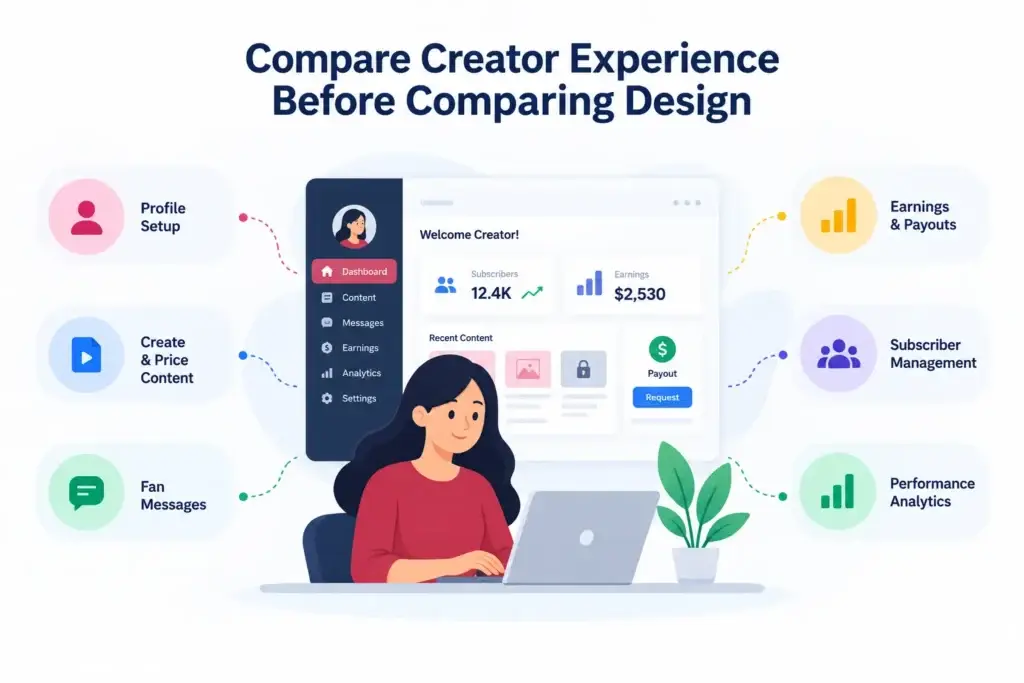
The creator experience decides supply quality. If creators cannot set up profiles, price content, understand earnings, message fans, and request payouts easily, they may not stay active.
A good creator dashboard should help creators manage:
- Profile details and bio
- Subscription price
- Free and paid content
- Locked media
- Public previews
- Subscriber lists
- Fan messages
- Earnings by source
- Pending and available balance
- Payout requests
- Content status
- Moderation feedback
- Performance analytics
Founders comparing different creator categories can also read this solo creator and larger creator strategy guide to understand how platform needs change based on creator size, audience depth, and monetization style.
Creators should not need platform support for every small change. They should be able to publish, price, promote, and track earnings with enough independence while still following platform rules.
This is where founders should compare depth, not just appearance. A clean dashboard is useful, but it must also support the creator’s actual business workflow.
3. Compare Subscriber Experience for Conversion and Retention
A subscription platform earns when subscribers trust the experience enough to pay repeatedly.
The subscriber journey should be simple:
- Discover a creator.
- Preview free or public content.
- Understand what the subscription unlocks.
- Pay without friction.
- Access premium content immediately.
- Manage renewals and cancellations clearly.
- Interact through comments, messages, live sessions, or paid unlocks.
- Get support when payment or access issues happen.
If subscribers do not understand what they are buying, churn increases. If payment fails without explanation, support load increases. If cancellation is confusing, trust decreases. If discovery is weak, creators struggle to grow.
A strong subscriber experience should include:
- Creator discovery
- Search and categories
- Profile previews
- Subscription plan details
- Locked content previews
- Wallet or direct payment options
- Renewal reminders
- Cancellation controls
- Purchase history
- Saved or bookmarked content
- Support access
- Abuse reporting
- Notification preferences
Subscriber retention depends on clarity, not only content volume.
4. Compare Payment, Wallet, and Payout Workflows
Payment infrastructure is one of the most important parts of any paid access platform.
The platform should not only collect subscription payments. It should track who paid, what was unlocked, what commission was deducted, what the creator earned, when the payout becomes available, and whether any refund or dispute affects the balance.
A strong financial workflow should support:
- Payment gateway integration
- Wallet funding where applicable
- Recurring billing records
- One-time purchase records
- Creator earnings dashboard
- Platform commission deduction
- Pending balance
- Available balance
- Payout requests
- Withdrawal approval
- Refund records
- Failed payment tracking
- Transaction history
- Admin visibility into money movement
Founders should avoid platforms where financial records are vague. When creator earnings and subscriber payments are unclear, disputes become difficult to resolve.
Miracuves’ subscription-based creator platform feature modules page is useful if you want to compare how subscriptions, pay-per-view access, wallet flows, messaging, live sessions, moderation, and admin controls work inside a complete platform foundation.
5. Compare Content Safety, Verification, and Moderation Controls
A paid creator platform needs strong trust and safety workflows before launch, especially when the business model involves private, premium, or adult creator content.
This does not mean every platform needs the same rule set. A premium fan club, influencer subscription platform, private creator community, or adult creator business may each require different access controls, verification steps, payment safeguards, and moderation policies. But every paid content platform needs a practical way to manage identity, age checks where required, abuse reports, disputes, content ownership, subscriber behavior, and platform rules.
Important safety controls may include:
- Creator verification
- Age-gating where relevant
- User reporting
- Content moderation
- Admin review queues
- Policy-based content removal
- Geo-restriction controls where relevant
- Block and mute options
- Abuse reporting
- Copyright or ownership reporting
- Suspicious activity flags
- Payment and payout review controls
- Audit-friendly admin records
Founders should not treat moderation as a later add-on. If the platform grows before safety workflows exist, the operator may struggle to protect creators, subscribers, payment relationships, platform reputation, and long-term business stability.he platform grows before moderation workflows exist, the operator may struggle to protect subscribers, creators, payment relationships, and brand reputation.
6. Compare Admin Control Like You Are Already Operating at Scale
A platform can look excellent from the subscriber side and still fail operationally if the admin panel is weak.
The admin dashboard should give the operator control over users, creators, payments, subscriptions, content reports, commissions, platform settings, analytics, and support workflows.
A serious admin system should support:
- User and creator management
- Creator approval workflows
- Subscription plan visibility
- Platform commission settings
- Content moderation queues
- Report and complaint handling
- Wallet and payment tracking
- Creator payout monitoring
- Refund and dispute visibility
- Category and discovery controls
- Featured creator placements
- Platform analytics
- Role-based admin access
- Activity logs
- App configuration settings
The admin panel is where business control lives. If the founder cannot update rules, manage disputes, review payments, or moderate content without technical support, the platform becomes difficult to scale.
7. Compare Ready-Made vs Custom Development Paths
Founders usually choose between two paths: starting with a ready-made foundation or building a custom platform from the ground up.
A ready-made foundation is useful when the founder wants to launch faster with proven flows such as subscriptions, paid content, wallet payments, messaging, creator dashboards, payouts, moderation, and admin controls.
A custom build is useful when the business model is highly unique, requires unusual workflows, or needs deep enterprise integrations from day one.
| Build Path | Best For | Founder Advantage | Founder Watchout |
|---|---|---|---|
| Ready-made foundation | Founders who want faster launch, core monetization workflows, and a branded platform base. | Reduces time spent rebuilding common subscription, payment, creator, and admin modules. | Customization scope should be confirmed before launch. |
| Custom development | Businesses with highly specific workflows, uncommon integrations, or complex product rules. | Offers deeper flexibility around unique product architecture. | Usually needs more planning, budget, testing, and delivery time. |
| Hybrid approach | Founders who want to start with a ready-made foundation and customize the experience. | Balances speed with product differentiation. | Requires clear prioritization to avoid unnecessary feature expansion. |
If your idea needs deeply tailored workflows beyond a ready-made creator platform foundation, Miracuves also offers custom mobile app development services for more specialized product builds.
Founder Decision Signals
Speed
If your first goal is market validation, compare how quickly the platform can launch with subscriptions, paid content, creator dashboards, wallet payments, payouts, moderation, and admin control already connected.
Cost
Cost depends on feature depth, platform scope, payment integrations, media infrastructure, moderation needs, branding, and customization. Avoid judging platforms only by the starting price.
Control
Choose a platform where the operator can manage creators, subscribers, commissions, payments, content rules, payouts, and reports from an admin dashboard without constant developer dependency.
Market Fit
A niche creator community, coaching network, premium fan club, agency-led platform,membership product may each need different pricing, access, moderation, and engagement rules.
8. Compare Ownership, Branding, and Future Flexibility
Ownership matters because subscription businesses rarely stay exactly the same after launch.
A founder may start with creator subscriptions, then add paid messages, live sessions, wallet spending, creator shops, agency workflows, regional payment gateways, new content policies, affiliate programs, analytics, or AI-assisted engagement.
If the platform cannot be extended, every future change becomes expensive or restricted.
Founders should compare:
- Source-code ownership
- White-label branding
- Custom domain support
- UI customization
- Payment gateway flexibility
- Admin configuration
- API readiness
- Infrastructure flexibility
- Future module expansion
- Regional localization
- Creator category customization
- Policy and moderation customization
Founders exploring broader creator economy models can review Miracuves’ influencer platform solution options to compare creator profiles, fan engagement, paid access, payout workflows, and branded platform opportunities.
A subscription business is not only a website or app. It is a monetization system. The founder should own enough of the system to adapt it as the business learns from real users.
9. Compare Media, Performance, and Scalability
Subscription platforms often carry heavy media usage. Creators may upload images, videos, audio, live content, stories, short clips, locked posts, or private files.
That means performance planning matters.
A scalable platform should consider:
- Media upload workflows
- File storage
- Video processing
- Image optimization
- CDN support
- Streaming readiness
- Access-controlled content delivery
- Watermarking where relevant
- Content expiration rules
- Backup and recovery planning
- Server monitoring
- Performance optimization
Technical readers can also explore this developer guide for paid creator platform architecture to understand media handling, subscriptions, messaging, payments, admin workflows, and scalable backend planning.
A slow paid content experience hurts both creator earnings and subscriber trust. Users who pay for content expect smooth access. Creators who upload premium media expect the platform to deliver it reliably.
Founders should ask whether the platform is built only for a demo or prepared for real creator and fan activity.
10. Compare Launch Support and Post-Launch Readiness
The launch process should include more than installation.
A founder may need branding, deployment, payment gateway setup, app publishing support, admin onboarding, content policy setup, creator onboarding planning, and post-launch support.
A launch-ready platform should provide clarity on:
- What ships at launch
- What requires customization
- What integrations are included
- Who handles deployment
- Who supports app publishing
- Who configures payment gateways
- How admin training works
- How post-launch bugs are handled
- What future updates are available
- How source code is handed over
Miracuves supports ready-made creator platform delivery with a 6-day launch timeline for suitable scopes, along with white-label branding, source-code ownership, admin control, and deployment support. Final customization, infrastructure, payment gateways, and moderation requirements should be confirmed before launch.
For founders comparing budget and scope, the subscription-based creator development cost guide can help clarify what affects pricing, customization, integrations, and launch planning.
Common Mistakes Founders Should Avoid
Choosing Based Only on the Lowest Price
A low starting price may not include payment flows, creator payouts, moderation, admin control, media handling, deployment, or source-code ownership. Compare the complete launch scope.
Ignoring Creator Earnings Visibility
Creators need to understand income by source, pending balance, available balance, platform commission, payout status, and transaction history. Weak earnings visibility reduces creator trust.
Launching Without Moderation Workflows
Content reports, creator verification, user complaints, abuse handling, and policy enforcement should be planned before launch. Trust and safety issues become harder to fix after growth begins.
Using a Platform You Cannot Customize
Subscription businesses evolve through pricing changes, new creator categories, regional payment needs, custom policies, and new engagement tools. A rigid platform can limit growth.
What Founders Should Ask Before Choosing a Platform
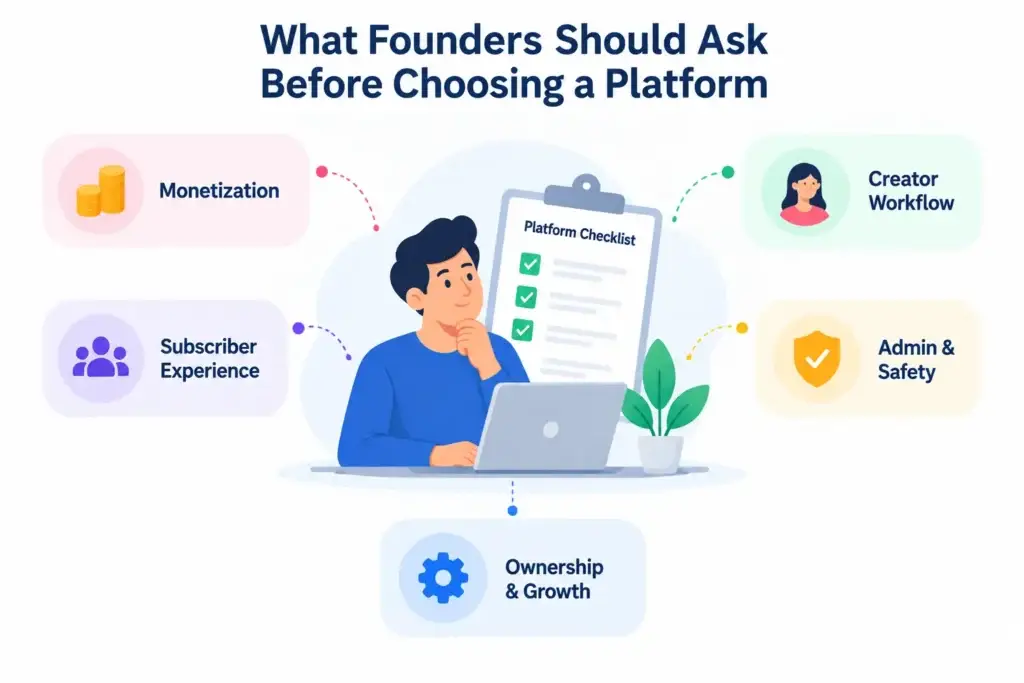
Before choosing a paid creator or membership platform, founders should ask practical questions.
Monetization Questions
- Can creators set recurring subscription prices?
- Can the platform support one-time paid content unlocks?
- Can users tip creators or buy virtual gifts?
- Can creators monetize messaging or live sessions?
- Can the operator set platform commission rules?
- Can promotional placements be monetized later?
Creator Workflow Questions
- Can creators publish free and premium content?
- Can creators view earnings by source?
- Can creators request withdrawals?
- Can creators message subscribers?
- Can creators segment fans or manage lists?
- Can creator access depend on verification status?
Subscriber Workflow Questions
- Is subscription access clear?
- Can subscribers manage renewals and cancellations?
- Can users unlock individual content without confusion?
- Is payment history visible?
- Are support and reporting options easy to access?
Admin and Safety Questions
- Can admins approve creators?
- Can admins review reported content?
- Can admins monitor payments and payouts?
- Can admins update categories and discovery sections?
- Are roles and permissions available for internal teams?
- Are audit-friendly activity records available?
Ownership Questions
- Do you receive source-code ownership?
- Can the platform be fully rebranded?
- Can payment gateways and business rules be customized?
- Can future modules be added?
- Is the platform suitable for your niche, region, and creator category?
If your team is comparing implementation partners, this guide on choosing a subscription-based creator development partner can help evaluate technical readiness, delivery process, ownership, and support expectations.
Miracuves Perspective: Choose the Platform That Matches Your Business Model
The strongest subscription platform is not always the one with the longest feature list. It is the one that matches your creator category, monetization strategy, subscriber expectations, payment model, moderation needs, and launch timeline.
A founder launching a premium coaching community may need structured memberships and live sessions. A creator agency may need delegated access, analytics, messaging, and earnings reports. A fan club may need locked media, renewals, wallet payments, and subscriber engagement tools. A niche media business may need strong content rules, branded access, and recurring revenue workflows.
Miracuves helps founders start with a ready-made, white-label creator monetization foundation that includes creator profiles, paid access, wallet workflows, messaging, live engagement, admin control, and source-code ownership. For suitable ready-made scopes, Miracuves can support 6-day delivery, helping founders validate faster without building every core workflow from zero.
Final Thoughts
Choosing a subscription platform is a business architecture decision, not only a software purchase.
Founders should compare monetization depth, creator workflows, subscriber experience, payment reliability, payout clarity, moderation controls, admin visibility, ownership, scalability, and launch support before committing to a platform.
A strong paid creator or membership platform should help creators earn, subscribers engage, and operators manage the business with confidence. The right foundation gives you room to validate faster, customize smarter, and expand into new revenue paths without rebuilding the product from scratch.
Miracuves helps founders move faster with ready-made, white-label creator platform foundations that support branding, source-code ownership, admin control, monetization workflows, and 6-day delivery for suitable ready-made solution scopes.
FAQs
What should founders compare before choosing a subscription platform?
Founders should compare monetization options, creator dashboards, subscriber experience, payment gateways, wallet flows, payout tracking, moderation tools, admin controls, source-code ownership, branding flexibility, scalability, and launch support.
Is a monthly subscription feature enough for a creator platform?
No. Monthly subscriptions may be the foundation, but many creator businesses also need locked content, one-time unlocks, paid messages, tips, gifts, live engagement, creator shops, wallet payments, and payout workflows.
Why is admin control important in a paid content platform?
No. Monthly subscriptions may be the foundation, but many creator businesses also need locked content, one-time unlocks, paid messages, tips, gifts, live engagement, creator shops, wallet payments, and payout workflows.
Why does source-code ownership matter for subscription businesses?
Source-code ownership gives founders more control over customization, payment integrations, branding, platform rules, moderation workflows, infrastructure, and future feature expansion. This matters because subscription businesses often evolve after launch.
What monetization models can a creator platform support?
A creator platform can support recurring subscriptions, locked content, one-time pay-per-view unlocks, paid messaging, tips, virtual gifts, paid live sessions, creator storefronts, promotional placements, and platform commission.
How should founders handle content moderation before launch?
Founders should define content policies, creator verification rules, user reporting workflows, admin review queues, removal actions, geo-controls where relevant, age-gating where relevant, and dispute handling before launching publicly.
Should founders choose ready-made or custom development?
A ready-made foundation is useful when the founder wants faster launch with proven subscription, payment, creator, and admin workflows. Custom development is better when the platform needs highly unique workflows, advanced integrations, or unusual product architecture.
How can Miracuves help launch a subscription-led creator platform?
Miracuves helps founders launch ready-made and white-label creator monetization platforms with source-code ownership, branded design, paid access workflows, creator dashboards, wallet payments, moderation tools, admin control, and 6-day delivery for suitable ready-made scopes.
Miracuves is an independent software development company. We are not affiliated with, connected to, sponsored by, or endorsed by any company or product named in this article.
Terms such as “X Clone” are used descriptively. It is how the software industry refers to building a platform with functionality comparable to a known service, and how clients search for it.
The entire design and codebase of our products is built by our own team. Our products contain no code, design, graphics, or content originating from any third-party website or applications.
All third-party names and marks referenced in this article are the property of their respective owners, referenced solely to identify the services discussed.



