A dating app can double the number of women signing up and still have fewer women using it a week later. One new member opens the app and sees hardly anyone nearby she would want to meet. Another finds plenty of profiles but receives so many unwanted requests that she turns off notifications. A third likes the idea but abandons onboarding when the app asks for information she isn’t ready to share.
On a dashboard, all three look like a retention problem. In practice, each calls for a different response. More advertising might fill the first member’s feed, but it won’t give the second more control over her inbox or explain to the third why the app needs her information.
The way to address dating app gender imbalance is to find out where women stop getting value. Start with one local market, recruit people who are likely to be mutually interested, and measure what happens between signup and the end of the first week. The goal isn’t a perfect signup ratio. It’s a dating experience women want to return to.
Key Takeaways
- Compare the gender mix at signup, activation, and Day 7 before deciding what to fix.
- Recruit within one area where members have a realistic chance of finding mutually relevant profiles.
- Measure reciprocal conversations and unwanted contact together; more messages alone do not indicate a better experience.
- Expand invitations only when the experience holds up across multiple cohorts and the moderation team can handle more volume.
What Does Gender Imbalance Actually Mean for a Dating App?
Gender imbalance is often described as a difference between the number of men and women on an app. In the United States, Pew Research Center found in 2023 that 34% of men had ever used a dating site or app, compared with 27% of women. That count can flag a problem, but it doesn’t explain what any individual member sees. A city might have a broadly balanced user base while someone in one neighborhood finds only a handful of recently active people who meet their preferences. At the same time, a smaller group of members may receive more attention than they can reasonably respond to.
For an early-stage team, it helps to separate acquisition imbalance, local match availability, and retention imbalance. Acquisition is about who hears about the app and signs up. Availability is about whether those people can actually find one another. Retention is about whether the experience gives them a reason to come back. The same headline ratio can result from any of the three.
What the published numbers show
There is no audited, app-by-app gender ratio that every platform publishes, so the most reliable figures come from regulators and survey researchers. Two large data sets point the same way: men use dating services more than women. The gap looks wider in Ofcom’s count of current UK users than in Pew’s measure of U.S. adults who have ever tried an app, though the two studies cover different countries and ask different questions.
| Source | Population measured | Men | Women |
|---|---|---|---|
| Pew Research Center | U.S. adults who have ever used a dating site or app (survey of 6,034 adults, July 2022) | 34% | 27% |
| Ofcom | UK adults using dating apps, May 2024 | 65% of users | 35% of users |
| Ofcom | Hinge users in the UK, May 2024 (the only top 10 service where women outnumbered men) | 47% of users | 53% of users |
The experience gap matters as much as the head count. Among current or recent U.S. users in the same Pew survey, 64% of men said they had felt insecure about the lack of messages they received, compared with 40% of women, while 54% of women and 25% of men said they had felt overwhelmed by the number of messages. Among everyone who had ever used a dating site or app, men were also more likely than women to describe their experience as positive (57% vs. 48%). In other words, the same app can feel empty to one group and crowded to the other. That is why the ratio on its own rarely tells a founder what to fix.
Dating markets aren’t always two-sided in the simple sense of men looking for women and women looking for men. Geography, orientation, age preferences, relationship intent, and recent activity all affect who can meet whom. Track women’s experience without assuming all women want the same thing or forcing people into binary categories for reporting. Use voluntarily shared information, keep “not disclosed” visible in aggregate reporting, and suppress small groups where reporting could expose individuals.
Diagnose the Drop-Off Before Spending More on Acquisition
Compare signup, activation, and first-week activity
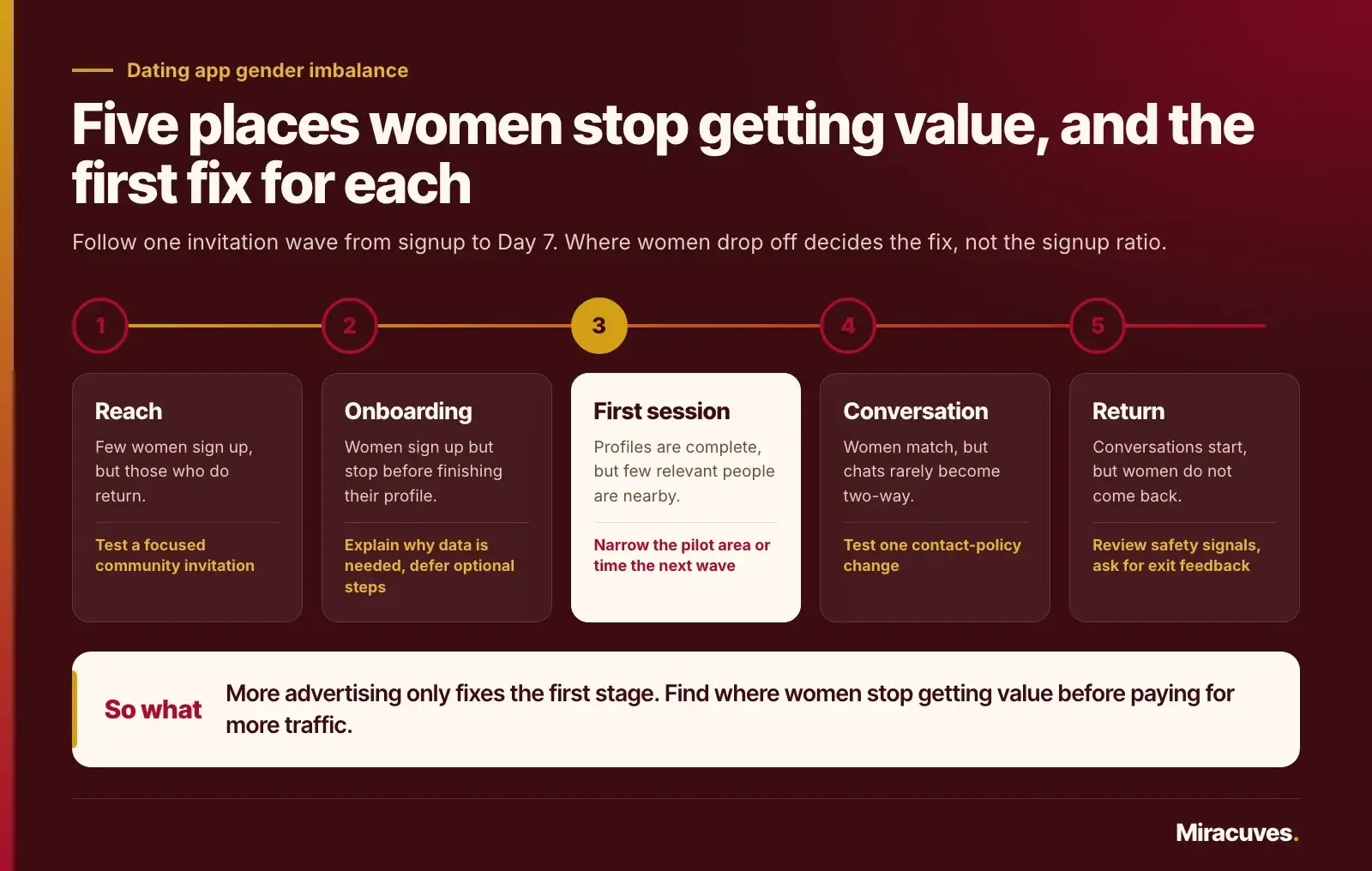
Follow people who sign up in the same invitation wave through three checkpoints: account creation, first useful session, and Day 7 activity. A useful first session might mean completing a profile and seeing at least one recently active person who meets applicable mutual preferences. Keep profile completion and profile availability as separate measures, too. Otherwise, you can’t tell whether someone left because the setup was too demanding or because there was no one relevant to see.
For retention, use all new signups in the denominator, not just those who finish onboarding. If you exclude everyone who left before seeing a profile, the app can appear to retain women well while losing many of them at the front door. Compare groups from the same area and time period so one cohort isn’t being judged against another that had a larger or more established match pool.
| What you observe | What to investigate | What to try first |
|---|---|---|
| Few women sign up, but those who do return | Whether your channels reach the intended audience and whether the landing page sets clear expectations | Test a focused invitation through a community partner |
| Women sign up but do not finish onboarding | Where the drop-off happens and whether requests for photos, location, or permissions feel premature | Explain why information is needed and defer optional steps |
| Women complete profiles but see few relevant people | How many recently active profiles meet applicable mutual preferences within the stated area | Narrow the pilot area or coordinate the next invitation wave |
| Women match but conversations rarely become two-way | Whether matches are inactive, openers are unwanted, or incoming requests are overwhelming | Test a contact-policy change and track replies alongside feedback |
| Conversations start, but women don’t return | Whether people are leaving after bad experiences, taking a break, or leaving for a positive reason | Review safety signals and ask for optional exit feedback |
A worked example: Why the signup ratio can point to the wrong fix
Imagine two invitation waves in the same city. These numbers are illustrative, not industry benchmarks. In the first wave, 60 of 200 signups are women, and 18 of those 60 are active on Day 7. In the second wave, 100 of 240 signups are women, but only 15 of those 100 are active on Day 7.
The signup share rose from 30% to about 42%. But Day 7 retention among women fell from 30% to 15%, and the absolute number of women active on Day 7 dropped from 18 to 15. If the team reports only the signup mix, it will call the second wave a success and probably buy more traffic.
A better next step is to compare the waves by channel, first-session profile availability, and reciprocal conversations. If the second wave recruited across a wider area, some new members may have had fewer relevant profiles nearby. If availability held steady but feedback points to intrusive messages, the team has a different problem. The numbers identify where to look; they don’t establish what caused the decline.
How Early-Stage Dating Apps Can Attract Women
Choose an audience you can actually serve in one place
Start with a clear group of adults in a manageable area, such as people in one metro who are looking for long-term relationships. The point isn’t to make the brand permanently narrow (some founders do keep one community for good, a trade-off covered in niche dating apps vs mainstream apps). It’s to recruit enough people with compatible preferences, at roughly the same time, for the first members to have a fair chance of meeting someone.
Before choosing an acquisition channel, interview women in that audience. Ask about the last time they tried a dating app and what happened next. What made them create a profile? What made them hesitate to share a photo or location? What was the last straw before they stopped opening it? Questions about specific past experiences are more useful than asking whether someone would download an app that promises better matches.
Show participants the proposed landing page and onboarding flow. Ask them to explain who they think the app is for, what other members can see, and when they can start meeting people. If they can’t answer those questions after looking at the screens, revise the experience before paying to send more traffic to it.
Recruit through communities that can set honest expectations
A local newsletter, community organizer, or opt-in event can help a team reach people who share a location or interest. A good partner does more than distribute a link: they can help explain who the pilot serves, when it opens, and what members should expect from the first week.
Avoid turning a community relationship into an implied endorsement of every member. Don’t import an attendee list into the app or expose someone’s participation to a partner without permission. Give people a clear opt-in and a private way to decline. This matters especially when the community is small and people are likely to know one another offline.
If you run paid acquisition alongside partnerships, give each channel the same basic promise. Compare how many signups from each source see a relevant profile, have a reciprocal conversation, and return. A campaign with cheaper installs can be the more expensive channel if it attracts people outside the pilot area or people who were expecting a different experience.
Use a waitlist to coordinate participation, not to manufacture scarcity
A waitlist is useful when you can’t yet give a market enough relevant profiles or when moderators can’t cover another large wave. Tell people why access is staged, what area you’re opening, and how they’ll hear about availability. Avoid countdowns you can’t honor or vague promises that a match pool is already active when it isn’t.
Open invitations in groups sized for both local availability and support capacity. If people join too far apart in time, early members may leave before the next wave arrives. If you invite everyone at once, a surge in unwanted contact or unresolved reports can undermine the pilot. Set the next wave size based on what happened in the previous one, not on how many people are waiting.
How to Retain Women After the First Session
Give members control over contact without making connection a chore
An empty inbox and an overloaded inbox can both make someone stop opening the app. In Pew Research Center’s 2023 report, 54% of U.S. women who had used an online dating site or app in the previous year said they had felt overwhelmed by the number of messages they received at least sometimes. That figure describes a specific survey population, not a benchmark for your market. It’s a useful reminder that message volume and member value are different measures.
If people can message before matching, consider testing an opt-in request inbox or a limit on how many new requests someone can send. If chat already requires a mutual match, examine what happens afterward: whether members face repeated follow-ups, feel pressure to respond, or receive notifications for conversations they’ve muted. Choose the intervention that fits the behavior you’re seeing.
Don’t assume that requiring women to send the first message solves the problem. It may reduce unsolicited openers in some situations, but it can also move more work onto the members you want to retain. Test one rule at a time and assess both sides of the trade-off: did unwanted contact fall, and could members still start conversations they wanted to have?
Make blocking and reporting work when someone needs them
Ask a pilot tester to report a message, block the sender, and then find out what happens next. Can they report after unmatching? Does blocking stop further contact? Does the acknowledgment tell them what to expect without promising an outcome the team can’t deliver? Test the member experience and the moderator workflow together. A visible report button doesn’t help much if urgent reports sit unseen.
Unwanted contact is one of the clearest reasons women leave. Among U.S. women under 50 who have used dating sites or apps, Pew Research Center found that 56% had received sexually explicit messages or images they did not ask for, 43% had someone keep contacting them after they said they were not interested, and 66% had experienced at least one of four forms of harassment it asked about. A pilot that cannot respond to these situations will lose women no matter how well it recruits them.
Before opening invitations, assign someone to own the queue, set escalation rules, and decide what coverage you can honestly offer. Limit access to sensitive report information and retain only what’s needed for the stated purpose. If you use profile verification, explain what was verified. A photo or phone check is not an assurance about how a person will behave.
Interpret reporting data in context. Reports may rise after the button becomes easier to find, even if underlying behavior hasn’t worsened. They may fall because members are experiencing less unwanted contact – or because people no longer expect a useful response. Read report volumes alongside repeat incidents, blocks, resolution times, and private feedback.
Give people a useful reason to return
Generic reminders to “come back and swipe” don’t address why someone stopped. A returning session is more useful if there are new relevant profiles to see or a conversation the member wants to continue. Let people control which alerts they receive, and avoid putting sensitive message details on a lock screen by default.
Also distinguish disengagement from a deliberate pause. Someone who met a partner, wants a break, or is no longer looking isn’t necessarily a product failure. Offer an optional, low-pressure way to say why they’re leaving. Those responses help you distinguish a healthy exit from a fixable problem such as thin local availability, unwanted contact, or an unresolved report.
How Established Dating Apps Have Tackled the Same Problem
Large apps rarely try to fix gender imbalance with quotas. Their recent changes target the experience gap instead: who carries the work of starting a conversation, how many conversations one person can leave unanswered, and whether members can trust that a profile is real. Each result below is the company’s own figure, not an independent study, but the design choices are useful to study.
| App and feature | What changed | Problem it targets | What the company reported |
|---|---|---|---|
| Bumble, Opening Moves (April 2024) | Women can set a question on their profile for matches to answer, instead of always writing the first message themselves | The effort of always making the first move | More chat starts, more replies and longer conversations in testing |
| Hinge, Your Turn Limits (September 2024) | Members with too many matches waiting on their reply must answer or end those chats before matching again | Inboxes full of unanswered matches and ghosting | Responsiveness up 20% in the test; 48% of users said it helped them focus on quality over quantity |
| Tinder, Face Check (expanded October 2025) | New members record a short video selfie that is checked against their profile photos; required for new users in California and seven countries at announcement | Fake profiles and impersonation | Over 60% less exposure to potential bad actors and over 40% fewer bad actor reports, alongside other safety changes |
Three lessons carry over to a small app. First, Bumble’s change shows that a women-first rule can itself become a burden, which is why this guide recommends testing contact rules rather than assuming one. Second, Hinge treated unanswered conversations as a product problem and measured responsiveness, not message volume. Third, Tinder paired verification with clear limits on what is stored, because a check that feels intrusive can raise signup friction for the very members you want. Copy the principle that fits your bottleneck, then measure it with the scorecard below.
A 30-Day Pilot Plan for Improving Dating App Gender Balance
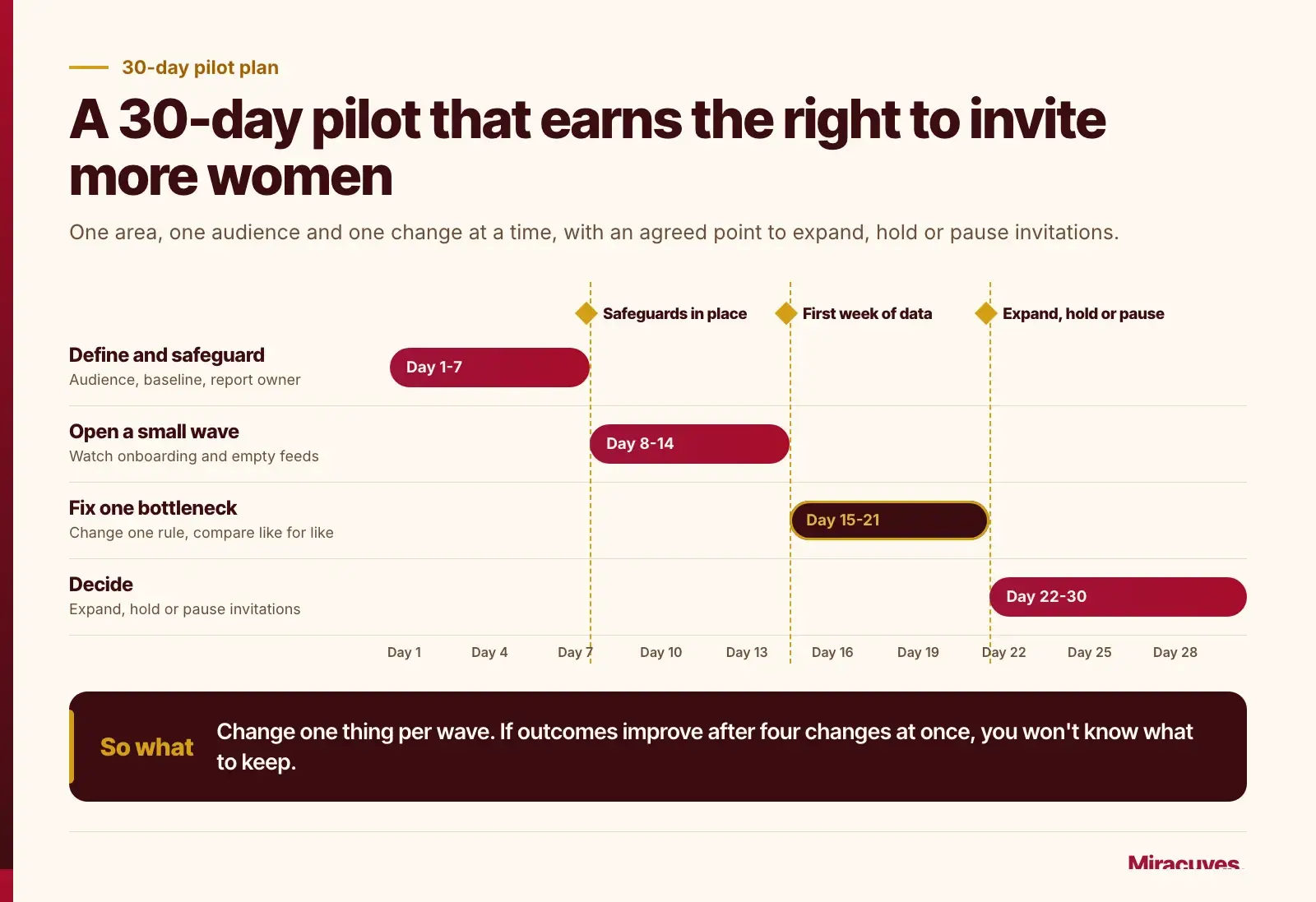
Days 1-7: Define the audience, baseline, and safeguards
Choose one area and one audience you can describe in a sentence. Identify where you’ll recruit, what qualifies as a relevant profile, and which behaviors you’ll measure. Record the area and acquisition source at signup where appropriate, but don’t collect additional sensitive information just because it might be useful later.
Run through the entire experience with testers: signup, visibility settings, discovery, a match, a conversation, blocking, and reporting. Give someone responsibility for each operational step. Agree in advance on what would cause you to slow or pause invitations, such as unresolved urgent reports or repeated feedback that members can’t find anyone relevant.
Days 8-14: Open a small invitation wave
Open access when your team can observe onboarding and respond to problems. Watch for permission requests that cause people to abandon signup, members who see no relevant profiles, and a small number of accounts generating a disproportionate share of incoming requests.
Ask a few members if they’d be willing to describe their first session. You don’t need to review private conversations to learn whether the feed felt empty or a member felt in control of contact. Use activity events for measurement, and ask for feedback separately and voluntarily.
Days 15-21: Change the biggest identifiable bottleneck
Once the first cohort has had a full week, pick the problem you can explain most clearly. If first-session availability was poor, concentrate the next wave geographically. If discovery was healthy but unwanted contact was common, test a narrower contact rule. Avoid changing the audience, onboarding, notification schedule, and messaging policy simultaneously. If outcomes improve after four changes, you won’t know what to keep.
Use equivalent observation windows when comparing waves. A cohort invited two days ago can tell you something about onboarding, but it can’t tell you anything about Day 7 retention yet.
Days 22-30: Decide whether to expand, hold, or pause
Expand within the current market if multiple waves show that members can find relevant people, conversations are becoming reciprocal, and the team is handling reports without accumulating a backlog. Hold the wave size steady if the evidence is mixed or the sample is too small. Pause expansion if members repeatedly report the same unresolved harm or the team cannot provide the coverage it promised.
Opening a second city is a separate decision. Check that you can recruit a mutually relevant group there and support it operationally. A good first city tells you something about the launch process; it doesn’t give the next city a ready-made community.
The Scorecard: What to Measure Beyond the Gender Ratio
Use the same definitions for every invitation wave. Keep counts alongside percentages, and review results by acquisition channel or area only when the groups are large enough to interpret safely. The point is to decide what to do next, not to produce a dashboard full of numbers.
| Metric | How to measure it | What it tells you |
|---|---|---|
| Onboarding completion | Share of new signups that finish required profile steps | Whether members are reaching discovery or getting stuck before it |
| First-session match availability | Share of new members entering discovery who see at least one recently active profile that meets applicable mutual preferences; track zero-result sessions separately | Whether the pilot has enough relevant people, not just enough accounts |
| First-week reciprocal conversation rate | Share of all new signups with at least one matched conversation in which both people send a message within seven days | Whether matches are leading to interaction; feedback helps establish whether that interaction was welcome |
| Day 7 retention | Share of new signups who return on the seventh day and take a meaningful action, such as browsing profiles or replying | Whether members return after the novelty of signing up |
| Moderation performance | Time to first review and resolution by severity, plus the number and age of unresolved urgent reports | Whether the operation can support a larger cohort |
Don’t set a universal threshold from somebody else’s benchmark. Start with your own baseline and look for improvement across more than one wave. If reciprocal conversations rise while blocks and negative feedback rise too, investigate before calling the change a success. If the signup mix barely moves but more women find relevant people and remain active, the pilot may be moving in the right direction.
What to Fix Before You Scale
You don’t need to wait for a 50:50 signup split. You do need to know whether people can find someone relevant, control who contacts them, and get help when something goes wrong. If women aren’t joining, fix how you reach them and what you promise. If they join and leave, fix the experience they actually had before paying to bring in more people.
Once you know what your pilot requires, separate software readiness from launch readiness. A ready-made dating app platform from Miracuves, or a women-first Bumble-style app, can give you a product to test. It can’t recruit a compatible local cohort, staff your moderation queue, or tell you when to open a second city. Those are operating decisions your team still owns.
Frequently Asked Questions About Dating App Gender Imbalance
What is the male-to-female ratio on dating apps?
Published figures point to more men than women. Pew Research Center found in 2023 that 34% of U.S. men had ever used a dating site or app, compared with 27% of women. Ofcom reported that UK dating app users were 65% men and 35% women in May 2024, with Hinge the only top 10 service where women outnumbered men, at 53%. Local ratios on a new app can differ widely.
What is a healthy gender ratio for a dating app?
There is no universal target. Compare the active member mix with local profile availability, reciprocal conversations, and Day 7 retention. A balanced signup ratio can still produce a poor experience if members cannot find people nearby who meet their preferences, or if a small group receives far more messages than it can answer.
Why do women leave dating apps?
Common reasons are unwanted contact, message overload and a thin pool of relevant people nearby. In Pew Research Center’s 2023 survey, 54% of women who were current or recent users said they had felt overwhelmed by messages, and 56% of women under 50 who had used dating apps had received unwanted explicit messages or images. Ask departing members why they are leaving, because some exits are healthy, such as meeting a partner.
How can a new dating app attract women without a large ad budget?
Focus on one local audience and recruit through channels it already trusts, such as an opt-in community newsletter or an event partnership. Be clear about who the app serves, when access opens, and what members can control, such as who can contact them and what other members can see. Then measure each channel by retention, not installs.
Why are women signing up but not finishing their profiles?
Look for the exact step where people stop and ask them what they expected at that point. Unclear visibility settings, premature requests for photos, location or permissions, and a long setup flow are different problems with different fixes. Test the simplest change that addresses the friction you observe, and defer optional steps until after the first session.
Should an early-stage dating app use gender quotas?
Staged invitations based on local match availability and moderation capacity are a more useful first test than a rigid quota. If you are considering restricting access by gender, seek jurisdiction-specific legal advice and consider how the policy would affect people outside binary categories. Large apps have mostly changed contact rules and trust features instead of using quotas.
How can dating apps reduce message overload?
Test contact controls that fit your product, such as mutual opt-in, limits on new requests, or a separate opt-in request inbox. Hinge, for example, now asks members with too many unanswered matches to reply or end those chats before matching again. Check that unwanted contact falls without making welcome conversations harder to start.
Does profile verification improve women’s retention?
Verification may address some concerns about profile authenticity, but it does not prevent harassment or prove that retention will improve. Tinder reported fewer bad actor reports after expanding facial verification, alongside other safety changes. Explain what a badge verifies, keep the data you store to a minimum, and assess verification alongside blocking, reporting, and moderation response times.
Which metric should founders track first?
Start with the share of new members who see at least one relevant, recently active profile in their first session. If they cannot find anyone suitable, weak messaging and retention results will not tell you much about what happens after a good match. Track zero-result sessions separately so you can see when a pilot area is too thin.
When should a dating app expand to a second city?
Expand when multiple cohorts in the first market show repeatable results and your team can handle more volume without a report backlog. Then confirm that the second city has its own recruitment channels, a viable local match pool, and adequate moderation coverage. A strong first city proves the launch process, not demand in the next one.
Miracuves is an independent software development company. We are not affiliated with, connected to, sponsored by, or endorsed by any company or product named in this article.
Terms such as “X Clone” are used descriptively. It is how the software industry refers to building a platform with functionality comparable to a known service, and how clients search for it.
The entire design and codebase of our products is built by our own team. Our products contain no code, design, graphics, or content originating from any third-party website or applications.
All third-party names and marks referenced in this article are the property of their respective owners, referenced solely to identify the services discussed.