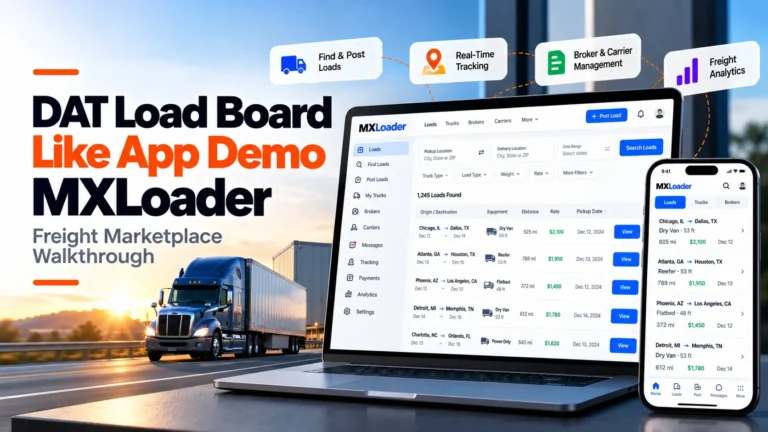
Watch this DAT Load Board Like App Demo to explore how a digital freight marketplace connects load posting, carrier search, bidding, rate negotiation, dispatch, fleet management, tracking, compliance and platform administration within one freight workflow.
What Does This DAT Load Board Like App Demo Show?
This DAT Load Board Like App Demo provides a practical look at the workflow behind a digital freight marketplace where shippers and brokers can post freight and carriers can search, bid, negotiate and move awarded loads into dispatch.
A load board becomes more valuable when the workflow does not end after a shipper and carrier are matched. The same load record can continue through assignment, vehicle and driver dispatch, route tracking, documentation, proof of delivery and invoicing.
The MXLoader Demo Video helps freight operators, brokerages, carriers and logistics businesses understand how the marketplace and execution layers work together before evaluating customization, integrations and deployment.
MXLoader Demo Video: Key Freight Platform Areas to Explore
While watching the walkthrough, focus on how the following parts of the freight lifecycle connect across shipper, broker, carrier and operator roles.
Load Posting
Explore how shippers and brokers create freight listings with lane, equipment, date and load information.
Board Search
See how carriers search and filter available freight based on the lanes and equipment they want to cover.
Bids & Negotiation
Review how carriers bid and how brokers and carriers can record counter-offers against the load.
Carrier Dispatch
Understand how an awarded load moves into vehicle, driver and route assignment.
Tracking & Compliance
Explore GPS tracking, operational milestones and compliance-related carrier records.
Operator Console
Review the administrative layer for KYC, compliance, finance, users and platform activity.
Inside the MXLoader Freight Marketplace Workflow
MXLoader represents the demo environment for a DAT Load Board Like App Demo, while the broader Miracuves freight platform combines marketplace discovery with negotiation, carrier TMS operations and operator governance.
1. Load Posting and Freight Discovery
A digital load board begins by bringing available freight and available carrier capacity into the same marketplace.
- Load Posting: Create freight opportunities with lane, equipment and commercial details.
- Multi-Stop Loads: Represent multiple pickup and delivery legs within one load.
- Board Filters: Search freight by lane, date, equipment and related criteria.
- Truck Posting: Allow carriers to publish available capacity.
2. Bidding and Rate Negotiation
Freight pricing often requires negotiation rather than a single fixed-price booking.
- Carrier Bids: Submit offers against posted freight.
- Counter-Offers: Negotiate pricing through recorded bid rounds.
- Negotiation History: Preserve the commercial trail attached to the load.
- Assignment: Move the accepted offer into an operational load state.
3. Carrier TMS and Dispatch
Once freight is awarded, the workflow moves from marketplace matching into transportation execution.
- Vehicle Assignment: Match the awarded load with an available vehicle.
- Driver Assignment: Assign the appropriate driver to the route.
- Route Management: Connect load stops with the operational trip.
- Fleet Records: Maintain vehicles, drivers and dispatch information within the TMS.
4. GPS Tracking and Delivery Visibility
Freight execution requires visibility after a load leaves the pickup location.
- GPS Positions: Follow load movement through vehicle location updates.
- Geofences: Trigger operational events around pickup and delivery locations.
- Public Tracking: Provide shipment visibility to outside stakeholders where configured.
- Status Updates: Keep the same load record current from dispatch through delivery.
5. Compliance, Documents and Proof of Delivery
Freight platforms also need operational controls around carriers, drivers and transportation documents.
- Carrier Verification: Review identity and business information before hauling.
- Compliance Records: Maintain relevant driver, fleet and carrier records.
- Document Handling: Store freight and delivery documents against the load.
- Proof of Delivery: Connect completed delivery evidence to the shipment record.
6. Invoicing and Operator Administration
After delivery, the same freight record can continue into financial and administrative workflows.
- Invoices: Raise billing records against completed freight.
- Financial Visibility: Monitor invoice status and related activity.
- KYC & Compliance Queues: Review operational approval workflows centrally.
- Audit Logs: Maintain records of privileged and administrative actions.
How the Digital Load Board Workflow Connects
A modern freight marketplace connects freight discovery, negotiation, transportation execution and financial operations against the same load.
| Platform Area | Primary User | Purpose |
|---|---|---|
| Load Posting | Shippers & Brokers | Publish available freight with lane, equipment, dates and commercial information. |
| Load Search | Carriers | Discover freight matching the carrier’s preferred lanes, equipment and availability. |
| Bidding & Negotiation | Carriers & Brokers | Submit bids, negotiate rates and preserve the agreed commercial history. |
| Load Assignment | Broker & Carrier | Convert an accepted offer into an assigned freight movement. |
| Dispatch | Carrier / Dispatcher | Assign vehicles and drivers and manage the operational movement of the load. |
| Tracking & Delivery | Carrier & Shipper | Track shipment progress and capture delivery milestones and proof of delivery. |
| Billing & Settlement | Finance / Operator | Convert completed shipment activity into invoice and financial workflows. |
| Platform Governance | Admin | Manage users, KYC, compliance, pricing, modules and audit activity. |
Why the Carrier TMS Is the Key Difference
A basic load board solves only the matching problem: one business has freight and another business has capacity.
The harder operational work starts after the match. The carrier still needs to assign equipment and drivers, track the shipment, maintain fleet and compliance records, collect delivery documents and move the load into billing.
Combining the load board with a carrier TMS means the freight record can remain connected from posting → negotiation → assignment → dispatch → transit → delivery → invoice.
Why Watch a DAT Load Board Like App Demo Before Choosing a Freight Platform?
A load-board feature list can confirm that software supports load posting and carrier search, but it does not necessarily show how the workflow continues after a carrier wins the freight.
A DAT Load Board Like App Demo helps freight operators understand how marketplace workflows connect with negotiation, dispatch, tracking, compliance and billing.
This is especially important for brokerages and carrier networks that want one operational platform rather than a listing board that still requires separate dispatch, tracking and invoicing systems.
Where Miracuves Fits Into the MXLoader Demo
MXLoader represents the Miracuves demo product for a DAT-style digital freight marketplace.
The broader Miracuves platform combines load posting, board search, bidding, negotiation, dispatch, carrier TMS, GPS tracking, compliance, documents, invoicing and operator administration.
If you want to evaluate the complete commercial solution rather than only watch the walkthrough, visit the Miracuves DAT-style freight marketplace and carrier TMS for detailed information about platform capabilities, source-code ownership, customization and deployment.
Frequently Asked Questions
What is shown in the MXLoader demo video?
The demo focuses on the workflow of a digital freight marketplace, including load-board activity, freight negotiation, carrier execution and the operational processes that follow an awarded load.
What is a DAT Load Board-like app?
It is a digital freight marketplace where shippers and brokers can publish available loads while carriers search for freight, submit offers and manage awarded shipments.
What is the difference between a load board and a carrier TMS?
A load board primarily connects available freight with carrier capacity. A carrier TMS manages what happens after the match, including dispatch, fleet and driver assignment, tracking, compliance, documents and transportation operations.
Does the platform support freight rate negotiation?
Yes. The broader platform supports carrier bids and multi-round counter-offers so rate negotiations can remain attached to the underlying freight record.
Does the platform support dispatch and tracking?
Yes. Awarded loads can move into vehicle and driver assignment, routing, GPS tracking, geofence events and delivery-status workflows.
Where can I review the complete Miracuves freight platform?
The Miracuves DAT-style platform page provides broader information about the freight marketplace, carrier TMS, broker tools, compliance, administration, customization and deployment.
Explore the Freight Marketplace & Carrier TMS
Use the MXLoader demo to understand the freight workflow, then explore the Miracuves platform when you are ready to evaluate load-board operations, negotiation, dispatch, tracking, compliance and platform ownership.
Explore Related Freight Platform Resources
Miracuves is an independent software development company and is not affiliated with, sponsored by or endorsed by DAT Freight & Analytics. Third-party names are referenced only to describe the software category and comparable workflow.