Case study · 2025

A Spanish-first telehealth platform for Doctta Health across Latin America.

Doctta Health launched in its first market in 9 weeks and rolled out to two more in the following six months.

  • Practo Clone · MXDoc
DDocttaDoctta Health
DDocttaClient · Practo Clone
Solution
Practo Clone
Product
MXDoc
Delivered
2025
Stack
PHP
Base build
6 working days
Blocks reused
21 of 26
Source code
Transferred
5applications on the base
21blocks reused unchanged
5per-client blocks on this base

Doctta Health and the Practo Clone base.

Doctta Health's Doctta shipped in 2025 on the Practo Clone base. Miracuves built its Spanish-language UX, asynchronous-queue logic and a regulator module for each country. The quote below calls the base MXHealth, the earlier name of MXDoc.

Doctta is a telehealth platform focused on Latin America — Spanish-first, with asynchronous consults and prescription delivery. Building a compliant telehealth stack from scratch in three markets would have been a year-plus effort. Miracuves's MXHealth base covered the patient/doctor apps, video consult, e-prescription and the pharmacy integrations. We added Spanish-language UX across every flow, our asynchronous-queue logic, and a custom regulator module for each country. We launched in our first market in 9 weeks and rolled out to two more in the following six months. Honestly, this product wouldn't exist yet without that base.

Dr. Carlos A. Palermo, Co-founder & CEO, Doctta Health

A Spanish-first health platform without monthly fees.

Doctta Health, led by co-founder and CEO Dr. Carlos A. Palermo, came to Miracuves for a telehealth platform focused on Latin America and built Spanish-first.

Doctta's model centered on asynchronous consults and prescription delivery. Its team put a compliant from-scratch build for three markets at more than a year of work, so the build started from the Practo Clone base, MXDoc, and was delivered in 2025.

The landing page in the project files made the pitch in Spanish: private healthcare with no monthly fee, where patients pay only for what they use, with entry points for medical care, one-click prescriptions, check-ups and treatments, and clinical analyses.

The requirements document behind the build was written for Argentina, with tax IDs, bank codes and peso pricing, while Doctta's own account describes a platform meant for three markets.

Doctta at a glance

ClientDoctta Health
Led byDr. Carlos A. Palermo, Co-founder & CEO
FocusLatin America, Spanish first
ModelNo monthly fee, pay per use
BasePracto Clone (MXDoc)
Delivered2025

A requirements list, one base, three additions.

Doctta's requirements arrived as a document, the Practo Clone base carried the core apps, and Miracuves built three additions on top of it.

The requirements

Provider fileslicense, tax and bank details
Provider levelsmanagers, institutions, polyclinics, private practice
Dollar feescharged in pesos at the day's rate

The Practo Clone base

Patient and doctor appsthe two apps people used
Video consult and e-prescriptionalready in the base
Pharmacy integrationsorders reaching pharmacies

MXDoc, the base the build started from

Built by Miracuves for Doctta

Spanish-language UXacross every flow
Asynchronous-queue logicqueue rules set by Doctta
Regulator modulesone for each country

Argentina's rules for digital prescriptions and prices.

The requirements were written for Argentina, so these rows describe Argentine rules and prices; they are market context, not part of Doctta's record.

01
Digital prescriptionsLaw 27.553, passed on 23 July 2020 and published on 11 August 2020, let prescriptions be written and signed by hand, electronically or digitally anywhere in Argentina.
02
Telehealth platformsThe same law allowed teleassistance platforms nationwide, under Law 25.326 on personal data protection and Law 26.529 on patient rights.
03
What a prescription carriesUnder the amended Law 17.132, a prescription states the prescriber's name, surname, profession, license number, address, phone and, where relevant, email, and is dated and signed.
04
Prices in pesosINDEC put Argentina's 2024 inflation at 117.8%, after 211.4% in 2023, as reported by the fact-checker Chequeado.
05
Rules by countryRecord-keeping, consent and prescribing duties for a health platform differ between jurisdictions, and Doctta's account mentions a regulator module for each country.
06
Doctta's requirementsThe requirements asked for prescriptions to be blocked without a date, diagnosis and doctor data, and for dollar fees to be charged in pesos.

What Doctta's requirements document asked for.

Doctta's team set out its needs in a requirements document, a provider sign-up form and a specialty list; these cards are what those files called for.

01
A complete provider fileEach provider was to register with a national or provincial license number, a CUIT tax ID, taxpayer type, malpractice insurance, municipal authorization and a Ministry of Health document.
02
Bank accounts for payoutsProviders were to add a CBU, Argentina's 22-digit bank code, or a bank alias, with room for two or three accounts, tied to the payment platform so it was clear who was paid.
03
Four provider levelsThe levels were managers, institutions, polyclinics and private practices. A doctor seeing patients at an institution was paid through it, and a manager's doctors and institutions were paid through the manager.
04
A set search orderResults were to sort by area from the patient's address or locality, then by specialty, rating and consultation price from lowest to highest; the doctor's sex was not a factor.
05
Dollar fees, peso paymentsDoctors were to set fees for consultations, prescriptions, treatments, imaging and lab tests in US dollars, shown in both currencies and charged in Argentine pesos at that day's rate.
06
A controlled exchange rateThe rate was to update automatically from a reliable source for the official selling rate, with manual changes in the admin panel limited to authorized staff.
07
Prescribing rulesThe document asked about an option to upload a pharmaceutical vademecum for predictive prescribing, and for the system to stop any prescription missing a date, diagnosis or doctor's data.
08
Ways to be seenThe sign-up form offered in-person, virtual and home visits plus prescriptions, up to three consulting-room addresses with geolocation, and specialties from a list of 99 entries.

Where Doctta's build needed more than the base.

Four problems shaped the project, each answered by the base or by work Miracuves built and recorded in Doctta's files.

Three markets without a year-plus build

Doctta's team estimated that a compliant stack of its own, built for three markets, would have taken more than a year.

What was doneThe project started from the Practo Clone base, which already covered the patient and doctor apps, video consult, e-prescription and the pharmacy integrations.

Spanish in every flow

Doctta was Spanish-first, and its requirements document listed syntax, vocabulary and translation issues that had been sent over in Word files.

What was doneThe reply recorded in the document says the corrections were made; Miracuves built Spanish-language UX into every flow, and the admin panel screenshot is in Spanish.

Different rules in each country

Record-keeping, consent and prescribing duties for a health platform change from one jurisdiction to the next.

What was doneMiracuves built a custom regulator module for each country Doctta served.

Editing without a developer

Doctta's team asked whether it could correct basic issues in the app and web content itself, without new development.

What was doneThe answer in the document was that the source code had already been provided, and the delivery record shows it was transferred to Doctta.

What the Practo base carried, and what Miracuves added.

Of the Practo Clone base's 26 blocks, 21 carry over untouched into each build, and Miracuves built three additions for Doctta on top.

The base shipped a patient app and website, a separate doctor app, an admin console and provider panels for doctors, labs and pharmacies. Patients searched by specialty, booked a slot and consulted by video; doctors wrote e-prescriptions; labs uploaded reports, and pharmacies checked a prescription before dispensing.

The admin reviewed providers before patients could see them, and the base stored a payment reference rather than card numbers. Its listed stack was Flutter for the two mobile apps, PHP 8.1 with Laravel 10, MySQL and Zoom.

Each client sets five blocks of its own here: brand and theming, payment gateways, clinical compliance, the practitioner network and specialities. Every client's base build on this family runs 6 working days, with customization planned separately.

Built for Doctta

LanguageSpanish-language UX across every flow
ConsultsAsynchronous-queue logic, to Doctta's own rules
RegulationA custom regulator module for each country
AdminSpanish panel with entity types, specialty types and entity plans

Reused from the Practo Clone base

Patientbook, consult, records
Doctorslots, consult, prescribe
Laboratorytests, samples, reports
Pharmacydispense, deliver
Adminverification, disputes
API gatewayauth, rate limits, idempotency
Realtime channelqueue position, consult presence
Event busreminders, result fan-out
Appointment calendarslots, holds, reschedules
Practitioner directoryprofiles, specialities, availability
Consultation roomvideo, chat, notes
Patient recordhistory, reports, documents
Prescription & orderse-Rx, lab and pharmacy orders
Consent & accesswho may read a record
Payments & refundsconsult fees, settlements
Identity & verificationaccounts, credentials on file
Notificationsreminders, results ready
Analyticsutilization, no-shows
Transactional storeappointments, records, ledger
Cache & realtimesessions, slot locks
Object storagereports, scans, documents

Per-client blocks on the Practo Clone base

Specialitieswhat your network covers
Practitioner networkwho you onboard
Clinical complianceyour regulator's rules
Payment gatewaysyour providers
Brand & themingpatient and clinician apps

MXDoc under Doctta Health.

The Practo Clone base reuses 21 of its 26 blocks.

Practo Clone architecture MXDoc / filled = per-client blocks
Practo Clone: the architecture, and one appointment traced through it 5 client surfaces reach an edge of gateway, realtime channel and event bus. The base holds 10 services, of which Appointment calendar is the source of truth, and 5 blocks are built for each client. Partner services sit behind a boundary and are chosen by the client. Underneath, one appointment is traced across 5 steps. 21 of 26 blocks are reused unchanged. Practo Clone MXDoc Four documented builds were made on this base. The filled blocks are set per client. Ships ready-made Per-client blocks Surfaces Edge The base - already built Partner boundary Data Patient book, consult, records Doctor slots, consult, prescribe Laboratory tests, samples, reports Pharmacy dispense, deliver Admin verification, disputes API gateway auth, rate limits, idempotency Realtime channel queue position, consult presence Event bus reminders, result fan-out Appointment calendar slots, holds, reschedules SOURCE OF TRUTH Practitioner directory profiles, specialities, availability Consultation room video, chat, notes Patient record history, reports, documents Prescription & orders e-Rx, lab and pharmacy orders Consent & access who may read a record Payments & refunds consult fees, settlements Identity & verification accounts, credentials on file Notifications reminders, results ready Analytics utilization, no-shows Per-client blocks Specialities what your network covers Practitioner network who you onboard Clinical compliance your regulator's rules Payment gateways your providers Brand & theming patient and clinician apps chosen by the client Payment gateway their merchant account Video consultation their room provider SMS & email their sender Maps & geocoding their key Object storage their bucket Transactional store appointments, records, ledger Cache & realtime sessions, slot locks Object storage reports, scans, documents one appointment, end to end every step below runs on blocks that already existed 1 Search speciality, location, availability 2 Book slot held, fee taken 3 Consult video, chat, notes 4 Prescribe e-Rx and orders written 5 Follow up record updated, next slot offered PHP LARAVEL · MYSQL · NODE.JS · GOOGLE MAPS 21 of 26 blocks reused unchanged 5 per-client blocks

Doctta's patient and doctor apps.

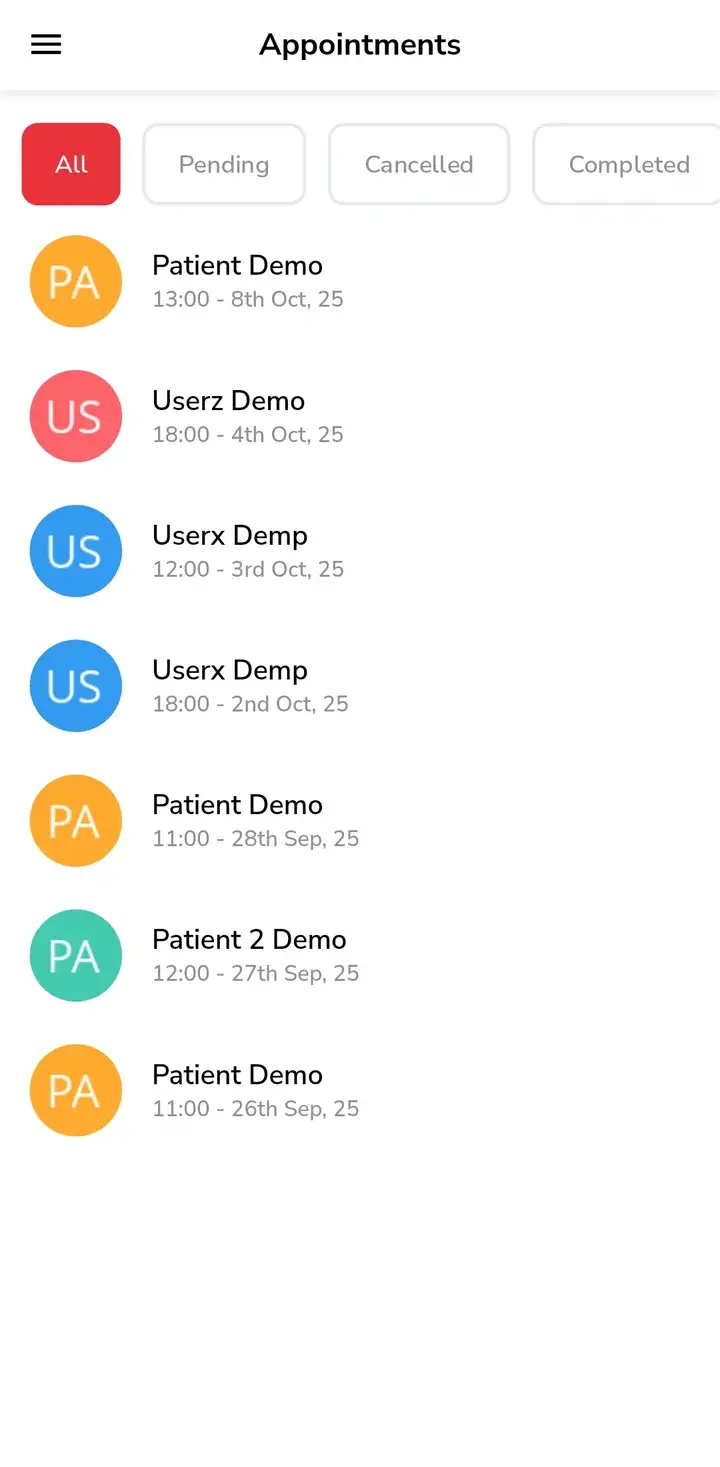
Two phone screens from the Doctta project screenshots, captured with demo accounts and an English interface; they show how the apps were organized, not patient data.
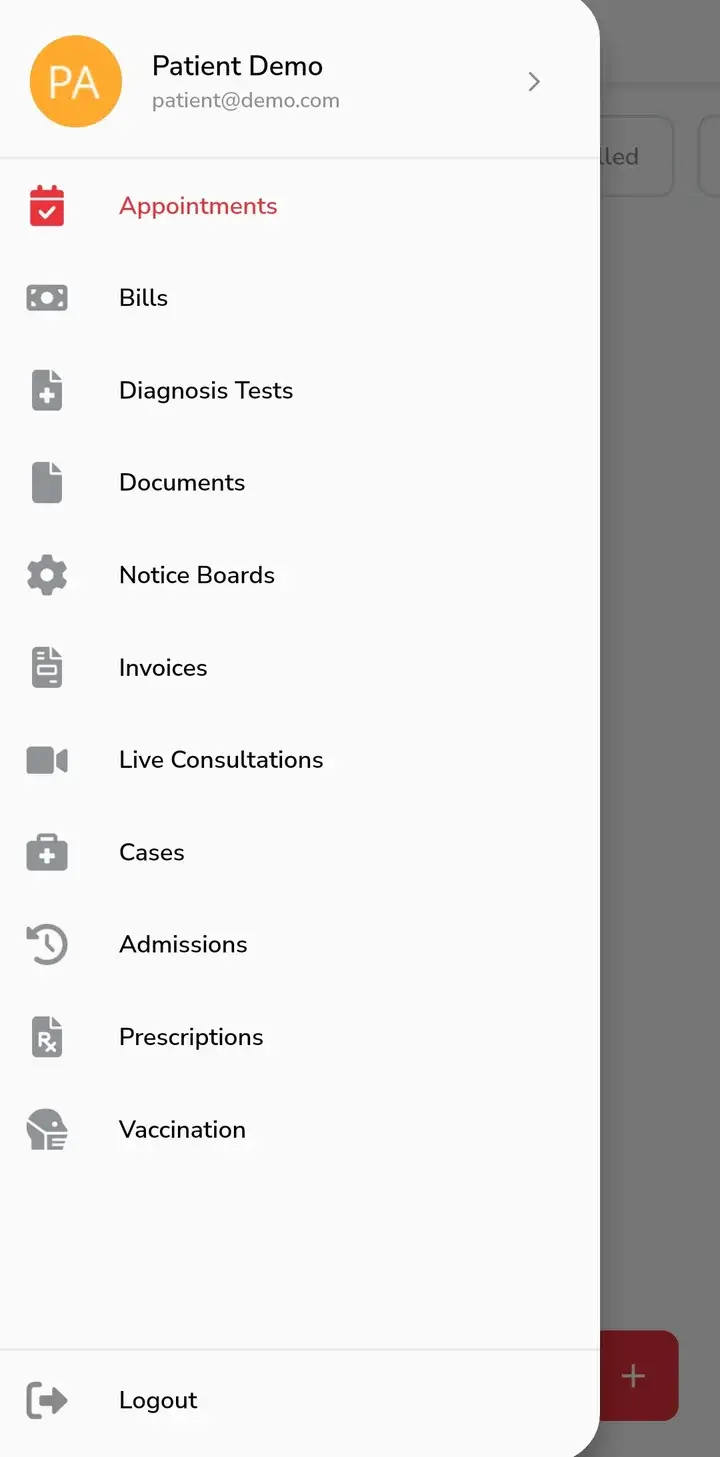
Doctta patient app side menu for a demo patient account, listing appointments, bills, diagnosis tests, documents, notice boards, invoices, live consultations, cases, admissions, prescriptions and vaccination
Patient menuAppointments, bills, diagnosis tests, documents, invoices, live consultations and prescriptions, under a demo patient account.
Doctta doctor app appointments screen with All, Pending, Cancelled and Completed filters and a list of demo patient bookings from September and October 2025
Doctor's bookingsThe doctor's appointment list with pending, cancelled and completed filters, filled with demo patients.

Patients, doctors, providers and the operator.

Four kinds of user met on Doctta, each with its own app, panel or set of rules.

01
Patients in the appThe patient app's menu held appointments, live consultations, prescriptions, diagnosis tests, documents, bills and invoices, and the landing page pitched paying per service instead of a monthly fee.
02
Doctors and bookingsThe doctor app sorted bookings into pending, cancelled and completed. On the base, doctors also wrote e-prescriptions and passed credential review before patients could find them.
03
Institutions and managersThe requirements placed managers, institutions and polyclinics beside private practices, with consultation payments routed to whichever entity a doctor worked through.
04
The operatorDoctta's Spanish admin panel opened on a dashboard of entities, revenue and active and expired entity plans, with menus for billing, consultations and a landing-page CMS.

Doctta's launch, market by market.

First market launched in 9 weeks, two more in the following six months.

Reported by Dr. Carlos A. PalermoCo-founder & CEO, Doctta Health

Region
Latin America, Spanish first
Delivered
2025, on the Practo Clone base (MXDoc)
Source code
Transferred to Doctta Health

9 weeks is Doctta's go-live time for its first market; the 6-working-day figure covers only the base build.

Questions about the Doctta build.

What was Doctta?

A telehealth platform for Latin America from Doctta Health, built Spanish-first around asynchronous consults and prescription delivery, and delivered on the Practo Clone base (MXDoc) in 2025.

What did the Practo Clone base already cover for Doctta?

By Doctta's own account, the patient and doctor apps, video consult, e-prescription and the pharmacy integrations. On the base these sat beside lab and pharmacy panels and an admin console.

What was added on top of the base?

Miracuves built Spanish-language UX across every flow, Doctta's asynchronous-queue logic and a custom regulator module for each country.

How were consultation fees meant to be priced?

The requirements asked for each doctor to set fees in US dollars, shown in dollars and pesos and charged in Argentine pesos at that day's rate, with the rate updated automatically or by authorized admin staff.

How fast did Doctta launch?

Its first market launched in 9 weeks and two more in the following six months, by Doctta's own account. That figure is Doctta's own go-live time, separate from the 6-working-day base build.

Did Doctta Health receive the source code?

Yes. Doctta Health received the transferred source code, and the requirements document records that it had already been provided when Doctta asked about editing content itself.

Disclaimer

Miracuves is an independent software development company. We are not affiliated with, connected to, sponsored by, or endorsed by any of the brands or platforms named on this page.

Why these names

Names of the form “Brand Clone” are used descriptively. It is how the software industry refers to building a platform with functionality comparable to a known service, and how clients search for it.

Who built this

The entire design and codebase of our products is built by our own team. Our products contain no code, design, graphics, or content originating from any third-party website or application.

Trademarks

All third-party names and marks listed on this page are the property of their respective owners, referenced solely to describe the category of software offered.