DeFi Futures App · Production Ready

White Label DEX - Perpetual Trading Exchange You Own

Miracuves' ready-made, white-label front end is a white label DEX you own outright: a long, short and swap trade screen plus Earn, referral, leaderboard and dashboard pages, as unencrypted source, launched on hosting you control inside six working days.

A trader links a wallet, chooses a market and sets leverage on a slider, seeing the liquidation price and every cost before the order goes out. Bots, a liquidity pools module, social trading and an NFT marketplace are priced add-ons; custody design, audits, licenses and asset listings remain your decisions. A native store app, or a KYC step before the first trade, is custom work we price in writing; expect 2-8 weeks once approved.

Launch in 6 Days with

  • Git Repository
  • Trade Screen
  • Staking Pages
  • Markets Dashboard
  • Network Switcher
  • Deployment Notes

StackResponsive Browser UI · Slide-Out Menu · TradingView · Indicators · Connect Wallet · Arbitrum · Avalanche · Test Networks

MMX panel · Trading viewIllustrative
Live positions14
Pending orders5
Active markets10

Recent activity

Positions, orders, trades and claimsshare a single panel below the chart
  • 5Costs Shown Before Sendingexecution price, fees, network fee, allowed slippage and maximum network fee buffer
  • 3Dashboard Tablesoverview, stats and a paged markets list with search
  • 0%Revenue Share With Miracuvesfee levels live in your code; none of that income reaches us
  • 6Buyer Profilesperp startups, DeFi protocol teams, trader communities, exchange operators, crypto media and Web3 agencies
  • 6Days to Launchand if the delay is ours, we keep going free
  • $4,299Paid Once, Not Rentedsource code yours, no per-seat fee, no monthly rental

Live in six working days, or we keep working free until you launch. Every build carries 60 days guidance, 6 months bug fixes and 12 months updates.Verify every figure

Live Since 2025 on This Base

Blue Silent Exchange opened a perpetuals and swap venue on this product, keeping 16 of 20 building blocks and spending its build on four client decisions.

No Back Office in the Demo

There is no screen for user roles, market settings or reports; fee levels and referral discounts are edited in the source until you commission a console.

Wallet First, Custody Unstated

No order leaves until a trader links a wallet. The demo does not show where funds are kept, so no custody or safety claim is made; an audit and penetration test are separate jobs.

Ready to run your own wallet-connected exchange under your brand?Speak With a Product Expert

Trusted by 6,000+ clients worldwide


Miracuves is listed by Expertise.com as a managed IT service provider.Miracuves is an official member of the Forbes Business Council.Miracuves is a verified agency on DesignRush, listed among top design agencies in India.Miracuves is reviewed on Trustpilot as a software development company.Miracuves is listed by The Manifest among top managed software development companies.Miracuves is listed by DesignRush as a top software development company.Miracuves is recognized by GoodFirms as a top software development company.Miracuves is ranked among the top 1000 companies globally by Clutch.Miracuves is a top managed service provider in the United States on Clutch.

01Try it live

Working Demo

Live Demo of the White Label DEX - Trade Screen, Phone View, Settings & Pages

Miracuves keeps its demo open to everyone: no login, just a market, a chart and a Connect Wallet button for a test order. No login is needed: open the demo, select a market, study the chart, then press Connect Wallet to try an order. What follows describes only what the demo itself shows.
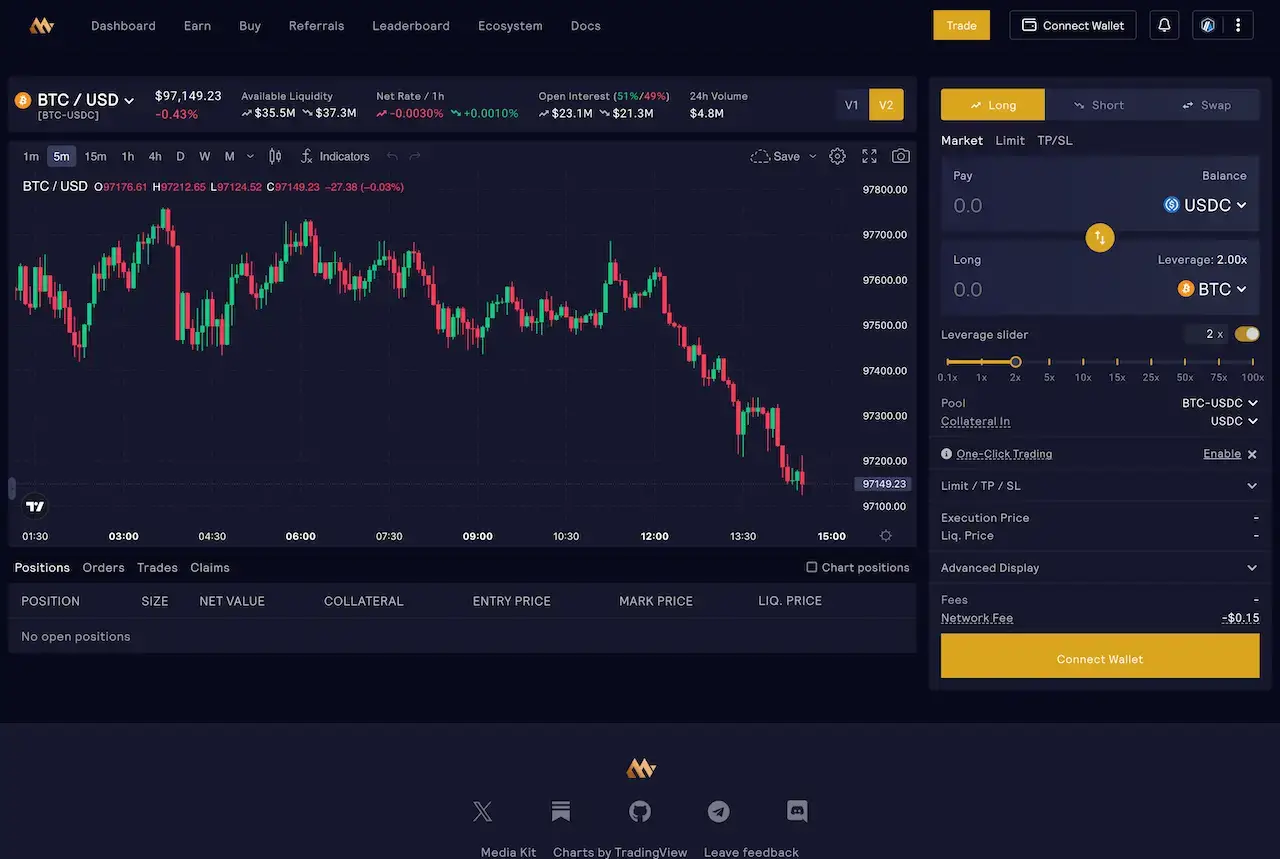
White Label DEX desktop trade screen with a market header, BTC/USD candlestick chart, order panel and a positions table.
Web trade screen

The Web Trade Screen

The main page puts a market header with price and liquidity numbers over a candlestick chart, beside the Long, Short and Swap order panel, with one table below for positions, orders, trades and claims.

  1. 1Load the demo in any browser tab
  2. 2Choose a timeframe for the chart
  3. 3Look at: Long, Short, Swap and each order type
Try:click Connect Wallet to try an order
White Label DEX phone trade screen with a BTC/USD candlestick chart, timeframe buttons and the Long, Short and Swap order panel.White Label DEX phone order panel with Long, Short and Swap tabs, a pay amount, a leverage slider, a pool selector and a Connect Wallet button.
Phone view

Trading From a Phone

Open the platform in a phone browser and the chart sits first, the order panel below it, and a slide-out menu lists each page.

  1. 1Use the identical demo link on a phone
  2. 2Tap the menu icon to see every page
  3. 3Look at: chart, order panel, menu
Try:visit the web demo from a phone
White Label DEX settings dialog with allowed slippage, a network fee buffer and display options.White Label DEX networks and settings dialog with a network list, language and settings buttons.
Settings & networks

Settings & Network Switcher

Behind the screen sit the allowed-slippage field, a network fee buffer, profit and loss display choices, and a switcher listing the networks this demo connects to.

  1. 1Launch the demo, then tap the network button
  2. 2Select a network in the list
  3. 3Look at: Settings, slippage and fee buffer
Try:adjust a setting, then try a test order
White Label DEX phone menu listing Dashboard, Earn, Buy, Referrals, Leaderboard, Ecosystem, Docs, Alerts and Settings.White Label DEX phone order panel with Long, Short and Swap tabs, a pay amount, a leverage slider, a pool selector and a Connect Wallet button.
Dashboard & pages

Dashboard, Earn, Referral & Leaderboard Pages

Next to the trade screen sit a Dashboard listing totals and markets, an Earn page for staking and pool tokens, a Referrals page for fee-discount codes, and a Leaderboard ranking top addresses and positions.

  1. 1Go to the Dashboard link
  2. 2Move between pages with the header menu
  3. 3Look at: totals, markets table, Earn, Referrals
Try:the Dashboard reads without a wallet
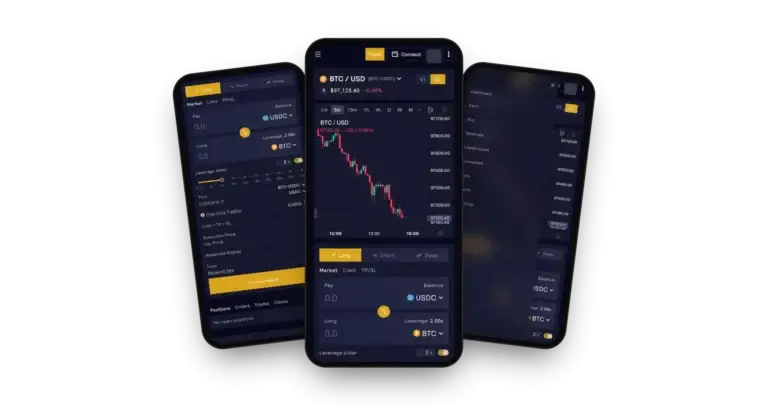
White Label DEX on three phones: the perpetual trade view with market header and chart, the perpetual trade panel with long, short and leverage controls and the navigation drawer with dashboard, earn, referrals and leaderboard

See It Together

Live Walkthrough of the Trade Screen, Order Types, Earn Pages & Settings

A live call is the fastest route to seeing everything. Over 30 minutes we go through the trade screen, order types, Earn, Referrals and Leaderboard pages and settings, then map each to your plan: markets, fees, networks and launch date.

Book a live walkthrough call.

All Screens Laid Out

DEX Screen Flows - Phone Trade Views & the Full Desktop Trade Screen

Miracuves captured five phone views and one desktop view from the live demo, running from the chart through slippage and network settings to the full positions table.

White Label DEX phone trade screen with a BTC/USD candlestick chart, timeframe buttons and the Long, Short and Swap order panel.
White Label DEX phone order panel with Long, Short and Swap tabs, a pay amount, a leverage slider, a pool selector and a Connect Wallet button.
White Label DEX phone menu listing Dashboard, Earn, Buy, Referrals, Leaderboard, Ecosystem, Docs, Alerts and Settings.
White Label DEX settings dialog with allowed slippage, a network fee buffer and display options.
White Label DEX networks and settings dialog with a network list, language and settings buttons.
5 screens · swipe →
White Label DEX desktop trade screen with a market header, BTC/USD candlestick chart, order panel and a positions table.
1 screen

Walk a trader from the chart into the order panel, then via slippage, network settings and the page menu, starting on a phone and ending on the complete desktop trade screen.

Browse Our Solutions

02Proof

Client Voices

Client Reviews - What Operators Say In Their Own Words

What clients say about building on Miracuves bases. Two of these come from the co-founder behind a published perpetuals and swap exchange build; the others come from other industries and are shown exactly as their authors gave them.

EErick BrennanCo-founder, Blue Silent Capital
“RFQ, matching and post-trade reporting was our long pole. Their OTC module covered it, and we layered on our compliance checks and multi-leg settlement. First counterparties were trading within weeks and we saved a third of the engineering budget.”
EErick BrennanCo-founder, Blue Silent Capital
“The perpetuals side is not something you start from nothing. The exchange mechanics were already built and proven, so what we worked on was our markets and our risk posture rather than the engine underneath them.”
DDr. Vivek RungtaFounder & Chief Dermatologist, Dermacian
“Every HMS I tried was built for general physicians, with no lesion mapping, no before/after tracking, and no procedure-based billing. Their MXHealth base gave us the patient app, doctor app, EMR and video consult out of the box. Front-desk time on scheduling and follow-ups is down ~70%, and we went fully digital in 9 months, where a fully custom job would have been 18.”
AAndre GittensCEO, Ride Corporation
“Turo is the obvious reference, but the Caribbean specifics, from different insurance norms to different payment rails, meant we needed a real partner, not just a clone. Miracuves’s MXCar base covered the listing, the trip flow, and the host payouts. We launched in 6 working days and are live in three islands.”
MMarsha WilliamsFounder, Bmore On Demands LLC
“The team was running it on a dispatcher and a Google Sheet, and we needed a real platform quickly, because we were about to onboard a major retail client. Miracuves’s Delivery Genie base gave us the rider app, the dispatch console, and live tracking. We launched in 6 weeks and cleared 4x the previous order volume in the first month.”
TTiffany DandreaOperations Director, Best Cabo Yacht Rentals
“We were running it on phone calls and a paper calendar, and we were losing bookings to bigger OTAs. Miracuves’s GetmyBoat Clone base gave us the calendar, the booking flow, and the payment engine. Online bookings are up roughly 70% in the first six months, and the ops team finally has a live view of the fleet.”
DDr. Carlos A. PalermoCo-founder & CEO, Doctta Health
“Building a compliant telehealth stack from scratch in three markets would have been a year-plus effort. Miracuves’s MXHealth base covered the patient and doctor apps, video consult, e-prescription and the pharmacy integrations. We launched in our first market in 9 weeks and rolled out to two more in the following six months.”
BBrian LatailleVP Logistics Technology, IBC Tanks Canada
“We were juggling spreadsheets, a third-party GPS provider, and a phone. We needed a single operations console. Miracuves’s MXLogistics base covered the trip lifecycle, the driver app, and the customer tracking page. We’ve cut operations admin time by about 40%.”
Read More Client TestimonialsOperators and founders in their own words

Proof in Production

Case Study - Blue Silent Exchange

Summarized from the published case study, this is how a perpetuals and swap exchange went live on the Miracuves platform. It covers what was delivered in 2025.

Case Study
Perpetuals and Swap Exchange

Blue Silent Exchange needed a perpetuals and swap exchange. Miracuves built on the GMX Clone base, reused 16 of 20 building blocks and put the effort into the four decisions that were the client's own.

Blue Silent ExchangeClient
Blue Silent CapitalCompany
Perpetuals and swap exchangeProduct
6 daysBuild time
16 of 20Blocks reused
4Client decisions built
White Label DEX desktop trade screen with a market header, BTC/USD candlestick chart, order panel and a positions table.
Challenges
  • Twenty pieces had to work together before the first trader could be served
  • Listed markets, leverage limits and fee and funding settings were commercial calls only the client could make
  • A fixed build window, with the source code to be handed over at the end
Goal
  • Launch the exchange without rebuilding the parts already proven on the base
  • Direct your effort at the four decisions that belonged to the client
  • Hold the source code, schema and deployment configuration outright
Solution by Miracuves
  • Two applications and consoles, each with its own permissions and release path
  • Listed markets, leverage limits and fee and funding settings configured for the client
  • Brand and theming applied across every surface
  • Development, staging and production environments
  • Source, schema, deployment configuration and architecture notes handed over
  • Build window of 6 working days on the ready-made base

“The perpetuals side is not something you start from nothing. The exchange mechanics were already built and proven, so what we worked on was our markets and our risk posture rather than the engine underneath them.”Erick Brennan · Co-founder, Blue Silent Capital

Read the full case studySee the 16 of 20 blocks that were reused and what the client supplied.

03The software

The Basics

What a White Label DEX Does for Traders and Operators

Miracuves' white label decentralized exchange (DEX) is a prebuilt, wallet-connected trading venue under your brand, with source code included. A trader links a wallet, settles on a market and sends a long, short or swap order, then follows each position, order, fill and claim. Staking, pool token, referral code and leaderboard pages ring that screen, every one in your colors.

White Label DEX on three phones: the perpetual trade view with market header and chart, the perpetual trade panel with long, short and leverage controls and the navigation drawer with dashboard, earn, referrals and leaderboard

Beyond the Chart

Most of the work is around the chart: several order types, a leverage control, a leaderboard, referrals, an Earn page and a table of positions.

Open, Not Sealed

The full source code is yours in readable, unencrypted form, which lets your developers rework screens and trading flows as volume grows, with no per-seat fee attached.

Clear About the Extras

Social trading, auto trading bots, a liquidity pools module and an NFT marketplace are extras priced individually. Each is a ready add-on, so you can extend the venue whenever you choose.

Web & Phone

What Is This DEX Software?

Building a trading front end is hardest at the trade screen: a live chart paired with an order panel that holds a leverage control and several order types, plus a table of all open items. That screen arrives working, surrounded by pages for Earn, Referrals, Leaderboard and Dashboard.

White Label DEX desktop trade screen with a market header, BTC/USD candlestick chart, order panel and a positions table.
  1. 01Market header showing price, liquidity and open interest
  2. 02Candlestick charts, timeframes and an indicators menu
  3. 03Long, Short and Swap orders, plus market, limit and TP/SL types
  4. 04Leverage slider with pool and collateral selectors
  5. 05Dashboard, Earn, Referrals and Leaderboard pages

What you receive is the web trading platform under your brand, built for desktop and phone, with the full source code. Whatever the demo shows is included; anything else is labeled an add-on.

Everything Included

White Label DEX Features - Wallet, Trade Screen, Orders, Earn, Referrals & Dashboard

Every item below traces back to the demo screens or the release log through Miracuves, and extras that need a module are tagged as add-ons. Where a feature depends on an extra module, the page marks it as an add-on further down.

Feature 01 of 12

Market Header & Pair Picker

A header over the chart names the market and its collateral pool, shows the price with the 24-hour change and gathers the figures a trader checks before acting.

  • Pair name displayed with its collateral pool label
  • Price beside the pair, with 24-hour change
  • Liquidity available on the long and short side
  • Hourly net rate for either side
  • 24-hour volume and the open interest split
  • V1 and V2 switch next to the market
Feature 02 of 12

Candlestick Charting

The trade screen is centered on a full candlestick chart with the usual charting controls that traders look for.

  • Timeframes ranging from 1 minute up to a month
  • An indicators menu plus a candle style toggle
  • Buttons to save, go full-screen or take a screenshot
  • A readout of open, close, high and low on the chart
  • TradingView charts, with credit in the footer
Feature 03 of 12

Long, Short, Swap Tabs

One order panel with three tabs handles opening a long, opening a short and exchanging one token for another.

  • Tabs for Long, Short and Swap
  • A pay field with a token picker and balance
  • A receive field with a token picker of its own
  • A direction switch between the two fields
  • The last button says Connect Wallet until a wallet gets linked
Feature 04 of 12

Order Choices

Below the tabs a trader changes the order type and can set exits on a position.

  • Market orders
  • Limit orders
  • Take-profit and stop-loss exits under TP/SL
  • An expandable Limit / TP / SL section in the panel
  • One-click trading, switched on via an Enable link
Feature 05 of 12

Leverage Control

Leverage is set inside the order panel, through a field and a slider, next to the pool and collateral choices.

  • Leverage value displayed by the position field
  • Leverage slider offering preset steps plus an on-off switch
  • A pool picker for the market
  • Collateral In picker
  • A liquidation price line shown ahead of sending
Feature 06 of 12

Costs Listed Before Sending

Before an order is submitted, the panel shows its cost, so nothing comes as a surprise after the click.

  • A line for execution price
  • Fees line
  • A network fee line
  • Allowed slippage, chosen in Settings
  • Max network fee buffer, chosen in Settings
Feature 07 of 12

Position, Order, Trade & Claim Tabs

Four tabs under the chart gather what a trader has open or has already done into one table.

  • Tabs named Positions, Orders, Trades and Claims
  • Position, size, net value and collateral columns
  • Columns showing entry, mark and liquidation prices
  • A checkbox labeled Chart positions
  • An empty view reading No open positions
Feature 08 of 12

Wallet Linking

A connected wallet is the starting point, and its button is never more than a tap away.

  • A Connect Wallet button in the header
  • A second Connect Wallet button ending the order panel
  • Several wallets supported from release 1.3
  • Token balance next to the pay amount
  • A notification bell in the header
Feature 09 of 12

Network Selector

The header's network button opens a list of networks, which lets one platform run on more than one chain.

  • A list of networks with the current one marked
  • The demo list includes Arbitrum and Avalanche
  • Test networks appear alongside
  • Several chains arrived in release 1.2
  • Language and Settings buttons share the menu
Feature 10 of 12

Earn Page: Staking & Pool Tokens

Holders stake and buy pool tokens on a separate Earn page, with the key figures beside each one.

  • Staking block with price, wallet and staked rows
  • A voting power row for the staked token
  • APR and rewards rows
  • Pool token block with its own price, wallet and staked rows
  • A Buy page listing the tokens and where to obtain them
Feature 11 of 12

Referrals & Rankings

The header menu holds two community pages: referrals, for fee discounts, and a trader ranking.

  • Enter a referral code for fee discounts
  • Tabs for Traders and Affiliates
  • Leaderboard tabs: Top Addresses and Top Positions
  • Dollar and percent profit and loss columns
  • Address search, plus total, 30-day and 7-day views
Feature 12 of 12

Dashboard & Settings Pages

A totals page, a settings dialog and an Ecosystem page of outbound links complete the platform.

  • Overview table covering fees, volume, TVL and pool values, plus open interest and long and short positions
  • Stats table covering fees, volume, users and treasury
  • A markets table listing price, TVL, liquidity, net rate and utilization
  • Settings offering profit and loss and chart positions display options
  • An Ecosystem page with outbound links

Read this before buying: The platform comes complete and rebranded to your identity. You provide hosting, a domain, your own branding and business details, the wallets and networks you pick, plus any third-party keys. Licenses, audits and exchange listings sit outside the build and remain your responsibility.

Speak With Our Team

Next to the Trade Screen

Dashboard, Earn, Referral & Settings Pages - What Surrounds the Trade Screen

Around the trade screen, Miracuves includes the pages that tell traders what the venue holds and earns: totals, markets, Earn, referrals, a ranking and settings.

White Label DEX desktop trade screen with a market header, BTC/USD candlestick chart, order panel and a positions table.

Pages Plus Controls

  • 01

    Dashboard Totals

    An Overview table lists open interest, long and short positions, TVL, pool values and 24-hour volume; a separate Stats table covers fees, volume, users and treasury.

  • 02

    Markets Table

    Every market row shows price, TVL, liquidity, net rate, utilization, and the table adds search, sortable headers and page buttons.

  • 03

    Token Figures

    Both the platform token and the pool token show price, supply, staked amount and market cap, each next to a distribution chart.

  • 04

    Earn

    Separate staking and pool token blocks each show price, wallet and staked rows, alongside APR and rewards, with a Buy page that lists the tokens.

  • 05

    Referrals

    Traders type in a referral code to receive fee discounts on this page, and an Affiliates tab sits apart.

  • 06

    Leaderboard

    Top Addresses and Top Positions views list rank, address and profit and loss, with ranges of total, 30-day and 7-day, and a search box for addresses.

  • 07

    Ecosystem Links

    An outbound-links page where you can direct traders to your own docs, governance and stats pages.

  • 08

    Settings Plus Alerts

    Controls for allowed slippage, a network fee buffer and profit and loss display, along with a notification bell and a language button.

Figures at a Glance

Numbers a trader or partner can scan quickly.

  • Tables for Overview and Stats
  • A markets table with search and paging
  • Price, supply and market cap of tokens
  • Distribution charts

Settings & Controls

Controls that sit behind the trade screen and header.

  • Allowed slippage
  • Maximum network fee buffer
  • Display options for profit and loss
  • Menus for language and network

Looking for a back office? The demo does not show user roles, fee and market settings or reports. Should your team require them, describe what they must control and we will put a scope and a quote in writing.

Speak With Our Team

04Contents and price

Complete Package

What You Receive - Trading Screens, Source Code & Deployment for Your White Label DEX

Miracuves delivers a finished decentralized exchange front end covering trading, staking, referrals, rankings, totals, settings and all the source underneath. You own it outright. Keeping it running needs no license, and there is no seat fee or per-run fee.

01

Complete Source Code

The whole web platform source arrives unencrypted, so your team can adapt it to fit your business.

  • Unencrypted web platform source
  • Yours to change, extend and redeploy
  • Handed over inside your own repository
  • No per-seat fees and no licensing to run it
02

Wallet & Chain Layer

Connect Wallet in the header, a network switcher, and multi-wallet and multi-chain support noted in the release log.

  • Connect Wallet appears in the header and order panel
  • A network list marking the active network
  • Several wallets since release 1.3
  • Several chains since release 1.2
03

Settings Plus Alerts

The settings dialog plus the header controls placed around the trade screen.

  • Allowed slippage plus a fee buffer
  • Display options for profit and loss
  • Notification bell
  • Language button
White Label DEX desktop trade screen with a market header, BTC/USD candlestick chart, order panel and a positions table.
04

Trade Screen

The main page brings together a market header, a candlestick chart, plus the order panel and a table of positions.

  • Header showing liquidity and open interest
  • A chart with timeframes plus indicators
  • Long, Short, Swap and three order types
  • Tabs for positions, orders, trades and claims
05

Phone Layout

The platform in a phone browser: chart first, order panel beneath it and a slide-out menu for pages.

  • Chart stacked over the order panel
  • A slide-out menu listing each page
  • Dialogs for settings and networks
  • Browser-based responsive layout
White Label DEX phone order panel with Long, Short and Swap tabs, a pay amount, a leverage slider, a pool selector and a Connect Wallet button.
06

Earn, Referral & Leaderboard Pages

In the header menu, three community pages each bring their own tables and entry fields.

  • Sections for staking and pool tokens
  • Referral code field
  • Top Addresses plus Top Positions
  • A page of Ecosystem links
White Label DEX phone menu listing Dashboard, Earn, Buy, Referrals, Leaderboard, Ecosystem, Docs, Alerts and Settings.
07

Dashboard & Markets List

The totals page: Overview table, Stats table, token figures and a list of markets.

  • Overview table and Stats table
  • Price, supply and market cap of tokens
  • Markets listed with liquidity and utilization
  • Search box and page buttons
08

Rebranding, Deployment & Support

Branding and deployment are on us, you receive a notes pack at handover, and from launch day three support periods all run at once.

  • Your logo, icons and colors applied
  • Deployed onto your hosting
  • Written deployment configuration and notes
  • Guidance for 60 days, bug fixes for 6 months, updates for 12 months

Prefer to see it first? Try the demo and use Connect Wallet, or request a guided tour. We walk through the chart, order panel, Earn page and settings, each tied to your own plan.

Speak With Our Team

Transparent Pricing

How Much Does a White Label DEX Cost in 2026?

In terms of decentralized exchange development cost, this launch-ready white label DEX is a flat $4,299. Extra integrations, add-ons or custom flows fall outside that price, and each is scoped and then quoted in writing.

Most Popular

Professional

Ready-Built Launch Package
$4,299one-time payment
Delivered in 6 days

Picked by: DeFi startups, trading communities and crypto brands adding a trading venue

The platform ships as the demo displays it: your logo, icons and colors in place, running on your hosting.

Get Started

Enterprise

Custom Work for Bigger Scope
Customquote
Go-live date: set by final scope

Picked by: Exchange groups, protocol teams and multi-market operators

Is the base missing a flow you need? Brief us, agree scope and price on paper, and we build it.

Ask for a Quote
Development Cost

White Label DEX Development Cost in 2026

Miracuves charges $4,299, paid once, for the white label DEX: the trade screen, Earn, Referrals, Leaderboard and Dashboard pages, your logo, icons and colors, and the unencrypted source in your own repository. The venue runs on your own hosting inside a six-working-day build, and trading volume never raises what you pay.

$4,299 Paid once
6 working days Rebranded and live
0% Revenue share

What moves your total sits outside the software invoice

  • Your hosting, domain and business details
  • Third-party keys and accounts registered in your name
  • Audits and penetration testing, planned and priced as separate jobs
  • Licenses and legal advice for the markets you serve
  • Custody design and the assets you choose to list

Need a store-listed mobile app or identity verification ahead of the first trade? Those are custom builds, priced in writing, usually 2-8 weeks after approval.

Compare Your Options

Ready-Made White Label DEX vs Custom Development vs SaaS

Three ways to open a branded crypto trading venue, compared row by row: the ready-built white label DEX from Miracuves, an exchange coded from zero by an agency, and a hosted SaaS trading front end.

CriteriaMiracuvesReady-Made White Label DEXCustom DevelopmentSaaS
Launch timeTrading live in 6 working daysQuoted in writing, then 2-8 weeksFast start, little room to differ
Upfront cost$4,299 one-timeAgency quote once scope is fixedRecurring subscription fees
Source code ownershipFull unencrypted web platform codePer the development contractKept by the SaaS operator
CustomizationFees, screens and pages, all editableEverything, at bespoke ratesOnly what the panel exposes
Ongoing feesNo runtime license or per-seat feeHosting and a support retainerSubscription and usage charges
Branding & app-store listingYour brand on your own domain, in the browserYour brand, after the buildProvider marks may appear
Best forDeFi startups and trading communitiesNovel protocol logic no base offersTesting demand for a venue

Same product, other editions: GMX Clone · Browse all Cryptocurrency solutions

Ownership

What White Label Means for a Decentralized Exchange

Miracuves means something specific by white label DEX: you hold the source and the branding layer. Here the code and the brand layer are yours, while licenses, audits and third-party keys remain with you.

What carries your name

The platform arrives rebranded to your identity, with your logo, icons and colors in place of ours. You provide the hosting, the domain, and the branding and business details, and the deployment is configured on your own hosting. The result is a trading site that visitors read as yours from the first screen.

What stays yours for good

You own the application source outright, delivered unencrypted into your own repository with its full history. The deployment configuration, the dependency list and the handover notes are transferred with it. No seat fee or per-run fee applies to you, and keeping the platform running needs no license. Your team can change, extend and redeploy it as the business grows.

What white label does not mean

White label here does not mean renting a tenancy that the vendor can cancel. You own the source code and deploy it on your own hosting. Third-party services like a wallet provider or data source run on accounts and keys in your name, set up at deployment. Audits, licenses and exchange listings sit outside the build and remain your job. Add-ons are priced separately.

Fit by Use Case

Decentralized Exchange Use Cases - Branded Venues, Communities, Protocol Front Ends & Multi-Network Platforms

Operators of the Miracuves DEX lean on different parts of one platform. A new venue leads with the trade screen, a community with referrals and the leaderboard, and a protocol team with Earn and the dashboard. Configuration sets the emphasis.

VenueBrandOwn-Brand Trading Venue

Start an exchange in your name, with the trade screen already built: a market header, a chart, the order panel and a positions table, ready for traders to link a wallet.

01
White Label DEX desktop trade screen with a market header, BTC/USD candlestick chart, order panel and a positions table.
CommunityReferralTrader Community Hub

The referral page and the leaderboard hand a community something to compete over and recruit for, and you control every page they sit on.

02
White Label DEX phone menu listing Dashboard, Earn, Buy, Referrals, Leaderboard, Ecosystem, Docs, Alerts and Settings.
ProtocolFront EndFront End for Protocols

A protocol team gets a front end that reaches past a swap box: a dashboard of totals and markets, an Earn page and an order panel.

03
White Label DEX phone order panel with Long, Short and Swap tabs, a pay amount, a leverage slider, a pool selector and a Connect Wallet button.
NetworksChainsPlatform Across Networks

Traders choose a network from the header list, which lets one branded platform span the chains you decide to support.

04
White Label DEX networks and settings dialog with a network list, language and settings buttons.
EarnStakingEntry Point for Staking and Pools

Direct holders towards the Earn page, which shows staking and pool tokens with price, wallet, staked amount, APR and rewards together.

05
White Label DEX phone trade screen with a BTC/USD candlestick chart, timeframe buttons and the Long, Short and Swap order panel.
DashboardMarketsTrading Site Led by Analytics

Begin with the Dashboard totals and markets table; readers can then reach the trade screen through the same header.

06
White Label DEX settings dialog with allowed slippage, a network fee buffer and display options.
Business Model

White Label DEX Business Model: Three Ways to Run It

One front-end codebase supports three operating styles, each leaning on a different slice of the trade screen and its neighboring pages.

Own-brand perpetuals venue

A startup opens a venue in its own name with the market header, chart, leverage slider and positions table live from day one, earning position and swap fees.

Community trading hub

A trader community recruits through referral codes with fee discounts and competes on the public leaderboard, all on pages you brand and host.

Protocol front end

A protocol team puts Earn staking, pool token pages and the dashboard beside the trade screen, replacing a plain swap box with a full product.

Whichever style you choose, a network switcher with test networks lets your team rehearse before going live.

One product, six uses. All six uses rely on one trade screen, one page menu and one settings dialog. Only the markets you list, the networks you offer, the pages you lead with and the branding differ, so one codebase needs looking after.

Speak With Our Team

Industries

Sectors a Perpetual DEX Serves

Miracuves' DEX fits any business after a wallet-connected trading venue of its own. DeFi startups open a venue for long and short trades. Crypto exchanges place a wallet-connected product next to their existing one. Communities of traders grow via referrals and rankings. Token projects and Web3 startups give holders somewhere to trade and earn. Brands in analytics and media attach a trading screen to their charts. Fintech teams and wallet providers widen their offering. DAOs and education brands back their community with a venue.

  1. 01DeFi Start-ups
  2. 02Exchange Businesses
  3. 03Trader Communities
  4. 04Web3 Start-ups
  5. 05Token Initiatives
  6. 06Analytics Companies
  7. 07Media in Crypto
  8. 08Fintech Groups
  9. 09Wallet Companies
  10. 10DAOs
  11. 11Web3 Agency Teams
  12. 12Trading Educators

Miracuves’ white label perpetual DEX is a wallet-connected trading platform that adapts to many crypto business models, and the trade screen, Earn pages and settings carry your name from the first screen.

06Inside the platform

End to End

How the White Label DEX Works - Connect, Select a Market, Build an Order, Review Settings & Explore

A trader on the Miracuves DEX sees a chart and an order panel, and works through five steps: link a wallet, pick a market, build the order, check the guards, track the position. That sequence comes first, then the order panel layout.

DEX Trader Journey - A Connected Wallet Through to a Tracked Position

  1. White Label DEX networks and settings dialog with a network list, language and settings buttons.
    1Connect a Wallet & Pick a Network

    The trader presses Connect Wallet, then selects a network from the header list, as the demo's network dialog displays.

    • A Connect Wallet button in the header
    • Network list with the current one marked
    • Settings and language share the menu
  2. White Label DEX phone trade screen with a BTC/USD candlestick chart, timeframe buttons and the Long, Short and Swap order panel.
    2Choose a Trading Pair

    The trade screen opens on a pair like BTC/USD, listing price, liquidity, net rate and open interest over the candlestick chart.

    • Pair name with collateral pool label
    • Chart timeframes and indicators
    • V1 and V2 switch beside the market
  3. White Label DEX phone order panel with Long, Short and Swap tabs, a pay amount, a leverage slider, a pool selector and a Connect Wallet button.
    3Set Up a Long, Short or Swap Order

    In the order panel a trader chooses between Long, Short and Swap, then sets the order type, along with pay amount and leverage, and sees the costs listed before sending.

    • Tabs for Long, Short and Swap
    • Order types: Market, Limit, TP/SL
    • Leverage slider plus pool and collateral selectors
  4. White Label DEX settings dialog with allowed slippage, a network fee buffer and display options.
    4Review Slippage & Fee Guards

    Settings hold fields for allowed slippage and a network fee buffer, plus display options for profit and loss and for chart positions.

    • Field for allowed slippage
    • Field for max network fee buffer
    • Options for display after fees and chart positions
  5. White Label DEX phone menu listing Dashboard, Earn, Buy, Referrals, Leaderboard, Ecosystem, Docs, Alerts and Settings.
    5Track Positions & Browse Pages

    Tabs for Positions, Orders, Trades and Claims sit below the chart, while the menu opens Dashboard, Earn, Buy, Referrals and Leaderboard.

    • Four tabs beneath the chart
    • Table shows entry, mark and liquidation prices
    • A header menu listing every page
Flow DiagramConnectMarketOrderGuardsTrack

How It Is Built

Perpetual DEX Layout & Order Panel

Speak With Our Team
  1. Part 01

    Whole Order on One Page

    On a single page sit the market header, the chart, the order panel and the positions table, which lets a trader judge the market and act without leaving.

  2. Part 02

    Wallet-Connected Trading Flow

    Until a wallet is linked, the final button in the order panel reads Connect Wallet, and the header repeats that button with the network switcher next to it.

  3. Part 03

    Sides and Order Types

    Tabs for Long, Short and Swap sit over a choice of market, limit, take-profit or stop-loss orders, plus a one-click trading option.

  4. Part 04

    Choosing Pool and Collateral

    A pool picker and a collateral picker sit beneath the leverage slider, so the funds backing a position are chosen in that same panel.

  5. Part 05

    Costs Ahead of the Click

    The panel spells out the execution price, the liquidation price, fees and the network fee ahead of sending, which keeps the user experience clear.

  6. Part 06

    Networks Plus Settings

    Traders tune how an order lands on their chosen chain using a network switcher, a slippage allowance field and a fee buffer.

Technical Details

DEX Platform Tech Stack - Web Interface, Charts, Wallets & Networks

Miracuves assembled this front end from a responsive browser user interface, TradingView charts and a clean wallet and network connector. What follows is how the platform is built, described just to the extent that the demo displays it.

INTERFACE

Trading Interface

Browser Responsive Page Menu
  • Trade screen in the browser
  • Phone view with a slide-out menu
  • Pages for Dashboard, Earn, Buy, Referrals, Leaderboard
  • An Ecosystem links page
CHARTS

Charting

Candlesticks Indicator Menu TradingView
  • Timeframes spanning 1 minute to a month
  • Indicators menu
  • Buttons for save, full-screen and screenshot
  • TradingView charts, credited in the footer
WALLETS

Wallet Connection

Connect Wallet Several Wallets
  • Connect Wallet appears in the header and order panel
  • Several wallets since release 1.3
  • Token balance by the pay amount
  • Wallet providers and keys of your own
NETWORKS

Network Switcher

Test Networks Arbitrum Avalanche
  • Network list marking the active network
  • The demo list shows Arbitrum and Avalanche
  • Test networks appear next to them
  • Several chains since release 1.2
CONTROLS

Trade Settings

Slippage Fee Buffer Display Options
  • Allowed slippage
  • Maximum network fee buffer
  • Display options for profit and loss
  • A one-click trading toggle
HANDOVER

Source & Handover Docs

Repository Configuration Notes
  • Application source along with full history
  • Written deployment configuration
  • Dependency list supplied with the source
  • Handover notes passed over
Notes for tech buyers:

The demo displays a browser interface whose candlestick charts are credited to TradingView, together with a settings dialog, a network switcher and wallet connection. The whole dependency list arrives with the full source code, and we go through it on a guided call. Services from other parties, for instance a wallet provider or a data source, run on accounts and keys that you supply when the platform is deployed.

Speak With Our Team

Made to Extend

Scaling a Crypto Trading Venue - More Markets, More Networks & Pages of Your Own

Since Miracuves puts every page in one shell, adding a market, a network or a screen means configuration and normal development, never a rewrite.

One Frame, Many Pages. Header menu, settings and wallet button are common to every page, and a page you add inherits them.

A Paged Markets List. The Dashboard shows markets with a search box and page buttons, so a long list of pairs stays easy to read.

Several Networks. The network switcher and the release notes point to support for multiple chains, and test networks appear in the same menu.

Code You Can Build On. Because the complete source code is yours, a new screen, rule or integration is normal development work for your team or for ours.

01

More Pairs, Same Trade Screen

The Dashboard pairs a market selector with a paged table, which keeps a growing list of markets easy to scan.

  • Selector for pairs in the market header
  • Search for markets on the Dashboard
  • Paging buttons below the markets table
02
CandlesOrdersPositions

Chart, Orders & Positions in One View

A trader's three most-used tools live on one page, so listing more markets never multiplies the screens.

  • Timeframes and indicators on the chart
  • Three order types in the order panel
  • Tabs for Positions, Orders, Trades and Claims
  • Checkbox to chart positions
03

More Than One Network

Every network the platform connects to appears in the switcher, and the release notes record support for multiple chains.

  • List of networks, active one marked
  • Demo list shows Arbitrum and Avalanche
  • Test networks sit next to them
  • Release 1.2 added multiple chains
04
ConnectSlippageCosts

Order Settings

In settings a trader adjusts how orders are placed, and the resulting figures show up in the order panel.

  • Slippage you allow
  • Maximum network fee buffer
  • Lines for execution and liquidation price
  • Lines for fees and the network fee
05

One Shell, Every Page

Header, settings and wallet button are common to Earn, Referrals, Leaderboard and Dashboard.

  • Menu in the header of every page
  • Wallet button available on all pages
  • Footer holds a media kit and a charts credit
  • Page of ecosystem links
06

Handover With Notes

Source code, deployment configuration and handover notes come with delivery, so a separate team is able to run the platform on its own.

Space to Adapt. Sooner or later every venue needs something specific to its audience or chain. With the complete source code in hand, that change is a normal development job you can scope, price and schedule.

If you are opening a venue: Start with the markets and the network you are able to support, and grow from the deployment you already run. Whatever lies outside the base is scoped first and then quoted separately, in writing.

Speak With Our Team

07Trust and security

Built to Be Checked

White Label DEX Security - Wallet Connection, Order Guards & Launch Checklist

A venue built by Miracuves handles wallet links, order settings and quick price swings. What counts is the information a trader gets before sending, who approves the transaction and how each launch step is scheduled. Here is what the screens show and what remains yours.

  1. 01 · Wallet
    Linking a Wallet

    No order goes out until a trader has linked a wallet, and the Connect Wallet button appears in the header and again at the bottom of the order panel.

    • Custody Is Not Stated: The demo shows how a wallet connects, yet says nothing about where funds are kept, so this page makes no custody claim at all.
  2. 02 · Guards
    Guard Settings

    Settings include a field for allowed slippage and a network fee buffer, which lets a trader decide how much price movement and cost is acceptable.

    • Slider Limits: The slider in the order panel moves in preset steps. The ceilings for your platform are a design decision to settle before launch, so no figure is quoted on this page.
  3. 03 · Preview
    Price Preview

    Before an order is submitted, the order panel lists the execution price and liquidation price, then the fees, then the network fee.

    • You Set the Fees: Fee levels are decided in development, on the source code that you receive. Numbers shown in the demo are samples, not recommendations.
  4. 04 · Visibility
    Open Exposure at a Glance

    In the positions table a trader reads size, collateral and the entry, mark and liquidation prices, keeping open exposure in one place.

    • How Liquidations Run: The table displays a liquidation price. The way liquidations behave on your deployment is design and testing work, and this page makes no claim about it.
  5. 05 · Networks
    Network Clarity

    The switcher highlights the active network and includes test networks, so a team can practice on a test network before going live.

    • Rehearse on a Test Network: Test networks sit next to the live ones in the list, so an order flow can be tried out on one before a live deployment.
  6. 06 · Audit
    Review Ahead of Launch

    Independent review is work to plan: penetration testing, a review of contracts where your design includes them, and a check of how you handle your own keys.

    • Outside the Base Build: Audits, penetration tests and insurance are available as separate engagements, each priced individually.

The base carries the controls you see on the screens, and independent review is planned with you at launch: penetration testing, key handling and a smart contract review (where contracts are part of your design) are arranged as launch work alongside the base build. Your own company, not Miracuves or the code, receives the attestation. Independent audit partners carry out the audit steps with you, while the DEX code draws its controls from ISO 27001, SOC 2, AML/KYC and GDPR. See the published capability note.

Review Security With Us Before Launch

Readiness for Regulation

DEX Operator Readiness - Software Delivered vs Tasks That Stay Your Job

The product here is trading software and carries no license. Miracuves delivers the platform layer that the demo displays: a trade screen with a leverage slider and order types, handling of wallets and networks, Earn and referral pages plus a leaderboard and a dashboard. Running a venue that offers derivative-style products or leveraged products, serving customers and listing assets are all regulated or rule-bound activities. Those obligations belong to you as the operator.

Ready means working software you can inspect.

On this page, ready refers to software that visibly runs in the demo. Licensing and registration belong to the entity that operates the venue, and this text is not legal advice.

What Ships in the Platform

One screen carries the trading: a leverage slider, a positions table and long, short or swap orders as market, limit, take-profit or stop-loss types. Around it you get wallet and network handling, the Earn and Referrals pages, a public ranking of traders and a totals dashboard, and the source code behind all of it belongs to you.

What Only a License or Registration Gives You

Authority to offer derivative-style products or leveraged products to the public. Authority to market to retail users, to hold customer assets, or to take the role of a crypto-asset service provider. Software cannot stand in for any of it, and the platform holds none for you.

Derivative Products & Marketing Rules

Rules differ by country on derivative-style crypto products, including leveraged products: which may be offered, to whom, and how they may be promoted. In the EU, MiCA and national rules covering crypto-asset service providers may apply, and in the US the CFTC and the SEC may come into play. Assessing all of this is the operator’s job.

Jurisdiction Shapes the Path

Which approvals, registrations and restrictions apply depends on your country of incorporation, the home countries of your traders and the assets you list. Take advice on your route from a qualified financial-services adviser before opening to the public. Miracuves is not a source of legal, licensing or regulatory advice.

08Extend the platform

Base buildMMX
  • Order types & trade screen
  • Claims, positions & charts
  • Leaderboard, referrals & Earn
  • Networks, settings & dashboard

Add a module

  1. 1
    Choose what fits

    Automation, pools, collectibles or copy trading, at launch or afterward.

  2. 2
    Quoted up front

    Work on any module starts only after you have a written scope and a separate quote for it.

  3. 3
    Delivered as code

    The module goes into the source code you already own.

Ask Us About Modules

Add More

Optional Extras for a White Label DEX - Bots, Liquidity Pools, NFT Marketplace & Social Trading

Straight from delivery the platform does everything the demo does. The four modules below are this product's listed extras, and each is priced individually since its scope moves with your trading pairs, venue rules and audience.

  • Trading

    Automated Trading Bots

    A bot module where users automate a strategy, drawing on technical-indicator options, risk settings plus algorithmic rules, so trades can carry on while they are away from the screen.

    Automation · Rules
  • Trading

    Liquidity Pools Module

    A pool integration in which users add liquidity to trading pairs and receive a share of fees, with its own scope for the pairs and rules you choose to offer.

    Pools · Fee share
  • Community

    NFT Marketplace

    A module for digital assets that users can buy, sell and trade, giving collectors and creators a place on the platform alongside traders.

    NFT · Marketplace
  • Community

    Social Trading

    A follow-and-copy feature: newer users learn from stronger traders and can opt to mirror their trades.

    Social · Copy

Related Products

Trading Products That Sit Next to a DEX

This white label DEX is one of several products in a broader trading and crypto suite. If your plans go beyond a trade screen, these two are the closest fits.

P2P Exchange Script illustration with a phone, a coin and a bank.01
Choose it if: Buyers and sellers should trade directlyP2P Exchange Script

Crypto trading between individuals, with escrow, wallet integration and KYC steps, suited to markets where buyers and sellers settle directly.

Explore Solution
White Label Trading Platform title card beside a desktop and phone showing candlestick charts and market tables.02
Choose it if: Your plans include regulated brokerage productsWhite Label Trading Platform

A multi-broker investing platform: investor apps, KYC, order management and portfolios come with it, and the focus is brokerage, not crypto.

Explore Solution
CatalogSee all 90+ solutions

09The revenue picture

Where Income Comes From

White Label DEX Revenue Models: Fees on Positions and Swaps, Net Rates, Pools, Staking & a Referral Program

A Miracuves DEX earns on several separate lines, and the screens keep them apart so tuning one leaves the others alone.

Position and swap fees tend to matter most to the totals, while staking, pool and referral lines affect how long users stick around.

  1. 01

    Position Fees

    A charge applied on opening, changing or closing a position. The order panel has a Fees line, which shows the trader the cost before sending.

  2. 02

    Swap Fees

    Swap has a tab of its own next to Long and Short, so exchanging one token for another can bear a separate fee, distinct from the position fee.

  3. 03

    Net Rates

    In the market header, every side displays a net rate per hour. It is an ongoing cost of holding a position and forms part of market design.

  4. 04

    Pool Fee Sharing

    Pool tokens on the Earn page come with an APR and a rewards line. The share of trading income that reaches pool holders is a design decision for you before launch.

  5. 05

    Staking Rewards

    A staking section on the same Earn page shows price, voting power, staked balance, APR and rewards, giving holders a reason to stay involved.

  6. 06

    Referral Rebates

    Referrals hand traders a code for fee discounts and give affiliates rebates. It costs revenue as well as bringing it in, so treat it as a growth cost to budget for.

What published trading venues charge on the lines this platform shows: position and swap fees, volume tiers, and the staking revenue a listed exchange reports, each figure traced to a fee page or an annual report.
Revenue streamHow it is chargedTake rateTypical take rateWhat sets the ceiling
Position FeesA percentage of position size when a position is opened, increased, decreased or closed.The perpetuals protocol the product is named after publishes 0.04% or 0.06% of position size. Hyperliquid lists 0.045% taker and 0.015% maker at its entry tier.Competing venues and trader volume. Hyperliquid's top tier, above 7B of 14-day volume, is 0.024% taker and 0.000% maker, so the entry rate falls steeply for large traders.
Swap FeesA percentage of the swapped amount, separate from the position fee.The same protocol lists 0.05% or 0.07% for a standard swap, lower for stablecoin swap markets. Binance lists 0.100% maker and taker at its entry spot level, or 0.075% when paying with BNB.What traders can compare. A spot venue's entry tier is 0.100%, so a swap priced well above that invites a comparison.
Referral RebatesA discount on the fee for a referred trader and a rebate for the affiliate, so the headline rate is rarely the net rate.Kraken's spot schedule runs from 0.40% maker and 0.80% taker at the entry tier to 0.0% and 0.05% at Pro 5, an example of steep volume discounts.How much volume you attract. Large traders pay far less than the entry rate, so entry-tier income is not blended income. Coinbase reports a lower average blended fee rate cut its 2025 consumer transaction revenue 3% to $3.32 billion.
Staking RewardsRewards paid to stakers are a cost to the operator, so the line earns only if the token design does.Coinbase reports $677.4 million of blockchain rewards (staking) revenue for 2025, 4% lower than the year before.Token price and reward rates move with the market, and rewards paid out reduce what an operator keeps.

How to read this. The position and swap fees for the perpetuals protocol the product name refers to come from its own published fee docs, used here as a benchmark and nothing more. Hyperliquid's perpetuals tiers are from its fee docs, the spot schedules from Binance and Kraken, and the consumer revenue and staking lines from the Coinbase annual report on Form 10-K. All are published prices and filings from other businesses. There is no app-store or card-fee row because the demo has no in-app purchase stream. Use the numbers as modeling inputs only: this table is not a quote and not a forecast of what any platform will earn.

Revenue Model

White Label DEX Revenue Model, Stage by Stage

Each income line on the white label DEX Miracuves delivers appears separately on screen, so launch revenue can come from trades alone and grow into pools and referrals.

Launch

Open with fees on positions and swaps, shown in the order panel before sending, while hourly net rates on each market side add a holding charge you shape in market design.

Traction

As traders return, Earn pages with staking and pool tokens add APR and rewards that keep holders around, and pool fee sharing deepens liquidity.

Scale

Referral codes with fee discounts and a public ranking turn a community into growth, and a bot, pool, social trading or NFT module can be added when volume justifies it.

Fee levels are set in your source code, and no seat or per-run fee ever applies.

Need a revenue model shaped around your own trading platform?Plan My Revenue Model

Market Benchmarks

Crypto Exchange Benchmarks - Independent Market Data, 2025-2026

The revenue models above are ours. The figures below are not. They come from the Coinbase annual report on Form 10-K, the Gemini annual report on Form 10-K, the Bank for International Settlements and Kraken's published fee schedule, reproduced as published. They show how listed exchanges earn from trading and what published fees look like, so you can test your own business case against sources you can check.

Coinbase 10-K01

59% of Coinbase Net Revenue Came From Trading

Coinbase's annual report on Form 10-K shows total transaction revenue of $4.06 billion in 2025, up 2 percent and equal to 59 percent of net revenue of $6.88 billion, against 63 percent in 2024. Consumer transaction revenue fell 3 percent to $3.32 billion: a lower average blended fee rate, as volume moved to users paying lower fees, outweighed a 7 percent rise in consumer Trading Volume.

Gemini 10-K02

$52.7bn Trading Volume, $93m Exchange Revenue

Gemini's annual report on Form 10-K reports 2025 Trading Volume of $52.7 billion, up from $38.6 billion, of which institutional was $46.0 billion and retail $6.7 billion. Exchange revenue across crypto assets totaled $93 million, about 0.18 percent of volume (our arithmetic on reported figures). Total revenue was $179.6 million against an operating loss of $345.7 million.

BIS03

$320bn Stablecoin Market, Used Mainly to Trade

The Bank for International Settlements reports in its Annual Economic Report 2026 that stablecoin market capitalisation was around $320 billion at end-May 2026, and that the main use of stablecoins so far has been crypto trading. It estimates annual stablecoin transaction volume at $28 trillion in 2025, and calls current use modest next to bank deposits.

Kraken04

Kraken Spot Fees: 0.40% Maker, 0.80% Taker

Kraken publishes a tiered maker-taker spot schedule. The entry tier, from $0 of 30-day volume, charges 0.40 percent maker and 0.80 percent taker. Fees fall with volume, assets on platform or futures volume, and the top Pro 5 tier at $500M+ of 30-day spot volume charges 0.0 percent maker and 0.05 percent taker. It shows how steeply an exchange discounts for scale.

Where each figure comes from.

Coinbase Global, Inc., Annual Report on Form 10-K for the year ended 31 December 2025, signed 12 February 2026 - sec.gov

Gemini Space Station, Inc., Annual Report on Form 10-K for the year ended 31 December 2025, filed 31 March 2026 - sec.gov

Bank for International Settlements, Annual Economic Report 2026, Chapter III: Anchoring trust in money: innovation beyond stablecoins, 23 June 2026 - bis.org

Kraken (Payward, Inc.), Fee schedule, accessed October 2026 - kraken.com

All figures are the publishers’ own filings, estimates and published fees, reproduced as published. The Gemini 0.18 percent is our arithmetic on reported figures (exchange revenue divided by Trading Volume). They describe the market and published price lists, not the performance of any platform Miracuves builds, and nothing here is investment advice or a revenue projection for your business.

The 2026 Timing

Why Build Wallet-Connected Trading Under Your Brand in 2026?

Traders size up a product in seconds, and a Miracuves-built venue lets you decide what they see first. Is the chart quick to load? Is the order panel easy to read? Are the costs on show? On a venue under your own brand, you set those answers rather than renting them from another team's front end.

01

Chart and Order Belong on One Screen

When the price moves, a trader wants to react without switching pages. Putting the chart, the order panel and the positions table on a single screen suits that habit.

02

Wallet Connection Stands In for the Sign-Up Form

Entry is through a Connect Wallet button, which means a visitor can get to a first order without completing a registration form.

03

Referral Codes and Rankings Act as Growth Loops

Entering a referral code and viewing a leaderboard of top addresses and positions gives a community two reasons to come back and invite others.

04

Staking and Pool Pages Keep Holders Engaged

An Earn page that shows staked balances, APR and rewards can turn a one-off trader into a participant who returns regularly.

05

Your Name, Your Pages, the Full Source Code

With the venue under your name and the complete source code in your hands, you decide who the audience is, what fees apply and where the roadmap goes.

06

Buy or Build Gets Settled Fast

Together, the chart, order panel, wallet and network handling and surrounding pages make up most of a trading front end. Once 6 days of our build time are done, a white label DEX runs on your own hosting.

The Platform in Figures

7

Pages in Header Menu

4

Positions Tabs

3

Kinds of Order

6

Build Time in Days

The bulk of a trading front end is the plain middle layer: a positions table, cost lines, order types and the handling of wallets and networks. On this platform that layer is finished.

The Commercial Picture

DeFi Exchange Market Appeal, Revenue Potential & Prospects

A venue earns once traders feel sure enough about the screen to place an order, and then come back for the other pages. Everything below concerns making those choices easier, and keeping the relationship yours afterward.

  1. 01

    A Fee on Each Trade

    Position and swap fees bring the operator income that rises with trade count and not with staff numbers, and the order panel already displays the fee line to the trader.

  2. 02

    Multiple Revenue Lines, One Platform

    Pool features, staking features, net rates and referral rebates are independent levers on one platform, which lets you rely on one without redesigning the others.

  3. 03

    Audience You Own

    Referral codes and the leaderboard live on a platform that you brand and host, which means the audience is yours rather than a third-party front end's.

  4. 04

    Freedom to Move On

    With the whole source code held by you, switching hosts, teams or direction later does not depend on anyone's consent.

Key Revenue Levers
  • Position Fees
  • Swap Fees
  • Net Rates
  • Pool Fee Sharing
  • Staking Rewards
  • Referral Rebates
Value Over Time

A venue stays defensible through audience and trust, not features.

  1. 01Traders return for rankings and referrals
  2. 02The audience built belongs to your brand
  3. 03Audience building begins at launch
  4. 04Visible costs and stated limits earn trust
Illustrative Revenue Cases

The three cases below differ chiefly in the count of listed markets, and each highlights whichever lever dominates at that size. Treat them as a frame for planning talks; none predicts what a platform will earn.

Pilot Venue3Markets Listed

Early revenue rests on position fees.

A modest venue with a handful of markets and a tight community, where fees on every executed order pay for running costs. Illustrative size, not a forecast.

Growing Venue10Markets Listed

Fees alongside staking and referrals.

A venue with more markets listed, in which referral rebates and the Earn page begin to count alongside fees on positions and crypto swaps. Illustrative size, not a forecast.

Multi-Market Venue50Markets Listed

Several revenue lines active, on more than one network.

A platform with plenty of markets across more than one network, where referrals, fees, staking and pool features all contribute, and the dashboard shows where attention is best spent. Illustrative size, not a forecast.

10Why Choose Us

Why Work With Us

Miracuves Compared With Other White Label DEX Developers

Decentralized exchange software can be sourced in several ways: an agency, a freelancer, a generic script for exchanges, or a finished base supplied by a team with earlier deliveries behind it.

Why Founders Pick Our DEX Software

  • 01

    A Complete Trade Screen

    The chart, order panel, leverage slider and positions table all come on one page. Generic swap widgets frequently end at one token-for-token box.

  • 02

    Community Pages Come Included

    Beside the trade screen sit Earn, Referrals, Leaderboard and Dashboard, which gives a venue more than a Buy button.

  • 03

    One Shell Across Pages

    Header, settings and wallet button are reused by every page, so the platform stays consistent when you add pages of your own.

  • 04

    Complete Source Code Ownership

    The whole codebase comes unencrypted with deployment notes, so the price cannot be reopened and the terms cannot be changed on you later.

  • 05

    Delivered Before

    Blue Silent Exchange was built on this base in 2025, reusing 16 of 20 building blocks unchanged; the published case study shows its scope.

  • 06

    Readiness Stated Plainly

    This page keeps three things apart: what the demo shows, which items are add-ons and what is yours to provide, such as hosting, keys, audits and licenses.

Development Company

How to Choose a White Label DEX Development Company

Choose the vendor whose demo already shows a leverage slider, order types and a positions table, and who hands over the source without strings.

What to look for Miracuves

  • A demo with no login Open the browser demo, pick a market, try an order
  • Code you own Unencrypted web source delivered to your repository
  • The full trade screen Price chart, order ticket, leverage control and positions list on a single page
  • Pages around it Earn, Referrals, Leaderboard and Dashboard in one shell
  • A delivered exchange A perpetuals and swap exchange built on this base, 16 of 20 blocks reused
  • Priced extras Bots, pools, social trading and an NFT marketplace, quoted separately

Walk away from any vendor who

  • Rents the front end and keeps the code
  • Adds a per-seat or per-run fee
  • Shows a swap box and calls it a trade screen

Where This Perp DEX Platform Stands Against Scripts and Agencies, Row by Row

CriteriaMiracuvesMiracuves White Label DEXGeneric ScriptCustom Build Agency
Launch SpeedOur build time: 6 daysUnclear, or DIYDefined per project, typically months
Who Owns the CodeComplete, unencryptedOften restricted or lockedUsually yes
Depth of Trade ScreenChart, order panel, leverage slider and positions tableJust a swap boxAs much as budget permits
Community PagesDashboard, Leaderboard, Referrals and EarnRarely includedMade to order
Wallets & NetworksConnect Wallet, multiple wallets, network switcherDiffers per scriptCustom integration
Settings & GuardsPanel shows slippage, fee buffer and cost linesSparse or missingMade to order, costs extra
Security & ComplianceStated limits: no audit claim, no license claimMinimalVaries widely
Price, Speed and QualityFixed price, fast launch, tested baseCheap, but riskyCostly and slow
Support & Updates After Launch12-month updates, 6-month bug fixes, 60-day guidanceRarely offeredPer the contract

Few routes to a trading platform come out of a first real launch unchanged. The rows above show where they split.

Get in Touch With Us

Changelog

Perpetual DEX Release Log - Versions & Updates

These release notes go newest first. They carry no dates, and the log is brief and has three versions; there is no version 1.1 entry.

VersionChangesWhat changed
V1.32 updates and 1 fixNew or changed
Design updates
Multiple wallets
Fixed
Stability
V1.21 update and 1 fixNew or changed
Multiple chains
Fixed
Bug fixes
V1.01 updateNew or changed
Initial launch

Build it with us

Bring us your trading platform idea and we will shape it into a venue ready to launch.

Ask for a free consultation and leave with a dependable timeline and straight answers. We would much rather be trusted than hurried into a sale.

  • First reply in under 2 hrs
  • Free consultation
  • Contracts without lock-in
  • The full source code is yours

11Learn more

Blog & Resources

Trading Platforms: The Latest Guides & Insights

Read our latest guides on pitfalls in building a trading platform, on weighing an alternative, and on the reasons founders choose a ready-made base.


The platform5 answers

01What is a white label DEX?

A white label DEX is a decentralized exchange platform that comes ready-built with wallet connection, launches under your own brand and includes the complete source code. Traders place long, short or swap orders next to a candlestick chart, with three order types (market, limit, TP/SL) and tabs for Positions, Orders, Trades and Claims, and Earn, Referrals, Leaderboard and Dashboard pages around them.

02How much does a white label DEX cost and what is included?

It costs a fixed $4,299. Unlike an agency build scoped per project, the decentralized exchange development cost here is a set price for a platform whose trade screen and pages already work. Build time is 6 working days and covers rebranding and deployment to your hosting, and the code arrives complete and unencrypted, so nobody can reprice it later.

03Can I launch a white label DEX legally?

Software like this is generally lawful to produce and sell, and the Miracuves platform is rebranded to you. Do not borrow another company's name or logo for your branding. Whether you may offer derivative-style products (or leveraged products), and to whom, depends on your jurisdiction and is a matter for you and your legal adviser; Miracuves gives no legal advice.

04What is the difference between a white label DEX and a custom build?

You receive a white label DEX already built and carrying your brand, whereas an agency scopes each custom build from the ground up. Rebranding is included in delivery, with your logo, icons and colors applied before deployment. The complete source code stays in your hands, so screens, flows and features remain open to change by your team or ours, and extras past the base are priced in writing ahead of any build.

05Can I get a mobile app with the platform?

Yes, in the browser: the web platform runs on any phone, chart above, order panel below and a slide-out page menu. Native store apps are available as custom work, scoped and quoted in writing.

Trading and wallets5 answers

06How does a trade flow through the platform?

A trade starts with Connect Wallet. The trader picks a network and a market, then completes the form in the order panel by choosing Long, Short or Swap, then setting the order type, how much to pay and the leverage. Before sending, the panel previews what the order will cost: execution price, liquidation price, fees, network fee; once sent, the Positions, Orders, Trades and Claims tabs track what is open and what has happened.

07What order types can traders place?

Three order types: Market, Limit and TP/SL, with Long, Short and Swap as the sides. A Limit / TP / SL section opens inside the order panel, and one-click trading can be enabled there. Anything beyond these three, for example trailing or conditional orders, is absent from the demo and would be custom work.

08Which wallets and chains can traders use?

Version 1.3 of the release log records multiple wallets, and version 1.2 records multiple chains. Traders connect through the Connect Wallet button, found in the header and at the bottom of the order panel, and the demo's network list includes Arbitrum and Avalanche together with test networks. Wallets or networks outside the demo would be custom work, scoped in writing.

09Does the white label DEX support leverage trading?

Yes. The order panel takes Long and Short orders, with a leverage field, a slider that moves in preset steps, plus a Collateral In selector and a pool selector; in the positions table a liquidation price is displayed. This page quotes no limits: limits for your platform are settled as a design decision before launch, and you must check the rules for offering such products.

10What does a trader see ahead of sending an order?

Execution price, liquidation price and lines for fees and the network fee are all listed in the order panel. In Settings a trader can set allowed slippage and a maximum network fee buffer, and the market header reports liquidity, net rate and open interest of whichever pair is chosen.

Earn & referral pages4 answers

11Does it include staking and liquidity pools?

Yes. On the Earn page, the staking section lists APR and rewards together with price, wallet, staked amount and voting power, while the pool token section shows price, wallet and staked figures of its own. Tokens are listed on a Buy page. Pools built around your own pairs and rules come with the Liquidity Pools Module, a ready add-on.

12How do referrals and the leaderboard work?

On the Referrals page a trader enters a referral code for fee discounts, and an Affiliates tab sits apart from it. The Leaderboard offers Top Addresses and Top Positions views that include profit and loss columns; users can search by address and choose total, 30-day or 7-day ranges. Rebate and ranking setup for your platform is agreed during scoping.

13Does it offer analytics and reporting tools?

Yes, through the Dashboard page, which shows platform totals. Its Overview table covers fees, 24-hour volume, open interest, TVL, pool values and long and short positions; the Stats table adds treasury, users, volume and fees; and a markets table gives price, TVL, liquidity, net rate and utilization, next to token figures. Exportable reports and third-party analytics integrations can be added as scoped work.

14Is there an admin panel for users and roles?

The demo centers on the trader-facing venue, and its Dashboard page is a public page of totals. A back office covering users, roles, markets or fees is available as custom work, built to the controls you list and priced in writing up front.

Fees, risk & regulation7 answers

15What fees apply to trading on the platform?

Traders see lines for fees and for the network fee in the order panel before an order goes out. Fee levels are chosen during development, working from the code you are handed, so no figure is quoted here. The take-rate table above lists published fees from other venues, as benchmarks and not as a quote.

16Can I customize trading fees, commissions and pool settings?

Yes, by changing the source code you receive: fee levels and referral discounts are set there, so your team or ours can adjust them. The demo has no settings screen for these, which makes a configuration interface custom work. Pools built around your own pairs and rules fall under the Liquidity Pools Module add-on, scoped on its own.

17Is KYC or AML required before trading starts?

The base launches without a KYC or AML step, so you decide whether to require identity checks and with which provider, as part of your regulatory duties as operator. We add the verification step you choose as custom work, scoped and quoted in writing.

18How secure is the platform for users' funds and data?

A trader links a wallet, sets slippage and a fee buffer, and reads liquidation prices and costs before sending, while custody design and independent review are available as agreed engagements.

19Which rules apply to a perpetual futures exchange?

That turns on your country and on what you offer. In the EU, MiCA may be relevant along with national rules on crypto-asset service providers and local marketing and consumer rules, while in the US the CFTC and the SEC may be involved. The operator assesses them with qualified advisers; Miracuves supplies software, not legal, licensing or regulatory advice.

20Realistically, where does first revenue come from?

Trade fees usually come first on a trading platform, since they need nothing else to sell: the very first executed order can carry one. Once enough traders are active for retention to matter, referral rebates join in, along with the pool and staking pages. Further lines such as advertising or partnerships rest on agreements you negotiate yourself rather than on built-in features.

21How defensible is a venue built on this platform?

Audience and trust keep a venue defensible, more than features do. A trader holding a referral code, a leaderboard rank and a record of positions has reasons to return, and that history builds up under your brand from the first day. Transparent cost lines and clearly stated limits form a second moat, because trust in a venue is hard to copy.

Launch and Miracuves10 answers

22How long does a white label DEX take to launch?

Six days, counted as Miracuves build time and covering rebranding and deployment onto your hosting. You supply hosting, a domain, plus any third-party keys and your wallet and network choices. Custom changes are scoped separately.

23Do I get the full source code handed over?

Yes. Every line of the web platform source code arrives unencrypted, along with deployment configuration and handover notes, and no seat fee or runtime license ever applies.

24What must I supply before launch?

You bring hosting and a domain, branding, business details, the wallets and networks you pick and keys for any outside services. Legal review, licenses, listings and audits sit with you, and Miracuves does not write the privacy policy or the terms.

25What support or services do you provide after I buy?

Three support windows come at no extra cost with every ready-made solution, starting on launch day: 60 days of guidance on the platform, 6 months of bug fixes handled first, and 12 months of ongoing product updates, all running side by side. Consulting or feature work beyond that is quoted on its own.

26Is this the same platform as the GMX Clone?

Yes. Under the GMX Clone pages sits this exact platform, presented there in the shape of a familiar app; this page presents it directly. Whichever page you start from, every Miracuves solution is delivered white-label and rebranded for the client. Blue Silent Exchange ran on this base in 2025, as a perpetuals and swap exchange that reused 16 of 20 building blocks. Miracuves has delivered software since 2010 and lists 90+ ready-made solutions, 6,000+ clients and 9,000+ projects delivered. It is sold at a fixed $4,299, launches in 6 working days, and three support windows (60 days, 6 months and 12 months) come with it.

27What is the business model of a white label DEX?

Revenue lines stay separate, so tuning one leaves the rest alone. Position fees apply when a trade is opened, changed or closed, swaps can carry their own fee, and each market shows an hourly net rate as part of its design. Pool fee sharing and staking rewards keep holders engaged, while referral rebates trade some revenue for growth and belong in the budget as a cost.

28What is the step-by-step process to launch my white label DEX?

Open the demo and run a trade: connect a wallet, pick a market and build an order. Then send your branding, business details, domain, hosting, the wallets and networks you want and any keys from outside services. We rebrand the web platform and deploy it on your hosting, and the venue goes live 6 working days after kickoff. Legal review, licenses, listings and audits run on your side in parallel.

29Who needs a white label DEX?

A white label DEX suits operators who want their own branded trading venue without building one from scratch. You get wallet connection, Long, Short and Swap orders, Earn, Referrals and Leaderboard pages, and the full source code under your own brand. It is a practical route for a crypto business that wants to validate a venue quickly, since launch takes 6 working days.

30Is a white label DEX cheaper than custom DEX development?

Yes, and the price is also fixed. The white label platform costs $4,299 and launches in 6 working days, with rebranding and deployment included. A custom build is scoped per project from the ground up, so cost and timeline depend on the agency. You also get the complete, unencrypted source code, so nobody can reprice it later.

31What happens if I need features beyond the base white label DEX?

Anything past the base is scoped as custom work and priced in writing before it starts. Examples include native store apps, a back office for users and roles, a KYC step with your chosen provider, exportable reports and extra order types. Because you own the complete source code, your team or Miracuves can extend it at any time.

Disclaimer

Miracuves is an independent software development company. We are not affiliated with, connected to, sponsored by, or endorsed by GMX.

Read our full Legal Notice & Disclaimer →
Why this name

“White label DEX” describes a category of product, not any one company. Brand names appear elsewhere on this site only to describe the kind of platform being built and the terms buyers search for.

Who built this

The entire design and codebase is built by our own team. The product contains no code, design, graphics, or content originating from the GMX website or applications.

Trademarks

GMX and all other third-party names and marks are the property of their respective owners, referenced here solely to describe the category of software offered.