
White Label Sports Betting Software - Exchange, Sportsbook & Casino, Under Your Own Brand
A betting platform delivered under your own name, running three verticals on one account and one wallet: a peer-to-peer exchange with a real matching engine, a fixed-odds sportsbook with accumulators and cash-out, and a multi-category casino.
One Node.js API over PostgreSQL and Redis serves web, native iOS and Android and the full operator back office over PostgreSQL and Redis, with KYC, responsible gambling controls and an immutable financial ledger built in rather than bolted on.
Go Live in 6 Days with P2P ExchangeFixed OddsCasinoMulti-CurrencyCompliance-ReadyWhite-Label
⚡ Platform at a Glance
6
Revenue Streams
exchange commission, margin, casino share, affiliates
3
Balance Types
total, available and exposed, tracked apart
0
Revenue Share
you own the source outright, with no per-seat fee
100%
Your Brand
no supplier name in the product or the app stores
You Are the Operator, Not a Reseller
Most white-label sportsbooks put you on someone else's licence and someone else's margin. Here the platform is yours outright, so the book, the odds and the commission are your decisions.
An Immutable Ledger Under Every Bet
Wallet movements are append-only entries each carrying their own reference, so exposure, settlement and payout can be reconstructed months later for a regulator or an auditor.
🚀 Ready to launch your own betting platform?









Live in Action
Live Demo - Exchange, Sportsbook, Casino & Operator Console
Skip the brochure. We hand over a customer login and an operator login to the running platform: place a back and a lay, build an accumulator, launch a casino game, then settle the market from the other side.
EXCHANGE & SPORTSBOOK
Betting Surface - Your Brand, Your Domain
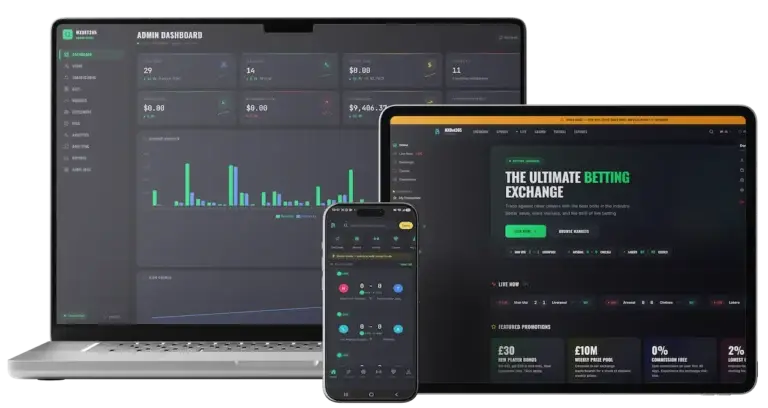
What the customer sees: sport and competition browsing, the exchange order book with back and lay, the fixed-odds bet slip with accumulators, live in-play markets and cash-out.
-
Open the web app in your browser
-
Login with the demo credentials below
-
Explore: Order book, Bet slip, Live, Cash-out
-
Try: demo@mxbetfair.com | Demo@1234
CASINO & WALLET
Games, Balances & Loyalty
The rest of the account: the casino catalog with category and provider filters, a multi-currency wallet with its ledger view, loyalty tiers and rewards, promotions and the affiliate dashboard.
-
Open the web app in your browser
-
Login with the same credentials below
-
Explore: Casino, Wallet, Loyalty, Affiliate
-
Try: demo@mxbetfair.com | Demo@1234
OPERATOR CONSOLE
Settlement, Risk & Compliance
Running it day to day: KPI dashboard, user management with KYC review, transaction oversight, market settlement and voiding, the risk desk, margin configuration and the audit log.
-
Open the admin console in your browser
-
Login with the demo credentials below
-
Explore: Dashboard, KYC, Settlement, Risk
-
Try: admin@mxbetfair.com | Admin@1234
ANDROID APP
Android Build - Your Brand, Your Store Listing
Shipped as React Native with near-complete web parity: tab navigation, bottom-sheet bet placement, the exchange order book, accumulators, casino launch and full account management.
-
Download the app to your Android device
-
Login with the customer credentials below
-
Explore: Sports, Live, Casino, Account
-
Try: demo@mxbetfair.com | Demo@1234
Watch It Work
Platform Walkthrough: Order Book, Bet Slip & Settlement
Want a guided tour? Book thirty minutes and we will map the launch with you: vertical mix, commission and margin settings, payment rails, KYC workflow and go-live sequencing against your licence timeline.
Every Screen Mapped
Platform Flows - Bettor, Trader, Casino & Operator Screens
More than 180 REST endpoints spread across 11 services, with a WebSocket hub carrying live odds, order status, matches, balances and scores over Redis pub/sub.

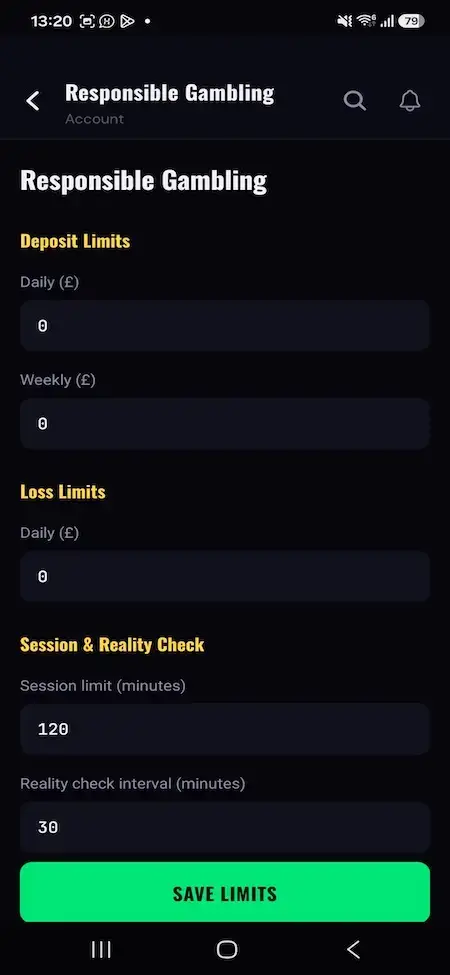

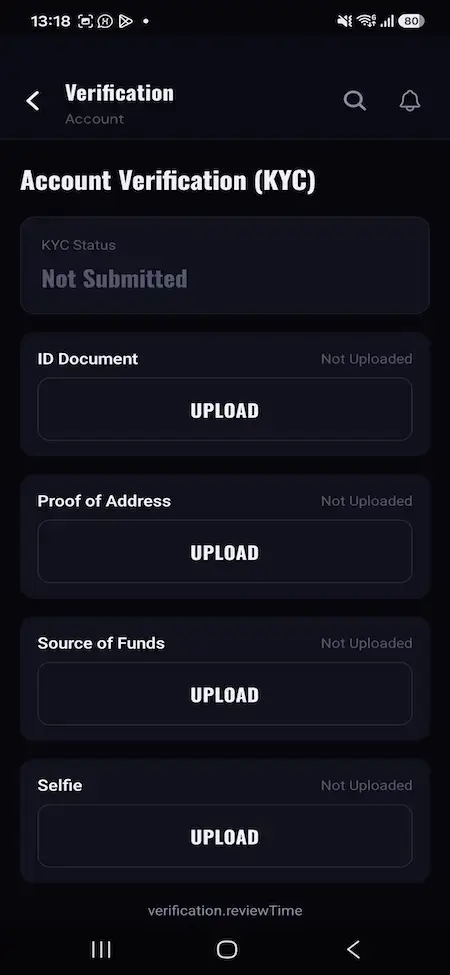

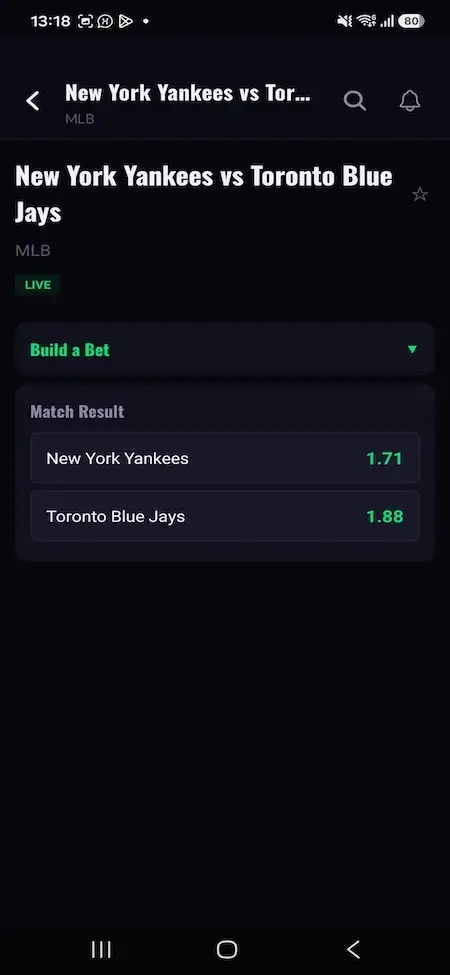
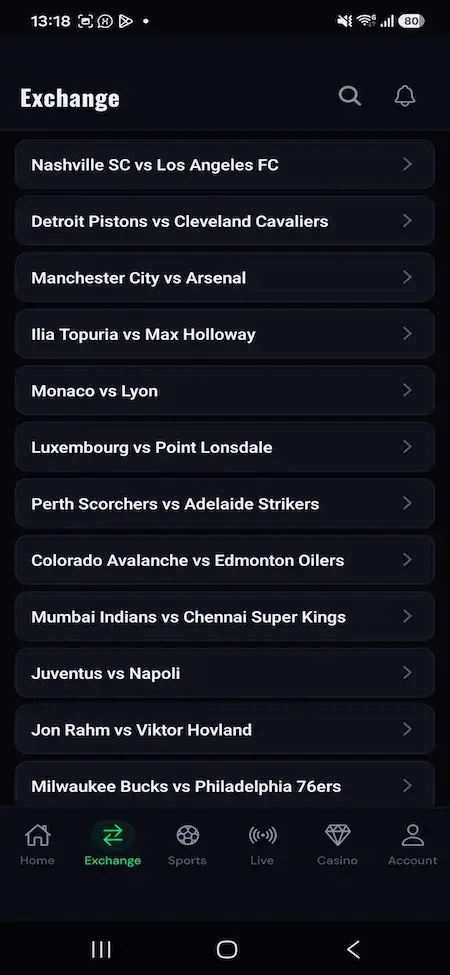
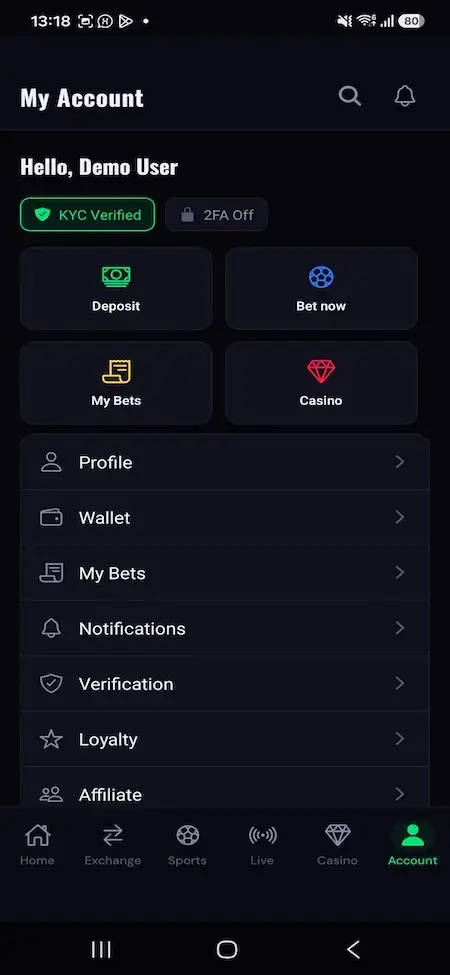
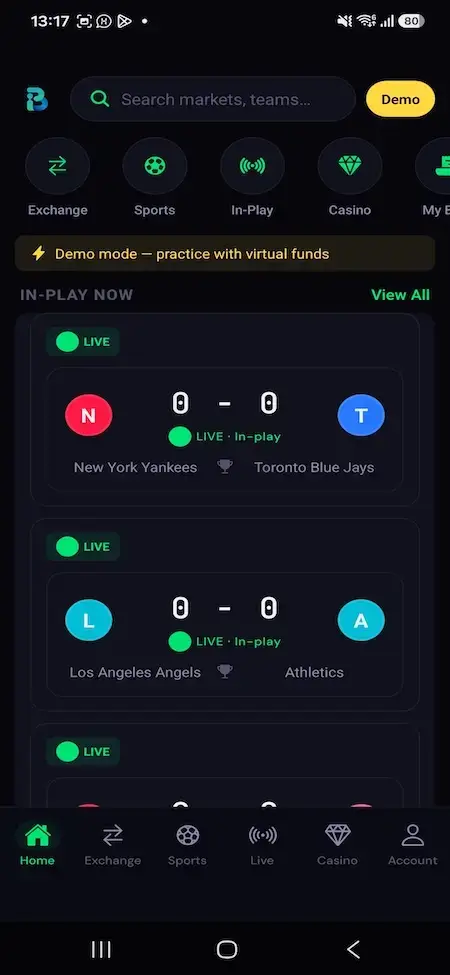
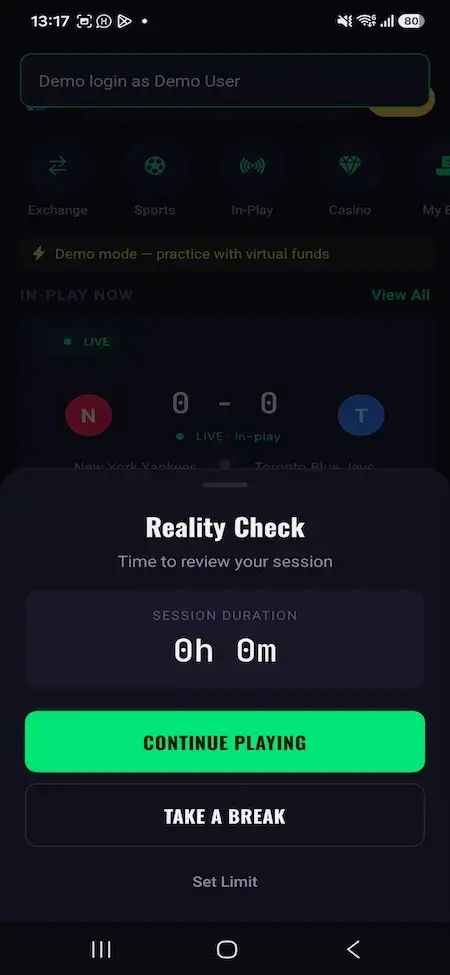
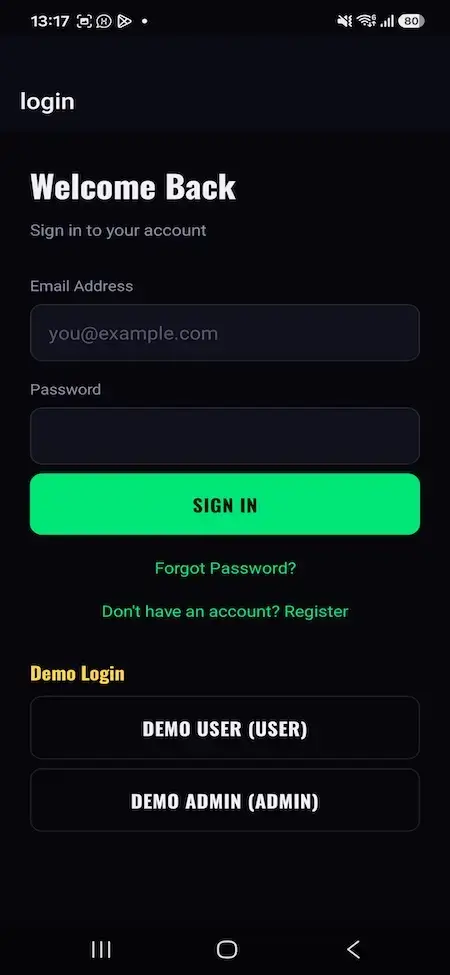
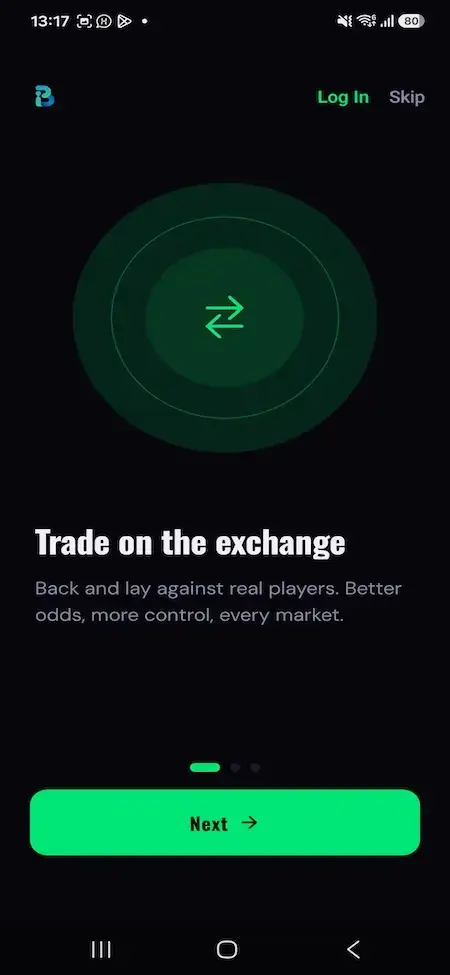
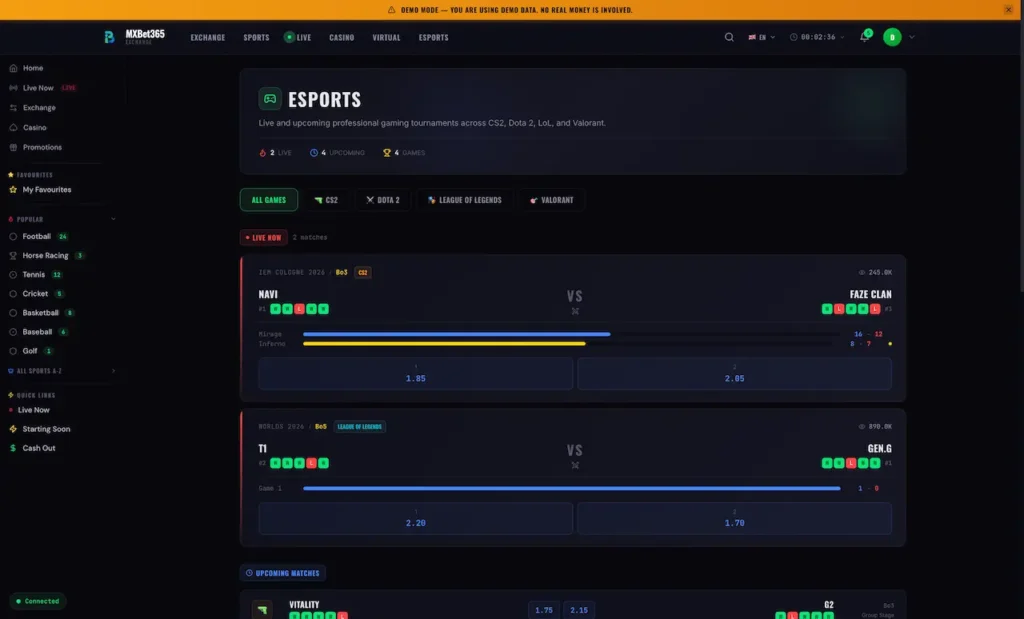
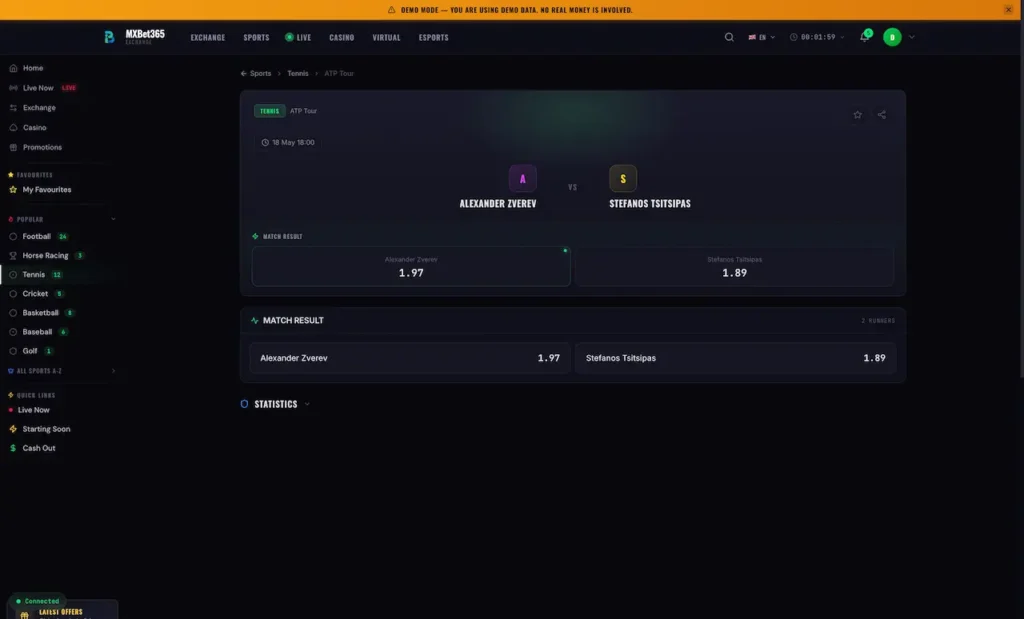
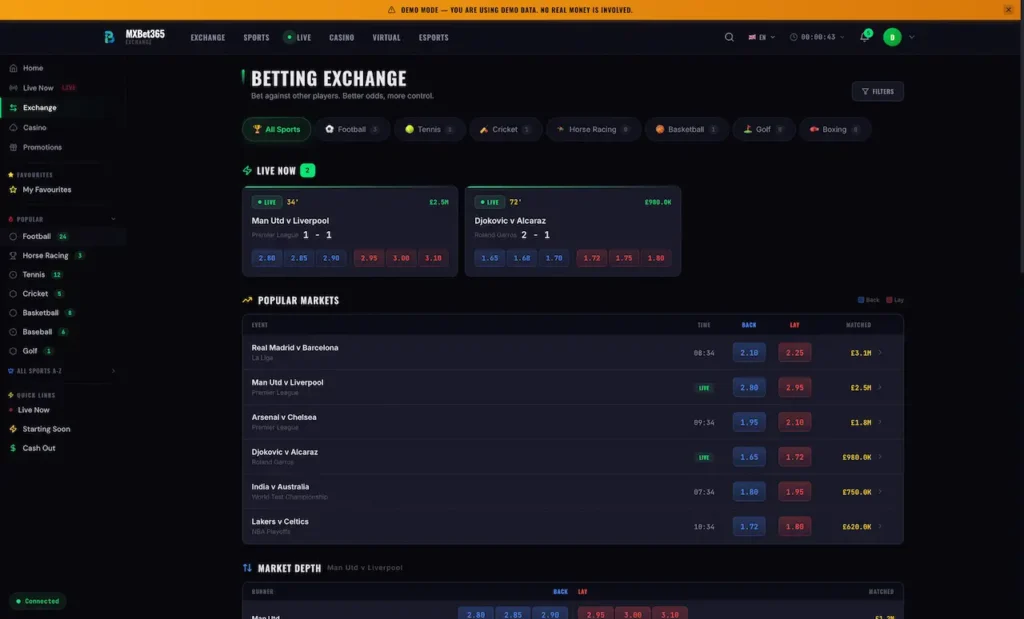
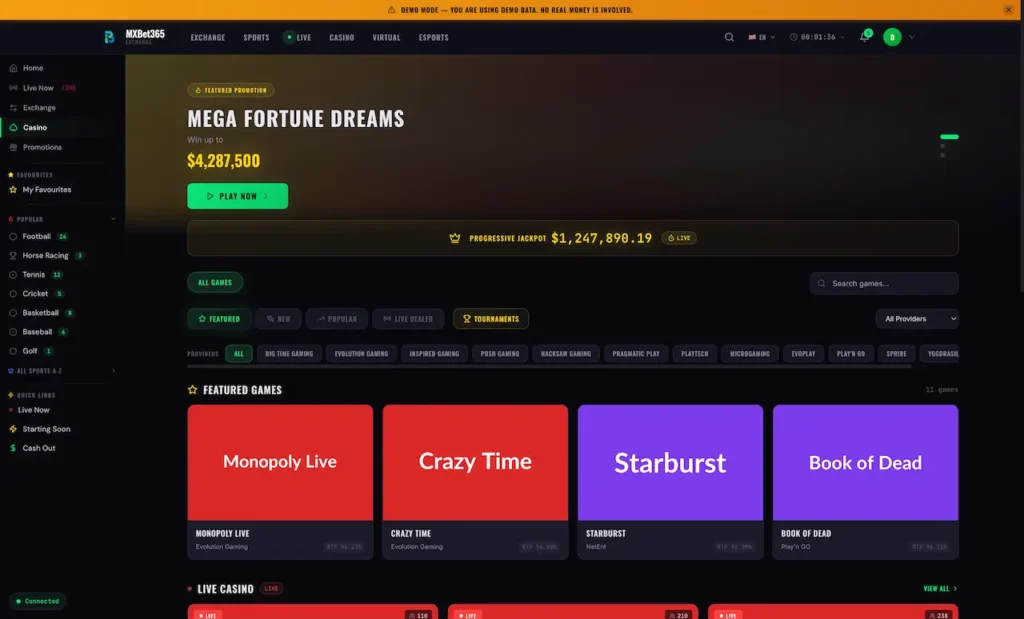
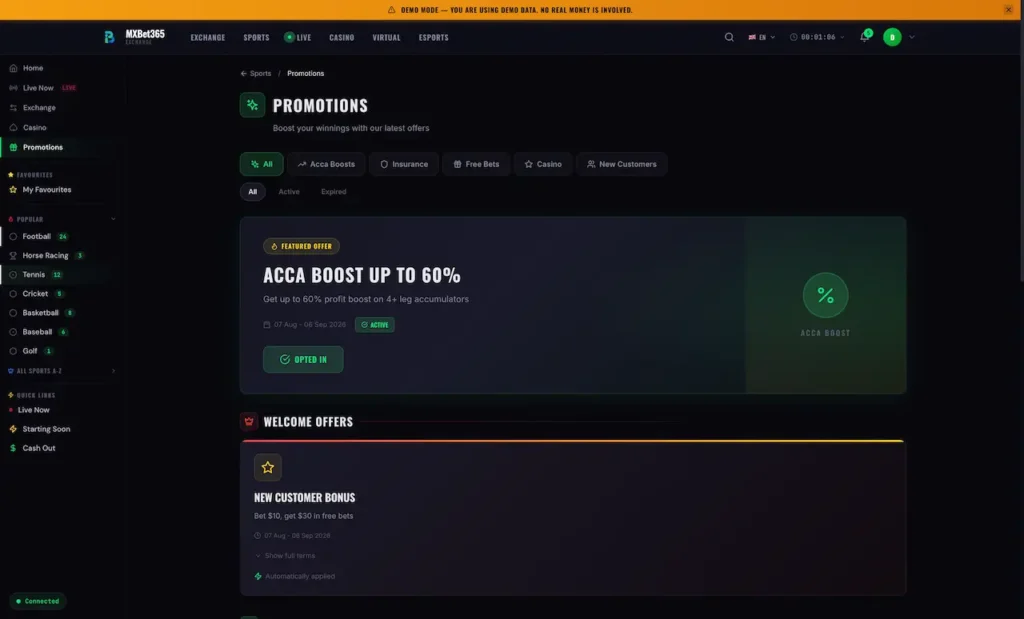
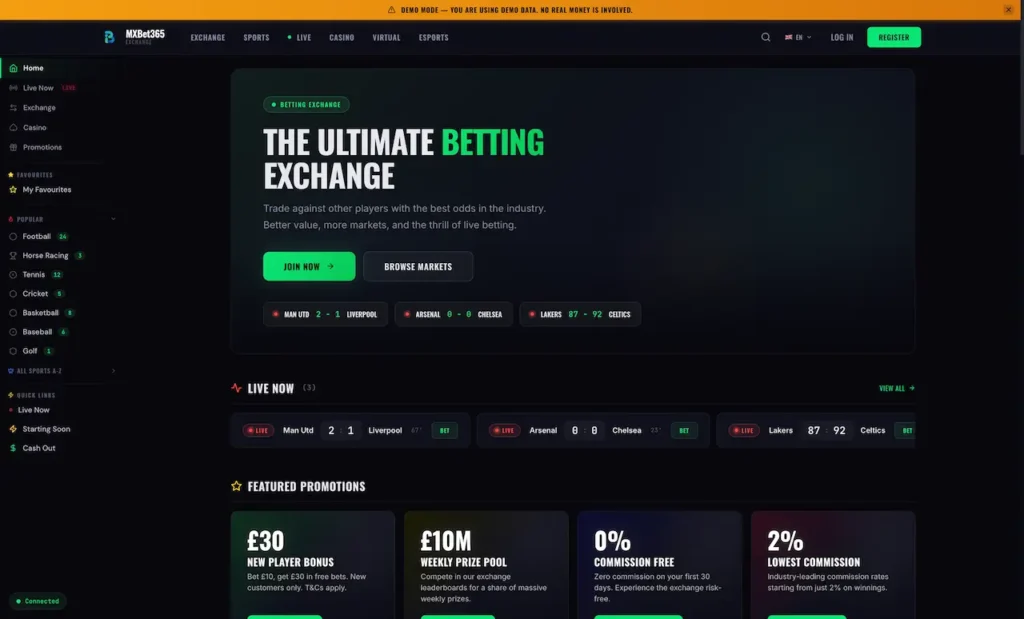
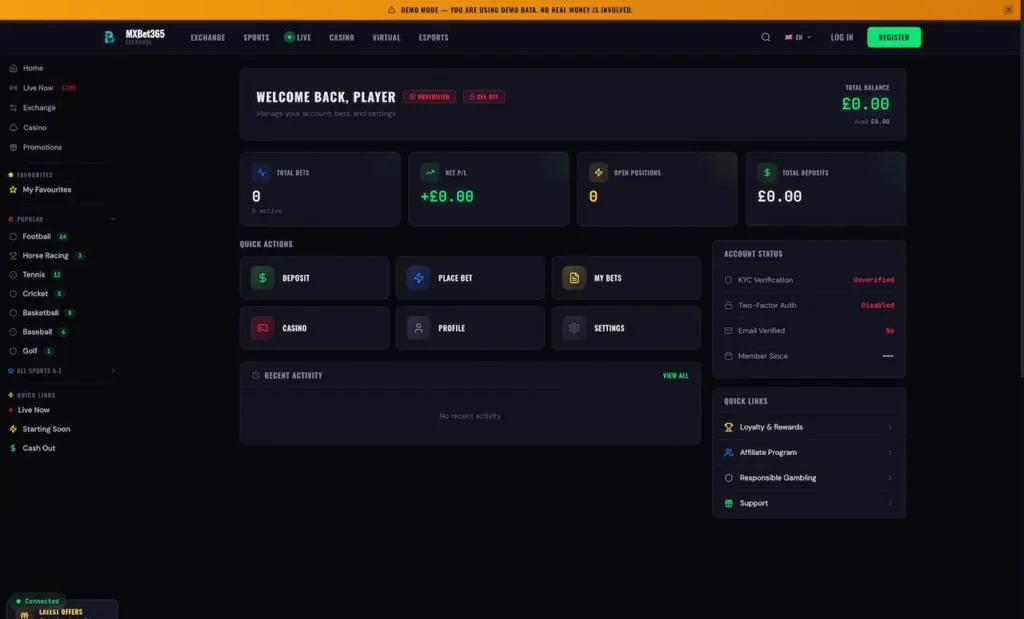
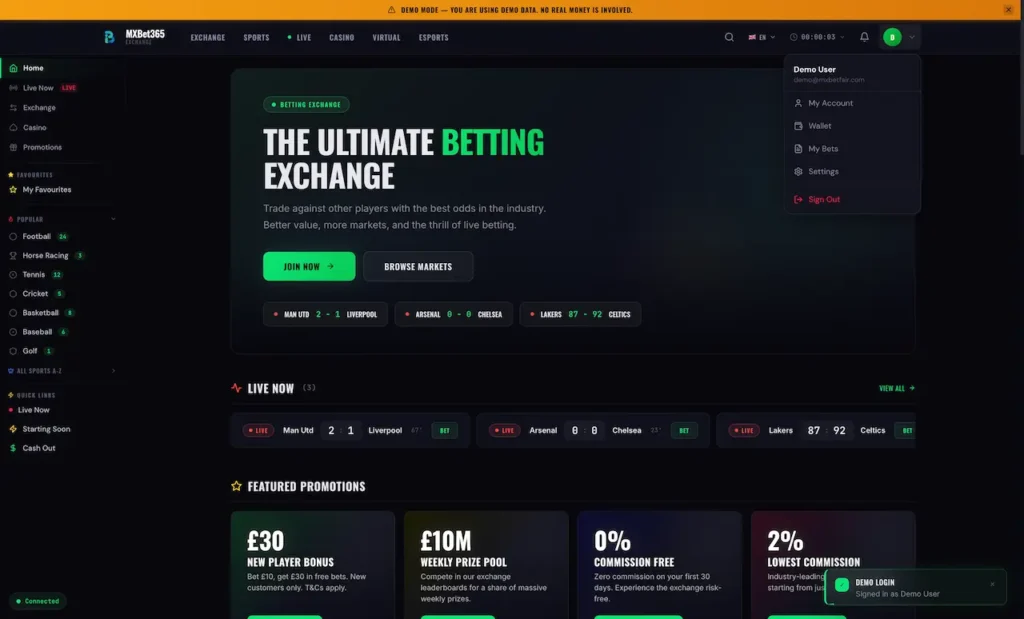
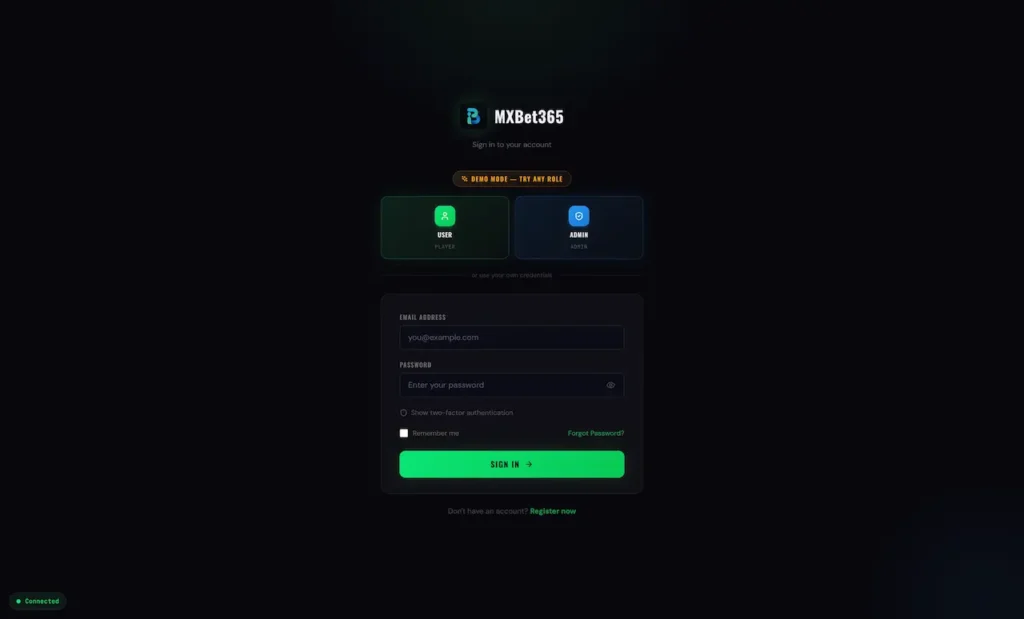
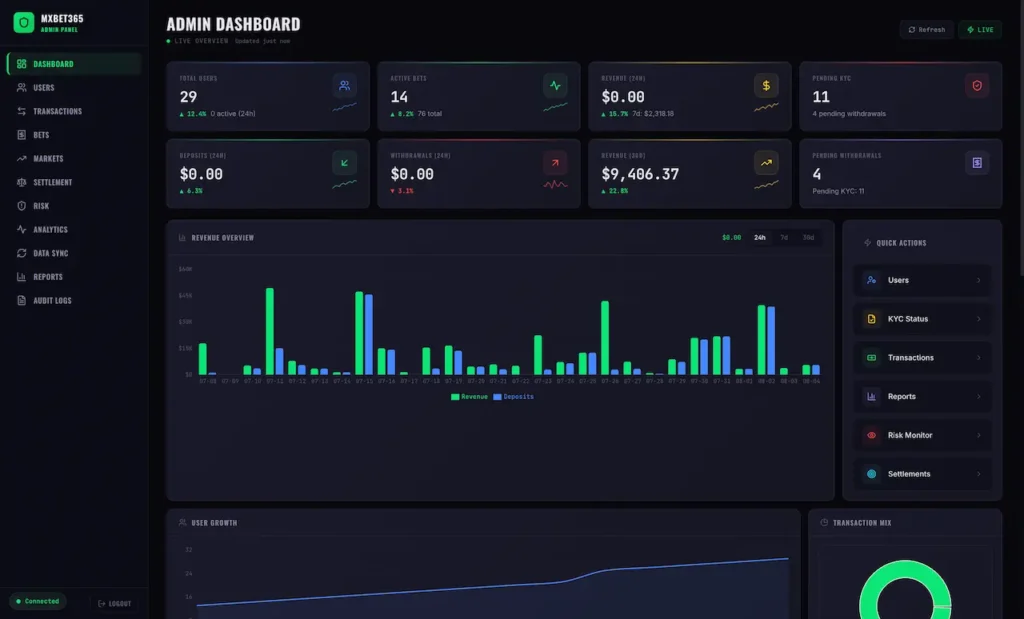
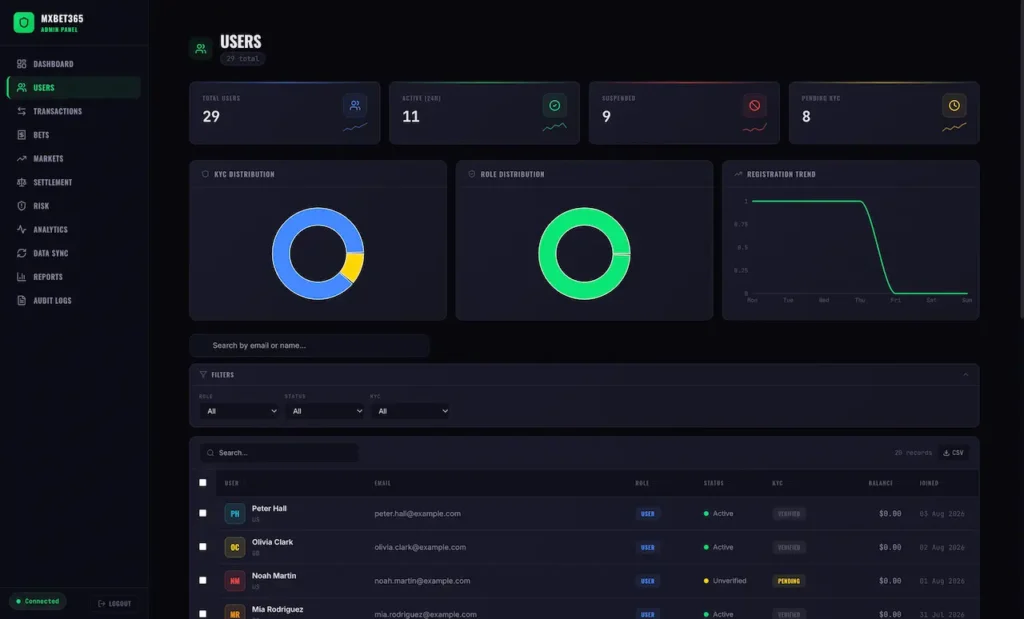
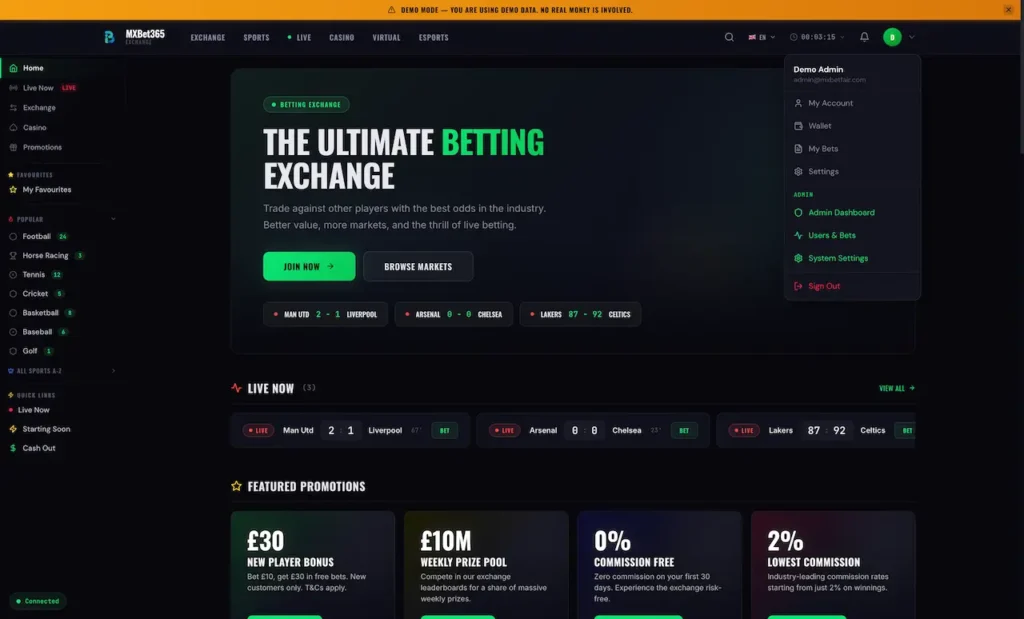
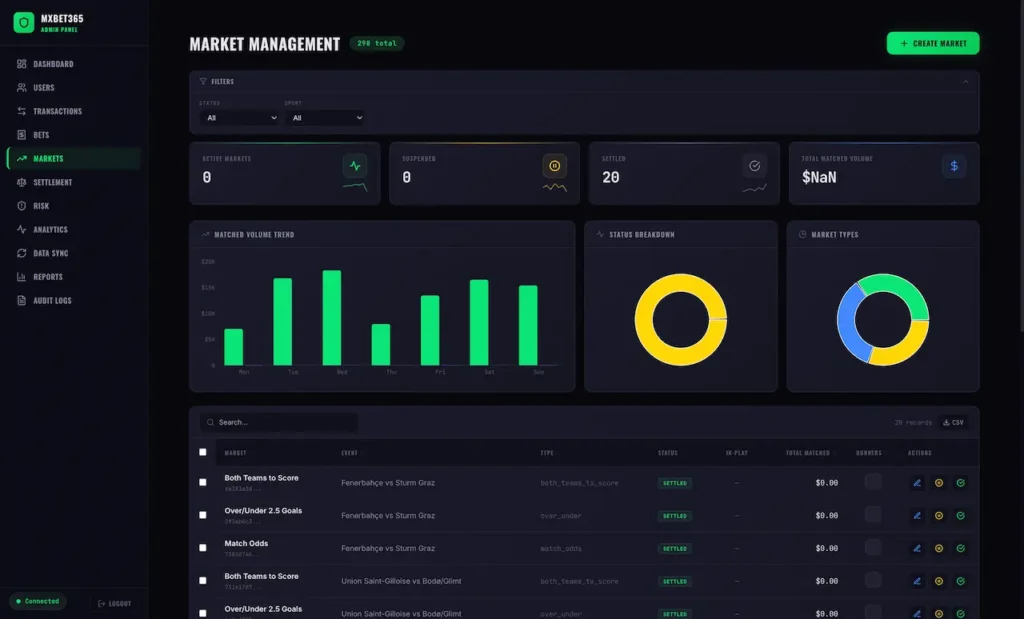
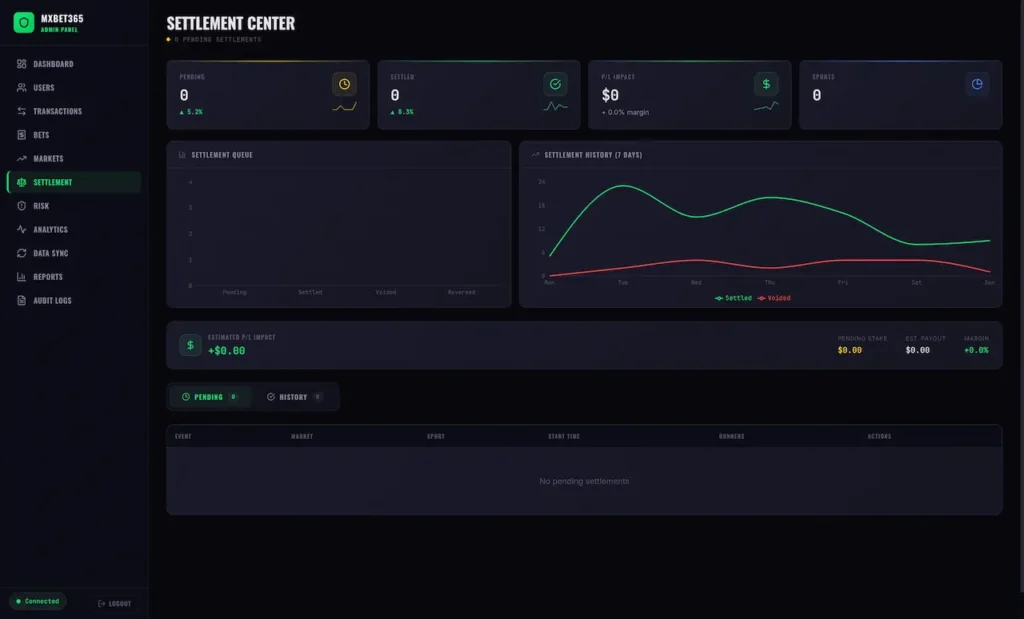
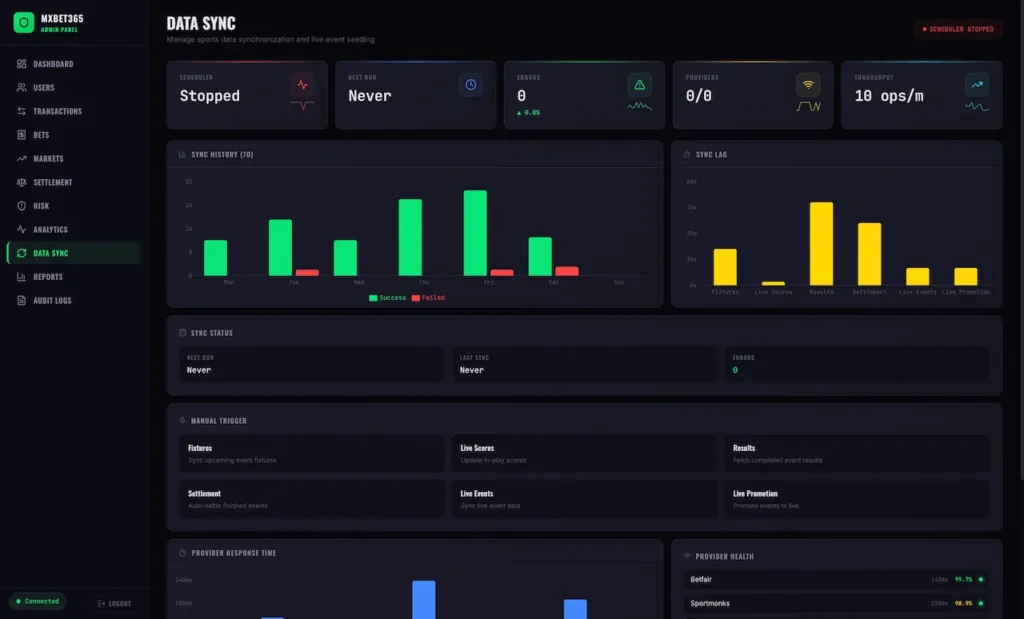
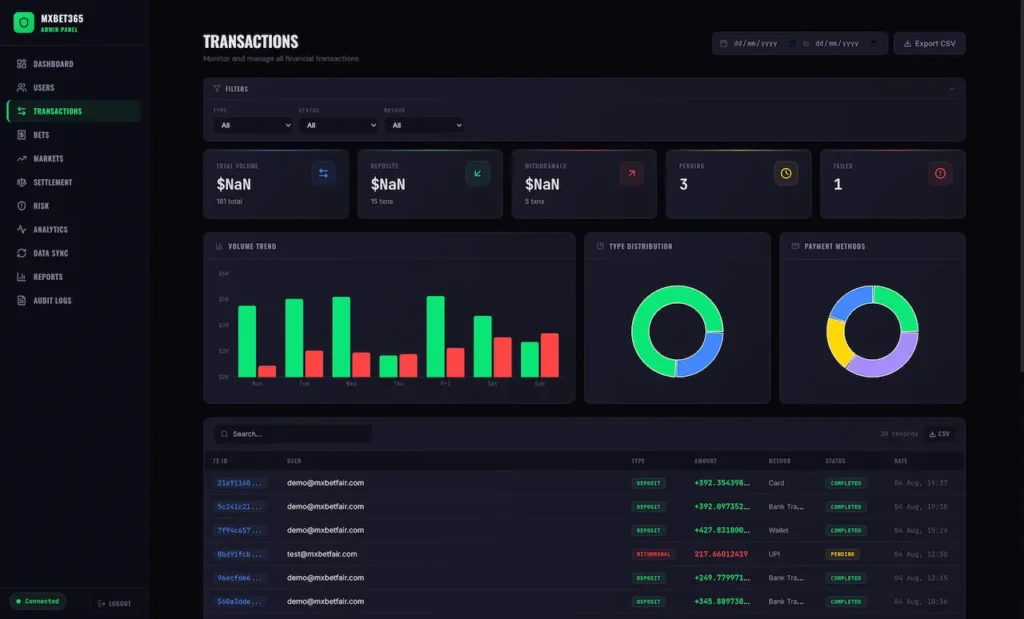
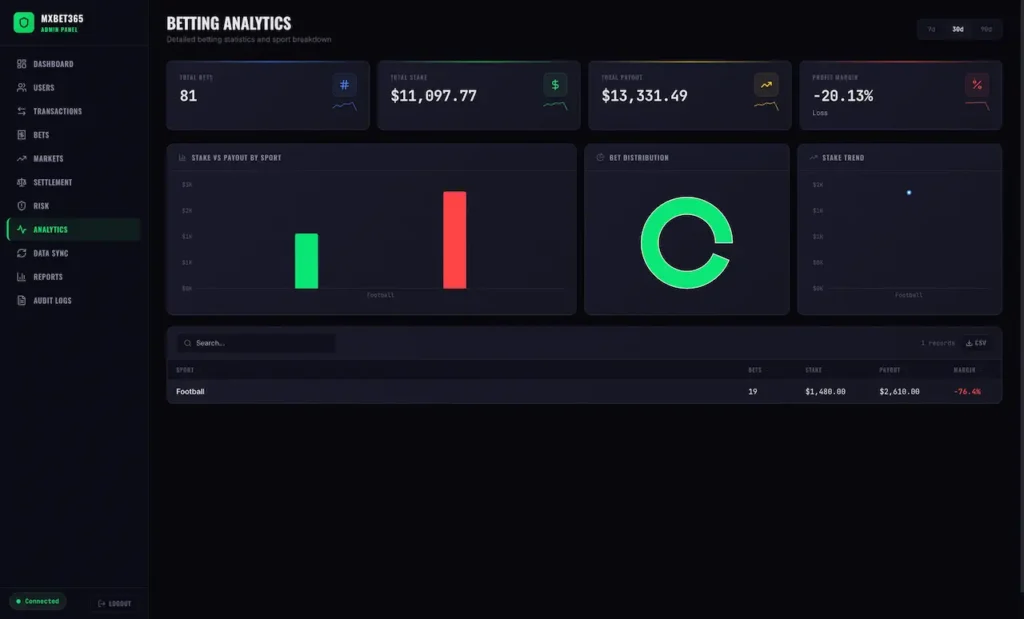
Watch a customer go from registration through KYC to a matched exchange order, a bettor from bet slip to a cashed-out accumulator, and an operator from a pending settlement to a reversed market.
Client Voices
Operator Reviews - Real Betting Platforms, Real Results
Operators who took betting brands to market on this platform, in their own words. Client identities withheld under NDA.
Proof in Production
Case Study - An Exchange & Sportsbook Deployment
How an operator launched a multi-vertical betting brand on this platform, under its own licence. Client identity withheld under NDA.
Confidential Deployment
Exchange & Sportsbook Operator
A regional betting brand launched on this platform under its own licence, running a peer-to-peer exchange, fixed-odds sportsbook and casino from one wallet and one back office.
- Running an exchange and a sportsbook from a single customer wallet
- KYC review and responsible gambling controls ready for the licence application
- Settlement, voiding and reversal handled in the back office rather than in the database
- Launch a multi-vertical betting brand without building a matching engine from zero
- Give the risk desk exposure monitoring and margin control on day one
- Earn from exchange commission, sportsbook margin and casino share at once
- In-memory order book with price-time priority matching
- Exchange commission, sportsbook overround & casino revenue share
- Six currencies across fiat and crypto
- Cash-out, accumulators, loyalty tiers & affiliate tools
- Node.js services with PostgreSQL, Redis and WebSocket
"The exchange is the part nobody else would quote us a sensible number for. Having it working on day one changed the whole plan."
The Basics
What Is White Label Sports Betting Software?
Betting software that ships under your name and covers three verticals at once: a peer-to-peer exchange where customers back and lay against each other, a fixed-odds sportsbook where the house prices the market, and a casino carrying slots, table games and live dealer categories. White label here means the brand, the domain, the wallet and the back office are all yours – and so is the source code that runs them.
Not a Sportsbook Skin
This is not a sportsbook with an exchange tab. Per-runner order books, price-time priority, partial fills, a validated ladder and cash-out with a hedging formula all work - and that engine is precisely why the category is expensive to build.
Not a Rental Platform
Handover, not access: the source, the Drizzle schema and the migrations, self-hosted on infrastructure you control. No per-seat fee, no dependency on our roadmap, standard PostgreSQL underneath.
You Bring the Licence
KYC, responsible gambling controls and audit trails all ship. A gambling licence does not. Operating in a regulated market is a legal responsibility that stays with you, and no software vendor can take it on.
Built for Web, Mobile & API
What Does White Label Ownership Mean Here?
Nobody loses a year on the front end. The year goes on a matching engine that fills correctly under load, a wallet that never loses a cent across bet placement and settlement, and a back office that can settle, void and reverse a market while a regulator is watching. Those are what this ships with.
-
Peer-to-peer exchange with a live order book
-
Fixed-odds sportsbook with accumulators and cash-out
-
Casino catalog with provider game launch
-
Six currencies across fiat and cryptocurrency
-
KYC, responsible gambling and audit built in
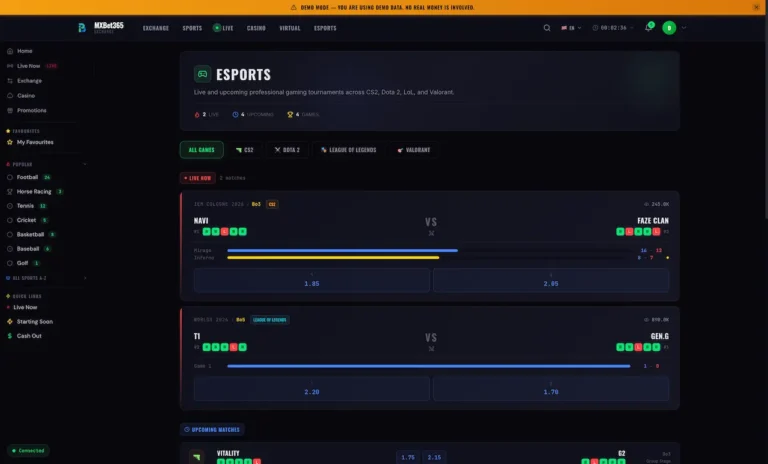
Put plainly: the multi-year engineering between an idea and a serious betting brand is already done. The build carries 35 PostgreSQL tables carrying 40 enums across 13 domains, over 180 REST endpoints across 11 services, six currencies spanning fiat and crypto, and a compliance suite covering KYC, responsible gambling and audit.
Everything Included
Platform Features - Exchange, Sportsbook, Casino, Wallet & Back Office
Nothing on this list is a roadmap item. Every capability below runs in the live demo you can open above. Where a feature needs a third-party account, a provider contract or a second migration before production, that is stated against the feature rather than implied away.
Identity & Two-Factor
Registration captures country and currency, followed by email verification, password reset and optional TOTP two-factor, over a three-tier role model that middleware enforces on every admin route.
- Country and currency chosen at registration
- Email verification plus password reset
- TOTP two-factor, enrolment through verification
- Three role tiers: user, admin, super admin
KYC Review Workflow
Documents come in as passport, licence, national ID or proof of address; an admin approves or rejects with a reason, and the reviewing admin is recorded against the decision.
- Passport, licence, ID and address accepted at upload
- Approve or reject at review, with a reason attached
- Status runs pending, then verified or rejected
- Reviewer identity recorded for the compliance trail
Responsible Gambling
Deposit caps set daily, weekly and monthly; daily loss limits; session time limits; self-exclusion with an end date; and reality check reminders. These are the controls a licence application asks to see.
- Deposit caps set daily, weekly and monthly
- Daily loss caps alongside session time caps
- Self-exclusion carrying an end date
- Reality check reminders on an interval you choose
Multi-Currency Wallet
Six currencies across fiat and crypto, each carrying total, available and reserved balances, so funds lock against open orders without ever leaving the customer balance.
- Six currencies ship: USD, EUR, GBP, BTC, ETH, USDT
- Total, available and reserved held as three balances
- Append-only ledger carrying balance-after snapshots
- Conversion between wallets built in
Immutable Ledger
Each movement is an append-only entry carrying direction, amount, balance after, source reference and description, written inside an ACID transaction with row-level locking.
- Stripe handles card deposits and withdrawals
- Bank transfer and crypto rails need configuring
- Saved methods stored as provider tokens only
- Transaction lifecycle with provider reconciliation
Exchange Matching Engine
Per-runner order books with price-time priority, partial fills, a validated ladder from 1.01 to 1000, three persistence types, and commission taken on net winnings.
- Hierarchy runs sport, competition, event, market, runner
- Back and lay placed against the order book
- Ladder validated across 1.01 to 1000
- Partial matches leave the remainder resting on book
Cash-Out Engine
Quotes come live off current market odds through a position-hedging formula, with a platform margin applied, a ten second validity window, and execution as an opposing order.
- Three persistence types governing market close
- Position tracking carrying profit and loss
- Cash-out quotes holding for ten seconds
- Commission taken on net winnings
Fixed-Odds Sportsbook
Pre-match and in-play pricing across single, accumulator and system bets, a full bet slip, cash-out on unsettled bets, and odds shown as decimal, fractional or American.
- Fixed odds shown pre-match and in-play
- Singles, accumulators and system bets
- Bet slip offering cash-out on anything unsettled
- Decimal, fractional or American odds display
Casino & Tournaments
Six game categories with provider and featured filters, launch through the provider API, session tracking, bonuses with wagering progress, and freeroll, buy-in and VIP tournaments across the tournament engine.
- Catalog spans six game categories
- Filter by provider or featured, with search
- Games launch through the provider API
- Bonuses tracked against wagering requirements
Promotions & Loyalty
Seven promotion types carrying opt-in and progress tracking, four loyalty tiers carrying points and a rewards catalog, plus free bets with restrictions, price boosts and cashback.
- Seven promotion types carrying opt-in and progress
- Four loyalty tiers on points, with a rewards catalog
- Free bets restricted by market, sport and odds
- Price boosts plus cashback claims
Affiliate Programme
Unique referral codes, four commission tiers, three calculation methods spanning net loss, deposit and wager, referral lifecycle tracking and commission withdrawal.
- Affiliate accounts carrying unique referral codes
- Four affiliate tiers, rates configurable
- Commission calculated on net loss, deposit or wager
- Referral lifecycle tracked through to commission withdrawal
Operator Back Office
KPI dashboard, user and KYC management, transaction oversight, settlement covering void and reverse, the risk desk, margin configuration, and an audit log you can filter.
- Live KPIs on the operator dashboard
- Settle, void or reverse a market
- Risk desk showing exposure, with large-bet flagging
- Margin configured per sport, with validation
Note for buyers: The software is complete on delivery and self-hosted on infrastructure you control. Card payments run through Stripe; bank transfer and crypto rails are configuration required. Push, email and SMS need Firebase, SendGrid and Twilio accounts. Casino games require provider contracts, and live odds require a sports data feed. eSports currently runs on mock data, poker and bingo are basic, and live dealer is integration-ready. The interface has an i18n framework but ships English only. Extended tables including promotions, loyalty, affiliates and tournaments need a second migration snapshot before production. Most importantly, the platform does not include a gambling licence.
How Operators Earn
Revenue Models - Commission, Margin, Casino Share & Affiliates
Revenue arrives from four directions at once here, and each is modelled as its own lever so an operator can tune one lever without disturbing the others.
Exchange Commission
A configurable percentage of net winnings, charged at settlement. The exchange never takes the other side, so this is revenue earned from matching two customers rather than from carrying risk.
Sportsbook Margin
Overround is built into fixed-odds pricing and configured per sport and per market type, with a validation tool checking each market against its band before it goes live.
Casino Revenue Share
Gross gaming revenue shared with game providers on whatever terms you negotiate, monetizing the customers that sports betting brought through the door.
Affiliate Acquisition
Four commission tiers across net loss, deposit and wager calculations turn marketing spend into a variable cost tied to what a customer is actually worth.
Free Bets as Acquisition
Free bets are issued by an admin or triggered by a promotion, carrying market, sport and minimum-odds restrictions, which keeps acquisition cost bounded and measurable.
White-Label Licensing
Branding, theme, currencies, margins and commission are configuration rather than code, so the same deployment can be licensed onward to another operator under their own identity.
Exchange commission and sportsbook margin carry most operators, because they monetize the same customer two different ways depending on which price is better at that moment, because they monetize the same customer in two different ways depending on which price is better at that moment.
Run It Without a Dev Team
Operator Console - Users, Settlement, Risk & Margins
A betting business is run from the back office, not the front end. Every admin route is protected at the router level by authentication and a role check, and every action lands in an audit log with the admin identity, the resource, a JSON payload of the change and an IP address.
Operator Console Sections
KPI Dashboard
Total and active users, bet volume and revenue across 24 hours, 7 days and 30 days, plus pending KYC, pending withdrawals and deposit volumes - with the queries issued in parallel.
User Management
A searchable, filterable user list; a detail view carrying wallets and balances; status management; and a per-user activity log for support and investigation.
KYC Review
The document queue shows front and back images. Approve or reject with a reason, and the reviewing admin is recorded against every decision for the compliance trail.
Transaction Oversight
Deposits and withdrawals filter by type, status and user, and carry provider references so they reconcile against the payment processor.
Market Settlement
Settle one market or batch settle a whole event, void a market and refund stakes, or reverse a settlement when a result is corrected after the fact.
Risk Desk
Exchange liability from unmatched lay orders sits next to sportsbook exposure from unsettled returns, with large bet and order flagging and velocity-based detection of suspicious accounts.
Margin Configuration
Overround minimum and maximum, odds range, maximum stake and commission percentage, all set per sport and market type, with a reset to defaults and a validation tool.
Reporting
Revenue by period, deposits by date range, user growth, and betting statistics per sport covering stakes, payouts and realized margin.
Audit Log
Admin actions are recorded with actor, action type, resource, JSON detail and IP address, filterable by action, user, resource type and date range.
- Revenue reported daily, weekly and monthly
- Deposits aggregated across a date range
- Growth tracked by registration date
- Per-sport betting statistics including realized margin
System & Sync
Health checks across every service, sports data sync triggering with provider health monitoring, live event seeding for demonstrations, and system settings management.
- Audit log filters on action, user and resource
- Health visible across every service
- Sync control for sports data, with provider health
- Live events seedable for demonstration
Need deeper governance? The documentation names four outstanding items: a monitoring stack, CSV and JSON export, a full-text search index, and a second migration snapshot for the extended tables. Automated KYC, geolocation and a WAF are the integrations regulated operators most often add. Tell us the requirement and we will scope it.
Transparent Pricing
How Much Does White Label Sports Betting Software Cost in 2026?
Deployment starts at $3,399 for a launch-ready platform in your own branding, with the source code handed over. What moves the number: which verticals you run, payment rails, casino provider integration, the sports data feed, KYC automation, and how much compliance work your licensing regime demands.
Not sure which option
is right for you?
Talk to us - we'll understand your goals, timeline, and budget, and point you to exactly what you need. No upselling, just honest advice.
The Full Package
What's Included - Full Source Code, Branded Apps & Deployment
Delivery here is a handover, not access. You receive the application source, the schema behind it, and the documentation a technical buyer and a licence consultant will both ask for. Everything transfers with full ownership and is self-hosted on your own infrastructure.
Full Source Code
Three codebases transfer: the Next.js 14 web application, the Expo React Native mobile app and the Node.js and Express backend, TypeScript throughout, yours to modify, rebrand and redeploy.
- Web application on Next.js 14, TypeScript throughout
- Expo React Native covering iOS and Android
- Backend on Node.js and Express, also TypeScript
- Hybrid monolith with microservice packages
35 Table Schema
PostgreSQL 16 under Drizzle ORM: 40 enums and around 60 indexes across 13 domains, with cascade rules on user-child tables and deliberately no cascade on financial records.
- 35 PostgreSQL tables carrying 40 enums
- Drizzle ORM giving type-safe queries and migrations
- Roughly 60 B-tree indexes across the hot paths
- Seed script supplying demonstration data
Exchange Engine
In-memory per-runner order books, price-time priority matching, partial fills, three persistence types, position tracking, and a cash-out calculation with quote expiry.
- Exchange engine keeping order books in memory
- Matching on price-time priority, partial fills included
- Ladder validated across 1.01 to 1000
- Cash-out priced by a position-hedging calculation
Sportsbook & Casino
Fixed-odds pricing across single, accumulator and system bets with cash-out, alongside a casino catalog carrying provider launch, sessions, bonuses and tournaments.
- Sportsbook covering singles, accumulators and system bets
- Casino catalog carrying provider launch and sessions
- Live and in-play carrying scores and match minute
- eSports and virtual sports listings
Wallet & Ledger
Six currencies, three-balance accounting, an append-only ledger with balance snapshots, decimal.js money maths, and ACID mutations under row-level locking.
- Wallet spanning all six currencies
- Immutable ledger holding balance-after snapshots
- decimal.js arithmetic, no float rounding anywhere
- Stripe wired for card deposits and payouts
Real-Time Layer
A WebSocket hub riding Redis pub/sub carries odds updates, order status, match executions, balance changes and live scores on per-user and per-market channels.
- WebSocket hub riding Redis pub/sub
- Odds, order status, matches and balances all live
- Score broadcasting with a heartbeat
- Per-user channels carrying personalized updates
Operator Console
Dashboard, users and KYC, transactions, settlement covering void and reverse, the risk desk, margin configuration, reporting, the audit log and system health.
- Operator console covering settlement and risk
- KYC review beside the audit log and reporting
- Margin configuration, validation tool included
- Role-based access across three tiers
Technical Documentation
Seven documents ship: entity relationship, schema reference, an API collection across 11 services, developer and security handbooks, the VAPT posture, and the PRD with feature catalog.
- Entity relationship document and schema reference
- Full API collection spanning 11 services
- Developer, security and deployment handbooks
- VAPT posture alongside the PRD and feature catalog
Want to see it running first? Use the customer or operator login above, or book a walkthrough and we will take you through a matched order, a cashed-out accumulator, a casino launch and a settled market against your own vertical mix.
Know Your Buyer
Who Is This White Label Betting Platform Built For?
This fits operators who want more than a sportsbook skin, and who understand that the exchange engine and the back office are what separate a real betting business from a front end.
Startup Operators
Established Sportsbooks
Crypto & Gaming Companies
Emerging Market Brands
Multi-Country Groups
Media & Publishers
Renting a betting platform means paying a licence fee forever to the company that holds your order book, your wallet and your compliance evidence. Owning it changes all three. If your business turns on customer deposits, on pricing risk correctly, or on proving to a regulator that your controls actually work, the platform stops being an operating expense and starts being an asset you can defend.
Where It Fits
Use Cases - Exchange, Sportsbook, Casino & Crypto Betting
Which vertical leads changes with the operator; the codebase does not. An exchange-first brand leans on the matching engine and commission; a sportsbook-first brand leans on margin configuration and the risk desk. Each is configuration rather than a fork.
Peer-to-Peer Exchange
Customers set their own prices and the platform earns commission on net winnings, never taking a position on the outcome and the platform earns commission on net winnings without ever taking a position on the outcome.
Fixed-Odds Sportsbook
Overround is configured per sport and market type, with a validation tool that catches a mispriced market, a validation tool that catches a mispriced market, and a risk desk showing exposure before it becomes a loss.
Casino & iGaming
A casino vertical monetizes the audience sports betting already brought through the door, with provider game launch, bonuses carrying wagering requirements and tournaments driving repeat sessions.
Crypto Betting Platforms
Bitcoin, Ethereum and USDT wallets sit alongside dollars, euros and pounds, all on the same three-balance accounting model.
Emerging Market Operators
Emerging markets get a mobile-first launch: native iOS and Android apps, near-complete feature parity with web, and a wallet designed for the payment rails that market actually uses.
Multi-Brand Enterprises
Several brands run as separate deployments, each holding its own database, domain and branding, but the same compliance tooling and the same operator training.
One platform, many configurations. Every use case above sits on the same 35 table schema and the same three verticals. What changes is which vertical leads, the commission and margin settings, the currencies enabled and the branding, not a fork you then maintain separately.
Market Timing
Why Launch a Betting Platform in 2026?
A from-scratch build of this scope is documented at roughly $1.29m to $2.95m over 18 to 36 months, with the matching engine alone accounting for $300k to $800k and eight to fourteen months of that. Those are the numbers this category is priced against.
The Engine Is the Barrier
Custom betting projects stall on exactly one thing: a price-time priority order book with partial fills and cash-out. Starting with one that already matches correctly removes the single largest build risk in the category.
One Wallet Lifts Value
A customer who bets on sport and plays casino off one balance deposits more and stays longer. Two products behind one signup is a retention mechanic, not a longer feature list.
Liquidity Cuts Both Ways
A pure exchange dies without volume. Running fixed odds beside it guarantees a price on screen even on a market nobody else is trading.
Compliance Is the Gate
Compliance is the gate, not the polish. KYC review, deposit and loss limits, self-exclusion and an audit trail carrying IP addresses are what a licence application asks for, and retrofitting them afterwards is considerably harder than having them from the start.
Crypto Widens the Market
Bitcoin, Ethereum and USDT running alongside fiat reach audiences card rails cannot, without routing settlement through a third-party processor.
Buy-Versus-Build Is Settled
From scratch, the documented range runs into seven figures across 18 to 36 months. This deployment is live on your infrastructure in under six days.
Platform by the Numbers
The barrier was never the front end. It is the matching engine, the wallet correctness, and the compliance surface a regulator will actually inspect. All three are unglamorous, mandatory and slow to get right.
Under the Hood
Tech Stack - Next.js 14, Node.js, PostgreSQL, Redis & React Native
Behind the screen, three things have to hold: a matching engine fast enough to fill in milliseconds, a wallet that cannot lose money under concurrency, and a real-time layer that keeps every screen honest. Here is what sits behind the odds.
Web Application
Next.js 14 App Router · TypeScript
- Public sport and casino pages rendered server-side
- State handled by Zustand against a typed API client
- WebSocket client carrying live odds and balance updates
- Dark, light and system theming with i18n framework
Mobile Application
Expo React Native · TypeScript
- One codebase producing native iOS and Android
- Tab navigation, bet placement in a bottom sheet
- Feature parity with web, near enough complete
- Push notifications plus biometric authentication
Backend Services
Node.js · Express · TypeScript
- A unified server sitting over microservice packages
- More than 180 REST endpoints across 11 services
- Every admin route passes authenticate, then authorize
- Health endpoint exposed by each service
Data & Money
PostgreSQL 16 · Drizzle ORM · decimal.js
- 35 tables, 40 enums and around 60 indexes
- numeric(18,8) precision for fiat and crypto alike
- ACID wallet mutations with row-level locking
- Append-only ledger carrying balance-after snapshots
Matching & Real-Time
In-Memory Order Book · Redis 7 · WebSocket
- Per-runner books ordered by price-time priority
- Redis pub/sub feeding the WebSocket hub
- Channels split across odds, orders, matches, balances and scores
- Heartbeat detection for stale connections
Identity & Access
JWT · bcrypt cost 12 · TOTP
- Access tokens last 15 minutes, refresh tokens 7 days
- Refresh rotation, with reuse detection triggering revocation
- Five failed attempts locks the account for 15 minutes
- Three-tier role model across user, admin and super admin
Note for Tech Buyers: order books live in memory, which is what makes matching fast and also makes the engine the one component scaling vertically rather than horizontally. Every other service is stateless. Input validation is inline rather than schema-driven, with no Zod or Joi layer. There is no bundled monitoring stack, no CSV or JSON export, and no full-text search index. The extended tables covering notifications, promotions, loyalty, affiliates and tournaments need a second migration snapshot before production. Card payments run through Stripe; bank and crypto rails, push, email, SMS, casino providers, the sports data feed, KYC automation and geolocation each need your own account or contract. Everything above is mainstream and widely hired for, self-hosted on your infrastructure.
End to End
How the Platform Works - Register, Fund, Bet, Match & Settle
From the outside this looks like odds and a bet slip. Underneath it is a tightly sequenced identity, funding, matching and settlement pipeline. Here is the path from registration to a settled market and a paid customer.
Customer Journey, From Signup to Settled Position

Register and Verify
A customer signs up with country and currency, then proves who they are before the withdrawal limits open up. This is the gate a regulator inspects first.
- Registration with country, currency and date of birth
- Email verification and optional TOTP two-factor
- KYC upload across passport, licence, ID and address
- Admin review with approve, reject and a recorded reviewer

Fund the Wallet
Money enters through a payment provider and lands in a per-currency wallet, with an immutable ledger entry written in the same transaction.
- Card deposits through Stripe with webhook confirmation
- Bank transfer and crypto rails as configuration
- Per-currency wallets across six supported currencies
- Ledger entry with a balance-after snapshot every time

Place the Bet
The customer chooses their vertical. On the exchange they set a price and side; on the sportsbook they take the house price. Either way funds are reserved, not spent.
- Exchange back or lay at a validated ladder price
- Sportsbook single, accumulator or system bet
- Funds moved from available to reserved on placement
- Rate limited at ten orders per second per market

Match and Broadcast
The engine fills the order against resting liquidity on the opposite side, then tells every affected screen at once over the real-time layer.
- Price-time priority matching against the book
- Partial fills leave the remainder resting
- Match recorded in the matched bets junction
- Odds, order, balance and position pushed over WebSocket

Trade Out or Ride It
Before the event ends the customer can take a price to close the position rather than waiting for the result.
- Cash-out quote from current market odds
- Position-hedging calculation with a platform margin
- Quote valid for ten seconds before it must refresh
- Execution places an opposing order at market price

Settle and Audit
The operator settles the market, the wallet moves, and every step of it is recoverable from the ledger and the audit log.
- Manual or batch settlement by market or event
- Commission applied to net winnings on the exchange
- Voiding refunds stakes, reversal undoes a settlement
- Admin action logged with resource, detail and IP
Visual Flow Diagram
Register → Verify KYC → Deposit → Bet → Match → Settle
How It's Built
Platform Architecture & Backend Flow
Hybrid Monolith and Services
One Express server consolidates routing while 11 service packages carry the domain logic, so you can start on a single process and split the busy services out later.
Two Parallel Event Hierarchies
Exchange and sportsbook share sports and competitions but split at market level, because peer-to-peer matching and house pricing genuinely need different models.
Money Moves Inside Transactions
Every wallet mutation runs inside a database transaction with row-level locking and writes a ledger entry, so a crash mid-settlement cannot leave a balance wrong.
State Machines Everywhere
Events, markets, orders, transactions, KYC and bonuses each follow an explicit enum lifecycle, which is what makes settlement and reporting deterministic rather than best-effort.
Redis as the Nervous System
Rate limiting, FX caching, session state and the pub/sub behind the WebSocket hub all run through Redis, which keeps the API stateless where it matters.
Audit as a First-Class Table
Admin actions write to an audit log carrying actor, resource, JSON detail and IP, with a Redis-indexed service alongside it for fast filtered retrieval.
Performance Targets
Built to Scale - In-Memory Matching, Indexed Reads & Growth Headroom
Documented targets: order placement under 100 milliseconds at the 95th percentile, page load under two seconds, 10,000+ concurrent users and 99.9% API availability. The architecture that supports those is deliberately conventional apart from the engine.
Matching Speed and Its Trade-Off
Holding order books in memory makes a fill sub-millisecond rather than a database round trip. That choice is what makes the exchange usable, and it is also the honest limit of the design.
The matching model rests on:
- Per-runner books ordered by price-time priority
- Partial fills leaving the remainder resting on book
- Sequential processing per market, parallel across markets
- Vertical scaling on the engine while every other service scales out
Financial Correctness Under Concurrency
Two customers hitting the same wallet in the same instant is what quietly corrupts betting platforms, so it is handled at the database rather than in application code.
The wallet model provides:
- Row-level locking on the wallet during mutation
- Available balance checked before any debit
- decimal.js arithmetic with no floating point rounding
- Append-only ledger entries with balance-after snapshots
Read Paths That Stay Cheap
Odds pages, bet history and the operator dashboard take the read load, so the schema is indexed for exactly those filters.
The read strategy runs across:
- Around 60 B-tree indexes on foreign keys and status columns
- Timestamp indexes for date-range reporting queries
- Dashboard aggregates issued in parallel rather than in series
- Redis caching for FX rates and rate limit counters
Real-Time Without a Broadcast Storm
A liquid market reprices constantly, and naive broadcasting is exactly how a WebSocket layer falls over.
The real-time model uses:
- Redis pub/sub between the engine and the socket hub
- Per-market and per-user channels rather than global fan-out
- Heartbeat detection to drop stale connections
- Horizontal hub scaling with Redis-backed session sharing
Sub-Millisecond Matching
Keeping order books in memory takes the database round trip out of the fill path, which is what holds order placement inside the documented 100 millisecond target.
Stateless Everywhere Else
Auth, user, wallet, sportsbook, casino, payment, notification and admin all run stateless and scale out horizontally behind a load balancer.
Indexed for the Real Queries
Around 60 B-tree indexes cover foreign keys, status columns and timestamps - the three filters betting and reporting workloads actually hit.
Parallel Dashboard Aggregates
The operator dashboard fires its queries concurrently rather than one after another, which is what holds load time down as the data grows.
Documented Bottlenecks
Engine memory, order table write pressure and WebSocket broadcast volume are each named with a mitigation in the documentation, rather than discovered under load.
Deployment Flexibility
Single server, multi-server, Docker, or cloud-native with managed PostgreSQL and Redis - self-hosted on infrastructure you control either way.
Built for Customization & Long-Term Growth
Every operator eventually needs something specific to their market or their regulator. The stack is conventional so extending it is ordinary work.
Adding a sport is two inserts; adding a payment provider is an enum value and a service class; adding a language is a JSON file. Next.js, Node.js, PostgreSQL, Redis and React Native are all widely hired for.
Note for founders and operators: The bottlenecks are documented rather than discovered: engine memory grows with open order count, database write pressure concentrates on the orders and matched bets tables, and the login rate limiter is in-memory per process until Redis backs it. Each has a stated mitigation, and none requires rearchitecting.
Built to Be Audited
Platform Security - OWASP-Mapped, Ledger-Backed & Audit-Ready
Security posture is mapped against the OWASP Top 10 in a dedicated compliance document. On a betting platform the questions that actually matter are whether money can go missing, whether an admin action can be denied, and whether a regulator can reconstruct what happened. All three are answered in the data model rather than in policy.
Validation Rated Moderate
Rate Limiting Tiers
Injection and XSS Posture
Card Data Never Stored
Monitoring Is Not Bundled
The Licence Is Yours
Money Cannot Silently Move
No balance moves silently. Every wallet mutation runs inside a transaction with row-level locking and writes an append-only ledger entry carrying a balance-after snapshot, so any balance can be reconstructed from first principles.
Precision Without Rounding
Monetary maths runs on decimal.js over numeric(18,8) columns: eight decimal places for crypto, exact arithmetic for fiat, and no floating point drift anywhere.
Session Security
A 15 minute access token against a 7 day refresh, one-time refresh use, reuse detection that revokes the entire chain, and hashed refresh storage in the database.
Credential Hardening
bcrypt at cost 12, an eight character minimum requiring uppercase, number and special character, and a lockout after five failed attempts for fifteen minutes.
Admin Accountability
Administrative actions write an audit row carrying actor, action type, resource, a JSON payload of the change and the originating IP, filterable by action, user, resource and date.
Player Protection
Deposit caps set daily, weekly and monthly, loss limits, session limits, self-exclusion with an end date and reality checks - enforced by the platform rather than merely displayed to the customer.
What is built is genuinely strong: bcrypt at cost 12, refresh token rotation with reuse detection, TOTP two-factor, ACID wallet mutations with row-level locking, an append-only ledger, and an audit log carrying the admin identity and IP address. Where the documentation rates something Moderate or Configuration Required, this page says so.
Go Further
Add-Ons - Compliance, Providers, Monitoring & Enterprise
The platform is complete and demonstrable on the day it ships. The modules below are what operators most often add, either because they need a provider contract, or because their scale, security review or licensing regime demands it.
Licensing & Regulatory Support
The compliance tooling a licence application expects is already here. Obtaining the licence itself, and adding whatever jurisdiction-specific controls your regulator asks for, is scoped work alongside your own legal advisors.
Casino Game Providers
Catalog, launch flow and session tracking are built. The games themselves need provider contracts and API credentials, which is commercial work rather than development.
Sports Data Feed
Fixtures, live scores and results arrive from an external provider. The sync management and provider health screens exist; the feed subscription is yours to arrange.
Automated KYC
Document upload and manual admin review ship complete. Wiring an automated identity verification provider in front of them to pre-screen submissions is a scoped integration.
Monitoring & Observability
Health endpoints and console logging ship today. Prometheus metrics, Grafana dashboards, Sentry error tracking and log aggregation are the standard additions on top.
Extended Table Migration
Core tables are migrated already. Notifications, promotions, loyalty, affiliates and tournaments sit in the schema and want a second migration snapshot before production.
Additional Payment Rails
Stripe cards ship wired. Bank transfer, crypto flows and whatever local method your market requires are configuration and integration on the same provider pattern.
Search & Export
Search is pattern matching rather than a full-text index, and reporting is API-first with no CSV or JSON export. Both are contained pieces of work once volume justifies them.
The Commercial Case
Marketability, Revenue Potential & Business Prospects
Demand is rarely the constraint in betting. Licensing, payment rails and the cost of building the technology are. It is licensing, payment rails and the cost of building the technology, and this platform removes the third of those entirely.
Four Revenue Lines
Exchange commission, sportsbook overround, casino revenue share and affiliate economics are four separate levers reaching different customers - not one model wearing four names.
Commission Without Position
On the exchange you never take the other side. Commission on net winnings is revenue earned from matching customers rather than from carrying their risk.
Cross-Vertical Lifetime Value
One wallet spanning sport and casino lifts deposit frequency and retention, which is the documented reason multi-vertical operators outperform single-product brands.
Exit Optionality
Codebase and schema are yours on standard PostgreSQL, self-hosted. Nothing proprietary to unwind later, and no platform fee anyone can renegotiate.
Fixed-odds sportsbook usually goes first, because it earns from the first settled market without needing two customers to agree on a price. The exchange runs beside it and accumulates liquidity over the opening months – which is the whole reason for the dual model, since there is always a price on screen meanwhile. Casino tends to follow once provider contracts are signed, and typically ends up the largest single line. The gating item is almost never the software. It is your licence and your payment rails.
Licence, liquidity and habit – not code. A licence is a real barrier every competitor has to clear too. Exchange liquidity compounds, because traders go where the book is deepest. And a customer holding a loyalty tier, a balance and a bet history does not drift off casually. What the platform contributes is making the second and third true early: liquidity gets seeded by running fixed odds alongside the exchange, and habit gets built by loyalty, promotions and free bets that ship rather than waiting to be built.
Example Revenue Scenarios
In betting the software sets your economics, which is the whole commercial case for owning it. Commission rate, overround per sport and casino share are the three numbers that determine profitability, and all three belong to whoever controls the deployment.
Single Market Launch
Verticals Live
Sportsbook margin carries early revenue.
A first brand where fixed odds carries the volume, the exchange accrues liquidity gradually, and casino monetizes the audience that sports betting brought through the door.
Regional Operator
Currencies Enabled
Commission and margin both material, casino share compounding.
A multi-market brand where crypto wallets reach audiences card rails cannot, and the affiliate programme turns acquisition into a variable cost.
Multi-Brand Group
Tables per Deployment
All levers active across separate deployments.
Several licensed brands, each on its own database and domain, sharing one operator playbook, one compliance posture and one engineering team.
Why Miracuves
Miracuves vs Other White Label Betting Software Vendors
There are many ways to get a betting platform: generic scripts, freelancers, agencies, or owning the infrastructure.
Why Founders Choose Miracuves
A Working Matching Engine
Price-time priority, partial fills, a validated ladder and cash-out, all working. Generic betting scripts ship a sportsbook front end and file the exchange under roadmap.
Three Verticals, One Account
Exchange, sportsbook and casino on one wallet. Stitching three vendors together instead gives you three integrations, three wallets and a customer experience with seams in it.
Money Handled Correctly
ACID mutations under row-level locking, an append-only ledger and decimal arithmetic. This is the quiet part that ruins betting platforms built in a hurry.
Compliance Tooling Included
KYC review with a reviewer trail, responsible gambling limits, self-exclusion and an audit log carrying IP addresses - ready for a licence application to point at.
Full Source Code, Self-Hosted
The complete Next.js, Node.js, PostgreSQL and React Native codebase is yours, running on your own infrastructure. No platform fee, and no provider in a position to change the terms.
Honest Readiness Language
Mock-data eSports, basic poker and bingo, an unshipped second migration and no bundled monitoring are all stated up front. Nothing surfaces after purchase that was not disclosed before it.
Compare & Discover Why Clients Choose Us as
#1 Ready-Made Clone Solution Partner
| Criteria | Miracuves White Label Platform | Generic Clone Script | Custom Dev Agency |
|---|---|---|---|
| Time to Launch | 6 days (Production) | Unknown / DIY | 6-9+ months |
| Source-Code Ownership | ✔ Full | Often limited / encrypted | Usually yes |
| Feature Depth (betting) | High (exchange, sportsbook & casino) | Basic (odds & feed only) | Depends on budget |
| Security & Compliance | Strong (ISO mindset, GDPR-ready) | Minimal | Varies widely |
| Scalability & Performance | Cloud & CDN-optimized | Rarely considered | Depends on architecture |
| Monetization Options | Multiple (ads, gifts, subs) | Limited / needs custom work | Custom (more time & cost) |
| Admin & Analytics | Full-fledged dashboard | Very basic or missing | Custom build (extra cost) |
| Cost vs Speed vs Quality | Balanced | Cheap but risky | High cost, slow |
| Ongoing Support & Updates | Available with clear plans | Usually none | Depends on contract |
Plenty of routes to a betting platform do not survive their first settled market. Here is where this one differs.
Industries
Industries We Serve
Any operator selling regulated wagering or gaming is running the same shape of business underneath. Startup operators launch a first brand with all three verticals live from day one. Established sportsbooks bolt on peer-to-peer exchange trading to compete on price rather than on marketing spend. Crypto and gaming companies enter betting with Bitcoin, Ethereum and USDT running alongside fiat. Emerging-market brands go mobile-first with native apps and local payment rails. Multi-country groups run several licensed brands on one consistent compliance posture. Media owners monetize an existing sports audience with a branded product and affiliate tracking. Casino-led operators cross-sell into sports betting from a player base they already hold. Fantasy and skill-gaming businesses reuse the exchange model for peer-to-peer contests.
- 🎯 Sports Betting Operators
- 🔁 Betting Exchanges
- 🎰 Casino & iGaming
- ₿ Crypto Betting
- 📱 Emerging Market Brands
- 🌍 Multi-Country Groups
- 📰 Sports Media Owners
- 🏆 Fantasy & Skill Gaming
- 🎮 eSports Wagering
- 🤝 Affiliate Networks
- 🏢 Enterprise Operators
- 🚀 Agencies & Builders
Everything here is exchange-first, because the order book is the hard part and every other vertical attaches to it. Any wagering model can sit on top, self-hosted on your infrastructure and branded entirely as yours. The gambling licence for your market remains yours to obtain – we build the software, not the permission to operate it.
Changelog
Platform Release Log - Version History & Updates
| Version | Date | <span style="color: rgb(6, 6, 8); font-family: Montserrat, sans-serif; font-size: 13px; font-style: normal; font-variant-ligatures: normal; font-variant-caps: normal; font-weight: 700; text-align: left; white-space-collapse: collapse; background-color: rgb(255, 255, 255);">What's New</span> |
|---|---|---|
| v2026.1 | Aug 2026 | Initial release. P2P exchange, fixed-odds sportsbook, casino, six-currency wallet, KYC, responsible gambling and operator back office. |
Blog & Resources
Sports Betting Software - Latest Insights & Guides
Guides and case studies on betting platform development, exchange technology and iGaming compliance.
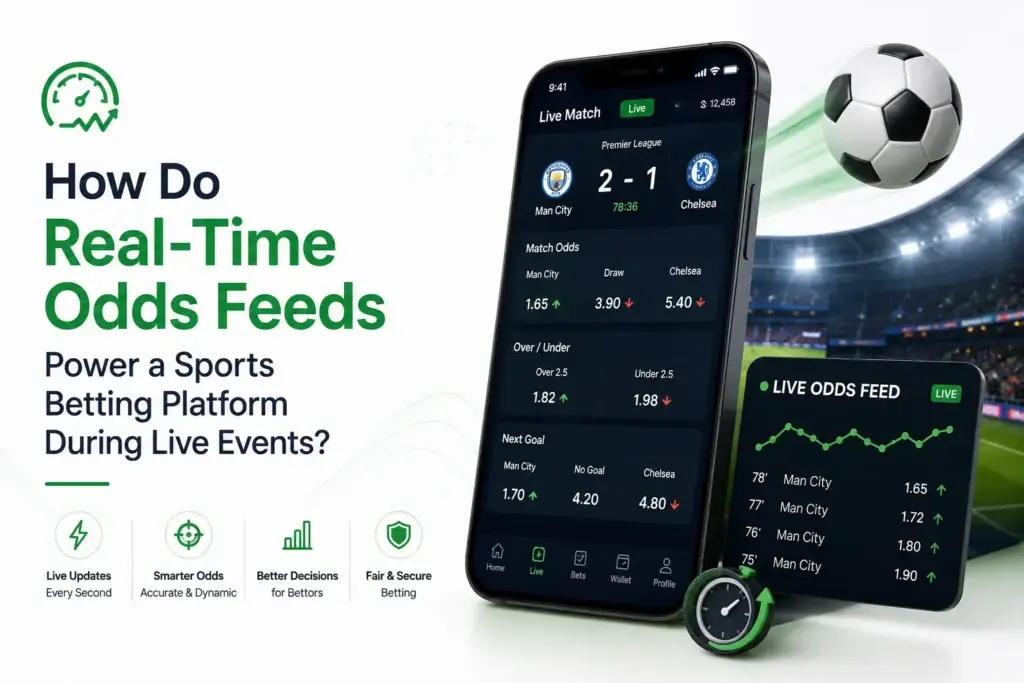
How Do Real-Time Odds Feeds Power a Sports Betting Platform During Live Events?
Key Takeaways Real-time odds feeds supply a sports betting platform with continuously updated prices, markets,…
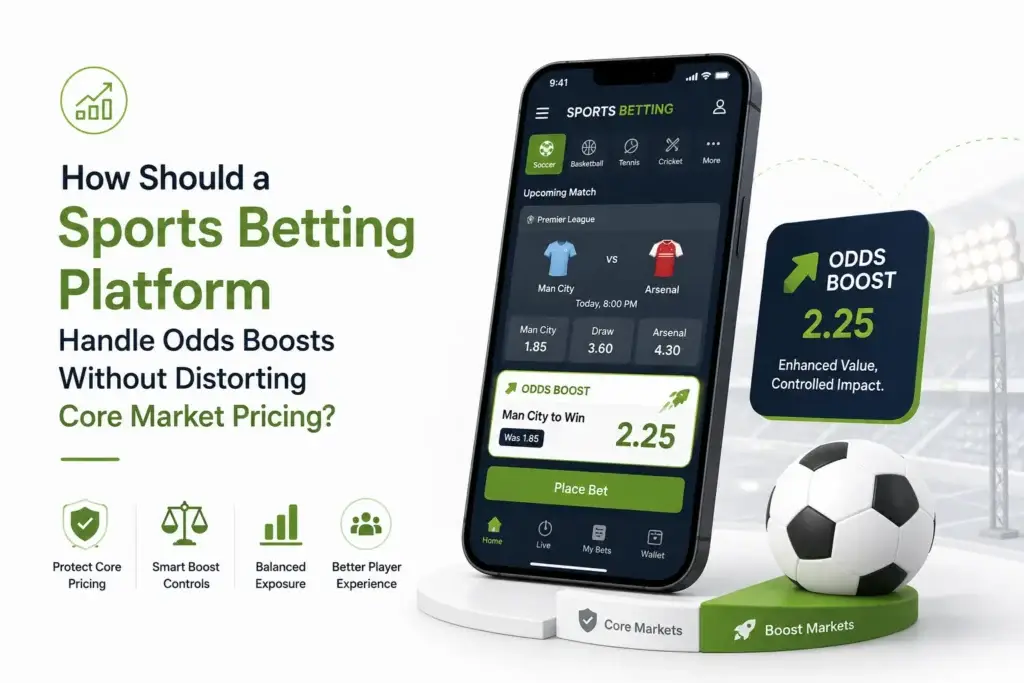
How Should a Sports Betting Platform Handle Odds Boosts Without Distorting Core Market Pricing?
Key Takeaways A sports betting platform should treat odds boosts as a promotional layer while…
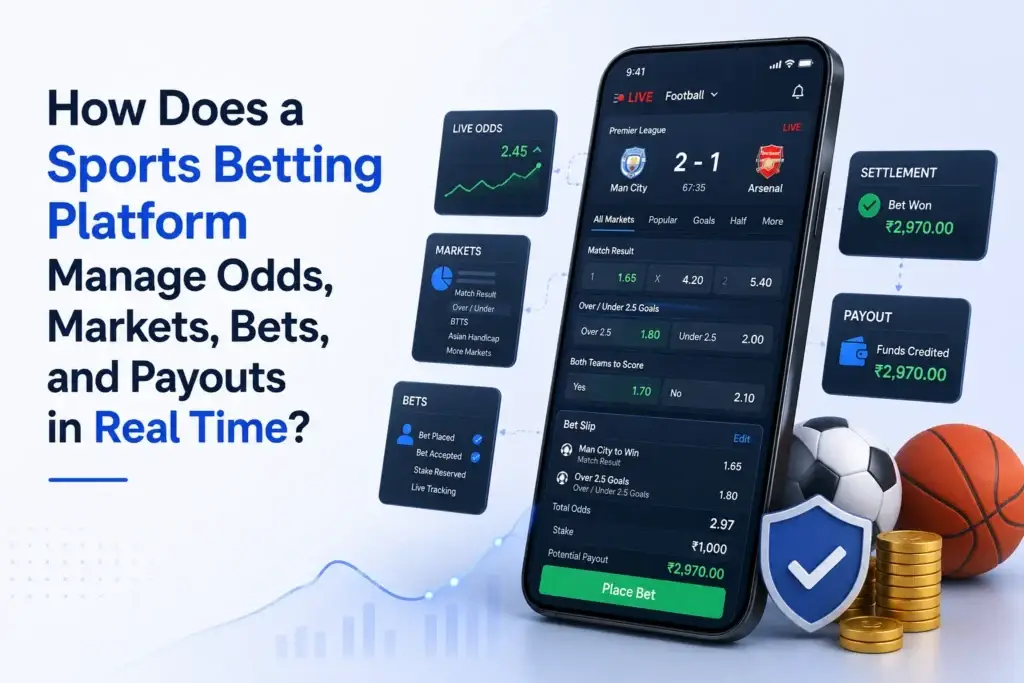
How Does a Sports Betting Platform Manage Odds, Markets, Bets, and Payouts in Real Time?
Key Takeaways Sports Betting Platform Management connects real-time odds, market states, bet validation, wallets, risk…
Key Takeaways A ready-made sports betting platform can provide prebuilt user accounts, sportsbook management, odds…
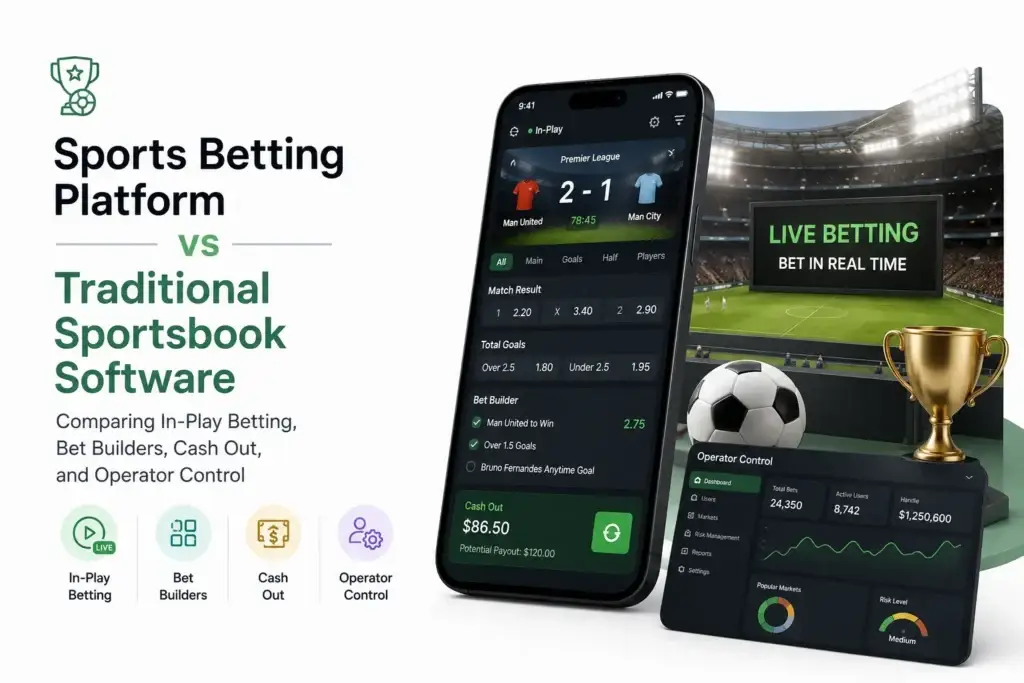
Key Takeaways A ready-made sports betting platform can provide prebuilt user accounts, sportsbook management, odds…
FAQ
White Label Sports Betting FAQ - Pricing, Licensing, Exchange & Deployment
The questions operators ask before signing, answered without hedging.
A betting platform that ships complete and carries your name, covering three verticals on one customer account: a peer-to-peer exchange with a real matching engine, a fixed-odds sportsbook with accumulators and cash-out, and a casino with provider game launch. Underneath sit a six-currency wallet, an immutable financial ledger, KYC and responsible gambling controls, and a full operator back office – across web, iOS and Android.
Yes, and it is yours to obtain. No software vendor can supply one. What the platform does ship is the compliance tooling a licence application expects: KYC document review with a reviewer trail, deposit and loss limits, session limits, self-exclusion, reality checks, and an audit log recording every admin action with an IP address. Getting the licence and meeting your regulator’s local rules is legal and commercial work – we can point at what the software does, but the obligation stays with you.
The platform starts at $3,399 for a launch-ready deployment under your own brand, with the source code handed over. Final scope moves with vertical mix, payment rails, casino provider integration, the sports data feed, KYC automation and your licensing requirements. For context, the documentation puts an equivalent from-scratch build at roughly $1.29m to $2.95m over 18 to 36 months.
Six working days on our side. Because the platform is already built, the work is rebranding it and deploying to your infrastructure. What actually stretches the calendar sits outside our control: your licence, merchant accounts, casino provider contracts and a sports data subscription.
Real. There are per-runner order books with price-time priority matching, partial fills where the remainder rests on the book, a validated price ladder from 1.01 to 1000, three persistence types governing behaviour at market close, position tracking with profit and loss, and cash-out calculated from live market odds with a ten second quote validity. The platform earns commission on net winnings and never takes the other side of the bet.
Liquidity, and nothing else. A pure exchange cannot function until enough customers are trading against each other, which is a slow and unforgiving start for a new brand. Fixed odds running alongside guarantees a price on screen from day one while the exchange builds depth. Both share the same customer account and wallet, so nothing gets duplicated.
Everything a customer or a regulator can see. The domain, the logo and colour system across the betting surface, the casino lobby and the operator console; the app name, icon, splash screen and store listing; the bet slip, the cashier and the account statements; the sender name and templates on transactional email; the terms, privacy and responsible-gambling pages, which point at your licensed entity rather than ours; and the descriptor that appears on a customer’s card statement. Inside the codebase, package identifiers and bundle IDs are set to your namespace before the apps are compiled. What does not change is the engineering underneath – the order book, the settlement engine, the wallet ledger and the KYC pipeline – because that is the part you are actually buying.
Every wallet mutation runs inside a database transaction with row-level locking, checks available balance before any debit, and writes an append-only ledger entry recording direction, amount, balance after the movement, the source reference and a description. Monetary arithmetic runs on decimal.js over numeric(18,8) columns, so there is no floating point rounding anywhere. Any balance can be reconstructed from the ledger alone.
Six currencies ship – US dollars, euros, pounds, Bitcoin, Ethereum and USDT – each with its own wallet and conversion between them. Card deposits and withdrawals run through Stripe with provider tokenization, so no card number reaches your database. Bank transfer and crypto rails are configuration required, and whatever local method your market needs follows the same provider pattern.
Better you hear it here. eSports currently runs on mock data, poker and bingo are basic implementations, and live dealer is integration-ready rather than integrated. The interface has an internationalization framework but ships English only. There is no bundled monitoring stack, no CSV or JSON export, and search is pattern matching rather than a full-text index. The extended tables covering notifications, promotions, loyalty, affiliates and tournaments need a second migration snapshot before production.
Order books live in memory, which is what delivers the documented sub-100 millisecond order placement at the 95th percentile. The same choice means the engine scales vertically rather than horizontally, and it is the one component carrying that limit – every other service is stateless and scales out behind a load balancer. The documentation names engine memory, order table write pressure and WebSocket broadcast volume as the three bottlenecks, each with a stated mitigation.
Yes, in full: the Next.js 14 web application, the Expo React Native covering iOS and Android, the Node.js and Express backend across 11 service packages, the PostgreSQL schema with its 35 tables and Drizzle migrations, and the seed script. Ownership transfers with them – modify, rebrand and extend – and the platform is self-hosted on your own infrastructure.
It maps to the OWASP Top 10 in a dedicated compliance document. Built controls: bcrypt at cost 12, a 15 minute access token with 7 day refresh rotation and reuse detection, TOTP two-factor, login lockout, three-tier role enforcement on every admin route, parameterized queries through Drizzle, Helmet security headers, tiered rate limiting, an append-only ledger and an audit log carrying IP addresses. The same document rates input validation Moderate because it is inline rather than schema-driven, and lists WAF, secrets management and monitoring as deployment hardening.
Let's turn your idea into
a live platform.
Get a free consultation, a clear timeline, and honest answers. We'd rather earn your trust than rush a sale.
Miracuves is an independent software development company. We are not affiliated with, connected to, sponsored by, or endorsed by Bet365 or any other betting operator.
“White label sports betting software” describes a category of product, not any one company. Brand names appear elsewhere on this site only to describe the kind of platform being built and the terms buyers search for.
We supply software, not permission to operate. Obtaining and holding a gambling licence in every market you accept customers from is your responsibility, as is age verification, responsible-gambling provision and any local advertising restriction. We do not advise on any of it.
The entire design and codebase is built by our own team. The product contains no code, design, graphics, or content originating from any third-party betting website or application. All third-party names and marks belong to their respective owners.
