






















Key Takeaways
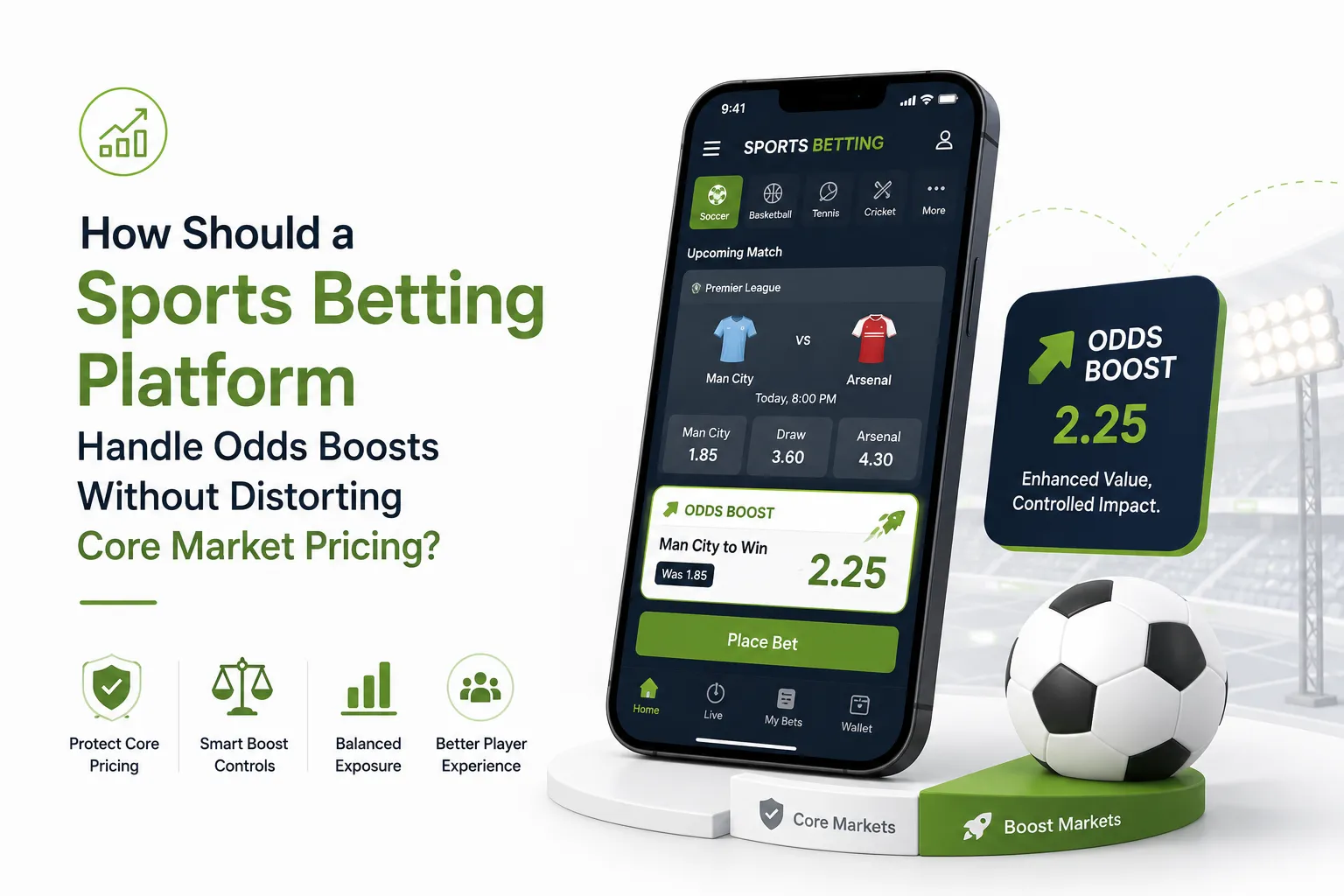
- A sports betting platform should treat odds boosts as a promotional layer while keeping the underlying market odds, margin calculations, and core pricing logic separate.
- Boosted odds should use clear eligibility rules, maximum stakes, market restrictions, promotion budgets, expiry conditions, and settlement logic without permanently changing the base sportsbook price.
- Reliable odds boost management depends on real-time pricing feeds, exposure monitoring, risk controls, promotion tracking, and transparent bettor-facing terms.
Odds Boost Control Signals
- The platform should store base odds and promotional odds separately so traders can update core market pricing without interfering with active boost campaigns.
- Operators can control boosts by sport, event, market, customer segment, stake limit, boost percentage, campaign duration, and total promotional exposure.
- Suspended markets, rapid price movements, stale odds, event changes, or risk-limit breaches should trigger validation before a boosted bet is accepted.
Pricing & Risk Insights
- Operators should measure promotional liability separately from normal sportsbook exposure to understand the true cost and performance of each odds boost campaign.
- Boost redemption, incremental bets, average stake, customer conversion, margin impact, exposure, and repeat activity can help determine whether a promotion adds value without weakening core pricing discipline.
- Miracuves develops customizable sports betting platforms with odds management, promotional boosts, betting limits, exposure controls, wallets, settlement workflows, analytics, responsible-gambling tools, and admin management.
Odds boosts are powerful sportsbook promotions. They can improve engagement, increase bet-slip activity, support event-led campaigns, and help operators highlight selected markets. But if they are handled poorly, odds boosts can damage the most important layer of a sports betting business: core market pricing integrity.
A sportsbook should never treat an odds boost as a casual front-end discount. A boost affects price display, user eligibility, maximum stake, exposure, settlement, reporting, risk control, responsible gambling, and promotional accounting. The standard market price and the boosted promotional price must remain separate in the system.
An odds boost is usually a limited-time promotional increase on a selected bet, where the bettor receives a better payout price than the regular market price if the bet wins. Industry examples describe boosts as enhanced prices on selected bets, often with caps, eligibility rules, and offer-specific terms.
For founders building or buying sportsbook software, the key question is not “Should we offer boosts?” The better question is whether the platform can manage boosts without damaging odds integrity, wallet accuracy, and trading control. If you are evaluating a broader sports betting platform foundation, odds boosts should be treated as a controlled product layer, not just a promotional banner.
Can the platform apply boosts without corrupting the core odds engine, trading margin, wallet ledger, cash-out logic, or compliance records?
That is where product architecture matters.
What Are Odds Boosts in Sportsbook Software?
An odds boost, also called a price boost or enhanced odds promotion, increases the displayed odds for a specific selection, market, bet builder, accumulator, or pre-configured offer. The customer sees a higher potential return than the standard market price.
For example:
| Standard Market Price | Boosted Promotional Price | What Changes |
|---|---|---|
| 2.00 | 2.20 | The payout improves if the boosted bet wins |
| 1.75 | 1.90 | The customer receives a better promotional price |
| 3.50 | 4.00 | The sportsbook absorbs additional promotional liability |
The important point is that the event probability has not changed. The team, player, race, scoreline, or outcome is not more likely to happen because the sportsbook increased the displayed price. The boost is a marketing decision, not a trading signal.
This is why odds boosts should be managed as promotional overlays. If the platform directly changes the core market price, every linked workflow can become unreliable.
Why Odds Boosts Can Distort Core Market Pricing
Core market pricing is the trading foundation of a sportsbook. It reflects probability, margin, data-feed movement, manual trader input, market status, and risk exposure.
When a sportsbook applies boosts directly to the market price, several problems can appear.
The risk desk may read the boosted price as the real market price. Automated trading tools may adjust related markets incorrectly. Cash-out may calculate from the wrong price. Bet builder pricing may inherit artificial value. Settlement reports may fail to separate marketing cost from trading result. Affiliate, bonus, and customer-value reports may overstate sportsbook margin.
A strong betting platform must answer a simple question for every boosted wager:
Was this price a real market movement or a promotional adjustment?
If the system cannot answer that clearly, the operator is not only running a promotion. It is polluting its own pricing data.
The Correct Principle: Keep Core Odds and Boosted Odds Separate
The safest architecture is to maintain two layers:
| Layer | Purpose | Controlled By |
|---|---|---|
| Core Market Price | Represents the sportsbook’s actual tradable price, margin, feed update, and trading position | Trading engine / odds feed / risk team |
| Boosted Promotional Price | Represents a temporary customer-facing enhancement for a specific offer | Promotion engine / CRM / admin campaign rules |
The core market price should remain the source of truth. The boosted price should be stored as a campaign-specific value linked to a promotion ID, eligibility rule, max stake, expiry window, and settlement record.
This structure protects the sportsbook from confusing promotional generosity with real probability.
Miracuves’ betting platform page already positions odds, promotions, price boosts, cashback, free-bet restrictions, risk desk, and real-time updates as operational layers inside the broader sportsbook system.
A Practical Odds Boost Workflow for Sports Betting Platforms
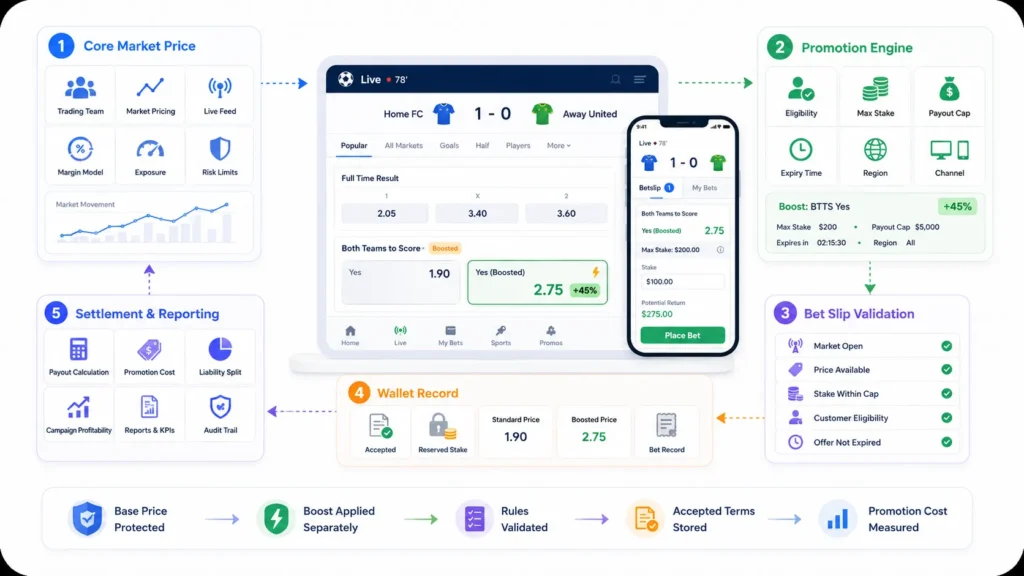
A well-designed sportsbook promotion workflow should follow a controlled path.
Operators still defining their sportsbook architecture can follow a deeper sports betting platform planning approach to map odds feeds, bet-slip validation, wallet movement, promotion rules, cash-out treatment, and settlement logic before launch.
1. The Trading Team Sets the Core Market Price
The market price should first come from the sportsbook’s normal pricing workflow. That may involve an odds feed, in-house trader input, overround settings, sport-specific margin, market status, and exposure control.
This base price should remain untouched by the promotion team.
2. The Promotion Engine Applies the Boost
The promotion engine should apply a separate boost rule. This rule may define:
- Eligible sport, league, event, market, or selection
- Boost percentage or fixed enhanced price
- Maximum stake
- Maximum payout
- Customer eligibility
- Expiry time
- Channel availability
- Country or jurisdiction restrictions
- Whether cash-out is allowed
- Whether accumulators or bet builders are included
- Whether the promotion can combine with other offers
3. The Bet Slip Validates the Boost
Before accepting the bet, the bet slip should verify that the offer is still valid.
It should check:
- Has the market changed?
- Is the market still open?
- Is the boosted price still available?
- Has the customer already used the boost?
- Is the stake within the cap?
- Does the bet meet the minimum odds or bet-type rule?
- Is the user restricted, self-excluded, or outside the eligible region?
- Is the offer expired?
If any rule fails, the platform should clearly explain what changed instead of silently repricing the bet.
4. The Wallet Reserves Stake at Accepted Terms
Once the bet is accepted, the wallet should reserve the stake and store the exact accepted price. For boosted bets, the record should include both the standard market price and the boosted promotional price.
This matters later for settlement, reporting, customer support, disputes, and audit review.
5. Settlement Separates Trading Result From Promotion Cost
At settlement, the platform should calculate the user payout from the boosted odds but attribute the extra liability to the promotion campaign.
That means the sportsbook can report:
- Standard market liability
- Additional promotional liability
- Total customer payout
- Promotion cost
- Trading margin before and after boost
- Campaign-level profitability
This separation helps founders understand whether odds boosts are actually supporting retention or simply burning margin.
Founder Decision Signals
Pricing Integrity
Choose a sportsbook platform where boosted prices do not overwrite the core market price. The trading layer should remain clean and auditable.
Risk Control
Every boost should have stake caps, payout limits, exposure monitoring, eligibility rules, and expiry logic before it goes live.
Settlement Accuracy
The wallet and ledger should store accepted odds, original odds, boost ID, stake, payout, and campaign attribution for every boosted bet.
Responsible Promotion
Boosts should not create misleading urgency or imply reduced risk. Terms must be visible, clear, and easy to understand.
What the Promotion Engine Should Control
Odds boost management becomes safer when the promotion engine has strict controls. These controls are easier to manage when the platform already includes mature sportsbook platform features such as campaign rules, admin permissions, stake limits, wallet visibility, risk monitoring, and audit logs.
| Control | Why It Matters |
|---|---|
| Maximum stake | Prevents one boosted offer from creating excessive liability |
| Maximum payout | Limits promotional exposure on high-odds selections |
| Eligible markets | Keeps boosts away from volatile or hard-to-price markets |
| Customer eligibility | Allows segmented campaigns without unfair or unclear access |
| Expiry window | Prevents stale boosted prices from remaining active |
| Boost ID | Connects every boosted bet to a specific campaign |
| Audit trail | Records who created, approved, edited, paused, or removed the offer |
| Display rules | Ensures users see the standard price, boosted price, and key terms |
| Responsible-gambling checks | Avoids promotions being shown to excluded or restricted users |
Regulators and advertising authorities also expect gambling promotions to communicate significant conditions clearly. The ASA notes that gambling promotions should clearly present conditions such as eligibility restrictions, deposit or wagering requirements, time limits, minimum odds, and bet types where omission could mislead users.
Why Boosts Should Not Be Applied Directly to the Odds Feed
An odds feed should represent market data. A boost represents a commercial decision.
When these two are merged, the sportsbook loses clarity.
For example, imagine a football market where the true sportsbook price is 2.10, but the marketing team boosts it to 2.40. If the feed, risk dashboard, or settlement engine now treats 2.40 as the normal market price, the platform may make poor decisions.
The operator may:
- Misread exposure
- Overpay cash-out
- Trigger incorrect odds movement
- Distort historical price analytics
- Miscalculate customer value
- Fail to attribute promotional spend correctly
- Apply boost logic to related markets accidentally
A clean sportsbook architecture keeps the feed price intact and applies the boost only at the promotion layer.
How Odds Boosts Affect Cash-Out Logic
Cash-out is one of the easiest places for boost-related mistakes.
A cash-out engine usually calculates an exit value based on current market odds, stake, potential return, remaining risk, and platform margin. If the original bet used boosted odds, the cash-out calculation must know whether the boost should be included, excluded, partially reflected, or disabled based on the offer terms.
The platform should define this upfront.
| Cash-Out Rule | What It Means |
|---|---|
| Cash-out disabled for boosted bets | Simpler risk control, but must be clearly stated |
| Cash-out based on core market price | Protects margin but may reduce user expectation |
| Cash-out based on boosted accepted odds | More generous but increases liability |
| Cash-out allowed only before in-play | Reduces live-market volatility |
| Cash-out allowed with adjusted promotional margin | Balances user experience and operator risk |
The worst approach is to let the system decide inconsistently.
A sportsbook should store cash-out rules at the promotion level so customer support, traders, and users can understand why a boosted bet can or cannot be cashed out.
Handling Odds Boosts in Bet Builders and Accumulators
Bet builders and accumulators need extra care because multiple selections can create correlated risk.
A simple odds boost on a single pre-match outcome is easier to manage. A boost on a same-event bet builder can be more complex because the selections may not be independent. For example, “Team A to win” and “Team A striker to score” may be connected.
The platform should avoid applying generic boost percentages across correlated selections without pricing rules. Instead, it should use controlled templates.
Better approaches include:
- Pre-approved boosted bet builders
- Boost caps by sport and market type
- Trader-reviewed offer templates
- Restricted correlated combinations
- Dynamic liability checks
- Separate rules for singles, accumulators, and same-event combinations
- Real-time suspension if the underlying event changes
This protects the platform from turning a marketing offer into uncontrolled trading exposure.
Responsible Gambling and Promotional Design
Odds boosts can influence user behaviour because they make certain bets feel more attractive. Gambling Commission research has found that promotional offers, including boosted odds, may affect how consumers judge the quality or risk of an offer and can encourage more speculative betting behaviour.
That does not mean sportsbooks should never use boosts. It means the product must handle them responsibly. This is especially important for operators building in the wider betting and gaming platform space, where promotions, user safety, trading visibility, and operational control must work together.
A responsible odds boost workflow should include:
- Clear offer terms
- No misleading “risk-free” framing
- No excessive urgency
- No boost targeting for self-excluded users
- No promotion visibility for restricted accounts
- Deposit, loss, and session-limit respect
- Campaign suppression for high-risk behavioural segments
- Easy access to responsible-gambling tools
- Transparent bet history and wallet records
ASA guidance also warns against presenting enhanced odds or similar offers as a way to reduce risk, and cautions against urgent promotional pressure around short-term offers.
For operators, this is not just compliance language. It is product design. The promotion engine, CRM system, user-risk flags, and front-end display should work together.
The Admin Dashboard Controls Operators Should Demand
A sportsbook admin panel should let operators manage odds boosts without developer involvement for every small campaign. But it should not allow uncontrolled promotion creation either.
A useful admin dashboard should include:
| Admin Control | Business Value |
|---|---|
| Campaign creation | Lets teams launch event-specific promotions quickly |
| Trader approval | Prevents risky or mispriced offers from going live |
| Market eligibility | Limits boosts to approved sports, events, and bet types |
| Stake and payout caps | Controls promotional liability |
| Customer segmentation | Targets offers responsibly and commercially |
| Real-time exposure view | Shows liability before the campaign becomes dangerous |
| Pause button | Lets operators stop a promotion immediately |
| Audit log | Records admin actions for review and dispute handling |
| Settlement report | Shows promotional cost and actual payout |
| Responsible-gambling filters | Blocks boosts for restricted or vulnerable users |
This is where a platform’s back office becomes more important than the front-end promotion banner.
Miracuves’ sportsbook platform foundation includes operator-facing workflows across odds, promotions, price boosts, cashback, risk controls, real-time updates, wallet movement, and audit-ready operations, making it relevant for founders evaluating how promotion-heavy sportsbook models should be structured.
A Better Data Model for Odds Boost Management
A clean data model helps prevent pricing confusion.
A sportsbook should not store only one “odds” value for a boosted bet. It should store enough context to reconstruct the full decision later.
Suggested fields include:
| Field | Purpose |
|---|---|
market_id | Links the bet to the original market |
selection_id | Identifies the boosted selection |
base_odds_at_acceptance | Stores the standard market price |
boosted_odds_at_acceptance | Stores the accepted promotional price |
promotion_id | Connects the bet to the campaign |
boost_type | Percentage boost, fixed price boost, token boost, or prebuilt offer |
max_stake_applied | Confirms stake cap enforcement |
cashout_rule | Defines whether and how cash-out applies |
eligibility_rule_snapshot | Records why the user qualified |
settlement_status | Tracks win, loss, void, refund, or reversal |
promotion_cost | Measures the extra liability created by the boost |
admin_approval_id | Links the offer to internal approval |
audit_log_id | Preserves operational history |
This helps operators answer future disputes clearly: what was shown, what was accepted, what terms applied, and how the payout was calculated.
Mistakes Founders Should Avoid
Changing the Core Market Price Instead of Applying a Promotion Overlay
This creates distorted trading records, inaccurate risk views, and unreliable reporting. The boost should sit above the market price, not replace it.
Launching Boosts Without Stake Caps
A boosted price without maximum stake or payout controls can expose the sportsbook to avoidable losses, especially on high-demand markets.
Ignoring Cash-Out Rules
Boosted bets need clear cash-out treatment. If the platform calculates cash-out from the wrong price, it can damage margin and user trust.
Using Urgency-Heavy Promotional Copy
Odds boosts should not pressure users into gambling quickly or imply that the promotion reduces betting risk. Responsible display rules matter.
How Odds Boosts Should Appear to Users
The user experience should be transparent.
A good odds boost display may show:
- Standard odds
- Boosted odds
- Maximum stake
- Eligible market
- Expiry time
- Whether cash-out applies
- Whether the offer can combine with other promotions
- Full terms link
- Responsible-gambling reminder where relevant
Avoid vague messaging like:
- “Guaranteed value”
- “Risk-free boost”
- “You cannot miss this”
- “Bet now before it disappears”
- “Safe way to increase returns”
Clear terms reduce support disputes and protect the platform from misleading promotion claims.
Commercial Value: When Odds Boosts Are Useful for Operators
Odds boosts can be commercially useful when they are linked to a clear business goal. When planned properly, they can support a wider sports betting platform business model by improving engagement, retention, event-led campaigns, and promotional reporting without hiding the true cost of boosted payouts.
They may help operators:
- Promote major sports events
- Improve first-bet conversion
- Increase bet-slip engagement
- Support retention campaigns
- Encourage discovery of new sports or markets
- Reward loyalty segments
- Compete around event-led pricing
- Drive app engagement during major fixtures
But boosts should not become the sportsbook’s only retention strategy. If users only return for promotions, the operator may be training customers to wait for enhanced prices instead of valuing the platform experience.
A stronger sportsbook model balances promotions with reliable odds, smooth deposits and withdrawals, fast settlement, responsible gaming controls, strong mobile UX, market depth, and trustworthy support.
Where Miracuves Fits Into This Platform Decision
For founders planning a sportsbook launch, odds boosts are not just a marketing feature. They are a test of platform maturity.
A basic sportsbook front end can display a boosted price. A serious sportsbook platform needs the deeper machinery behind it: promotion rules, trader approvals, odds validation, stake caps, wallet accuracy, risk dashboards, settlement reporting, and audit logs.
The cost of handling odds boosts properly depends on the promotion engine, odds-feed logic, wallet ledger, risk dashboard, settlement reporting, and integrations, which is why founders should review the broader sports betting platform development cost before finalizing scope.
Miracuves helps founders launch ready-made and white-label betting platforms with source-code ownership, admin control, sportsbook workflows, promotion management, and scalable backend logic. Founders exploring a broader ready-made sportsbook and betting exchange solution can understand how sportsbook, exchange, casino, wallet, KYC, promotions, risk controls, and operator back-office flows connect inside one product ecosystem.
Final Thoughts
Odds boosts can help a sportsbook increase engagement, promote key events, and create stronger betting moments, but they should never weaken the platform’s pricing foundation. The real challenge is not displaying a higher promotional price. It is keeping the core market price clean, controlling exposure, protecting wallet and settlement accuracy, and making every promotional rule transparent to both users and operators.
For founders building a sports betting platform, the smarter decision is to treat odds boosts as a structured product layer, not a quick marketing shortcut. With the right promotion engine, admin controls, risk visibility, and audit-ready workflows, odds boosts can support growth without distorting the market logic that the sportsbook depends on.
FAQs
What is odds boost management in sportsbook software?
Odds boost management is the process of creating, controlling, displaying, validating, settling, and reporting enhanced odds promotions inside a sportsbook platform. It includes rules for eligible markets, stake caps, expiry, customer eligibility, cash-out, settlement, and promotional cost tracking.
Should odds boosts change the core sportsbook market price?
No. A sportsbook should keep the core market price separate from the boosted promotional price. The core price should remain the trading source of truth, while the boost should be applied as a campaign-specific overlay.
Why can odds boosts create risk for operators?
Odds boosts increase potential payout. Without stake limits, payout caps, exposure monitoring, and trader approval, a promotion can create liability that exceeds the campaign’s expected value.
How should cash-out work on boosted bets?
Cash-out rules should be defined clearly before the promotion goes live. Operators may disable cash-out, calculate it from the core market price, include the boosted odds, or use a specific promotional margin. The chosen rule should be visible in the offer terms.
What should a sportsbook admin panel include for odds boosts?
The admin panel should include campaign creation, eligibility rules, market selection, stake caps, payout limits, trader approval, real-time exposure tracking, promotion pause controls, audit logs, settlement reporting, and responsible-gambling filters.
Are odds boosts responsible-gambling sensitive?
Yes. Boosts can influence user behaviour, so the platform should avoid misleading claims, excessive urgency, and visibility to restricted or self-excluded users. Terms should be clear, and responsible-gambling controls should apply before the offer is shown or accepted.
Can a ready-made sportsbook platform support odds boosts?
Yes, if the platform includes a proper promotion engine, odds validation, wallet ledger, risk controls, admin workflows, settlement reporting, and customization flexibility. Founders should inspect the back office before choosing any sportsbook software.
Miracuves is an independent software development company. We are not affiliated with, connected to, sponsored by, or endorsed by any company or product named in this article.
Terms such as “X Clone” are used descriptively. It is how the software industry refers to building a platform with functionality comparable to a known service, and how clients search for it.
The entire design and codebase of our products is built by our own team. Our products contain no code, design, graphics, or content originating from any third-party website or applications.
All third-party names and marks referenced in this article are the property of their respective owners, referenced solely to identify the services discussed.