


Key Takeaways
- A ready-made sports betting platform can provide prebuilt user accounts, sportsbook management, odds integration, payments, reporting, risk controls, and admin workflows for a faster development path.
- Custom sportsbook development offers greater architectural freedom but requires more work across betting logic, data feeds, payments, security, compliance, integrations, and backend operations.
- Startup control depends on source-code ownership, customization flexibility, data access, hosting options, API integrations, payment control, and the ability to modify platform workflows over time.
Control & Development Signals
- Ready-made sportsbook software can reduce repeated development by providing event management, odds feeds, bet slips, wallets, transaction records, user management, and administrative modules.
- Custom development gives founders deeper control over platform architecture, user experience, betting markets, integrations, risk rules, reporting, localization, and operational workflows.
- Both approaches should be evaluated for security, regulatory requirements, responsible-gambling controls, scalability, data-feed reliability, payment integrations, and ongoing maintenance.
Startup Decision Insights
- Startups should compare target markets, licensing requirements, product differentiation, development resources, launch priorities, operational complexity, and long-term ownership before choosing an approach.
- A customizable ready-made foundation can suit teams prioritizing faster validation, while custom sportsbook development may fit businesses requiring highly specialized workflows or technology architecture.
- Miracuves develops customizable sports betting platforms with sportsbook management, odds integrations, wallets, payments, risk controls, reporting, analytics, responsible-gambling features, and admin management.
Sports betting software is no longer judged only by whether users can place a pre-match bet. The real competitive difference now sits inside the live betting layer: how quickly odds update, how markets suspend, how bet builders price correlated selections, how cash out behaves during volatile moments, and how much control the operator has over risk, margins, promotions, and settlement.
That is why founders and betting operators often get stuck between two options: a broader sports betting platform or more traditional sportsbook software.
At first, they sound similar. Both can display odds, accept stakes, settle outcomes, and manage player accounts. But once you compare in-play betting, bet builders, cash out, wallet logic, trading controls, and admin workflows, the difference becomes clearer.
A traditional sportsbook software setup may help an operator publish markets and accept bets. A modern sports betting platform goes further by connecting the betting surface, wallet, risk desk, compliance workflows, settlement logic, promotions, reporting, and operator dashboard into one controlled product ecosystem.
For founders planning a regulated betting business, this distinction matters because the hardest part is not the front end. It is running a product where every odds change, wallet movement, bet acceptance, market suspension, and cash-out quote can affect user trust, operator exposure, and regulatory readiness.
What Is a Sports Betting Platform?
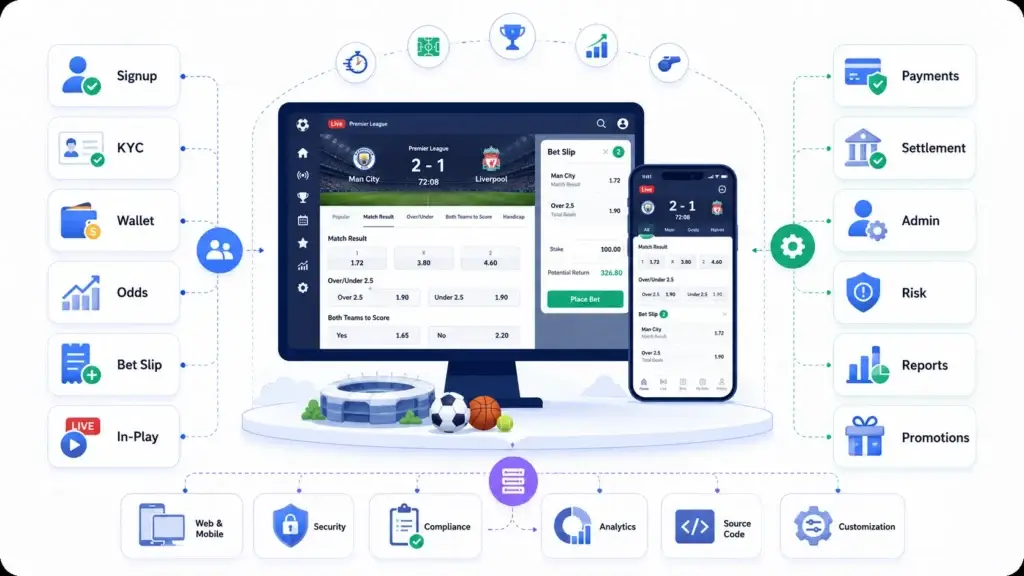
A sports betting platform is the broader product and operating system behind an online betting business. It usually includes the player-facing web and mobile experience, odds display, bet slip, wallet, payment integrations, settlement engine, admin dashboard, promotion tools, risk controls, reporting, and compliance support workflows.
In a strong platform, these parts are not separate tools stitched together loosely. They work as one system.
For example, when a user places an in-play bet, the platform should check the latest odds, validate the market status, apply stake limits, reserve the wallet balance, record the bet, update exposure, and prepare settlement logic. If the event changes while the bet is being placed, the system may delay, reject, reprice, or suspend acceptance based on operator rules.
That level of coordination is what makes a platform different from a simple odds-and-bet-slip product.
For a deeper planning view, founders can review Miracuves’ guide on sports betting platform planning, which explains how odds, cash out, bet builders, wallet logic, and settlement workflows should be considered before development begins.
A sports betting platform is usually better suited for operators who want:
- Web, iOS, Android, wallet, admin, and sportsbook workflows connected.
- More control over user management, payments, markets, promotions, and reporting.
- A launch-ready foundation that can be branded and customised.
- A system that supports both user experience and back-office operations.
- A clearer path to source-code ownership, infrastructure control, and long-term customisation.
For founders exploring a faster route to launch, Miracuves’ ready-made betting platform foundation is a relevant next step because it connects sportsbook, exchange, casino, wallet, KYC, and operator back-office workflows in one product ecosystem.
What Is Traditional Sportsbook Software?
Traditional sportsbook software focuses mainly on the core sportsbook function: showing markets, accepting bets, managing odds, and settling outcomes. Depending on the vendor, it may include pre-match betting, live betting, accumulator bets, basic reporting, and limited admin controls.
This can be enough for operators with a narrow betting scope or teams that already have trading, risk, payment, compliance, and CRM systems in place.
The challenge appears when the operator needs deeper control.
A sportsbook may display markets, but can it configure different margin rules by sport? Can it suspend markets instantly? Can it handle partial cash out? Can it expose risk by market, player group, or event? Can the operator manage KYC reviews, bonus restrictions, responsible gambling limits, payment reconciliation, and settlement reversals from the same back office?
If the answer is no, the operator may still need additional systems around the sportsbook.
That is where traditional software can become operationally fragmented. The front end may work, but the business still depends on disconnected tools for payments, reporting, risk decisions, user controls, and compliance workflows.
Sports Betting Platform vs Sportsbook Software: The Core Difference
The simplest way to compare both options is this:
Sportsbook software helps you run betting markets. A sports betting platform helps you run the betting business.
That distinction becomes important when the operator moves beyond basic pre-match betting into real-time odds, bet builders, cash out, promotions, account controls, and multi-vertical monetization.
Sports Betting Platform vs Traditional Sportsbook Software
| Comparison Area | Modern Sports Betting Platform | Traditional Sportsbook Software | Founder Impact |
|---|---|---|---|
| Product scope | Betting surface, wallet, admin, risk, settlement, KYC, promotions, and reporting | Mainly markets, odds, bet slip, and settlement | Platforms reduce dependency on disconnected tools. |
| In-play betting | Real-time odds, market suspension, latency rules, live bet validation, and exposure visibility | May offer live markets but with limited control depth | Better live control protects both user experience and operator margin. |
| Bet builder | Can support same-event combinations, selection rules, pricing logic, and risk limits | May be unavailable, outsourced, or limited to selected sports | Bet builder depth affects engagement and product differentiation. |
| Cash out | Configurable full or partial cash out with margin, quote validity, and settlement controls | May offer basic early settlement with fewer operator rules | Cash out should be managed as a risk workflow, not only a button. |
| Operator control | Admin dashboard, exposure rules, user limits, payment visibility, risk desk, and audit logs | Often narrower back-office visibility | More control helps operators act faster during live events and disputes. |
| Customisation | Stronger fit for branded experiences, local payment rails, source-code ownership, and long-term changes | Can be restricted by vendor roadmap or licensing model | Founders avoid being trapped by product limitations after launch. |
In-Play Betting: Why Live Markets Expose Weak Software Quickly
In-play betting is where sportsbook architecture gets tested hardest.
Pre-match odds can be prepared before an event starts. Live odds cannot. During a football match, tennis game, cricket over, or basketball quarter, the platform must react to fast-changing event data. A goal, red card, penalty, injury, substitution, rain delay, or match suspension can change market probability immediately.
Regulatory guidance from the UK Gambling Commission explains that in-play betting prices are amended continuously based on information and liabilities held by licensed operators. It also notes that operators use real-time sports data to revise prices, suspend markets, and settle bets accurately.
For founders, this creates a clear product question:
Can the software protect the operator when the event changes faster than the user interface?
A serious in-play betting system should include:
- Real-time odds feed integration.
- Score, clock, and event status updates.
- Market suspension rules.
- Bet acceptance delay logic.
- Repricing or rejection workflows.
- Stake validation.
- Exposure monitoring.
- Trader override controls.
- Live settlement preparation.
- Audit logs for odds and market changes.
Traditional sportsbook software may support live markets, but the operator must check how much control sits inside the back office. Without proper market suspension and delay logic, the platform can accept stale prices after a major live event. That can create avoidable exposure and user disputes.
A sports betting platform should treat in-play betting as a full workflow: data comes in, odds update, market state changes, bets are validated, wallet balances are reserved, exposure is tracked, and admin actions are recorded.
That is why live betting is less about having a “Live” tab and more about controlling the entire real-time betting lifecycle.
Bet Builders: The Feature That Separates Basic Betting From Modern Engagement
Bet builders allow users to combine multiple selections into one custom wager. For example, a football user may want to combine match result, total goals, player shots, cards, and corners from the same event.
This feature is attractive because it gives users more control over the wager experience. But for operators, bet builders are technically difficult because selections inside the same event are often correlated.
A simple accumulator may multiply independent odds across different events. A bet builder cannot always do that. If one selection affects the probability of another, the pricing engine must account for that relationship.
Kambi describes bet builder functionality as the ability to combine selections within a single event, across multiple events, or across sports, and positions core-platform integration as important for consistency and scalability.
Operators comparing sports betting platform features should look beyond the front-end bet slip and check whether live betting, bet builder, cash out, wallet settlement, and admin controls work together as one connected system.
A strong bet builder module should support:
- Same-event selections.
- Multi-event combinations where allowed.
- Player props and event-specific markets.
- Correlation-aware pricing.
- Invalid combination rules.
- Maximum leg limits.
- Minimum odds rules.
- Market availability checks.
- Pre-match and in-play availability where supported.
- Cash-out compatibility where the operator allows it.
Traditional sportsbook software may offer bet builders as an add-on, but that creates a key evaluation question: is the feature native to the betting engine, or is it bolted on through a third-party layer?
If the bet builder is not integrated with odds, market status, risk limits, and cash out, the operator may face inconsistent pricing, unavailable markets, or poor user experience during live events.
For founders, the decision is not simply “Do we need bet builder?” The better question is:
Can the system price, restrict, settle, and report bet builder wagers safely under real match conditions?
Cash Out: A Player Feature With Operator Risk Behind It
Cash out lets a user close an unsettled bet before the event finishes. It can improve user control and engagement, but it also creates risk for the operator because the offer must reflect live odds, current probability, stake, potential payout, platform margin, and market status.
The UK Gambling Commission notes that cash-out offers linked to live betting can be volatile during a sporting event and may increase, decrease, or be removed as the chances of winning change. It also requires operators offering cash-out facilities to provide clear and accessible terms and conditions.
From a software perspective, cash out should include:
- Real-time quote calculation.
- Quote expiry timer.
- Full or partial cash-out rules.
- Market suspension checks.
- Margin configuration.
- Player eligibility rules.
- Bet type restrictions.
- Wallet settlement.
- Audit trail.
- Admin reporting.
A weak cash-out feature can damage user trust. If the user sees an offer but the system delays or rejects it without clear logic, support tickets and disputes increase. If the system accepts quotes too generously during volatile live moments, the operator absorbs unnecessary exposure.
A platform-level approach gives operators stronger control over how cash out behaves across sports, markets, player groups, and risk conditions.
Miracuves’ sports betting money page describes cash-out logic as part of a deeper betting product, including quote validity and execution logic for unsettled positions. That is exactly the kind of operational detail founders should look for when comparing vendors.
Operator Control: The Part Founders Often Underestimate
Many sportsbook buying decisions begin with the user app. Founders review the home screen, odds display, event pages, bet slip, and payment flow.
That is important, but it is not enough.
The admin and operator control layer decides whether the business can actually run the sportsbook after launch. This is where the operator manages risk, users, payments, limits, promotions, disputes, settlement, and reporting.
A strong operator control system should include:
- User account management.
- KYC review workflows.
- Deposit and withdrawal visibility.
- Payment reconciliation support.
- Market creation and suspension controls.
- Exposure by sport, event, market, and user.
- Stake limits and liability settings.
- Promotion and bonus configuration.
- Free bet restrictions.
- Responsible gambling limits.
- Self-exclusion workflows.
- Admin roles and permissions.
- Audit logs for admin actions.
- Settlement, voiding, and reversal tools.
- Reports for finance, trading, compliance, and support teams.
Traditional sportsbook software may include some of these features, but platform-level products usually give more connected control because the wallet, betting engine, admin panel, and reporting layer are designed to work together.
For a founder, this matters because every operational gap becomes a manual process. Manual processes create delays, errors, and compliance risk.
The strongest buying signal is not only whether the vendor can show a betting screen. It is whether they can show the back office that protects the business when something goes wrong.
Founder Decision Signals
Speed
Choose a ready-made sports betting platform when your priority is faster market validation with existing wallet, betting, admin, and settlement workflows.
Control
Choose a platform with source-code ownership and a strong admin layer if you need long-term control over branding, integrations, risk rules, and product evolution.
Live Betting Depth
Check how the system handles odds updates, bet delays, market suspension, stale prices, and event-driven settlement before trusting the in-play layer.
Operational Risk
Evaluate cash out, bet builder, wallet ledger, exposure limits, audit logs, and dispute tools because these affect the business after launch.
Wallet, Ledger, and Settlement: The Hidden Backbone of Betting Software
A sportsbook cannot work properly without reliable wallet and settlement logic.
When a user places a bet, the platform should reserve the stake correctly. When the market settles, the wallet should update accurately. If the result changes, the platform should support reversal or correction. If a withdrawal is requested, the system should know which funds are withdrawable, which are locked in open bets, and which are restricted by bonus rules.
This is why wallet logic matters as much as the betting interface.
For regulated or compliance-conscious operators, the platform should maintain records that show:
- When funds entered the account.
- Which bets reserved funds.
- Which settlements changed the balance.
- Which bonuses restricted withdrawals.
- Which admin actions adjusted or reviewed transactions.
- Which payment provider records match internal wallet history.
A simple sportsbook can accept bets. A stronger platform can explain every wallet movement.
Strong wallet and settlement logic also connects directly to the sportsbook revenue and margin model, because operator earnings may depend on margins, commissions, cash-out rules, promotions, casino activity, exchange fees, and other monetization layers.
This is especially important for cash out, bet settlement, voided markets, bonus wagering, payment disputes, responsible gambling limits, and financial reconciliation.
Miracuves’ relevant betting platform page explains that the product includes wallet, ledger, KYC, responsible gambling controls, and a full operator back office across web, iOS, and Android.
Compliance and Responsible Gambling Workflows Should Not Be Treated as Add-Ons
Betting software does not provide a gambling licence. The operator is responsible for licensing, legal review, payment approvals, tax requirements, responsible gambling policies, and jurisdiction-specific compliance.
However, the software should support the workflows that regulated operators commonly need.
These may include:
- Age and identity verification workflows.
- KYC document review.
- Responsible gambling limits.
- Deposit limits.
- Loss limits.
- Session limits.
- Self-exclusion.
- Reality checks.
- Transaction monitoring.
- Admin audit logs.
- User risk flags.
- Reporting support.
- Clear cash-out and betting terms.
- Role-based admin permissions.
This is where a sports betting platform can be more practical than narrow sportsbook software. In broader betting and gaming platform development, compliance workflows should connect with account creation, wallet use, deposit logic, bet placement, promotions, and admin review so the operator gets a stronger control layer.
The safest wording is important: no software is automatically compliant in every market. Compliance depends on the operator’s jurisdiction, licence, legal review, payment partners, data providers, and operational policies.
For founders, the goal should be a compliance-ready product foundation that can be configured around the market they are legally allowed to serve.
When Traditional Sportsbook Software Makes Sense
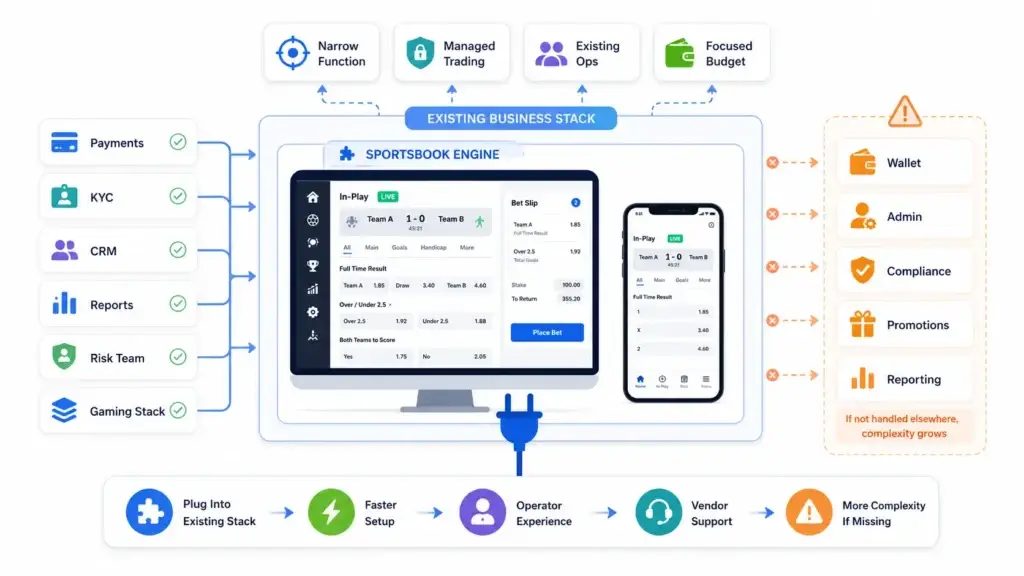
Traditional sportsbook software can still be a practical choice in certain situations.
Operators exploring adjacent products can also review broader betting and gaming app solutions if they plan to expand beyond sportsbook into casino, exchange, wallet-based gaming, or multi-vertical wagering experiences.
It may fit when:
- The operator only needs a narrow sportsbook function.
- The team already has payment, KYC, CRM, and reporting systems.
- Trading and risk teams are already experienced.
- The business is integrating sportsbook functionality into an existing gaming stack.
- The operator does not need source-code ownership.
- The budget is focused on one specific betting module.
- The vendor offers strong managed trading and support.
This route can work well for established operators that already understand their risk model and only need a sportsbook layer to plug into existing operations.
The risk is that founders may underestimate what sits outside the sportsbook. If payments, wallet, admin, compliance, reporting, and promotion logic need to be built separately, the “simpler” route may become more complex over time.
When a Sports Betting Platform Is the Stronger Route
A sports betting platform is usually stronger when the founder or operator wants a connected launch foundation.
It may fit when:
- The business needs web and mobile apps under one brand.
- The operator wants a wallet, betting, admin, and reporting system together.
- Live betting, cash out, and bet builders are part of the product roadmap.
- The founder wants more control over the user experience.
- The business needs custom payment rails or local market configuration.
- Source-code ownership matters.
- The team wants to avoid long from-zero development.
- The platform may expand into multiple betting or gaming verticals.
- Operator control is more important than simply renting a feature module.
A ready-made platform can reduce execution risk because the core flows already exist. The founder can focus more on licence preparation, payment partners, sports data feeds, branding, market acquisition, and operational setup.
This is also where sports betting development cost factors become important. The final investment depends on feature scope, live data feeds, payment integrations, wallet logic, compliance workflows, branding, and the level of customisation required.
That does not mean every operator should avoid custom development. Custom builds make sense when the business has unique trading logic, proprietary risk models, unusual compliance needs, or a large technical team with the time and budget to build deeply.
Founders who are still deciding between a ready-made launch foundation and a from-zero build can also compare sports betting platform vs custom sportsbook development to understand the tradeoffs around launch speed, control, cost, and long-term scalability.
The practical decision is not “ready-made or custom” in abstract. It is:
Which route gives you the right control, at the right speed, for the market you are legally and operationally prepared to serve?
Mistakes Founders Should Avoid When Comparing Sportsbook Vendors
Choosing based only on the betting interface
A polished odds screen does not prove the system can manage exposure, wallet settlement, cash out, market suspension, admin actions, or compliance workflows.
Ignoring in-play latency and stale price risk
Live betting is sensitive to event changes, data delays, and market volatility. Founders should check how the software accepts, delays, reprices, or rejects live bets.
Treating bet builder as a simple accumulator
Same-event selections can be correlated, so pricing and restrictions need deeper logic than standard multi-bet combinations.
Assuming cash out is easy to add later
Cash out touches live odds, wallet balance, margin, market status, settlement, and user trust. It should be designed into the betting workflow early.
Forgetting who controls the roadmap
If the operator cannot customise rules, integrations, branding, reporting, and product flows, growth may become dependent on the vendor’s roadmap.
Practical Vendor Evaluation Checklist
Before selecting a sports betting platform development partner, founders should ask technical, operational, compliance, and control-related questions instead of judging the vendor only by app screens or demo design.
In-Play Betting Questions
- Does the system support real-time odds updates?
- How does it handle delayed data?
- Can markets be suspended automatically?
- Can traders override markets manually?
- Does the platform reject stale-price bets?
- Are bet delays configurable by sport or market?
- Is there a full audit trail of price and market changes?
Bet Builder Questions
- Does the bet builder support same-event combinations?
- Which sports and markets are supported?
- Can the platform block invalid combinations?
- Does it support in-play bet building?
- Can bet builder wagers be cashed out?
- How are correlated selections priced?
- Can the operator configure leg limits and restrictions?
Cash-Out Questions
- Is cash out full, partial, or both?
- How long is a quote valid?
- Can cash out be removed during market suspension?
- Can rules differ by sport, event, player group, or market?
- Does the system record cash-out acceptance and rejection?
- Is the wallet updated instantly and accurately?
- Are terms clear for users?
Operator Control Questions
- Can admins manage users, deposits, withdrawals, KYC, and restrictions?
- Can the trading team monitor exposure?
- Can the operator configure margins and stake limits?
- Are admin actions logged?
- Can settlement be reversed or corrected?
- Can promotions be restricted by sport, odds, player group, or market?
- Does the operator own the source code or rent access?
Miracuves Perspective: Build for the Business Behind the Bet
For founders, the right sportsbook decision should start with operations, not UI.
A betting product needs more than markets and odds. It needs wallet accuracy, controlled in-play betting, cash-out logic, market suspension, user verification, settlement workflows, risk visibility, admin permissions, and reporting.
That is why Miracuves approaches betting platform development as a full product foundation rather than only a sportsbook screen. The goal is to help founders understand what they need to operate, control, and evolve the business after launch.
If you are comparing vendors, use the live betting layer as your stress test. Ask how the platform handles odds changes, bet delays, cash out, market suspension, wallet settlement, and admin intervention. If those answers are vague, the product may look complete but operate poorly under real conditions.
Related reading: How Does a Sports Betting Platform Manage Odds, Markets, Bets, and Payouts in Real Time and Sports Betting Platform Go-to-Market Strategy.
Final Thoughts: Choose the Software That Gives You Control After Launch
The difference between a sports betting platform and traditional sportsbook software becomes clear when the product goes live.
Before launch, the focus is usually on screens, odds, and features. After launch, the focus shifts to live market control, payment reliability, settlement accuracy, user restrictions, cash-out disputes, exposure management, and reporting.
That is why founders should compare software based on operational depth, not only feature names.
If the product needs in-play betting, bet builders, cash out, multi-currency wallets, KYC workflows, admin controls, and long-term customisation, a broader sports betting platform may provide a stronger foundation. If the operator already has the surrounding systems and only needs a sportsbook module, traditional sportsbook software may be enough.
The smarter decision is the one that matches your licence, operating team, risk model, market scope, and launch timeline.
Miracuves helps founders make that decision with a practical view of what needs to be ready before users place the first bet.
FAQs
What is the main difference between a sports betting platform and sportsbook software?
A sports betting platform usually includes the full product ecosystem: betting interface, wallet, admin panel, settlement, risk tools, KYC workflows, promotions, reporting, and integrations. Sportsbook software is often narrower and may focus mainly on odds, bet slip, market management, and settlement.
Is in-play betting difficult to build?
Yes. In-play betting requires real-time odds, market suspension rules, latency handling, bet validation, exposure monitoring, and accurate settlement. The platform must react quickly when live events change odds or market status.
Why are bet builders complex in sportsbook software?
Bet builders are complex because selections from the same event may be related. For example, total goals and a player scoring are not always independent outcomes. The pricing engine must understand correlation, invalid combinations, limits, and settlement rules.
How does cash out work in a sports betting platform?
Cash out calculates an offer that lets the user close an unsettled bet before the event ends. The calculation usually depends on current odds, stake, potential return, market status, margin, and quote validity. The system should also update the wallet and record the transaction accurately.
What operator controls should founders check before buying sportsbook software?
Founders should check user management, KYC review, payment visibility, exposure monitoring, market suspension, stake limits, margin rules, settlement tools, promotion controls, audit logs, responsible gambling workflows, and reporting dashboards.
Does sportsbook software include a gambling licence?
No. Betting software does not include a gambling licence. Operators must confirm legal, regulatory, payment, tax, and compliance requirements in their target jurisdiction with qualified advisors.
Is a ready-made sports betting platform better than custom development?
A ready-made sports betting platform can be better for faster launch and validation when the required workflows already exist. Custom development may be better when the operator needs proprietary trading logic, unusual compliance workflows, or highly specific technical architecture.
Why does source-code ownership matter in betting platform development?
Source-code ownership gives the operator more control over future customisation, integrations, infrastructure, security changes, and product roadmap decisions. It can reduce long-term dependency on vendor limitations.
Miracuves is an independent software development company. We are not affiliated with, connected to, sponsored by, or endorsed by any company or product named in this article.
Terms such as “X Clone” are used descriptively. It is how the software industry refers to building a platform with functionality comparable to a known service, and how clients search for it.
The entire design and codebase of our products is built by our own team. Our products contain no code, design, graphics, or content originating from any third-party website or applications.
All third-party names and marks referenced in this article are the property of their respective owners, referenced solely to identify the services discussed.