

Key Takeaways
- Premium creator content is a common target for scraping.
- Advanced watermarking helps trace leaked content.
- Dynamic watermarks are stronger than static logos.
- Watermarking works best with DRM and access controls.
- Content protection helps maintain creator trust.
Protection Signals
- Use dynamic user-based watermarks during playback.
- Protect videos with DRM and signed URLs.
- Track sessions, devices, and access logs.
- Limit content sharing through token expiry rules.
- Monitor suspicious downloads and playback activity.
Real Insights
- Static watermarks alone cannot stop modern scrapers.
- Leak tracing improves accountability after content theft.
- Different content types need different protection levels.
- Layered security reduces long-term revenue loss.
- Miracuves builds creator platforms with advanced content protection workflows.
Paid creator content is valuable because it feels personal, private, and exclusive. In a Cameo clone or creator subscription app, a user may pay for a personalized video shoutout, private message, livestream replay, exclusive photo, or subscriber-only content. But the same value that makes this content monetizable also makes it vulnerable to scraping, screen recording, unauthorized downloads, and reposting.
For founders, content scraping is not only a technical problem. It is a business risk.
When paid content leaks, creators lose confidence in the platform. Subscribers may share private media outside the app. Refund disputes increase. Premium creators may hesitate to join. The platform may look weak before it has enough traction to defend its reputation.
That is why a modern content protection app script needs more than a visible logo watermark. Advanced watermarking should work with DRM, signed media URLs, device tracking, access logs, CDN protection, and admin-level leak investigation workflows.
Miracuves helps founders build secure, white-label creator platforms and Cameo clone apps with source-code ownership, branded workflows, admin control, and faster launch support. But the stronger decision is not just launching quickly. It is launching with the right protection layer before creators start uploading premium content.
Why Content Scraping Is a Bigger Problem in Subscription Apps
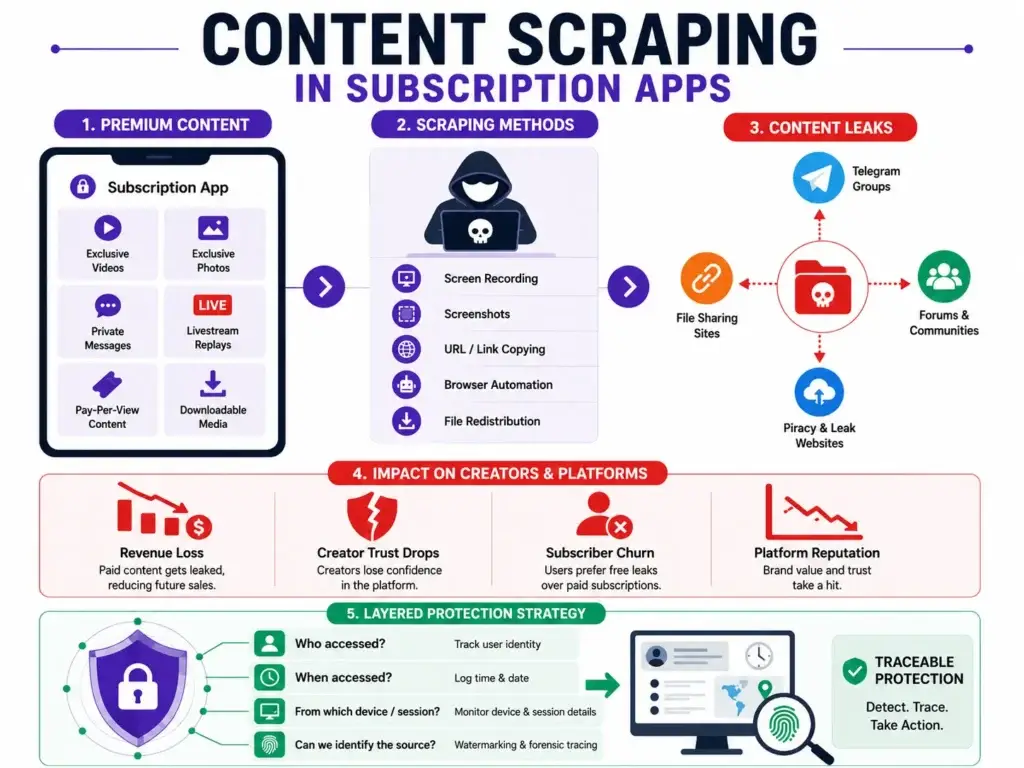
Content scraping becomes more serious when users pay for access.
In a public social media app, scraped content may hurt reach, attribution, or brand control. In a subscription app, scraped content directly affects revenue. A user who downloads or records paid content can share it in Telegram groups, forums, file-sharing sites, or competing fan communities. That leak may reduce future purchases and make creators question whether the platform is worth using.
A Cameo clone or creator subscription app usually handles several high-risk content types:
- Personalized video shoutouts
- Private creator messages
- Exclusive photos
- Subscriber-only videos
- Pay-per-view content
- Livestream replays
- Downloadable digital media
- Creator profile previews
- Fan-requested custom videos
Each content type has a different scraping risk. A video shoutout may be screen recorded. A private photo may be screenshotted. A livestream replay may be copied from a media URL. A paid message may be captured through browser automation. A downloadable file may be redistributed after purchase.
This is why founders should think beyond a single anti-piracy feature. The right strategy is layered protection.
A strong content protection app script should answer four questions:
- Who accessed the content?
- When did they access it?
- From which device or session?
- Can the platform identify the source if the content leaks?
If the app cannot answer these questions, the founder may only discover leaks after damage has already happened.
Read More: Cameo Booking Engine Architecture: Handling Live Video Call Scheduling and Payments
What Is Advanced Watermarking in a Content Protection App Script?
Advanced watermarking is the process of adding visible, invisible, dynamic, or forensic identifiers to digital content so the platform can discourage misuse and trace unauthorized sharing.
For subscription apps, watermarking should not be treated as a design element. It should be treated as part of the security and trust architecture.
A simple watermark may show the platform logo. That helps with branding, but it does not prove who leaked the content. Advanced watermarking goes further by linking the content playback session to a specific user, device, timestamp, IP signal, or transaction record.
For example, when a subscriber opens a paid creator video, the app may overlay a moving watermark with the user’s ID, email abbreviation, session code, or timestamp. If the user screen records and uploads the video elsewhere, the platform may visually identify the account associated with the leaked clip.
For premium video, the platform may also use forensic watermarking. This can embed an invisible identifier into the media stream so the leak source can be traced even if there is no obvious visible watermark.
In a Cameo clone, advanced watermarking can protect:
- Paid shoutout videos
- Creator-to-fan private video replies
- Premium feed content
- Livestream replays
- Subscriber-only video libraries
- Download-restricted media
- High-value celebrity content
The goal is not to claim that watermarking makes piracy impossible. No responsible founder should think that. The real goal is to make scraping harder, make leaks traceable, and make misuse riskier for the user.
Static Watermarks vs Dynamic Watermarks vs Forensic Watermarks
Not all watermarks offer the same level of protection. Founders should understand the difference before choosing a Cameo clone or creator subscription platform.
| Watermark Type | How It Works | Best Use Case | Weakness |
|---|---|---|---|
| Static watermark | Adds a fixed logo, brand name, or text overlay | Branding and basic ownership display | Easy to crop, blur, cover, or remove |
| Dynamic watermark | Shows user-specific or session-specific data during playback | Deterring screen recording and identifying careless leaks | May be visible to users and can affect viewing experience if poorly designed |
| Forensic watermark | Embeds hidden identifiers into the content or stream | Leak tracing for premium videos and high-value creator content | Requires deeper technical implementation and extraction workflow |
Static watermarks are useful, but they are not enough for paid creator platforms. A fixed logo does not tell the admin who leaked the content.
Dynamic watermarks are more practical for subscription apps because they can show user-specific data during playback. A user is less likely to share a screen recording if their email, user ID, or session code appears on the video.
Forensic watermarks are stronger for premium media because they are designed to be hidden and traceable. This is especially useful when visible overlays can be cropped or blurred.
A strong platform may use all three:
- Static watermark for platform branding
- Dynamic watermark for subscriber accountability
- Forensic watermark for high-value video leak tracing
Why Basic Watermarks Fail Against Modern Scrapers
Basic watermarks fail because modern scraping is no longer limited to right-click downloads.
Scrapers may use browser automation, API abuse, session hijacking, screen recording tools, media URL extraction, CDN hotlinking, or AI-based watermark removal. Even non-technical users can crop a video, blur a corner, cover a logo, or record content from another device.
Common scraping methods include:
- Cropping out fixed logo watermarks
- Blurring or covering visible text
- Recording the screen during playback
- Inspecting media URLs from browser tools
- Using bots to download unlocked files
- Sharing login credentials across users
- Capturing content through virtual machines
- Reposting videos on social platforms
- Using AI tools to clean visible overlays
This is why a content protection app script should avoid depending on one visible watermark. A watermark should move, change opacity, appear in different positions, and connect to backend logs.
For example, instead of placing a fixed watermark in the bottom-right corner, the app can display a dynamic watermark that moves across safe zones of the video, changes position every few seconds, and includes partial user identity. This makes it harder to crop without damaging the viewing experience.
The backend should also log the viewing event. If a leak appears later, the admin can compare the watermark, timestamp, session ID, and access history.
Advanced Watermarking Architecture for a Cameo Clone
A Cameo clone has a different content protection challenge than a normal video library. The content is often personalized, emotional, and high-value. A birthday message from a celebrity, a paid fan reply, or an exclusive creator video may not be useful if it leaks publicly.
That means watermarking should be built into the content workflow from the beginning.
A practical advanced watermarking architecture includes the following layers:
| Watermarking Layer | What It Tracks | Founder Value |
|---|---|---|
| User ID watermark | Links playback to a user account | Helps identify who viewed or leaked the content |
| Session ID watermark | Links playback to one viewing session | Useful when multiple users access the same account |
| Timestamp watermark | Shows when the content was accessed | Helps compare leak timing with access logs |
| Device signal | Connects access to device/browser information | Helps detect account sharing or suspicious access |
| IP/location signal | Logs approximate access context | Helps identify unusual viewing behavior |
| Dynamic placement | Moves watermark across the content | Reduces cropping and masking effectiveness |
| Opacity variation | Changes watermark visibility | Makes removal harder without hurting user experience |
| Server-side logging | Stores playback and access events | Supports admin investigation after leaks |
A secure Cameo clone should connect watermarking to user access control. The watermark should not be randomly added after upload. It should be generated at playback or delivery time based on who is watching, what they are watching, and what permission they have.
For example, a user buys a personalized video shoutout. When the video is ready, the user receives a notification. When the user opens the video, the platform verifies their purchase, generates a short-lived playback token, loads the protected media stream, applies a dynamic watermark, and logs the access session.
This is the kind of workflow founders should expect from a serious creator platform. It connects monetization, access control, user accountability, and admin investigation.
Read More: What is Cameo App and How Does It Work?
Watermarking for Different Content Types in Creator Apps
A Cameo clone or subscription content app may include several types of media. Each one needs a different protection approach.
| Content Type | Scraping Risk | Recommended Protection |
|---|---|---|
| Personalized video shoutouts | Screen recording, reposting, download attempts | Dynamic user/session watermark, signed URLs, token expiry, access logs |
| Paid livestreams | Live screen recording, restreaming, shared links | DRM for premium streams, moving watermark, session tracking, device limits |
| Livestream replays | URL scraping, unauthorized downloads | DRM, forensic watermarking, signed CDN delivery, replay access control |
| Private photos | Screenshots, reposting, right-click saves | Visible dynamic watermark, screenshot policy, download restrictions |
| PPV videos | Screen recording, account sharing, leaked files | DRM, dynamic watermark, forensic watermark, payment-linked access logs |
| Creator DMs | Screenshotting, copy-paste leaks, private media sharing | Message watermarking, abuse reporting, screenshot warnings, access records |
| Downloadable media | File redistribution after purchase | Buyer-specific watermark, download limits, license terms, user logs |
| Profile previews | Scraping creator images or teaser clips | Compressed previews, static branding watermark, bot rate limiting |
Founders should not apply the same protection level to every file. A public preview does not need the same level of protection as a paid celebrity video. A premium PPV video needs stronger protection than a free teaser. A private creator message needs user accountability and reporting controls.
This is where platform architecture matters. A secure app should allow different rules for different content categories.
Watermarking Is Not Enough: The Full Anti-Scraping Stack
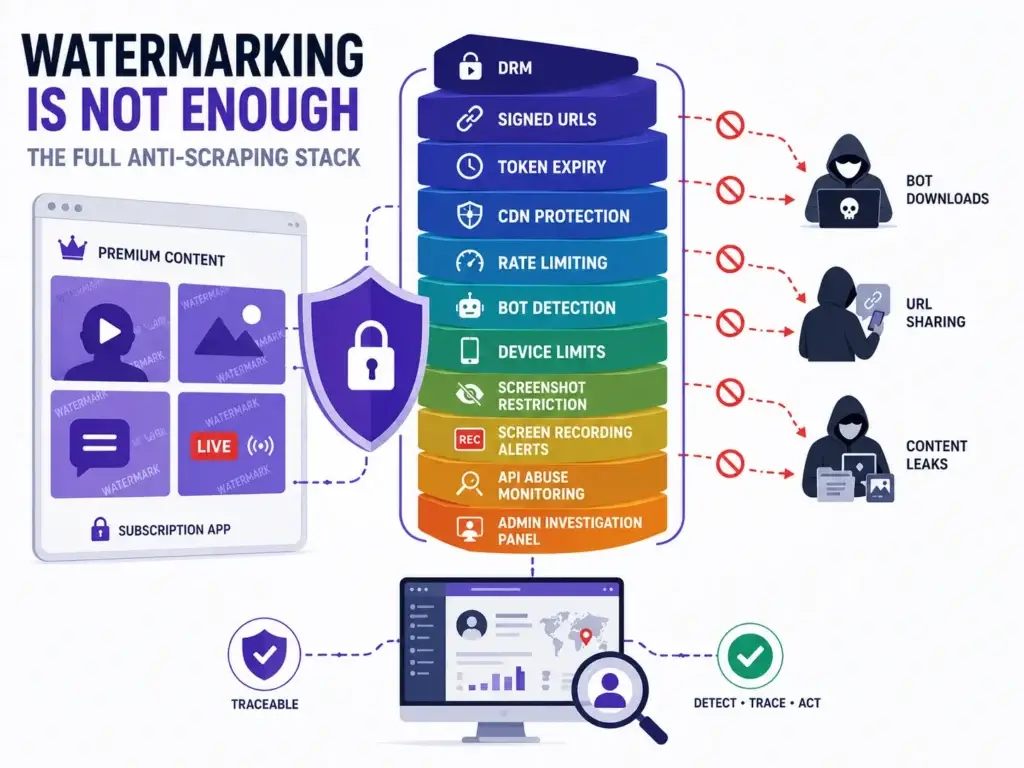
Watermarking is important, but it is not a complete anti-scraping system by itself.
A watermark can discourage misuse and help identify leaks. But it does not automatically stop unauthorized playback, token abuse, bot downloads, or media URL extraction. For that, founders need a broader protection stack.
A stronger anti-scraping stack includes:
| Protection Layer | What It Does | Why It Matters |
|---|---|---|
| DRM | Controls authorized playback using encryption and licensing rules | Helps protect premium video from unauthorized playback |
| Signed URLs | Generates temporary media links | Reduces long-term sharing of direct file URLs |
| Token expiry | Limits access duration | Prevents old links from being reused |
| CDN hotlink protection | Blocks unauthorized domains from serving media | Stops external sites from embedding or using media URLs |
| Rate limiting | Limits repeated requests from users, IPs, or bots | Reduces automated scraping attempts |
| Bot detection | Flags suspicious automation behavior | Helps detect scraping tools and fake accounts |
| Device limits | Restricts excessive devices per account | Reduces credential sharing |
| Screenshot restriction | Limits capture in supported app environments | Helps protect private photos and messages |
| Screen recording alerts | Warns or logs when supported devices detect recording | Adds deterrence and investigation signals |
| API abuse monitoring | Tracks abnormal API usage patterns | Helps protect content endpoints from automated extraction |
| Admin investigation panel | Gives admins leak tracing tools | Turns detection into action |
The right approach depends on the app’s monetization model. A lightweight creator marketplace may start with signed URLs, dynamic watermarking, access logs, and rate limiting. A premium celebrity content platform may need DRM, forensic watermarking, stricter device rules, and deeper leak investigation workflows.
The founder’s goal should be realistic: reduce scraping opportunities, increase user accountability, and make leaks traceable.
How Leak Tracing Works After Content Is Scraped
Leak tracing is where advanced watermarking becomes valuable.
Imagine a creator discovers that a paid video has been uploaded to a public channel. Without watermarking, the platform may only know that the video leaked. With advanced watermarking, the admin can investigate the source.
A practical leak tracing workflow looks like this:
- A creator or admin finds leaked content online.
- The admin reviews the visible watermark or extracts the forensic identifier.
- The platform matches the watermark to a user, session, device, or access event.
- The admin checks playback logs, payment records, and IP/device signals.
- The suspicious account is restricted or blocked.
- The creator is notified that the leak is being investigated.
- The platform starts a takedown workflow where applicable.
- The admin updates security rules if a pattern is detected.
This workflow matters because creators want to know the platform is not passive. Even when leaks happen, a platform with clear investigation controls can respond faster and protect trust.
For founders, this is also useful for operations. Leak tracing can reveal account sharing, suspicious buyer behavior, bot traffic, weak access rules, or content categories that need stronger protection.
Founder Checklist Before Launching a Subscription App
Before launching a Cameo clone or subscription content platform, founders should review content protection as part of the product foundation.
Use this checklist before going live:
- Dynamic watermarking is enabled for paid videos.
- User ID, session ID, or timestamp-based watermarking is available.
- Premium video uses DRM where required.
- Signed media URLs are used for protected content.
- Media tokens expire after a short access window.
- CDN hotlink protection is configured.
- Subscriber identity logs are stored for paid content access.
- Download restrictions are applied to premium media.
- Device/session limits are defined for subscriber accounts.
- Rate limiting is active on media and API endpoints.
- Bot detection is configured for abnormal content access.
- Screenshot and screen recording policies are defined.
- Creator reporting workflow is available.
- Admin panel includes leak investigation tools.
- Takedown workflow is documented.
- Terms of use clearly explain content misuse rules.
- Support team knows how to handle creator leak complaints.
Founders often delay these details because they want to launch faster. But adding them later can be more expensive and operationally messy. It is better to build a secure foundation early, especially if the app depends on creator trust.
How Miracuves Builds Secure Subscription Apps and Cameo Clone Platforms
A Cameo like app is not just a fan video request app. It is a creator marketplace where trust, payments, private content, delivery workflows, and user accountability need to work together.
Miracuves helps founders launch white-label Cameo clone platforms with branded user flows, creator profiles, paid video request workflows, wallet and payout logic, admin controls, and secure media delivery layers. For founders who want to explore broader ready-made product options, the Miracuves solutions hub is a useful starting point.
For content protection, Miracuves can align the app foundation with practical security workflows such as:
- Dynamic watermarking for paid videos
- User and session-based access logs
- Signed media URLs
- Secure video delivery
- Admin content moderation
- Creator verification flows
- Abuse reporting
- Payment-linked content access
- Role-based admin controls
- Custom security workflows based on app scope
The advantage of a ready-made approach is that founders do not need to build every creator platform module from zero. They can start with a launch-ready foundation and customize the protection, branding, monetization, and admin workflows around their business model.
If you are planning a creator app, celebrity shoutout marketplace, fan subscription platform, or private video monetization app, Miracuves can help you build a source-code-owned foundation that supports faster validation without ignoring content protection.
Read More: How to Build a Cameo Clone: A Step-by-Step Guide for Entrepreneurs
Mistakes Founders Should Avoid
Treating watermarking as only a logo overlay
A logo watermark may support branding, but it does not identify the user who leaked the content. For paid creator content, the watermark should connect to user identity, session history, or device signals.
Protecting videos but ignoring photos and messages
Many creator platforms protect video but forget private photos, chat attachments, and creator DMs. These content types can also be screenshotted, reposted, or scraped.
Using permanent media URLs
If media URLs never expire, users can share them outside the app. Signed URLs and token expiry reduce this risk.
Launching without an admin investigation workflow
Protection is not useful if admins cannot investigate leaks. The admin panel should show user access history, payment records, device signals, and content access logs.
Assuming DRM solves everything
DRM helps control authorized playback, but it does not automatically identify who recorded a screen or leaked a copy. Watermarking and logging are still important.
Ignoring creator communication
When content leaks, creators want fast action. A secure platform should include reporting, investigation, notification, and takedown workflows.
Founder Decision Signals
Speed
Launch speed matters, but paid content protection should be planned before creators upload premium media. Adding watermarking and secure delivery after launch can create technical and operational friction.
Cost
A weak protection layer can increase refund disputes, creator churn, support load, and rebuild costs. A ready-made foundation with configurable security workflows can be more cost-efficient than fixing leaks later.
Scalability
As more creators, subscribers, and media files join the platform, watermarking should connect with CDN delivery, session logs, access rules, and admin investigation tools.
Market Fit
Creator trust is part of market fit. If creators feel their paid videos, DMs, and private content are exposed, they may not bring their audience to the platform.
Speed
Launch speed matters, but paid content protection should be planned before creators upload premium media. Adding watermarking and secure delivery after launch can create technical and operational friction.
Cost
A weak protection layer can increase refund disputes, creator churn, support load, and rebuild costs. A ready-made foundation with configurable security workflows can be more cost-efficient than fixing leaks later.
Scalability
As more creators, subscribers, and media files join the platform, watermarking should connect with CDN delivery, session logs, access rules, and admin investigation tools.
Market Fit
Creator trust is part of market fit. If creators feel their paid videos, DMs, and private content are exposed, they may not bring their audience to the platform.
Final Thoughts: Build Creator Trust Before You Scale
Advanced watermarking is not about making unrealistic promises that content will never be copied. It is about making content misuse harder, riskier, and easier to trace.
For a Cameo clone or subscription content app, that difference matters. Paid creator content depends on trust. If creators believe the platform cannot protect their videos, photos, messages, or livestream replays, they may not upload their best content. If subscribers know every paid session is logged and watermarked, careless redistribution becomes less attractive.
The stronger founder decision is to build content protection into the app foundation before launch. Watermarking, DRM, signed URLs, access logs, rate limiting, and admin leak investigation should work together as one protection stack.
Miracuves helps founders move from idea to launch faster with ready-made, white-label, source-code-owned app solutions built for branding, monetization, admin control, and secure creator-platform workflows.
FAQs
What is advanced watermarking for subscription apps?
Advanced watermarking adds visible, invisible, dynamic, or forensic identifiers to paid content so the platform can discourage misuse and trace leaks. In a subscription app, it can connect content playback to a user, session, timestamp, device, or access record.
Why does a Cameo clone need watermarking?
A Cameo clone handles personalized paid videos, creator messages, private media, and fan-requested content. If this content is scraped or reposted, it can damage creator trust and reduce platform revenue. Watermarking helps identify where a leak came from.
Is watermarking enough to stop content scraping?
No. Watermarking is useful for deterrence and leak tracing, but it should be combined with DRM, signed URLs, token expiry, CDN hotlink protection, device limits, rate limiting, and admin monitoring.
What is the difference between dynamic watermarking and forensic watermarking?
Dynamic watermarking usually shows user-specific or session-specific information during playback. Forensic watermarking embeds hidden identifiers into the media or stream so leaked content can be traced without showing obvious visible text.
Can watermarking prevent screen recording?
Watermarking cannot fully prevent screen recording, but it can discourage users from sharing recorded content if their identity or session details appear in the video. For stronger protection, apps should also use DRM, device policies, and screen recording alerts where supported.
What should a content protection app script include?
A content protection app script should include dynamic watermarking, signed media URLs, token expiry, secure CDN delivery, user/session logs, bot detection, rate limiting, download restrictions, and admin leak investigation workflows.
How does leak tracing work in a creator subscription app?
When leaked content is found, the admin checks the visible or forensic watermark, matches it with user/session records, reviews access logs, restricts the account if needed, notifies the creator, and starts a takedown workflow.
Can Miracuves build a Cameo clone with content protection features?
Yes. Miracuves can help founders build white-label Cameo clone and creator subscription platforms with branded workflows, admin control, secure media delivery, watermarking logic, and source-code ownership based on the required project scope.
Miracuves is an independent software development company. We are not affiliated with, connected to, sponsored by, or endorsed by any company or product named in this article.
Terms such as “X Clone” are used descriptively. It is how the software industry refers to building a platform with functionality comparable to a known service, and how clients search for it.
The entire design and codebase of our products is built by our own team. Our products contain no code, design, graphics, or content originating from any third-party website or applications.
All third-party names and marks referenced in this article are the property of their respective owners, referenced solely to identify the services discussed.