Key Takeaways
- The developer trap buy prebuilt core architecture decision is about directing engineering budgets toward business value instead of rebuilding standard functionality unnecessarily.
- Pre-built architecture can help founders reuse common components such as authentication, databases, notifications, dashboards, and transaction workflows while focusing custom development on differentiating capabilities.
- Buying existing software is not automatically cheaper. Founders should evaluate documentation, security, licensing, integrations, customization requirements, maintenance, and total cost of ownership before choosing a foundation.
- The strongest approach is often to separate the commodity core from the competitive edge and decide which components should be reused, customized, or built from scratch.
- A hybrid architecture can provide a practical balance by reusing proven foundational modules while custom-building specialized workflows, pricing logic, matching systems, or other business-critical capabilities.
- Founders should compare build-versus-buy decisions using realistic long-term costs, including development, integration, QA, infrastructure, maintenance, security, and expected rework.
- The goal is not simply to write less code or buy more software. It is to reuse where it preserves value and build where it creates value, allowing the business to validate customers and invest more heavily in its true competitive advantage.
A White Label App Development Company. The team starts with user authentication, database structures, payment integrations, admin permissions, and basic workflows. Weeks turn into months. The product looks increasingly complete, but no paying customer has used it.
Then comes the uncomfortable realization: much of the development budget has gone toward functionality that already exists in other software products.
This is the $50,000 developer trap.
The figure is illustrative, not a universal development cost. The trap occurs when a founder spends substantial resources rebuilding standard technical foundations before proving that customers actually want the product.
The problem is not that developers are unnecessary or that custom software is inherently wasteful. Custom engineering can create enormous business value.
The problem is deciding where that engineering effort belongs.
For many startups, the more strategic approach is to reuse suitable pre-built app architecture for common functionality while investing custom development resources in the workflows, experiences, and operational capabilities that make the business distinctive.
But buying existing architecture also creates risks. Poor documentation, restrictive licensing, weak security, and difficult integrations can erase the apparent savings.
So how should a founder make this decision?
The answer begins with understanding what is being built, what already exists, and what the business genuinely needs to own.
What Is the $50,000 Developer Trap?
The $50,000 developer trap is a founder decision-making problem: spending a meaningful part of the product budget on engineering work that does not yet establish a competitive advantage.
Consider a startup developing a marketplace connecting customers with local service providers.
The founder needs customer registration, provider profiles, bookings, notifications, payments, reviews, and a management dashboard.
Developing these components requires planning, API design, databases, frontend interfaces, testing, and deployment. Each component has legitimate engineering requirements.
But the founder’s actual business hypothesis may be entirely different:
Can we attract enough qualified service providers, generate repeat bookings, and operate the marketplace profitably?
Writing a new authentication system or booking calendar does not automatically answer that question.
Yet a founder can spend months building those systems before collecting meaningful evidence about customer demand.
A hypothetical $50,000 development budget
The following example shows how an early software budget might be allocated. These are hypothetical planning figures, not current industry benchmarks or Miracuves prices.
| Development activity | Illustrative allocation |
|---|---|
| Core backend and database setup | $11,000 |
| Authentication and user management | $6,000 |
| Standard booking and payment workflows | $10,000 |
| Admin dashboard and reporting | $8,000 |
| API integrations and deployment | $6,000 |
| Testing, bug fixes, and rework | $9,000 |
| Total | $50,000 |
None of these activities is inherently unnecessary. The problem arises when the same business requirements could have been met through an appropriately evaluated existing foundation at a lower total cost.
A founder may reach the end of this spending cycle with a functional application but limited evidence that the business model will work.
That is the real trap: technical progress without equivalent business learning.
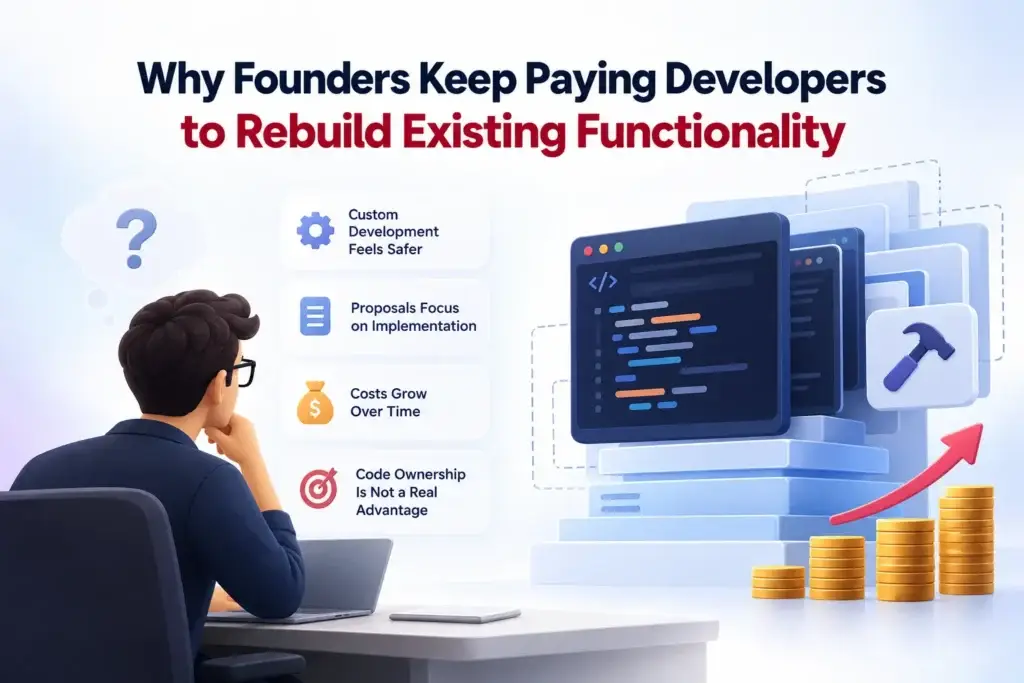
Why Founders Keep Paying Developers to Rebuild Existing Functionality
Most founders do not deliberately choose inefficient development. They encounter decisions that make starting from scratch appear sensible.
1. Custom development feels like greater control
A fresh codebase promises flexibility. The founder imagines a product tailored precisely to the original vision, without compromises introduced by existing software.
That control can be valuable.
However, the ability to customize everything is not the same as a business need to customize everything.
If standard account creation, basic notifications, and administrative permissions do not differentiate the product, rebuilding them may offer limited strategic value.
The relevant question is not whether custom development provides control. It is whether that additional control justifies its cost and delay.
2. Early technical proposals emphasize implementation
A traditional project estimate may be organized around screens, modules, integrations, and developer hours.
Those are necessary planning categories, but they do not automatically distinguish between standard functionality and business-critical innovation.
Without that distinction, a founder may approve development of every component as though each were equally important.
Before committing to months of engineering, founders should validate their app idea before development to understand whether the proposed product solves a meaningful customer problem.
A stronger architecture discussion begins by identifying which modules must be unique and which can be reused safely.
3. The true cost of development emerges gradually
An initial estimate does not always capture integration complexity, revised requirements, security improvements, production monitoring, or regression testing.
For example, a booking workflow may appear simple until the team must handle cancellations, rescheduling, time-zone differences, partial refunds, and conflicting availability.
The founder may approve additional work because each individual change seems reasonable.
Over time, the accumulated cost becomes much larger than the original expectation.
4. Founders confuse code ownership with competitive advantage
Owning a completely custom codebase may give a business technical independence. But ownership alone does not create customer demand.
A startup’s defensibility may come from its supplier relationships, network effects, proprietary data, distribution, operational execution, or unique service experience.
Technical architecture should support those advantages rather than consume resources that could help establish them.
What Pre-Built Core Architecture Actually Means
Pre-built core architecture refers to an existing software foundation that can be adapted and extended instead of reconstructed from zero.
It may include backend services, database schemas, application interfaces, operational dashboards, API integrations, and standard business workflows.
A useful foundation is more than a collection of attractive screens.
Its value comes from the working relationships between components.
For example, an order management workflow may need to update a customer’s order history, notify a service provider, record a payment event, and expose the transaction to an administrator.
If those interactions already operate reliably in an existing foundation, a development team can potentially concentrate on the startup’s distinctive requirements.
The application layers founders should examine
| Architecture layer | Typical responsibility | Reuse consideration |
|---|---|---|
| Identity and access | Login, authentication, permissions | Often reusable with security review |
| Data management | Database schema, records, migrations | Reusable if aligned with expected workflows |
| Transaction workflows | Orders, bookings, payment states | Reusable when business rules are similar |
| Communication | Push notifications, email, SMS | Often reusable through supported integrations |
| Administration | User oversight, reporting, approvals | Reusable if operational controls are configurable |
| Integration interfaces | APIs, webhooks, external systems | Require compatibility and reliability testing |
| Differentiating business logic | Proprietary matching, pricing, allocation | Often requires custom development |
These layers are not universally interchangeable.
A platform designed around ordinary service bookings may be unsuitable for a business requiring complex auctions or real-time financial settlement.
Similarly, a reusable payment interface does not remove the need to evaluate payment security, provider requirements, and transaction integrity.
Founders comparing reusable software components can also explore ready-made software foundations to understand how established application workflows can serve as a starting point for different business models.
The correct objective is to reuse the right architecture, not simply the largest amount of existing code.
The Commodity-Core vs. Competitive-Edge Framework
One of the most practical ways to evaluate a software investment is to divide product requirements into two categories.
The first category is the commodity core: functionality necessary for the product to operate but unlikely to make customers choose it over an alternative.
The second is the competitive edge: functionality that expresses the business’s distinctive value.
Where should engineering effort go?
Commodity core
Common product requirements that can often be reused:
• User accounts
• Standard notifications
• Basic transaction records
• Admin permissions
• Standard reporting
First evaluate existing modules.
Competitive edge
Capabilities central to the product’s differentiation:
• Proprietary matching logic
• Unique pricing rules
• Specialized workflows
• Domain-specific intelligence
• Distinctive user experiences
Consider custom engineering.
These are decision categories, not rigid technical rules. Security, compliance, and performance requirements can make even ordinary modules unsuitable for reuse.
Example: A specialized service marketplace
Imagine a startup connecting commercial property managers with verified maintenance providers.
The business requires familiar marketplace functionality: registration, profiles, scheduling, messaging, and payment records.
Those components may be available within an existing platform foundation.
However, the company could differentiate itself through a specialized provider qualification process, contractual service-level rules, and automated emergency-job allocation.
Those capabilities deserve closer custom-development attention because they directly affect the service promise.
The founder should evaluate whether the existing architecture can support the distinctive logic without major restructuring.
If it can, a hybrid architecture may be appropriate.
If it cannot, custom engineering may be necessary for the central workflow, even while peripheral components are reused.
The Hidden Financial Costs of Coding Everything From Scratch
A founder comparing a developer proposal with a pre-built software offer should not compare only the initial prices.
The meaningful comparison is the total cost of achieving and maintaining a usable product over a defined period.
Development budgets should account for architecture, integrations, testing, and maintenance. Reviewing the scope of custom software engineering can help founders understand which technical activities need to be included in a realistic project plan.
That includes several cost categories that may be overlooked.
Development and rework
A new system requires implementation and testing. As business requirements become clearer, some of the original work may need to change.
Rework is common when early assumptions about customers or operations are incomplete.
This does not necessarily indicate poor development. It reflects the uncertainty involved in creating a new product.
But it does have a financial cost.
Integration and infrastructure
Applications rarely operate in isolation.
They may rely on external payment services, mapping systems, identity verification, communication providers, cloud infrastructure, analytics tools, and operational software.
Each integration introduces configuration, error handling, monitoring, testing, and potentially recurring third-party charges.
These expenses apply to both custom and reused architectures, although the amount of implementation work may differ.
Security and reliability
Security cannot simply be deferred until the product becomes popular.
Authentication, authorization, secure data handling, access logging, backups, and incident recovery are relevant from the beginning.
Existing architecture can reduce some implementation effort, but only after reviewing its security posture.
Reusing insecure software merely transfers risk into the new product.
Maintenance and future changes
The first release is not the end of engineering expenditure.
Software needs dependency updates, compatibility changes, bug resolution, operational monitoring, and changes to accommodate evolving customer requirements.
The total cost of ownership should account for continuing maintenance rather than assume that a completed application stops costing money.
Opportunity cost of delayed learning
This may be the hardest expense to calculate.
While development continues, founders may be unable to test real retention, conversion, willingness to pay, or operational performance.
A delay is not necessarily lost revenue. An unvalidated product may not have generated revenue at all.
The more defensible concern is delayed evidence.
Every month spent exclusively on foundational engineering is a month in which the startup may learn less from real customers.
That can be especially costly when capital is limited or the business hypothesis remains uncertain.
A Better Way to Compare the Real Cost of Building vs. Buying
The initial software price is only one line in the budget.
A proper build-versus-buy comparison should model the same requirements and time horizon for both alternatives.
A useful starting point is a 12- or 24-month ownership model.
For each option, estimate:
\[ \text{Total Cost} = \text{Acquisition or Build} + \text{Integration} + \text{QA} + \text{Infrastructure} + \text{Maintenance} + \text{Expected Rework} \]
Then evaluate launch delays and business uncertainty separately, rather than treating speculative revenue as guaranteed savings.
Custom-Built vs. Pre-Built vs. Hybrid Architecture
| Decision Factor | Fully Custom Build | Pre-Built Foundation | Hybrid Architecture |
|---|---|---|---|
| Initial Engineering | Most components built from zero | Existing modules configured and adapted | Standard modules reused; unique logic custom-built |
| Upfront Cost | Depends on full development scope | Depends on acquisition, integration, and customization | Depends on reuse compatibility and custom scope |
| Differentiation | Potentially extensive | Constrained by existing architecture | Focused on selected capabilities |
| Launch Timeline | Determined by full build and testing | Potentially shorter for well-matched requirements | Depends on integration boundaries |
| Technical Risks | New implementation defects and design assumptions | Inherited code quality and dependencies | Integration complexity between old and new modules |
| Future Flexibility | Depends on architecture and team | Depends on rights, code quality, and extensibility | Depends on ownership and modular design |
| Appropriate Use | Novel or highly specialized products | Products with common, well-understood workflows | Products mixing familiar workflows with unique capabilities |
A ready-made platform is not automatically the least expensive option.
If the foundation requires extensive rewrites, proprietary integrations, or changes to its underlying data model, the supposed advantage may disappear.
The strongest financial choice is the one with the lowest realistic total cost for the capabilities the business actually needs.
How to Evaluate a Pre-Built Codebase Before Buying It
The build-versus-buy decision becomes much easier when founders stop evaluating architecture through demonstrations alone.
A working demo can establish that certain product flows exist.
It does not establish code quality, legal ownership, production reliability, or ease of modification.
Before committing funds, founders should examine the following areas.
1. Architecture and documentation
Ask whether the codebase has clear modules, understandable dependencies, database documentation, and setup instructions.
Can a new engineer identify where business logic is implemented?
Can the application be deployed without relying on undocumented manual steps?
Poor documentation increases future maintenance costs, even when the product initially appears functional.
2. Source-code rights and licensing
Receiving source-code files is not necessarily the same as owning all intellectual property rights.
A purchase agreement may provide a license to modify and deploy software while restricting resale, redistribution, or transfer to another party.
Other agreements may assign specific ownership rights.
Founders should confirm:
- Which source-code repositories are delivered?
- What rights are granted to modify, deploy, transfer, and resell the code?
- Are third-party components included under separate licenses?
- Can a different engineering team maintain the software?
- Are hosting, accounts, data, and deployment credentials controlled by the buyer?
The written agreement should determine these rights, not marketing terminology alone.
3. Security and dependency quality
Ask for information about authentication, role-based access control, dependency management, encrypted data handling, and known vulnerabilities.
Sensitive systems may also require audit logs, stronger access restrictions, and specialized regulatory reviews.
A reusable foundation should make necessary security testing possible rather than restrict visibility into the implementation.
4. Integration readiness
List every external system needed for the first release.
Check whether the architecture exposes documented APIs, supports webhooks where necessary, and handles third-party failures predictably.
A demo that uses a payment interface is not proof that the application supports your intended payment provider or jurisdiction.
5. Scalability and maintainability
Scalability is not a permanent property achieved simply by selecting a particular framework.
It depends on workload, application design, database performance, infrastructure, monitoring, and operational practices.
Ask how the software behaves under realistic transaction patterns and whether the architecture can be extended without changing unrelated modules.
6. Customization boundaries
Identify exactly which requirements are configuration changes and which require engineering work.
Changing brand colors is different from replacing a pricing engine or redesigning a multi-step booking workflow.
A supplier should be able to describe those boundaries before the project begins.
7. Support and handoff
Review the documentation, defect-resolution process, update policy, and responsibilities after deployment.
A sustainable handoff should make the business less dependent on any single developer or vendor.
The Founder Decision Test: Should You Build or Reuse?
Reuse
Standard features already exist in a suitable, well-documented codebase.
Customize
Your differentiation depends on a limited number of business-specific workflows.
Build
Your core requirements cannot be supported by existing architecture without major redesign.
Validate
Launching an initial product will help answer important customer-demand questions.
Build-or-reuse readiness check
0 of 6 answered
1. Are most of your first-release features standard application workflows?YesNo
2. Is your unique business value concentrated in a small number of capabilities?YesNo
3. Would launching earlier help you test a major customer-demand assumption?YesNo
4. Can an existing foundation support your essential data and integration requirements?YesNo
5. Can you obtain acceptable documentation, security evidence, and written code rights?YesNo
6. Does the product require novel core algorithms or unusual architecture that existing platforms cannot accommodate?YesNo
Answer all six questions to see an initial recommendation.
Reset assessment
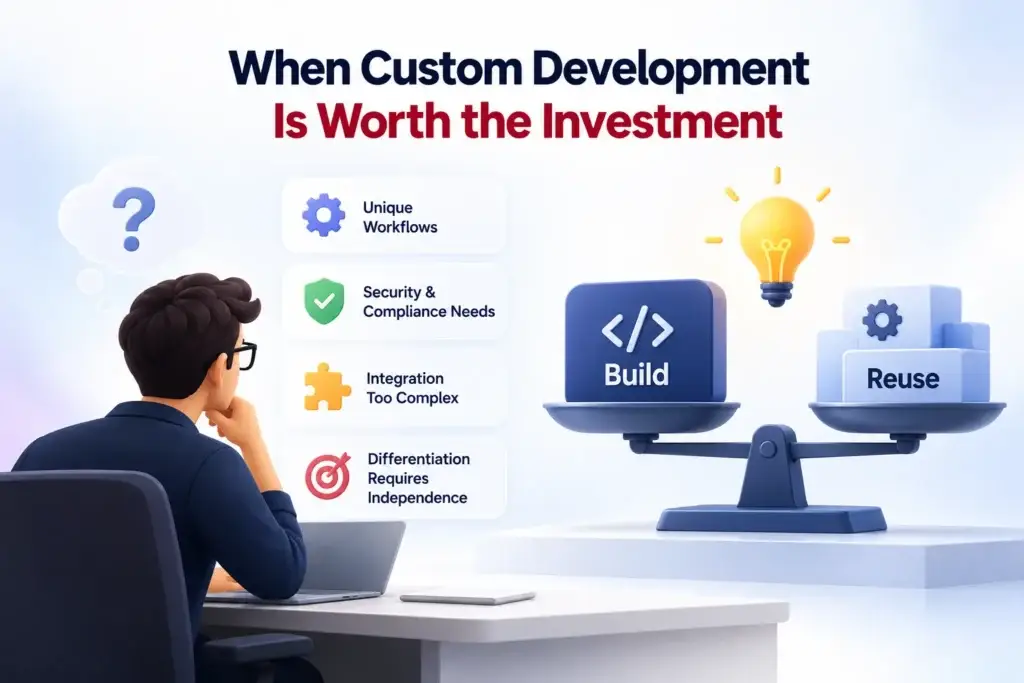
When Custom Development Is Worth the Investment
A reusable foundation should never become a constraint that prevents a business from delivering its essential value.
There are situations where writing substantial custom software is the more rational decision.
Your core workflow is genuinely unusual
If the product depends on a novel optimization algorithm, specialized real-time coordination, unique computational logic, or an unconventional data structure, existing applications may provide little useful foundation.
Trying to force the product into an unsuitable architecture can create expensive workarounds.
Your security or regulatory requirements are specialized
Certain products operate under strict security, privacy, auditability, or regulatory requirements.
An existing codebase may still be useful, but it must be evaluated against the applicable requirements.
If the architecture cannot support necessary controls, a custom implementation or major redesign may be justified.
Integration costs exceed the value of reuse
A foundation can be inexpensive to acquire but expensive to integrate.
If most modules require replacement or extensive modification, the founder may be better served by a purpose-designed architecture.
Your differentiation requires architectural independence
Some businesses compete through software behavior that cannot be implemented cleanly as an additional feature.
In those cases, engineering the underlying system is not wasted effort. It is part of developing the business’s distinctive capabilities.
The strategic principle is simple: reuse where it preserves value, and build where it creates value.
Why Hybrid Architecture Is Often the More Useful Answer
The build-versus-buy decision is frequently framed as though founders must select one approach for the entire product.
That is often unnecessary.
A business can start with an existing foundation and develop selected components independently.
For example, a service platform might reuse authentication, basic dashboards, notifications, and transaction records while implementing custom provider matching and service allocation.
The arrangement works best when modules have clear responsibilities and interfaces.
A custom component should communicate with the foundation through well-defined APIs or other maintainable integration boundaries.
Without that discipline, a hybrid application can become harder to maintain than either a clean custom build or a largely unchanged existing product.
Founders should also decide which systems hold authoritative data and how changes will be tested.
The value of hybrid architecture lies in selectively allocating engineering effort, not creating a complicated mix of technologies for its own sake.
Launch Speed Matters Because Customer Evidence Matters
A shorter development schedule is only valuable when it helps the business reach a meaningful milestone sooner.
A founder does not need every future feature before learning whether customers understand the offer, complete onboarding, or return to use the service.
An initial product release can answer questions that internal planning cannot:
- Do customers complete the primary transaction?
- Which steps create abandonment?
- Can the business acquire suppliers or service providers reliably?
- Are operational costs compatible with the proposed revenue model?
- Which capabilities do users actually request?
These observations help determine where subsequent development investment belongs.
Launching a product is only the first milestone. As requirements evolve, founders may need to reconsider backend design, infrastructure, and scalability. Our guide to scaling applications with custom architecture explains the next stage of that decision.
Miracuves offers ready-made application foundations with a 6-working-day delivery model for eligible, appropriately scoped deployments. The timeline should be understood as a defined deployment commitment, not a promise that every possible customization, external integration, regulatory requirement, or app-store approval will finish within six days.
For founders considering this path, the practical question is whether the available foundation already supports the essential customer journey.
When it does, the business may be able to move into validation sooner.
When it does not, a longer development period may be necessary.
Five Mistakes That Turn Pre-Built Software Into a New Developer Trap
Choosing solely by the lowest upfront price
A low acquisition price can conceal missing functionality, poor documentation, difficult integrations, or expensive future modifications.
Evaluate the cost of achieving your actual release requirements, not merely purchasing a codebase.
Assuming a working demonstration proves production readiness
A demo may show only carefully selected workflows.
Review error handling, permissions, backend reliability, dependency quality, and deployment procedures before treating the architecture as production-ready.
Ignoring licensing and transfer restrictions
A source-code package may carry legal restrictions that affect modifications, commercial use, resale, or transfer.
Review applicable licensing terms before committing the product strategy to the codebase.
Customizing everything immediately
Extensive changes can eliminate the reuse advantage.
Begin with the minimum adaptations needed to deliver a coherent customer experience and test the business hypothesis. Prioritize later changes using real customer evidence.
Treating launch as the final engineering milestone
Even a successful initial release requires maintenance, observability, security updates, and future improvements.
Choose an architecture that the business can understand, operate, and extend.
Poor architectural decisions can create expensive rework after launch. Miracuves explores a related challenge in its analysis of the software rebuild tax in AI products, highlighting why maintainability should influence early development decisions.
How Founders Can Redirect Engineering Budgets Toward Business Growth
A sound architecture decision should change how a founder allocates money and attention.
Instead of asking how many developers are required to write every feature, consider which investments will reduce the most important business uncertainty.
For an early-stage marketplace, that may mean allocating more resources to supplier onboarding, customer acquisition experiments, operational training, or payment-flow validation.
For a subscription-based product, it may mean studying activation, retention, cancellation reasons, and willingness to pay.
For a specialized enterprise application, it may mean investing in integration reliability or the distinctive workflow that determines whether customers adopt the product.
None of this makes software engineering less important.
It makes engineering expenditure more intentional.
A startup that spends less time rebuilding ordinary infrastructure may be able to devote more effort to designing, testing, and improving its actual business model.
That is a stronger goal than simply minimizing development costs.
Where Miracuves Fits Into the Build-or-Reuse Decision
Miracuves helps founders and businesses evaluate ready-made application foundations that can be adapted to their branding, operating model, and functional requirements.
The relevant question is not whether an existing platform can be purchased.
It is whether its core workflows, technical structure, customization boundaries, and contractual terms align with the business being launched.
For founders who determine that reusable architecture fits their business requirements, Miracuves offers an approach to adapting ready-made application foundations that can help reduce repetitive engineering work while allowing necessary branding and customization.
Founders who determine that reusable architecture is appropriate can explore Miracuves’ approach to adapting ready-made application foundations to understand available deployment options, app components, and the commercial engagement process.
A sensible next step is to map the proposed product into three groups:
- Functionality that an existing foundation already handles.
- Functionality that requires configuration or limited modification.
- Functionality that genuinely needs custom engineering.
This exercise creates a clearer development scope and a more meaningful basis for comparing proposals.
It also reduces the risk of choosing a solution purely because it promises the lowest price or shortest timeline.
Final Thoughts: Stop Paying to Reinvent What Your Business Does Not Need to Own
The $50,000 developer trap is not fundamentally about developer rates.
It is about the relationship between engineering investment and business value.
A custom-built application can be the correct choice when its underlying architecture creates a meaningful advantage.
A pre-built foundation can be the correct choice when the essential functionality is already available, technically suitable, and commercially viable.
And a hybrid approach may offer the most practical balance when a startup needs familiar operational workflows alongside genuinely distinctive capabilities.
Founders should not measure progress exclusively by the amount of code written.
Before purchasing an existing foundation, founders should clarify delivery responsibilities, modification rights, post-launch updates, and maintenance arrangements. Miracuves addresses several of these issues in its software delivery and support FAQs.
They should measure progress by how efficiently they can create a dependable product, learn from real customers, and strengthen the capabilities that matter to the business.
The smarter investment is not always more development. It is better-directed development.
FAQs
Is building an app from scratch always more expensive than using pre-built architecture?
A custom build can be more economical when existing software requires major changes, unsuitable integrations, or expensive modifications. The correct comparison includes acquisition or development costs, integration, QA, security, infrastructure, maintenance, and future rework.
What exactly is the $50,000 developer trap?
It describes a hypothetical situation where a founder spends $50,000 rebuilding standard software functionality before validating the underlying business opportunity. The amount is illustrative, not an industry benchmark. The broader issue is investing heavily in technical foundations without confirming whether that investment creates meaningful business value.
Which application components are usually suitable for reuse?
Common candidates include authentication, standard user management, notifications, basic dashboards, transaction records, and familiar booking or ordering flows. Each component still needs evaluation for security, compatibility, licensing, and business requirements before reuse.
Can pre-built app architecture support future customization?
Yes, when the architecture is sufficiently modular, documented, and legally available for modification. The depth of possible customization depends on how the codebase is designed, what dependencies it contains, and which rights the buyer receives.
Does buying existing source code eliminate vendor lock-in?
Not necessarily. Receiving source code can improve flexibility, but independence also depends on legal permissions, deployment access, documentation, third-party licenses, proprietary dependencies, and the ability of another engineering team to maintain the system.
How can founders identify hidden development costs before starting?
Create a detailed requirements map and request estimates for implementation, integration, QA, deployment, hosting, security review, maintenance, and likely changes. Ask which assumptions could materially change the estimate. Evaluate competing approaches across the same functional scope and ownership period.
When should a founder choose custom architecture instead of a ready-made foundation?
Custom architecture may be more appropriate when the product depends on unusual business logic, highly specialized performance requirements, novel technical capabilities, or strict requirements that existing systems cannot reasonably support. In those situations, adapting an unsuitable foundation can be more expensive than creating an appropriate one.
Can a startup combine pre-built software with custom-developed features?
Yes. A hybrid architecture can reuse well-matched foundational modules while allowing custom development for differentiating workflows. It works best when components have clear responsibilities, documented interfaces, consistent security controls, and a defined maintenance strategy.
Miracuves is an independent software development company. We are not affiliated with, connected to, sponsored by, or endorsed by any company or product named in this article.
Terms such as “X Clone” are used descriptively. It is how the software industry refers to building a platform with functionality comparable to a known service, and how clients search for it.
The entire design and codebase of our products is built by our own team. Our products contain no code, design, graphics, or content originating from any third-party website or applications.
All third-party names and marks referenced in this article are the property of their respective owners, referenced solely to identify the services discussed.