



























Key Takeaways
- Generative AI App Budget should account for both development expenses and recurring API usage as customer activity grows.
- AI token consumption can increase because of repeated instructions, long conversation histories, excessive document context, verbose outputs, retries, and multi-step agent workflows.
- Tracking token usage and expense at the request, feature, user, and account levels helps founders identify where AI spending is actually occurring.
- Prompt caching, relevant context selection, model routing, output limits, batch processing, and bounded agent execution can reduce unnecessary API consumption.
- A lower token price does not always mean lower operating costs. Founders should evaluate the total expense required to complete a successful task, including retries and additional model calls.
- Backend-enforced token allowances, spending limits, atomic budget reservations, and usage reconciliation can help prevent individual users or workflows from creating unexpected API bills.
- The best AI cost strategy balances token efficiency with response quality, reliability, latency, and customer value rather than simply minimizing the number of tokens consumed.
An Generative AI App can look affordable when only a few people are testing it. The real financial pressure often begins when customers start using it every day.
A customer support assistant may receive hundreds of conversations. A document analysis tool may process lengthy files. An AI agent may perform several operations before producing one useful result.
Every interaction can consume API tokens, and those charges accumulate.
For founders using OpenAI or Anthropic APIs, the question is no longer just whether an AI feature works. It is whether the product can keep delivering useful results without allowing inference expenses to grow unpredictably.
AI API token cost optimization is the practice of reducing unnecessary model usage, tracking what each task consumes and enforcing practical spending limits.
The objective is not to generate the shortest possible response or always select the least expensive model. It is to deliver reliable output while keeping consumption measurable and controlled.
This guide explains how to calculate token usage, identify unnecessary spending, optimize API requests and introduce safeguards before growing traffic creates larger financial risks.
Why API Token Burn Becomes a Problem as AI Apps Grow
A conventional application may have relatively predictable infrastructure requirements for each transaction.
Generative AI workloads behave differently.
One user might ask for a short summary. Another might upload a lengthy document. A third might request a complex analysis requiring multiple model calls.
Those requests create different amounts of consumption.
Unpredictable API spending also highlights a wider product risk: depending on external model services without sufficient control over your application layer. Founders evaluating long-term sustainability should also understand the risks of relying entirely on external AI APIs, particularly when usage grows faster than the value generated by the product.
The issue becomes more complicated when an application automatically adds context before calling the model.
For founders still learning how applications communicate with language models, understanding how OpenAI API integrations work provides useful context on requests, authentication, model responses, and usage monitoring before introducing advanced spending controls.
For example, a customer support assistant may send its operating instructions, product knowledge, previous conversation history and retrieved help articles with every message.
A user might ask a question containing only 15 words, but the application could send several thousand tokens to process it.
The visible message is therefore not a reliable representation of total usage.
Where Does the Extra Token Consumption Come From?
There are several common sources:
- Repeated system instructions: The same lengthy instructions are included in many requests.
- Growing conversation history: Previous messages accumulate as sessions continue.
- Excessive document context: More retrieved text is supplied than the question requires.
- Unnecessarily long outputs: Responses include explanations or content the user did not request.
- Multiple model calls: A single feature invokes several processing steps.
- Retries and failures: Requests are repeated after timeouts, validation errors or incomplete answers.
These issues are manageable, but only when founders can identify them.
A monthly provider bill shows what was spent. A request-level usage record helps explain why.
How OpenAI and Anthropic API Token Billing Works
Both APIs use model-dependent pricing, commonly expressed per million tokens.
However, calculating an application’s true expense requires more than multiplying all tokens by one rate.
Different categories can have different pricing arrangements.
| Token or usage category | What it represents | Budgeting consideration |
|---|---|---|
| Input tokens | Instructions, messages and context supplied to a model | Large repeated inputs increase spending |
| Output tokens | Content generated by the model | Long responses and unnecessary generation can be expensive |
| Cached input tokens | Eligible repeated prompt content reused through provider caching | May receive a different rate |
| Cache-write tokens | Eligible context stored for later reuse | Writing and reading can have different rates |
| Reasoning usage | Internal processing reflected in supported models’ usage accounting | Can affect billed output consumption |
| Tool and workflow usage | Additional model requests or chargeable tools invoked during processing | One customer action can involve several expenses |
Provider pricing structures change with models and features. Some caching arrangements can also introduce distinct write charges or retention-related pricing.
For current rules, consult the official OpenAI API pricing documentation and Anthropic API pricing documentation.
How to Calculate Token Expenses Per API Request
For a simple text-only request without special caching rates or additional tools, the calculation is:
Request expense = (Input tokens × Input rate per million + Output tokens × Output rate per million) ÷ 1,000,000
Suppose a request uses:
- 4,000 input tokens.
- 800 output tokens.
- An illustrative input rate of $2 per million tokens.
- An illustrative output rate of $8 per million tokens.
The calculation is:
Input charge = 4,000 × $2 ÷ 1,000,000 = $0.008
Output charge = 800 × $8 ÷ 1,000,000 = $0.0064
Total illustrative request charge = $0.0144
At 10,000 identical requests, the corresponding charge would be $144.
These are hypothetical rates selected to demonstrate the calculation, not quotations for a particular API model. Actual accounting must include the applicable model rates, cached-token categories and other chargeable operations.
This calculation becomes particularly useful when founders evaluate different user behaviors and feature types.
Seven Ways to Reduce Unnecessary AI API Token Consumption
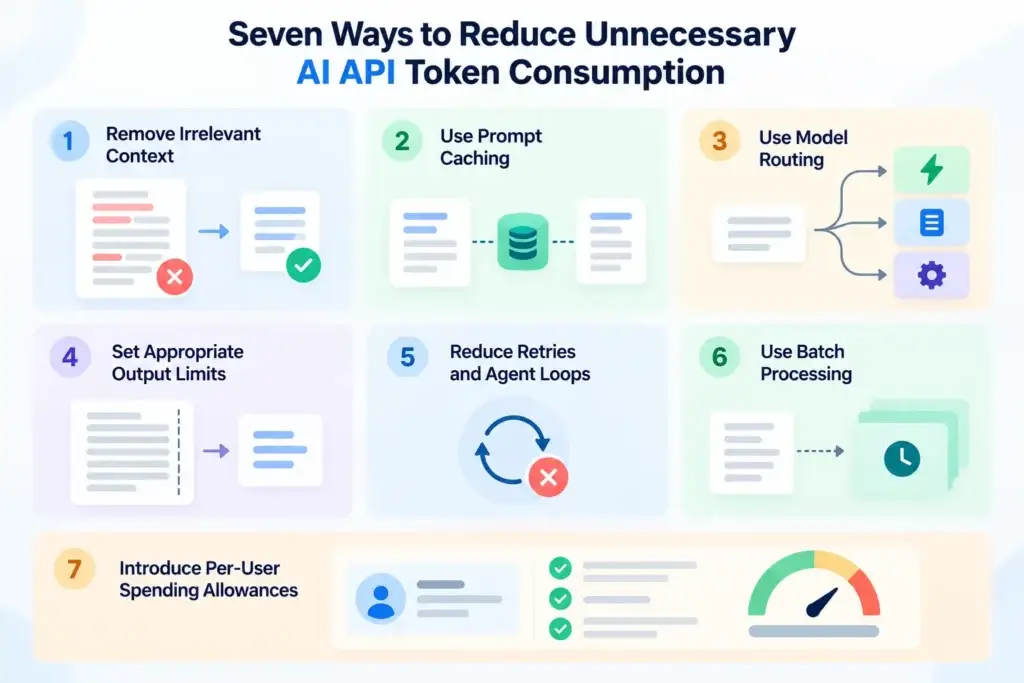
1. Remove Irrelevant Context Before Sending Requests
An effective prompt should contain enough information to complete the task accurately, but not an unlimited amount of supporting material.
Many applications send entire conversations or large document sections because it simplifies development.
That convenience can create unnecessary recurring consumption.
A better approach is to divide information into:
- Instructions that must always be present.
- Information directly relevant to the current request.
- Historical context that can be summarized or retrieved selectively.
Consider a document assistant handling employee policy questions.
If a user asks about annual leave, the system should retrieve the relevant policy sections instead of sending the entire employee handbook.
The same principle applies to customer support, financial document processing and AI knowledge assistants.
However, aggressive reduction is not always beneficial. Removing the paragraph containing an important exception could make the response inaccurate.
2. Use Prompt Caching for Repeated Instructions
Some AI applications repeatedly send the same instruction sets, reference material or tool definitions.
Prompt caching allows eligible repeated content to be reused according to the provider’s supported mechanisms.
This can reduce the expense of repeatedly processing identical context.
For example, a customer support assistant might use the same instructions for tone, permitted actions and response formatting across thousands of conversations.
Provider-level prompt caching is only one way to reduce repeated processing. Applications that frequently receive similar questions can also explore semantic response reuse. For a deeper technical explanation, read Miracuves’ guide to reducing repeated chatbot calls through vector caching.
Instead of unnecessarily treating those instructions as entirely new content on every call, a suitable caching configuration may reuse the stable portion.
An effective setup generally considers:
- Consistent, reusable prompt prefixes.
- Stable tool definitions.
- Appropriate cache lifetimes.
- Actual cache-hit measurements.
- The cost of writing and reading cached context.
- User and data-isolation requirements.
OpenAI and Anthropic have different caching controls and pricing arrangements, so the implementation should follow the specific model documentation.
Caching is not equivalent to eliminating the API request. New input still requires processing, and the model must still generate the requested response.
3. Use Model Routing Instead of One Model for Every Task
A generative AI application may perform many different operations.
Some require straightforward classification or data extraction. Others need advanced reasoning, analysis or multi-step decision-making.
Model routing is also important in products that perform multiple AI operations within a single workflow. Miracuves’ explanation of AI app builder architecture and model orchestration explores how complex applications coordinate generation, backend operations, previews, and model usage.
Using the same model for every operation can create avoidable expense.
Model routing assigns requests to configurations appropriate for the task.
| AI task | Suitable evaluation approach | Important quality measure |
|---|---|---|
| Support ticket classification | Test an economical model | Classification accuracy |
| Structured data extraction | Evaluate smaller or specialized configurations | Valid schema and field accuracy |
| Routine text summaries | Compare models on representative documents | Completeness and factual consistency |
| Multi-document analysis | Evaluate stronger reasoning models | Evidence quality and accuracy |
| Complex agent workflows | Route individual steps according to difficulty | End-to-end task success |
A lower per-token rate does not automatically produce a lower total expense.
If a less capable model frequently returns invalid outputs, the application might need additional calls to correct them.
That is why founders should optimize expense per successful task, not simply the advertised token rate.
4. Set Appropriate Output Limits
Applications sometimes generate more text than customers need.
A sentiment classifier may only need a category and confidence indicator. An invoice processor may need a structured JSON response. A product description tool may need a particular word range.
Allowing unnecessarily extensive responses increases output consumption.
Practical controls include:
- Defining the required response format.
- Limiting response length when appropriate.
- Using structured outputs for predictable data.
- Applying model-supported output-token controls.
- Avoiding unnecessary explanatory paragraphs in machine-readable workflows.
Limits must be chosen carefully.
If an output cap truncates important information or produces invalid structured data, the application may need additional requests, defeating the original objective.
5. Reduce Uncontrolled Retries and Agent Loops
AI agents can execute multiple operations in response to one user instruction.
An agent might interpret the task, retrieve information, call a tool, validate the result and generate a final answer.
Each model step can contribute to the total bill.
Without safeguards, failed tool responses or incomplete outputs may cause repeated calls.
This makes agent-level budgeting essential.
Useful controls include maximum execution steps, bounded retries, backoff policies, tool-call limits and stopping conditions.
An application should also track requests that time out. A client-side timeout does not necessarily mean the provider performed no billable work.
When calculating task consumption, account for all attempts associated with that task, not only the final successful response.
6. Use Batch Processing for Tasks That Do Not Need Immediate Answers
Some AI work can happen asynchronously.
Examples include categorizing historical support tickets, summarizing archived documents, processing large collections of product descriptions and generating scheduled reports.
Supported batch-processing features may provide different pricing arrangements from immediate interactive requests.
The main tradeoff is response time.
A live customer-facing assistant generally needs quick results. A nightly document-processing job may be able to tolerate longer execution times.
Founders should separate interactive and non-interactive workloads rather than forcing every operation through the same processing method.
Always verify the relevant model’s eligibility, pricing and execution limits before assuming batch processing will be less expensive.
7. Introduce Per-User Token and Spending Allowances
The previous techniques can reduce average token consumption.
They do not guarantee that one highly active user or automated workflow will remain within a reasonable budget.
Application-level spending controls help prevent that problem.
A backend system can track usage by user, account, feature and billing period.
Depending on the business model, it may enforce:
- Request limits.
- Per-user token allowances.
- Estimated spending ceilings.
- Maximum expensive operations per session.
- Concurrency restrictions.
- Additional authorization for unusually large requests.
A trial user might receive a small allowance, while a subscribed user receives a higher one.
These restrictions should be implemented in trusted backend systems rather than relying on client-side counters.
The objective is to preserve a predictable operating model even when individual usage patterns vary.
AI API Token Optimization Techniques Compared
Different optimizations address different causes of token consumption. Founders should prioritize improvements according to their application workflow and measured usage patterns.
| Technique | What It Controls | Business Value | When to Prioritize |
|---|---|---|---|
| Context Optimization | Unnecessary input tokens and repeated history | Reduces avoidable request processing | Prompts contain lengthy documents or conversations |
| Prompt Caching | Processing of eligible repeated context | Can reduce recurring input processing charges | Many requests share stable instructions |
| Model Routing | Model capability assigned to each task | Balances operating expense and response quality | Application has both simple and complex requests |
| Output Limits | Unnecessary generated tokens | Improves response consistency and token efficiency | Outputs are longer than users need |
| Batch Processing | Execution method for non-urgent tasks | May offer favorable processing economics | Large asynchronous workloads are available |
| Retry and Agent Limits | Repeated model calls and excessive agent steps | Prevents avoidable task-level consumption | Multi-step agents or frequent failures exist |
| Backend Budget Controls | Authorized spending by account and feature | Helps prevent uncontrolled consumption | Product serves multiple users or subscriptions |
How to Build a Backend Token Budget Control System
Monitoring identifies unexpected expenses. Budget enforcement attempts to prevent them before a request is executed.
This distinction matters.
A spending alert may notify an administrator after the application has already consumed resources. A backend spending guard can reject or modify a request before authorizing additional usage.
Token allowances cannot operate reliably without a secure backend responsible for authentication, request authorization, accounting, and execution limits. This is part of the wider challenge of AI backends with proper engineering oversight rather than depending exclusively on generated application code.
A practical budget-control workflow follows six stages.
Stage 1: Identify the Request and Account
Associate every API operation with an authenticated user, workspace, application feature and billing period.
This helps the platform distinguish ordinary usage from a single account consuming excessive resources.
Stage 2: Estimate the Expected Expense
Estimate the input volume and apply a suitable upper bound for output and other allowed operations.
The estimate should use the selected model’s applicable rates.
Stage 3: Reserve an Allowance Before Execution
Deduct or reserve the estimated amount against the account’s available budget using an atomic operation.
Atomic reservations matter when several requests arrive simultaneously.
Without them, concurrent requests may all observe the same remaining balance and collectively authorize more spending than intended.
Stage 4: Execute the Request With Appropriate Limits
Send the request using server-side credentials, suitable output controls, bounded execution policies and an approved model configuration.
Stage 5: Reconcile Actual Reported Usage
After execution, record the provider’s returned usage information and calculate the applicable expense.
Release unused reserved budget or account for additional billed consumption according to the system’s financial rules.
Stage 6: Update Monitoring and Enforcement Records
Update the account’s allowance, feature-level analytics and operational logs.
If an operation times out or its final billed usage is unknown, handle that uncertainty rather than automatically treating it as free.
A typical backend usage record might contain:
| Field | Purpose |
|---|---|
| Request ID | Trace the specific operation |
| User or account ID | Attribute resource consumption |
| Feature name | Identify expensive functionality |
| Model ID | Apply appropriate pricing |
| Input tokens | Track request context consumption |
| Output tokens | Track generated content |
| Cache usage | Account for eligible discounted or write-billed tokens |
| Reserved amount | Protect the remaining allowance |
| Actual charge | Reconcile the operation |
| Status | Record success, failure or uncertainty |
This level of visibility becomes particularly useful when a product serves many customers with different usage patterns.
Example: Optimizing a Document Assistant’s Monthly Token Usage
Consider a hypothetical document assistant processing 20,000 customer questions per month.
Its initial workflow sends substantial document context with each request and often produces lengthy answers.
The founder tests retrieval improvements, shorter outputs and more relevant context selection.
For illustration, assume the following results:
| Metric | Original workflow | Optimized workflow |
|---|---|---|
| Monthly questions | 20,000 | 20,000 |
| Average input tokens | 5,000 | 2,000 |
| Average output tokens | 700 | 450 |
| Monthly input tokens | 100 million | 40 million |
| Monthly output tokens | 14 million | 9 million |
Using hypothetical rates of $2 per million input tokens and $8 per million output tokens:
Original monthly token charge
Input: $200
Output: $112
Total: $312
Optimized monthly token charge
Input: $80
Output: $72
Total: $152
That represents an illustrative reduction of approximately 51.3%.
These figures are an arithmetic scenario, not measured customer results or actual provider quotations. They exclude other infrastructure charges, special caching rates and tool expenses.
The important qualification is that the optimized workflow must still pass the same accuracy and usefulness evaluations as the original.
If shorter context makes the assistant produce incorrect answers, the apparent savings may be misleading.
For founders, the stronger metric is how much a correct, completed customer interaction costs.
Founder Decision Signals
1. Spending Predictability
If monthly API usage varies dramatically without a clear relationship to customer activity, introduce feature-level monitoring and account spending limits.
2. Cost per Successful Task
Measure the total tokens, retries, and model calls required to complete one customer task. A low token price means little if repeated failures raise overall expenses.
3. Scalability of Usage
If each new user creates disproportionately more model requests or longer prompts, investigate context growth, retrieval efficiency, and execution limits before scaling.
4. Product Value and Quality
If reducing tokens lowers answer accuracy or customer satisfaction, reconsider the optimization. Prioritize reliable outcomes over minimizing token consumption at any cost.
What Should an AI Token Usage Dashboard Track?
A production dashboard should do more than display a provider invoice.
It should help a founder understand which features are generating expense, whether usage is changing and where intervention is required.
| Metric | Business value |
|---|---|
| Token usage per completed task | Reveals workflow efficiency |
| Expense by feature | Identifies expensive capabilities |
| Input-to-output ratio | Highlights large prompts or unnecessary output |
| Cache-hit rate | Shows whether reusable context is working |
| Retry rate | Reveals expenditure caused by failures |
| Model usage distribution | Supports routing decisions |
| Expense per active account | Identifies highly concentrated usage |
| Remaining account allowance | Supports timely enforcement |
| Response quality | Confirms optimization has not damaged usefulness |
| Task latency | Highlights delays caused by routing or caching decisions |
Spend monitoring should also include unexpected spikes and changes after model upgrades.
For example, a prompt that performs efficiently on one model version may behave differently after an application changes its model configuration.
Maintaining historical measurements helps teams distinguish improvements from regressions.
Common Mistakes That Make AI API Bills Unpredictable
1. Sending Entire Conversation Histories
Repeatedly supplying all previous messages expands input tokens. Use summaries or selective context retrieval while preserving important information.
2. Choosing Models Only by Token Price
A lower-priced model may require additional retries or produce unacceptable answers. Evaluate the total expense per successful customer task.
3. Allowing Unlimited Agent Execution
AI agents may repeatedly invoke models and tools. Introduce execution budgets, retry limits, and clear stopping conditions.
4. Relying Only on Provider Billing Alerts
Alerts can identify unusual spending but may not prevent requests from consuming additional resources. Add backend-enforced allowances and request controls.
5. Assuming Prompt Caching Always Works
Caching benefits depend on eligible prompt content, model support, and cache reuse. Measure actual cache hits rather than assuming savings.
6. Sacrificing Answer Quality to Save Tokens
Removing necessary context can increase incorrect responses and retries. Test every optimization against accuracy, latency, and task completion.
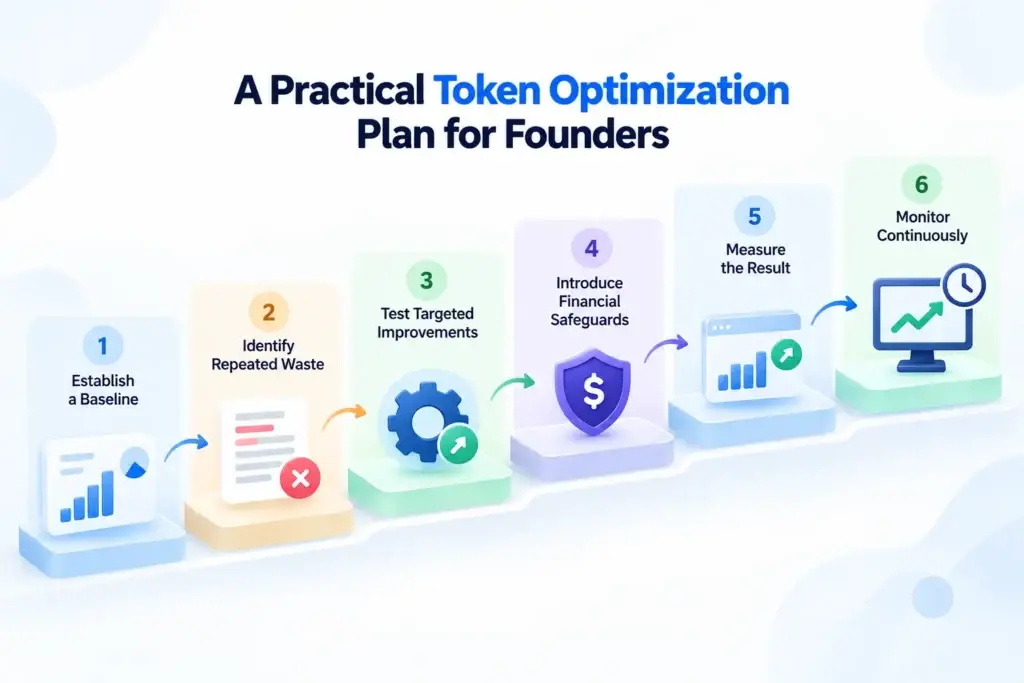
A Practical Token Optimization Plan for Founders
Founders do not need to change the entire application at once.
A measured sequence helps identify useful improvements while minimizing disruption.
First, establish a baseline. Collect representative API usage records for the application’s most important features. Measure tokens, actual expense, latency and task success.
Second, identify repeated waste. Look for oversized retrieval context, repeated instructions, unnecessary outputs and expensive retries.
Third, test targeted improvements. Reduce irrelevant input, evaluate caching and test model routing on a controlled set of requests.
Fourth, introduce financial safeguards. Implement account allowances, bounded execution and backend request authorization.
Fifth, measure the result. Compare the optimized workflow with the original using identical evaluation tasks.
Finally, monitor continuously. Repeat the review when usage grows, new features launch or model configurations change.
For founders moving beyond an early AI experiment, selecting the right application foundation can simplify future integration and operational planning. Explore Miracuves’ ready-made application solutions when evaluating a faster route to initial product validation.
The goal is a repeatable operating process rather than a one-time prompt adjustment.
When Does API Token Optimization Require Specialist Engineering?
Founders can often manage simple AI features using basic monitoring, sensible prompts and request limits.
As products become more complex, several technical responsibilities begin interacting.
A document assistant may need retrieval controls, usage attribution and secure account separation. An AI agent may need execution limits, tool permissions, observability and cost reconciliation. A subscription-based platform may need application-level allowances that remain accurate during concurrent requests.
At that point, usage optimization becomes part of production architecture.
Miracuves helps founders plan and implement these capabilities through its generative AI engineering services, including model integrations, retrieval workflows, application backends and deployment planning.
For eligible ready-made AI platforms, Miracuves offers a 6-working-day delivery timeline, subject to the selected solution and launch prerequisites. Custom engineering and additional optimization requirements are scoped separately.
The practical starting point is to identify the workflows that consume the most resources and determine which technical controls need to exist before the product scales.
Conclusion: Build an AI Product That Can Control Its Own Consumption
Reducing AI token burn is not simply a matter of sending shorter prompts.
A sustainable approach requires founders to understand where resources are consumed, remove unnecessary processing, choose models according to task requirements and prevent requests from exceeding authorized allowances.
Prompt caching, relevant context selection, model routing and output limits can improve efficiency.
Backend reservations, usage ledgers and execution limits provide the operational safeguards that help keep spending predictable.
Most importantly, cost optimization should never be separated from answer quality.
The stronger product is not the one consuming the fewest tokens at any cost. It is the one consistently delivering useful outcomes without wasting resources.
If you are planning an AI assistant, agent-based workflow or document intelligence product, Miracuves can help evaluate the architecture and operating controls needed for a reliable launch.
FAQs
What causes excessive token usage in generative AI applications?
Excessive usage commonly results from repeated instructions, long conversation histories, large retrieved documents, verbose outputs and multiple model calls for a single task. Uncontrolled retries and agent loops can increase consumption further. Request-level usage records help identify the most expensive operations.
How can I reduce OpenAI API token costs without reducing response quality?
Start by identifying unnecessary input context and excessively long output. Then test prompt caching, controlled conversation history, relevant document retrieval and model routing. Compare every optimization against an evaluation dataset to confirm that the application still produces accurate and useful results.
How does Anthropic prompt caching help manage API spending?
Supported caching mechanisms allow eligible repeated prompt content to be reused. Cache creation and subsequent reads can have different rates, so savings depend on reuse frequency, cache lifetime, prompt structure and the selected model. Developers should measure actual cache usage rather than assuming a fixed reduction.
Can an AI application enforce spending limits for individual users?
Yes. A backend system can associate requests with authenticated accounts, estimate their expense, reserve an allowance before execution and reconcile actual usage afterward. Atomic budget reservations and bounded requests help prevent concurrent activity from exceeding intended limits.
Is a smaller language model always less expensive to operate?
Not necessarily. A smaller model may have lower per-token charges but require more retries or produce unacceptable results for complex tasks. The relevant comparison is total expense per successful task, including additional processing, latency and quality requirements.
What is the difference between prompt caching and application-level response caching?
Provider prompt caching reuses eligible context processing while the model still handles the new request. Application-level response caching stores a previously approved result and may avoid a new model call entirely when that result is safe and appropriate to reuse. These approaches have different cost, freshness and privacy considerations.
How can founders prevent AI agents from consuming unlimited tokens?
Introduce task-level execution budgets, maximum model-call counts, bounded retries, tool permissions and stopping conditions. Track the total resource consumption across every step of a user task rather than monitoring only the final response.
What metrics should a startup monitor to keep AI API spending under control?
Monitor API expense by feature, tokens per successful task, cache-hit rates, retry frequency, model distribution, spending per active account, latency and response quality. These metrics show where resource consumption is rising and whether optimizations are improving operating efficiency without harming user experience.
Miracuves is an independent software development company. We are not affiliated with, connected to, sponsored by, or endorsed by any company or product named in this article.
Terms such as “X Clone” are used descriptively. It is how the software industry refers to building a platform with functionality comparable to a known service, and how clients search for it.
The entire design and codebase of our products is built by our own team. Our products contain no code, design, graphics, or content originating from any third-party website or applications.
All third-party names and marks referenced in this article are the property of their respective owners, referenced solely to identify the services discussed.