Key Takeaways
- Model the invoice as a state machine Draft, verified, debtor confirmed, minted, funded, settled and the dispute and default branches drive every screen and contract call.
- Keep the claim and the cash in separate tokens A receivable token per invoice and a settlement token for money let the escrow swap them atomically.
- The escrow waterfall ends reconciliation fights Advance, reserve, fees and rebate are paid in a fixed order every party can read.
- Verification happens before the mint Fingerprinting, a duplicate registry and debtor confirmation stop the same invoice being financed twice.
- A token is not a legal assignment by itself Notice of assignment, governing law and the purchase agreement still decide who can collect.
- KYB matters as much as KYC Most participants are companies, so beneficial owners, screening and receivables-specific monitoring rules belong in the core build.
- Personal data stays off the chain Documents and identity data live in your encrypted database; the ledger holds ownership, state, hashes and payouts.
- Own the platform when the marketplace is the business A single factor in one market is usually better served by hosted software.
A supplier ships goods on 60-day terms and then waits two months for cash it has already earned. Factoring closes that gap by selling the receivable to a funder at a discount, and blockchain invoice factoring platform development is about running that same old trade on shared rails: each verified invoice becomes a token, funders buy it through an escrow contract, and the debtor’s payment releases money to everyone in one recorded step.
The hard part is not the token. It is proving the invoice is real, stopping the same receivable from being sold twice, keeping funders inside anti-money laundering rules, and making sure the on-chain record still means something in a courtroom. What follows covers each of those pieces of invoice tokenization as a founder or product lead will meet them when building the platform: invoice states, roles, money flows, failure cases and the decision to build or rent.
It is written for fintech founders, trade finance teams inside banks and NBFCs, and supply chain operators who want to run a receivables marketplace of their own rather than refer clients to someone else’s.
The Life of an Invoice From Upload to Settlement
Before you think about chains or wallets, model the invoice as a state machine. Every screen, contract function and notification in the product hangs off these states, and most bugs in factoring software come from transitions nobody wrote down.
A workable set of states looks like this. An invoice starts as Draft when the seller uploads it or pulls it from an accounting system. It moves to Verified once document checks pass, then to Debtor Confirmed when the buyer acknowledges the amount and due date. Only then is it Minted as a receivable token and Listed for funders.
From the marketplace side it becomes Funded (fully or partly), then Awaiting Payment until the due date. The happy ending is Settled. The unhappy branches are Disputed, Overdue, Diluted (a credit note reduced the amount) and Defaulted, each with its own rules for who absorbs the loss.
Seller-led factoring versus buyer-led reverse factoring
The same state machine supports two business models, and you should decide which one you are launching first. In seller-led factoring, suppliers bring their own invoices, and the platform prices each one on the debtor’s credit. In buyer-led reverse factoring, a large buyer approves a batch of payables and invites its suppliers to sell them early, so pricing rests on the buyer’s stronger credit.
Reverse factoring removes most of the confirmation friction, because the debtor is the one uploading the approved list. It also concentrates risk on one obligor, which funders will watch closely. A blockchain invoice factoring platform that starts with one anchor buyer and its suppliers is often easier to launch than an open marketplace, and the open model can follow once the flows are proven.
The roles that touch each state
- Seller (supplier): uploads invoices, accepts offers, receives the advance and later the rebate.
- Debtor (buyer): confirms invoices, receives the notice that payment now goes to a new account, and pays at maturity.
- Funder: a bank, credit fund, family office or vetted individual investor who buys receivable tokens.
- Platform operator: runs onboarding, credit limits, pricing rules, the escrow contracts and collections.
- Compliance analyst: clears KYC and KYB files, reviews alerts and can freeze a token or account.
- Servicer or collections agent: chases overdue debtors and records disputes and partial payments.
Write the permission matrix early. A seller should never be able to move an invoice out of Disputed, and a funder should never see a debtor’s bank details. These rules end up in both the backend and the smart contracts, so changing them late costs twice.
Dual-Token Escrow: Separating the Claim From the Cash
The cleanest architecture for receivables uses two kinds of token with different jobs. The first represents the claim: one non-fungible receivable token per invoice, or a small fungible series per invoice when you allow fractional funding. The second represents money: a regulated stablecoin, a tokenized bank deposit or an internal settlement token that is redeemable one to one through a partner bank.
Keeping them apart matters. The receivable token carries metadata hashes, the due date, the debtor reference and its current state. The settlement token simply moves value. When a funder buys, the escrow contract swaps one for the other atomically, so nobody ends up holding cash without the claim or the claim without having paid.
Advance, reserve and rebate inside the contract
Take an illustrative invoice with a face value of 100,000 dollars and a 90-day term. The funder agrees to an 85 percent advance, so the escrow releases 85,000 to the seller at funding. The remaining 15,000 is the reserve, which protects the funder against short payment or a credit note.
When the debtor pays 100,000 at maturity, the escrow contract pays the funder its 85,000 back plus the agreed discount fee, deducts the platform fee, and returns what is left of the reserve to the seller as a rebate. If the debtor pays only 96,000 because of a returned shipment, the shortfall comes out of the reserve first, and the seller’s rebate shrinks accordingly.
Encoding this waterfall in a contract removes a whole class of reconciliation arguments. Every party can read the same payout order and see the same balances, which is the strongest practical reason to put factoring on a ledger at all.
Allowlists, not open wallets
Receivable tokens should only be transferable between addresses that passed onboarding. In practice that means a transfer hook that checks an on-chain allowlist maintained by the compliance team, plus the ability to freeze a token if a fraud flag goes up. Token standards built for permissioned securities make this simpler than retrofitting a plain NFT contract, a trade-off that also comes up when tokenizing real estate through an NFT marketplace.
Invoice Tokenization Starts With Verification: Stopping Double Financing
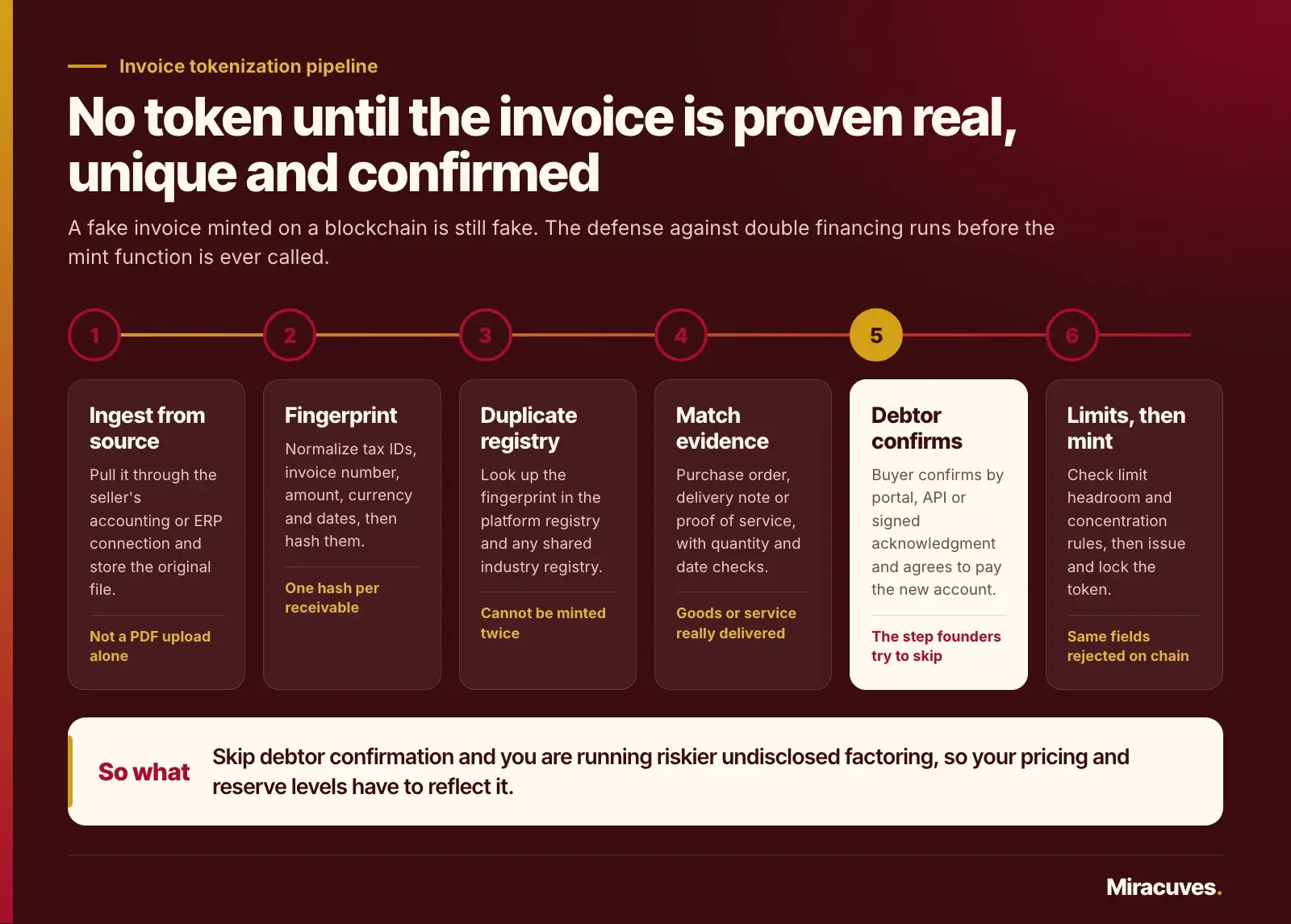
The oldest fraud in factoring is selling the same invoice to two funders, or inventing an invoice for goods that never shipped. A ledger does not fix this on its own. A fake invoice minted on a blockchain is still fake; it just has a permanent record. The defence sits in the pipeline that runs before the mint function is ever called.
A verification sequence that holds up in production usually runs in this order:
- Ingest from source: pull the invoice through the seller’s accounting or ERP connection where possible, rather than accepting a PDF upload alone, and store the original file.
- Normalize and fingerprint: extract seller tax ID, debtor tax ID, invoice number, amount, currency and dates, then compute a hash over those normalized fields.
- Check the duplicate registry: look up that fingerprint in the platform registry, and in any shared industry registry you have joined, so the same receivable cannot be minted twice.
- Match supporting evidence: purchase order, delivery note or proof of service, with automated checks that quantities and dates line up.
- Get debtor confirmation: the buyer confirms the invoice through a portal, an API call from its payables system or a signed acknowledgment, and agrees to pay the new account.
- Run credit and limit checks: confirm the debtor and seller limits have headroom and that concentration rules are respected.
- Mint and lock: only now does the contract issue the receivable token, writing the fingerprint so any later attempt with the same fields is rejected on chain.
Debtor confirmation is the step most founders try to skip, because large buyers are slow to engage. Without it you are running a riskier product, often called undisclosed or confidential factoring, and your pricing and reserve levels have to reflect that. Many platforms offer both and label them clearly to funders.
Where the Ledger Ends and Contract Law Begins
A token transfer is not automatically a legal assignment of the debt. The funder’s right to collect still comes from receivables law in the jurisdiction that governs the invoice, plus the platform’s own purchase agreement. Your terms of use have to say plainly that holding the token is how a funder evidences ownership of the purchased receivable, and your legal team has to check that position holds where your sellers and debtors sit.
Law has been moving toward recognizing electronic records. The UNCITRAL Model Law on Electronic Transferable Records, adopted on 13 July 2017, treats control of an electronic record as the functional equivalent of possession of a paper instrument. That concept maps closely to what a token in a wallet does.
In England and Wales, the Electronic Trade Documents Act 2023 came into force on 20 September 2023 and lets documents such as bills of exchange, promissory notes and bills of lading exist in electronic form with the same effect as paper, provided a reliable system is used. The Act does not name any technology, so a ledger qualifies only if it meets the reliability tests. Invoices are not on the Act’s list of trade documents, so a funder’s right to collect a tokenized receivable still rests on assignment law and the purchase agreement.
In the United States, sales of receivables fall under Article 9 of the Uniform Commercial Code, which treats a sale of accounts much like a secured loan: the buyer usually perfects its interest by filing a financing statement, and an earlier filing against the seller can outrank a later funder. The 2022 UCC amendments added Article 12 for controllable electronic records, which a growing number of states have adopted, but an ordinary invoice stays an Article 9 account unless the debtor has agreed to pay whoever controls the record. For the product, that means a lien search on every seller at onboarding and a filing reference stored against each funded invoice.
Practical consequences for the product
- Store a notice of assignment for every funded invoice and record when the debtor received it, because that notice usually decides whether a payment to the seller still discharges the debt.
- Flag invoices whose underlying contract restricts assignment, and route them to legal review instead of the open marketplace.
- Keep a governing law field on each invoice and limit funders to jurisdictions your counsel has signed off.
- Make the off-chain purchase agreement reference the token ID, so the legal record and the ledger record point at each other.
Onboarding Sellers, Debtors and Funders Under AML and KYC Rules
Trade finance is a known channel for laundering money, because invoices can be inflated, circular or invented. Whoever operates the marketplace, or the regulated partner behind it, carries identity and monitoring duties, and the software has to make them routine rather than heroic.
Most participants are companies, so KYB matters as much as KYC. In the United States, the customer due diligence rule at 31 CFR 1010.230 requires covered financial institutions to identify and verify each individual who owns 25 percent or more of a legal entity customer, plus one individual with significant responsibility to control or manage it. Other jurisdictions set similar tests with different thresholds, so model the threshold as configuration, not a constant.
Onboarding data the platform should capture
- Registered company details, registration documents and tax IDs for sellers, debtors and corporate funders.
- Ownership tree with beneficial owners and the controlling individual, each verified against identity documents.
- Sanctions and politically exposed person screening at onboarding and on a recurring schedule.
- Bank accounts and wallet addresses tied to each verified entity, with wallet screening against known illicit addresses.
- Investor eligibility for funders, where local securities rules limit who may buy receivable tokens.
Monitoring rules specific to receivables
Generic transaction monitoring misses factoring patterns. Build rules for circular trade, where a seller’s debtor is also its supplier or shares an owner; for invoice amounts far above the seller’s usual range; for a new debtor that appears just as volume spikes; and for payments arriving from an account that does not belong to the confirmed debtor. Each alert should land in a case queue with the full invoice history attached.
Pricing and Marketplace Mechanics Funders Will Ask About
Funders judge the product by how it prices risk and how quickly they can exit. Decide early which of these models you support, because each changes the contract design.
Fixed discount versus auction
A fixed schedule sets the discount rate from the debtor’s risk grade and the tenor, and the first funder to commit wins. It is simple and predictable for sellers. An auction lets funders bid a rate over a short window, which tends to give sellers better pricing on strong debtors but adds latency and needs anti-sniping rules. Many platforms start fixed and add reverse auctions for large tickets.
Risk grades, advance rates and the discount fee: a worked example
Whichever model you pick, the pricing engine turns a debtor risk grade into two numbers: the advance rate, which sets how much cash the seller gets at funding, and the discount fee, which is what the funder earns for waiting. The grade usually comes from the debtor’s payment history on the platform (average days beyond terms, disputes and dilution), external credit data and financial statements, adjusted for tenor and concentration. Keep the grade, its inputs and the version of the pricing table on each funded invoice, so a funder can see why a price was offered months later.
The table below uses illustrative parameters to show the mechanics, not market rates. Real tables are set by your funders and credit team.
| Debtor grade | Advance rate | Discount fee per 30 days | Typical reserve use |
|---|---|---|---|
| A (investment-grade buyer, clean history) | 90 percent | 0.8 percent of face value | Rarely touched |
| B (established buyer, some late payments) | 85 percent | 1.0 percent of face value | Covers occasional credit notes |
| C (new or thinly rated buyer) | 75 percent | 1.5 percent of face value | Expected to absorb dilution |
Back to the 100,000-dollar, 90-day invoice from the escrow section, priced at grade B. The seller receives an 85,000 advance. The discount fee is 1.0 percent for each of three 30-day periods, or 3,000. With a platform fee of 0.5 percent of face value (500), the waterfall at maturity pays the funder 88,000, the platform 500 and the seller a rebate of 11,500. The seller has paid 3,500 in total, 3.5 percent of face value, to get most of its cash 90 days early. The funder earned 3,000 on 85,000 deployed for 90 days, about 3.5 percent for the period, or roughly 14 percent a year before losses. If the debtor short-pays 96,000, the 4,000 shortfall comes out of the reserve and the rebate drops to 7,500.
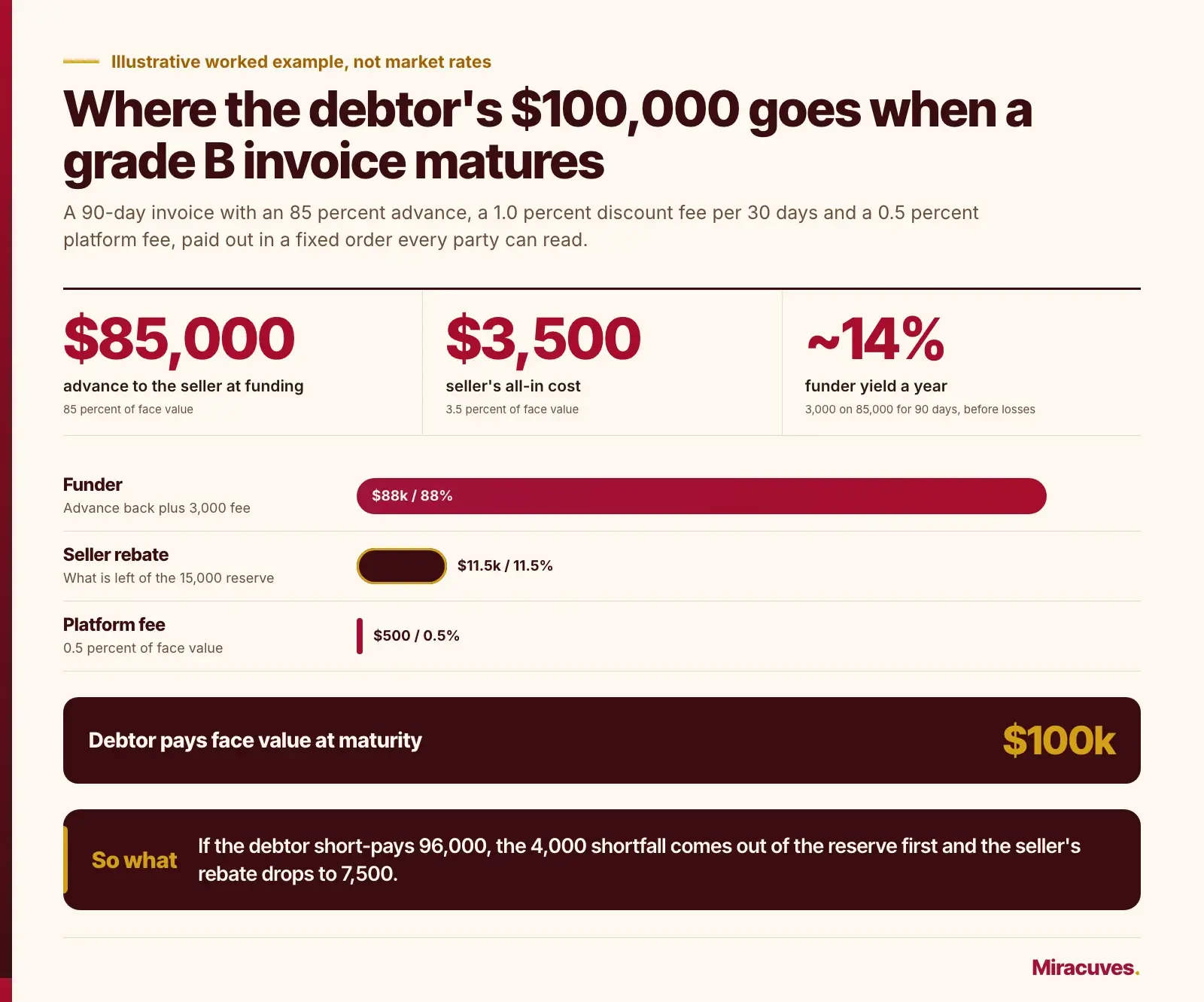
Show both views in the product. Sellers want the all-in cost of an offer in currency, and funders want annualized yield after expected losses, so the same calculation has to drive the seller offer screen and the funder portfolio report.
Recourse, non-recourse and credit cover
With recourse, the seller must buy back an invoice the debtor fails to pay, so the contract needs a buyback function and a claim against the seller’s future advances. Without recourse, the funder carries the debtor’s credit risk, and the platform may attach trade credit insurance whose policy number and limit sit in the token metadata.
Credit limits and concentration rules
Every debtor needs a platform limit, and every seller needs a limit on how much of its book is funded at once. Funders will also set their own caps per debtor, per sector and per country. The marketplace has to check all of these before an offer is shown, not after a funder clicks buy, or you end up unwinding trades.
Store limits in the database with a full change history, and mirror only the current headroom into the contract layer if you enforce it on chain. Credit analysts should be able to cut a limit to zero in one action when news breaks about a debtor, with listed invoices pulled from view at the same moment.
Fractional funding and secondary transfers
Splitting a large receivable into units lets several funders share it, and lets a funder sell its units before maturity. That liquidity is a real selling point, but it raises questions about who can buy, how the price is shown and whether secondary sales trigger securities rules where you operate. Keep secondary trading switched off until counsel confirms the position. The funder side works much like an investor platform with a double-entry ledger, scheduled payouts and a secondary market, which is a useful reference when you design unit ownership and payout records.
Splitting Data Between the Chain and Your Own Database
Putting invoice files or personal data on a public ledger is a mistake that cannot be undone. Identity documents, bank details, invoice PDFs and pricing negotiations belong in your own encrypted storage. The chain should carry only what parties must agree on: token ownership, state, fingerprints, amounts in escrow and the payout record.
A typical stack pairs smart contracts in Solidity with a relational store such as PostgreSQL for the operational data, an event indexer that mirrors contract events into the database for fast queries, and an object store for documents. The admin panel and analytics read from the database, never directly from the chain.
Choosing the network
A permissioned ledger gives you control over who runs nodes and sees transactions, which banks often prefer. A public chain or a layer 2 network on Ethereum gives funders access to existing stablecoins and wallets but exposes transaction patterns unless you design around it. Some operators run a permissioned chain for invoice records and settle cash on a public network through a bridge they control. Each option changes your key custody, gas cost and privacy design.
Choosing the settlement asset: stablecoins, deposit tokens or bank rails
The settlement token is a business decision as much as a technical one, because it decides which funders can take part and how cash gets in and out. Regulation has firmed up. In the United States, the GENIUS Act, signed into law on July 18, 2025, created a federal framework for payment stablecoins and their issuers. In the European Union, the Markets in Crypto-Assets Regulation (EU) 2023/1114 brought e-money tokens and asset-referenced tokens under licensing rules from 30 June 2024. Bank rails keep improving too: the Federal Reserve launched its FedNow instant payment service on July 20, 2023, alongside the existing ACH and wire systems.
| Settlement option | How funders pay in and get paid | Strengths | Watch out for |
|---|---|---|---|
| Regulated dollar stablecoin such as USDC | Funders hold the stablecoin in an allowlisted wallet; the escrow pays out in the same token | Atomic swap with the receivable token, 24/7 settlement, familiar to crypto-native funders | Issuer and regulatory status by market, wallet screening, a pause or depeg plan, funders who cannot hold digital assets |
| Tokenized bank deposit | A partner bank issues tokens backed one to one by deposits held with it | Bank-grade counterparty, easier for institutional funders and auditors | Only works with that bank’s customers and network; fewer partners offer it |
| Internal settlement token redeemable through a partner bank | Funders wire money to a collection account and receive platform tokens; redemption runs the other way | Full control of the flow, works with ordinary bank accounts | The operator carries reconciliation and possibly money transmission or e-money licensing questions |
| Bank rails only (ACH, wire, instant payments) | No cash token; the payment oracle records bank transfers and the contract records who is owed what | Easiest for traditional funders and debtors, no digital asset custody | No atomic swap, so the escrow becomes a record rather than the payer, and cut-off times return |
Many operators start with bank rails or a single regulated stablecoin, keep the contract able to switch the settlement asset under multi-signature control, and add a second asset only when a funder group asks for it. Whichever you choose, debtors almost always keep paying by bank transfer, so the payment oracle described next is needed in every option.
The payment oracle
Most debtors will keep paying by bank transfer for years. Something has to observe the incoming payment in the collection account, match it to the right invoice and call the settlement function. That oracle is the most sensitive service in the system: if it is wrong, money goes to the wrong party. Give it dual approval for unmatched or partial payments, and log every match decision.
Reporting that funders and partner banks expect
Institutional funders rarely log in daily. They want a portfolio file: outstanding exposure by debtor, ageing buckets, dilution rates, dispute counts and realized yield, delivered on a schedule and reconciled to on-chain balances. Build that report from the indexed event data so the numbers always tie back to contract state, and let the operator export it per funder without manual edits.
Security management around the keys
Admin keys that can pause contracts, update allowlists or upgrade logic are the crown jewels. Hold them in hardware security modules or a multi-signature scheme, rotate them on a schedule and keep a written recovery procedure. Funders and partner banks will usually ask how your information security management is run, and ISO/IEC 27001:2022 is the standard most of them recognize for that conversation.
Failure Modes the Product Must Handle on Day One
Demos show the happy path. Funders and auditors look at what happens when things break. These are the cases to design, test and document before launch.
- Debtor pays the seller by mistake: the seller is obliged to forward the funds. The platform records the misdirected payment, starts a timer and offsets the amount from the seller’s next advance if it is not passed on.
- Dispute raised after funding: the token moves to Disputed, transfers are frozen and the reserve is held until the dispute closes with a recorded outcome.
- Dilution through credit notes: the seller must report any credit note against a funded invoice; the contract reduces the expected amount and adjusts the rebate.
- Late payment: a grace period, then late fees accrue per the purchase agreement, then the invoice passes to collections with every reminder logged.
- Default: recourse invoices trigger a buyback demand on the seller; non-recourse invoices trigger an insurance claim workflow or a write-off recorded against the funder.
- Settlement token disruption: if the stablecoin or deposit token is paused or loses its peg, contracts need an administrator path to switch settlement asset under multi-signature control.
- Lost funder keys: a recovery process that reissues the receivable token to a new verified address after identity checks, with the old token burned.
Test these cases against the contracts on a test network with scripted debtors and funders before launch, and keep the scripts as a regression suite. Every contract upgrade later should replay the full set, because a change to the payout order can quietly break the dispute or dilution path even when the happy path still passes.
Each of these needs an owner, a screen in the admin panel and an audit trail. If a case can only be resolved by an engineer writing a one-off script, it is not handled yet.
Renting a Tool Versus Owning an On Chain Trade Finance Platform
Most people who search for factoring software expect a subscription product they can switch on next week. For many businesses that is the right answer. If you are a single factoring company handling a few hundred invoices a month in one country, a hosted factoring system will run your ledger, statements and collections far more cheaply than any build.
Owning your own on chain trade finance platform starts to make sense when the marketplace itself is the business. That covers a fintech that wants to bring outside funders to a pool of supplier invoices, a large buyer running supply chain finance for its own suppliers, or a lender that needs custom risk rules, its own token design and control over where data lives. In those cases rented software becomes the ceiling on what you can offer.
| Decision factor | Hosted factoring software | Ready-made platform you own | Fully custom build |
|---|---|---|---|
| Best fit | One factor, one market, funding from its own balance sheet | New marketplace that needs to launch and test demand | Bank, large buyer or fund with distinct risk and token rules |
| Outside funders | Usually not supported | Supported through standard escrow flows | Any structure, including tranches and secondary transfers |
| Token and escrow design | None, ledger is internal | Proven contracts, adjustable parameters | Designed around your legal structure |
| Data location and keys | Vendor decides | Your servers, your keys | Your servers, your keys, your network choice |
| Source code | Not available | Delivered to you | Delivered to you |
| Main risk | Outgrowing the product, lock-in | Customizing beyond the base design | Longer path to first funded invoice |
Be honest about the middle path too. A ready-made base that you own, extended where your business differs, often gets a blockchain invoice factoring platform in front of real sellers sooner than a blank-page build, while still giving you the code and the keys. Teams weighing these routes across lending, payments and wealth products can see how the trade-offs play out on the fintech software page.
Whichever route you choose, plan a controlled pilot before opening the doors. Pick one anchor debtor or a small group of sellers, two or three committed funders and a single settlement asset. Run real invoices through every state, including at least one dispute and one late payment, and only widen access once the payouts reconcile to the cent. A blockchain invoice factoring platform earns funder trust through that track record far more than through its token design.
Building does not suit everyone. If you have no funders lined up, no regulated partner and no legal opinion on assignment in your target markets, write those down first. Software cannot stand in for a funding pipeline or a licence.
Cost and Timeline for an Invoice Factoring Platform
Ranking build guides on this topic quote cost and timeline, and the honest way to do that is from hours. The phases below assume a custom build for one jurisdiction and one settlement asset, with a team of a product lead, a designer for part of the time, two or three backend and contract engineers, a frontend or mobile engineer and a tester. Week ranges are typical, not promises, and they overlap.
| Phase | What it covers | Typical weeks | What makes it longer |
|---|---|---|---|
| Discovery and legal mapping | Invoice states, roles, assignment and notice rules, funder eligibility, settlement asset choice | 3 to 4 | Several jurisdictions, no legal opinion yet |
| Onboarding and compliance | KYC and KYB with beneficial owners, sanctions and PEP screening, wallet screening, case queue | 5 to 7 | Custom monitoring rules, several screening providers |
| Invoice pipeline | Accounting and ERP ingest, fingerprinting, duplicate registry, evidence matching, debtor confirmation portal | 6 to 8 | Each extra ERP connector, buyer-side API integrations |
| Contracts and escrow | Receivable and settlement tokens, allowlist and freeze, escrow waterfall, recourse buyback | 6 to 8 | Fractional units, auctions, upgradeable contracts |
| Payment oracle and reporting | Bank feed matching, dual approval for partial payments, funder portfolio files | 4 to 6 | Many collection accounts or currencies |
| Security review and pilot | External smart contract audit, failure-mode test suite, pilot with real invoices | 4 to 8 | Audit findings that need contract changes |
Run in parallel, those phases usually add up to about six to nine months from discovery to a pilot with live invoices, and longer when outside funders, several countries or secondary trading are in the first release. Starting from a ready-made base you own shortens the contract and onboarding phases most, because those pieces are already built and tested.
For a rough budget, convert the time into hours. As an illustrative estimate, five to six people for 26 to 36 weeks is about 5,200 to 8,600 engineering hours. At the median wage for software developers, quality assurance analysts and testers, which the US Bureau of Labor Statistics puts at $64.44 an hour (May 2025), that is roughly $335,000 to $554,000 in wages alone, before benefits, overhead or any partner margin, and before the external contract audit and your legal opinions, which are quoted separately by those firms. Teams in other regions cost less per hour, so multiply the hours by the rate you are actually quoted.
How Miracuves Approaches Blockchain Invoice Factoring Platform Development
For trade finance operators, Miracuves delivers both custom software and ready-made platforms. A receivables marketplace from us is planned around the verification pipeline first, not the token. The first release usually covers seller and debtor onboarding, invoice ingest with fingerprinting and the duplicate registry, debtor confirmation, the receivable and settlement token contracts with escrow waterfall from our smart contract engineers, and the operator admin panel for limits, pricing and case review.
The roles map to the ones described above: seller, debtor, funder, operator, compliance analyst and servicer, each with its own views and permissions. Integrations typically include accounting and ERP connectors for invoice ingest, a bank account feed for the payment oracle, an identity and screening provider for KYC and KYB, and the node or network provider for the chosen chain. Funder dashboards, auctions, fractional units and insurance links come next, once the core flows are proven with live invoices.
You receive Android and iOS apps for sellers and funders, an operator console on the web and the complete source code, so the marketplace and its contracts belong to your company. Before any funder money touches the contracts, your team should insist on a test run that walks every invoice state, and an external smart contract audit is worth budgeting for at this stage. On security and financial crime, Miracuves writes the software to the controls of ISO/IEC 27001 and to the AML and KYC requirements that your regulated partner sets. For the ISO/IEC 27001 audit, independent audit partners work directly with your team, and the resulting certificate belongs to your organization rather than to us or the software. How much audit preparation we take on is agreed during scoping; the background is set out in our compliance record.
Every receivables product differs in jurisdiction, funder mix and token design, so Miracuves prices each build separately after a working session on your invoice flow and legal structure. If you are mapping out a marketplace for supplier invoices, the fintech development team can start from your state diagram and turn it into a build plan.
Frequently Asked Questions
What is a blockchain invoice factoring platform?
It is a marketplace where verified supplier invoices are issued as tokens and sold to funders at a discount. An escrow contract releases the advance to the seller and splits the debtor’s payment between funder, platform and seller at maturity. The ledger gives every party the same record of ownership and payouts.
What does blockchain invoice factoring platform development involve?
It covers far more than the token contract. A typical build includes seller, debtor and funder onboarding with KYC and KYB, invoice ingest from accounting systems, fingerprinting and a duplicate registry, debtor confirmation, receivable and settlement token contracts with an escrow waterfall, a payment oracle that matches bank transfers to invoices, and an operator console for limits, pricing and disputes.
How does the platform stop the same invoice being financed twice?
Before minting, the platform normalizes key invoice fields, hashes them and checks that fingerprint against its duplicate registry. It also matches purchase orders and delivery evidence and asks the debtor to confirm the invoice. Only then is the token issued, and the fingerprint is written on chain so a repeat attempt fails.
Does owning the token give a funder a legal right to collect the debt?
Not by itself. The right to collect comes from receivables law where the invoice is governed and from the platform’s purchase agreement, which should state that holding the token evidences ownership. A notice of assignment to the debtor is usually what makes payment to the new account binding.
Does a funder need a UCC filing for tokenized invoices?
In the United States, usually yes. A sale of accounts falls under UCC Article 9, and the buyer generally perfects its interest by filing a financing statement against the seller. An earlier filing by another lender can outrank the funder, so the platform should run a lien search at onboarding and store the filing reference against each funded invoice. Article 12 changes this only where the debtor agreed to pay whoever controls the record.
How are advance rates and discount fees set?
The pricing engine maps a debtor risk grade, built from payment history, disputes, external credit data and financials, to an advance rate and a discount fee per period. For example, an 85 percent advance and a 1 percent fee per 30 days on a 90-day invoice costs the seller 3 percent of face value plus any platform fee. Real rates are set by funders and the credit team.
Which settlement asset should a factoring marketplace use?
Common choices are a regulated dollar stablecoin such as USDC, a tokenized bank deposit, an internal settlement token redeemable through a partner bank, or plain bank rails with the contract acting as a record. The right pick depends on your funders, banking partner and local rules, including the GENIUS Act in the United States and MiCA in the EU. Keep an admin path to switch assets.
What KYC and KYB checks do sellers and funders go through?
Companies provide registration documents, tax IDs and an ownership tree, and the platform verifies beneficial owners and a controlling individual. Everyone is screened against sanctions and politically exposed person lists, and wallet addresses are screened too. Funders may also need investor eligibility checks depending on local securities rules.
How much does it cost and how long does it take to build an invoice factoring platform?
A custom build for one jurisdiction and one settlement asset typically takes about six to nine months to a live pilot. As an illustrative estimate, that is 5,200 to 8,600 engineering hours; at the US median developer wage of $64.44 an hour, wages alone are roughly $335,000 to $554,000. Jurisdictions, fractional funding, ERP connectors, the payment oracle and the external contract audit move the number most.
When is hosted factoring software a better choice than building?
If you are one factoring company funding invoices from your own balance sheet in a single market, hosted software is usually cheaper and faster. Owning a platform pays off when outside funders, custom risk rules, your own token design or data residency are central to the business model.
Miracuves is an independent software development company. We are not affiliated with, connected to, sponsored by, or endorsed by any company or product named in this article.
Terms such as “X Clone” are used descriptively. It is how the software industry refers to building a platform with functionality comparable to a known service, and how clients search for it.
The entire design and codebase of our products is built by our own team. Our products contain no code, design, graphics, or content originating from any third-party website or applications.
All third-party names and marks referenced in this article are the property of their respective owners, referenced solely to identify the services discussed.