
Key Takeaways
What You’ll Learn
- RWA tokenization is not regular NFT trading because real assets need legal, compliance, and ownership controls.
- The case study covers a $50M real estate portfolio using a white-label tokenization marketplace.
- KYC should stay off-chain while smart contracts enforce verified wallet eligibility.
- Transfers need contract-level restrictions so users cannot bypass rules through direct wallet transfers.
- The main lesson is to build RWA platforms around compliance, reconciliation, security, and legal clarity.
Stats That Matter
- The platform supported a reported $50M portfolio with fractional real estate transactions.
- Thousands of fractional transactions were processed during the stated deployment period.
- No critical smart-contract vulnerability was recorded in the observed project window.
- No successful KYC-policy bypass was logged during the stated deployment period.
- Evidence should include audits, transaction counts, KYC workflow details, reconciliation reports, and deployment records.
Real Insights
- Tokenization does not guarantee liquidity because buyers, valuation, rules, and market demand still matter.
- Ledger reconciliation is critical across blockchain balances, investor records, orders, and legal ownership data.
- Admin roles must be separated for issuing supply, pausing transfers, changing rules, and managing access.
- White-label platforms save standard build effort but still need legal review, audits, integrations, and customization.
- For founders, build an RWA tokenization marketplace around verified investors, transfer controls, smart-contract review, audit logs, reconciliation, and secure asset administration.
Tokenizing a commercial property portfolio is fundamentally different from listing digital artwork on a consumer NFT marketplace.
An art marketplace can often treat ownership as a straightforward relationship between a token ID and a wallet address. An RWA tokenization marketplace, especially for real estate, must coordinate legal rights, investor eligibility, fractional balances, transfer restrictions, asset disclosures, transaction monitoring, and secondary-market rules. This makes the architecture more complex than a standard NFT trading platform because every token is connected to a real asset, compliance workflow, and enforceable ownership structure.
That distinction shaped the architecture of an anonymized Miracuves deployment designed to represent fractional economic interests in a commercial real estate portfolio with a reported value of $50 million.
The objective was not simply to mint property-linked tokens. It was to deploy a white-label marketplace engine that could:
- Onboard and verify eligible investors
- Represent multiple properties and ownership fractions
- Enforce transfer permissions before settlement
- Support controlled secondary-market transactions
- Maintain synchronized ownership records
- Give administrators visibility into every material action
- Process thousands of low-value fractional transactions
- Preserve a clear audit trail across the asset lifecycle
According to the project information supplied for this case study, the deployment completed its observed transaction period without a recorded critical smart-contract vulnerability or logged KYC-policy bypass. Miracuves’ NFT development services support projects that require secure marketplace architecture, smart-contract integrations, and enterprise-grade tokenization workflows. These results should still be substantiated with audit and operational evidence before being presented as externally verified performance.
The End of JPEG Trading: Why RWA Requires a Different Marketplace Architecture
Traditional NFT marketplaces were designed primarily for digitally native assets. Their core workflow is usually simple:
- A creator connects a wallet.
- An NFT is minted or imported.
- The asset is listed.
- Another wallet purchases it.
- The smart contract changes ownership.
That model becomes insufficient when a token represents an interest in commercial real estate.
The token cannot be treated as the property deed itself unless the relevant legal structure and jurisdiction explicitly recognize that relationship. In many practical RWA structures, the physical asset is held by a legal entity, such as a special-purpose vehicle, while tokens represent defined economic, contractual, or beneficial interests associated with that entity.
This creates a hybrid system:
| Layer | Responsibility |
|---|---|
| Legal layer | Asset ownership, investor rights, disclosures, jurisdiction, dispute handling |
| Identity layer | Investor verification, accreditation status, sanctions screening, eligibility |
| Token layer | Issuance, balances, transfer controls, supply, redemption |
| Marketplace layer | Listings, orders, matching, settlement, fees |
| Data layer | Property records, valuations, income events, documents |
| Administration layer | Approvals, pauses, flags, reporting, reconciliation |
Recent research into deployed RWA systems reaches a similar conclusion: blockchain tokens can control representation, transfer, redemption, and programmability, but the legal guarantees remain connected to off-chain contracts, custodians, verification processes, and governance.
For the Miracuves deployment, that meant the white-label marketplace could not behave as an open, permissionless exchange. It needed an eligibility-aware transaction layer.
Read more: The Future of NFT Marketplace Apps: Trends to Watch in 2026 and Beyond
Why a standard OpenSea-style model was unsuitable
An unrestricted marketplace would introduce several unacceptable risks:
- An unverified wallet could purchase a restricted asset
- A token could move into a prohibited jurisdiction
- A sanctioned or blocked account could participate
- Ownership records could diverge between legal and blockchain systems
- Administrators might lack the controls needed to respond to disputes
- A peer-to-peer transfer could bypass marketplace-level checks
- Corporate actions might be distributed using outdated balance records
The engineering problem was therefore not “How do we trade NFTs?”
It was:
How do we preserve programmable transferability while ensuring that every settled ownership change satisfies the asset’s configured eligibility rules?
Engineering the Fractional RWA Ledger on EVM
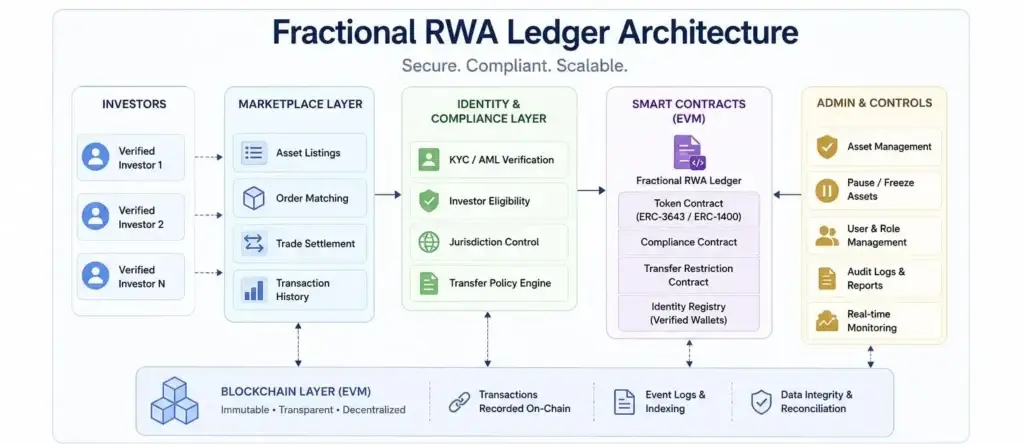
The architectural centre of the platform was the Fractional RWA Ledger: a coordinated set of smart contracts, backend services, identity records, event processors, and administrative controls used to maintain fractional ownership across the portfolio.
Separating the asset record from the ownership units
Each commercial property required a persistent master record containing information such as:
- Internal asset identifier
- Legal entity or holding structure
- Property documentation references
- Valuation records
- Issuance terms
- Total authorized token supply
- Distribution and income rules
- Transfer eligibility policy
- Redemption or exit conditions
The fractional ownership units were represented separately from this asset metadata.
This separation allowed the platform to maintain one authoritative asset identity while issuing many divisible interests against it. Depending on the final legal and technical design, such interests may use a permissioned fungible-token standard, a security-token framework, or a multi-token standard.
A compliance-oriented standard such as ERC-3643 can support identity-aware transfer logic through modular identity registries and compliance contracts. However, the appropriate standard must be selected according to the legal instrument, investor rights, jurisdiction, custody model, and interoperability requirements.
The ledger was more than a smart-contract balance
A reliable fractional ledger had to reconcile four views of ownership:
- On-chain token balances
- Marketplace order and settlement records
- Verified-investor identity records
- Off-chain legal or cap-table records
A successful transaction was not treated as complete merely because a blockchain transaction returned a successful receipt. The event-processing layer also had to confirm that the transfer was indexed, associated with the correct investor profiles, written to the internal transaction history, and reflected in relevant reporting.
This was especially important when thousands of micro-transactions could be generated across a portfolio. A single missed event, duplicate index, or asynchronous processing failure could create inconsistencies between the blockchain and the platform interface.
Simplified transfer-control flow
Investor submits purchase request
        ↓
Marketplace checks account status
        ↓
Identity service confirms verification status
        ↓
Compliance engine evaluates asset-specific rules
        ↓
Smart contract checks sender and recipient eligibility
        ↓
Order is settled or rejected
        ↓
Transfer event is indexed
        ↓
Internal ledger and audit history are reconciled
KYC was verified off-chain and enforced on-chain
The phrase “KYC embedded in the smart contract” can be misleading.
Passports, corporate documents, proof of address, sanctions checks, and investor-accreditation evidence should not be placed openly on a public blockchain. KYC providers and compliance teams process that information off-chain.
The smart contract can instead reference a privacy-conscious eligibility result, such as:
- Wallet is verified
- Verification remains valid
- Investor category is permitted
- Jurisdiction is allowed
- Asset-specific holding limits are satisfied
- Wallet is not frozen or blocked
This approach avoids placing sensitive identity data on-chain while still preventing unauthorized settlement.
Miracuves’ security language follows the same practical principle: blockchain and fintech systems should support KYC, AML, transaction-monitoring, audit, and access-control workflows without claiming universal legal compliance. Final compliance depends on jurisdiction, legal review, integrations, and the operator’s business model.
Building Compliance Into Every Transfer Path
Marketplace-level checks alone are not enough.
A user may attempt to move tokens through a wallet interface, external contract, administrative function, or peer-to-peer transfer. If restrictions exist only in the website backend, a direct blockchain transfer could bypass them.
The transfer policy therefore needed to operate at the token or compliance-contract level.
Core transfer conditions
Before a fractional token could move, the architecture could evaluate conditions such as:
- Is the sender’s wallet active and verified?
- Is the recipient’s wallet active and verified?
- Is the recipient eligible for this particular asset?
- Is the investor’s jurisdiction permitted?
- Has the investor exceeded an ownership threshold?
- Is the asset currently paused?
- Is the wallet subject to a compliance hold?
- Does the transfer violate a lockup period?
- Is the transaction type permitted?
- Does the transaction require administrator approval?
A failed condition returned a deterministic rejection rather than allowing settlement and attempting to reverse it later.
Why policy modules were kept configurable
Hard-coding every regulatory condition into one monolithic contract would make future amendments difficult and increase upgrade risk.
A modular architecture allowed the platform operator to maintain separate controls for:
- Identity status
- Geographic restrictions
- Investor classification
- Holding limits
- Transfer windows
- Asset-specific lockups
- Administrative freezes
- Secondary-market permissions
This matters because two properties in the same marketplace may use different legal structures or investor conditions.
The $50M Stress Test: Controlled Secondary Trading at Micro-Transaction Scale
The reported portfolio value was $50 million, but nominal asset value was not the only technical concern.
Fractionalization increases the number of ownership units and potential transactions. A portfolio held by ten institutions creates a very different load profile from the same portfolio divided among thousands of eligible investors.
The deployment therefore had to support:
- High-frequency order creation
- Small fractional purchases
- Partial order fills
- Repeated wallet-eligibility checks
- Concurrent secondary-market listings
- Blockchain-event ingestion
- Balance reconciliation
- Transaction-status updates
- Administrative reporting
- Exception handling
Test objectives
| Test area | Engineering objective | Failure being prevented |
|---|---|---|
| Fractional supply | Maintain authorized supply across issuance and transfer | Over-issuance or balance mismatch |
| Identity gating | Reject unverified recipients | Unauthorized ownership |
| Secondary orders | Support partial fills and cancellations | Locked or duplicated balances |
| Event processing | Index transactions once and in sequence | Missing or duplicate history |
| Administrative control | Pause affected assets without stopping the entire portfolio | Platform-wide disruption |
| Reconciliation | Compare blockchain and internal records | Silent ledger divergence |
| Access control | Limit privileged functions by role | Unauthorized administrative action |
| Monitoring | Flag abnormal activity and repeated failures | Undetected operational or fraud risk |
Processing thousands of micro-transactions
The supplied case-study brief reports that the engine processed thousands of fractional micro-transactions during the deployment window.
The architecture addressed this volume through several design choices:
1. Event-driven indexing
Every issuance, transfer, freeze, pause, redemption, and administrative action generated a structured blockchain event. An indexing service consumed those events and updated the marketplace’s query layer.
This prevented the frontend from repeatedly scanning the blockchain for historical state.
2. Idempotent processing
Event consumers were designed so that replaying the same event would not create duplicate transactions or ownership entries.
Idempotency is critical because blockchain listeners may reconnect, reprocess blocks, or respond to chain reorganizations.
3. Reserved balances for open orders
Tokens committed to an active sell order were reserved or escrowed so that the same balance could not be offered in multiple transactions.
4. Asset-level pausing
The operator could isolate one asset if a legal, valuation, or technical issue emerged, rather than disabling the entire marketplace.
5. Batched reconciliation
Periodic reconciliation jobs compared on-chain balances and internal records. Differences were routed into an exception queue for investigation.
6. Role-separated administration
Functions such as issuing supply, approving assets, changing compliance rules, pausing transfers, and managing user access were separated by administrative role.
Reported Security and Compliance Outcome
According to the project brief:
- The marketplace supported a real estate portfolio valued at $50 million
- Thousands of fractional transactions were processed
- No critical smart-contract vulnerability was recorded during the stated deployment period
- No successful KYC-policy bypass was logged during the stated deployment period
These statements should not be converted into absolute claims such as “the platform was vulnerability-free” or “the platform guaranteed compliance.”
A more defensible interpretation is:
During the defined deployment and monitoring window, project records did not identify a critical exploited smart-contract vulnerability or a completed transfer involving a wallet that failed the configured eligibility checks.
That wording reflects the scope of the observed result without suggesting that any software system is permanently immune to defects, exploits, policy errors, or evolving regulation.
Evidence required before publication
Miracuves should attach or internally verify:
- Smart-contract audit summary
- Audit date and audited contract version
- Deployment addresses or redacted evidence
- Number of properties represented
- Total authorized and issued token supply
- Exact transaction count
- Test versus production transaction split
- KYC provider or workflow description
- Number of rejected eligibility checks
- Incident and vulnerability classification
- Reconciliation reports
- Client permission to reference portfolio value
Read more: How to Start a NFT Marketplace Platform Business
Why Secondary Trading Was Permissioned Rather Than Open
Secondary-market capability is frequently described as if tokenization automatically makes real estate liquid.
It does not.
A marketplace may reduce transfer friction and broaden access, but trading activity still depends on buyer demand, valuation transparency, legal restrictions, available inventory, market-making, and investor confidence. Research on tokenized RWAs has found that many assets continue to experience low trading volumes and limited participation.
The Miracuves architecture therefore prioritized controlled tradability, not artificial promises of instant liquidity.
Eligible investors could:
- View approved offerings
- Review asset information
- Submit buy or sell orders
- Trade permitted fractions
- Access transaction histories
- Monitor balances and distributions
The platform operator could:
- Approve assets and issuances
- Configure transfer conditions
- Review investor status
- Monitor transactions
- Pause assets
- Freeze restricted wallets
- Manage disputes
- Export audit and ownership records
White-Label Foundation Versus Building the Entire Stack From Zero
A white-label foundation does not remove the need for legal structuring, security review, integration, or customization.
It reduces the amount of standard marketplace infrastructure that must be recreated.
Miracuves solution ecosystem includes blockchain, crypto, NFT, marketplace, and custom-development capabilities, alongside ready-made products that can be rebranded and adapted.
For this type of deployment, reusable components may include:
- Account and wallet workflows
- Asset listings
- Order interfaces
- Transaction histories
- Administrative dashboards
- Notification services
- Document management
- Role-based access
- Marketplace fee logic
- Reporting interfaces
The RWA-specific work is concentrated where differentiation and risk are highest:
- Legal-entity mapping
- Token-standard selection
- Eligibility rules
- Identity integrations
- Smart-contract controls
- Fractional ledger reconciliation
- Asset distributions
- Secondary-market restrictions
- Custody and wallet design
- Audit and security testing
Consumer NFT Marketplace vs Enterprise RWA Marketplace
| Architecture Area | Consumer NFT Marketplace | Enterprise RWA Marketplace |
|---|---|---|
| Participation | Generally open-wallet access | Verified and eligibility-controlled access |
| Asset relationship | Digital-native item or collectible | Token connected to legal and economic rights |
| Transfers | Usually permissionless | Restricted by identity and asset rules |
| Fractional ledger | Optional | Core ownership infrastructure |
| Administration | Listings and moderation | Issuance, freezes, limits, reconciliation, reporting |
| Compliance | Platform-policy focused | KYC/AML and jurisdiction-sensitive workflows |
| Off-chain dependencies | Metadata and media storage | Legal rights, custody, valuation, identity, disclosures |
Founder Decision Signals
Legal Enforceability
Define what each token represents, who legally owns the underlying property, and how token-holder rights are enforced before selecting the token standard.
Transfer Control
Use contract-level restrictions when an asset cannot legally move to every wallet. Website-only checks leave a bypass path.
Ledger Integrity
Plan reconciliation across blockchain balances, investor records, marketplace orders, and legal ownership records.
Liquidity Reality
Build efficient secondary trading, but do not assume tokenization will independently create buyers, volume, or continuous liquidity.
Mistakes Enterprise RWA Platforms Should Avoid
Treating a token as automatic legal title
A blockchain record cannot independently resolve the legal relationship between the token holder and the property. The rights, entity structure, custody model, and dispute process must be documented.
Putting KYC only in the frontend
A website can block an interface action, but it cannot prevent a direct token transfer unless the underlying contract enforces recipient eligibility.
Storing sensitive identity documents on-chain
Use privacy-conscious off-chain verification and expose only the minimum eligibility state required by the transfer policy.
Ignoring reconciliation
Smart-contract balances, marketplace records, legal registers, and distribution calculations must remain synchronized throughout the asset lifecycle.
Promising instant liquidity
Fractionalization can reduce entry barriers, but active secondary trading still depends on demand, valuation confidence, regulation, and market structure.
Conclusion:
The central lesson from this deployment is that real estate tokenization should not be approached as a cosmetic variation of an NFT marketplace.
The marketplace interface is only the visible layer. The real product is the coordinated infrastructure underneath it:
- A legally mapped asset record
- A controlled fractional supply
- Verified investor identities
- Policy-aware smart contracts
- Permissioned secondary transfers
- Reconciled ownership records
- Administrative intervention controls
- Complete audit visibility
Miracuves’ white-label marketplace approach gives founders and asset managers a reusable product foundation while preserving room for asset-specific legal structures, compliance integrations, token standards, custody arrangements, and operational controls.
The business value is not “putting a building on the blockchain.” It is creating a controlled system in which eligible investors can acquire, hold, and transfer precisely defined interests with stronger transparency and programmable administration.
Ready to tokenize real-world assets with a secure, white-label marketplace? Contact us to discuss your RWA platform requirements.
FAQs
What is an RWA tokenization marketplace?
An RWA tokenization marketplace is a platform for issuing, managing, and transferring blockchain-based tokens connected to rights in real-world assets. Unlike a consumer NFT marketplace, it usually requires identity verification, asset documentation, transfer restrictions, administrative controls, and integration with off-chain legal structures.
Can a real estate token represent direct ownership of a property?
It depends on the legal structure and jurisdiction. A token may represent shares in a property-holding entity, beneficial interests, contractual rights, debt, revenue rights, or another instrument. The token’s legal meaning must be defined by enforceable documentation rather than assumed from the blockchain record.
How does fractional real estate tokenization work?
The asset or an associated legal interest is divided into a defined supply of digital units. Verified investors can acquire those units, subject to the offering terms and transfer restrictions. The platform records token balances, transactions, distributions, and eligibility status.
Can KYC and AML be automated through smart contracts?
Smart contracts can enforce the result of KYC and compliance checks, but they generally should not process or store sensitive identity documents directly. Verification occurs off-chain, after which an identity registry or eligibility service informs the contract whether a wallet may transact.
Which token standard is suitable for RWA tokenization?
The answer depends on whether the token represents a security, fund interest, debt instrument, property share, or another right. ERC-3643 and ERC-1400 are frequently considered for permissioned assets, while ERC-20, ERC-721, or ERC-1155 may be adapted in other structures. Legal and technical reviews should precede selection.
Does tokenizing real estate guarantee liquidity?
No. Tokenization can improve transferability and lower minimum investment sizes, but liquidity still depends on buyer demand, pricing transparency, asset quality, trading permissions, investor access, and market structure.
Why use a white-label RWA tokenization platform?
A white-label foundation can provide standard marketplace functions such as accounts, wallets, listings, dashboards, orders, transaction records, and administrative tools. This allows the project team to focus more resources on legal structuring, token engineering, compliance, security, and asset-specific workflows.
How should an RWA platform be secured?
Important controls include smart-contract review, role-based access, multisignature administration, wallet verification, transfer restrictions, encrypted data handling, event monitoring, reconciliation, incident response, audit logs, and secure API integrations. No platform should claim permanent immunity from vulnerabilities.
Miracuves is an independent software development company. We are not affiliated with, connected to, sponsored by, or endorsed by any company or product named in this article.
Terms such as “X Clone” are used descriptively. It is how the software industry refers to building a platform with functionality comparable to a known service, and how clients search for it.
The entire design and codebase of our products is built by our own team. Our products contain no code, design, graphics, or content originating from any third-party website or applications.
All third-party names and marks referenced in this article are the property of their respective owners, referenced solely to identify the services discussed.