Key Takeaways
- The cost to build an app like DoorDash depends on the complete operating scope. A one-city custom food delivery launch can involve customer and courier apps, restaurant and operator workspaces, backend services, dispatch, payments, testing, deployment, and monitoring.
- A one-city custom launch can be modeled at $75,000-$150,000. The article uses 1,500-2,000 project hours and illustrative blended rates of $50-$75 per hour. This is a planning scenario, not a fixed development quote.
- Development cost should be separated from operating costs. Build and launch expenses, recurring software and infrastructure, and order-level economics should be tracked separately to avoid misleading budget estimates.
- API costs depend on usage units, not simply completed orders. Address searches, routing requests, payment attempts, verification events, notifications, POS calls, hosting, and monitoring can create costs before an order is successfully completed.
- Payment, kitchen, and delivery should have separate workflows. A customer may pay before a restaurant accepts the order, while a courier may become unavailable after preparation. Keeping these timelines distinct makes refunds, reassignment, and reconciliation easier to manage.
- Courier operations can significantly change the development scope. Restaurant-managed delivery, an owned courier fleet, third-party delivery partners, and hybrid models require different software, integrations, and ongoing operating costs.
- Failed orders can still create substantial costs. Cancellations, partial refunds, courier cancellation payments, restaurant adjustments, failed handoffs, and unrecovered payment fees should be included in the financial model.
- Peak dinner-rush capacity needs to be tested separately. Monthly order volume can hide short periods when restaurants, couriers, checkout systems, and support teams face the highest demand.
- Vendor quotes should be compared using real workflows. Test scenarios such as payment, a missing menu item, partial refund, courier replacement, and payout reconciliation rather than comparing feature names alone.
- A first release should match the actual business model. A reliable one-city platform with the required ordering, payment, dispatch, and recovery workflows can be more practical than overbuilding complex infrastructure before demand is validated.
At 7:20 p.m., a restaurant accepts an order, then discovers that one of the items is sold out. The customer has already paid and a courier is on the way. Can support refund just that item? Will the restaurant’s payable balance change? Does the courier still get paid if the customer cancels? These are the situations that make the cost to build a food delivery app hard to judge from a screen count. Whether you commission a custom build or start with a White-Label Food Delivery app, put those recovery steps in the estimate before you compare prices.
This guide covers a marketplace with multiple restaurants, customer ordering, delivery coordination, and an operator who can intervene when an order stalls. It separates the build quote, recurring software spend, and the cost of fulfilling orders. All sample figures are in USD. The rates and volumes are assumptions you can replace with your own quotes and pilot data; they are not live provider prices or estimates of another company’s infrastructure.
How Much Does It Cost to Build a Food Delivery App in 2026?
A scoped one-city custom launch can be modeled at $75,000-$150,000: 1,500 project hours at $50 per hour at one end, and 2,000 hours at $75 per hour at the other. This assumes one language and currency, cross-platform customer and courier apps, web workspaces for restaurants and operators, one payment integration, and basic dispatch with a manual override. Project hours include design, engineering, testing, and release work – not courier labor.
| Workstream | Example hours | What the estimate covers |
|---|---|---|
| Discovery and workflow design | 180 | Delivery zones, role permissions, order states, and prototype review |
| Customer, courier, restaurant, and operator interfaces | 520 | Two cross-platform apps and two web workspaces |
| Backend, dispatch, and integrations | 600 | Order processing, payment callbacks, notifications, routing, and manual overrides |
| Testing, release, and handover | 450 | Device testing, order recovery, deployment, monitoring, and runbooks |
| Base scenario | 1,750 | $105,000 at an illustrative $60 blended hourly rate |
Make suppliers state what they excluded. Two quotes that both say “live tracking” may describe different work: one updates the location of an already assigned courier; the other also predicts arrival, handles lost connectivity, and recalculates the route when a stop changes. Compare the behavior you’ll get, not the label on the proposal.
Cost and Timeline by Scope: From MVP to Multi-City Platform
The one-city model is one point on a range. The tiers below use the same arithmetic, project hours multiplied by a $50-$75 blended rate, so you can see what drives the jump from one tier to the next. For a rate reference, the US Bureau of Labor Statistics puts the May 2025 median wage for software developers, QA analysts and testers at $64.44 per hour. That is pay before employer overhead, so US agency billing sits above it, while offshore or blended teams often sit inside or below the band used here. For a feature-by-feature view, see the food delivery app cost breakdown.
| Scope | What it includes | Example hours | Illustrative cost | Typical timeline |
|---|---|---|---|---|
| Single-restaurant ordering app | One brand, customer app and web ordering, restaurant dashboard, restaurant-managed or partner delivery | 500-800 | $25,000-$60,000 | 10-16 weeks |
| One-city marketplace (this guide’s model) | Multiple restaurants, customer and courier apps, restaurant and operator workspaces, one payment integration, basic dispatch | 1,500-2,000 | $75,000-$150,000 | 16-26 weeks |
| Multi-city platform | Owned fleet with batching and automatic reassignment, several POS connectors, multiple currencies or tax regions, promotions engine, higher uptime targets | 3,500-5,500 | $175,000-$412,500 | 8-12 months |
| Ready-made platform plus configuration | Licensed, tested ordering and dispatch workflows, rebranded and deployed, with your integrations added as custom work | Custom work only | Fixed license price plus custom hours | Days for software delivery; onboarding and store review are separate |
How Long Does It Take to Build an App Like DoorDash?
For the one-city scenario, a typical schedule runs 16 to 26 weeks from kickoff to a controlled pilot. Phases overlap, and the ranges below are typical, not guarantees.
| Phase | Typical duration | Output |
|---|---|---|
| Discovery and workflow design | 2-4 weeks | Delivery zones, order states, role permissions and a clickable prototype |
| UI design | 3-5 weeks, overlapping discovery | Customer, courier, restaurant and operator screens |
| Core build | 8-12 weeks | Ordering, payments, dispatch, notifications and admin tools |
| Integrations and QA | 3-5 weeks | Payment, maps and POS testing, failed-order recovery, and a dinner-rush load test |
| Store submission and pilot | 2-4 weeks | App review, payment activation, and one restaurant group in one zone |
Store review is rarely the bottleneck: Apple’s App Review typically clears most submissions within two days. The schedule usually slips on payment-provider onboarding, restaurant menu setup and the fixes a real pilot exposes, so leave room for them.
Decide who delivers before paying for courier software
Restaurant-managed delivery can remove the need for a separate courier app, but you still need status updates and a way to handle a missing order. An owned fleet puts assignment, courier availability, tracking, and proof of delivery in your scope. A delivery partner can reduce what you build, but its coverage, cancellation rules, and per-job charges become part of your budget. DoorDash itself sells this model to restaurants: with Drive On-Demand, a merchant requests a Dasher for orders from its own website or app and pays a flat fee per delivery instead of a commission, so the partner cost scales with deliveries, not order value.
A hybrid model is worth pricing separately. For example, a restaurant might deliver within two kilometers and hand longer trips to a partner. Now the platform needs an eligibility rule before checkout, a fallback when neither option is available, and a way to explain the delivery charge. The food and beverage technology overview gives teams broader context for planning the restaurant side of that operation.
Which Tech Stack Decisions Actually Move the Budget?
The expensive question is rarely which programming language to choose. It is which parts of the system must keep working together when a kitchen tablet goes offline, a payment provider sends an update late, or a courier loses signal. Start with a stack your team can deploy and troubleshoot. Add services when you can name the problem they solve and who will operate them.
| Layer | Practical starting point | What increases cost |
|---|---|---|
| Customer and courier apps | Cross-platform mobile apps with device-specific testing | Separate native builds, background location, offline pickup and drop-off |
| Restaurant and operator tools | Responsive web workspaces with role-based access | Dedicated tablets, printer support, franchise permissions, POS certification |
| Orders and finance | Modular backend with a relational database and an auditable history of adjustments | Complex promotions, multiple currencies, split payouts, multiple sales channels |
| Background work | A queue for notifications, callbacks, and safe retries | Replay tools, longer retention, more integrations, higher throughput |
| Dispatch and tracking | Zone rules, availability, manual assignment, and configurable location updates | Multi-stop batching, automatic reassignment, route optimization, tighter ETA requirements |
| Reliability | Staging, backups, monitoring, and a documented recovery process | Higher uptime targets, peak capacity, on-call coverage, stricter recovery targets |
Treat payment, kitchen, and delivery as separate timelines
A customer can have paid before the kitchen accepts the order. A kitchen can have finished cooking while no courier is available. A delivery can be complete while a partial refund is still pending. If the team stores all three as one status, operator overrides become risky and finance may have to reconstruct events manually. Define what each role can change, which transitions are valid, and how a correction appears to the other roles.
One order, three timelines
- 01 · Payment Authorize or collect payment, confirm the result, and record voids, refunds, or disputes.
- 02 · Kitchen Check availability, accept or reject the order, prepare it, and mark it ready.
- 03 · Delivery Assign a courier, confirm pickup, record the handoff, or recover a failed delivery.
Use this diagram in the scope review. Ask what happens when one timeline advances and another stops.
One well-structured backend can be enough for a pilot. Keep the order, payment, and dispatch logic distinct in code, but don’t take on several independently deployed systems solely because you expect to expand. Split components when independent scaling, release schedules, or failure isolation justify the additional monitoring and operational work.
Food Delivery APIs: Budget the Integration and the Usage
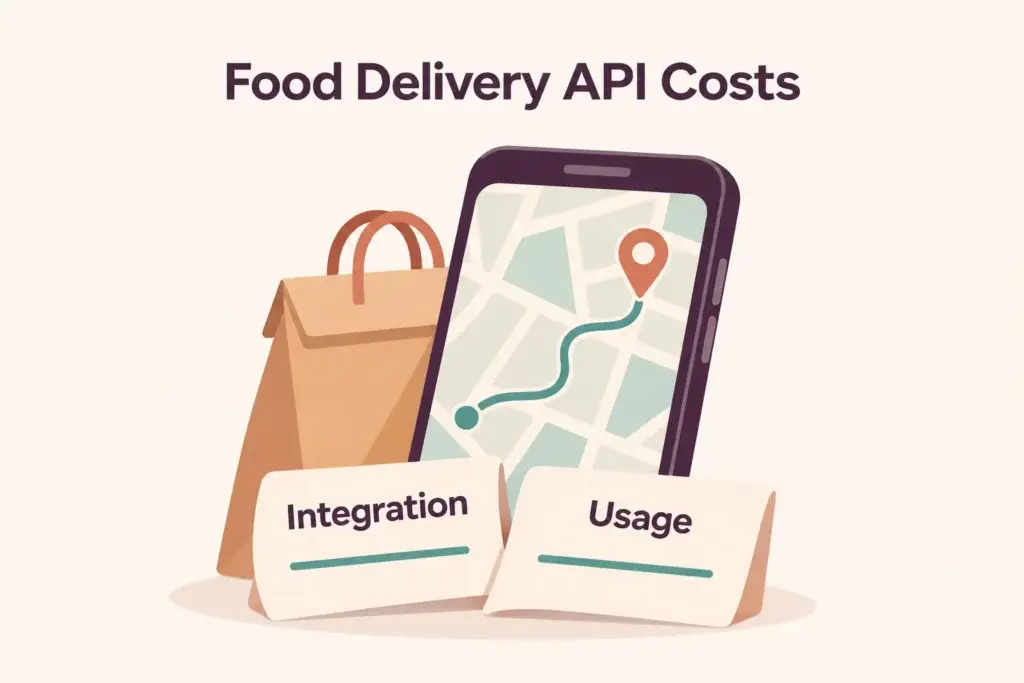
For every external service, write down two numbers: the cost to integrate and maintain it, and the cost to use it. Then record the billing unit. A routing matrix may be billed per origin-destination pair, while a simple route lookup may be billed per request. A messaging provider might bill by message segment or verification event. Without those units, a forecast based on “10,000 orders” can miss a large share of usage.
Address Search and Validation
Count searches, sessions, or lookups, including those from abandoned checkouts. Confirm what ends a session and whether editing an address triggers another charge.
Routing and Dispatch
Count route requests, matrix elements, or optimization jobs. Confirm which calculation options affect pricing and whether you can set usage caps.
Payments and Payouts
Count payment captures, payouts, refunds, and disputes. Confirm who pays each fee, which fees are retained after a refund, and whether payouts are billed separately.
Verification and Notifications
Count verification attempts, message segments, and fallback messages. Confirm how retries are billed and which channels or countries cost more.
POS and Menu Sync
Count connected locations and integration calls, and factor in any contractual minimums. Confirm who certifies and supports the connector and who handles sync failures.
Hosting and Monitoring
Count compute, storage, logs, backups, and data transfer. Confirm how production and staging environments, data retention, and dinner-rush traffic affect costs.
Maps: A tracking update is not a routing request
Moving a courier marker on a screen does not require recalculating the route every time. Recalculate when an event changes the customer’s ETA enough to matter, such as reassignment or a substantial route deviation. For a full matrix of six courier origins against four possible destinations, one request can represent 24 origin-destination pairs. Check the routing API billing documentation and the terms for your chosen product before modeling calls, quotas, or caching.
Payments: A timeout does not prove a charge failed
If checkout loses its connection after the provider receives a payment request, the order can look unpaid even though the customer was charged. Before trying again, look up the transaction or use the provider’s mechanism for recognizing the same request. On incoming callbacks, guard against applying the same event twice. Test payment authorization, capture, partial refunds, and payouts independently; they are not interchangeable states.
POS: Price what happens when the menu stops syncing
Decide which system owns the item price, availability, and modifiers. If a restaurant marks an item unavailable and the marketplace misses the update, someone needs to be able to pause that item without waiting for an engineer. Price a manual fallback, a way to see stale data, and a process for restoring sync without overwriting newer changes. One connector that behaves predictably during service is more valuable than several that only work in a demo.
A Worked Monthly Budget: From Checkout Attempt to Completed Delivery
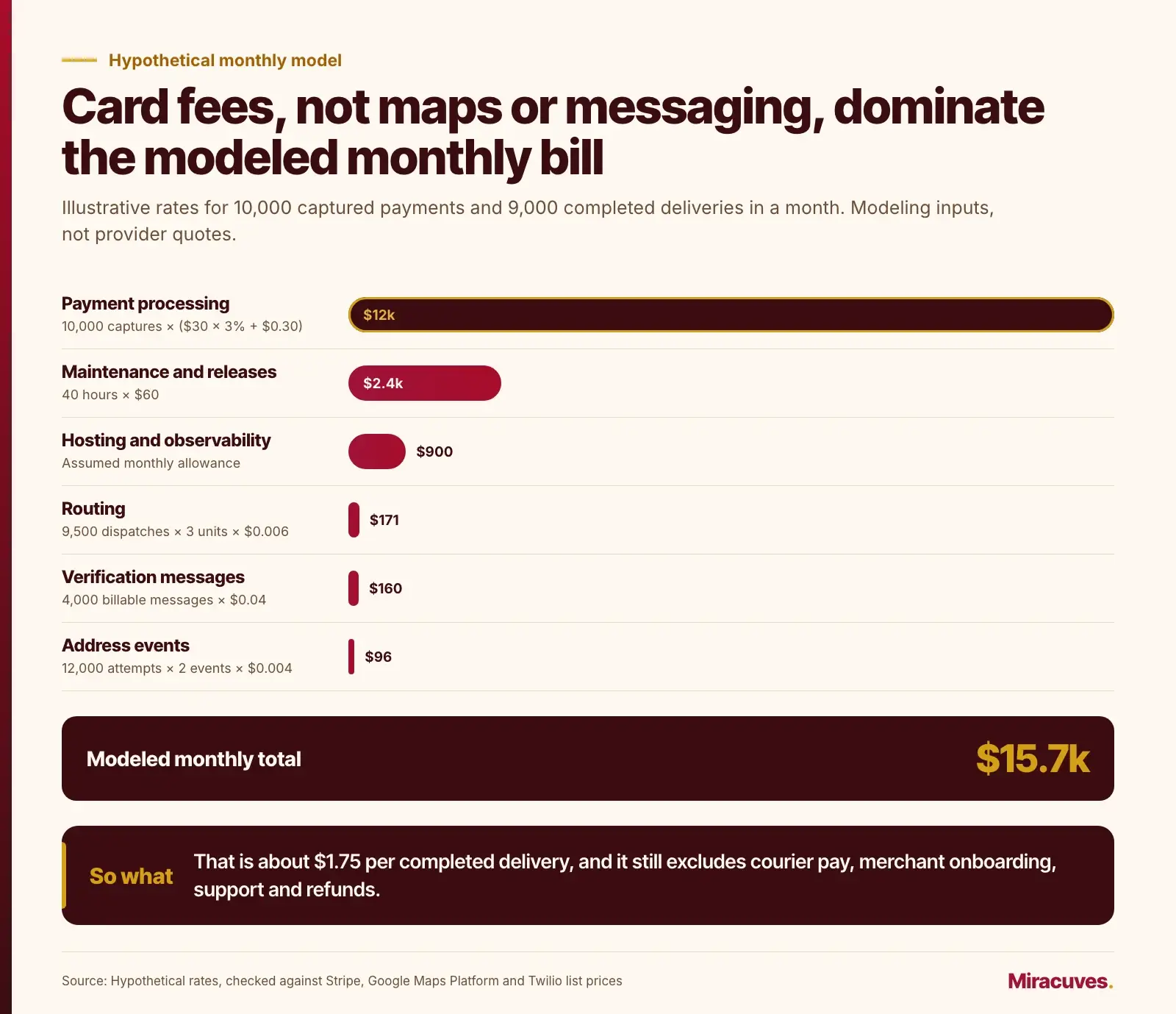
Assume 12,000 checkout attempts, 10,000 captured payments, 9,500 dispatched orders, and 9,000 completed deliveries in a month. Assume a $30 average captured basket. These are modeling inputs, not expected conversion or cancellation rates. Keeping the four counts separate makes it possible to see which costs remain when orders fail.
| Cost | Illustrative calculation | Monthly spend |
|---|---|---|
| Address events | 12,000 attempts × 2 events × $0.004 | $96 |
| Routing | 9,500 dispatches × 3 billable units × $0.006 | $171 |
| Verification or fallback messages | 4,000 billable messages × $0.04 | $160 |
| Hosting and observability | Assumed monthly allowance | $900 |
| Maintenance and releases | 40 hours × $60 | $2,400 |
| Software and infrastructure | Excludes payments and marketplace operations | $3,727 |
| Payment processing | 10,000 captures × ($30 × 3% + $0.30) | $12,000 |
| Modeled total | Software, infrastructure, and payment processing | $15,727 |
The listed costs are about $1.75 per completed delivery. That figure is not your delivery cost or your margin: it excludes courier compensation, merchant onboarding, support, and refunds or credits borne by the operator. If the business earns a commission on a $30 order, the full $30 still is not marketplace revenue. The food delivery marketplace revenue breakdown explains the other side of that calculation.
How the Example Unit Prices Compare With Public List Prices
The model’s rates are assumptions, but they sit close to published list prices. Checked in November 2026:
| Cost line | Model assumption | Public list price reference |
|---|---|---|
| Address search | $0.004 per event | Google Maps Platform Autocomplete Requests: $2.83 per 1,000 calls (about $0.003 each) after 10,000 free calls a month (Google pricing) |
| Routing | $0.006 per billable unit | Google Compute Routes Essentials: $5 per 1,000 calls ($0.005 each) after 10,000 free calls a month; route matrices are billed per element |
| Verification messages | $0.04 per message | Twilio Verify: $0.05 per successful verification plus a per-channel fee such as the SMS charge (Twilio pricing) |
| Card processing | 3% + $0.30 | Stripe standard US online rate: 2.9% + 30 cents for domestic cards, plus 1.5% for international cards (Stripe pricing) |
Two details matter more than the unit price. The first is the billing unit: a six-by-four route matrix is 24 billable elements, not one request. The second is the free monthly allowance, which can make a small pilot look much cheaper than the same traffic at scale.
Test low volume and poor completion separately
If half as many orders enter the funnel and the same proportions hold, the model has 4,500 completed deliveries. Halving the metered API and payment charges while keeping $3,300 in hosting and maintenance gives $9,513.50, or about $2.11 per completion. The lower-volume month costs less overall but more per delivery because fixed software spend is spread across fewer orders.
Now keep the original checkout, capture, and dispatch counts but reduce completions to 8,000. If the listed costs stay unchanged, the cost rises to $1.97 per completion even before extra support, refunds, or courier fees. The first case is a demand problem; the second is a fulfillment problem. They need different responses, even though both make your per-delivery number worse.
The Hidden Costs That Don’t Fit Neatly in a Build Quote
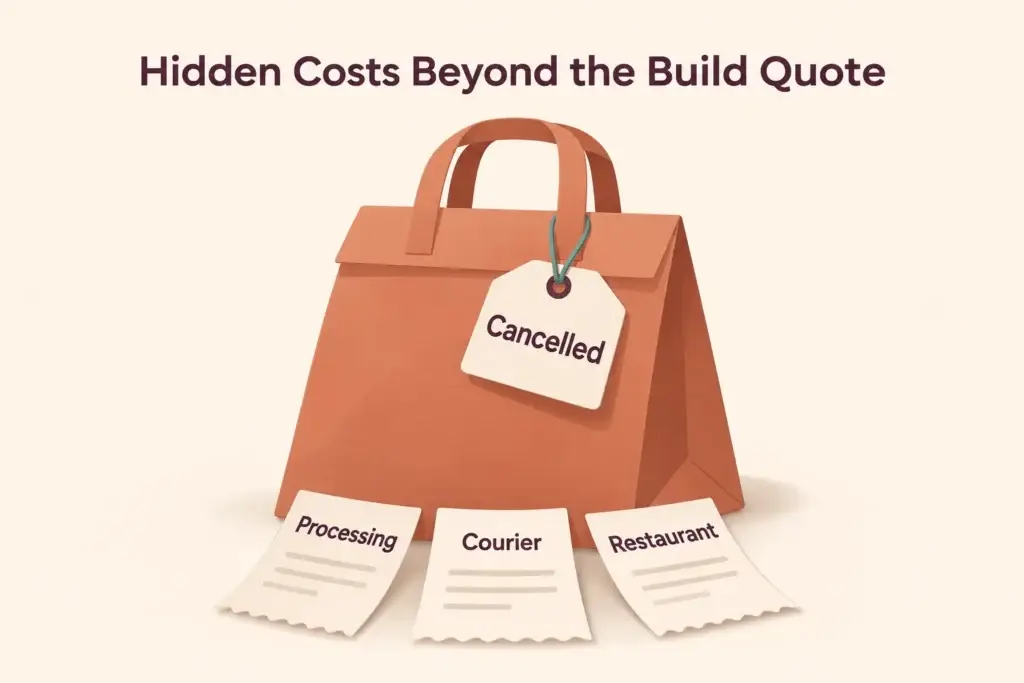
1. A failed order can still leave three bills
Suppose a $30 order is canceled after the restaurant starts cooking and the courier is dispatched. The operator returns the $30, retains a hypothetical $1.20 in unrecovered processing cost, and owes a $4 courier cancellation payment and a $6 restaurant adjustment under its agreements. That is $11.20 in modeled costs on an order with no retained sales proceeds, before support time. The $30 returned is a reversal of money received; don’t add it again as a separate loss when calculating the $11.20. Actual fee treatment and compensation depend on your contracts.
2. Restaurants need onboarding and menu maintenance
Budget for collecting menus, entering modifiers, checking opening hours, validating pickup addresses, and training the staff who will use the system on shift. Then decide who handles holiday hours and temporary closures. If only engineering can make routine updates, a low build price can turn into a recurring support bill.
3. Settlement discrepancies need tools and an owner
Finance must be able to connect an order to its charge, refund, merchant payable, courier payable, and provider settlement. The work includes controlled adjustments, restricted access to payout settings, and an audit trail for sensitive changes. The delivery marketplace security guide is a useful companion when scoping access and monitoring beyond checkout.
4. Maintenance continues even when the feature list stays the same
Provider APIs change, mobile permissions need retesting, and credentials expire. Include time for dependency updates, release preparation, backups, and restore drills. Make sure someone on your team can access the production accounts and ship a fix after handover. Ask the supplier to distinguish warranty fixes from maintenance and new scope before signing.
5. Dinner-rush capacity is more than a cloud setting
A monthly order count hides the short windows when restaurants, couriers, and support are busiest. Load-test checkout and assignment around a realistic peak, then test the business response: can staff pause an overloaded restaurant, widen a promised delivery window, or stop taking orders in a saturated zone? Those controls may cost less than routinely issuing credits for orders the operation could never fulfill on time.
Build a First-Year Budget Without Counting the Same Cost Twice
Combine the $105,000 build, an assumed $15,000 contingency, and 12 operating months at the modeled $15,727 per month. The result is $308,724 for the build plus 12 full operating months, before marketplace operating costs and taxes. That is not automatically your first calendar-year cash requirement. Development and pilot expenses start before live payments, and a launch rarely runs at the same order volume from the first month.
For the real budget, make one column per month. Place engineering invoices when they are due, start metered usage when the relevant activity begins, and add courier and restaurant settlements according to their payment schedules. If a courier partner’s per-job price includes driver compensation, don’t add a second driver-pay line for that job. If provider fees are deducted from settlement rather than invoiced, record them once as an expense and show their timing in the cash forecast.
Keep three budget totals on the same worksheet
- 01 · Launch spend Discovery, build or configuration, connectors, testing, deployment, and contingency.
- 02 · Recurring software Hosting, maintenance, licenses, API usage, monitoring, and release work.
- 03 · Order economics Processing, courier and merchant adjustments, refunds, credits, and attributable support.
Add a cash-flow view to show when money is collected, when it settles, and when partners must be paid.
How to Compare a Custom Quote With an Existing Platform
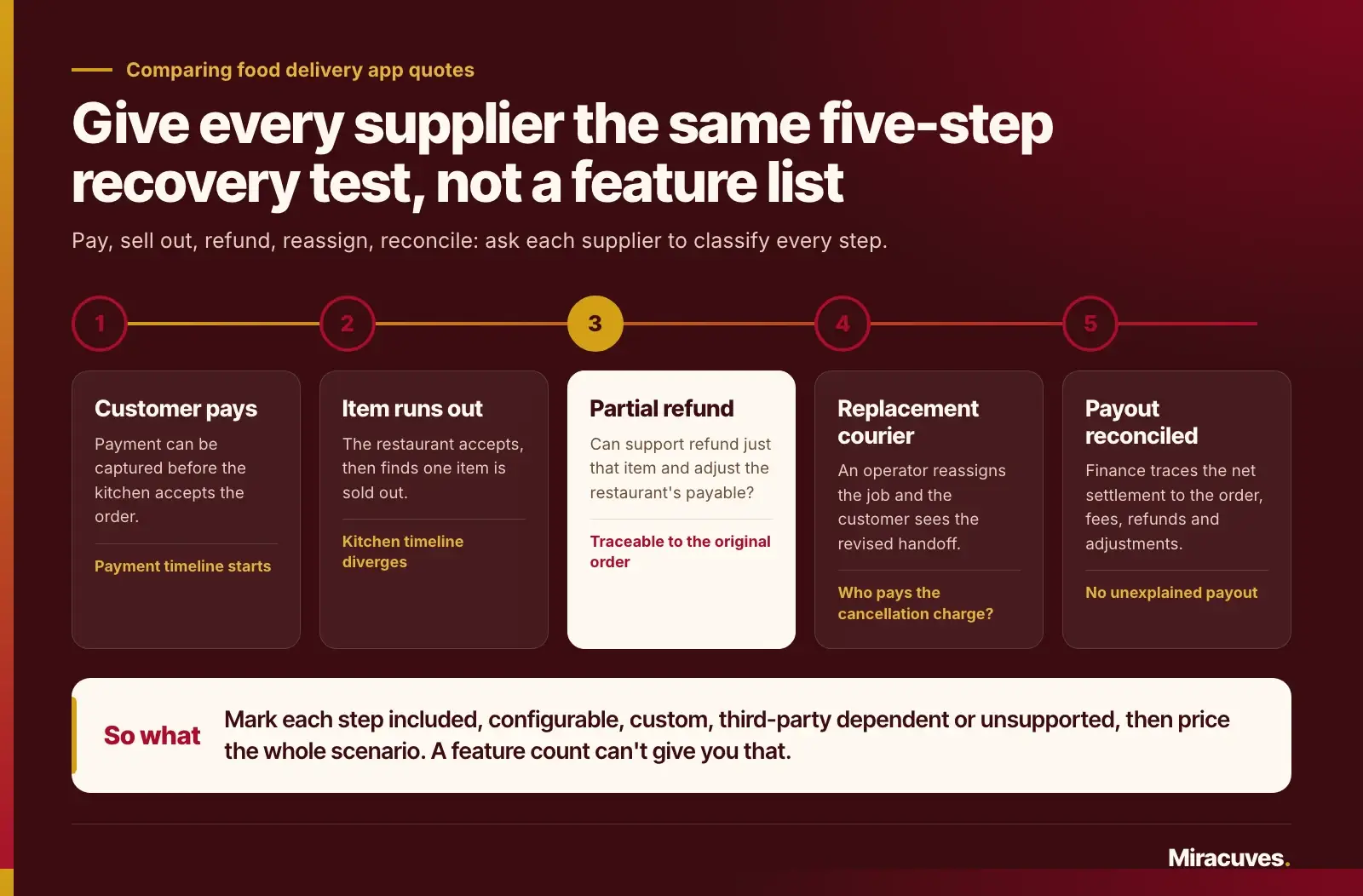
Give every supplier the same test: a customer pays, a restaurant runs out of one item, support issues a partial refund, a replacement courier takes the order, and finance reconciles the payout. Ask them to mark each step as included, configurable, custom, dependent on a third party, or unsupported. Then ask for the total cost to make the full scenario work. That gives you a comparison that a feature count cannot.
Reusing a platform is worth evaluating when the normal ordering and dispatch flows fit and the remaining changes are limited. If the business depends on different settlement policies for each restaurant group, several POS connectors, or a contracted fleet’s unusual dispatch rules, scope those changes explicitly. The food delivery engineering service is a relevant next step for teams that need to price those workflows separately.
| Question for the supplier | What to ask for in writing |
|---|---|
| Which workflows are included? | Supported roles, devices, normal order steps, exception handling, and acceptance criteria |
| Who owns each external account? | Hosting, app-store accounts, API credentials, payment onboarding, and provider invoices |
| How are changes priced? | Scope exclusions, approval process, and rates or fixed quotes for additional work |
| What happens after handover? | Warranty limits, deployment access, monitoring, and response expectations |
| What does “live” mean? | Separate dates for software delivery, app-store approval, payment activation, and pilot readiness |
Four Failures That Should Stop Launch Sign-Off
Run these tests with a small restaurant group and a controlled delivery zone. Check what the customer, kitchen, courier, and operator each see. Then compare your measured API events with the usage model. The pilot should tell you whether the system can recover an order and whether your budget counts the work required to recover it.
Duplicate financial action
Replaying a callback creates a second charge, refund, or merchant adjustment.
Stale menu with no fallback
The restaurant can’t pause an unavailable item or temporarily receive orders another way.
Abandoned job with no reassignment
An operator can’t assign a replacement courier or communicate a revised handoff to the customer.
Unexplained payout
Finance can’t trace a net settlement back to the order, fees, refunds, and adjustments that produced it.
Final Thoughts: Budget for Recovery, Not Just Checkout
The most useful budget isn’t the one with the smallest headline number. It’s the one that explains what you’ll pay to build, what you’ll pay when people use it, and what happens financially when an order falls through. Keep checkout attempts, payment captures, dispatches, and completions separate from the start. You’ll be able to tell whether rising costs come from demand, fulfillment, or the way your integrations are designed.
For reference, Miracuves sells its ready-made DoorDash-style platform at a fixed $3,399 (one-time price covering the solution, rebranding, deployment and source code), delivered in six working days for the standard scope. Custom integrations, payment-provider onboarding and app-store review sit outside that price and timeline.
If you’re evaluating a White-Label Food Delivery app, bring the same budget and failed-order scenarios to the demo. Ask which workflows already work, which need configuration or custom engineering, and which ongoing costs remain yours. Compare a working launch scope with another working launch scope – not a custom-build estimate with a package price in isolation.
Frequently Asked Questions
How much does it cost to build a food delivery app in 2026?
The one-city custom scenario in this guide models $75,000 to $150,000 using 1,500 to 2,000 project hours at blended rates of $50 to $75 per hour. A single-restaurant ordering app can cost $25,000 to $60,000, and a multi-city platform $175,000 or more. These are planning examples, not quotes, and exclude provider fees and marketplace operations.
How long does it take to build an app like DoorDash?
A custom one-city marketplace typically takes 16 to 26 weeks from kickoff to a controlled pilot: two to four weeks of discovery, eight to twelve weeks of core build, three to five weeks of integrations and testing, and two to four weeks for store submission and the pilot. A multi-city platform usually takes eight to twelve months.
What is the cheapest way to launch a DoorDash-style app?
Usually a ready-made white-label platform: you license tested ordering, dispatch and payment workflows, rebrand them, and pay custom rates only for changes. Letting restaurants or a delivery partner handle couriers can also remove the courier app from a first release.
Which APIs should a food delivery app budget for?
Start with address search, routing, payments, and notifications. Add POS, courier partner, tax, or payout integrations where the operating model requires them. Estimate integration labor and usage charges separately, and record each provider’s billing unit and free monthly allowance before you forecast costs.
Why can API fees grow faster than completed deliveries?
Abandoned checkouts, verification retries, route recalculations, and canceled orders can generate billable activity even when no delivery is completed. Forecast each provider using its actual billing unit, such as a session, a request or a route-matrix element, rather than the number of completed deliveries.
Do I need a courier app for the first release?
Not necessarily. Restaurants or a contracted partner may handle delivery, and services such as DoorDash Drive charge merchants a flat fee per delivery. You still need order status updates and a way to escalate failed handoffs. An owned fleet usually needs more courier-side controls.
What hidden costs should I ask a food delivery app vendor about?
Ask about retained payment fees after refunds, payout charges, routing usage, verification retries, POS maintenance, staging, store releases, and support coverage. Have the supplier separate the build price from recurring costs, and ask who owns each provider account and invoice after handover.
Does six-day software delivery mean the marketplace can take orders in six days?
Not necessarily. Standard software delivery is separate from app-store review, payment-provider onboarding, restaurant setup, courier readiness, and custom work. Confirm which milestone the supplier controls and which depend on you or third parties before you set a public launch date.
Miracuves is an independent software development company. We are not affiliated with, connected to, sponsored by, or endorsed by any company or product named in this article.
Terms such as “X Clone” are used descriptively. It is how the software industry refers to building a platform with functionality comparable to a known service, and how clients search for it.
The entire design and codebase of our products is built by our own team. Our products contain no code, design, graphics, or content originating from any third-party website or applications.
All third-party names and marks referenced in this article are the property of their respective owners, referenced solely to identify the services discussed.