Key Takeaways
- The cross-platform Flutter vs native development decision should be based on product requirements, platform coverage, engineering resources, and long-term ownership costs—not framework popularity alone.
- Flutter can reduce duplicated engineering work when a startup needs similar functionality across both iOS and Android through a shared codebase.
- Native Swift and Kotlin can provide stronger financial value when a product depends heavily on platform-specific APIs, specialized hardware, advanced performance, or a single operating system.
- A realistic budget should include mobile development, backend infrastructure, integrations, testing, deployment, maintenance, security updates, and future feature development.
- Flutter does not eliminate platform-specific testing. iOS and Android still require validation for permissions, notifications, accessibility, device behavior, payments, and operating system changes.
- Startups can combine Flutter with native Swift or Kotlin modules when only selected features require direct platform-level capabilities.
- The best technology choice is the one that delivers the required product experience while preserving enough budget and runway for customer validation, iteration, and future growth.
For an early-stage startup, choosing between Flutter and native Swift or Kotlin development is not simply a technical decision. It is a financial commitment that influences hiring costs, product launch speed, ongoing maintenance, and how much runway remains after the first application reaches users.
Flutter allows founders to build iOS and Android applications using a shared Dart codebase, while native development typically involves Swift for iOS and Kotlin for Android. Both approaches can deliver high-quality mobile experiences, but their development economics change significantly depending on product complexity, team capabilities, and platform requirements.
Before committing to either approach, founders should evaluate their requirements alongside available custom mobile app engineering options. The right decision is not necessarily the framework with the lowest initial quotation, but the architecture that supports product validation without introducing avoidable operating expenses.
So, which technology saves more budget? For startups launching a conventional business application on both iOS and Android, Flutter often offers a lower initial engineering workload because much of the interface and application logic can be shared. However, native Swift and Kotlin development may provide better financial value when an application requires extensive hardware integration, advanced platform capabilities, or highly specialized performance.
This guide compares both approaches through development costs, staffing, testing, maintenance, scalability, and realistic startup budgeting decisions.
Understanding Flutter, Swift, and Kotlin Before Comparing Development Costs
The fundamental difference between Flutter and native mobile development is how application code interacts with the operating system and how much engineering work can be reused across platforms.
Flutter: One Shared Application Codebase for Multiple Platforms
Flutter is a cross-platform UI framework that uses the Dart programming language. Developers can create application interfaces, navigation flows, business logic, and reusable components within a shared project targeting iOS and Android.
Unlike traditional web-based hybrid applications, Flutter uses its own rendering system to draw application interfaces. This provides significant control over visual consistency across supported devices.
For startups building booking platforms, marketplaces, delivery applications, subscription products, or productivity tools, a shared implementation can simplify coordination between engineering and product teams.
However, Flutter applications still require platform-specific configuration, integration testing, signing, app store submission, and sometimes native Swift or Kotlin code. A single codebase reduces duplicated work, but it does not make two operating systems identical.
Swift: Native Application Development for the Apple Ecosystem
Swift is a programming language widely used for applications targeting iOS and other Apple platforms. Native iOS teams typically work with SwiftUI, UIKit, and platform SDKs to create applications closely integrated with the operating system.
For a startup focused exclusively on iPhone users, native Swift development can be a rational budget decision. The company can avoid building and supporting an Android application until demand justifies expansion.
Native development also provides direct access to supported platform APIs, which can matter for advanced device integrations, specialized background processing, or features that depend heavily on the latest operating system capabilities.
Kotlin: Native Android Development With Platform-Level Control
Kotlin is a primary language for Android development and works with Android SDKs and modern interface frameworks such as Jetpack Compose.
It is particularly relevant when Android is the startup’s initial market priority or when the product depends on Android-specific functionality.
For businesses serving users across both iOS and Android, separate Swift and Kotlin applications mean maintaining two platform implementations. That can provide excellent platform-specific flexibility, but it increases the number of components that must be developed, tested, and maintained.
Flutter vs. Native Swift and Kotlin: A Startup Budget Comparison
Founders should compare the technologies across the full development lifecycle rather than focusing only on the number of developers required during the first build.
For founders evaluating multiple frameworks, choosing the right mobile technology stack also involves understanding backend requirements, scalability, third-party integrations, and future product expansion.
| Budget Factor | Flutter | Native Swift and Kotlin |
|---|---|---|
| Mobile codebase | One largely shared codebase | Separate iOS and Android implementations |
| Engineering resources | Primarily one cross-platform skill set | Two platform skill sets when supporting both |
| Initial development | Often less duplicated UI and logic work | More platform-specific implementation work |
| Interface consistency | Shared widgets simplify consistency | Consistency requires coordination between teams |
| Hardware integrations | Plugins or native modules may be required | Direct SDK access |
| QA and testing | Shared logic tests, plus platform testing | Separate implementations and platform testing |
| Maintenance | Shared updates with platform-specific exceptions | Updates managed across separate applications |
| Release management | Common release planning, separate store submissions | Independent platform release cycles |
| Single-platform startup | Possible, but shared-code savings may be limited | Often sensible when only one platform is needed |
| Specialized performance | Suitable for many applications; native work may be needed | Greater direct control over platform-specific implementation |
Founder insight: Flutter is not automatically less expensive for every application. Its financial advantage is strongest when the startup needs similar functionality across both operating systems and can share a substantial portion of the implementation.
Why Flutter Can Reduce Initial Development Spending
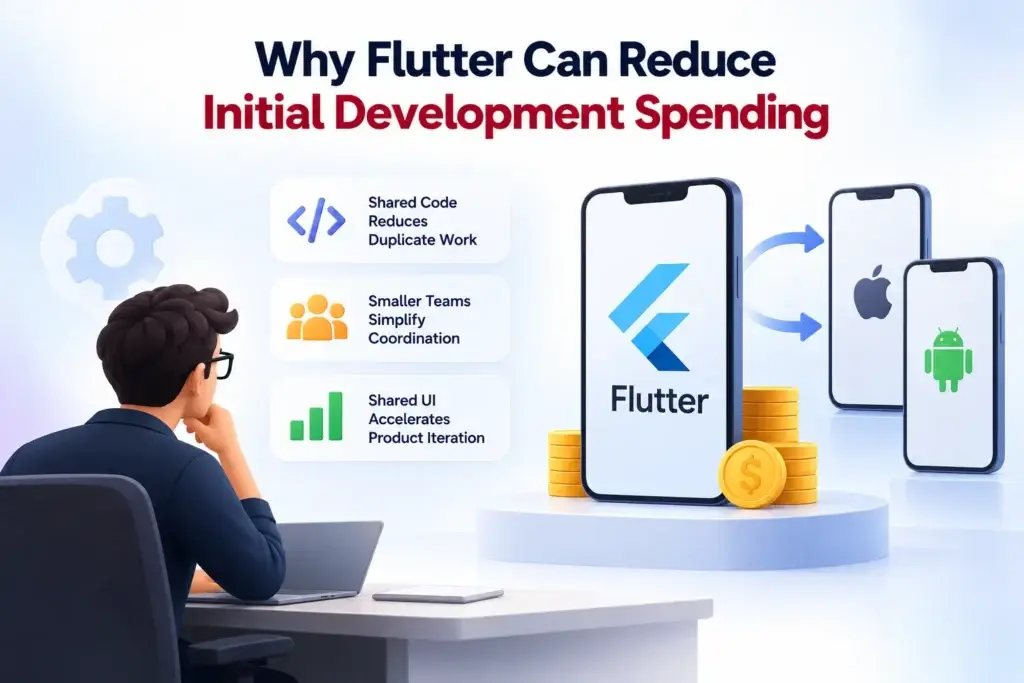
One of the most significant expenses in mobile development is engineering time. Flutter can reduce the amount of repeated work required to deliver the same product functionality across two mobile platforms.
Beyond reducing duplicate code, different cross-platform development approaches can affect engineering efficiency, interface consistency, release management, and long-term maintenance costs.
1. Shared Code Reduces Duplicate Implementation Work
Consider a startup building an appointment-booking application. The product requires registration, provider discovery, scheduling, payments, notifications, booking history, and account settings.
With separate native applications, engineers may need to implement many of these interface flows and application behaviors independently in Swift and Kotlin. Both applications can connect to the same backend, but their mobile interface code remains separate.
Using Flutter, the startup can share substantial portions of its application logic and interface components between platforms. Developers may still write platform-specific integrations, but the repetitive screen-building workload can decrease.
The actual financial benefit depends on how much application functionality can be reused, the complexity of native plugins, and the experience of the engineering team.
2. Smaller Engineering Teams Can Simplify Early Coordination
Early-stage startups frequently operate with limited engineering capacity. Hiring separate iOS and Android specialists can increase recruitment expenses, team coordination, onboarding, and delivery management.
A Flutter-focused engineering team can potentially manage much of the development effort across both platforms. This creates opportunities to allocate more resources toward backend reliability, analytics, quality assurance, product design, or user acquisition.
However, a smaller team should not mean removing essential expertise. Backend engineering, security, interface design, testing, and release management remain important regardless of the chosen mobile framework.
3. Shared UI Components Can Accelerate Product Iteration
Startups rarely launch a perfect application on their first attempt. Product teams often modify onboarding, payment flows, search filters, notifications, and navigation after observing customer behavior.
When these features share a Flutter implementation, a substantial portion of the changes can be developed once and delivered across both platforms.
For example, if users abandon registration because too many fields are required, a team can simplify the shared onboarding flow without separately implementing the same interface redesign in two native applications.
This matters financially because product iteration consumes engineering resources after launch. Reducing repetitive implementation work can protect the budget reserved for learning from real users.
When Native Swift and Kotlin Development Can Be the More Economical Choice
Although Flutter often offers savings for dual-platform business applications, native development can provide better financial value for certain product requirements.
The critical question is whether the complexity introduced by cross-platform abstractions outweighs the code-sharing benefit.
1. Applications Requiring Advanced Hardware Capabilities
Applications involving specialized Bluetooth devices, advanced camera pipelines, demanding audio processing, or complex sensor integration may require substantial native engineering.
Flutter can access many device features through packages and platform channels. Nevertheless, when a product depends heavily on specialized native APIs, its engineering team may spend considerable time developing and maintaining custom integrations.
If these integrations represent the core product rather than an occasional feature, developing natively may reduce abstraction overhead and simplify troubleshooting.
2. Products With Strict Platform-Specific Performance Requirements
Many business applications perform well with Flutter when properly engineered. Standard screens, content feeds, booking flows, forms, and dashboards do not automatically require native development.
However, applications with demanding real-time processing, sophisticated graphics, or specialized system interactions may benefit from direct native implementations.
Performance decisions should be based on benchmarks using representative devices and actual product workloads. Choosing native development merely because it is assumed to be faster can result in unnecessary spending.
3. Startups Launching on Only One Operating System
Suppose a startup has validated that its initial customer base uses almost exclusively iOS devices. Building a separate Android application immediately might not provide enough commercial benefit to justify the expense.
In that situation, a Swift application may be the most focused initial investment. The company can evaluate demand and expand to Android when its business case becomes clearer.
The same logic applies to an Android-first product built using Kotlin.
Flutter also supports single-platform deployment, so the decision should account for future expansion. If a second platform is expected soon, starting with a shared framework may avoid rebuilding substantial interface functionality later.
The Real Cost Difference: What Founders Should Include in Their Budget
Mobile development quotations can be misleading when they include different responsibilities. One proposal might cover only application screens, while another includes authentication, backend services, administration, testing, and deployment.
To compare Flutter with native development fairly, founders should estimate the same product scope using the same delivery assumptions.
Initial Engineering Costs
Start with interface implementation, state management, API integration, navigation, data storage, notifications, and device-specific functionality.
For a two-platform product, Flutter may reduce the engineering hours associated with shared screens and workflows. Native development may require separate implementation effort, although platform teams can work in parallel.
Parallel development can shorten calendar time but may still require greater combined engineering capacity. Founders should distinguish total person-hours from elapsed development time.
Backend and Infrastructure Costs
The choice between Flutter and native technologies does not eliminate backend expenses.
Authentication services, application programming interfaces, payment integrations, databases, storage, analytics, notification infrastructure, and administrative dashboards may be necessary regardless of the client-side framework.
A startup building a two-sided marketplace might need customer management, provider onboarding, commissions, dispute handling, and order processing. These workflows involve backend and operational systems that cannot be replaced merely by selecting a shared mobile codebase.
Therefore, a realistic budget should separate mobile frontend engineering from backend development and recurring infrastructure expenses.
Testing and Quality Assurance Costs
Flutter reduces some duplicated testing effort because shared application logic can be validated through common test suites.
However, both iOS and Android still require testing on representative devices. Permissions, operating system behaviors, keyboard interactions, notifications, payment flows, accessibility, and app lifecycle events can differ between platforms.
Native development also benefits from automated testing, but each platform has its own implementation and test infrastructure.
The financial advantage comes from reducing repeated test development where appropriate, not from eliminating platform-specific testing.
Post-Launch Maintenance and Upgrade Costs
After deployment, engineering expenses continue through bug fixes, dependency upgrades, security improvements, operating system changes, new features, and performance optimization.
In Flutter, shared fixes can benefit both platforms, but framework upgrades and package compatibility may require additional work.
In native development, iOS and Android may need separate updates. Their independence can be beneficial when platform requirements diverge, but it can also increase duplicated maintenance work.
A Practical Budget Calculation for Flutter vs. Native Development
Instead of relying on broad claims that one framework is a fixed percentage cheaper, founders can estimate costs using a workload-based model.
Illustrative scenario: A startup needs a customer-facing application available on both iOS and Android. Both implementations use the same backend, product design, and feature scope.
The following figures are hypothetical engineering hours designed to demonstrate the calculation. They are not market averages, vendor quotations, or promised development savings.
| Engineering Activity | Flutter Hours | Native Hours |
|---|---|---|
| Mobile UI and application logic | 380 | 620 |
| Platform integration | 100 | 100 |
| Mobile-specific testing and release work | 140 | 180 |
| Total mobile engineering | 620 | 900 |
| Shared backend and infrastructure setup | 250 | 250 |
| Total engineering workload | 870 | 1,150 |
In this hypothetical scenario, Flutter reduces the combined engineering workload by 280 hours, equivalent to approximately 24.3% of the native project’s total hours.
If every engineering hour carried the same illustrative cost, that reduction would translate into a similar percentage of labor expenditure. In real projects, hourly rates, seniority, integration difficulty, and rework vary, so actual financial savings may be higher, lower, or nonexistent.
Notice that mobile-specific work decreases more than overall engineering work. This happens because shared backend activities remain necessary under both approaches.
Budget formula:
Total estimated development cost = (Mobile engineering hours × applicable hourly rate) + (Backend hours × applicable hourly rate) + QA, infrastructure, tooling, and external service expenses not already included.
When comparing two proposals, check that shared activities are counted once and that the same expenses are not included in multiple categories.
A Three-Year Cost-of-Ownership Model for Startup Planning
The first development invoice rarely represents the entire application investment. Founders planning a sustainable product should consider total cost of ownership over a longer period.
For mobile applications, total ownership costs include initial construction, production infrastructure, ongoing feature work, maintenance, platform upgrades, monitoring, and support.
A practical three-year model can be expressed as:
Three-year TCO = Initial development + Year 1 maintenance + Year 2 maintenance + Year 3 maintenance + Incremental integration and migration expenses.
Ongoing infrastructure subscriptions should also be included in each year. Costs already included in a development or maintenance contract must not be counted again.
How Flutter Can Affect Long-Term Ownership Costs
Flutter may simplify maintenance when the application uses shared business logic, consistent interface components, and well-maintained packages.
Common changes, such as adjusting a search interface or fixing a validation rule, can often be handled within one implementation.
However, package upgrades, deprecated integrations, custom platform channels, and operating system compatibility can still produce substantial maintenance work. Selecting Flutter does not guarantee a permanently lower maintenance budget.
How Native Development Can Affect Long-Term Ownership Costs
Native applications benefit from direct platform tooling and SDK access. Teams can adopt operating system changes independently and optimize experiences specifically for each platform.
At the same time, maintaining separate implementations can increase coordination and testing effort, particularly when both applications must maintain feature parity.
The key distinction is whether maintaining independent applications creates more value than the additional work requires.
The Hidden Budget Risks That Can Reduce Flutter’s Savings
Shared-code development is attractive because it removes certain categories of duplication. Yet founders should account for situations where the framework introduces additional complexity.
Dependency and Plugin Compatibility
Flutter applications often rely on packages for authentication, payments, maps, device capabilities, local storage, and notifications.
While established packages can accelerate development, poorly maintained dependencies may create compatibility issues during framework or operating system upgrades.
Founders should ask whether critical packages are actively maintained, whether essential integrations can be supported through native modules, and whether the application can continue operating if a dependency becomes unsupported.
Complex Platform-Specific Customization
A startup may initially expect identical interfaces on both platforms but later discover that users need significantly different interactions.
Flutter can implement adaptive platform experiences, but increasingly divergent interfaces reduce the practical value of shared components.
If a large portion of the product requires independent platform behavior, founders should reconsider whether maintaining a shared framework still offers sufficient savings.
Insufficient Architecture and Documentation
Technical debt can become more expensive than the original implementation regardless of programming language.
An application with tightly coupled components, inconsistent state management, limited test coverage, or poorly documented integrations can become difficult to modify.
For startups, clean architecture is an operating-cost decision. A maintainable structure allows a small team to deliver improvements without repeatedly rebuilding existing functionality.
Development Speed vs. Development Budget: Why Founders Should Evaluate Both
Faster development can create financial value beyond reducing engineering invoices. It can help a startup reach customer feedback sooner and avoid spending months building features users may not need.
However, development speed and engineering expenditure are different measurements.
Two native teams working in parallel might deliver their respective applications quickly, even when the combined engineering workload is greater than a Flutter implementation.
Similarly, an experienced native team could outperform an inexperienced Flutter team despite using separate codebases.
Startup founders should evaluate three dimensions:
- Engineering effort: How many total person-hours are required to deliver the product?
- Calendar duration: How soon can the application reach its intended users?
- Opportunity cost: What business validation, sales, or product learning is delayed until launch?
A lower-cost technology choice becomes less valuable if it introduces months of avoidable delays or compromises a product capability essential to customer adoption.
Which Tech Stack Fits Different Early-Stage Startup Business Models?
The appropriate mobile architecture often becomes clearer when founders connect technical requirements to their actual business model.
| Startup Product | Likely Starting Choice | Financial Reasoning |
|---|---|---|
| Service-booking platform | Flutter | Shared forms, profiles, scheduling, and booking workflows |
| Local delivery application | Flutter, subject to integration tests | Shared ordering, tracking, and user interface logic |
| Content or subscription app | Flutter | Similar user experiences across iOS and Android |
| Internal business productivity app | Flutter | Common screens, dashboards, and API-driven workflows |
| iOS-only premium application | Swift | Avoids funding an unnecessary second platform |
| Android-specific device application | Kotlin | Direct access to required Android capabilities |
| Specialized hardware-control app | Evaluate native first | May reduce custom integration complexity |
| Mixed business app with one advanced native feature | Flutter plus native module | Retains shared-code benefits while supporting the specialized feature |
These are starting points for technical evaluation rather than universal rules. Product requirements, available expertise, and proof-of-concept results should determine the final architecture.
How Startup Runway Changes the Flutter vs. Native Decision
For an early-stage company, the development budget is only one part of the financial picture. A startup also needs funding for customer acquisition, product support, analytics, infrastructure, and ongoing iteration.
When nearly all available capital is spent on the first version of an application, the team may have insufficient resources to improve the product after customers begin using it.
Before committing a large share of their available capital to engineering, founders should prioritize validating a startup app idea through customer research, feature prioritization, and early market feedback.
This creates a strategic reason to consider a lower-complexity architecture: preserving capital for the period when the business is learning what customers actually value.
Example: Preserving Budget for Market Validation
Imagine a startup planning a two-platform subscription application. Its primary business questions involve customer acquisition, trial conversion, paid subscriptions, and retention.
If the application has no unusual hardware requirements, allocating substantial resources to two independent mobile interfaces might create limited additional value during the initial validation stage.
A shared codebase could allow the company to preserve more development capacity for improving onboarding, analyzing customer behavior, and refining its subscription experience.
But consider a different startup developing software for a specialized medical device. If direct platform integration is essential to product functionality, choosing Flutter solely to reduce an initial quotation could produce expensive rework later.
The financial objective is not to minimize engineering spending at any cost. It is to allocate engineering resources to the capabilities that create the most meaningful business value.
Flutter vs. Native Maintenance: What Happens After the First Release?
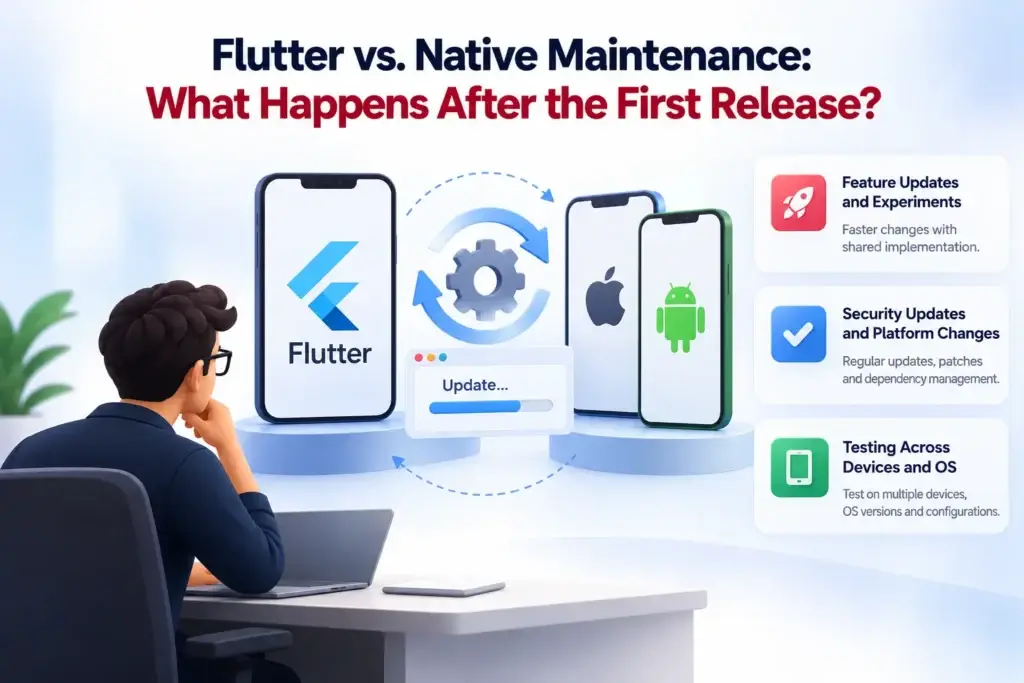
Technology decisions often receive the most attention before launch, yet maintenance can become a major cost driver as the application evolves.
Startups should examine how frequently they expect to release new features, update integrations, and change platform-specific behavior.
Feature Updates and Product Experiments
Applications that rely on frequent interface experiments can benefit from shared implementation. Updates to navigation, content presentation, onboarding, and general business logic may require fewer separate engineering changes.
Native teams can also deliver fast changes through reusable components and automated pipelines. Their ongoing cost depends on how much behavior differs across platforms and how efficiently the teams coordinate releases.
Security Updates and Platform Changes
Both approaches require regular updates to dependencies, authentication systems, payment integrations, storage practices, and access controls.
For applications handling sensitive information, technology selection should not replace a documented security process. Encrypted network communication, secure credential storage, access controls, and regular vulnerability review remain necessary.
Flutter teams must monitor framework and plugin compatibility, while native teams must track changes to their respective platform SDKs and dependencies.
Testing Across Devices and Operating Systems
Device testing remains important because Android manufacturers, device sizes, hardware capabilities, and operating system versions can produce different behaviors.
Even with identical Flutter UI code, applications may behave differently due to system permissions, background execution rules, native SDKs, and device-specific configurations.
Founders should retain a testing budget rather than treating cross-platform development as a replacement for quality assurance.
Can Startups Combine Flutter With Native Swift and Kotlin Modules?
Yes. A mobile architecture does not always require choosing exclusively between Flutter and native development.
Flutter provides mechanisms for communicating with platform-specific code. Engineers can build most of an application’s interface in Dart while implementing selected features using Swift or Kotlin where appropriate.
For example, a startup might use Flutter for customer accounts, bookings, payments, and reporting while relying on native integrations for a specialized device feature.
This approach can preserve much of the shared-code advantage without sacrificing access to important platform capabilities.
However, founders should consider the maintenance cost of custom native modules. These modules still require specialist knowledge, independent testing, and future compatibility updates.
The hybrid architecture is most useful when native requirements are limited and well-defined. If most core features require extensive platform-specific implementation, fully native development deserves serious consideration.
Founder Decision Framework: Seven Questions Before Selecting a Mobile Tech Stack
A technology decision should be documented before development begins. The following questions can help founders distinguish genuine requirements from assumptions.
Platform Coverage
Does the first release genuinely need both iOS and Android?
Product Similarity
Will users need largely equivalent features on both platforms?
Native Dependencies
Which features require specialized operating system or hardware access?
Internal Capabilities
What expertise can the startup access reliably?
Release Frequency
How often will the team update functionality after launch?
Budget Runway
How much capital must remain for validation, marketing, and operations?
These questions also help make vendor quotations more comparable. Instead of accepting a technology recommendation without explanation, a founder can ask the engineering team to show how the architecture affects implementation effort and long-term ownership costs.
Five Costly Mistakes Founders Make When Choosing Flutter or Native Development
Mistake 1: Selecting Flutter Based Only on a Lower Initial Quote
A low quotation does not necessarily represent a lower lifetime cost. If an application relies on unsupported plugins, extensive custom integrations, or poorly designed architecture, future maintenance may become expensive.
Founders should request a technical explanation of the implementation approach and identify any features that require native development.
Mistake 2: Assuming Native Development Always Produces Better User Experiences
High-quality user experiences depend on product design, implementation quality, performance profiling, and testing. Many standard mobile applications can deliver responsive interfaces using Flutter.
Native development should be justified by specific product needs rather than a general assumption that cross-platform applications are inherently inferior.
Mistake 3: Overlooking Backend and Operational Expenses
A startup may save money on mobile interface development while underestimating the expense of authentication, cloud infrastructure, payment processing, analytics, customer support, and administration.
The technology comparison should always sit within a complete product budget.
Mistake 4: Building Two Platforms Before Validating Demand
When initial demand is concentrated on one operating system, building both platforms immediately may divert resources from more valuable activities.
Founders should investigate customer device preferences and decide whether dual-platform availability is necessary for the initial business model.
Mistake 5: Ignoring Future Code Ownership and Maintainability
A mobile application is a business asset. The startup should understand who owns the source code, how repositories are managed, whether deployment credentials remain accessible, and what technical documentation will be provided.
Without these controls, even an inexpensive initial development project can create costly dependencies when the company wants to improve or migrate its software.
How to Compare Two Mobile Development Proposals Without Misreading the Costs
When evaluating proposals, founders should request the same scope in both Flutter and native estimates. Otherwise, differences in features and responsibilities can make one option appear less expensive for reasons unrelated to technology.
A comparable estimate should explain which screens, integrations, backend services, and administrative capabilities are included. It should also identify the assumptions behind development timelines and staffing.
Ask for a breakdown of shared engineering work, platform-specific implementation, automated testing, device testing, release preparation, documentation, and post-launch maintenance.
Founders should also request separate estimates for future changes. A modest interface adjustment, payment integration upgrade, and major new device feature will have different economic implications.
A useful comparison should answer not only which project costs less to build, but which architecture can be maintained and expanded predictably with the team’s available resources.
A Practical Approach to Choosing the Right Mobile Architecture
For founders uncertain about their ideal technology, a short technical evaluation before full development can prevent expensive architectural changes later.
- Define the essential product flows. Identify which capabilities users actually need for the first useful release.
- Separate shared and platform-specific requirements. Document integrations that depend on iOS or Android APIs.
- Confirm initial device demand. Determine whether both platforms are commercially necessary.
- Test high-risk technical features. Validate demanding integrations or performance requirements through a small proof of concept.
- Estimate total engineering effort. Compare mobile implementation, shared backend work, testing, and release operations.
- Model future ownership. Include maintenance, dependencies, documentation, and anticipated feature expansion.
- Choose the architecture that protects the business objective. Prioritize reliable product delivery and sufficient runway for learning from users.
Miracuves helps founders evaluate implementation choices in the context of product requirements, available foundations, and long-term ownership. For appropriate ready-made solutions, its 6-working-day delivery approach can shorten the implementation stage, while fully custom products require separate scoping and timelines.
A six-day delivery commitment for an eligible ready-made product should not be interpreted as a universal timeline for building a new Flutter or native application from scratch. Branding requirements, external approvals, integrations, and app store reviews also affect the practical launch process.
Final Verdict: Does Flutter or Native Swift and Kotlin Save More Startup Budget?
For early-stage startups building conventional applications across both iOS and Android, Flutter frequently presents the stronger budget-efficiency case. Shared interface components, reusable application logic, and more unified feature development can reduce repetitive engineering work.
However, the comparison changes when a startup depends on intensive platform-specific features, highly specialized device capabilities, or a single operating system. Under those conditions, Swift or Kotlin may provide a more focused and maintainable investment.
The final decision should consider total engineering effort, time to customer feedback, future maintenance, available specialist skills, and the product’s most important technical requirements.
For founders, the winning tech stack is not necessarily the one requiring the fewest initial development hours. It is the one that delivers the necessary product experience while leaving enough financial capacity to validate, improve, and grow the business.
Final Thoughts: Build for Financial Flexibility, Not Just Technical Preference
The Flutter versus native decision becomes easier when founders focus on business outcomes rather than framework popularity. A shared codebase can reduce duplicated work when an application serves both mobile platforms with similar functionality. Native development can be worth the investment when product differentiation depends on deep operating system capabilities.
For startups considering a cross-platform approach, exploring Miracuves’ Flutter implementation options can help connect the technical decision with practical delivery requirements, source-code ownership, and future product maintenance.
Miracuves also supports founders evaluating whether their first release should use a ready-made foundation or a specifically engineered application. The appropriate choice depends on the product’s required workflows, integrations, and level of customization.
Ultimately, successful startup budgeting means investing in the capabilities that matter now without making the next stage of product development unnecessarily expensive.
Frequently Asked Questions About Flutter vs. Native Development Costs
Is Flutter cheaper than Swift and Kotlin for startups?
Flutter often costs less when a startup needs both iOS and Android applications with similar functionality because developers can share substantial interface and application logic. However, the actual savings depend on integrations, team expertise, testing, and maintenance requirements.
Can Flutter reduce mobile app maintenance expenses?
Flutter can reduce duplicated maintenance work by allowing shared fixes and feature updates across platforms. However, framework upgrades, third-party dependencies, operating system changes, and native integrations still require ongoing engineering effort.
When should an early-stage startup choose native Swift or Kotlin?
Native development is worth evaluating when the application targets only one platform, depends on advanced hardware capabilities, needs extensive platform-specific functionality, or requires specialized performance. In these situations, direct native access may justify the additional engineering effort.
Is Flutter fast enough for a production mobile application?
Flutter can provide responsive performance for many production applications, including marketplaces, booking platforms, and subscription services. Performance depends on architecture, implementation quality, device capabilities, and workload. Specialized workloads should be benchmarked before selecting the framework.
Does one Flutter codebase eliminate separate iOS and Android testing?
No. Flutter can share application logic and automated tests, but platform-specific testing remains necessary. Permissions, notifications, accessibility, background execution, payment flows, and device behavior must still be validated on iOS and Android.
Can a startup use Flutter and native code in the same application?
Yes. Flutter can communicate with platform-specific Swift and Kotlin implementations through supported integration mechanisms. This allows startups to share most application functionality while using native modules for selected device features. Those modules still need specialist maintenance and testing.
Is Flutter a better choice when startup funding is limited?
Flutter is often a practical option when limited funding must support both mobile platforms and the product uses mostly shared workflows. However, the startup should also consider the required user experience, engineering skills, backend costs, and future maintenance before deciding.
What is the biggest hidden cost in Flutter vs. native development?
A major hidden cost is underestimating work beyond the initial interface build. Backend systems, integration complexity, platform-specific testing, security updates, framework dependencies, and future feature changes can significantly affect total ownership costs in either approach.
Miracuves is an independent software development company. We are not affiliated with, connected to, sponsored by, or endorsed by any company or product named in this article.
Terms such as “X Clone” are used descriptively. It is how the software industry refers to building a platform with functionality comparable to a known service, and how clients search for it.
The entire design and codebase of our products is built by our own team. Our products contain no code, design, graphics, or content originating from any third-party website or applications.
All third-party names and marks referenced in this article are the property of their respective owners, referenced solely to identify the services discussed.